R. K. Thapa1*, M. P. Ghimire1, Rosangliana2, Sandeep1 and Lalmuanpuia1
1 Department of Physics, Mizoram University, Aizawl 796009, India
2 Department of Physics, Govt. Zirtiri Residential Science College, Aizawl 796001, India
Received 3 April 2010 | Revised 7 April 2010 | Accepted 9 April 2010
ISSN 0975-6175
DOS and band structures calculations of transition metals
(W and Nb) using FP-LAPW method
ABSTRACT
The paper describes a technique to determine the density of states (DOS) and band struc-tures results of W and Nb by using FP-LAPW method in the framework of density functional theory (DFT), within generalized gradient approximation (GGA). We have calculated the opti-mized lattice constants of both W and Nb and used them to find the DOS and band struc-tures. Our study indicates that DOS of W and Nb are similar in character. The DOS of Nb at the Fermi level is quite large as compared to W. These are indicative of good conductivity. The contribution to DOS and band structures is due to d state electrons of W and Nb. Our study indicates that W and Nb are metallic in character.
Key words: DFT; GGA; FP-LAPW; DOS; band structure.
Corresponding author: R. K. Thapa
Phone. +91-0389-2328044 Fax. +91-0389-2330522 E-mail: [email protected]
INTRODUCTION
Transition-metals have been the object of much research for some time because of their unusual physical properties.1 As a refractory metal, tungsten (W) and niobium (Nb) is an ex-cellent material for experimental studies on well -characterized surfaces because clean annealed facets can readily be prepared by flashing to white heat.2 Stimulated by the availability of high quality experimental data showing a rich variety of features, W (100) has been widely adopted as a prototype for theoretical studies of
the electronic structures of metal-vacuum inter-faces. Moreover, the electronic structure of the tungsten-vacuum interface is of great practical importance, as thermionic emission from a heated tungsten filament is widely used in elec-tronic devices. Study of elecelec-tronic band struc-ture and density of states is very much required for detail investigation of these properties in view of its high potential in technological appli-cations.3
In this paper we will present a theoretical study of the electronic properties of these mate-rials by using the density functional theory (DFT) as given by Hohenberg and Sham et al.4
Density functional electronic band calcula-tions were carried out for W and Nb, using full potential linearized augmented plane wave method (FP-LAPW) as implemented in the WIEN2k code.5 The exchange and correlation effects were treated using the generalized gradi-ent approximation (GGA) as parametrized by Perdew and Wang.6 The core states were treated fully relativistically and the valence states were treated semi-relativistically.
For the calculations, the angular momenta inside the muffin-tin spheres is Lmax = 10, RMT *
KMAX = 8 and GMAX = 12. RMT* KMAX determines the
number of basis functions, where KMAX is the
energy plane wave cut-off, and RMTis the
small-est of all atomic sphere radii. An energy cut-off of -9.0 Ry. is taken to separate the core states from the valence states. For W, the experimental lattice constant used is 3.159 Å, RMT = 2.44 a.u.
For Nb, the experimental lattice constant used is 3.32 Å, RMT = 2.5 a.u. 20 special k points
(equivalent to 500 k points in the entire Bril-louin zone) were used in both calculations. The Bravais lattice is body-centered cubic; the basis consists of one W and Nb atom each.
RESULTSAND DISCUSSION
In the transition metals, it is well known that the s-p and d bands overlap so that both are par-tially occupied. This leads to strong hybridiza-tion effects, particularly in those energy ranges where the s-p and d bands are degenerate.7
Density of sStates (DOS)
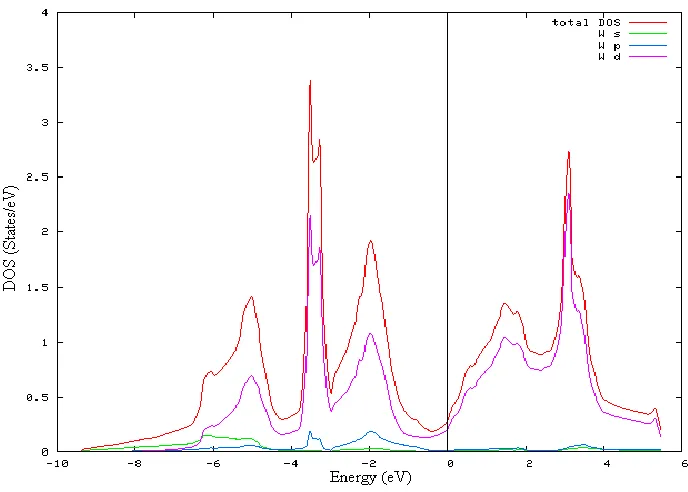
We have calculated and compared the DOS results of W and Nb as shown in Figure 1 and Figure 2. The DOS is an integral over the full Brillouin zone. In case of W, peaks occur at -3.8 eV and -2.0 eV in the valence region and 3.2 eV in the conduction region. These peaks are con-tributed by d- states of W.8 Sharp peak implies that there are many k vectors having the same eigen value. The d states decomposes into d-eg and d-t2g states which changes the behaviour
considerably at EF. d-t2g contributes to total
DOS in the valence region and d-eg to the con-duction region. The contribution provided by s and p state electrons is negligible. The DOS cuts the Fermi level (EF) showing the metallic
behaviour of the system. Similarly, The DOS plot of Nb as shown in Figure 2. has a broad peak at EF. High DOS at EF indicates good
con-ductivity of Nb. The increase in the DOS at EF
as the valence electrons is increased is a rigid-band-like effect resulting from the positive slope of the DOS as a function of energy in this energy range. This increase reflects the super-conducting transition temperature of Nb. Sharp peaks occur at - 1.7 eV, - 0. 15 eV and 3.2 eV which is mostly contributed by d states of Nb to the total DOS. Like W, d states of Nb decom-poses into d-eg and d-t2g state electrons. d-t2g
states contributes mainly in the valence region and d-eg states to the conduction region. The hybridization effects in Nb is large as compared to W.
Band structures
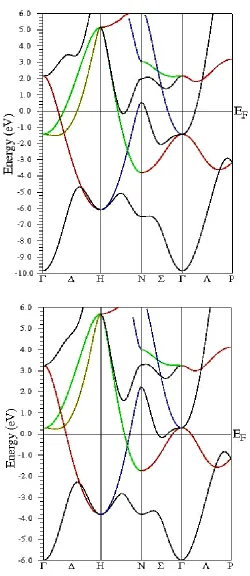
The band structures plot of W and Nb is shown in Fig. 3 and Fig. 4 for its ground state b.c.c structure in the first Brillouin zone. It has four high symmetry points indicated by Γ, H, N and P. These points are connected by lines, la-beled Δ, G, Σ and Λ. These four lines define a path through the Brillouin zone for both W and Nb.9 The DOS plot shown in Fig. 1 and 2 sup-plements the band structures of the systems.
The lowest lying bands are due to s states of W and Nb atoms. The second bands which lie at -6.2 eV and -2.4 eV are the energy bands of W due to its s and p state electrons. Peaks are ob-served at -1.7 eV at Γ point and 3.9 eV at the H point. Both are due to the d state electrons. Similar band structure behaviour is observed in case of Nb as shown in Fig. 4. The difference being the peaks are at different energy ranges. For Nb, peaks are observed at energy range of -1.7 eV at P point, - 0. 15 eV at H → N direction and 3.2 eV at Γ point. From the plots of band structures it can be found that both has a metal-lic behaviour.
Figure1. DOS plot of W with partial DOS of s, p and d states.
Figure 4. Band structures plot for bcc Nb. Figure 3. Band structures plot for bcc W.
3. Mrovec M, Manh DN, Pettifor DG & Vitek V (2001). Bond-order potentials with analytic environment-dependent tight-binding integrals:application to BCC molybdenum. Mat Res Soc Symp Proc, 653, Z6.3.1-Z6.3.6.
4. Kohn W & Sham L J (1965). Self-consistent equations including exchange and correlation effects. Phys Rev A, 140, 1133-1138.
5. Blaha P, Schwarz K, Madsen G, Kvasnicka D & LuitzJ (2001). An augmented plane wave plus local orbitals program for calculating crystal properties. Tech. Uni-versitat, Wien, Austria.
6. Perdew J P, Burke S & Ernzerhof M (1996). General-ized gradient approximation made simple. Phys Rev Lett, 77, 3865-3868.
7. Posternak M, Krakauer H, Freeman AJ & Koelling DD (1980). Self-consistent electronic structure of sur-faces: Surface states and surface resonances on W (001). Phys RevB, 21, 5601-5612.
8. Wei SH, Krakauer H & Weinert M (1985). Linearized augmented-plane-wave calculation of the electronic structure and total energy of tungsten. Phys Rev B, 32, 7792-7797.
9. Ghimire MP & Thapa RK (2010). Band structures cal-culation of NbN and Nb. M ynetresearch.com (27 Feb-ruary 2010).
CONCLUSIONS
We have reported the FP-LAPW calculations of the energy band structures and DOS of W and Nb. It is observed that both W and Nb shows metallic character with high DOS at Fermi level for Nb. The contribution to DOS and band structures is due to d states of W and Nb. High DOS at EF are indicative of superconductivity.
ACKNOWLEDGEMENT
RKT acknowledges a research grant and SD a research fellowship (JRF) from DAE (BRNS), Mumbai, India.
REFERENCES
1. Vorburger TV, Penn D & Plummer EW (1975). Field emission work functions. Surf Sci,48, 417-431.