GSJ© 2019
www.globalscientificjournal.com
GSJ: Volume 7, Issue 6, June 2019, Online: ISSN 2320-9186
www.globalscientificjournal.com
A STUDY ON USING DEEP LEARNING TECHNOLOGIES IN CONVOLUTIONAL
NEURAL NETWORKS FOR MULTIPLE OBJECTS IDENTIFICATION
VAQ-Nguyen
Vietnam Korea friendship IT College
KeyWords
Deep learning, Convolutional neural networks, CNNs, RCNN, Fast RCNN, Object dentifying, Object positioning, Multiple object positioning, Image processing
ABSTRACT
GSJ© 2019
www.globalscientificjournal.com
I. INTRODUCTION
Artificial Intelligence (AI) is used in many fields in our life. It's used to automatically reply on email, learn how to drive a car, rearrange photos into individual albums, and even help manage house well and so on. AI can simply be interpreted as composed of stacked layers, in which the artificial neural network is located at the bottom, machine learning is located on the next layer and deep learning is located on the top.
In 2011, Google created the Google Brain project with the aim of creating a neural network trained by Deep Learning algorithms. This project later proved Deep Learning's ability to acquire both high-level concepts. Facebook also created AI Research Unit, AI research unit using Deep Learning to create more effective solutions that help identify faces and things on 350 million photos and videos posted to Face-book everyday. Another good example of Deep Learning is in fact the ability to recognize the voice of virtual assistants Google Now and Siri. Deep Learning is increasingly showing a promising future with applications to drive self-driving cars or robbers. Although these prod-ucts are still have some limitations, but the things they do today are really hard to imagine just a few years ago. The upgrade rate is also unprecedented high. The ability to analyze big data and using deep learning into computer systems that can self-adapt to what they receive without human’s programming. These breakthroughs can be the design of virtual assistants, self-driving car systems, graphic design, music composition, new materials development that help robots understand the world around us. In particular, Deep Learning or general artificial intelligence has a lot of great apps, but we now live in a early stage so the limitations are inevitable.
CNN is one of the Deep Learning algorithms that gives the best results in most machine vision problems such as classification and iden-tification. Since LeNet's success with Yann LeCun and colleagues [3] published in 1998 and ImageNet published by Alex Krizhevsky and his colleagues in 2012 [4], convolutional neural networks (CNNs) have become standard for image classification. From that time, the deviation of CNN has improved to approximately the same level as humans.
If you only need to identify a single object in image, you simply need to use a simple CNN network. But the problem is that when the image has many objects in the image, the problem becomes very complicated. We have to find the objects’ position in the image and then proceed to classify. The position of objects may overlap in different contexts, in addition to finding images that require us to define bounda-ries, differences and relationships with each other. In this section, we will learn through the main techniques used in the detection of classi-fication and location of objects. Specifically, it will introduce the initial techniques of CNN network and later development techniques such as RCNN, Fast RCNN, Faster RCNN. Here are the techniques used to identify locations and objects in the CNN network like using a simple CNN network, R-CNN technology and, Fast R-CNN technology.
II. TECHNICAL USES TO DETERMINE LOCATION AND SUBJECTS IN CNN NETWORK
A. Convolutional neural network
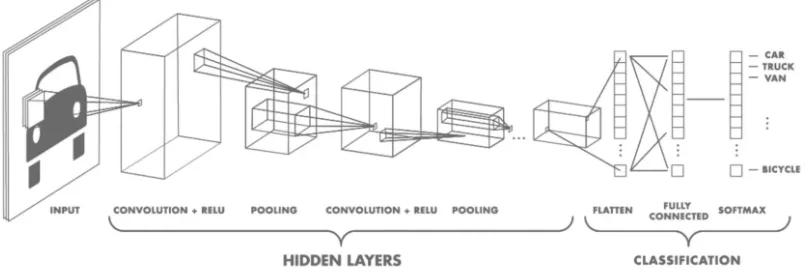
CNN has architecture formed from basic components including Convolution (CONV), Pooling (POOL), ReLU, and Fully-connected (FC). A general CNN architecture is described as Figure 1. CNN is an algorithm with architecture consisting of many layers with different functions in which the main layer operates with a convolution mechanism. During the training process, CNN will automatically learn the parameters for the filters - corresponding to each level. For example in the image classification problem, CNN will try to find the optimal parameters for the corresponding filters in pixels> edges> shapes> facial> high-level features. This is a reason why CNN has superior results compared to previ-ous algorithms.
GSJ© 2019
www.globalscientificjournal.com
B. Determine a single object using a simple CNN network.
Here, the regression algorithm is used to increase the accuracy of bounding boxes to determine the position of the object. The indexes (x0, y0, height, width) of the bounding box are regressed. We train the network with the object image that has been defined with the origi-nal index of the bounding box and compare the regression index with the origiorigi-nal index for calculating the error of the bounding box. Usual-ly, the locating function is added to the fully connected layer of the convolution network.
C. R-CNN technique
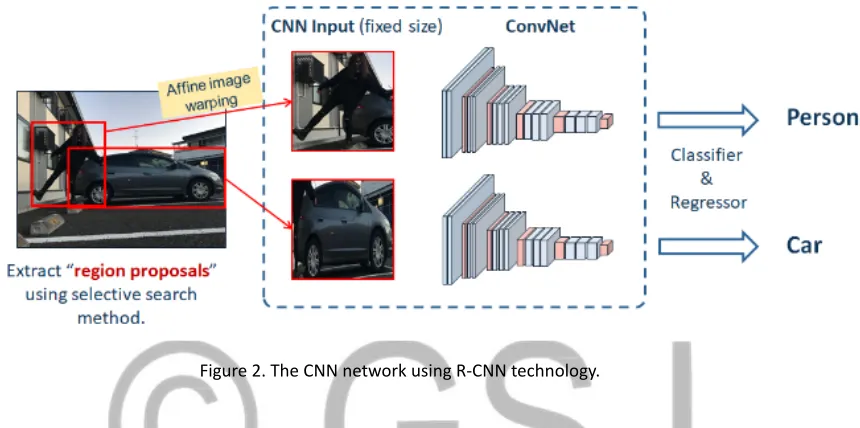
Figure 2. The CNN network using R-CNN technology.
RCNN (Regions + CNN) is a method using selective searching algorithms to predict possible locations of objects in the image, called pro-posed regions. These propro-posed regions will be resized by image processing algorithms and included in trained CNN networks. The number of proposed regions can be up to 2000 region per image. After being fed into the input of the CNN network that has been pre-trained for feed forward calculations, it will obtain the convolution characteristics of each proposed region, then continue to train SVM to determine which objects are contained in the proposal region. These proposed regions will be saved to memory. Finally, linear regression algorithms will be used to calibrate the values of the vertices of the proposed regions. Since a large number of proposed regions are to be added to the CNN network and processed in a sequential manner, the speed of RCNN is very slow.
D. Fast R-CNN technique
GSJ© 2019
www.globalscientificjournal.com
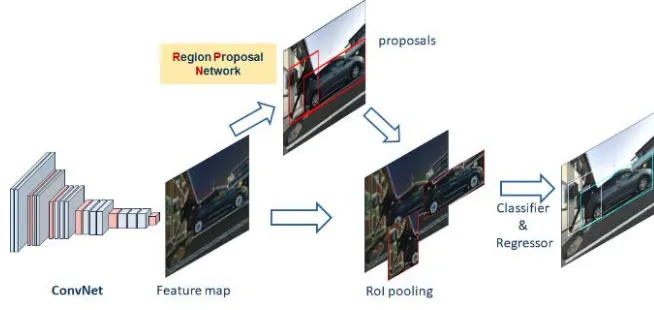
Adopting available training networks to feed forward for predicted regions, it will take a long time because with each image the selected search algorithm will produce thousands of predicted regions. We will only feed-forward once for the original image, and receiving the con-volution characteristics of the image. Based on the size and position of the predicted regions, we will calculate the position of the predicted region in the convolution region. Then we predict the position of the edges of contour as well as what object is in the contour. As we can see, due to sharing calculations between regions in the image, the execution time of the algorithm has been reduced from 120s to 2s per image. The calculation that causes congestion is the predicted input regions, which can only be executed sequentially on the CPU. Faster RCNN solved this problem by applying the Region Proposal Network to calculate the predicted regions of this subject.
E. Faster R-CNN technique
Figure 4 . The CNN network uses Faster R-CNN technology.
Figure 4. CNN network using Faster R-CNN technology.
The main difference between faster RCNN and fast RCNN is that the RCNN employs selective searching algorithms to initiate the pro-posed regions while faster RCNN uses RPN to initiate the propro-posed regions. A time to initialize the propro-posed regions is greatly shortened when using RPN method versus using selective searching algorithms. RPN adopts an algorithm to sort the cell called anchors and check whether these anchor are able to contain objects in it. Depending on the object you need to define in the network, you can customize the size as well as the amount of anchor to increase the effectiveness of this technique. RPN usually has two main steps: feed-forward images over the network and obtain convolution characteristic and use the sliding windows on the images that have obtained convolution charac-teristics.
III. NETWORK MODEL AND DATA SET
VGGNet network model was developed by Karen Simonyan and Andrew Zisserman [1]. VGGNet has shown that network performance will depend on the depth of the network. The best network model consists of 16 CONV/FC layers and especially it is uniform in terms of architecture with 3x3 convolutions and 2x2 pooling. One weakness of the network model is that it employs a lot of memory and parame-ters, with over 138 million weights and needs 24Mb for each image to be processed. Detailed parameters are shown in Table 1.
Table 1. Network parameters CNN uses to identify multiple objects.
Class Size Memory Weight
Input 224x224x3 224 * 224 * 3 0
Conv 224x224x64 224 * 224 * 64 1728 Conv 224x224x64 224 * 224 * 64 36864 Pool 112x112x64 112 * 112 * 64 0 Conv 112x112x128 112 * 112 * 128 73728
GSJ© 2019
www.globalscientificjournal.com
Pool 56x56x128 56 * 56 * 128 0
Conv 56x56x256 56 * 56 * 256 294912
Conv 56x56x256 56 * 56 * 256 589824
Conv 56x56x256 56 * 56 * 256 589824
Pool 28x28x256 28 * 28 * 256 0
Conv 28x28x512 28 * 28 * 512 1179648
Conv 28x28x512 28 * 28 * 512 2359296
Conv 28x28x512 28 * 28 * 512 2359296
Pool 14x14x512 14 * 14 * 512 0
Conv 14x14x512 14 * 14 * 512 2359296
Conv 14x14x512 14 * 14 * 512 2359296
Conv 14x14x512 14 * 14 * 512 2359296
Pool 7x7x512 7 * 7 * 512 0
FC 1x1x4096 4096 102760448
FC 1x1x4096 4096 16777216
FC 1x1x1000 1000 4096000
Total weight: 138,344,128
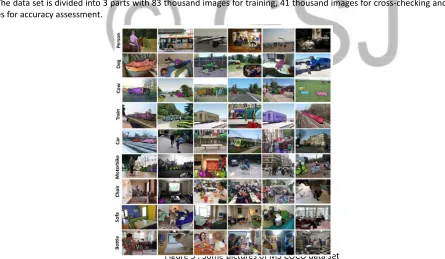
In this section we will use the MS COCO data set [7], the properties of this dataset are as follows: 80 objects with 330000 images. The data set is divided into 3 parts with 83 thousand images for training, 41 thousand images for cross-checking and 41 thousand imag-es for accuracy assimag-essment.
Figure 5 . Some pictures of MS COCO data set
GSJ© 2019
www.globalscientificjournal.com
(a) (b)
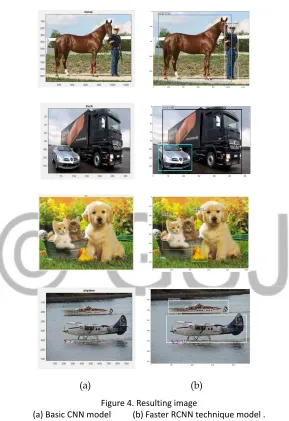
Figure 4. Resulting image
(a) Basic CNN model (b) Faster RCNN technique model .
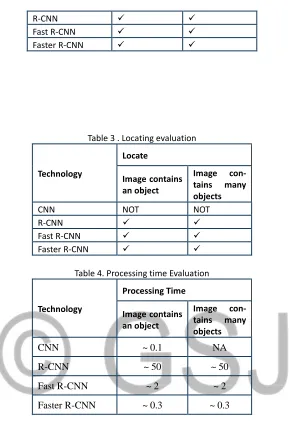
From 4 images results above, we can remark on the outstanding advantages of CNN using technology Faster RCNN compared to CNN without using Faster RCNN. Images processed via CNN without using Faster RCNN technique almost identify wrong input image with many objects. Based on the simulation results with the CNN technique, Faster RCNN presented above and many researches in [5], [6], [9], [10], we can evaluate techniques as follows:
Table 2. Objects recognition Evaluation
Technology
Identification ability
Image contains
an object Image contains many objects
GSJ© 2019
www.globalscientificjournal.com
R-CNN
Fast R-CNN
Faster R-CNN
Table 3 . Locating evaluation
Technology Locate Image contains an object Image con-tains many objects
CNN NOT NOT
R-CNN
Fast R-CNN
Faster R-CNN
Table 4. Processing time Evaluation
Technology Processing Time Image contains an object Image con-tains many objects
CNN ~ 0.1 NA
R-CNN ~ 50 ~ 50
Fast R-CNN ~ 2 ~ 2
Faster R-CNN ~ 0.3 ~ 0.3
V. CONCLUSION
CNN technique has partly solved the problem of object identification in images. However, the CNN technique only deal with images con-taining an object. It is almost impossible with multiple objects. But the Faster RCNN technology is born later, not only to overcome this shortcoming, but also to increase processing speed and ability to expand network identity. Thereby also showed the potential of this tech-nique, here is the CNN technology using Faster RCNN to understand what objects in the image are and know the position of the object in the image.
References
[1] Karen Simonyan, Andrew Zisserman, Very Deep Convolutional Networks For Large-Scale Image Recognition , 2015.
[2] Y. LeCun and Y. Bengio, Convolutional networks for images, speech, and time-series, 1995.
[3] Krizhevsky, Alex, Ilya Sutskever, and Geoffrey E. Hinton, Imagenet classification with deep convolutional neural networks , 2012.
[4] Vedaldi, Andrea and Karel Lenc, MatConvNet-convolutional neural networks for MATLAB, 2014.
[5] Ross Girshick Jeff Donahue Trevor Darrell Jitendra Malik, Rich feature hierarchies for accurate detection and semantic segmentation Tech report (v5) , 2014.
[6] Ross Girshick, Fast R-CNN , In Microsoft Research, 2015.
[7] Tsung-Yi Lin, Michael Maire, Serge Belongie, Lubomir Bourdev, Ross Girshick, James Hays, Pietro Perona, Deva Ramanan, C. Lawrence Zitnick, Piotr Dollar, "
Mi-crosoft COCO: Common Objects in Context ", 2015.
[8] Ian Goodfellow and Yoshua Bengio, Deep Learning , 2016.