VOLUME 2, ISSUE 12, Dec. -2016
PROCESS IMPROVEMENT THROUGH DMAIC SIX SIGMA
METHODOLOGY
PRAMOD KAMBLE
PG Student, Mechanical Engineering Department
Viva Institute of Technology Virar (E), Mumbai - India
DR. ARUN KUMAR
Principal, Viva Institute of Technology
Virar (E), Mumbai - India
ABSTRACT:
Due to continuous improvement of the quality and therefore fully satisfy the needs and expectations of each partner (customers, staff and other
stakeholders) and also maintain competitive
advantage. It becomes necessary to implement different quality improvement initiatives like Total Quality Management, ISO certification, Agile & Lean manufacturing etc. But these initiatives are not profitability as well as time efficient in terms of quality so introducing and implementing the Six Sigma methodologies was proven to provide breakthrough quality improvements in a reasonable short time. This paper present manufacturing process improvement through DMAIC Six Sigma methodology.
KEYWORDS: DMAIC; Six Sigma; Manufacturing process; Lean six sigma.
INTRODUCTION:
In real several manufacturing areas at present, real challenges are arising for the improvements in downtime reduction, quality improvement, efficiency improvement, machine utilization improvement, cycle time reduction etc. To do such improvement Six Sigma's DMAIC approach (Define – Measure – Analyze – Improve - Control) is very helpful.
Six Sigma is recognized as a problem-solving method that uses quality and statistical tools for basic process improvements. Six Sigma is now widely accepted as a highly performing strategy for driving defects out of a company's quality system. Six Sigma is defined as a set of statistical tools adopted within the quality management to construct a framework for process improvement [1, 2]. Statistical tools identify the main quality indicator which is the parts per million (PPM) of non-conforming products [3]. Achieving a Six Sigma level means to have a process that generates outputs with 3.4 defective PPM (Coleman, 2008). Six Sigma is also defined as a multifaceted, customer-oriented, structured, systematic, proactive and quantitative philosophical approach for business
improvement to increase quality, speed the deliveries up and reduce costs [4].
The literature suggests the DMAIC and the design for Six Sigma (DFSS) methods as the two most common methodologies to implement Six Sigma, although according to [5], the main objectives of the two techniques are quite different. While DMAIC is a problem-solving method which aims at process improvement [6], DFSS refers to the new product development. In a recent paper, [7] introduced the Six Sigma-based methodology for non-formal service sectors, the framework which explores the quality needs and maps them to define – measure – analyze - improve and control (DMAIC) methodology. Eisenhower (2008) used DMAIC methodology to show that quality performance data expressed as the usual percentage defect rate can be converted into a wide range of vital, Six Sigma metrics and that these can be used to develop insight into a company's quality system.
Process improvement is nothing but the understanding of an existing process and introducing process changes to improve quality of product, reduce costs, overall efficiency of process or accelerate productivity. Generally the overall efficiency of machine or process is calculated based on the machine utilization percentage and the machine productivity over the available hours for production.
1.1 DMAIC APPROACH:
VOLUME 2, ISSUE 12, Dec. -2016
5 | P a g e
and still does not meet the level of customer specification or six sigma level.
1.2 ADVANTAGES OF DMAIC APPROACH:
Can realize genuine cost savings: DMAIC is a particularly astute means of identifying waste and unnecessary rework. A successful DMAIC implementation can pay for itself several times over by greatly increasing the effectiveness of a process. The cycle of DMAIC is reusable too businesses can continually repeat the process, identifying further enhancements and improvements over time.
Structured thinking: The DMAIC process is systematic and thorough. It enables decisions to be made based on actual data and measurement. The various tools and techniques used in the analysis phase can flush out problems and issues that might not have been exposed otherwise and the approach often brings a fresh way of thinking to established processes.
Looks at the longer term: DMAIC implementation is seldom about quick fixes. The approach lends itself to longer term process resolution so for established businesses or businesses with particularly complicated processes, DMAIC works very well. Many projects toy with a problem, implement a quick fix and then walk away. The control phase of the DMAIC methodology ensures that this never happens.
LITERATUREREVIEW:
The aim of Six Sigma DMAIC is to remove variation from processes and strive to manufacture defect-free products. It is considered a business strategy and a science that combines statistical and business methodologies
which focus on continuous and breakthrough
improvements to reduce manufacturing costs, improve customer satisfaction and to predictably produce world class products and services [9,10,11,12].
[13] determined that the Six Sigma team members apply sophisticated root cause analysis techniques and obtain significantly more control and exploration into a problem as compared to any other quality improvement initiative. The distinguishing feature was that continuous improvement was incremental whereas Six Sigma produced a dramatic improvement.
[15,16,17], stated the define, measure, analyze, improve and control (DMAIC) cycle served to define a process to improve, measure the baseline and target performance of the process, analyze the process data to determine the key process inputs that affect the outputs, improve the process to optimize the outputs, and, finally, to control the improved process for sustaining the improvement.
The Six Sigma toolbox comprises of the seven design tools, the seven statistical tools, the seven project tools, the seven lean tools, the seven customer tools, the
seven quality control tools and the seven management tools. Despite this variety, [16] advised that previous empirical studies indicate that the seven quality control tools were very popular and are commonly used in Six Sigma projects.
Accoding to [18] operating at a Six Sigma level meant that the organization or process does not produce more than 3.4 defects per million opportunities.
[19] defined an opportunity as a chance for non conformance or not meeting the required specifications. The statistical focus of Six Sigma reflects its basic philosophy which can be shared beneficially by customers, stakeholders, employees and suppliers. It is a technique that seeks to measure existing performance metrics and investigates how the desired and optimum performance level can be achieved [20].
From a practical perspective, [21] acknowledged that Six Sigma had been recognized as an overall business improvement technique rather than just a measure of goodness or a methodology for defect reduction.
According to [13] the Six Sigma technique was not restricted to improvement efforts on the production floor only, but it also has effects in different facets of an organization [8, 22].
After providing some background information and the key focus areas of Six Sigma, the following section discusses why Lean and Six Sigma should be combined into an integrated business improvement technique.
METHODOLOGY:
This work is based on implementation of DMAIC
approach in manufacturing industry. The natures of this work require a methodology that could be flexible to allow open questions to collect information since the organizations under study have many different settings.
The data required for this work will be mainly collected through different sources of evidence such as: Literatures on six sigma, semi-structured face-to-face
interviews, questionnaires, organization’s written
procedures, websites, onsite visits, and e-mail correspondence.
DESCRIPTIONOFTHEWORK:
4.1 SIX SIGMA DMAIC APPROACH:
VOLUME 2, ISSUE 12, Dec. -2016
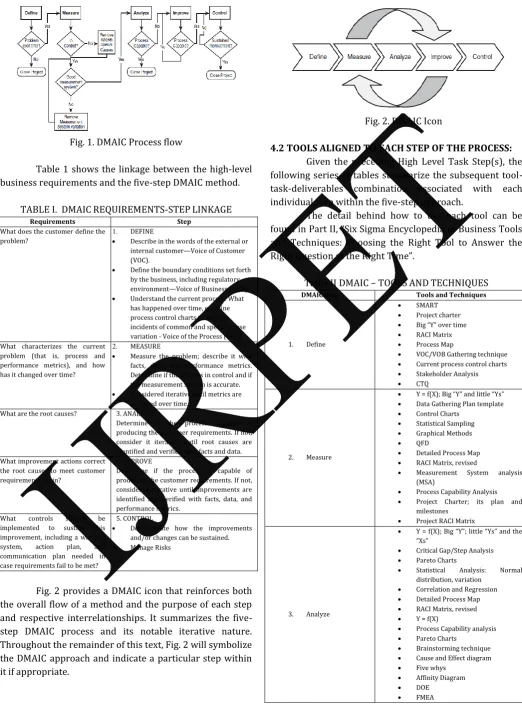
Fig. 1. DMAIC Process flow
Table 1 shows the linkage between the high-level business requirements and the five-step DMAIC method.
TABLE I. DMAICREQUIREMENTS-STEPLINKAGE
Requirements Step
What does the customer define the problem?
1. DEFINE
Describe in the words of the external or internal customer—Voice of Customer (VOC).
Define the boundary conditions set forth by the business, including regulatory environment—Voice of Business (VOB). Understand the current process. What
has happened over time, examine process control charts to identify incidents of common and special cause variation - Voice of the Process (VOP). What characterizes the current
problem (that is, process and performance metrics), and how has it changed over time?
2. MEASURE
Measure the problem; describe it with facts, data, and performance metrics. Determine if the process in control and if the measurement system is accurate. Considered iterative until metrics are
gathered over time. What are the root causes? 3. ANALYZE
Determine if the process capable of producing the customer requirements. If not, consider it iterative until root causes are identified and verified with facts and data. What improvement actions correct
the root causes to meet customer requirements again?
4. IMPROVE
Determine if the process is capable of producing the customer requirements. If not, consider it iterative until improvements are identified and verified with facts, data, and performance metrics.
What controls should be implemented to sustain this improvement, including a warning system, action plan, and communication plan needed in case requirements fail to be met?
5. CONTROL
Demonstrate how the improvements and/or changes can be sustained. Manage Risks
Fig. 2 provides a DMAIC icon that reinforces both the overall flow of a method and the purpose of each step and respective interrelationships. It summarizes the five-step DMAIC process and its notable iterative nature. Throughout the remainder of this text, Fig. 2 will symbolize the DMAIC approach and indicate a particular step within it if appropriate.
Fig. 2. DMAIC Icon
4.2 TOOLS ALIGNED TO EACH STEP OF THE PROCESS: Given the preceding High Level Task Step(s), the following series of tables summarize the subsequent tool-task-deliverables combination associated with each individual step within the five-step approach.
The detail behind how to use each tool can be found in Part II, “Six Sigma Encyclopedia of Business Tools and Techniques: Choosing the Right Tool to Answer the Right Question at the Right Time”.
Table II DMAIC – TOOLSANDTECHNIQUES
DMAIC Step Tools and Techniques
1. Define
SMART
Project charter Big “Y” over time RACI Matrix Process Map
VOC/VOB Gathering technique Current process control charts Stakeholder Analysis
CTQ
2. Measure
Y = f(X); Big “Y” and little “Ys” Data Gathering Plan template Control Charts
Statistical Sampling Graphical Methods
QFD
Detailed Process Map RACI Matrix, revised
Measurement System analysis (MSA)
Process Capability Analysis Project Charter; its plan and
milestones Project RACI Matrix
3. Analyze
Y = f(X); Big “Y”; little “Ys” and the “Xs”
Critical Gap/Step Analysis Pareto Charts
Statistical Analysis: Normal distribution, variation
Correlation and Regression Detailed Process Map RACI Matrix, revised Y = f(X)
Process Capability analysis Pareto Charts
Brainstorming technique Cause and Effect diagram Five whys
Affinity Diagram
DOE
VOLUME 2, ISSUE 12, Dec. -2016
7 | P a g e 4. Improve
Positive Deviance
TRIZ
Basic DOE
FMEA
Cost/Benefit Analysis Positive Deviance Pugh Concept Evaluation Solution Selection matrix Force Field diagram
QFD
Process Capability Analysis
MSA
Process capability analysis RACI Matrix
5. Control
Control Plan Design Control Charts (SPC) FMEA/Risk Analysis Communication Plan Stakeholders Analysis Cost/Benefit Analysis Training/Transition plan Process Map
RACI
Procedure manuals Scorecard or Dashboard New SIPOC
MINITAB graphical data analysis
4.3 SOME OF THE KEY CONCEPTS THAT
CHARACTERIZE DMAIC APPROACH:
There are some key characteristics that distinguish DMAIC from other Six Sigma methods. The following overview wraps up the DMAIC highlights and introduces some of its variants.
A. HOW IS THE PROBLEM DEFINED?
The problem statement in a Project Charter
typically speaks to defects or variance from a target over
time with an existing, steady state, process, or product. (The charter is part of a standard Six Sigma toolset used to document the project scope. Typically, the customer should determine the target; however, at times the business, industry standard, or regulatory agency may set it. Time-based problem statements indicate the problem may be chronic (has persisted for a period of time), which helps create a case for change (versus a one-time occurrence) to incite interest in and resources to tackle the issue.
Common metrics include DPMO (Defects per Million Opportunities (or units)), PPM (Parts per Million), Mean Time between Failures (MTBF), Cost, Percent Variance, or Errors.
B. WHAT IS COMMONLY MEASURED?
Typically, three key items are measured:
• Output (or Outcome) - The end result of the process (or product) requiring improvement
• Process - The workflow (of activities and items) that produces the output
• Inputs - The raw materials and information used by the process to produce the output
The relationship of these three key items often is described as an equation:
Y = f(x), which reads, “Y is a function of X.” The “Y” refers to the output (s); the “X” refers to the key measures from the process variables (inputs and/or the process itself).
The DMAIC project goal is to identify the critical
(or vital few) Xs - the root cause of the problem and select
their optimal level(s) to best drive the desired improvement in the output performance (sometimes called the “Big Y”). This language sounds foreign to many people not comfortable with mathematically-structured sentences; however, it is readily used in most Six Sigma texts. A simpler articulation is the goal of a DMAIC project is to improve PFQT—Productivity (how many), Financial
(how much money), Quality (how well), and Time (how
fast).
C. DMAIC VARIATIONS?
There are two prevalent variations to the traditional DMAIC method. Both build on the DMAIC fundamentals but add new dimensions to extend its
applications. The first is DMAIIC, wherein innovation is
added for situations where a simple improvement modification is inadequate and a new design may be required. DMADV distinguishes itself from DMAIIC by not only its often unique environment scenario, but also it usually calls for a requirement of building a new process (or product design) from scratch at the start of the project; whereas, DMAIIC often is unaware of the redesign requirement until much later into the project lifecycle. The
second is Lean Six Sigma, which adds concepts of velocity,
value-add, and flow to the DMAIC concepts.
1. DMAIIC - ADDING AN “I” FOR INNOVATION:
Many organizations have found that improving a current process or product may not be enough to deliver
the desired results, and at times innovation is needed.
Since the project teams have just completed the Define-Measure- Analyze stages of the process and are in the midst of Improve, rather than starting over from scratch, project teams have found that the work done to this point is a good foundation for innovation work. Hence, some companies have built on the DMAIC framework already in-place and added a second “I” for innovation to keep the project team progressing. Therefore, the variation is Define-Measure- Analyze-Improve/Innovate-Control.
2. LEAN SIX SIGMA - ADDING LEAN CONCEPTS:
By incorporating lean concepts into DMAIC, the
VOLUME 2, ISSUE 12, Dec. -2016
time), value-add, and flow to what Six Sigma already offers. Both concepts share similar views on customer-focus, process-centric work, and appropriate tools. Lean simply adds a deeper set of tools to eliminate waste between process steps handoffs. Often DMAIC provides a project the big picture view (what the customer values balanced by business values) and process stabilization and capability - while Lean introduces speed and flow concepts at a more detailed level. The Define-Measure-Analyze-Improve-Control structure still holds true for Lean Six Sigma projects.
CONCLUSIONS:
Successful implementation and growing
organizational interest in 6σ DMAIC method have been exploding in the last few years. It is rapidly becoming a major driving force for many technology-driven and
project-driven organizations. Following are the
conclusions related to implementation of DMAIC Six Sigma methodology.
Six Sigma is an effective way to find out where the
greatest process needs are and which the softest points of the process are. Also, Six Sigma provides measurable indicators and adequate data for analytical analysis.
The DMAIC steps are a proven roadmap for any
process improvement project which offers a structured approach to solving problems and improving results.
When the DMAIC steps have properly applied, they
offer any project team an organized approach, a structure, to solving key business problems.
The DMAIC steps are flexible and can be used in any
industry or with any type of process improvement effort.
By establishing process controls, smooth operationwill be ensured. Developing equipment / process capabilities help in de-constraining the supply chain bottlenecks. This will help not only in sound inventory control system, but also a judicious balancing between conflicting cost and benefits along with speedy delivery to customers, which is one of vital requirements in this era of lean manufacturing.
Industries have to deal with a host of problems relatedto productivity and quality control. Substandard productivity hampers the internal customer demand of the products which directly affects the company targets. Organizations have to suffer huge losses which are not easy to cope up with. Thus there is a need to improve the process simultaneously keeping in mind the quality and the productivity of the product which will be only possible by implementing six sigma DMAIC approach.
By incorporating lean concepts into DMAIC, theprojects add a dimension of velocity i.e. improved cycle time, values add, and flow to what six sigma already offers.
REFERENCES:
1) Goh, T.N. & Xie, M. (2004). Improving on the Six Sigma
paradigm. TQM Magazine, Vol. 16, No. 4, pp. 235-240.
2) McAdam, R. & Evans, A. (2004). Challenges to Six Sigma
in a high technology mass manufacturing environments. Total Quality Management, Vol. 15, Issue 6, pp. 699-706.
3) Mitra, A. (2004). Six Sigma education: a critical role for
academia. TQM magazine, Vol. 16, No. 4, pp. 293-302
4) Mahanti, R. and Antony, J. (2005). Confluence of Six
Sigma, simulation and software development. Managerial Auditing Journal, Vol. 20, Issue 7, pp. 739-762.
5) Edgeman, R.L. & Dugan, J.P. (2008). Six Sigma from
products to pollution to people. Total Quality Management, Vol. 19, Issue 2, pp. 1-9.
6) Pande, P.S., Neuman, R.P. & Cavanagh, R.R. (2000). The
Six Sigma Way: How GE, Motorola and Other Top Companies are Honing Their Performance. New York (NY – USA): McGraw-Hill.
7) Talankar, A., Verma, P. & Seth, N. (2011). A conceptual
framework for application of Six Sigma improvement methodology in non-formal service sector. International Journal of Six Sigma and Competitive Advantage, Vol. 6, Issue 4, pp. 321–338.
8) Evans, J.R. and Lindsay W.M. (2005). “An Introduction to
Six Sigma and Process Improvement.” Ohio: Thomson South-Western.
9) Noone et al., (2010). “Examing the application of Six
Sigma in the service exchange.”Managing Service Quality. 20(3), 273-293.
10)Thomas et al., (2009). “Applying lean six sigma in a
small engineering company – a model for change,” Journal of Manufacturing Technology Management, 20(1), 113-129.
11)Antony and Desai (2009). Assessing the status of six
sigma implementation in the Indian industry - Results from an exploratory empirical study. Management Research News, 32(5), 413-423.
12)Banuelas et al., (2006). “Selection of Six Sigma projects
in the UK.” The TQM Magazine. 18(5), 514-527.
13)Schroeder, R.G. (2007). “Operations Management:
Contemporary Concepts and Cases.” (3rdedition). New
York: McGraw-Hill.
14)Schroeder, R.G. (2007). “Operations Management:
Contemporary Concepts and Cases.” (3rdedition). New
York: McGraw-Hill.
15)Starbird and Cavanagh (2011). “Building Engaged
VOLUME 2, ISSUE 12, Dec. -2016
9 | P a g e
Achieve Game-Changing Business Results.” New York: McGraw-Hill.
16)Pulakanam and Voges (2010). “Adoption of Six Sigma:
Review of Empirical Research.” International Review of Business Research Papers. 6(5), 149-163.
17)Foster, T. (2010). “Managing Quality–Integrating the
supply chain.” (4thedition). New Jersey: Pearson Prentice Hall.
18)Karthi et al., (2011). “Integration of Lean Six Sigma
with ISO 9001:2008 standard.” International Journal of Lean Six Sigma. 2(4), 309-331.
19)Barnes, C. and Walker, R. (2010). “Improving corporate
communications: Lean Six Sigma science has broad reach.” Journal of Business Strategy. 31(1), 23-36.
20)Nauhria et al., (2009). “ERP Enabled Lean Six Sigma: A
Holistic Approach for Competitive Manufacturing.” Global Journal of Flexible Systems Management. 10(3), 35-43.
21)Gupta, P. (2005). “The Six Sigma Performance
Handbook: A Statistical Guide to Optimising Results.”New York: McGraw-Hill.
22)Haikonen, A., Savolainen, T. and Jarvinen, P. (2004).