R E V I E W
Open Access
Taxonomy of approaches to developing
interventions to improve health: a
systematic methods overview
Alicia O
’
Cathain
1*, Liz Croot
1, Katie Sworn
1, Edward Duncan
2, Nikki Rousseau
2, Katrina Turner
3, Lucy Yardley
3and
Pat Hoddinott
2Abstract
Background:
Interventions need to be developed prior to the feasibility and piloting phase of a study. There are a
variety of published approaches to developing interventions, programmes or innovations to improve health.
Identifying different types of approach, and synthesising the range of actions taken within this endeavour, can
inform future intervention development.
Methods:
This study is a systematic methods overview of approaches to intervention development. Approaches
were considered for inclusion if they described how to develop or adapt an intervention in a book, website or
journal article published after 2007, or were cited in a primary research study reporting the development of a
specific intervention published in 2015 or 2016. Approaches were read, a taxonomy of approaches was developed
and the range of actions taken across different approaches were synthesised.
Results:
Eight categories of approach to intervention development were identified. (1) Partnership, where people
who will use the intervention participate equally with the research team in decision-making about the intervention
throughout the development process. (2) Target population-centred, where the intervention is based on the views
and actions of the people who will use it. (3) Evidence and theory-based, where the intervention is based on
published research evidence and existing theories. (4) Implementation-based, where the intervention is developed
with attention to ensuring it will be used in the real world. (5) Efficiency-based, where components of an
intervention are tested using experimental designs to select components which will optimise efficiency. (6) Stepped
or phased, where interventions are developed with an emphasis on following a systematic set of processes. (7)
Intervention-specific, where an approach is constructed for a specific type of intervention. (8) Combination, where
existing approaches to intervention development are formally combined. The actions from approaches in all eight
categories were synthesised to identify 18 actions to consider when developing interventions.
Conclusions:
This overview of approaches to intervention development can help researchers to understand the
variety of existing approaches, and to understand the range of possible actions involved in intervention
development, prior to assessing feasibility or piloting the intervention. Findings from this overview will contribute
to future guidance on intervention development.
Trial registration:
PROSPERO
CRD42017080553
.
Keywords:
Intervention development, Review, Methodology, Guidance, Health
* Correspondence:[email protected]
1Medical Care Research Unit, Health Services Research, School of Health and Related Research (ScHARR), University of Sheffield, Regent Court, 30 Regent Street, Sheffield S1 4DA, UK
Full list of author information is available at the end of the article
Background
Policy makers, health professionals, patient groups, the
public, designers and researchers develop interventions,
programmes or innovations to improve health. It is
im-portant that the intervention development process
maxi-mises the chances that an intervention will be effective
and sustainable. Unless it does, there is a risk of research
waste [
1
], where expensive evaluations are undertaken of
flawed interventions that turn out not to be feasible,
ac-ceptable or effective in subsequent feasibility studies or
fully powered evaluations [
2
].
In recent years, researchers have published journal
ar-ticles, websites and books on how to develop
interven-tions. This international endeavour, proposing ways of
developing interventions that others can follow, could be
described as the production of guides, guidance,
meth-odology or frameworks. In this article, the umbrella term
‘
approaches
’
is used. These approaches are distinct from
publications describing the development of a specific
intervention. Approaches that show how to develop
in-terventions are useful for those new to intervention
de-velopment. They offer an opportunity for research
communities to refine and improve those approaches for
future use.
There are a variety of approaches to intervention
de-velopment and it is timely to bring these together and
synthesise them to understand the range of actions
avail-able. Previous reviews of intervention development have
focused on identifying approaches used in the specific
context of behaviour change in implementation science
[
3
], optimisation in terms of making final modifications
to interventions prior to formal evaluation [
4
], the use of
theory in intervention development for a single
condi-tion [
5
] and ways of adapting interventions for ethnic
minority communities [
6
].
Complex interventions are widely used to improve
health. These interventions have multiple interacting
components, target multiple groups or levels of an
or-ganisation and attempt to affect multiple outcomes [
7
].
The United Kingdom Medical Research Council (MRC)
is widely cited for its guidance on developing and
evalu-ating complex interventions [
7
], describing the four
phases of developing, feasibility/piloting, evaluation and
implementation. One part of the guidance has been
ex-tended recently to offer more detail on process
evalu-ation [
8
]. Guidance on the feasibility/piloting phase is
currently being extended, following recent publication of
a systematic review of existing guidance for this phase
[
9
]. Some researchers have considered enhancements to
the development phase of the MRC guidance for the
specific field of nursing studies [
10
]. The MRC has
funded a study to produce guidance on intervention
de-velopment:
‘
IdentifyiNg and assessing different
ap-proaches to DEveloping compleX interventions (the
INDEX study). As part of the INDEX study [
11
], a
sys-tematic review of approaches to intervention
develop-ment
was
undertaken
to
identify
the
range
of
approaches available, and to synthesise the actions
within these approaches, in order to help researchers to
develop complex interventions and to inform future
guidance on intervention development.
Methods
Systematic methods overview
Systematic methods overviews are reviews of the
methods literature [
12
–
14
]. Guidance has been
pub-lished to help researchers to undertake systematic
methods overviews [
14
]. This guidance was followed to
undertake a systematic methods overview of different
approaches to developing complex interventions.
Ex-haustive searching and inclusion of all relevant literature
associated with systematic reviews of primary research is
not necessary because learning and arguments about
methodology and methods are repeated frequently in the
literature. Instead, there is an emphasis on broad
search-ing to identify the range of relevant literature, and on
data saturation of learning and arguments [
12
,
13
]. The
protocol
is
available,
registered
at
PROSPERO
CRD42017080553.
The aim of the overview
The aim of this overview was to identify a broad range
of approaches to intervention development. The
em-phasis was on recently produced or recently used
ap-proaches, because of the rapid development of this field,
with newer approaches building explicitly on older
ap-proaches. The objectives were to construct a taxonomy
of approaches to help future developers think about the
approach they might take, and to synthesise the actions
within each approach to identify the full range of actions
developers can consider.
Definitions used in this overview
Intervention
health care, social care and public health practitioners,
as well as professionals working outside of the health
care sector, such as teachers, charity workers and peers.
Intervention development
Craig et al. [
15
] proposed the development phase to be
the period when the
‘
intervention must be developed to
the point where it can reasonably be expected to have a
worthwhile effect
’
. (p. 9). The start and end points of the
development phase are not always clear. There may be
overlap between the development phase and the
subse-quent phase of feasibility and piloting, because some
ex-ploration of feasibility is often part of the intervention
development process [
16
]. A helpful indicator of the end
of the development phase is the production of a
docu-ment or manual describing the intervention and how it
should be delivered [
16
]. There may also be overlap
be-tween the intensive development phase and a longer
period of preparation prior to intervention development,
when a team undertakes a series of studies over a
num-ber of years before the point of formally developing an
intervention. This may involve assessment of the
evi-dence base, including reviewing the effectiveness of
existing interventions, and/or qualitative research with
stakeholders. Alternatively, these studies may be
under-taken as part of the intensive intervention development
phase. This overview focuses on the intensive
develop-ment phase, recognising that the start and end of this
phase may be hard to define.
Refinement, optimisation, modification and adaptation
During the development process, the initial version of
the intervention may be repeatedly refined by making
improvements based on early assessment of feasibility
and acceptability. This process continues throughout the
formal feasibility/pilot testing and evaluation phases (see
Fig.
1
). Indeed, some researchers see intervention
devel-opment as a long-term ongoing endeavour which lasts
throughout the full evaluation and implementation
phases [
17
]. Early refinement, during the development
phase, is included in this overview but later refinement,
during or after the formal pilot phase of an evaluation, is
excluded.
Intervention optimisation is the process of improving
the efficiency of an intervention. Different components
are assessed to identify those affecting intermediate
out-comes, so that only effective components are included in
the intervention to be fully evaluated. A recent review of
optimisation of complex health interventions prior to a
full trial has been published [
4
]. Approaches to
optimisa-tion are therefore not a focus of this overview unless
their authors frame them specifically as approaches to
intervention development.
Sometimes researchers take interventions that have
been shown to be effective at the evaluation phase, and
perhaps implemented in the real world, and adapt them
for a new sub-population, health condition or context
(Fig.
1
); for example, an existing effective intervention
might be adapted for ethnic minority communities [
6
].
Such adaptation may involve a formal development
phase, so approaches to adaptation are included in this
overview if they are framed by their authors as
interven-tion development.
An
‘
approach
’
to intervention development
‘
Approach
’
refers to the whole process of intervention
development documented in a book, website or journal
article where authors explicitly offer a guide to
undertak-ing intervention development. Approaches may provide
different amounts of detail about how to develop an
intervention. All are included in this overview regardless
of the amount of detail offered.
Development versus design
Sometimes researchers use the terms
‘
development
’
and
‘
design
’
interchangeably. In this overview, the term
‘
de-velopment
’
is used for the whole process of intervention
development and the term
‘
design
’
is reserved for a point
in the development process where developers make
de-cisions about the intervention content, format and
delivery.
Search
The focus of systematic methods overviews can
in-clude the literature describing or critiquing methods
or methodology, and the methods sections of primary
research papers [
14
]. The focus of this overview is
re-cent literature documenting how to develop an
inter-vention. Approaches were considered for inclusion if
they describe how to develop an intervention in a
book, website or journal articles published after 2007,
or are cited in a primary research study reporting the
development of a specific intervention published in
2015 or 2016.
any intervention development approaches that were
used and referenced. The most up-to-date version of
journal articles, books or websites referenced in these
ar-ticles were obtained for data extraction. This search also
identified articles describing approaches, and systematic
reviews of approaches, to intervention development.
Be-cause the search term
‘
intervention development
’
was
simple and potentially limited the breadth of approaches
identified, a check was undertaken with a second search
using a broader set of search terms to see if this yielded
a broader set of approaches. A set of diverse terms
asso-ciated with intervention development were searched in
the same databases in the same time period: complex
behavioural intervention, develop, design, phase I,
ex-ploratory, refine and translate. This identified 808
records. AOC and KS conducted a title and abstract
screen on a sample of records from this search: the first
100 records and 1 in every 8 records. Allowing for
over-lap, this identified 189 records. The full texts of 26 met
the inclusion criteria and did not identify further
ap-proaches to intervention development. Both search
strat-egies are detailed in Additional file
1
.
Different terms to those used in the searches of
data-bases were used deliberately to facilitate broad searching.
Finally, the authors of this overview drew on their
exist-ing reference libraries because use of personal
know-ledge is also important in reviews of complex evidence
[
18
].
Inclusion and exclusion criteria
Approaches were considered for inclusion if they
pre-sented a guide to developing an intervention that had
been produced or updated since 2007 or used in primary
research published 2015
–
2016. A purposeful approach
to selection of literature is advocated in systematic
methods overviews, with use of maximum variation
sampling. The inclusion of literature stops when new
is-sues no longer emerge. As approaches were identified,
members of the team (AOC, LC, KS) inductively
devel-oped a taxonomy of approaches. Data saturation was
considered and further approaches not included if the
team considered that saturation was reached. For
ex-ample, not all approaches to developing digital
interven-tions were included because they repeated the acinterven-tions
already identified within that category of approach.
At-tention was also paid to diversity of context within each
category and across all categories in the emerging
tax-onomy. This process was led by AOC with team
discus-sions with LC and KS.
Data extraction
For each approach, AOC read the article, website or
book and extracted the rationale stated by authors for
the approach, the context for which the approach was
constructed, the key actions undertaken, the methods
used to deliver each action and the strengths and
limita-tions of the approach. These strengths and limitalimita-tions
were identified by the authors of the approach, the
au-thors of other approaches included in the overview or
the research team (indicated by
‘
INDEX
’
).
Quality appraisal
Quality appraisal is a challenge in these overviews [
14
].
There was no formal assessment of the quality of the
ap-proaches to intervention development because
assess-ment criteria do not exist.
Analysis
The constant comparative method has been
recom-mended for synthesising within systematic methods
overviews [
14
]. Most overviews are aggregative in terms
of bringing together different concepts, rather than
in-terpretative in terms of developing new concepts [
14
]. A
constant comparative aggregative approach was
under-taken within three concurrent steps:
(i) AOC extracted data on rationale, context, key
actions, methods and strengths and limitations to
summarise each approach within a table.
(ii) AOC developed a taxonomy of approaches. AOC
grouped approaches together based on the stated
rationales for each approach because these convey
the intentions of the authors. These rationales were
extracted from statements made by the authors
when introducing their approach. The categories of
approach, and the individual approaches included
within them, were discussed and refined by AOC,
LC and KS until an agreed taxonomy was
produced.
(iii) AOC listed the actions from each approach,
grouped similar actions and brought these together
to identify a comprehensive set of actions from all
the categories of approach, including the methods
that could be used at each action. AOC, LC and KS
discussed these actions until agreement was
reached.
Results
Approaches identified and included
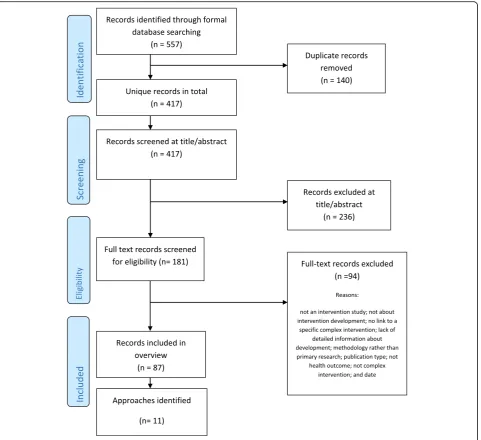
As previously stated, the intention was to undertake a
broad rather than an exhaustive search, where more
in-formal searches are as important as in-formal searches.
PRISMA flow charts are devised to display exhaustive
searches within standard systematic reviews. For this
systematic methods overview, a PRISMA flow chart is
displayed for the search using the term
‘
intervention
de-velopment
’
of primary studies reporting intervention
de-velopment in 2015
–
2016 (Fig.
1
).
Taxonomy of approaches
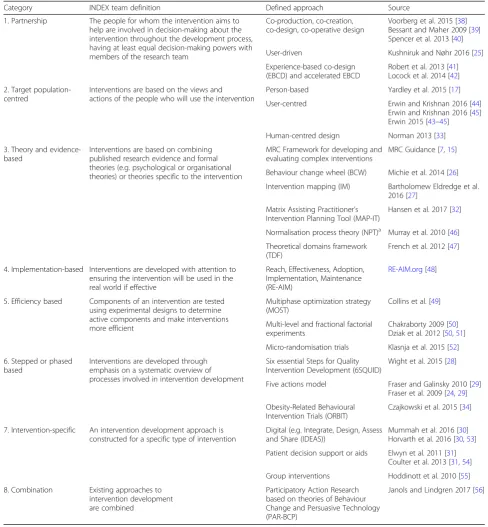
Eight categories of approach to intervention
develop-ment were identified, distinguished by the rationales
stated by the authors of these approaches (Table
1
). The
review team identified the following labels for these
eight categories based on the language used by authors
of approaches.
1. Partnership intervention development. Three
approaches were included, addressing a range of
contexts (quality improvement, social innovation
and radical innovation). Partnership approaches
included co-production with equal participation in
decision-making of the research team and the
people whom the intervention aimed to help, and
user-driven development. Due to similarities with
approaches already included, a partnership
ap-proach for implementation science was not
in-cluded [
19
]. Primary research studies reported using
intervention development could not be located so it
was not included here.
2. Target population-centred intervention
develop-ment. Three approaches were included,
address-ing a wide range of contexts (health care
delivery, technology, behaviour change and
self-management).
3. Evidence and theory-based intervention
develop-ment. Six approaches were included, addressing a
range of contexts (complex interventions in health
and health care, public health, social policy,
behav-iour change and quality improvement). Some of
these approaches also proposed a rationale of being
systematic (see category 6) but were included in this
Table 1
Taxonomy of approaches to intervention development
Category INDEX team definition Defined approach Source
1. Partnership The people for whom the intervention aims to help are involved in decision-making about the intervention throughout the development process, having at least equal decision-making powers with members of the research team
Co-production, co-creation, co-design, co-operative design
Voorberg et al. 2015 [38] Bessant and Maher 2009 [39] Spencer et al. 2013 [40]
User-driven Kushniruk and Nøhr 2016 [25]
Experience-based co-design (EBCD) and accelerated EBCD
Robert et al. 2013 [41] Locock et al. 2014 [42]
2. Target population-centred
Interventions are based on the views and actions of the people who will use the intervention
Person-based Yardley et al. 2015 [17]
User-centred Erwin and Krishnan 2016 [44] Erwin and Krishnan 2016 [45] Erwin 2015 [43–45]
Human-centred design Norman 2013 [33]
3. Theory and evidence-based
Interventions are based on combining published research evidence and formal theories (e.g. psychological or organisational theories) or theories specific to the intervention
MRC Framework for developing and evaluating complex interventions
MRC Guidance [7,15]
Behaviour change wheel (BCW) Michie et al. 2014 [26]
Intervention mapping (IM) Bartholomew Eldredge et al. 2016 [27]
Matrix Assisting Practitioner’s Intervention Planning Tool (MAP-IT)
Hansen et al. 2017 [32]
Normalisation process theory (NPT)a Murray et al. 2010 [46]
Theoretical domains framework (TDF)
French et al. 2012 [47]
4. Implementation-based Interventions are developed with attention to ensuring the intervention will be used in the real world if effective
Reach, Effectiveness, Adoption, Implementation, Maintenance (RE-AIM)
RE-AIM.org[48]
5. Efficiency based Components of an intervention are tested using experimental designs to determine active components and make interventions more efficient
Multiphase optimization strategy (MOST)
Collins et al. [49]
Multi-level and fractional factorial experiments
Chakraborty 2009 [50] Dziak et al. 2012 [50,51]
Micro-randomisation trials Klasnja et al. 2015 [52]
6. Stepped or phased based
Interventions are developed through emphasis on a systematic overview of processes involved in intervention development
Six essential Steps for Quality Intervention Development (6SQUID)
Wight et al. 2015 [28]
Five actions model Fraser and Galinsky 2010 [29] Fraser et al. 2009 [24,29]
Obesity-Related Behavioural Intervention Trials (ORBIT)
Czajkowski et al. 2015 [34]
7. Intervention-specific An intervention development approach is constructed for a specific type of intervention
Digital (e.g. Integrate, Design, Assess and Share (IDEAS))
Mummah et al. 2016 [30] Horvarth et al. 2016 [30,53]
Patient decision support or aids Elwyn et al. 2011 [31] Coulter et al. 2013 [31,54]
Group interventions Hoddinott et al. 2010 [55]
8. Combination Existing approaches to intervention development are combined
Participatory Action Research based on theories of Behaviour Change and Persuasive Technology (PAR-BCP)
Janols and Lindgren 2017 [56]
a
category because they emphasised the role of
evi-dence and theory within their rationale. There were
a large number of these. Some approaches identified
in the primary research study search were not
in-cluded here due to data saturation [
20
,
21
].
4. Implementation-based intervention development.
One approach was included, in the context of
health behaviour interventions.
5. Efficiency-based intervention development. Three
approaches were included, although they were not
independent of each other. Two of the approaches
defined different ways of optimising components for
parts in the first approach in this category.
6. Stepped or phased-based intervention development.
Three approaches were included, addressing a range
of contexts (public health, social policy and clinical
practice).
7. Intervention-specific development. Five approaches
were included in three intervention groups
—
digital
behaviour change interventions, patient decision
aids and group interventions. Other approaches
were identified but not included here because of
data saturation, because they were outside the time
range of post 2007 and had not been used in the
primary research studies published 2015
–
2016 [
22
],
or because they offered recommendations for the
future rather than current guidance [
23
].
8. Combination approach to intervention
development. There was one approach included
here in the context of behaviour change.
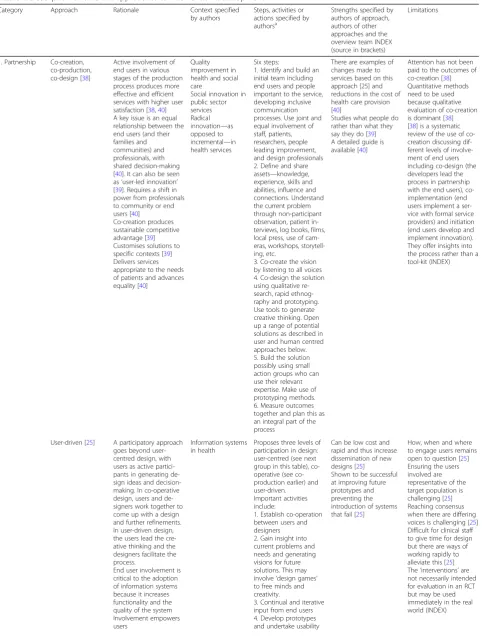
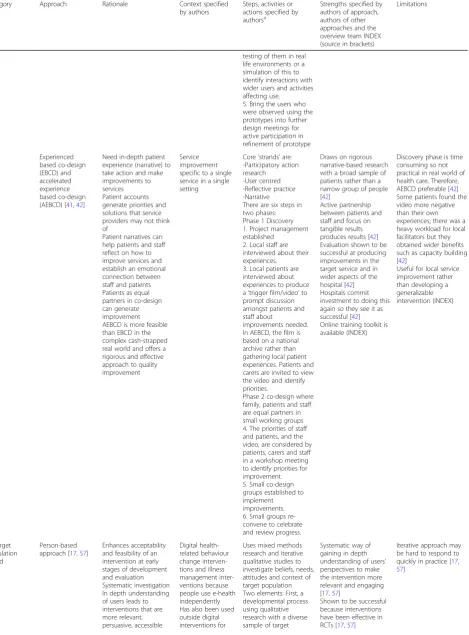
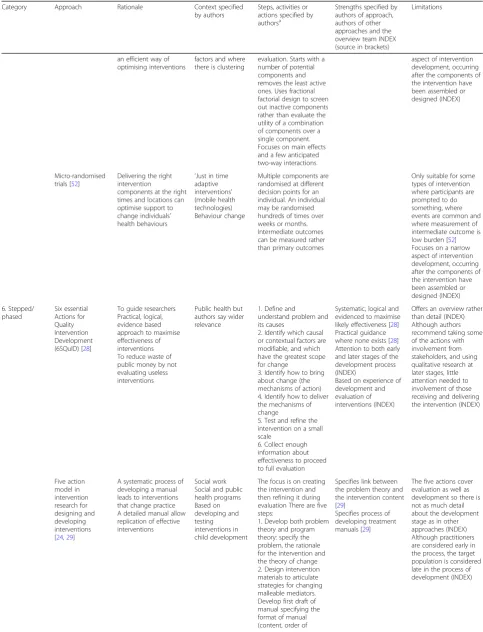
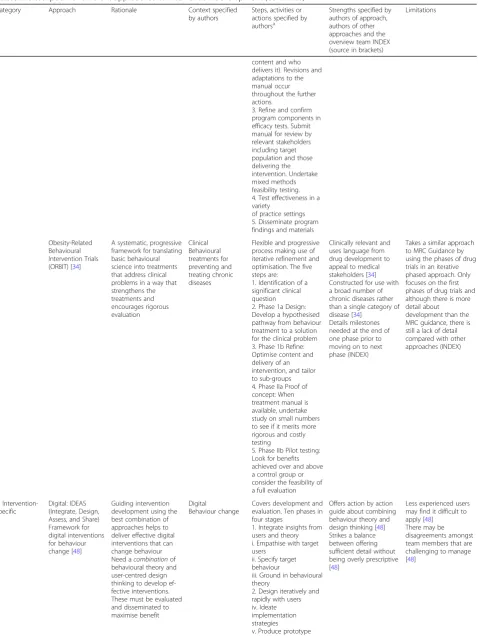
The stated rationale, context, key actions and strengths
and limitations of each included approach are described
in Table
2
and these characteristics are considered
below.
Contexts
The approaches included were produced for a wide
range of contexts and sometimes for multiple contexts.
They addressed the contexts of behaviour change (11
approaches), public health and health promotion (9),
digital health (6), complex interventions (5), quality or
service improvement (3), clinical research (2), social
pol-icy or innovation (2) and others (Table
2
).
Key actions
The actions from all the included approaches were
syn-thesised to identify a total of 18 actions. These actions
are displayed in seven domains of intervention
develop-ment. Although some authors describe intervention
de-velopment as a broadly sequential process, in that some
actions are usually undertaken prior to others [
24
],
au-thors also emphasise that intervention development is a
cyclical or iterative rather than linear process (for
example, action four may generate understanding that
takes developers back to action two), or there may be
repetition within a single action until the developers are
ready to move on to the next action [
15
,
17
,
25
–
31
].
Some actions may be undertaken concurrently.
There-fore, the actions are presented within domains, with
some attention to broad sequencing of domains and
ac-tions, to facilitate understanding of the process of
inter-vention development. The seven domains are presented
in three tables (Tables
3
,
4
and
5
) and described below.
Authors of some approaches state that intervention
development is a cumulative or progressive process,
ar-guing that it is necessary to spend time on the early
ac-tions and get this right because later ones depend on
these [
26
].
Conception and planning
The first two domains of intervention development are
Conception and Planning (Table
3
). Although the
Con-ception domain has only one action, it emphasises the
importance of being transparent about where the idea
for an intervention has originated. The Planning domain
has seven actions, from deciding who will be involved in
the development process and how, through to
consider-ing whether it is worthwhile designconsider-ing an intervention
(Table
3
). Authors of some approaches identify the need
to spend resources on the Planning domain to get the
intervention right (e.g. [
32
]).
Designing and creating
The next two domains of intervention development are
Designing an intervention and then Creating it (Table
4
).
The Creating domain can be an integral action within
the Designing domain in some approaches. Two ways of
addressing both of these domains have been proposed:
one prioritises working with stakeholders, particularly
the target population, and the other focuses on theory.
Constructing a rough prototype early in these domains
is key to some approaches. These domains require
cre-ativity [
24
,
33
,
34
], with use of a multidisciplinary team
proposed as a way to maximise idea generation and
innovation [
30
,
34
].
Table 2
Description of different approaches to intervention development
Category Approach Rationale Context specified
by authors
Steps, activities or actions specified by authorsa
Strengths specified by authors of approach, authors of other approaches and the overview team INDEX (source in brackets)
Limitations
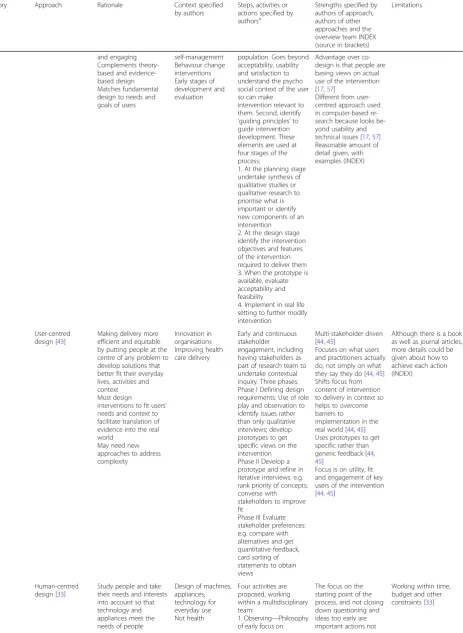
1. Partnership Co-creation, co-production, co-design [38]
Active involvement of end users in various stages of the production process produces more effective and efficient services with higher user satisfaction [38,40] A key issue is an equal relationship between the end users (and their families and communities) and professionals, with shared decision-making [40]. It can also be seen as‘user-led innovation’ [39]. Requires a shift in power from professionals to community or end users [40]
Co-creation produces sustainable competitive advantage [39] Customises solutions to specific contexts [39] Delivers services appropriate to the needs of patients and advances equality [40]
Quality improvement in health and social care
Social innovation in public sector services Radical innovation—as opposed to incremental—in health services
Six steps:
1. Identify and build an initial team including end users and people important to the service, developing inclusive communication processes. Use joint and equal involvement of staff, patients, researchers, people leading improvement, and design professionals 2. Define and share assets—knowledge, experience, skills and abilities, influence and connections. Understand the current problem through non-participant observation, patient in-terviews, log books, films, local press, use of cam-eras, workshops, storytell-ing, etc.
3. Co-create the vision by listening to all voices 4. Co-design the solution using qualitative re-search, rapid ethnog-raphy and prototyping. Use tools to generate creative thinking. Open up a range of potential solutions as described in user and human centred approaches below. 5. Build the solution possibly using small action groups who can use their relevant expertise. Make use of prototyping methods. 6. Measure outcomes together and plan this as an integral part of the process
There are examples of changes made to services based on this approach [25] and reductions in the cost of health care provision [40]
Studies what people do rather than what they say they do [39] A detailed guide is available [40]
Attention has not been paid to the outcomes of co-creation [38] Quantitative methods need to be used because qualitative evaluation of co-creation is dominant [38] [38] is a systematic review of the use of co-creation discussing dif-ferent levels of involve-ment of end users including co-design (the developers lead the process in partnership with the end users), co-implementation (end users implement a ser-vice with formal serser-vice providers) and initiation (end users develop and implement innovation). They offer insights into the process rather than a tool-kit (INDEX)
User-driven [25] A participatory approach goes beyond user-centred design, with users as active partici-pants in generating de-sign ideas and decision-making. In co-operative design, users and de-signers work together to come up with a design and further refinements. In user-driven design, the users lead the cre-ative thinking and the designers facilitate the process.
End user involvement is critical to the adoption of information systems because it increases functionality and the quality of the system Involvement empowers users
Information systems in health
Proposes three levels of participation in design: user-centred (see next group in this table), operative (see co-production earlier) and user-driven. Important activities include:
1. Establish co-operation between users and designers 2. Gain insight into current problems and needs and generating visions for future solutions. This may involve‘design games’
to free minds and creativity.
3. Continual and iterative input from end users 4. Develop prototypes and undertake usability
Can be low cost and rapid and thus increase dissemination of new designs [25] Shown to be successful at improving future prototypes and preventing the introduction of systems that fail [25]
Table 2
Description of different approaches to intervention development
(Continued)
Category Approach Rationale Context specified
by authors
Steps, activities or actions specified by authorsa
Strengths specified by authors of approach, authors of other approaches and the overview team INDEX (source in brackets)
Limitations
testing of them in real life environments or a simulation of this to identify interactions with wider users and activities affecting use. 5. Bring the users who were observed using the prototypes into further design meetings for active participation in refinement of prototype
Experienced based co-design (EBCD) and accelerated experience based co-design (AEBCD) [41,42]
Need in-depth patient experience (narrative) to take action and make improvements to services Patient accounts generate priorities and solutions that service providers may not think of
Patient narratives can help patients and staff reflect on how to improve services and establish an emotional connection between staff and patients Patients as equal partners in co-design can generate improvement AEBCD is more feasible than EBCD in the complex cash-strapped real world and offers a rigorous and effective approach to quality improvement
Service improvement specific to a single service in a single setting
Core‘strands’are: -Participatory action research -User centred -Reflective practice -Narrative There are six steps in two phases: Phase 1 Discovery 1. Project management established
2. Local staff are interviewed about their experiences. 3. Local patients are interviewed about experiences to produce a‘trigger film/video’to prompt discussion amongst patients and staff about
improvements needed. In AEBCD, the film is based on a national archive rather than gathering local patient experiences. Patients and carers are invited to view the video and identify priorities.
Phase 2 co-design where family, patients and staff are equal partners in small working groups 4. The priorities of staff and patients, and the video, are considered by patients, carers and staff in a workshop meeting to identify priorities for improvement. 5. Small co-design groups established to implement improvements. 6. Small groups re-convene to celebrate and review progress.
Draws on rigorous narrative-based research with a broad sample of patients rather than a narrow group of people [42]
Active partnership between patients and staff and focus on tangible results produces results [42] Evaluation shown to be successful at producing improvements in the target service and in wider aspects of the hospital [42] Hospitals commit investment to doing this again so they see it as successful [42] Online training toolkit is available (INDEX)
Discovery phase is time consuming so not practical in real world of health care. Therefore, AEBCD preferable [42] Some patients found the video more negative than their own experiences; there was a heavy workload for local facilitators but they obtained wider benefits such as capacity building [42]
Useful for local service improvement rather than developing a generalizable intervention (INDEX) 2. Target population based Person-based approach [17,57]
Enhances acceptability and feasibility of an intervention at early stages of development and evaluation Systematic investigation In depth understanding of users leads to interventions that are more relevant, persuasive, accessible
Digital health-related behaviour change interven-tions and illness management inter-ventions because people use e-health independently Has also been used outside digital interventions for
Uses mixed methods research and iterative qualitative studies to investigate beliefs, needs, attitudes and context of target population Two elements: First, a developmental process using qualitative research with a diverse sample of target
Systematic way of gaining in depth understanding of users’ perspectives to make the intervention more relevant and engaging [17,57]
Shown to be successful because interventions have been effective in RCTs [17,57]
Iterative approach may be hard to respond to quickly in practice [17,
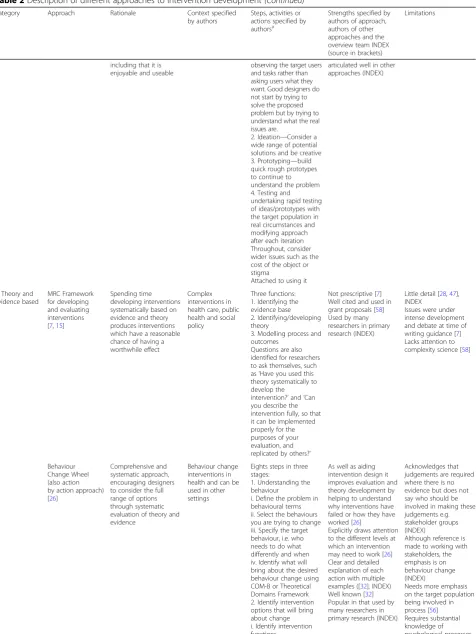
Table 2
Description of different approaches to intervention development
(Continued)
Category Approach Rationale Context specified
by authors
Steps, activities or actions specified by authorsa
Strengths specified by authors of approach, authors of other approaches and the overview team INDEX (source in brackets)
Limitations
and engaging Complements theory-based and evidence-based design Matches fundamental design to needs and goals of users
self-management Behaviour change interventions Early stages of development and evaluation
population. Goes beyond acceptability, usability and satisfaction to understand the psycho social context of the user so can make
intervention relevant to them. Second, identify
‘guiding principles’to guide intervention development. These elements are used at four stages of the process:
1. At the planning stage undertake synthesis of qualitative studies or qualitative research to prioritise what is important or identify new components of an intervention 2. At the design stage identify the intervention objectives and features of the intervention required to deliver them 3. When the prototype is available, evaluate acceptability and feasibility
4. Implement in real life setting to further modify intervention
Advantage over co-design is that people are basing views on actual use of the intervention [17,57]
Different from user-centred approach used in computer-based re-search because looks be-yond usability and technical issues [17,57] Reasonable amount of detail given, with examples (INDEX)
User-centred design [43]
Making delivery more efficient and equitable by putting people at the centre of any problem to develop solutions that better fit their everyday lives, activities and context Must design
interventions to fit users’
needs and context to facilitate translation of evidence into the real world
May need new approaches to address complexity
Innovation in organisations Improving health care delivery
Early and continuous stakeholder engagement, including having stakeholders as part of research team to undertake contextual inquiry. Three phases: Phase I Defining design requirements: Use of role play and observation to identify issues rather than only qualitative interviews; develop prototypes to get specific views on the intervention Phase II Develop a prototype and refine in iterative interviews: e.g. rank priority of concepts; converse with stakeholders to improve fit
Phase III Evaluate stakeholder preferences: e.g. compare with alternatives and get quantitative feedback, card sorting of statements to obtain views
Multi-stakeholder driven [44,45]
Focuses on what users and practitioners actually do, not simply on what they say they do [44,45] Shifts focus from content of intervention to delivery in context so helps to overcome barriers to
implementation in the real world [44,45] Uses prototypes to get specific rather than generic feedback [44,
45]
Focus is on utility, fit and engagement of key users of the intervention [44,45]
Although there is a book as well as journal articles, more details could be given about how to achieve each action (INDEX)
Human-centred design [33]
Study people and take their needs and interests into account so that technology and appliances meet the needs of people
Design of machines, appliances, technology for everyday use Not health
Four activities are proposed, working within a multidisciplinary team:
1. Observing—Philosophy of early focus on
The focus on the starting point of the process, and not closing down questioning and ideas too early are important actions not
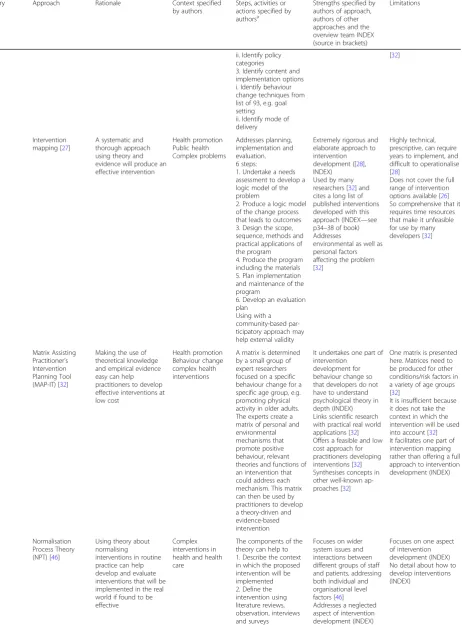
Table 2
Description of different approaches to intervention development
(Continued)
Category Approach Rationale Context specified
by authors
Steps, activities or actions specified by authorsa
Strengths specified by authors of approach, authors of other approaches and the overview team INDEX (source in brackets)
Limitations
including that it is enjoyable and useable
observing the target users and tasks rather than asking users what they want. Good designers do not start by trying to solve the proposed problem but by trying to understand what the real issues are.
2. Ideation—Consider a wide range of potential solutions and be creative 3. Prototyping—build quick rough prototypes to continue to understand the problem 4. Testing and undertaking rapid testing of ideas/prototypes with the target population in real circumstances and modifying approach after each iteration Throughout, consider wider issues such as the cost of the object or stigma
Attached to using it
articulated well in other approaches (INDEX)
3. Theory and evidence based
MRC Framework for developing and evaluating interventions [7,15]
Spending time developing interventions systematically based on evidence and theory produces interventions which have a reasonable chance of having a worthwhile effect
Complex interventions in health care, public health and social policy
Three functions: 1. Identifying the evidence base 2. Identifying/developing theory
3. Modelling process and outcomes
Questions are also identified for researchers to ask themselves, such as‘Have you used this theory systematically to develop the intervention?’and‘Can you describe the intervention fully, so that it can be implemented properly for the purposes of your evaluation, and replicated by others?’
Not prescriptive [7] Well cited and used in grant proposals [58] Used by many researchers in primary research (INDEX)
Little detail [28,47], INDEX
Issues were under intense development and debate at time of writing guidance [7] Lacks attention to complexity science [58]
Behaviour Change Wheel (also action by action approach) [26]
Comprehensive and systematic approach, encouraging designers to consider the full range of options through systematic evaluation of theory and evidence
Behaviour change interventions in health and can be used in other settings
Eights steps in three stages:
1. Understanding the behaviour
i. Define the problem in behavioural terms ii. Select the behaviours you are trying to change iii. Specify the target behaviour, i.e. who needs to do what differently and when iv. Identify what will bring about the desired behaviour change using COM-B or Theoretical Domains Framework 2. Identify intervention options that will bring about change i. Identify intervention functions
As well as aiding intervention design it improves evaluation and theory development by helping to understand why interventions have failed or how they have worked [26]
Explicitly draws attention to the different levels at which an intervention may need to work [26] Clear and detailed explanation of each action with multiple examples ([32], INDEX) Well known [32] Popular in that used by many researchers in primary research (INDEX)
Acknowledges that judgements are required where there is no evidence but does not say who should be involved in making these judgements e.g. stakeholder groups (INDEX)
Although reference is made to working with stakeholders, the emphasis is on behaviour change (INDEX)
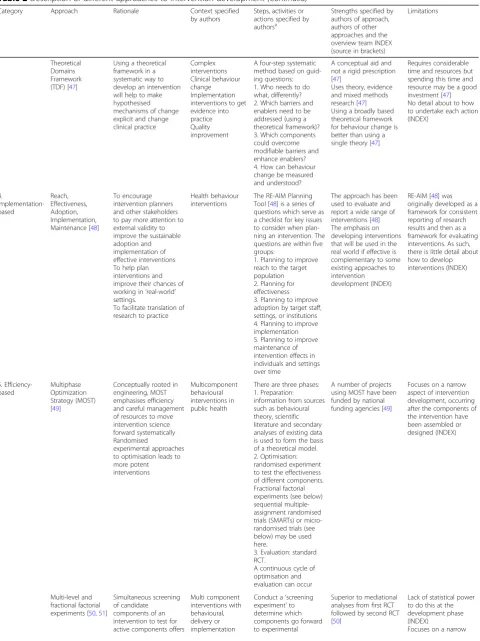
Table 2
Description of different approaches to intervention development
(Continued)
Category Approach Rationale Context specified
by authors
Steps, activities or actions specified by authorsa
Strengths specified by authors of approach, authors of other approaches and the overview team INDEX (source in brackets)
Limitations
ii. Identify policy categories
3. Identify content and implementation options i. Identify behaviour change techniques from list of 93, e.g. goal setting
ii. Identify mode of delivery
[32]
Intervention mapping [27]
A systematic and thorough approach using theory and evidence will produce an effective intervention Health promotion Public health Complex problems Addresses planning, implementation and evaluation. 6 steps:
1. Undertake a needs assessment to develop a logic model of the problem
2. Produce a logic model of the change process that leads to outcomes 3. Design the scope, sequence, methods and practical applications of the program 4. Produce the program including the materials 5. Plan implementation and maintenance of the program
6. Develop an evaluation plan
Using with a community-based par-ticipatory approach may help external validity
Extremely rigorous and elaborate approach to intervention development ([28], INDEX) Used by many researchers [32] and cites a long list of published interventions developed with this approach (INDEX—see p34–38 of book) Addresses
environmental as well as personal factors affecting the problem [32]
Highly technical, prescriptive, can require years to implement, and difficult to operationalise [28]
Does not cover the full range of intervention options available [26] So comprehensive that it requires time resources that make it unfeasible for use by many developers [32]
Matrix Assisting Practitioner’s Intervention Planning Tool (MAP-IT) [32]
Making the use of theoretical knowledge and empirical evidence easy can help practitioners to develop effective interventions at low cost
Health promotion Behaviour change complex health interventions
A matrix is determined by a small group of expert researchers focused on a specific behaviour change for a specific age group, e.g. promoting physical activity in older adults. The experts create a matrix of personal and environmental mechanisms that promote positive behaviour, relevant theories and functions of an intervention that could address each mechanism. This matrix can then be used by practitioners to develop a theory-driven and evidence-based intervention
It undertakes one part of intervention
development for behaviour change so that developers do not have to understand psychological theory in depth (INDEX) Links scientific research with practical real world applications [32] Offers a feasible and low cost approach for practitioners developing interventions [32] Synthesises concepts in other well-known ap-proaches [32]
One matrix is presented here. Matrices need to be produced for other conditions/risk factors in a variety of age groups [32]
It is insufficient because it does not take the context in which the intervention will be used into account [32] It facilitates one part of intervention mapping rather than offering a full approach to intervention development (INDEX)
Normalisation Process Theory (NPT) [46]
Using theory about normalising interventions in routine practice can help develop and evaluate interventions that will be implemented in the real world if found to be effective
Complex interventions in health and health care
The components of the theory can help to 1. Describe the context in which the proposed intervention will be implemented 2. Define the intervention using literature reviews, observation, interviews and surveys
Focuses on wider system issues and interactions between different groups of staff and patients, addressing both individual and organisational level factors [46] Addresses a neglected aspect of intervention development (INDEX)
Table 2
Description of different approaches to intervention development
(Continued)
Category Approach Rationale Context specified
by authors
Steps, activities or actions specified by authorsa
Strengths specified by authors of approach, authors of other approaches and the overview team INDEX (source in brackets)
Limitations
Theoretical Domains Framework (TDF) [47]
Using a theoretical framework in a systematic way to develop an intervention will help to make hypothesised mechanisms of change explicit and change clinical practice Complex interventions Clinical behaviour change Implementation interventions to get evidence into practice Quality improvement
A four-step systematic method based on guid-ing questions: 1. Who needs to do what, differently? 2. Which barriers and enablers need to be addressed (using a theoretical framework)? 3. Which components could overcome modifiable barriers and enhance enablers? 4. How can behaviour change be measured and understood?
A conceptual aid and not a rigid prescription [47]
Uses theory, evidence and mixed methods research [47] Using a broadly based theoretical framework for behaviour change is better than using a single theory [47]
Requires considerable time and resources but spending this time and resource may be a good investment [47] No detail about to how to undertake each action (INDEX) 4. Implementation-based Reach, Effectiveness, Adoption, Implementation, Maintenance [48]
To encourage intervention planners and other stakeholders to pay more attention to external validity to improve the sustainable adoption and implementation of effective interventions To help plan interventions and improve their chances of working in‘real-world’
settings.
To facilitate translation of research to practice
Health behaviour interventions
The RE-AIM Planning Tool [48] is a series of questions which serve as a checklist for key issues to consider when plan-ning an intervention. The questions are within five groups:
1. Planning to improve reach to the target population 2. Planning for effectiveness 3. Planning to improve adoption by target staff, settings, or institutions 4. Planning to improve implementation 5. Planning to improve maintenance of intervention effects in individuals and settings over time
The approach has been used to evaluate and report a wide range of interventions [48] The emphasis on developing interventions that will be used in the real world if effective is complementary to some existing approaches to intervention development (INDEX)
RE-AIM [48] was originally developed as a framework for consistent reporting of research results and then as a framework for evaluating interventions. As such, there is little detail about how to develop interventions (INDEX) 5. Efficiency-based Multiphase Optimization Strategy (MOST) [49]
Conceptually rooted in engineering, MOST emphasises efficiency and careful management of resources to move intervention science forward systematically Randomised
experimental approaches to optimisation leads to more potent interventions Multicomponent behavioural interventions in public health
There are three phases: 1. Preparation: information from sources such as behavioural theory, scientific literature and secondary analyses of existing data is used to form the basis of a theoretical model. 2. Optimisation: randomised experiment to test the effectiveness of different components. Fractional factorial experiments (see below) sequential multiple-assignment randomised trials (SMARTs) or micro-randomised trials (see below) may be used here.
3. Evaluation: standard RCT.
A continuous cycle of optimisation and evaluation can occur
A number of projects using MOST have been funded by national funding agencies [49]
Focuses on a narrow aspect of intervention development, occurring after the components of the intervention have been assembled or designed (INDEX)
Multi-level and fractional factorial experiments [50,51]
Simultaneous screening of candidate components of an intervention to test for active components offers
Multi component interventions with behavioural, delivery or implementation
Conduct a‘screening experiment’to determine which components go forward to experimental
Superior to mediational analyses from first RCT followed by second RCT [50]
Lack of statistical power to do this at the development phase (INDEX)
Table 2
Description of different approaches to intervention development
(Continued)
Category Approach Rationale Context specified
by authors
Steps, activities or actions specified by authorsa
Strengths specified by authors of approach, authors of other approaches and the overview team INDEX (source in brackets)
Limitations
an efficient way of optimising interventions
factors and where there is clustering
evaluation. Starts with a number of potential components and removes the least active ones. Uses fractional factorial design to screen out inactive components rather than evaluate the utility of a combination of components over a single component. Focuses on main effects and a few anticipated two-way interactions
aspect of intervention development, occurring after the components of the intervention have been assembled or designed (INDEX)
Micro-randomised trials [52]
Delivering the right intervention
components at the right times and locations can optimise support to change individuals’
health behaviours
‘Just in time adaptive interventions’
(mobile health technologies) Behaviour change
Multiple components are randomised at different decision points for an individual. An individual may be randomised hundreds of times over weeks or months. Intermediate outcomes can be measured rather than primary outcomes
Only suitable for some types of intervention where participants are prompted to do something, where events are common and where measurement of intermediate outcome is low burden [52] Focuses on a narrow aspect of intervention development, occurring after the components of the intervention have been assembled or designed (INDEX) 6. Stepped/ phased Six essential Actions for Quality Intervention Development (6SQuID) [28]
To guide researchers Practical, logical, evidence based approach to maximise effectiveness of interventions To reduce waste of public money by not evaluating useless interventions
Public health but authors say wider relevance
1. Define and understand problem and its causes
2. Identify which causal or contextual factors are modifiable, and which have the greatest scope for change
3. Identify how to bring about change (the mechanisms of action) 4. Identify how to deliver the mechanisms of change
5. Test and refine the intervention on a small scale
6. Collect enough information about effectiveness to proceed to full evaluation
Systematic, logical and evidenced to maximise likely effectiveness [28] Practical guidance where none exists [28] Attention to both early and later stages of the development process (INDEX)
Based on experience of development and evaluation of interventions (INDEX)
Offers an overview rather than detail (INDEX) Although authors recommend taking some of the actions with involvement from stakeholders, and using qualitative research at later stages, little attention needed to involvement of those receiving and delivering the intervention (INDEX)
Five action model in intervention research for designing and developing interventions [24,29]
A systematic process of developing a manual leads to interventions that change practice A detailed manual allow replication of effective interventions
Social work Social and public health programs Based on developing and testing interventions in child development
The focus is on creating the intervention and then refining it during evaluation There are five steps:
1. Develop both problem theory and program theory: specify the problem, the rationale for the intervention and the theory of change 2. Design intervention materials to articulate strategies for changing malleable mediators. Develop first draft of manual specifying the format of manual (content, order of
Specifies link between the problem theory and the intervention content [29]
Specifies process of developing treatment manuals [29]
Table 2
Description of different approaches to intervention development
(Continued)
Category Approach Rationale Context specified
by authors
Steps, activities or actions specified by authorsa
Strengths specified by authors of approach, authors of other approaches and the overview team INDEX (source in brackets)
Limitations
content and who delivers it). Revisions and adaptations to the manual occur throughout the further actions.
3. Refine and confirm program components in efficacy tests. Submit manual for review by relevant stakeholders including target population and those delivering the intervention. Undertake mixed methods feasibility testing. 4. Test effectiveness in a variety
of practice settings 5. Disseminate program findings and materials
Obesity-Related Behavioural Intervention Trials (ORBIT) [34]
A systematic, progressive framework for translating basic behavioural science into treatments that address clinical problems in a way that strengthens the treatments and encourages rigorous evaluation
Clinical Behavioural treatments for preventing and treating chronic diseases
Flexible and progressive process making use of iterative refinement and optimisation. The five steps are:
1. Identification of a significant clinical question 2. Phase 1a Design: Develop a hypothesised pathway from behaviour treatment to a solution for the clinical problem 3. Phase 1b Refine: Optimise content and delivery of an intervention, and tailor to sub-groups 4. Phase IIa Proof of concept: When treatment manual is available, undertake study on small numbers to see if it merits more rigorous and costly testing
5. Phase IIb Pilot testing: Look for benefits achieved over and above a control group or consider the feasibility of a full evaluation
Clinically relevant and uses language from drug development to appeal to medical stakeholders [34] Constructed for use with a broad number of chronic diseases rather than a single category of disease [34]
Details milestones needed at the end of one phase prior to moving on to next phase (INDEX)
Takes a similar approach to MRC Guidance by using the phases of drug trials in an iterative phased approach. Only focuses on the first phases of drug trials and although there is more detail about development than the MRC guidance, there is still a lack of detail compared with other approaches (INDEX)
7. Intervention-specific
Digital: IDEAS (Integrate, Design, Assess, and Share) Framework for digital interventions for behaviour change [48]
Guiding intervention development using the best combination of approaches helps to deliver effective digital interventions that can change behaviour Need acombinationof behavioural theory and user-centred design thinking to develop ef-fective interventions. These must be evaluated and disseminated to maximise benefit
Digital Behaviour change
Covers development and evaluation. Ten phases in four stages
1. Integrate insights from users and theory i. Empathise with target users
ii. Specify target behaviour
iii. Ground in behavioural theory
2. Design iteratively and rapidly with users iv. Ideate implementation strategies v. Produce prototype
Offers action by action guide about combining behaviour theory and design thinking [48] Strikes a balance between offering sufficient detail without being overly prescriptive [48]
Table 2
Description of different approaches to intervention development
(Continued)
Category Approach Rationale Context specified
by authors
Steps, activities or actions specified by authorsa
Strengths specified by authors of approach, authors of other approaches and the overview team INDEX (source in brackets)
Limitations
vi. Obtain user feedback vii. Create a product 3. Assess rigorously viii. Pilot test to assess potential efficacy and usability
ix. Evaluate in RCT 4. Share
x. Share intervention and results
Digital—practical advice for internet-based health interventions [53]
Concrete examples from experience of digital intervention development can complement best practices guidance
Online health interventions Public Health
Based on the views of researchers and practitioners:
1. Hire the right research team, e.g. include computer science experts
2. Know the needs of the target population 2. Plan the process before engaging a web designer
3. Recognise that different stakeholders have different values and language e.g. researchers and web designers 4. Develop a detailed contract
5. Document all decisions 6.Use a content management system 7. Allow extra time for testing and refining
Based on views of researchers with experience and offers complementary knowledge of intervention
development to existing published sources [53]
The focus is largely on how to work with commercial web designers in the context of a digital intervention (INDEX)
Web-based decision support tools for patients [31]
A clear project management and editorial process will help to balance different priorities of variety of stakeholders [31] Need close consultation with target users and iterative development process to develop accessible and useful intervention [31]
Decision aids available in web-based versions
A process map for developing decision aids addressing two areas: First, content specification by combining scientific evidence and patient perspectives. Second creative design to tailor it to specific audiences by considering presentation of information, help for patients to assess how they feel about future events and allow patients to formulate a preference
Five groups are established: a project management group of 3–4 people to drive the process; an advisory group of 6–10 stakeholders who advise but do not have editorial rights; a virtual scientific reference group of experts to review evidence synthesis and the evolving tool; a technical production group which will create and host the website; and stakeholder consultations with a
Use of creative design and consultation as well as scientific evidence [31]
Close liaison with target users [31]
Iterative method of refinement [31]
Table 2
Description of different approaches to intervention development
(Continued)
Category Approach Rationale Context specified
by authors
Steps, activities or actions specified by authorsa
Strengths specified by authors of approach, authors of other approaches and the overview team INDEX (source in brackets)
Limitations
series of prototypes including patients undergoing the decision and practitioners who interact with patients Overlapping steps are: 1. Identify patients’ needs using qualitative research
2. Evidence synthesis 3. Consensus on evidence
4. Construct storyboard 5. Undertake sandpit testing with experts 6. Undertake usability testing
7. Undertake field testing with real patients
Patient decision aids [54]
Systematic and transparent process of development allows users to check validity and reduce chance of causing harm and increase chance of benefit. Explicit that there is no hard evidence to support this rationale
Decision support Based on a review of different approaches to developing decision aids, core features common to all are:
1. Scoping and design 2. Development of a prototype
3. Iterative‘alpha’testing by patients, clinicians and other stakeholders involved in the development 4. Iterative‘beta’testing in real-life contexts with patients and clinicians not involved in the development 5. Production of final version
The process is overseen by a multi-stakeholder group
More comprehensive than previous guides [54]
Uncertainty remains about how best to address the individual elements of the guide [54]
Lack of detail about how to undertake different actions (INDEX)
Group interventions [55]
More systematic approach to designing interventions
Health improvement interventions or behaviour change interventions occurring in a group setting in public health and primary care
Interventions are complex adaptive social processes with interactions between the group leader, participants, and the wider community and environment. When designing them consider:
1. What the intervention is and the quantity delivered 2. How someone becomes a group member 3. The social and behavioural theories that inform the intervention 4. How the group influences members’ attitudes, beliefs and behaviours. Existing theories may inform this, e.g. social support theory 5. The intended outcomes 6. Who should be the target population
Fills a gap in the evidence base [55] Can be used in conjunction with another approach when delivery to groups is required (INDEX)
designs for optimising the intervention. A number of
ap-proaches recommend iterative processes, as new insights
emerge and changes are made to the intervention.
The Documenting domain involves writing a set of
in-structions so others can use the intervention. The
com-pilation of this document or manual is likely to start
early in the process and be finalised towards the end of
the development process. The document or manual, like
the intervention, is likely to undergo multiple iterations
during the development process and be further refined
after any formal pilot or evaluation. The description of
the intervention in any document can follow guidelines
for reporting interventions: why, what, who provides,
how, where, when and how much, and tailoring [
35
].
Some approaches recommend planning for an
even-tual evaluation from the beginning of the development
process [
24
,
27
].
Methods and activities used in the development process
Authors of different approaches propose using different
research methods and activities to deliver each action
(Tables
3
,
4
and
5
). Methods and activities include using
non-participant observation to understand the problem
and the context in which the intervention will operate,
playing games to generate ideas for the content of the
intervention and using
‘
think aloud
’
methods to
understand the usability, acceptability or feasibility of
early versions of the intervention.
Strengths and limitations of approaches
The strengths of each approach, reported largely by its
authors, included those related to processes (that they
are systematic, practical, clear or detailed) and outcomes
(that they have been used a number of times, or there is
evidence that they have produced effective
interven-tions). Authors did not formally compare their approach
with others. Limitations, again reported largely by
au-thors, included that some approaches lacked detail, were
time consuming to undertake, required expertise or did
not address how to deal with conflicting opinions from
diverse stakeholders. These strengths and limitations are
further detailed below.
Comprehensiveness
Some of the approaches were more comprehensive than
others in addressing a higher proportion of the 18
ac-tions (Table
6
). More comprehensive approaches
in-cluded Intervention Mapping and the Behaviour Change
Wheel. Some offered more detail about how to
under-take specific actions because they were published as
books or included a lot of examples. These included
Intervention Mapping, the Behaviour Change Wheel and
Table 2
Description of different approaches to intervention development
(Continued)
Category Approach Rationale Context specified
by authors
Steps, activities or actions specified by authorsa
Strengths specified by authors of approach, authors of other approaches and the overview team INDEX (source in brackets)
Limitations
8. Combination Participatory Action Research process based on theories on Behaviour Change and Persuasive technology (PAR-BCP) [56]
Aids the integration of theories into a participatory action research design process because behaviour is hard to change
Behaviour change systems for health promotion (possibly in digital health)
Combines theory from two fields (behaviour change and persuasive technology) with a participatory action research methodology. A checklist includes 1. Understand and define the behaviour to target
2. Understand the target group’s experiences and attitudes towards the behaviour and intervention 3. Consider ease of use of intervention 4. Understand what kind of proactive feedback is needed to change behaviour
5. Understand how to visualise progress 6. Explore what about the patient-health pro-fessional relationship builds trust 7. Describe how social interactions can promote behaviour change 8. Evaluate prototypes
Brings together two categories of approach to intervention development: partnership and theory-based (INDEX)
No detail on how to undertake actions (INDEX) Although the label
‘participatory action research’is used, some examples describe a target population centred approach (INDEX)
a
Table 3
Synthesis of actions in conception and planning (based on all approaches in taxonomy)
Domain Action Methods
1. Conception 1. Identify that there is a problem in need of a new intervention [28,29,33,34]
Authors of stepped or phased approaches to intervention development start by describing how a problem has been identified. The existence of a problem may be identified from published evidence synthesis, clinical practice, political strategy or needs assessment [28]. Alternatively, researchers or practitioners may have worked in a field for many years and identified the need for a new intervention [29]. In a clinical setting, the clinical significance of the problem, and the ability to make a clinically significant difference, is identified as the driver for selection of problems in need of a new intervention [34].
2. Planning 2. Establish a group or set of groups to guide the development process, thinking about engagement of relevant stakeholders such as the public, patients, practitioners and policy makers [27,31,34,39–41,53,54]
Authors of a range of categories of intervention development explicitly consider the number, membership and role of groups that need to be established and run throughout the whole development process. Some authors recommend that a group is established that has‘editorial rights’ (that is, makes final decisions about the intervention) and other groups are established that may deliver any technical expertise needed or offer advice and expertise for decision-making [31]. The‘editorial rights’ group—sometimes called‘the development team’—includes the devel-opers and, in some approaches, includes members of the target popula-tion at which the intervenpopula-tion is aimed and practipopula-tioners likely to deliver it. Authors of user-centred approaches recommend including a variety of disciplines and expertise in this development team to generate innovation [33,43]. Authors of stepped or phased approaches also rec-ommend diverse membership to facilitate the development process, e.g. include people with computer science skills when designing digital inter-ventions [34,53].
In partnership approaches, the development team includes a diverse range of stakeholders, particularly members of the target population, who are equal partners with other team members, that is, have editorial rights [39,40]. Those leading the intervention development will make efforts to encourage engagement of members of the target population, especially of hard-to-reach groups, develop inclusive communication pro-cesses for the group, and consider the assets (knowledge