1
INFLUENCE OF TRAINING AND DEVELOPMENT, EMPLOYEE
PERFORMANCE ON JOB SATISFACTION AMONG THE STAFF OF
SCHOOL OF TECHNOLOGY MANAGEMENT AND LOGISTICS,
UNIVERSITI UTARA MALAYSIA (STML, UUM)
Worlu Okechukwu
Universiti Utara Malaysia College of Arts and Sciences School of Multimedia Technology and Communication
*Corresponding E-mail: [email protected]
Abstract
This paper explored on the influence of training and development, employee performance on job satisfaction among the staff of School of Technology Management and Logistics (STML). The purpose of this research paper is to identify the influence of training & development program and employee performance on job satisfaction among university academic and administrative staff in STML. The quantitative analysis method of a primary source was utilized to collect the data from 81 staff respondents. Responses retrieved were 81. 73 responses were accepted and used for data analysis. The context of this study is in Universiti Utara Malaysia, Sintok, Kedah (UUM) in the northern region of Malaysia. Seven Likert scales were used to measure the degree of training & development and employee performance on job satisfaction. (SPSS) 20.0 was utilized to analyze the collected data. The result found that training & development and employee performance positively influence on job satisfaction, and there is a significant relationship between training & development, employee performance, and job satisfaction. It also established that training & development and employee performance is an efficient and supportive strategic to organization and employee success. This paper presents significant theoretical contribution for academic knowledge purpose and managerial contributions for practitioners.
Keywords: Human resource management, Human resource practices, Training & development, Employee performance, job Satisfaction.
1.0
Introduction
2
job outline, and engagement practices result in worker effect, participation, contribution, and optional conduct that result in enhanced employee performance and expanded organizational benefit and degree of profitability results. This study will focus on two types of HRP namely; training & developing (T&D), and employee performance (EP) as the independent variables on the influence of job satisfaction (JS) as the dependent variable. Studies have also discussed on the theories that underpin job satisfaction. Tan and Waheed (2011) mentioned that in the area of job satisfaction theories, the Herzberg's inspiration hygiene theory concentrated on this component and distinct job satisfaction emerged by different elements. In light of Herzberg theory, satisfaction and dissatisfaction are two separate points at the working environment that relies on upon various factors (Herzberg, 1964). Maslow's (1943) Need Hierarchy Theory which discussed on the level of the human need that relates and reflects on satisfaction. These theories will support and strengthen the findings on job satisfaction of staff.
1.1
Background of the Study
The amount of university in Malaysia has increment immensely for the past few years. Due to the expanding number of universities in Malaysia, University academic staffs may face more issues in their profession as the administrations are facing competitive pressure from different schools. (Ahsan, Abdullah, Fie, & Alam, 2009). Successful educational programs rely on the significant commitments of effort, involvement, and above all on the general instructor (academic staff) professionalization. Teaching staff work satisfaction, responsibilities, and maintenance are critical to viable schools (educational establishments) (Noordin & Jusoff, 2009). The increasing development of academic staff at the university and building up the number of schools has been detectable in an educational organization (Mehrad, Hamsan, Redzuan & Haslinda, 2015). Furthermore, perceiving and applying these HRP components broadened the measure of university results and bolstered academic staff's performance (Ghafoor, 2012).
3
feeling prompts to a few unbalanced organizational behaviors at school (Mehrad, et al., 2015). This issue is the theoretical gap of paper which affects the organization. The practical gap derived from the problem of job dissatisfaction by employees in Malaysia. Another study believed that training and development are very vital in today's situation since most organizations are facing more challenges within themselves to stay ahead in the marketplace. To withstand and live in such an energetic circumstances is an important and primary test for them (Chaudhary, & Bhaskar, 2016).
According to Jobstreet.com, a surprising 74% of respondents in a current JobStreet.com overview on Workers' Job Satisfaction in Malaysia stated they were not satisfied with their present job. Be that as it may be, this was a slight change from the 78% of the study carried out in September 2012. Despite the four-percent point change, the number of dissatisfied workers is still high (JobStreet.com, 2015). This research hopes to find a holistic result discussion and conclusion. Studies have contributed in portraying and informing on the findings on job satisfaction on staff in public sectors specifically in the University. See, Ibrahim, et al. (2014); Mehrad, et al., (2015) on the job satisfaction among public university staff. Also, the issues that affect staff job satisfaction in the educational organization in Malaysia (Mehrad, et al., 2015; Job Street.com, 2015; Chaudhary, & Bhaskar, 2016). However, there seems to be no instantaneous study done on the influence of HRP such as training & development, and employee performance on job satisfaction among the staff of STML, UUM.
The attraction of researching on the (training & development and employee performance on staff job satisfaction) was due to the issues of educational organization been worried on how to retain their employees (Mehrad, et al., 2015). Job dissatisfaction by Malaysian employees (Job Street.com, 2015). Training and development have been vital for organizations facing more challenges within themselves (Chaudhary, & Bhaskar, 2016). With the aims to contribute a strategic that can assist the HRM in educational organization UUM and another university to diminish the physical and mental effect among staff. Also to prevent them from having abnormal organizational behavior, for example, turnover, struggle, non-attendance and deficient relations with other employees (Mohammad, et al., 2011; Mehrad, et al.,2015). The gap highlighted in this study has shown the need for research objectives. The issues faced by the educational organization and staff dissatisfaction as mentioned by Mehrad et al. (2015) and Job Street.com (2015), have raised the questions and research objectives. Below presents the research questions developed that need to be answered at the end of this study.
1. Does training & development program influence on the staff of STML UUM job satisfaction?
2. Can employee performance influence staffs of STML, UUM job satisfaction?
The objectives of this study are as stated below.
1. To identify the influence of training & development program on the staff of STML UUM job
Satisfaction.
2. To determine the employee performance influence on the staffs of STML, UUM job satisfaction.
2.0
Literature Review
2.1
Human Resource Management (HRM)
Personnel management regularly refers to as human resource management. HRM and
work
4
employees and provides close connections between the individual objectives of people and organizational goals (Collins & Devanna, 1992). HRM is consequently worried about the selection and placement of employees, their improvement and efficient operation to achieving the capability of individual workers and organization objectives and goals (Aina, 1992). According to Guest (1987), human resource management is a competitive advantage concentrated method in choosing skilled, dedicated and an adaptable workforce. Storey (1987) HRM as a component of production and their treatment resembles that of the factor cost of working together. HRM is an arranged and discerning plan for the administration of individual's working in an organization that alone and together invests the exertion for the achievement of organizational targets. HRM associations' influence on staffs mediated by social exchange processes (Kehoe & Wright, 2013). In a work background, HRM organizations may direct signs that indicate workers' predictions not only for future opportunities but also for expected finishes (Korff, Biemann, & Voelpel, 2017). Studies have shown that the procedures accounting for the last revolution of human resource management (HRM) systems into organizational performance have increased rising attention regarding both experiential examination (Jiang, Lepak, Hu, & Baer, 2012) and hypothetical clarification (Lepak, Liao, Chung, & Harden, 2006). HRM is an advantage of practices attributed to making sure an efficient and operative staff in the exact place to perform productive requirements of the organizations (Jafri, 2013). Also, the observed HRM practice use at the job group level has been revealed to foresee employees' emotional commitment (Kehoe & Wright, 2013). More recent study have argued that H RM organizations do not, in and of themselves, result in individual level work attitudes. Rather, they offer their basis (Korff, et al., 2017).
2.2
Human Resource Practice (HRP)
5
study sections 2.2.2 and 2.2.2 discussed in the following literature.
2.2.1 Training and Development (T&D
)
According to Iyayi (2007), training and development can be seen as the way toward gaining new knowledge, furthermore, abilities for completing duties at working environment. Training and development high deliberate endeavors and exercises utilized by organizations to outfit their workforce with the significant attitudes, knowledge, and attitude keeping in mind the end goal to complete their obligations and undertakings adequately and productively (Raymond, Bawa, & Dabari, 2016). Training is the securing of the technology which grants worker to perform as according to the required standard. It is an experience, a discipline or a planned activity which causes individuals to obtain new skills and learning and predetermined behavior (Aina, 1992). Training and development are a procedure of expanding the performance of a worker, and also their conduct is corrected (Naris & Ukpere, 2009). Few studies have seen training and development as an instrument to improve performance in the place of work (Lee et al., 2012; Barzegar & Farjad, 2011). Training and development are considered as the quick forecaster that influence efficiency and employee performance (Tahir et. al., 2014). Further research states that training and development is a learning practice that can assist the workers to grow their ability and knowledge for improved performance (Dermol et. al., 2013). It is a foundation of self-possession of which employees perform in pressure and labor with minimum direction and training. Additionally, training effect employee's performance and it will grow a real logic that will fetch the growth of commitment between the workers (Bhat, 2014). A more recent study found that training distinguishes the unhappy necessity of employees and indeed, it will increase their level of capability to perform well for the association vision (Talwar and Thakur, 2016). Studies have shown that training and development have a significant impact on job satisfaction. Training and development' has a significant positive impact on employees' job satisfaction (Garcia, 2005). Training development and Job satisfaction have been widely studies. This survey of past studies demonstrates that there are numerous results, and impacts on the relationship between the training development and job satisfaction (Schmidt, 2012). Another study by Taormina (1999) states that there is a significant association with training development and job satisfaction. A more current study portrays a positive relationship among Training and Development and job satisfaction. Also, their findings demonstrate that the faculties who undertake training and development course sense that they are capable of improving their active parts and skill (Chaudhary, & Bhaskar, 2016). Base on the evidence shown in previous studies on the relationship between training & development and job satisfaction, hypothesis 1 was developed to justify and accept the theory.
H1: There is a significant relationship between training & development and job satisfaction.
2.2.2 Employee Performance (EP)
6
vital influences of worker management that decide the achievement of an association (Alshery, & Ahmad, 2016).
Employees' performance guarantees the existence as well as the progress of the organizations (Emami et al., 2013). Some scholars debated that HRM practices ought to be the main component for organizations achievement utilizing improved employee performance (Al-Homayan, Shamsuddin, and Islam, 2013). Based on Karatepe (2013) study HRM practices have an active and straight association with staff' work commitment, particularly in productive work organization. Employee performance is mainly the outcomes gained and accomplishment by workers at the place of work that retains up organizational strategies through targeting for the projected results (Anitha, 2014). Several types of research on employees' performance are carried out in the developed economy, but very limited in the setting of developing nations (Ahmed, Shaheen, Ahmad, and Mohd, 2016). Studies have mentioned that job satisfaction has a convinced connection with the performance of employee as the specialist is satisfied and more involved in the work the performance automatically improves (Velnampy, 2008). Job satisfaction and performance are directly correlated to each other which imply that if the satisfaction level is high the performance will be likewise excellent and the other way around (Pushpakumari, 2008). A recent study found that there is a positive relationship between job satisfaction and employees' performance. Also, it states that the high level of reasonable advancement, fair pay, suitable job and decent working situation leads to a significant level of workers' performance (Almutairi, Moradi, Idrus, Emami, & Alanazi, 2013). Base on the evidence also shown by previous studies on the relationship between employee performance and job satisfaction, the developed hypothesis two for this study is
H2: There is a significant relationship between employee performance and job satisfaction.
2.2.3 Job Satisfaction
7
3.0
Methodology
3.1
Research design method
A research design is a backbone of the research study because it highlights the steps that will be taken to carry out the research finding (Sekaran, 2003). A research plan a group of initiative that determines the way and processes for data collection and analysis (Burns & Bush, 2002). According to Hair, Babin, Money & Samouel (2003), a proper research design draws the kind of information, the way of collecting information, the way of supplying samples and the budget, and the schedule are determined. There are three categories of research work: exploratory, causal, and descriptive (Aaker et al., 2000; Burns and Bush, 2002; Churchill and Iacobucci, 2004; Hair et al., 2003). This study used descriptive research to identify the influence of HRP such as (Training and development, employee performance on staff job satisfaction) at STML UUM.
3.2
Data Collection Method
A quantitative research design of questionnaire form was used to gather the data from the respondents because this study incorporates different variables (i.e. Training and development, employee performance and job satisfaction). This study utilized Personally administration method. The techniques used was by approaching the coordinator of the STML staffs departmental meeting for approval in distributing the questionnaires to the staffs. The questionnaires form were giving out by hand to the workers. According to Creswell (2013), quantitative research method is important to generate measurable causes and effect relationship between the variables. In collecting data, the six items of training and development were from Masood (2010) with reliability score was Cronbach alpha = 0.82. Eight (8) items of employee performance were adapted from Liao et al., (2012) study which was developed by Yu (1996). Reliability result of Cronbach alpha = 0.95. Eight (8) items of job satisfaction were adapt from Spector (1985) with Cronbach's alpha =0.95. Based on the previous study by Zikmund et al. (2000), in overall, coefficient alpha of 0.70 and above indicates the excellent reliability which means that all items adapt for this research are reliable and accepted to use for developing and measuring the questions set for this study. Seven Likert scales were used to measure all items of section A, B, and C of this study. The seven Likert scale is range from 1= strongly disagree, and 7= strongly agree. A nominal scale was used to attain the respondent profile of four items in section D. Distributing the questionnaires was through online data collection.
3.3
Population
The process of sampling begins with the identification of the population. A population is a collection of people or individuals who are of interest to the researcher (Sekaran, 2003; Sekaran & Bougies, 2010). The target population for this research is staff respondents from STML Universiti Utara Malaysia (UUM) located in Northern Region of Malaysia. The total population for this study is eighty-one staff only. This number of the population includes the academic and administrative staff of STML. The focus of (STML) UUM as the sample size of this research was due to its establishment of “Green Management Technology” in July 2011. This management is new compared to other schools at UUM and has few number of employees. As a new management, the primary objective of this study is to identify the influence of training & development and employee performance on its staff's job satisfaction.
3.4
Sample Size
8
(2003). Table 1 illustrates the overall probability sampling and a population of staff involved in this study.
Table 1: Probability Sampling of STML Staffs
STML Population staff Allocated questionnaire Sample Size
Required
Academician 70 70 59
Administrators 11 11 10
Total 81 81 69
3.4
Data Analyses Techniques
The techniques used in analyzing the data collected was descriptive statistics. For the respondents demographic, the test conducted was frequency distribution test. According to Sekaran (2003), a descriptive statistic of a frequency distribution is used to obtain all personal data or classificatory variables of a study. A reliability test was run to check whether the items measured are consistently correlating to one another. As suggested by Sekaran, (2003) Reliability Cronbach's alpha is need when measuring the internal consistency of the position of items. And reposition of a lower Cronbach's alpha limit of 0.70 is mostly accepted by researchers (Nunnally, 1975). A correlation test was carried out to examine the relationship between all the variables. According to Cohen (1988), the range and strength of the association's coefficient can be distinguished from the following rule of thumb (+ .10 to + .29 is small, + .30 to + .49 is medium and + .50 to + 1.0 is large). Statistical Package for the Social Sciences (SPSS) 20.0 was used to analyze the data.
4.0
Results
4.1
Response Rate
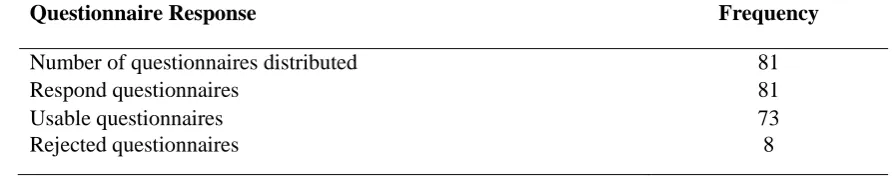
A total of 81 questionnaires size were distributed to staff through by hand to hand. 81 yielded a response rate of 100% were recovered, however, only 73 (79%) responses were accepted and used for the data analysis. The rejected questionnaires are 8 (21%) and were due to the incomplete answers from the participants. Justifying the use of 73 valid responses, the required sample size for this study should be sixty-nine 69, but according to Sekaran (2003), a sample size more than 30 and less than 500 is appropriate and suitable for most research. Meaning that the 73 (90.1%) achieved is acceptable to analysis the data. Table 2 illustrate the sample size and response rate of the data distributed and collected.
Table 2: The Sample Size and Response Rate
Questionnaire Response Frequency
Number of questionnaires distributed 81
Respond questionnaires 81
Usable questionnaires 73
Rejected questionnaires 8
4.2.
Respondents Demographic Profile Results
9
Table 3: Demographic profile Result
Respondent Current Position
Frequency Percent Valid Percent Cumulative
Percent
Valid Academician 56 76.7 76.7 76.7
Administration 17 23.3 23.3 100.0
Total 73 100.0 100.0
Respondent Work Department
Frequency Percent Valid Percent Cumulative
Percent
Valid Operation Management 27 37.0 37.0 37.0
Technology Management 28 38.4 38.4 75.3
Logistics & Transportation 11 15.1 15.1 90.4
Other 7 9.6 9.6 100.0
Total 73 100.0 100.0
Respondent Work Experience
Frequency Percent Valid Percent Cumulative
Percent
Valid 5 Years and above 49 67.1 67.1 67.1
5 Years below 24 32.9 32.9 100.0
Total 73 100.0 100.0
Respondent Race
Frequency Percent Valid Percent Cumulative
Percent
Valid Malaysian 68 93.2 93.2 93.2
Chines 2 2.7 2.7 95.9
Indian 2 2.7 2.7 98.6
Other 1 1.4 1.4 100.0
10
4.3
Reliability Results
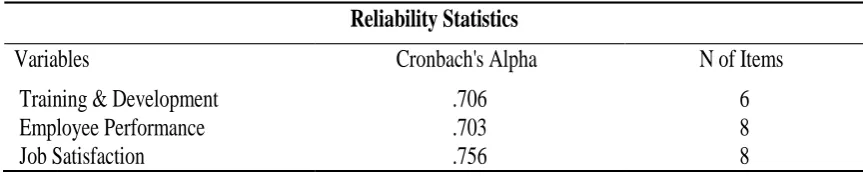
This section presents all results found during the data running with the use of SPSS 20.0 program. The objectives of this research were to identify the influence of training & development and employee performance on the job. Table 4 present the total reliability results on the variables.
Table 4:Reliability Result
Reporting based on table 4, the reliability (α= 0.714) measured by T&D 6 items, (α= 0.709) measured on EP 8 questions and the (α= 0.758) measured on JS of 8 items shows that all variable items measured have maintained internal consistency. These items were accepted based on the Cronbach's alpha .70 is most taken for research study recommendation by Nunnally (1975).
4.1
Correlation Results
This section analysis presents the correlation analysis. Correlation analysis was conducted to inspect the relationship between independent variables and dependent variable. Note that all decision on the statistical significance of the results relies on the alpha level of 0.05. Hypothesis 1 was first analysis and presents in Table 5.
Hypothesis 1: there is a significant relationship between training and development and job satisfaction
Table 5: Correlations Result Correlations
TD JS
T&D Pearson Correlation 1 .652**
Sig. (2-tailed) .000
N 73 73
JS Pearson Correlation .652** 1
Sig. (2-tailed) .000
N 73 73
**. Correlation is significant at the 0.01 level (2-tailed).
Reporting bases on table 5, the Pearson Correlation found (r = 0.652, p< .000) on the relationship between T&D on JS which established that there is a significant relationship between training & development and job satisfaction. The (r= 0.652) result of Pearson correlation shows that the strength of the relationship between T&D and JS is reliable and accepted for this study. This based on Cohen (1988) Correlation range and strength of the relationship between two variables. Table 6 further presents the result found on hypothesis 2.
Hypothesis 2: there is a significant relationship between employee performance and job satisfaction
Reliability Statistics
Variables
Cronbach's Alpha
N of Items
Training & Development
.706
6
Employee Performance
.703
8
11
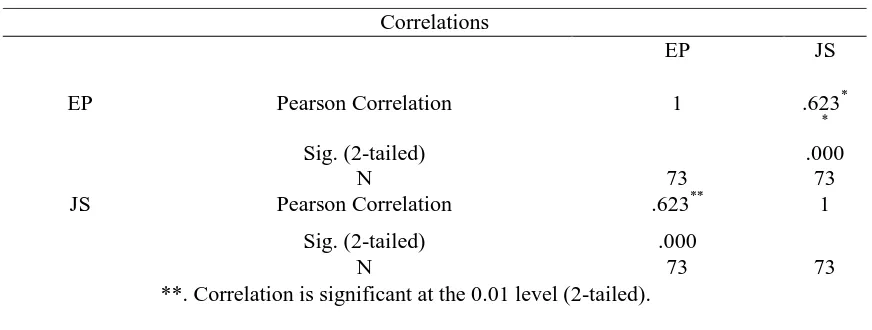
Table 6: Correlations Test Correlations
EP JS
EP Pearson Correlation 1 .623*
*
Sig. (2-tailed) .000
N 73 73
JS Pearson Correlation .623** 1
Sig. (2-tailed) .000
N 73 73
**. Correlation is significant at the 0.01 level (2-tailed).
Reporting bases on table 6, the Pearson Correlation found (r = 0.623, p< .000). On the relationship between EP on JS. This established that there is a significant relationship between training & development and job satisfaction. The (r= 0.623) result of Pearson correlation shows that the strength of the relationship between EP and JS is good and was accepted for this study.
5.0
Discussion
The general objective of this study is to identify the influence of training & development (T&D), employee performance (EP) and job satisfaction (JS) among university staff in STML, UUM. This chapter discusses on the attained significant findings and analysis tested in this study based on the research questions. Hypotheses results. The first research question was, does training & development program influence on the staff of STML UUM job satisfaction? The significant results found on the correlation test shows that the training and development has an important influence on job satisfaction among the staff of STML, UUM. The last research question was, can job satisfaction influence employee of STML, UUM employee performance? The result found on the correlation tests shows that employee performance has a significant impact on job satisfaction among the workers of STML, UUM. Furthermore, the results found established that training and development program, employee performance do have a positive influence on job satisfaction among the staff of STML, UUM and has achieved the objectives of this study.
Examining the relationship between the two variables involved in this study; hypotheses were developed with the aim to affirm that there is a significant relationship between training & development, employee performance, and job satisfaction. The result found on hypothesis 1 indicate that there is a significant relationship between training and development program and job satisfaction. Hypothesis 2 further established that there is a significant relationship between employee performance and job satisfaction. Consequently, this study acknowledges that training and development, employee performance as part of HRM practices are significantly related to employee job satisfaction and will improve organization success. Theoretically, this study tribute to the past studies by Taormina, (1999); Garcia, (2005); Schmidt, (2012); Chaudhary; Bhaskar, (2016); and Almutairi, et al. (2013). Which found that training and development, employee performance as features of HRM practices do have a significant correlation with job satisfaction.
12
other words, it theoretically expands the study conducted by Ibrahim, et al. (2014) on job satisfaction among Malaysian workers, which utilized the Job Satisfaction Survey (JSS). Their study carried out on human resource practices such as pay, promotion, fringe benefits, rewards, supervision, co-workers and nature of work subscales. Which found significant differences in pay, promotion, fringe benefits, rewards, supervision, co-workers and quality of work subscales (Ibrahim, et al., 2014) and Mehrad, et al. (2015) study on differences in job satisfaction on gender among academic staff of Malaysian public universities. Their study also found a significant relationship between supervision as one of the dimensions of job satisfaction. This further research on the influence of training & development, employee performance on job satisfaction.
5.2
Theoretical Contribution
Based on the achieved findings and discussion, some contributions have raised. These contributions are the theoretical and practical contribution. The contributions are significant to the researchers and practitioners of any industries. The theoretical contributions of this study clarify the contradiction of the relationship between training & development, employee performance and job satisfaction among the staff of STML, UUM public sector in Malaysia. Theoretically, it informs that training & development and employee performance do influence on job satisfaction in STML UUM. A previous study by Ibrahim, et al. (2014) and Mehrad, et al. (2015) focuses on pay, promotion, fringe benefits, rewards, supervision, co-workers and nature of work subscales, differences in job satisfaction on gender among academic staff. This study focuses on only training & development and employee performance and job satisfaction. Also, the support of the theories proposed by Herzberg (1964) and Maslow's (1943) assist in finding a positive result. Consequently, these theories are acknowledged significant for staff job satisfaction.
5.3
Practical Contribution
The empirical contribution of this research can assist organizational management to understand the type of human resource practices to concentrate on for staff job satisfaction. Also, the factors of HRP that influence their worker or personal well-being of the working environment. It can support the organization to understand to what extent does the training & development, employee performance uplift and enhance the worker performance and increases the growth of the business for both side benefit. It further contributes in informing the organization that training & development and employee performance are equally significant in overall HRP for the management of any organization accept. Also, it also helps to inform the association management that training & development and employee performance is an active and supportive practice for wellbeing working environment.
5.4
Limitations and Recommendations for Future Study
13
study will continue this as a longitudinal research for more impressive results.
6.0
Conclusion
14
References
Aaker, A., Kumar, V. D., & George, S. (2000). Marketing research. New York: John Wiley and Sons, Inc.
Ahsan, N., Abdullah, Z., Fie, D. G., & Alam, S. S. (2009). A study of job stress on job satisfaction among
university staff in Malaysia: Empirical study. European journal of social sciences, 121-131.
Aina, O. (1992). Personnel Management in Nigeria: a work-centered approach. Ikeja: Edition F
Communications.
Antwi, J. O., Opoku, A. C., Seth, A., & Margaret, O. B. (2016). Assessing the human resource manageme nt practices of public banks from employees ‘perspective: case study of selected branches of Ghana
commercial bank. Journal of Human Resource Management, 4(1),13-30.
Burns, A. C., & Bush, R. F. (2002). Marketing research: Online research applications. New Jersey: (4th ed.)
Prentice Hall.
Budhwar, P. S., & Debrah, Y. A. (2001). Human Resource Management in Developing Countries. London:
Routledge.
Churchill, G. A., & Iacobucci, D. (2004). Marketing research: Methodological foundations. 9th ed. South
Western Ohio: Thomson.
Cohen, J. (1988). Set correlation and contingency tables. Applied Psychological Measurement, 12(4), 425-434.
Creswell, J. W. (2013). Research design: Qualitative, quantitative, and mixed methods approach. Sage
publications.
Chih, W.-H. W., Yang, F.-H., & Chang, C.-K. (2012). The study of the antecedents and outcomes of attitude
toward organizational change. Public Personnel Management, 597–617.
Churchill, G. A., & Iacobucci, D. (2004). Marketing research: Methodological foundations. 9th ed. South
Western Ohio: Thomson.
Collins, E.G.C. & Devanna, M.A. (1992). The Portable MBA. England: Safari Books Limited.
Davoudi, S. M., & Fartash, K. (2012). Integrating human resource management with firm’s strategy: A key
concept to achieve firm’s superior performance. Journal of Economics and Management, 1-20.
Dawal, S. Z. M., & Taha, Z. (2006). The effect of job and environmental factors on job satisfaction in
automotive industries. International Journal of Occupational Safety and Ergonomics, 267–280.
Dessler, G. ( 2007). Human resource management. New Delhi: Prentice Hall of India Private Limited.
Dysvik, A., & Kuvaas, B. (2008). The relationship between perceived training opportunities, work motivation
and employee outcomes. International Journal of Training and Development, 12(3), 138-157.
Edgar, F., & Greare, A. (2005). HRM practice and employee attitudes: Different measures – different results.
Personnel review, 34 (5), 534-549.
Farid, H. T., Yahin, H., & Nahin, H. (2014). HRM practice in commercial banks: A case study of Bangladesh.
IOSR Journal of Business and Management, 16,(2) 29-3.
Garcia, M. (2005). Training and business performance: The Spanish case. International Journal of Human
Resource Management, 1691-1710.
Ghafoor, M. M. (2012). Role of demographic characteristics on job satisfaction. Far East Research Centre,
6(1), 30-45.
Guest, D. (1997). Human resource management and performance: a review and research agenda. International
Journal of Human Resource Management,, 263-276.
Guest, D. E. (1987). Human resource management and industrial relations . Journal of management Studies,
503-521.
Guest, D. (2002). Human resource management, corporate performance, and employee wellbeing: Building the
worker into HRM. The journal of industrial relations, 44(3), 335-358.
Hair, J. F., Babin, B., Money, A. H., & Samouel, P. (2003). Essentials of Business Research Method. : . United
States of America: John Wiley & Sons, Inc.
Herzberg, F. (1964). The motivation-hygiene concept and problems of manpower. Personnel Administration,
27, 3–7.
Huselid, M. A. (1995). The impact of human resource management practices on turnover, productivity, and
corporate financial performance. Academy of management journal, 635-672.
Hair, J. F., Babin, B., Money, A. H., & Samouel, P. (2003). Essentials of Business Research Method. United
States of America: John Wiley & Sons, Inc.
Insaniah, K. U. (26 January 2017). Insaniah. Retrieved from www.insaniah: http://www.insaniah.edu.my/portal/
Isaac, S., & Michael, W. B. (1995). Handbook in research and evaluation. San Diego, CA: Educational and
Industrial Testing Services.
Ibrahim, R. Z. A., Ohtsuka, K., Dagang, M. M., & Bakar, A. A. (2014). Job satisfaction among Malaysian
employees: An application of Spector’s Job Satisfaction Survey in the South East Asian context. Jurnal
15
Iyayi, S. A. (2007). Training and Development of Human Resources in Bello-Imam, Il Bet al (eds),
Fundamentals of Human Resource Management in Nigeria. Ibadan: College Press and Publishers Ltd.
Job Street. ( 8 May 2015 ). More Malaysians Dissatisfied at Work. Retrieved from jobstreet.com.my:
http://www.jobstreet.com.my/career-resources/malaysians-dissatisfied-work/#.WDp-3eZ97ce
Krejcie, R., & Morgan, D. (1970). Determining sample size for research activities. Educational and
Psychological Management, 30, 607-610.
Katou, A. A., & Budhwar, P. S. (2007). The effect of human resource management policies on organizational
performance in Greek manufacturing firms. Thunderbird international business review, 1-35.
Krejcie, R. V, & Morgan, D. W. (1970). Determining sample size for research activities. Journal of Educational
and Psychological Measurement, 607–610.
Liao, C. W., Lu, C. Y., Huang, C. K., & Chiang, T. L. (2012). Work values, work attitude and job performance
of green energy industry employees in Taiwan. African Journal of Business Management, 5299-5318.
Locke, E. A. (1976). The Nature and Causes of Job Satisfaction. In M. D. in Dunnette. Chicago, IL: Rand McNally.
Mahmood, M. H. (2004). The institutional context of human resource management: Case studies of
multinational subsidiaries in Bangladesh. University of Manchester.: UK:
Maslow, A. H. (1943). A theory of human motivation. Psychological Review, 50(4), 370-96.
Masood, T. (2010). Impact of Human Resource Management (HRM) Practices on Organizational Performance:
A Mediating Role of Employee Performance. Jinnah University, Karachi: Doctoral dissertation Mohammad Ali.
Mehrad, A., Redzuan, H. H. M. R. B., & Abdullah, H. (2015). The Role of Personality Factors on Job
Satisfaction among Academic Staff at Public Research University. Journal of Educational, Health and
Community Psychology, 20-28.
Meyer, J. P. & Allen, N. J. (1997). Commitment in the workplace: Theory, research, and application. Thousand
Oaks C.A: Sage Publications.
Mohammad, J., Quoquab Habib, F., & Alias, M. A. (2011). Job satisfaction and organizational citizenship
behavior: An empirical study at a higher learning institution. Journal of Asian Academy of
Management, 149–165.
Mottaz, C. J. (1986). An analysis of the relationship between education and organizational commitment in a
variety of occupational groups. , 28,. Journal of vocational behavior, 214-228.
Meyer, J. P., Allen, N. J., & Allen, N. J. (1997). Commitment in the workplace. Sage Publications.
Nunnally, J. C. (1975). Psychometric Theory: 25 years ago and now. Educational Researcher, 7-14.
Noordin, F., & Jusoff, K. (2009). Levels of job satisfaction amongst Malaysian academic staff. Asian Social
Science, 122.
Orute, R. O., Mutua, S. M., Musiega, D., & Masinde, S. W. (2012). Leadership Style And Employee Job
Satisfaction In Kakamega County, Kenya. International Journal of Management Research & Review,
5(10) 876-895.
Petrescu, A. I., & Simmons, R. (2008). Human resource management practices and workers job satisfaction.
International Journal of Manpower, 651-667.
Pushpakumari, M. D. (2008). The impact of job satisfaction on job performance: An empirical analysis. In City
Forum, Vol. 9, No. 1, pp. 89-105.
Qureshi M.T., Mohammad, R.I., & Syed H.T. (2007). The impact of human resource management practices on
organizational performance in Pakistan. Journal of Business & Policy Research, 3(2), 128-138.
Raymond, M. K., Bawa, A. B., & Dabari, I. J. (2016). Utilization Of Training Fund For Staff Development In
Adamawa State Local Government Service Commission. European Journal of Training and
Development Studies, 3(4), 1-16.
Sekaran, U. (2003). Research methods for business: A skill building approach. India: John Willey & Sons Inc.
Sekaran, U., & Bougie, R. (2010). Research methods for business: Building approach (5th ed.). West Susses,
UK: Wiley.
Saner, T., & Eyüpoğlu, Ş. Z. (2013). The gender marital status job satisfaction relationship of academics.
Procedia-Social and Behavioral Sciences (pp. 106, 2817-2821).
Schmidt, S. W. (2012). The relationship between job training and job satisfaction: A review of the literature.
Vocational Education Technologies and Advances in Adult Learning, 197.
Schouten, R., & Van Der Vleuten, T. (2013). Organizational change and job satisfaction among voluntary and
paid workers in a Dutch voluntary organization. The Netherlands: Radboud University.
Sekaran, U. & Bougie, R. (2010). Research methods for business. A skill building approach. UK: John Willey.
Sekaran, U. (2003). Research methods for business: A skill building approach. India: John Willey & Sons Inc.
Singh, K. (2004). The impact of HR practices on perceived firm performance in India. An Asia-Pacific Journal
16
Smith P, Kendall L, & Hulin C. (1969). The Measurement of Satisfaction in Work and Retirement. Chicago:
Rand McNally.
Spector, P. E. (1985). Job satisfaction survey. Tampa, Florida: University of South Florida.
Truss, C., Gratton, L., Hope‐ Hailey, V., McGovern, P., & Stiles, P. (1997). Soft and hard models of human
resource management: a reappraisal. Journal of Management Studies, 34(1), 53-73.
Tan, T. H., & Waheed, A. (2011). Herzberg’s motivation-hygiene theory and job satisfaction in the Malaysian
retail sector: The mediating effect of the love of money. Journal of Asian Academic of Management,
73–94.
Taormina, R. J. (1999). Predicting employee commitment and satisfaction: The relative effects of socialization
and demographics. International Journal of Human Resource Management, 1060–1076.
Theriou, G. N, & Chatzoglou, P. (2013). The impact of best HRM practices on performance – identifying
enabling factors. Employee Relations, 36(5), 535 561.
Universiti Utara Malaysia. (2015). 3514 Exceptional students register for first semester 2015/2016 academic
session. Retrieved from www.uum.edu.my: http://uum.edu.my/index.php/en/es/other-news/1374-3514-exceptional-students-register-for-first-semester-2015-2016-academic-session
ul Islam, Z., Bangish, S. B., Muhammad, H., Jehan, A. S., Sung, H. Y., Kim, J. J., & Youn, M. K. (2016). The
Impact of HR Practices on Job Satisfaction: A Case Study of Hotel Industry in Pakistan. The Journal of
Asian Finance, Economics, and Business, 3(1).
Velnampy, T. (2008). Job attitude and employee’s performance of public sector organizations in Jaffna district,
Sri Lanka. GITAM Journal of Management, 6(2), 66-73.
Wadhwa, D. S., Verghese, M., & Wadhwa, D. S. (2011). A study on factors influencing employee job
satisfaction: Journal of Management and Business Studies, 109–111.
Yapa, P. M. S. P., Rathnayake, R. M., Senanayake, G., Premakumara, P., & Yapaa, P. M. S. P. (2014). Effect of
demographic factors on job satisfaction of non-academic staff in universities. In Proceedings of the 3rd
International Conference on Management and Economics, (p. p. 27).
Yeganeh, H., & Su, Z. (2008). An Examination of human resource management practices in Iranian public
sector. Personnel Review, 203-221.
Zikmund, W. G. (2000). Business Research Methods (6th edition). New Jersey: John Wiley and Sons.
Korff, J., Biemann, T., & Voelpel, S. C. (2017). Human resource management systems and work
attitudes: The mediating role of future time perspective. Journal of Organizational
Behavior, 38(1), 45-67.
Jiang, K., Lepak, D. P., Hu, J., & Baer, J. C. (2012). How does human resource management influence
organizational outcomes? A meta-analytic investigation of mediating mechanisms. Academy of
Management Journal, 55(6), 1264–1294. doi:10.5465/ amj.2011.0088
Kehoe, R. R., & Wright, P. M. (2013). The impact of high-performance human resource practices on
employees’ attitudes and behaviors. Journal of Management. doi:10.1177/0149206310365901.
Lepak, D. P., Liao, H., Chung, Y., & Harden, E. E. (2006). A conceptual review of human resource
management systems in strategic human resource management research. In J. Martocchio (Ed.), Research in personnel and human resources management. Greenwich, CT: JAI Press
Dermol, V., & Cater, T. (2013). The influence of training and training transfer factors on organizational
learning and performance. Personnel Review, 42(3), 324--348.
Ahmed, Shaheen, Fais Bin Ahmad, and Mohd Hasanur Raihan Joarder. (2016). "HRM Practices-
Engagement-Performance Relationships: A Conceptual Framework for RMG Sector in Developing
Economy." Mediterranean Journal of Social Sciences 7, no. 4: 87.
Tahir, N., Yousafzai, I., Jan, S., & Hashim, M. (2014). The impact of training and development on
employees performance and productivity. A case study of united bank limited Peshawar City, KPK, Pakistan. International Journal Of Academic Research In Business And Social Sciences,4 (4), 86—98. Talwar, E., & Thakur, M. (2016). Training and Development and its Impact on Employee Performance.
We'Ken-International Journal of Basic and Applied Sciences, 1(1), 18-27.
Chaudhary, N. S., & Bhaskar, P. (2016). Training and Development and Job Satisfaction In Education
Sector. Training and Development, 2(8).
Almutairi, D. O., Moradi, E., Idrus, D., Emami, R., & Alanazi, T. R. (2013). Job satisfaction and job
performance: A case study of five-star hotels in Riyadh, Saudi Arabia. 3(1)
Alshery, W. B. R., & Ahmad, F. B. (2016). The Impact of Job Satisfaction, Training, and Leadership on the performance of Employees While Taking Role Ambiguity as a Moderating Variable: Empirical