ABSTRACT
This study explores the association between small to medium enterprise strategic planning, use of accounting information systems and role of accounting advisors in the growth of small to medium enterprises (SMEs). SMEs play a significant role in national economies worldwide. Research on SME growth and influence of management accounting on decision making is evolving. This study examines qualitative and quantitative data collected from 54 SMEs through a series of interviews held in conjunction with consultative programs. Contemporary SME life cycle literature, the use of accounting information and the implications of financial knowledge in the growth of small- to medium-sized businesses are considered. The study concludes with the proposition that central to the growth of SMEs is the embeddedness of knowledge into organisational motor cognition. Keywords: small to medium enterprise, management accounting system, management accounting information, strategic planning, business planning
R
ole ofs
tRategicp
lanning,
a
ccountingi
nfoRmationanDa
DvisoRs in theg
Rowthofs
malltom
eDiume
nteRpRisesM. Christopher Catto Putney Breeze Business Advisors,
Melbourne, Australia
ARTICLE INFO
INTRODUCTION
The growth and development of SMEs play a vital role in the fortunes of national economies worldwide. Small to medium enterprises (SMEs) employ approximately 70% of the Australian workforce (Davidsson, 2012) and account for 59% of the UK workforce (Elster, 2013). The World Bank Group’s World Development Indicators survey of business entry density estimates that high-income countries have up to approximately 3 times more businesses per 1000 individuals than low-income countries. The success of small- to medium-sized businesses exerts a direct effect on the development of the living standards of the entire population. Given the effect of a healthy small- to medium-sized business community on the economies of nations, research on the key factors of success for small businesses can contribute to the underpinning for a resilient economy that can withstand unforeseen economic shocks. The nature of the resource-constrained SME environment, particularly the prioritisation of the SME owner’s time, limits in-depth research on the growth of SMEs. Literature on the growth and success of SME start-ups has evolved from Gibrat’s economic assumptions, Penrose’s theory of knowledge accumulation and Greiner’s (1972) phased models to Osterwalder’s business model canvas. The link between growth and competence of entrepreneurs has also been explored by Ghoshal and Moran (1999). The study examined the use of management accounting information and its relationship with small business growth.
cognition. Management accounting plays a critical role in the process of establishing organisational motor cognition, that is, to determine what critical decision making information is central to business growth and what tacit knowledge is required to act on the information in an appropriate manner. The role of an advisor is to understand the tacit knowledge within the business and complement knowledge gaps with specialised expertise to accelerate organisational motor cognition. Hence, this study aims to address two propositions. The first proposition pertains to whether organisation transferable tacit knowledge is central to growth and viability, whether informal business development and operational indicators derived from ad-hoc management accounting systems complement business tacit knowledge in SME decision making and whether financial accounting information plays a secondary role in SME decision making.Secondly, this study examines whether SME advisors complement knowledge gaps of an entrepreneur with specialised competencies.
LITERATURE REVIEW
or improvements. Ghoshal (1999) observed that ‘the value (to the firm) of a firm’s internal resources, such as its managers, increases with the level of experience in their deployment with other resources inside the firm. Given that this learning process takes time, it effectively limits the rate at which a firm can internalise resources into its organisational structure - the rate of the firm’s growth’.
Many staged-growth models have been developed to represent an organic SME growth model. Greiner (1972) developed the five phases of growth outlined in Evolution and Revolution as an Organization Grows. Welsh and White (1978) refined the model further into the five-stage model of existence, survival, success, take off and resource maturity. Welsh and White eliminated the grow-or-fail hypothesis implicit in Greiner’s (1972) model and the stagnation caused by management. The business model generation methodology outlined by Osterwalder and Pigneur (2010), which is also known as ‘lean start-up’, focuses on hypothesis experimentation through direct customer feedback to create a minimal viable product and on developing the ‘minimum viable product’. Elster and Phipps (2013) outlined the factors of SME growth as three key enablers grouped into clusters. The three clusters are internal capacity and capability, vision of the business owner and external environment.
The skills of business owner–managers and employees within a firm provide the absorptive capacity for businesses to overcome ‘tipping points’. The skills of business leadership exert a direct positive effect on labor productivity, innovation activity and economic growth of the business. Business performance management techniques, such as Amoeba management accounting philosophy, focus on the labor hourly efficiency system and the principle of cash basis accounting (Inamori, 1999). A genuine question to answer is what information, how often and how much is required to manage a business efficiently. Specifically, the role of accounting information in this equation should be determined. Ohno (1988) noted that
Much of the excess information generated by computers is unnecessary for production at all. Receiving information too quickly results in early delivery of raw materials and thus causes waste.
Business advisors and accountants can influence the growth of SMEs via legitimate and expert power through the understanding of compliance frameworks and technical financial knowledge. The source of influence of a consultant stems from informational and expert power (Mole, 2002). Critical to a productive and positive advisory relationship are to reconcile a shared ambition and build empathy in the client–advisor relationship; external advisers need to share ‘contextual compatibility’ for the effective development of knowledge within a firm (Mole, 2002).
The use of accounting information in SME growth can be linked to business planning cycles according to ACCA research (ACCA, 2012). Start-ups prepare financial forecasts and budgets predominately for the purpose of seeking a finance process. However, the preparation of financial statements is often a one-off exercise. ACCA (2012) research suggests that
The effect of external financing on the use of business planning
is negligible after the effects of fast growth are considered. Indeed, among very small businesses, only those with aspirations of substantial growth adopt a consistent approach to business planning.
The first use of management accounting systems (MAS) for management reporting coincides with the recruitment and implementation of the following:
Formal business plans and financially trained staff are therefore
mostly about monitoring employees and aligning their incentives with business objectives, putting internal controls into place and, in the case of newly incorporated businesses, living up to the
obligations of a company to its stakeholders. (ACCA, 2012)
budgets and company growth for early stage companies’ (Davila, 2005). In addition, Davila concluded that the presence of venture capital, the number of employees in the company and the CEO beliefs about the benefits of planning are critical factors in the speed of MAS adoption. The adoption of MAS tends to coincide with the employment of a finance manager.
Barbera and Hasso (2013) explored the relationship among use of external accountants, sales growth of family-run SMEs and use of strategic planning processes. Adopting a resourced-based view (RBV), Barbera found a positive correlation between the embeddedness of external advisors and high strategic planning process within businesses. External advisors are used mainly to fill a knowledge gap in the business. However, the presence of an external advisor does not necessarily improve the survivability of a firm nor lead to sales growth. The success of external advisors depends on the advisors’ ability to obtain tacit knowledge of the business and complement the tacit knowledge with technical knowledge. The nature of advice provided by external advisors depends on the life stage of the business. Young firms require advice on matters pertinent to the survival of the firm, whereas mature firms require advice relating to the improvement of existing sales growth (Barbera, 2013).
the adoption of MAS and financial control advice. Bruhn, Karlan and Schoar (2013) in their experiment on the effect of consulting services on Mexican SMEs concluded that financial control and marketing advice are significant. The consultants filled key gaps in the business owner’s managerial skills and knowledge that would otherwise impose a significant constraint on the firm’s growth.
RESEARCH METHOD
1. Defining the business purpose,
direction and measures of success Workshop 1 and 2 – Reviewing the mission and vision and key performance indicators
2. Maximising staff performance through culture, motivation and organisational structure
Workshops 3 and 4 – Alignment of organisational structure and implementation of a review process incorporating the accountability of organisational culture
3. Understanding financial information and planning with cash flow forecasting
Workshops 5 and 6 – Understanding financial statements, considering cash flow drivers and forecasting cash flow for business planning
The workshops were complemented by a one-on-one consultation series. The initial pre-programme meeting established the current focus of the business owner and highlighted the areas of concern. Each of the three workshop sessions were followed by a two-hour one-on-one meeting. The one-on-one meetings applied the key business concepts to the business owner’s specific circumstances. The outcome of the programme was a high-level business plan that addresses the specific elements to improve profitability highlighted in the workshops and discussed in the one-on-one consultation that followed. A high-level business plan was presented in the final one-on-one consulting session that completed the eight hours of consultation. The additional 11 observations included in the research data were derived from consulting clients who engaged in business strategic reviews involving a comparable process to understand key business facts.
Description of the Sample
A total of 54 SMEs were observed. An SME was defined according to the criteria prescribed by the Australian Bureau of Statistics.
1. Micro businesses are small businesses with 0–4 employees.
2. Small business as an actively trading business with 5–19 employees. 3. Medium business as an actively trading business with 20–
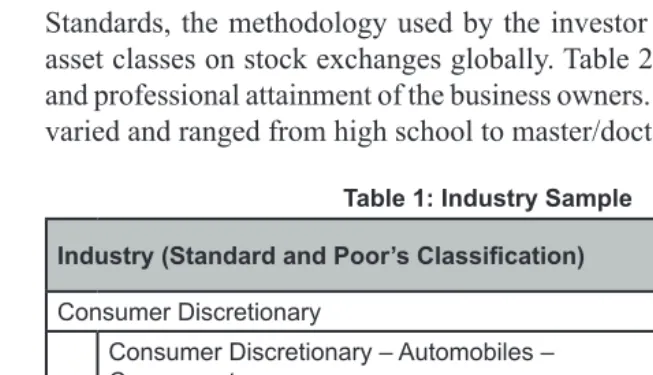
The data presented in this study provide a statistical insight into the use of accounting information and planning practices of SMEs at a point in time in the development of the organisation. Fifty-seven percent of the sample included service businesses. The service sample was divided further and included 7% software, 17% industrial commercial, 2% health and 31% consumer services, including hotels, education and professional services, as shown in Table 1. Twenty-one percent of the sample was involved in retailing or supply of the retail industry. Nine percent of the sample competed in the provision of consumer media. Nine percent sold industrial capital goods, and the remaining 4% operated in financial services. The industry classifications reflect Standard and Poor’s Global Industry Classification Standards, the methodology used by the investor community to classify asset classes on stock exchanges globally. Table 2 shows the educational and professional attainment of the business owners. Educational attainment varied and ranged from high school to master/doctorate.
Table 1: Industry Sample
Industry (Standard and Poor’s Classification) No. %
Consumer Discretionary 30 56%
Consumer Discretionary – Automobiles –
Components 1 2%
Consumer Discretionary – Consumer Services 3 6%
Consumer Discretionary – Consumer Services -
Specialised 8 15%
Consumer Discretionary – Consumer Services –
Education 2 4%
Consumer Discretionary – Consumer Services –
Hotels, Restaurants and Leisure 4 7%
Consumer Discretionary – Media 5 9%
Industry (Standard and Poor’s Classification) No. %
Consumer Staples – Food, Beverage and Tobacco 3 6%
Financial – Real Estate Management 2 4%
Healthcare – Providers Services 1 2%
Industrial – Capital Goods – Machinery 5 9%
Industrial – Commercial and Professional Services 9 17%
Information Technology – Software Services 4 7%
Total 54 100%
Table 2: Educational and Professional Attainment of Business Owners
Turnover BusinessYears in No. of Staff Business Owner Educational Attainment <$250k 15 28% 1<3 20 37% 1<3 16 30% SchoolHigh 5 9%
$250k<
>$1m 13 24% >104< 20 37% >10 224< 41%
Diploma/ Trade
Certificate 20 37% $1m<
>$3m 16 30% 10<>20 6 11% 10<>20 10 19% University Degree 26 48%
$3m<
>$10m 6 11% 20> 8 15% 20> 6 11%
Masters and
Doctorate 3 6%
$10m> 4 7% Total 54 100% Total 54 100% Total 54 100%
Analysis of Research Data: Years in Business and Annual Turnover
Established businesses operating between their 4th and 10th year accounted for an additional 37% of the total sample. The largest sample segment in the 4 to 10 years of operating history category serviced the consumer discretionary industries (65%). The remaining 26% of the businesses surveyed are mature organisations with over 10 years of operating history. Fifty percent of the mature businesses with over 10 years of operational history serviced the industrial commercial or capital goods market.
Table 3: Years in Business and Annual Turnover Years in
Business <$250k $250k<>$1m $1m<>$3m $10m> Total %
1<3 11 5 4 0 20 37%
4<>10 4 7 9 0 20 37%
10<>20 0 1 2 3 6 11%
20> 0 0 1 3 8 15%
15 13 16 6 54
28% 24% 30% 11%
Annual Planning and Annual Turnover
A standard research question is involved the analysis of existing SME planning processes. For the purposes of this research, ‘structured annual planning process’ refers to the systematic process of determining a desired future and translating resource and commitment decisions into broadly defined goals or objectives in a sequence of steps to achieve them. Seventy-two percent of the sample businesses does not have a structured strategic planning process. Among the 28% of businesses that engage in a structured planning process, 93% of those that prepare an annual plan employ administrative staff. Only 1 of the 54 sampled businesses prepares an annual plan and does not employ administrative staff.
planning process. Thirty-one percent of the sample with incomes between $250k and $1m, 38% of businesses with revenues between $1m and $3m and 67% of businesses with incomes between $3 and $10 m engage in annual planning. Exhibiting a reverse trend for structured annual planning are businesses with over $10m turnover. Only 25% of the SMEs surveyed engage in an annual planning process. Notably, the sample size in the category is small with only four businesses surveyed. Nevertheless, three of the four mature and profitable businesses can operate successfully without a structured annual planning process. Table 4 summarises the annual planning and annual turnover.
Table 4: Annual Planning and Annual Turnover Prepare
Annual Plan <$250k $250k<>$1m $1m<>$3m >$10m $10m> Total$3m< % Yes – W
Administration 0 3 6 4 1 14 26%
Yes – No
Administration 0 1 0 0 0 1 2%
No – W
Administration 4 6 10 2 3 25 46%
No – No
Administration 11 3 0 0 0 14 26%
15 13 16 6 4 54
28% 24% 30% 11% 7%
Maintenance of Financial Statements
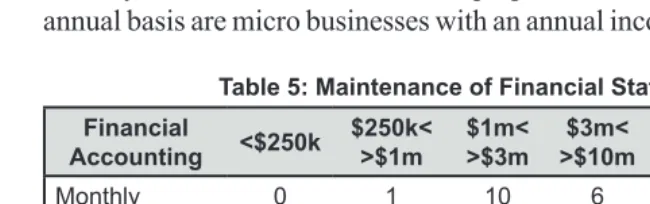
monthly maintenance of financial accounting as the level of income increases and the obligations to meet statutory tax reporting requirements increase. Notably, 57% of the businesses that prepare their financial accounts on an annual basis are micro businesses with an annual income of less than $250k.
Table 5: Maintenance of Financial Statements Financial
Accounting <$250k $250k<>$1m $1m<>$3m >$10m $10m> Total$3m< %
Monthly 0 1 10 6 4 21 39%
3 monthly 2 5 3 0 0 10 19%
Annual 13 7 3 0 0 23 42%
Total 15 13 16 6 4 54
28% 24% 30% 11% 7%
Understanding of Gross Margin and Breakeven Position
Table 6: Understanding of Gross Margin and Breakeven Position Gross
Margin <$250k $250k<>$1m $1m<>$3m >$10m $10m> Total$3m< % Yes – W
Administration 1 4 6 5 1 17 31%
Yes – No
Administration 1 1 0 0 0 2 4%
No – W
Administration 3 5 10 1 3 22 41%
No – No
Administration 10 3 0 0 0 13 24%
Total 15 13 16 6 4 54
28% 24% 30% 11% 7%
Use of Accounting Systems
All businesses with annual turnover of $1m or more and 72% of the sampled businesses use accounting software (Table 7). Approximately 66% of the businesses that do not use accounting software have an annual turnover of $250k or less. Businesses that do not use accounting software prepare their financial accounts on an annual basis. The tax compliance requirements of the businesses that do not use accounting software are prepared on spreadsheets or through other manual calculation methods.
Table 7: Use of Accounting Systems
Accounting <$250k $250k<>$1m $1m<>$3m >$10m $10m>$3m< Total %
Yes 5 8 16 6 4 39 72%
No 10 5 0 0 0 15 28%
Total 15 13 16 16 4 54
RESEARCH LIMITATIONS
Several limitations should be highlighted when interpreting the results of this study. The research examined the position of SMEs at a moment in time in their development process. The study did not evaluate the progress of an entity from the point in time at which the organisation was surveyed. The study observed the planning processes and systems in place but did not make comparisons of the complexity of the product portfolio or service offering of each organisation and the level of difficulty in obtaining meaningful management information. The study also did not assess the work preference styles or management skills and techniques of the entrepreneurs interviewed. The data presented were collected over a three-year period with changing macro–micro economic conditions and changing cost of software available to SMEs. All the businesses sampled are geographically located in Melbourne, Victoria, Australia. Differences in the regulatory environment in particular state regulations, taxes and legislations may affect the results in comparative geographical locations.
CONCLUSION AND DISCUSSION
the main reason accounting systems are used is to satisfy tax compliance record-keeping requirements rather than to present management information for decision making.
Proposition 1
The results from the 54 established SMEs surveyed support proposition 1. The organisation of transferable tacit knowledge in a business enterprise is central to growth and viability. Informal business development and operational indicators derived from ad-hoc management accounting systems complement business tacit knowledge in SME decision making. Financial accounting information plays a secondary role in SME decision making. That is, the organisation and transferability of tacit knowledge play a critical role in the growth, establishment and decision making of SMEs. Formal planning and the use of financial accounting reports in management decision making are absent in the majority of SME environments surveyed. Decision making in the established SMEs surveyed is based on ad-hoc management accounting information combined with intimate understanding of customer needs and operational processes. The embeddedness of tacit business knowledge held in an SME can be described as organisational motor cognition, that is, the embeddedness of mental and social actions within an organization required to fulfil market needs and deliver customer satisfaction. The use of ad-hoc management accounting information acts as a steering mechanism that refines the actions fulfilled by the embedded organisational motor cognition.
Proposition 2
and breakeven position, even though 57% of the surveyed businesses have their financial accounts updated quarterly or even more frequently. The SME management accounting advisor should provide operational insights that complement the entrepreneur’s tactic knowledge and enhance the efficiencies of operational motor cognition held in business processes. The specialised competency that the management accounting professional provides to an entrepreneur is the capability to align operational statistics and key performance indicators with staff accountabilities to facilitate the execution of strategic goals in an efficient manner.
FURTHER RESEARCH
REFERENCES
ACCA Accountant for Business: Driving SME Growth through an evolving finance function, The Association of Chartered Certified Accountants, April 2012. 29 Lincoln’s Inn Fields, London, United Kingdom.
Barbera, F. & Hasso, T. (2013). ‘Do We Need to Use an Accountant? The Sales Growth and Survival Benefits to Family SMEs’. Family Business Review, 26(3) 271–292.
Blank. S. (2013). Why the Lean start up changes everything. Harvard Business Review, 91(5): 63–72.
Bruhn. M., Karlan. K. & Schoar. A. (2013). The Impact of Consulting Services on Small to Medium Enterprises – Evidence from a Randomized Trial in Mexico.
World Bank Policy Research Working Paper No. 6508.
Churchill, N.C., & Lewis, V. L. (1983). The five stages of small business growth.
Harvard Business Review, 61, 30-50.
Daviddson. P, Gordon. S, & Steffens. P. (2012 Early stage start-ups: evidence from Comprehensive Australian Study of Entrepreneurial Emergence (CAUSEE).” Australian Small Business: Key Statistics and Analysis, 4-17.
Davila A. & Foster G. (2005). Management accounting systems adoption decisions: evidence and performance implications from startup companies.
The Accounting Review,80(4), 1039-1068.
Dyer, L. M. & Ross, C. A. (2007) Advising the small business client. International Small Business Journal,25(2), 130-151.
Elster, E., & Phipps, J. (2013). SMEs: The Key Enablers of Business Success and The Economic Rationale for Government Intervention. London: Department for Business Innovation & Skills.
Ghoshal, S., & Moran, P. (1999). Management Competence, Firm Growth and Economic Progress. Contributions to Political Economy, 18, 121-150.
Inamori. K, (1999). Amoeba Management– The Dynamic Management System for Rapid Market Response. London:CRC Press.
McMahon, R. (2006). Staged Models of SME Growth Reconsidered, The Flinders University of South Australia, Research paper series 98-5.
Mole, K. (2002). Business Advisers’ Impact on SMEs: An Agency Theory Approach. International Small Business Journal, 20(2), 139-162.
Ohno. T, (1988). Toyota Production Systems – Beyond Large-Scale Production, Cambridge, Productivity Press.
Osterwalder, A. & Pigneur, Y. (2010). Business Model Generation: A Handbook for Visionaries, Game Changers, and Challengers. Hoboken, New Jersey: John Wiley & Sons.
Parkin,. D. & Bourke, P. (2011). Captain – Coach Leadership – Performance Strategies from Professional Sport, Integro Systems Pty Ltd, Melbourne,
Penrose, E. T, (1959). The Theory of The Growth of The Firm. New York: John Wiley & Sons.
Perényi, Á, Selvarajah, C & Muthaly, S. (2008) ‘The Stage Model of Firm Development: A Conceptualization of SME Growth’ Regional Frontiers of Entrepreneurship Research 2008, Gillin, M, Melbourne, AGSE, Swinburne University of Technology, 23-36.
Santarelli. E., Klomp, L. & Thurik, A. R. (2006). Gibrat’s Law: An overview of the Empirical Literature. In Santarelli (Ed), Entrepreneurship, Growth, and Innovation The Dynamics of Firms New York: Springer, 41-73.
Welsh. J. A. & White, J. F. (1978). Recognizing and Dealing with the Entrepreneur. Advanced Management Journal, 21-31.
15 A cc ou nt in g ERP CRM 1 Co ns um er D is cr et io na ry ‐ A ut om ob ile s $1m <>$3 m 4< >1 0 1<3 N o Ye s A nn ua l N o Ye s N o Ye s 2 Co ns um er D is cr et io na ry ‐ Co ns um er S er vi ce s <$ 25 0K 1< 3 4< >1 0 N o Ye s 3 m on th ly Ye s Ye s N o N o 3 Co ns um er D is cr et io na ry ‐ Co ns um er S er vi ce s <$ 25 0K 1< 3 1< 3 No No A nn ua l No No No No 4 Co ns um er D is cr et io na ry ‐ Co ns um er S er vi ce s <$ 25 0K 1< 3 1< 3 N o N o 3 m on th ly Ye s Ye s N o N o 5 Co ns um er D is cr et io na ry ‐ Co ns um er S er vi ce s $1m <>$3 m 4< >1 0 1<3 N o Ye s A nn ua l N o Ye s N o N o 6 Co ns um er D is cr et io na ry ‐ Co ns um er S er vi ce s $1 m <> $3 m 4< >1 0 20 > Ye s Ye s M on th ly N o Ye s N o N o 7 Co ns um er D is cr et io na ry ‐ Co ns um er S er vi ce s $1 m <> $3 m 4< >1 0 4< >1 0 N o Ye s M on th ly N o Ye s Ye s N o 8 Co ns um er D is cr et io na ry ‐ Co ns um er S er vi ce s $1 m <> $3 m 10 <> 20 4< >1 0 Ye s Ye s M on th ly N o Ye s N o N o 9 Co ns um er D is cr et io na ry ‐ Co ns um er S er vi ce s $2 50 k< >$ 1m 1< 3 4< >1 0 Ye s N o 3 m on th ly Ye s Ye s N o N o 10 Co ns um er D is cr et io na ry ‐ Co ns um er S er vi ce s $2 50 k< >$ 1m 4< >1 0 1< 3 N o N o A nn ua l N o Ye s N o N o 11 Co ns um er D is cr et io na ry ‐ Co ns um er S er vi ce s $2 50 k< >$ 1m 4< >1 0 1< 3 N o Ye s A nn ua l N o N o N o N o 12 Co ns um er D is cr et io na ry ‐ Co ns um er S er vi ce s <$ 25 0K 1< 3 1< 3 No No A nn ua l No No No No 13 Co ns um er D is cr et io na ry ‐ Co ns um er S er vi ce s $2 50 k< >$ 1m 4< >1 0 4< >1 0 N o Ye s A nn ua l N o Ye s N o N o 14 Co ns um er D is cr et io na ry ‐ Co ns um er S er vi ce s <$ 25 0K 4< >1 0 4< >1 0 N o Ye s A nn ua l N o Ye s N o N o 15 Co ns um er D is cr et io na ry ‐ Co ns um er S er vi ce s $1 m <> $3 m 10 <> 20 4< >1 0 Ye s Ye s M on th ly Ye s Ye s Ye s Ye s 16 Co ns um er D is cr et io na ry ‐ Co ns um er S er vi ce s $1m <>$3 m 10 <>20 1<3 N o Ye s M on th ly Ye s Ye s N o N o 17 Co ns um er D is cr et io na ry ‐ Co ns um er S er vi ce s $1 m <> $3 m 10 <> 20 4< >1 0 Ye s Ye s M on th ly Ye s Ye s Ye s Ye s 18 Co ns um er D is cr et io na ry ‐ Co ns um er S er vi ce s $2 50 k< >$ 1m 4< >1 0 4< >1 0 N o N o 3 m on th ly No No No No 19 Co ns um er D is cr et io na ry ‐ M ed ia $2 50 k< >$ 1m 1< 3 4< >1 0 No No An nu al No No No No 20 Co ns um er D is cr et io na ry ‐ M ed ia $3 m <> $1 0m 10 <> 20 20 > Ye s Ye s M on th ly Ye s Ye s N o Ye s 21 Co ns um er D is cr et io na ry ‐ M ed ia <$ 25 0K 1< 3 1< 3 No No A nn ua l No No No No 22 Co ns um er D is cr et io na ry ‐ M ed ia <$ 25 0K 4< >1 0 4< >1 0 N o N o A nn ua l N o N o N o N o 23 Co ns um er D is cr et io na ry ‐ M ed ia <$ 25 0K 1< 3 1< 3 No No A nn ua l No No No No 24 Co ns um er D is cr et io na ry ‐ Re ta ili ng $1 0m > 20 > 20 > N o Ye s M on th ly N o Ye s N o Ye s 25 Co ns um er D is cr et io na ry ‐ Re ta ili ng $1 m <> $3 m 4< >1 0 4< >1 0 Ye s Ye s M on th ly Ye s Ye s Ye s Ye s 26 Co ns um er D is cr et io na ry ‐ Re ta ili ng $2 50 k< >$ 1m 4< >1 0 1< 3 N o Ye s A nn ua l Ye s Ye s N o Ye s 27 Co ns um er D is cr et io na ry ‐ Re ta ili ng $2 50 k< >$ 1m 1< 3 10 <> 20 Ye s Ye s 3 m on th ly No Ye s No No 28 Co ns um er D is cr et io na ry ‐ Re ta ili ng $3 m <> $1 0m 10 <> 20 10 <> 20 N o Ye s M on th ly Ye s Ye s Ye s Ye s 29 Co ns um er D is cr et io na ry ‐ Re ta ili ng <$ 25 0K 1< 3 1< 3 No No A nn ua l Ye s Ye s No No 30 Co ns um er D is cr et io na ry ‐ Re ta ili ng <$ 25 0K 1< 3 4< >1 0 N o Ye s A nn ua l N o N o N o N o 31 Co ns um er S tap le s ‐ Fo od , B ev er ag e an d Ta ba cc o $1 m <> $3 m 10 <> 20 4< >1 0 N o Ye s A nn ua l N o Ye s N o N o 32 Co ns um er S tap le s ‐ Fo od , B ev er ag e an d Ta ba cc o $3 m <> $1 0m 20 > 20 > N o Ye s M on th ly Ye s Ye s N o N o 33 Co ns um er S tap le s ‐ Fo od , B ev er ag e an d Ta ba cc o <$ 25 0K 4< >1 0 1< 3 No No A nn ua l No No No No 34 Fi na nc ia ls ‐ Re al es tat e M an ag em en t $2 50 k< >$ 1m 4< >10 1< 3 N o Ye s A nn ua l Ye s Ye s N o N o 35 Fi na nc ia ls ‐ Re al es tat e Ma na ge m en t $3m <> $10 m 20> 10< >20 Ye s Ye s M on th ly Ye s Ye s N o N o 36 H ea lt h Care ‐ Pr ovi de rs S er vi ce s $2 50 k< >$ 1m 4< >1 0 4< >1 0 Ye s Ye s 3 m on th ly Ye s Ye s N o N o 37 In du st ri al ‐ Cap it al Go od s ‐ Ma ch in er y $1 0m > 10 <> 20 20 > N o Ye s M on th ly N o Ye s Ye s N o 38 In du st ri al ‐ Cap it al Go od s ‐ Ma ch in er y $1 0m > 20 > 20 > N o Ye s M on th ly N o Ye s Ye s N o 39 In du st ri al ‐ Cap it al Go od s ‐ Ma ch in er y $2 50 k< >$ 1m 1< 3 4< >1 0 N o Ye s 3 m on th ly No No No No 40 In du st ri al ‐ Cap it al Go od s ‐ Ma ch in er y $3 m <> $1 0m 10 <> 20 20 > Ye s Ye s M on th ly Ye s Ye s N o Ye s 41 In du st ri al ‐ Cap it al Go od s ‐ Ma ch in er y <$ 25 0K 1< 3 1< 3 No Ye s A nn ua l No Ye s No No 42 In du st ri al ‐ Comm er ci al an d Pr of es si on al S er vi ce s $1 0m > 20 > 20 > Ye s Ye s M on th ly Ye s Ye s Ye s Ye s 43 In du st ri al ‐ Comm er ci al an d Pr of es si on al S er vi ce s $1 m <> $3 m 4< >1 0 4< >1 0 N o Ye s 3 m on th ly No Ye s No No 44 In du st ri al ‐ Comm er ci al an d Pr of es si on al S er vi ce s $1 m <> $3 m 4< >1 0 4< >1 0 N o Ye s M on th ly N o Ye s N o N o 45 In du st ri al ‐ Comm er ci al an d Pr of es si on al S er vi ce s $1m <>$3 m 4< >1 0 1<3 Ye s Ye s M on th ly N o Ye s Ye s N o 46 In du st ri al ‐ Comm er ci al an d Pr of es si on al S er vi ce s $1 m <> $3 m 4< >1 0 10 <> 20 N o Ye s M on th ly Ye s Ye s N o N o 47 In du st ri al ‐ Comm er ci al an d Pr of es si on al S er vi ce s $1 m <> $3 m 4< >1 0 4< >1 0 N o Ye s 3 m on th ly No Ye s No No 48 In du st ri al ‐ Comm er ci al an d Pr of es si on al S er vi ce s $1 m <> $3 m 10 <> 20 10 <> 20 N o Ye s 3 m on th ly No Ye s No No 49 In du st ri al ‐ Comm er ci al an d Pr of es si on al S er vi ce s $3 m <> $1 0m 20 > 10 <> 20 Ye s Ye s M on th ly N o Ye s N o N o 50 In du st ri al ‐ Comm er ci al an d Pr of es si on al S er vi ce s <$ 25 0K 1< 3 1< 3 No No A nn ua l No No No No 51 In fo rm at io n Te ch no lo gy ‐ Sof tw ar e Se rv ic es $2 50 k< >$ 1m 4< >1 0 4< >1 0 N o Ye s A nn ua l Ye s N o N o Ye s 52 In fo rm at io n Te ch no lo gy ‐ Sof tw ar e Se rv ic es $2 50 k< >$ 1m 4< >1 0 1< 3 Ye s Ye s M on th ly N o Ye s N o Ye s 53 In fo rm at io n Te ch no lo gy ‐ Sof tw ar e Se rv ic es <$ 25 0K 1< 3 1< 3 No No A nn ua l No No No No 54 In fo rm at io n Te ch no lo gy ‐ Sof tw ar e Se rv ic es <$ 25 0K 1< 3 1< 3 No No A nn ua l No No No No In du st ry Pr od uc t/ Se rv ic e G ro ss M ar gi n Syst em s A dm in is tr at io n St af f Pr ep ar e A nn ua l P la n Ye ar s in Bu si ne ss # St af f & Sub con tr ac tor s Tu rn ov er Ma in te na nc e of Fi nan ci al St at em en ts APP ENDIX 1 Sample of Comparative Data