Experimental Study On Egg Shell Powder
(Esp) Concrete With Partial Replacement Of
Micro Silica
1
Satya Deepika.S, 2Anil Chandra.B, 3Sailaja Reddy.Y, 4Raj Kumar.C
1
Assistant professor, 2,3,4Student at GPREC
1
Civil Engineering Department,
1
GPREC, Kurnool, India
Abstract — Concrete has become the most commonly used material after water. Recent advancements in building construction are finding the substitute material for cement both from economy point of view and environmental friendly. The goal of this investigation work is to use the egg shell powder (ESP) and silica fume as a limited additional of cement. An experimental research demonstrates the strength features such as split tensile strength, compressive strength and flexural strength test of egg shell based concrete are investigated. ESP is replaced in the different proportions of 5%, 10%, 15% and 20% for cement to determine the optimum percentage of replacement at which maximum strength properties of concrete are attained. Then Silica Fume is replaced in the proportion of 2.5%, 5% and 7.5% for cement, keeping optimum replacement percentage of ESP as constant and strength properties of concrete are determined. The maximum compressive strength of 46.53 MPa or N/mm2 and split tensile strength of 3.39 N/mm2 is obtained with respect to M30 grade concrete when cement replaced by 15% egg shell powder and 5% of silica fume. Whereas Flexural strength decreases with replacement of ESP.
Keywords — Egg shell powder (ESP), Silica fume, Cement, Compressive strength, Split tensile test, Flexural strength test.
I.INTRODUCTION
Industrial and poultry by-products are often used as cement substitutes in concrete production to enhance the freshness and hardening properties of concrete and to protect the environment from the negative effects of its disposal. India produces approximately 1.61 million tons of eggshells per year and ranks fifth in the world. From an egg we can get 5 grams of eggshell powder. Measures are being taken around the world to balance industrial development and environmental prevention with pollution through the reuse of industrial waste. The feasibility of using eggshell powder (ESP), a fine waste from the poultry industry, as a partial replacement for cement in traditional concrete is studied. The use of industrial and agricultural waste from industrial processes has been the focus of waste reduction research for economic, environmental and technical
reasons. ESP is one of the main by-products and can be used as a mineral.
We realize that cement production has caused great damage to the environment. It involves large amounts of carbon emissions associated with other chemicals. Studies have shown that half a ton of carbon dioxide can be released per ton of cement produced, so there is an urgent need to control the use of cement.
On the hand materials wastes such as ESP is difficult to dispose which in return is environmental Hazard. ESP gives concrete higher early strength and reduces concrete permeability. The calcium present in ESP replaces the proportion of lime, so we can save natural lime mainly used in cement production. Therefore, the use of ESP in concrete can not only reduce environmental pollution, but also improve the performance of concrete, reduce costs and also makes the concrete more durable. The project mainly involves replacing cement with a fixed proportion of eggshell powder.
Silicon fume also known as micro silica, is an ultrafine powder that is a by-product of the production of silicon and ferrosilicon. Silica is a pozzolanic material. Volcanic ash materials are usually combined with hydrated calcium hydroxide, starting with hydrated calcium silicate, which is the main cause of the benefits of hydrated cement slurry. The addition of silica fume to the concrete results in a decrease in porosity. Therefore, silica fume and eggshell powder in cement improve the strength and durability of traditional concrete cubes.
II. EXPERIMENTAL INVESTIGATION
A. Materials Used
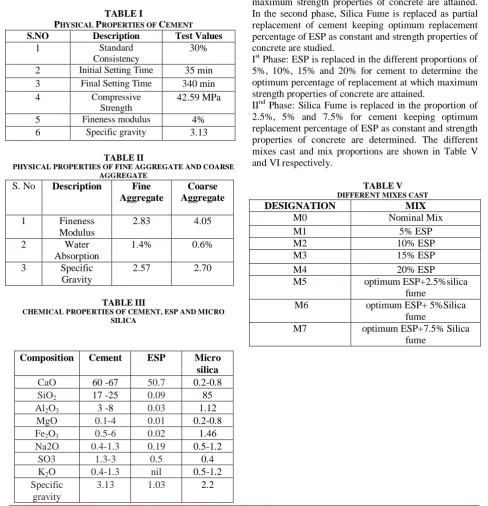
physical properties of cement, coarse aggregate and fine aggregate are shown in Tables I and II.
Eggshells from Namakkal in Tamil Nadu are considered to be India's egg export centers, accounting for more than 90% of India's total egg exports. The average weight of an eggshell is found to be 7.2 to 7.8 grams. Eggshells are thoroughly cleaned to remove organic matter and dried it in the sun for 5 to 7 days to achieve an average particle size of 45 μm.
Silica is a pozzolanic material. Volcanic ash materials are generally capable of combining with hydrated calcium hydroxide to initiate hydration of calcium silicate, which is a major cause of the benefits of hydrated cement slurries. The addition of silica fume to the concrete results in a decrease in porosity. Therefore, silica fume and eggshell powder in cement improve the strength and durability of traditional concrete cubes. The chemical properties of cement, ESP and micro silica are shown in Table III.
TABLE I
PHYSICAL PROPERTIES OF CEMENT
S.NO Description Test Values
1 Standard Consistency
30%
2 Initial Setting Time 35 min 3 Final Setting Time 340 min 4 Compressive
Strength
42.59 MPa
5 Fineness modulus 4% 6 Specific gravity 3.13
TABLE II
PHYSICAL PROPERTIES OF FINE AGGREGATE AND COARSE AGGREGATE
S. No Description Fine Aggregate
Coarse Aggregate
1 Fineness Modulus
2.83 4.05
2 Water
Absorption
1.4% 0.6%
3 Specific Gravity
2.57 2.70
TABLE III
CHEMICAL PROPERTIES OF CEMENT, ESP AND MICRO SILICA
Composition Cement ESP Micro
silica CaO 60 -67 50.7 0.2-0.8
SiO2 17 -25 0.09 85
Al2O3 3 -8 0.03 1.12
B. Mix Proportioning
Experimental investigation has been carried out with reference mix of M30 grade concrete which was designed using IS: 10262-2009. The adopted mix proportion is shown in Table IV.
TABLE IV
ADOPTED MIX PROPORTION
Cement Fine Aggregate
Coarse Aggregate
Water
411 (Kg/m3)
637 (Kg/m3)
1110 (Kg/m3)
193 (Litres)
1
1.55
2.7
0.47
C. Experimental Work
Present work is carried out in two phases. In the first phase, ESP as partial replacement of cement is done to find the optimum percentage of replacement at which maximum strength properties of concrete are attained. In the second phase, Silica Fume is replaced as partial replacement of cement keeping optimum replacement percentage of ESP as constant and strength properties of concrete are studied.
Ist Phase: ESP is replaced in the different proportions of 5%, 10%, 15% and 20% for cement to determine the optimum percentage of replacement at which maximum strength properties of concrete are attained.
IInd Phase: Silica Fume is replaced in the proportion of 2.5%, 5% and 7.5% for cement keeping optimum replacement percentage of ESP as constant and strength properties of concrete are determined. The different mixes cast and mix proportions are shown in Table V and VI respectively.
TABLE V DIFFERENT MIXES CAST
DESIGNATION MIX
M0 Nominal Mix
M1 5% ESP
M2 10% ESP
M3 15% ESP
M4 20% ESP
M5 optimum ESP+2.5%silica fume
M6 optimum ESP+ 5%Silica fume
TABLE VI
MIX PROPORTIONS
III. RESULTS AND DISCUSSION
Compressive strength, Split Tensile strength and Flexural Strength of various concrete mixes using ESP and Silica fume are discussed. Results are analysed and compared with the compressive strength, split tensile strength and flexural Strength of nominal mix.
A. Compressive Strength of Concrete
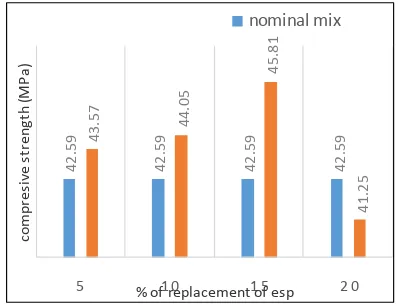
The compressive strength of reference mix (M0) and all other mixes cast (28 days) using Egg shell powder and silica fume are shown in Table VII. It is observed that compressive strength increased up to 15% replacement of cement with Egg shell powder. The maximum compressive strength 45.81 N/mm2 was obtained with mix (M3) 15% Egg shell powder which was 7.56% more compared to nominal mix. Variation of compressive strength of M30 grade concrete with different percentage replacement of cement by Egg shell powder is as shown in below graphs (Figure 1).
Compressive strength of M30 grade are studied with combination of 15% Egg shell powder plus 2.5%, 5% and 7.5% silica fume replaced with cement. Mix with M30 grade with 15% Egg shell powder and 5% micro silica obtained maximum strength among all silica fume replacements. It was observed that silica fume percentage in concrete increased, its compressive strength increased up to 5% and then decreased. The maximum compressive strength is obtained at 15% Egg shell powder and 5% silica fume mix (M6) obtained a compressive strength of 46.53 N/mm2 which is 9.25 % more than the reference mix (M0). Variation of compressive strength of concrete with 15% Egg shell powder and different percentages of silica fume is as shown in below graphs (Figure 2).
TABLE VII
STRENGTH PROPERTIES OF CONCRETE
S
il
ic
a
fum
e
%
0 0 0 0 0 2.5 5 7.5
E
S
P
(kg) 0
20.
55
41.
1
61.
65
82.
2
61.
65
61.
65
61.
65
E
S
P
%
0 5 10 15 20 15 15 15
W
at
e
r(
K
g/
m
3 )
193 193 193 193 193 193 193 193
C
A
10m
m
(
K
g
/
m
3 )
444 444 444 444 444 444 444 444
C
A
2
0m
m
(
K
g/
m
3 )
666 666 666 666 666 666 666 666
S
a
nd
(
K
g/
m
3
)
637 637 637 637 637 637 637 637
Ce
m
e
n
t
(K
g/
m
3 )
411
390.
45
369.
9
349.
35
328.
8
339.
1
328.
8
318.
52
IN
G
R
ED
I
EN
TS
M0 M1 M2 M3 M4 M5 M6 M7
Mi x
Compressive
Strength MPa
Split Tensile Strength
MPa
Flexural Strength MPa
M0 42.59 2.646 5.85
M1 43.57 2.72 5.60
M2 44.05 3.01 5.23
M3 45.81 3.42 4.90
M4 41.25 3.25 4.81
M5 45.97 3.31 5.12
M6 46.53 3.39 5.08
Fig. 1 Comparision between compressive strength of nominal mix and egg shell powdered concrete after 28days
Fig.2 Variation of compressive strength of concrete with 15% ESP + varying (2.5, 5 and 7.5) % of Silica Fume
B. Split Tensile Strength of Concrete
The split tensile strength of reference mix (M0) and all other mixes cast (28 days) using Egg shell powder and silica fume are shown in above Table VII.
Fig. 3 Variation of split tensile strength of nominal mix
shell replacement which was 29.25% more compared to nominal mix. Variation of split tensile strength of M30 grade with different percentage replacement of cement by ESP is as shown in below graph (Figure 3). Split tensile strength of M30 grade are studied with combination of 15% ESP plus 2.5%, 5% and 7.5% silica fume replaced with cement. Mix with M30 grade with 15% ESP replacement and 5% silica fume obtained maximum strength among all silica fume replacements. It was observed that as silica fume percentage in concrete increased, its split tensile strength increased up to 5% and then decreased. The maximum split tensile strength was obtained at 15% ESP and 5% silica fume (M6) obtained a split tensile strength of 3.39 MPa or N/mm2 which was 28.11% more than the nominal mix (M0). Variation of split tensile strength of concrete with 15% ESP and different percentages of Silica fume is as shown in graph (Figure 4). Variation of split tensile strength of different mixes is shown in Figure 5.
Fig. 4 Variation of split tensile strength of nominal mix and 15%ESP+ varying % of silica fume concrete after 28
days
Fig. 5 Variation of split tensile strength of different mixes 2 .6 4 6 2 .6 4 6 2 .6 4 6 2 .6 4 6 2 .7
2 3.01 3
.4
2
3
.2
5
5 1 0 1 5 2 0
s p li t te n s il e S tr e n g th (M p a )
% Of replacement of cement with ESP
Split tensile strength after replacement of ESP
nominal mix 28 days
2 .6 4 6 2 .6 4 6 2 .6 4 6 3 .3 1 3 .3 9 3 .3 6
M 5 M 6 M 7
s p li t ten s il e s tr en th (M p a )
Split tensile strength after replacement of ESP and silica fume
nominal mix 28 days
2.646 2.72 3.01 3.42 3.25 3.31 3.39 3.36 2 2.2 2.4 2.6 2.8 3 3.2 3.4 3.6
M0 M1 M2 M3 M4 M5 M6 M7
4 2 .5 9 4 2 .5 9 4 2 .5 9 4 2 .5 9 4 3 .5 7 4 4 .0 5 4 5 .8 1 4 1 .2 5
5 1 0 1 5 2 0
co m p re si ve s tr e n g th (M P a )
% of replacement of esp nominal mix 45 .9 7 46 .5 3 43 .7 9 42 .5 9 42 .5 9 42 .5 9
2 . 5 5 7 . 5
Co m pr es si ve s tr en gth ( M pa )
% Of replacemnt of silica fume
C. Flexural Strength of Concrete
The flexural strength of reference mix (M0) and all other mixes cast using egg shell powder and silica fume are shown in above Table VII.
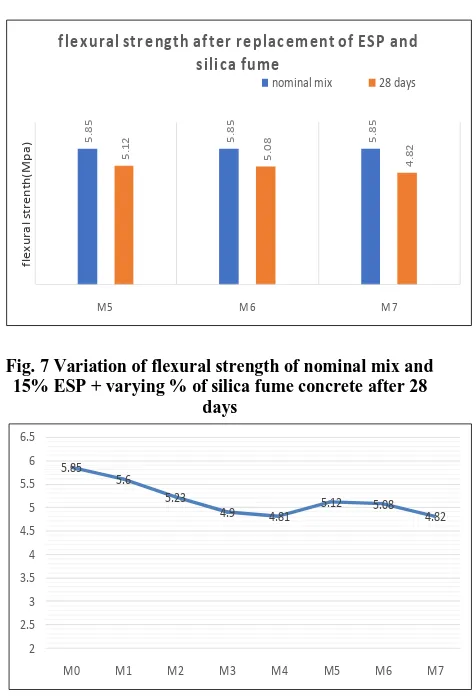
It is observed that the decrease in flexural strength is observed with replacement of cement by egg shell powder. The maximum flexural strength 5.85 N/mm2was obtained with mix (M0), hence with the replacement of cement with egg shell powder there is a decrease in the flexural strength of concrete. Hence this
replacement is not useful where flexural strength of concrete is significant. Flexural strength of M30 grade are studied with combination of 15% egg shell powder and 2.5%, 5% and 7.5% silica fume
replaced with cement. Flexural strength variation with replacement silica fume and egg shell powder is shown in below graphs (Figure 6 and 7). Variation of flexural strength of different mixes is shown in Figure 8.
Fig. 6 Variation of flexural strength of nominal mix and egg shell powder concrete after 28 days
Fig. 7 Variation of flexural strength of nominal mix and 15% ESP + varying % of silica fume concrete after 28
days
IV. CONCLUSIONS
Based on above study, the following observations are made regarding the strength properties of concrete on partial replacement of cement by egg shell powder and silica fume.
1. As increase in the percentage of egg shell powder there is considerable decrease in the sworkability.
2. The maximum compressive strength of 45.81 N/mm2 was obtained with respect to M30 grade concrete when 15% cement replaced by egg shell powder (M3). Maximum compressive strength obtained for mix (M3) was 7.56% more compared with reference mix M0 (42.59 N/mm2).
3. The maximum compressive strength of 46.53 N/mm2 was obtained with respect to M30 grade concrete when cement replaced by 15% egg shell powder and 5% of silica fume (M6) . Maximum compressive strength obtained for mix (M6) was 9.25% more compared with reference mix M0 (42.59 N/mm2).
4. The maximum split tensile strength of 3.42 N/mm2 was obtained with respect to M30 grade concrete when 15% cement replaced by egg shell powder (M3). Maximum split tensile strength obtained for mix (M3) was 29.25% more compared with reference mix M0 (2.646N/mm2).
5. The maximum split tensile strength of 3.39 N/mm2 was obtained with respect to M30 grade concrete when cement replaced by 15% egg shell powder and 5% silica fume. Maximum split tensile strength obtained for mix (M6) was 28.11 % more compared with reference mix M0 (2.646 N/mm2).
6. For M30 grade concrete the replacement of egg shell powder leads to decrease in flexural strength with increase in percentage of egg shell powder.
Fig. 8 Variation of flexural strength of different mixes
7. Similarly with 15% egg shell powder (optimum) plus various proportions of silica fume also leads to decrease in the flexural Strength of concrete.
8. Based on experimental results, it is observed that there is significance improvement in the compressive strength and split tensile strength of concrete with the replacement of egg shell powder and silica fume, decrease in the flexural strength of concrete.
5
.8
5
5
.8
5
5
.8
5
5
.1
2
5
.0
8
4
.8
2
M 5 M 6 M 7
fl
ex
u
ra
l
st
ren
th
(M
p
a
)
flexural str ength after r eplacement of ESP and silica fume
nominal mix 28 days
5
.8
5
5
.8
5
5
.8
5
5
.8
5
5
.6
5
.2
3
4
.9
4
.8
1
5 1 0 1 5 2 0
fl
ex
u
ra
l
st
ren
g
th
(M
p
a
)
% Of replacement of cement with ESP
flexr ual str ength after r eplacement of ESP
nominal mix 28 days
5.85 5.6
5.23
4.9 4.81 5.12 5.08 4.82
2 2.5 3 3.5 4 4.5 5 5.5 6 6.5
REFERENCES
[1] Anand Parkash, A., & Yadav, P. K. A Review Study of Egg Shell Powder as a Cement replacing material in Concrete.
[2] Doh, S. I., Chin, S. C., & Suil, A. (2014, October). Eggshell powder: potential filler in concrete. In Malaysia University Conference Engineering Technology.
[3] Gowsika, D., Sarankokila, S., & Sargunan, K. (2014). Experimental investigation of egg shell powder as
partial replacement with cement in
concrete. International Journal of Engineering Trends and Technology, 14(2), 65-68.
[4] Ing, D. S., & Choo, C. S. (2014, November). Eggshell Powder: Potential Filler in Concrete. In Malaysian Technical Universities Conference on Engineering and Technology.
[5] Jayasankar, R., Mahindran, N., & Ilangovan, R. (2010). Studies on concrete using fly ash, rice husk ash and egg shell powder. International Journal of Civil and Structural Engineering, 1(3), 362.
[6] Kumar, P., Vijaya, R. S., & Jose, R. B. (2016). Experimental study on partial replacement of cement with egg shell powder. International Journal of Advances in Engineering Technology Management and Research, 1(7).
[7] Parthasarathi, N., Prakash, M., & Satyanarayanan, K. S. (2017). Experimental Study on Partial Replacement of Cement with Egg Shell Powder and Silica Fume. Rasayan Journal of Chemistry, 10(2), 442-449. [8] Shuhadah, S., & Supri, A. G. (2009). LDPE-Isophthalic
Acid Modified Egg Shell Powder Composites (LDPE/ESPI). Journal of Physical Science, 20(1), 87-98.