e-ISSN: 2278-067X, p-ISSN: 2278-800X, www.ijerd.com
Volume 12, Issue
6
(
June
2016), PP. 33-40
Development Of Test Method For Evaluating Soot Dispersancy
Of Diesel Engine Lubricants
G.K. Acharya
1, K.A. Subramanian
2, R.K. Malhotra
3 1,2Indian Oil Corporation Ltd, Faridabad2Indian Institute of Technology Delhi, New Delhi 3
Petroleum Federation of India, New Delhi
Abstract:-
Diesel engine is the preferred prime mover for transport sector because of its higher thermal efficiency and the resultant increased fuel economy and lower CO2 emissions. But on the flip side, a diesel engine emits higher level of Particulate Matter (Pm) and Oxides of nitrogen (NOx ). For reducing the NOx emissions, an Exhaust gas recirculation (EGR) is used, but this in turn increases the particulate matter emissions. During the course of engine operation, the lubricating oil undergoes ingress of some amount of particulate matter / soot through the blow by gases and with engine oil. For addressing this problem, reserve alkalinity, dispersancy, detergency etc. have been incorporated in the engine oil formulation thereby soot remaining dispersed in the engine oil, and the component surfaces are kept clean.In this crankcase engine oil, soot particulates agglomerate, get sheared during the normal operation of engine and amalgamate with the disintegrated lubricant additives & wear metals. These processes results in change in the structure the soot particulates in the engine oil. Engine oil soot particulates tend to increase the viscosity and also affect the tribological / frictional properties of the oil. MackT-7 to T-12 test engines generally used for soot dispersancy are of higher capacity and operation & maintenance of these test beds are cost intensive. Therefore it is imperative to develop a comprehensive test method for evaluation of soot dispersancy characteristics of engine oils. For this developmental work, a diesel engine conforming to Euro-II emission norms with mechanical / distributor type fuel injection pump was selected. Further, certain engine operating parameters such as injection timing throttling of intake and reduced injector pressure were modified. These increased severity of the engine operating conditions resulted in soot loading of 5-6% in engine oil with 250 hours of operation. During the study total 6 samples of engine oils with different viscometrics were evaluated and used oil samples drawn at every 25 hours for continuously assessing the impact of soot on kinematic viscosity, TBN and wear metals during the test.
Keywords:- Lubricants, Soot, Diesel engine, Wear metals , Engine test method development
I.
INTRODUCTION
Diesel engine lubricating oils are formulated by blending various additives in base oil to meet diverse conditions during the engine operation. Chemically inert additives are intended for improving the physical properties such as pour point, viscosity, emulsification etc. Some of the additives are chemically active and interact with metal surfaces to form protective films for reducing the friction and wear. These additives include dispersants, detergents, anti-wear and extreme pressure. Dispersants are typically the highest treat additive in an engine oil formulation and have a polar head group with an oil soluble hydrocarbon tail. Dispersants are used to disperse the contaminants like sludge and soot (1). The higher level of soot generation takes place in heavy duty diesel engines when the engine is operated under very high loads, fuel injection is retarded and EGR is used. Dispersants play major role in keeping the engine clean and is an important component in engine oil formulation.
In modern engine oil formulation, dispersants range from 3-6% by weight which account for about 50% of total oil additives in lubricant. The dispersant prevents the agglomeration of the soot into large macrostructure. The impact of soot on wear mechanism is complex and need to conduct certain fundamental work to understand the same. Several research papers reveal that the soot induced wear mechanism may be due to preferential adsorption of the anti-wear additive, decreasing the anti-wear film formation on metal surface, competition of soot with anti-wear for the active site, weakening of / removal of film by abrasion and pump-ability problem due to oil thickening (2) .
The soot handling performance of diesel engine oil is measured by increasing viscosity of the oil by conducting test on an engine equipped with turbo-charger, intercooler, cooled EGR and electronic controlled fuel injection. Changes in the engine design parameters have an impact on the engine oil soot. The reactivity of carbonaceous samples of diesel engine soot was evaluated using thermo-gravimetric / temperature programmed oxidation. The high rate of oxidation of Euro IV soot is reported which is due to the defective graphenes that are more reactive than those of Black Smoke soot. The fullerene likes soot is easier to oxidize then well graphitized samples (3).
In a study, tests were conducted at 1416, 1539 and 1750 bar injection pressures. In all three cases chain-like agglomerates composed of primary soot particles are found. The chain length and the size of the agglomerates decrease with increasing injection pressure due to less number of primary soot particles within the agglomerates (4). The soot oxidation was reduced at increased EGR rate because both oxygen availability and temperature were lowered in the combustion chamber. Larger primary soot particle diameters and higher number concentration of particles were observed at higher EGR rates (5). Severe oil thickening in heavy duty diesel engines is linked to soot agglomeration in the engine oil. The engine operating conditions can affect the soot produced by diesel engine (6).
A rapid change from idle or low load to high load and high speed (quick acceleration at low gears) causes a large amount of soot to be produced. It is observed that at higher engine loads, the combustion chamber temperature and the amount of injected fuel are also higher, while the air/fuel ratio is on the lower side (7). These conditions increase the initial soot formation and also accelerate the agglomeration process.
Diesel soot was extracted from used oil by dilution with hexanes followed by centrifuging and soxhlet extraction analysis of the soot revealed that primary particulate size of diesel soot is 20-30 nm and has larger agglomerates with components of lubricants, carbon and oxygen (8). The dimensions of average primary particles gradually decreased as injection pressure increased at all operating engine conditions (9). Carbon and some elemental traces were detected in diesel soot aggregate having diameter 2-5 µm in the vehicle exhaust. The relative carbon composition reached 63.4% in the dynamometer testing because of several trace metals which got embedded in the soot (10).
Soot related lubricant oil thickening is a primary concern for heavy-duty diesel engines. Engines which produce a relatively low level of particulate matter in exhaust emissions show a significant low level of soot contamination in the lubricant. The soot contaminates the lubricant and changes the chemical properties resulting in the lubricant losing its functional properties. This causes an increase in viscosity of the engine oil causing pumpability problems. The dispersant level and soot level influenced the viscosity of the oil samples at two different temperatures (11).
Statistically designed experiments were developed to study the effect of soot contamination on engine oil viscosity. The oil samples used for the study differed in the base stock, dispersant level and Zinc Dithiophosphate (ZDP) level. The results showed that viscosity of the oil samples increased with increase in soot. The statistical analysis at 40°C and 90°C indicate that the effect of base stock and ZDP levels were negligible at 40°C whereas the dispersant level and soot level influenced the viscosity of the oil samples at both temperatures (12).
Engine oil soot affects the film forming tendency of the oil and it is reported that low speed and high load engine operations that occur during start-up, shutdown, and high torque conditions can cause starvation the contact zone of the lubricant. This results in breakdown of the full oil film permitting contact between soot particles and the engine surfaces (13).
Studies conducted on two different engines (Mack EM6–285 and GM 6.2L) to determine what portion of lubricant viscosity growth was related to bulk oil oxidation versus soot contamination (14) (15). Post experimentation it was concluded that oil thickening was not caused by oxidation, but was caused by the amount of soot present and/or soot particle agglomeration. Engine oil viscosity is affected by soot content and level of oxidation and soot content has major effect on wear of engine components (16).
It was found that the mass weighted median diameter of soot particles in the lubricating oil varies from 0.12 to 0.27 μm and is largely dependent on the type of the engines (2). EGR may be an effective means for reducing NOx emissions from diesel engines but it accelerates the degradation of engine oils in terms of increased soot particulates loading (17).
Some of the studies indicate that oil with low dispersant and high anti-wear performed better than the oil with high dispersant and low anti-wear level at high soot level. It may be due to the fact that high dispersant level may induce oil thickening with soot contamination and result in increased wear (18).
6.0 % and also evaluation of soot dispersancy characteristics of engine oils using commercially available diesel engines.
II.
EXPERIMENTAL SETUP
For enhancing the soot loading in the diesel engine oil, simulating the typical operating condition prevailing in India such as overloading lugging and highway operation, diesel engine conforming to Euro-II emission norms with mechanical / distributor type fuel injection pump was selected. Additionally certain engine operating parameters such as injection timing throttling of intake and reduced injector pressure were modified. This increased severity of the engine operating conditions resulted in soot loading of 5-6% in engine oil within 250 hours of operation. The specification of test engine is given in Table-1.
Table I. Technical specification of the test engine
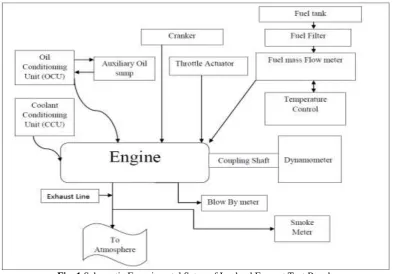
The control and data acquisition system allows continuous and precise monitoring of engine variables, like speed, power, lubricating oil temperature, cooling water temperatures, air flow, fuel flow etc. The test bed is equipped with Oil Conditioning Unit (OCU) and Coolant Conditioning Unit (CCU) to maintain crankcase oil and coolant as per test condition requirement. An intercooler downstream of the turbo charger is provided to maintain inlet air temperature to the engine. Blow-by data is recorded hourly in order to monitor the clearances of piston liner assembly. Instantaneous fuel flow rate is measured by fuel mass flow meter based on coriolis principle. A smoke meter installed downstream of the exhaust manifold so as to take representative sample of the average soot from all cylinders. The soot content in the exhaust flow is measured in terms of Filter Smoke Number (FSN). The engine is installed on the test bed coupled with steady state eddy current dynamometer as shown in Figure-1.
Fig. 1 Schematic Experimental Setup of Leyland Ecomet Test Bench
Engine Diesel 4 stroke, In-line overhead valve,
4 cylinder, turbocharged
Peak Torque 40kgm@1500-1600rpm
Displacement 3.839 litre
Rated Power 88.25 kW@2500rpm
Bore & Stroke 104 mm & 113 mm
Compression ratio 17.5:1
Fuel injection equipment Distributor type with manifold compensator and cold start injection advance
III.
TEST METHOD DEVELOPMENT
Tests were conducted on engine test bed for 150 hours using commercial grade engine oils. During this test it was observed that there is no significant change in properties of engine oil, particularly soot formation at the end of 150 hour test. Hence, it is proposed to modify the engine operating conditions such as intake air, fuel delivery and coolant & oil temperatures for maximum soot generation.
A. Air Intake System
In order to enhance the combustion process with fuel rich mixture (for increasing soot levels) air flow restriction was introduced by an additional throttle / butterfly valve post the intercooler. Trial runs were conducted with various throttle positions in order to ascertain the optimum throttle position for maximum soot generation. Further, it was observed that the diaphragm valve of the fuel injection pump received feedback from the inlet manifold and therefore any air throttling resulted in a corresponding decrease of fuel flow rate. For countering this effect the feedback line from the inlet manifold was disengaged and an auxiliary air supply system was designed to actuate the diagram valve.
The pressure of auxiliary air supply system could be regulated which correspondingly affected the opening and closing of the diaphragm valve of the fuel pump. An iterative procedure of varying the air and fuel flow simultaneously was followed after which it was decided to set the butterfly valve at 30 % opening for achieving the required soot level.
B. Fuel delivery system
The test engine is having a distributor type fuel-injection pump with mechanical governor. Incomplete combustion with rich mixture was achieved through altered fuel delivery as well as fuel injection timing for enhancing soot growth. For the present study maximum fuel delivery was set using the adjusting screw.
The injection timing was retarded to the maximum possible value by adjusting the FIP plunger and plunger lift. In order to further deteriorate the combustion process through prior atomization of fuel, the injection pressure was reduced by increasing the travel of injector needle. This modification was later retracted as no visible increase in soot was observed during trial runs.
C. Oil conditioning unit
To increase the test severity, it is desirable not to top up any fresh oil while the test is in progress. In the existing OCU configuration, it is necessary to perform regular oil top-ups in order to prevent oil starvation. Therefore, oil sump system and lines were modified by incorporating an auxiliary oil reservoir which was connected to engine for maintaining a constant level in the oil sump. The Piping and Instrumentation diagram of the OCU is shown in Figure-2. Also the oil level within the engine sump was maintained at bare minimum level of 3.5 litres which helps in increasing the severity and at the same time ensures no oil starvation within the engine.
D. Optimization of test severity
The test severity was increased by changing the engine design parameters and also operating conditions in order to generate 2 & 6% of soot level at the end of 150 & 250 hrs respectively. A total of 17 liters of test oil is charged once at the start of each test which suffices the requirement of engine sump, auxiliary oil reservoir, and the suction pump of OCU. The finalized test conditions for generating 2/6% soot on this test bench are shown in Table 2.
Table 2. Test Conditions for generating 2-6 % soot level
Analysis of Used Oil Samples
Oil samples were drawn at the end of every 25 hrs and soot content in oil was determined through Thermo-gravimetric Analysis (TGA). This technique provides the most accurate estimate of the concentration of soot as a percent by weight. The test involves progressively heating the sample in a nitrogen-rich atmosphere over time to vaporize volatile fractions until the weight of the sample levels off, typically occurring at around 600º C. Then, the nitrogen environment is replaced by air and the temperature is further raised allowing the oil to oxidize until the weight again stabilizes. Soot concentration is then calculated by subtracting the weight of the volatile ash components from the weight of the original sample. Kinematic viscosity @ 100 °C was determined through ASTM D 445 test procedure. ICAP (Inductively Coupled Argon Plasma) equipment is used to analyse the wear metals in used oil.
Test Oils
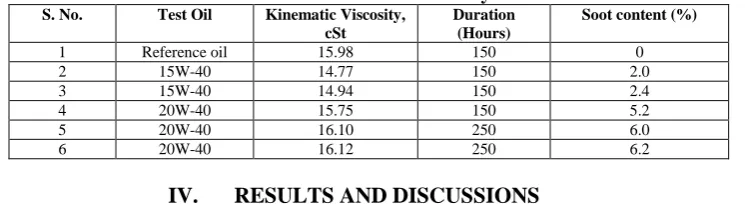
For establishing the test procedure for increasing the soot loading in engine oil, total 6 no. of lubricating oils are evaluated during the study. The test procedure was employed for differentiating the performance of the lubricants with respect to soot. Details of test oils are as follows (Table 3),
Table 3. Used oil analysis S. No. Test Oil Kinematic Viscosity,
cSt
Duration (Hours)
Soot content (%)
1 Reference oil 15.98 150 0
2 15W-40 14.77 150 2.0
3 15W-40 14.94 150 2.4
4 20W-40 15.75 150 5.2
5 20W-40 16.10 250 6.0
6 20W-40 16.12 250 6.2
IV.
RESULTS AND DISCUSSIONS
During the test oil samples were drawn at every 25 hours and samples were analysed for kinematic viscosity at 40 °C, Total Base Number (TBN), soot content and wear metals.
A. Soot:
Soot content in the used oil was determined through TGA. The trend of soot generation in engine oil with the engine operating hour is shown in Figure-3. The reference oil showed no soot generation with the Engine (without modification) engine operating conditions for 150 hours. The engine is modified and with the new test conditions the soot generation was increased in a linear trend. The similar trend was observed for the both the test oils.
Operating Parameters 150 Hours 250 Hours
Time, hrs 150 250
Engine speed, rpm 1200±15 1200±15
Load, Nm. (full throttle) Record Record
Fuel flow rate, kg/hr. 9-10 10-11
Sump oil temp, oC 93 ± 2 95 ± 2
Oil pressure, bar (min) 3.5 3.5
Coolant outlet, oC 85±2 66 ±2
Exhaust Temperature, oC 50 -600 650-700
Exhaust back pressure, mbar 10-18 10-18
Inlet air temp, oC 35-40 35-40
Blow-by rate , LPM 35 ± 5 35 ± 5
Fig 3. Engine oil soot generation w.r.t. engine running hour
It is observed that with the modified test conditions, Test oils 2 & 3 have shown increase in soot loading of ~2/2.4% at the end of 150 hours of testing. In case of Test oils 5 & 6, the soot level is ~2.5 % at 150 hours and further oils are subjected to testing upto 250 hours for generating ~6% soot. Under severe operating conditions with Test oil 4, it is observed that the high level of soot loading is ~5.2%.
B. Kinematic Viscosity
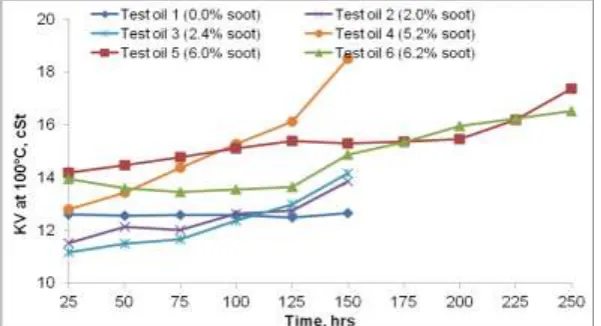
It is observed that the kinematic viscosity increased with the soot percentage as shown in Figure-4. The Test oil 1 without soot loading, with the kinematic viscosity remains stable for a duration of 150 hours. In case of Test oil 2 & 3, there is gradual increase in kinematic viscosity as a result of soot loading of 2-2.4%. There is a sharp increase in kinematic viscosity for Test oil-4 with ~5.2% soot. Test oil-5 & 6 were subjected to 250 hours testing and there is increase in viscosity in both the cases with ~6% soot. However, there is a decrease of oil viscosity during the first 25-75 hrs is seen with test oil 6. This trend can be attributed to shearing of VI modifiers during the initial operational hours subsequently increases on account of soot loading. In case of test oil 2 there has been continuous increase in the viscosity. There is considerable.
Fig 4. Trend of Kinematic viscosity of engine oil at 100°C w.r.t. engine running hour
C. Total Base Number
Fig 5. Trend of TBN depletion the used engine oil w.r.t. engine running hour
D. Wear Metals: Iron and Lead:
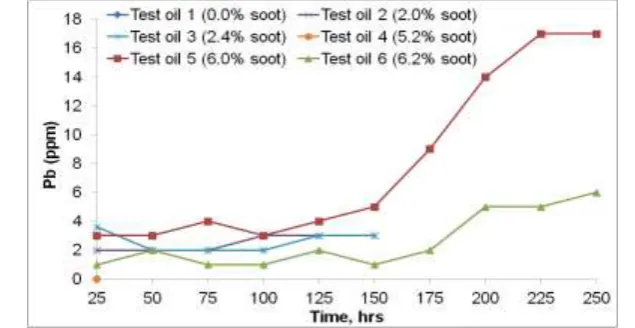
The trend of wear metals such as Iron (Fe) and Lead (Pb) are shown in Figure 6a & 6b. It is observed that the major wear element present in the used engine oil samples was Fe indicating that significant wear is occurring in the liner assembly. It is observed that there is increase in Fe level in Test oil - 2 & 3. In case of Test oil-5 & 6 there is very high level of Fe and Pb wear metals with higher soot loading in engine oil. The correlation study provides insight into the root cause of engine wear and thereby helps to evaluate the performance of the lubricants under real world engine conditions.
Soot related wear can be explained in terms of wear that is caused by excessive oil thickening (viscosity rise) or soot particle itself can act as an agent of wear (though abrasion or by selective adsorption of anti wear additives). The present correlation analysis has been developed with an objective for differentiating and understanding the exact mechanism followed for wearing of metal parts. It is clear from Figure 6a & 6b rate of wear increases with the increase in soot percentage.
V.
CONCLUSIONS
A commercial LCV engine is modified to develop a test method for evaluating the diesel engine oils with respect to soot dispersancy. In this study, six (6) no. of lubricant formulations were evaluated through endurance tests. The following conclusions can be drawn from the test data,
Test method is suitable for evaluation of engine oil formulations designed for high severity operations with respect to soot loading up to 6.0%.
Soot in the engine oil during the engine operation increased with severity and it follows a linear relationship.
Significant increase in kinematic viscosity and depletion in TBN was observed with soot loading of 2-6% in engine oil
Ferrous is the major wear metal in the used engine oil samples and rate of wear increased with soot content more than 4%.
Test method developed is an effective tool for evaluating the performance of engine oil in terms of dispersancy.
ACKNOWLEDGEMENT
Author would like to thank Management of IndianOil R&D Centre for their constant encouragement and permission to publish this work. Author would like to acknowledge the contribution of team members of Engine Test Lab, Tribology, Automotive oil and Analytical Division of IndianOil R&D Centre.
REFERENCES
[1]. Rudnick, Leslie. Lubricant Additives-Chemistry and Applications. 2009.[2]. Sam George, Santosh Balla, Mridul Gautam. Effect of diesel soot contaminated oil on engine wear. Wear, pp. 1113-1122, 2006 [3]. Su, D.S., Muller, J. O., Jentoft, R. E., Rothe, D., Jacob, E., Schlogl, R. Fullerene-like Soot from EURO-IV Diesel Engine:
Consequences for Catalytic Automotive Pollution Control. 30/31 . 2004.
[4]. Mackovic, M. Characterization of Soot Particles from Diesel Engines and Tin Dioxide Particles Milled in Stirred Media Mills. PhD Thesis., 2012
[5]. Urs Mathis, Martin Mohr, Ralf Kaegi. Influence of Diesel Engine Combustion Parameters on Primary Soot Particle Diameter. Environmental Science and Technology, 2005
[6]. Esangbedo, C., Boehman, A. L., Perez, J. M. Characteristics of diesel engine soot that lead to excessive oil thickening. Tribology International, pp. 194-203, 2012
[7]. Green, D.A., Lewis, R., Dwyer-Joyce, Wear effects and mechanisms of soot-contaminated automotive lubricants, R.S. Proceedings of the Institution of Mechanical Engineers, Part J: Journal of Engineering Tribology, pp. 220(3):159-169, 2006
[8]. Mihir Patel, Cristy Leonor, Azanza Ricardo, Paolo Scardi, Pranesh B Aswath. Morphology, structure and chemistry of extracted diesel soot – Part I: Transmission electron microscopy, Raman spectroscopy, X ray Photoelectron spectroscopy and synchrotron X ray diffraction study. Tribology International, pp. 52:29-39, 2012
Lee, S.C. Choi, C.S. Lee. Impact of SME blended fuel combustion on soot morphological characteristics in a diesel engine. International Journal of Automotive Technology, pp. 145:757-762, 2013
[9]. Luo Chin-Hsiang, Lee Whei May, Liaw Jiun Jian. Morphological and semi quantitative characteristics of diesel soot agglomerates emitted from commercial vehicles and a dynamometer. Journal of Environmental Science, pp. 21:452-457, 2009
[10]. Size Distribution of Diesel Soot in the Lubricating Oil. Sun, R., Kittelson, D., and Blackshear, P. 1991, SAE Technical Paper, p. SAE 912344.
[11]. Sam George, Santhosh Balla, Vishaal Gautam, Mridul Gautam. Effect of diesel soot on lubricant oil viscosity. Tribology International, Vol. 40, pp. 809–818, 2007
[12]. Mridul Gautam, Karthik Chitoor, Murali Durbha,Jerry C. ,Summers. Effect of diesel soot contaminated oil on engine wear — investigation of novel oil formulations. Tribology International, Vol. 32, pp. 687-699, 1999
[13]. Bardasz EA, Cowling SV, Ebeling VL, George HF, Graf MM, Kornbrekke RE, Ripple DE. Understanding soot mediated oil thickening through designed experimentation — Part 1: Mack EM6–287, GM 6.2L. SAE, Vol. 952527, 1995
[14]. Bardasz EA, Carrick VA, Ebeling VL, George HF, Graf MM, Kornbrekke RE, Pocinki SB. Understanding soot mediated oil thickening through designed experimentation—Part 2: GM 6.5L. SAE, Vol. 952527, 1996
[15]. John J Truhan, Jun Qu, Peter J Blau. The effect of lubricating oil condition on the friction and wear of piston ring and cylinder liner materials in a reciprocating bench test. Vols. 259:1048-1055, 2005
[16]. S. Aldajah, O.O. Ajayi, G.R. Fenske, I.L. Goldblatt. Effect of exhaust gas recirculation (EGR) contamination of diesel engine oil on wear. Wear, pp. 263: 93-98, 2007
[17]. T.C. Jao, S. Li, K. Yatsunami, S.J. Chen, A.A Csontos, and J.M. Howe. Soot characterization and diesel engine wear., Lubrication Science, Vols. 16-2, 2004