
Page 70 www.ijiras.com | Email: [email protected]
Deficit Of Light Off Temperature With Reducing Agent Support
On Precious Metal & Metal Oxides Washcoat
Sunil K. Sharma
Mewar University, Gangrar, Chittorgarh (Rajasthan), Chemistry Department
Dr. Reeta Chauhan
RKGIT November 28’2019
I. INTRODUCTION
“Emissions from the automotive exhaust, mainly carbon mono-oxides (CO), hydrocarbons (HC), nitrous oxides (NOX) have a direct negative impact on the environment as well as our health so, it’s required to reduce the amount of these gases from the exhaust emissions. Basically, catalytic converter used to convert toxic exhaust emissions (e.g. CO, HC and NOx) to less toxic substances from an internal combustion engine.[1-7]. There are two types of catalytic converter two way and three way catalytic converters. In the two way catalytic converter these main reaction occur as per below equation 1& 2. ,,
Oxidation of carbon monoxide to carbon dioxide 2CO + O2 → 2CO2 (1)
Oxidation of Un-burnt Hydrocarbons (HC) to carbon dioxide and water
CxH2x+2 + [(3x+1)/2] O2 → xCO2 + (x+1) H2O (2)
Because, two way catalytic converter has limitations so, in 1981 it is over ride by three way catalytic converter with
reduction of nitrogen oxides to Nitrogen and Oxygen as per equation 3.
2NOx → xO2 + N2 (3)
“In 1970s Robert C. Stempel use the precious metals like platinum, palladium and rhodium to raise the exhaust gases reaction in the catalytic converter. ,,
“Authors investigated hydrocarbon emissions from the in-cylinder post-injection effect on NO oxidation over a diesel oxidation catalyst (DOC) with various feed mixtures. In the temperature ramp experiments with varying C3H6 concentrations in NO/O2 and NO/O2/H2 mixtures, addition of C3H6 was observed to inhibit NO oxidation by delaying the ignition temperature of NO. [8] They investigated a persulfate-bioaugmentation serial foam spraying technique to remove total petroleum hydrocarbons (TPHs) present in diesel-contaminated unsaturated soil. Feeding of remedial agents by foam spraying increased the infiltration/unsaturated hydraulic conductivity of reagents into the unsaturated soil.[9] A Series of mixed metal oxides were synthesized by gel-combustion method and their catalytic activities for soot oxidation were Abstract: The primary objective of this work is to focus on the low temperature light off study of the catalyst with reducing agent support on precious metal. The conventional procedure was used to make washcoat and coated samples with reducing agent, Lithium Aluminium Hydride (LAH). The light off temperature in different percentage combination of LAH with respect to precious metal amount like 0.11, 0.13, 0.14, 0.17, 0.5 to 1.0 times. The catalyst was characterized by BET, SEM & evaluation testing and X-Ray technique was used to observe the coat ability of the samples. BET analysis showed very slight changes in specific surface area of the washcoat after reducing agent addition. SEM analysis showed proper distribution of precious metal after reducing agent addition. The significant results observed after evaluation testing in case of carbon monoxide (CO) & hydrocarbon (HC) conversion. The addition of reducing agent showed deficit in the light off temperature of CO & HC conversion. Light off temperature shows deficiency with reducing agent washcoats as compare to without reducing agent washcoat.,,
Page 71 www.ijiras.com | Email: [email protected] investigated. The catalysts were M-Ce-Zr (M = Mn, Cu, Fe, K,
Ba, Sr), and xK-20Mn-Ce-Zr (x = 0, 5, 10, 20). [1] Catalytic oxidation of diesel soot particulate on Ce(x)Zr(1-x)O(2) catalysts was investigated. Results indicated that Ce/Zr ratios had a significant influence on the catalytic activities.[10] A
series highly efficient and stable
metallophthalocyanine/La0.8Ce0.2NiO3 (ML/LCNO) photocatalysts were prepared by a facile sol-gel and immersion method.[11] The coaxial arrays of AAO-CeO2 NTs have been successfully galvanostatically deposited on an anode, characterized and adopted as a catalyst for removing organic sulfurs from diesel.[12] A series of Pt-V/Ce-Zr-O diesel oxidation catalysts was prepared using the impregnation method. The catalytic activity and sulfur resistance of Pt-V/Ce-Zr-O were investigated in the presence of simulated diesel exhaust. The effect of vanadium on the structure and redox properties of the catalysts was also investigated.[13] The activities of catalysts during soot combustion were tested by thermogravimetric and differential scanning calorimetry. The contact conditions of soot/catalysts (sintered at 450 and 380 degrees C, respectively, under loose and tight contact conditions) were observed by scanning electron microscopy to study the effect of contact conditions on catalytic activity, and it was determined that the catalytic activities under tight contact conditions are superior to those under loose contact conditions.[4] A Diesel Particulate Filter (DPF) regeneration process was investigated during aftertreatment exhaust of a simulated diesel engine under the influence of a Diesel Oxidation Catalyst (DOC).[14]
Increase in of vehicles on the earth are increasing rapidly also increasing the toxic gases so, there is need to minimize the toxic exhaust gases percentage after engine emission with modified combination of the washcoat materials. In this perusal, focus of work is to decrease the light off temperature of diesel catalyst by washcoat preparation of metal oxides with addition of precious metals as well as strong reducing agent materials. Addition of reducing agent in the precious metal washcoats in different ratios, considering total precious metal amount gives reasonable outputs. Before washcoat coating on the samples check the washcoat parameters like pH, Viscosity, Solid concentration XRF & BET etc. Suction coating on the ceramic monolith with calculated wet washcoat amount, after that dry these coated samples with hot air as well as high temperature heating and check the samples quality & loaded dry washcoat amount. Evaluation study shows better emission results with washcoat of metal oxides & precious metal as well as reducing agent. Nearby 20-25degC better light off temperature with metal oxides & reducing agent washcoat consider without reducing agent washcoat formulation at specific parameters of reducing agent addition in metal oxides washcoats.[15, 16] ,,
“Catalytic converters washcoat material usually consist of high surface and precious metals. These combination successfully convert carbon monoxide (CO), hydrocarbons (HCs) and nitrogen oxides (NOx) to carbon dioxide (CO2), Nitrogen and water so, consider this we use the conventional materials as well as strong reducing to get the early light off temperature and reduce the exhaust emission at low temperature as a primary goal of work. As a secondary objective we prefer conventional coating method to prevent
the changes in coating method and procedure.[1, 6, 12, 17-27]”
II. EXPERIMENTAL
A. CHEMICALS & REAGENTS
“Silicon oxides, Aluminium oxide, Dextrin, Silica, Zirconium oxides, cerium oxides, Barium oxide, Palladium nitrate solution, Platinum nitrate solution, Aluminium lithium hydride LIAlH4(CDH -97.0%) and Sodium borohydride NaBH4 (CDH- 99.9%),,
B. INSTRUMENTS USED
“Pot mill roller, Particle Size analyzer ( Model), BET Surface area analyzer (Model), SEM & EDS (Model ), XRF Analysis (Model), Viscometer ( Model), pH meter (Model), X-Ray (Model), Heating furnace & evaluation testing machine (Model).,,
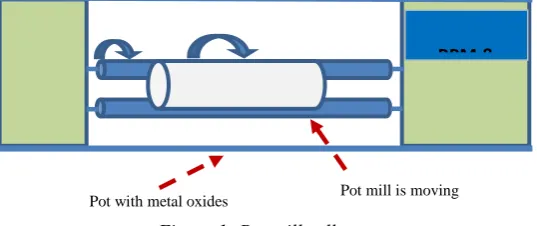
a. PREPARATION OF WASHCOAT A
“The washcoat A was prepared by using Silicon oxides, Aluminium oxide, Dextrin and silica in 40+40+10+10 Ratio mix with the help of ball milling methodology (Ref-3). The mixing of the chemicals will results in the formation of a slurry suspension on a particular pH. The pH of the suspension was changed by varying the amount of the chemicals. ,,
Figure 1: Pot mill roller
b. PREPARATION OF WASHCOAT B
“The washcoat B was prepared by using Zirconium oxides, cerium oxides, Aluminium oxide, Barium oxide mix with 14+6+70+10 Ratio mix with the help of ball milling methodology (Ref-3). The mixing of the chemicals will results in the formation of a slurry suspension on a particular pH. The pH of the suspension was changed by varying the amount of the chemicals.,,
C. CATALYST ADDITION IN WASHCOATS
“Now, weigh the precious metals platinum nitrate and palladium nitrate in a glass beaker. Precious metal in the metal oxides washcoat added drop by drop for proper distribution/mixing with metal oxides washcoats. Add Platinum nitrate in washcoat-A and palladium nitrate in washcoat-B with proper mixing up to 15min stirring propeller RPM &
Time Setting
Panel
Page 72 www.ijiras.com | Email: [email protected] stirring and measure all the required parameters like Viscosity
[6], pH (7), solid concentration and BET (specific surface area) as per below table:1 ,,
Slurry Solid
%
pH Viscosity
(cP)
Particle size (nm) BET
(m2/gm)
Washcoat Metal
%
D10 D50 D90
A
Pt-2.50
30.37 2.99 9490 2.092 5.95 17.04 200.10
B
Pd-0.70
32.24 4.64 5019 2.252 8.6 25.83 73.78
Table 1: Measured parameters of washcoat A&B
D. REDUCING AGENT ADDITION IN PLATINUM & PALLADIUM METAL WASHCOAT A & B
“After checking required parameters with precious metal addition in washcoats A&B Now, addition of the reducing agent (Aluminium lithium hydride make CDH -97.0%) done based on below trend in table:2 Weigh the wash coat of beaker serial number 1 (Platinum based washcoat) & 8 (Palladium based washcoat) foil wrap & keep with air tight rubber band. Remaining serial number 2 to 7 (Platinum based washcoat) & 9 to 14 (Palladium based washcoat) aluminum lithium hydride added with different calculated ratio’s. Slurry poured in different 500ml plastic beakers for washcoat A & B. Before start agitation with propeller wrap the beakers with aluminum foil. Now, based on below table aluminum lithium hydride weighed in weighing paper (4’’x 4’’ Fisher brand) for washcoat A & B. ,,
S. No.
Slurry
Reducing agent
quantity (Pure Metal Χ
Reducing agent) S. No. Slurry Reducing agent quantity (Pure Metal Χ
Reducing agent) Washc oat Metal % Wash coat Meta l %
1 A
Pt-2.50
Pt Χ 0
8 B
Pd-0.70
Pd Χ 0
2 ↑ ↑ Pt Χ 0.11 9 ↑ ↑ Pd Χ 0.11
3 ↑ ↑ Pt Χ 0.13 10 ↑ ↑ Pd Χ 0.13
4 ↑ ↑ Pt Χ 0.14 11 ↑ ↑ Pd Χ 0.14
5 ↑ ↑ Pt Χ 0.17 12 ↑ ↑ Pd Χ 0.17
6 ↑ ↑ Pt Χ 0.50 13 ↑ ↑ Pd Χ 0.50
7 ↑ ↑ Pt Χ 1.0 14 ↑ ↑ Pd Χ 1.0
Table 2: Reducing agent added with different calculated ratios “Place the washcoat-A & B beaker of serial number 1 & 8 for propeller agitation and start agitation slowly. Measured aluminum lithium hydride for Pt based washcoat and aluminum lithium hydride for Pd based wash coat in weighing paper (4’’x 4’’ Fisher brand) ; added very slowly with spatula for proper mixing up to approx. 15-20min and during that process color change from light yellow to blackish. After color change agitate it for 10 min more and check the parameters pH, Viscosity, particle size, solid concentrations & BET [7). Same process follow for serial number 2 to 7 & 9 to 14 as well with different reducing agent amount for washcoat A & B. Now washcoat formulation was ready for coating in the honeycomb substrates. ,,
E. COATING OF REDUCING AGENT ADDED
WASHCOAT A & B IN HONEYCOMB SUBSTRATES
“After six different amount of reducing agent addition in platinum washcoat A (Table: 2), seven types of formulation is
ready for coating with washcoat A (Pt- based) and seven types formulation with wash coat B (Pd-based).,,
“Cylindrical cordierite selected for coating with 400 square cells/in2 with dimensions of diameter 25.4mm and length 30mm [8]. Ceramic honeycomb immersed in to the washcoat by use the normal dip coating well known method in the industry [6&7] and to check the coating uniformity we cut and check the coating length. After coating sample dried at 100degC for 1hr and then calcine at 500degC for 3hr in the furnace. Calcined samples dry washcoat loading weight check by hot air drying process for 30 min at 150degC. After weight checking samples are ready for testing. ,,
F. EVALUATION TESTING OF THE SAMPLES
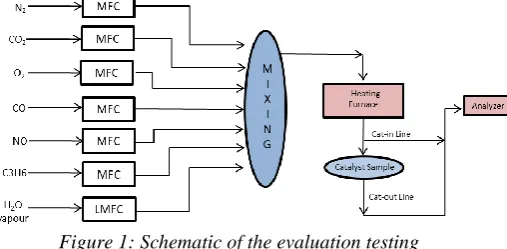
“Evaluation of this work was conducted. Sample size was of dia-25.4mm and Length 30mm set up within the holder. The operational gas flow control by the mass flow controllers (MFCs) which are connected to gas cylinders through stainless steel gas lines (SS 316 material).In this simulated gas reactor there is seven gas lines MFCs with one liquid MFC (LMFC) for water injection in to the mixture. The mass flow controller have flow accuracy with in ±1%.The mass flow controllers (MFC’s) confirm the required gases concentrations which are transported through the catalyst sample that was located in the furnace are within the simulated gas engine machine. The furnace within the machine for inlet temperature control of the catalyst through automatic setup allows the user to specify the desired temperature profile. Temperature ramp up rate throughout the reaction was 20°C/min. Inlet gas concentrations mention in the table: 4, set up for start the test. The mixture of the gases passes through the heated tube after that from the catalyst sample to the analyzer. The gases conditions for test are as per below:,,
Gases
CO (%)
1.00
Propane (ppm)
3000
NO (ppm)
300
Oxygen, O
2(%)
0.80
CO
2(%)
10.0
H
2O (%)
10.0
N
2(%)
Remaining
Table 3: Composition of the model exhaust gas [9] “Analyzer for this study was able to analyze the gases like Carbon monoxide (CO), Carbon dioxide (CO2), Nitrogen oxides (NO & NOx), and Oxygen (O2) as well as total hydrocarbons (THC). A schematic of the evaluation testing of the samples. ,,
Page 73 www.ijiras.com | Email: [email protected] “The data is analyzed by the detectors in analyzer that
recorded in separate PC with software of evaluation processing. The inlet & outlet temperature of the catalyst are also recorded throughout the reaction at every one second. As inlet concentrations of gases is known then outlet concentration of the gases is recorded by the analyzer and the conversion efficiency can be calculated using equation -1,,
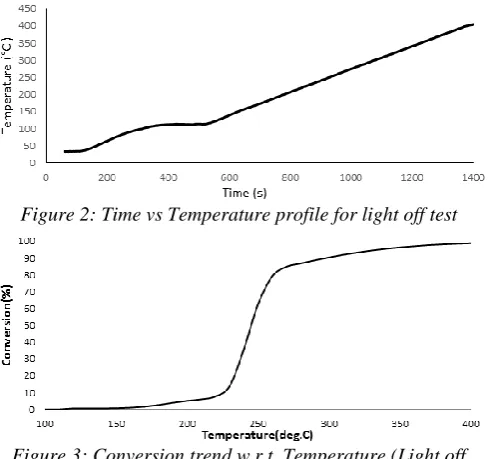
(4) “For three way catalyst study test sample used was of commercial formulation with platinum in formulation -A and palladium in formulation-B as active metal and for further study to observe the effect of reducing agent on conversion as well as light off temperature of the catalyst. The slurry washcoat was coated on 400cpsi ceramic honeycomb substrate of dia25.4mm & length 30.0mm.The flow rate of light off test was calculated on the basis of catalyst volume (0.0152 Liter) of the catalyst to maintain a space velocity of 79000 . The evaluation test results of seven types of samples for platinum based wash cost slurry as well as palladium based slurry with different reducing amount addition shows the light off trend with constant temperature increase in the reactor unit. The light off test procedure include gas condition setting below 100°C of N2, CO, C3H6, NO, O2, CO2 & H2O gases as per above table-3, through mass flow controller (MFC’s) and after stability, gases flow starts through the catalyst sample with continuously temperature increase up to 400°C with ramp up rate 20°C/min. The purpose of the temperature increasing ramping rate was to make sure the temperature uniformity throughout the catalyst sample inlet and outlet during gas flow. The temperature of the furnace increase continuously with constant ramp up rate and light off conversion data with set gases flow concentrations results collected in the PC software by per seconds. Catalyst evaluation done sample by sample with same gas flow rate as well as procedure for light off results comparison. Figure-2 shows an example of the temperature increase with time up to 400degC and figure-3 shows a light off conversion trend with respect to the temperature,,
Figure 2: Time vs Temperature profile for light off test
Figure 3: Conversion trend w.r.t. Temperature (Light off conversion)
III. RESULTS AND DISCUSSION
A. CHARACTERIZATION
a. IMPACT OF VARYING LIALH4 ON PH, VISCOSITY, PARTICLE SIZE AND SPECIFIC SURFACE AREA
S.No. Metal %
Chemical in slurry
(Pure Metal Χ
Chem. times )
pH Viscosity
(cP)
Particle size (um)
BET (m2/gm)
D10 D50 D90
1
Pt-2.50
0.00 2.99 9490 2.092 5.95 17.04 200.10
2 0.11 3.35 7498 2.749 5.590 10.550 196.80
3 0.13 3.40 6849 2.616 5.300 9.570 196.70
4 0.14 3.20 6379 2.689 5.510 10.380 195.10
5 0.17 3.41 8158 2.709 5.610 10.280 194.60
6 0.50 7.86 3660 2.514 4.830 9.620 179.40
7 1.00 8.28 2900 2.742 5.630 10.950 181.30
8
Pd-0.70
0.00 4.64 5019 2.252 8.600 25.830 73.78
9 0.11 4.83 6139 3.100 6.030 10.030 73.35
10 0.13 4.84 5729 2.556 6.730 19.370 75.47
11 0.14 4.79 6099 3.160 11.310 103.000 75.38
12 0.17 4.83 6189 2.698 6.580 17.880 74.15
13 0.50 7.86 3660 2.442 6.460 18.130 67.28
14 1.00 8.28 2900 2.940 9.280 23.090 68.53
Table 4: Varying impact of LiAlH4 on pH, Viscosity, particle size and specific surface area
“The BET specific surface area measurement results is carried out with N2 adsorption. Adsorption phenomenon
carried out on the powder samples after 150℃ heating for 45 minutes with vacuum in heating with vacuum instrument. The results shown in the table-4 with platinum based washcoat and palladium washcoat after reducing agent addition. It can be observed that there is very slight changes was observed with the addition of reducing agent in the washcoat of different variations, it means that there is considerable difference of specific surface area seen in the washcoat formulations similarly there is no considerable difference observed with palladium based slurry.,,
b. SAMPLE COATING AND X-RAY ANALYSIS
Page 74 www.ijiras.com | Email: [email protected]
Figure 4.1 & 4.2: without and with Reducing Agent
“It can be observed from figure that the coating uniformity was good, in both with and without reducing agent samples, it means there is no significant change of reducing agent addition on washcoats. ,,
c. SEM AND EDS ANALYSIS
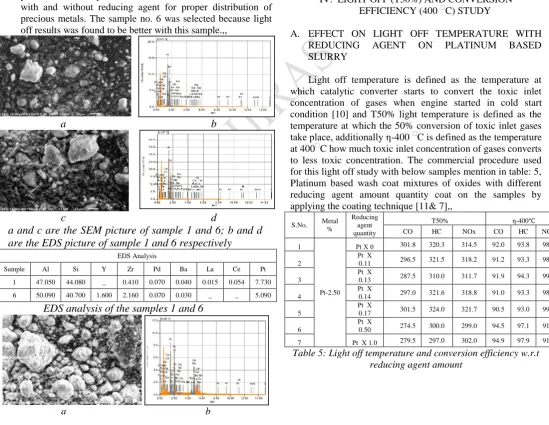
“After sample coating the SEM and EDS analysis was performed for sample no. 1 & 6 to observe the difference for with and without reducing agent for proper distribution of precious metals. The sample no. 6 was selected because light off results was found to be better with this sample.,,
a
b
c
d
a and c are the SEM picture of sample 1 and 6; b and d
are the EDS picture of sample 1 and 6 respectively
EDS Analysis
Sample Al Si Y Zr Pd Ba La Ce Pt
1 47.050 44.080 _ 0.410 0.070 0.040 0.015 0.054 7.730
6 50.090 40.700 1.600 2.160 0.070 0.030 _ _ 5.090
EDS analysis of the samples 1 and 6
a b
c d
a and c are the SEM picture of sample 8 and 13; b and d are the EDS picture of sample 8 and 13 respectively
EDS Analysis
Sample Al Si Y Zr Pd Ba La Ce Pt
8 13.890 0.040 1.090 33.430 0.980 8.790 0.970 40.750 _
13 12.920 _ 1.110 33.710 0.980 8.0 8.000 0.660 42.610
EDS analysis of the samples 8 and 13
After SEM analysis considerable amount of palladium metal was observed in both with and without reducing agent washcoats.
IV. LIGHT OFF (T50%) AND CONVERSION EFFICIENCY (400 C) STUDY
A. EFFECT ON LIGHT OFF TEMPERATURE WITH
REDUCING AGENT ON PLATINUM BASED
SLURRY
Light off temperature is defined as the temperature at which catalytic converter starts to convert the toxic inlet concentration of gases when engine started in cold start condition [10] and T50% light temperature is defined as the temperature at which the 50% conversion of toxic inlet gases take place, additionally η-400 C is defined as the temperature at 400 C how much toxic inlet concentration of gases converts to less toxic concentration. The commercial procedure used for this light off study with below samples mention in table: 5, Platinum based wash coat mixtures of oxides with different reducing agent amount quantity coat on the samples by applying the coating technique [11& 7],,
S.No. Metal
%
Reducing agent quantity
T50% η-400℃
CO HC NOx CO HC NOx
1
Pt-2.50
Pt Χ 0 301.8 320.3 314.5 92.0 93.8 98.9
2
Pt Χ
0.11 296.5 321.5 318.2 91.2 93.3 98.9
3
Pt Χ
0.13 287.5 310.0 311.7 91.9 94.3 99.3
4
Pt Χ
0.14 297.0 321.6 318.8 91.0 93.3 98.9
5
Pt Χ
0.17 301.5 324.0 321.7 90.5 93.0 99.5
6
Pt Χ
0.50 274.5 300.0 299.0 94.5 97.1 91.4
7 Pt Χ 1.0 279.5 297.0 302.0 94.9 97.9 91.6
Page 75 www.ijiras.com | Email: [email protected] Figure a
Figure b
Figure c
(a) CO, (b) HC and (c) NOx Light-Off Conversion curve corresponding to various reducing agent amounts “The light off conversion for CO is shown in figure a : as can be seen from figure that the light off conversion improves as reducing agent (Lithium Aluminium hydride) amounts increases from 0.11 to 1 times platinum amount. This is due to the fact that oxygen storage component gets removed under lean conditions and extent catalyst activity for NO reduction. Catalyst pick this oxygen under oxidizing condition in presence of reducing agent and increase the conversion of CO & HC (Fig. a & b)[12].The light off conversion for CO & HC with using reducing agent is better than without reducing agent (Table 5). At 400°C temperature the conversion of the inlet toxic gases is also increased in between 92% to 95% for CO and 93% to 98% for HC with and without reducing agent (Table 5). [13&14]. ,,
Figure a
Figure b
“The light off conversion observed for NOx is shown in figure c is less since rhodium (Rh) was not used in work thus low NOx conversion was observed but T50% looks slight better because of platinum [1].,,
B. EFFECT OF REDUCING AGENT AMOUNT ON PALLADIUM BASED SLURRY
“Similar procedure employed for palladium based wash coat, mixtures of oxides with different reducing agent amount, discussed in section 4.1 the results are shown in table: 7,,
S.No. Metal
%
Reducing agent quantity
T50% η-400℃
CO HC NOx CO HC NOx
8
Pd-0.70
Pd Χ 0 210.0 244.6 247.7 96.0 98.8 99.5
9 Pd Χ 0.11 237.1 255.0 259.2 96.2 98.7 99.4
10 Pd Χ 0.13 194.9 247.0 250.5 96.0 98.4 99.5
11 Pd Χ 0.14 238.9 256.5 261.3 96.1 98.3 99.5
12 Pd Χ 0.17 241.5 258.5 262.9 95.8 98.3 99.6
13 Pd Χ 0.50 229.5 245.9 252.0 95.1 98.6 90.3
14 Pd Χ 1.0 253.9 264.1 272.2 94.6 97.8 90.4
Table 7: Light off temperature and conversion efficiency w.r.t. reducing agent amount
Figure a
Figure b
Page 76 www.ijiras.com | Email: [email protected] (a) CO, (b) HC and (c) NOx Light-Off Conversion curve
corresponding to various reducing agent amounts
Figure a
Figure b
Figure a, b & c represents the light off conversion for CO, HC & NOx respectively with different reducing agent amounts. The results shows that there is decrease in the T50% and η-400℃ in palladium based slurry (Washcoat B) because of the water vapour used in light off test study as per gas condition in table 3. [15]
V. CONCLUSION
“In order to reduce the light off temperature of the catalyst, different amounts of reducing agent was added to the platinum and palladium based metal oxides washcoat’s and performance of the catalyst was studied.,,
BET surface area analysis results indicated that the addition of reducing agent in the metal oxides washcoat show slight change in specific surface area of the washcoat.
Reducing agent slurry did not affect the coating uniformity on the honeycomb and it can be adjusted by coating parameters.
SEM results showed a proper distribution of the precious metal after reducing agent addition in the metal oxides washcoat’s.
The reducing agent addition in the metal oxide washcoat shows better light off conversion in case of CO & HC than without reducing agent washcoat in platinum based coated samples even though in the palladium based coated samples it is not specific
The maximum CO light off conversion was observed with reducing agent quantity 0.5 & 0.1 times of platinum metal.
Slight NOx reduction was observed with platinum based washcoat but with palladium based washcoat it is not specific
It can be observed from this study that reducing agent should promote the light off performance of the catalyst in addition of the appropriate amount for platinum based washcoat.
There is no any specific changes was observed in the metal oxide washcoat with reducing agent addition that can affect the conventional industrial method of washcoat making or sample coating.
REFERENCES
[1] Alinezhadchamazketi, A., et al., Catalytic evaluation of promoted CeO2-ZrO2 by transition, alkali, and alkaline-earth metal oxides for diesel soot oxidation. J Environ Sci (China), 2013. 25(12): p. 2498-506.
[2] Andre, V., et al., Comparative mutagenicity and genotoxicity of particles and aerosols emitted by the combustion of standard vs. rapeseed methyl ester supplemented bio-diesel fuels: impact of after treatment devices: oxidation catalyst and particulate filter. Mutat Res Genet Toxicol Environ Mutagen, 2015. 777: p. 33-42. [3] Shin, K.H., et al., Earthworm toxicity during chemical oxidation of diesel-contaminated sand. Environ Toxicol Chem, 2005. 24(8): p. 1924-9.
[4] Sui, L., et al., Effect of Cs-Ce-Zr Catalysts/Soot Contact Conditions on Diesel Soot Oxidation. ACS Omega, 2017. 2(10): p. 6984-6990.
[5] Nascimento, L.F., et al., Effect of lanthanum loading on nanosized CeO2-ZnO solid catalysts supported on cordierite for diesel soot oxidation. J Environ Sci (China), 2018. 73: p. 58-68.
[6] Vaaraslahti, K., et al., Effect of oxidation catalysts on diesel soot particles. Environ Sci Technol, 2006. 40(15): p. 4776-81.
[7] Feng, X., et al., Effects of particulate oxidation catalyst on unregulated pollutant emission and toxicity characteristics from heavy-duty diesel engine. Environ Technol, 2015. 36(9-12): p. 1359-66.
[8] Wang, P., et al., Mechanism Investigation of Hydrocarbon Emissions from the In-Cylinder Post-Injection Effect on NO Oxidation over a Diesel Oxidation Catalyst. J Phys Chem A, 2019. 123(37): p. 8009-8016.
[9] Bajagain, R., S. Lee, and S.W. Jeong, Application of persulfate-oxidation foam spraying as a bioremediation pretreatment for diesel oil-contaminated soil. Chemosphere, 2018. 207: p. 565-572.
[10] Zhu, L., J. Yu, and X. Wang, Oxidation treatment of diesel soot particulate on CexZr1-xO2. J Hazard Mater, 2007. 140(1-2): p. 205-10.
[11] Li, S.W., et al., Photocatalytic oxidation desulfurization of model diesel over phthalocyanine/La0.8Ce0.2NiO3. J Colloid Interface Sci, 2015. 460: p. 8-17.
[12] Du, X., et al., Preparation of AAO-CeO2 nanotubes and their application in electrochemical oxidation desulfurization of diesel. Nanotechnology, 2017. 28(6): p. 065708.
[13] Huang, H., et al., Promoting effect of vanadium on catalytic activity of Pt/Ce-Zr-O diesel oxidation catalysts. J Environ Sci (China), 2015. 33: p. 135-42.
Page 77 www.ijiras.com | Email: [email protected] [15] Plummer, H.K., Jr., et al., Measurement of Automotive
Catalyst Washcoat Loading Parameters by Microscopy Techniques. Microsc Microanal, 1999. 5(4): p. 267-281. [16] Gomez, D.M., et al., TAP study of toluene total oxidation
over a Co3O4/La-CeO2 catalyst with an application as a washcoat of cordierite honeycomb monoliths. Phys Chem Chem Phys, 2014. 16(23): p. 11447-55.
[17] Shukla, P.C., et al., Effectiveness of non-noble metal based diesel oxidation catalysts on particle number emissions from diesel and biodiesel exhaust. Sci Total Environ, 2017. 574: p. 1512-1520.
[18] Yang, H., et al., Experimental investigation into the oxidation reactivity and nanostructure of particulate matter from diesel engine fuelled with diesel/polyoxymethylene dimethyl ethers blends. Sci Rep, 2016. 6: p. 37611.
[19] Heeb, N.V., et al., Impact of low- and high-oxidation diesel particulate filters on genotoxic exhaust constituents. Environ Sci Technol, 2010. 44(3): p. 1078-84.
[20] Sutton, N.B., T. Grotenhuis, and H.H. Rijnaarts, Impact of organic carbon and nutrients mobilized during chemical oxidation on subsequent bioremediation of a diesel-contaminated soil. Chemosphere, 2014. 97: p. 64-70.
[21] Bunger, J., et al., Influence of fuel properties, nitrogen oxides, and exhaust treatment by an oxidation catalytic converter on the mutagenicity of diesel engine emissions. Arch Toxicol, 2006. 80(8): p. 540-6.
[22] Wang, W., et al., Mixed-phase oxide catalyst based on Mn-mullite (Sm, Gd)Mn2O5 for NO oxidation in diesel exhaust. Science, 2012. 337(6096): p. 832-5.
[23] Weitkamp, E.A., et al., Organic aerosol formation from photochemical oxidation of diesel exhaust in a smog chamber. Environ Sci Technol, 2007. 41(20): p. 6969-75. [24] Soloviev, S.O., A.Y. Kapran, and Y.P. Kurylets, Oxidation
of diesel soot on binary oxide CuCr(Co)-based monoliths. J Environ Sci (China), 2015. 28: p. 171-7.
[25] Fayad, M.A., et al., Role of Alternative Fuels on Particulate Matter (PM) Characteristics and Influence of the Diesel Oxidation Catalyst. Environ Sci Technol, 2015. 49(19): p. 11967-73.
[26] Li, C., et al., Ultra-deep desulfurization of diesel: oxidation with a recoverable catalyst assembled in emulsion. Chemistry, 2004. 10(9): p. 2277-80.
![Figure a (China), 2013. 25(12): p. 2498-506. [2] Andre, V., et al., Comparative mutagenicity and genotoxicity of particles and aerosols emitted by the](https://thumb-us.123doks.com/thumbv2/123dok_us/1391490.1650436/7.595.40.284.78.310/figure-china-comparative-mutagenicity-genotoxicity-particles-aerosols-emitted.webp)
