E-ISSN 2308-9830 (Online) / ISSN 2410-0595 (Print)
Energy Efficiency through Dynamic Packet Transmissions in
Sensor Network
Mohammed S. Al-kahtani
Dept. of Computer Engineering, Prince Sattam bin Abdulaziz University, Saudi Arabia
ABSTRACT
The work presented in this study proposes an efficient mechanism to reduce the computational and communicational costs associated with sensor network models. Specifically, the study focuses on two different models or topologies, each consisting of three different methods of data transmission for the purpose of reducing the interaction among network nodes when data measured at some instant, t-1, is equal to the data sensed at later instant, t. In terms of the model configurations, the simulation-based approach used to validate our proposed technique indicates that scenarios where member nodes of a cluster was not needed for computation required for less resources for data transmission with increased energy consumption than scenarios that required both member nodes and cluster heads for computation.
Keywords:Sensor Network; Packet transmission; Single-hop; Multi-hop; Energy Efficiency.
1 INTRODUCTION
Sensors play an important role in many emerging technologies such as opportunistic networks, big data and vehicular ad hoc networks. Therefore, enhancing the efficiency of sensor networks in terms of computation and energy consumption is integral for ubiquity of smart and efficient technologies. Consequently, a lot of studies have been devoted to the design of efficient routing protocols, network topologies, data aggregation, localization and many other approaches for sensor networks. Notwithstandingthe progress recorded in these directions, the need to improve the computational costs required for sensors to transmit data directly to the cluster head (CH) or multi-hop through other nodes is still an open question. More so, since there is need to curtail the transmission of redundant data to the CH using either single- or multi-hop communication, thereby enhancing the computational efficiency of network infrastructure.
The study presented in this work is primarily aimed at contributing to similar efforts by undertaking a comparative analysis of the computational requirements needed for single and multi-hop communication protocols between member nodes and CH of a cluster. Moreover, available literature [1-10] suggest that these protocols do not analyze cost if the computation is performed at the member nodes of a cluster,
confined to the CH, both or none. Since most of these protocols are cluster-based, i.e., they utilize single hop communication between member nodes and CH, these algorithms do not consider comparisons between data from two consecutive timestamps. For instance, there is widespread use of LEACH [1-3], PEGASIS [4], DSC [5], TEEN [6-7], APTEEN [8], LESCS [9], advanced multi-hop LEACH [10], hybrid multi-hop LEACH [11] and zone-based routing protocol [12], which are mostly either proactive (transmit data periodically) or reactive (transmits data when sensor senses a certain value). Meanwhile, by using a uniform multi-hop clustering mechanism, the study in [13] reduces communication overhead while the efforts in [14-15] compare multi-hop routing protocols. Specifically, in [15], Singh et al. compared single-hop and multi-single-hop sensor communications in terms of energy efficiency and signal-to-noise-ratio without considering requirements for processing data at different nodes of the network.
Scenario 2 where computation takes place in the sensors but not at the CH level; and Scenario 3 where computation is executed at both sensor and CH levels. These scenarios provide the framework to validate the performance of our proposed technique and our simulation-based assessment. Simulation results suggest that computational costs of the multi-hop transmission is almost five times more than that of the single-hop transmission. Moreover, Scenario 3 was found to have the least energy consumption for data transmission in both models.
The remainder of the paper is outlined as follows. In Section 2, an overview of the proposed sensor network models including the three computational Scenarios used to assess them is presented. Following this, in Section 3, a detailed evaluation of the proposed technique is undertaken and its performance in terms of network energy consumption and resources needed for data transmission is reported. Section 4 presents a few concluding remarks as well as insights into possible improvements to the proposed technique.
2 PROPOSED NETWORK MODELS AND APPROACHES
This study presents three different Scenarios on sensors data computation and transmission from data collecting sensor nodes to the sink node. The Scenarios include: Scenario 1: where neither the sensor nor the CH is used for computation instead these nodes will only transmit data to the sink once they sense and receive data from other nodes. Hence, there is no cost (in terms of consumption or computation) in those nodes for processing data. In other words, in this Scenario, only the sink node is utilized to perform the required computation. Scenario 2 – where data collecting sensors are only used to sense and transmit data to the CH but not for computation. The CH performs some computation (i.e., data aggregation) and then the processed data is sent to the sink. The computation undertaken at the CH includes checks to ascertain whether data received by it at the current instant is identical to data received at some previous instant. When the data received at the consecutive time instant differentiates by a factor, the CH will transmit to the sink; otherwise, the CH will drop the packet. In Scenario 3, both data collecting sensors and CH perform computations as Scenario 2. After this sensors transmit partially processed data to the CH, which transmits processed data to the sink. Data will be processed only if data received at the current time instant varies from the previous time instant by a substantial factor.
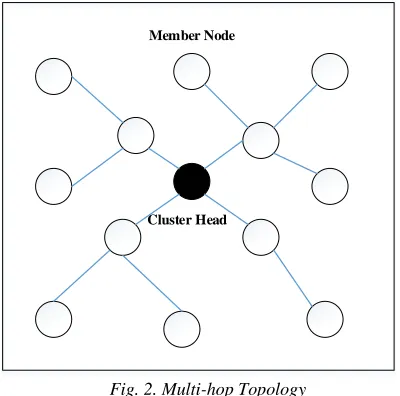
Each of the three computational Scenarios will be applied to the two sensor network models or topologies, i.e., Model 1 (the single-hop model) comprising of a number of clusters with each node transmitting directly to the CH and Model 2 (the multi-hop model) where a single cluster comprising of a number of nodes that transmit data to the CH via other nodes or directly. Another objective of this study is identify optimal models in terms of energy dissipation and resource needed for data transmission in two consecutive instants.
Cluster Head Member Node
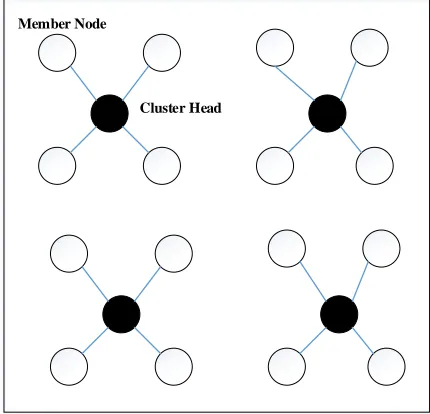
Fig. 1. Single Hop Topology
Figure 1 illustrates the single-hop topology (or model) with n = 4 clusters (each member node is one-hop away from the CH) and m = 4 nodes per cluster. In this model a base station (BS) randomly selects a number of nodes as CHs and then other nodes connect to the closest cluster of a CH as member nodes.
Cluster Head Member Node
Fig. 2. Multi-hop Topology
2.1 Computational Models
Here, we present the computational cost of the sensor network topologies or models presented and three approaches in each model. The symbols used and their corresponding meaning of each symbol is presented in Table 1.
Table 1: Parameters and their corresponding symbols
Parameter Name Symb
ol
Energy consumptions for data sensing
s
E
Energy consumption for data computation
c
E
Energy consumption for transmitting data
TX
E
Energy consumption for receiving data
RX
E
Probability that the data transmitted at time instant t-1 is different from the data measured at time instant t
p
The number of iterations i
Number of nodes having one-hop to CH (model
2) m1
Number of nodes having two-hops to CH (model
2) m2
Number of nodes with one-hop to CH in model 1 m Number of bits in each transmission b Number of clusters n
2.2 Sensor Network Models
The sensor network models and three computational Scenarios on which the proposed technique is built are presented in the next Section.
2.2.1 Model 1 - Topology 1 (Single Hop to CH and Multiple-Cluster)
Scenario 1
In this Scenario, no nodes in the cluster will perform any computation. m member nodes and CH of a cluster performs data sensing and transmiss-ions. If the experiment is run for n times or iterations, m cluster heads in the network receive data from its member nodes and then transmit to the sink. If the size of a data packet is b bytes the total computational cost will be given as:
m E b E m E E b
n i
C ( 1)( s TX) ( TX RX)
(1) Scenario 2
In this Scenario, member nodes do not perform any computation only the cluster head performs the computation. The computational cost associated with this model at the initial time instant is given as: 1 1 1 0 ) ( ) )( 1 ( m k TX m
k TX RX
c s E b E E b E E m n i C (2)
If the probability that the data transmitted at instant t-1 is different from the data measured at instant t the computational cost of this model at second and all subsequent time instant is given as:
1 1 1 ) ( ) )( 1 ( m k TX m
k TX RX
c s E p b E E b E E m n i C (3) Scenario 3
In this Scenario, both member nodes and cluster head perform computation. Computation cost at the initial time instant is denoted as:
n k TX m
k TX RX
Similarly, computational cost at the subsequent time instants is denoted as:
n k TX m
k TX RX
c s E p b E E b E E m n i C 1 1 ) 2 ( ) )( 1 ( (5)
2.2.2 Model 2 – Topology 2 (Single Cluster, Multiple-hop to CH)
Computational costs for three different methods in this model are represented as follows.
Scenario 1 (No computation)
b E m m b E E m m E m m n i C TX RX TX s ) 1 2 ( ) )( 2 ( ) 1 ( 1 2 1 2 2 1 (6)
Scenario 2 (Computation only by CH)
This Scenario requires more message transmission and reception by CH as compared to method 1.
The computational cost at the initial time instant is denoted as:
1 1 1 2 2 1
0 1 2
) )( 2 ( ) 1 ( m m k TX RX TX s E b b E E m m E m m n i C (7)
The computational cost for subsequent time instants is denoted as:
1 1 1 2 2 1 2 1 ) )( 2 ( ) 1 ( m m k TX RX TX s E b p b E E m m E m m n i C (8)
Scenario 3 (Computation both at member nodes and CH)
This Scenario is expected to have more message transmissions and computations by both CH and member nodes as compared to other two methods. The computational cost at the initial time instant is denoted as: 1 2 1 1 2 1 0 ) 2 ( ) 2 3 ( ) )( 1 ( m
k TX RX TX m
k TX RX c s E b E E b E E b E E m m n i C (9)
The computational cost for the subsequent time instants is denoted as:
1 2 1 1 2 1 ) 2 ( ) 2 3 ( ) )( 1 ( m
k TX RX TX m
k TX RX c s E p b E E p b E E p b E E m m n i C (10) 3 SIMULATION RESULTS
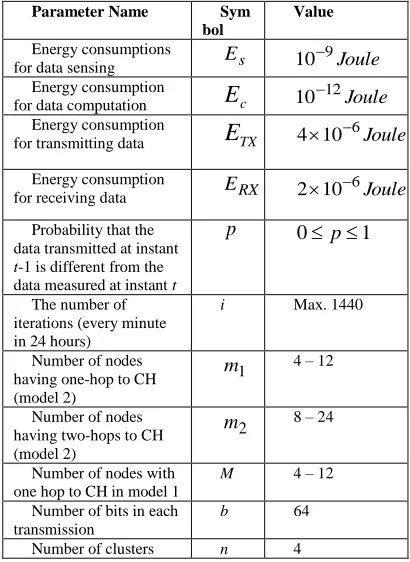
The results of the simulation-based evaluation of the proposed technique were carried out using MATLAB. In this simulation, parameter values and descriptions as summarized in Table 2 were used. Similarly, computational models described in earlier sections of the paper (Equations 1-10) were used to compute relevant parameters. Furthermore, the simulation-based results were obtained by presetting number of clusters as 1 and 4 for models 1 and 2, respectively. A maximum of 1440 iterations were run and the results obtained are presented in Figures. 3 - 6.
Table 2: Simulation parameters and their respective values
Parameter Name Sym bol
Value
Energy consumptions
for data sensing Es Joule
9
10
Energy consumption
for data computation
E
c 10 12Joule
Energy consumption
for transmitting data
E
TX Joule6
10
4
Energy consumption
for receiving data ERX Joule
6
10
2
Probability that the data transmitted at instant
t-1 is different from the data measured at instant t
p 0 p1
The number of iterations (every minute in 24 hours)
i Max. 1440
Number of nodes having one-hop to CH (model 2)
1
m 4 – 12
Number of nodes having two-hops to CH (model 2)
2
m 8 – 24
Number of nodes with one hop to CH in model 1
M 4 – 12
Number of bits in each transmission
b 64
Figure 3 illustrates the number of message transmissions in Model 1 (multiple clusters, single-hop nodes) for varying number of nodes. Here, we observe that number of message transmission is less in Scenario 1 as compared to other two Scenarios where there is no computations at the member nodes and CH in Scenario 1. Hence, no message is transmitted between nodes in Scenario 1 whereas other two Scenarios require transmitting messages among member nodes and CH to perform computations. Similarly, Figure 4 illustrates that the network energy consumption of different scenarios in Model 1. Here, we observe that the network energy consumption is less in Scenario 1 as compared to other two Scenarios for similar reasons stated above.
Fig. 3. Number of transmissions varying the number of nodes for Scenarios of Model 1
Figure 5 illustrates the network energy consumption of the different Scenarios in model 1 showing variation in the probability p, which represents the probability that the data sensed by a sensor nodes at the time instant t is different than the data that was sensed at the time instant t – 1. The energy consumption of Scenarios 2 and 3 increases if the probability increases at two consecutive time instant (i.e., data sensed that time instant t is more likely to be different than data sensed at time instant t-1). However, probability in Scenario 1 will not have much impact on energy consumption as neither member nodes of a cluster nor CH performs any data computation in Scenario On the other hand, the network energy consumption in model 2 (multi-hop, single cluster) will be much more than that in model 1 varying the probability p (as illustrated in Figure 6) because the average distance that a packet travels to reach to the destination will exceed those in model 2.
Fig. 4. Variation of network energy consumption with the number of nodes for different Scenarios of Model 1.
Fig. 5. Energy consumptions of different approaches in model 1 varying probability p
Fig. 6. Comparison of energy consumptions of models 1 and 2 varying probability p
4 CONCLUSION
Scenarios. These models include single-hop and multi-hop data transmission between member nodes and cluster head of a cluster in a sensor network. Then, each model is assessed along three computational scenarios in terms of resources for data transmission and energy cost. The three computational scenarios include Scenario 1: data computation is confined to only the sink node, Scenario 2: computation takes place in the sensors but not at the CH level and Scenario 3: computation is performed at both sensor and CH levels. Then, a simulation was conducted to measure the performance of these models with their different Scenarios in terms of energy cost and number of data transmissions. The network model that used single hop data transmission between sensor nodes and cluster head where both member nodes of a cluster and cluster head process data before transmitting to the sink node is considered to be the best model. In future, we plan to compare these approaches in terms of packet loss ratio and other relevant performance metrics.
5 REFERENCES
[1] L. M. C. Arboleda and N. Nasser, "Comparison of Clustering Algorithms and Protocols for Wireless Sensor Networks," 2006 Canadian Conference on Electrical and Computer Engineering, Ottawa, Ont., 2006, pp. 1787-1792.doi: 10.1109/CCECE.2006.277358 [2] Qing Fang, Feng Zhao, and Leonidas Guibas,
“Lightweight sensing and communication protocols for target enumeration and aggregation”, In Proceedings of the 4th ACM international symposium on Mobile ad hoc networking & computing (MobiHoc '03). ACM, New York, NY, USA, 165-176
[3] W. B. Heinzelman, A. P. Chandrakasan and H. Balakrishnan, "An application-specific protocol architecture for wireless microsensor networks," in IEEE Transactions on Wireless Communications, vol. 1, no. 4, pp. 660-670, Oct 2002. doi: 10.1109/TWC.2002.804190 [4] Lindsey S., Raghavendra C.S. “PEGASIS:
Power-Efficient Gathering in Sensor Information Systems”, IEEE Aerospace Conference, 2002.
[5] F. Bajaber and I. Awan, "Dynamic/Static Clustering Protocol for Wireless Sensor Network," 2008 Second UKSIM European Symposium on Computer Modeling and Simulation, Liverpool, 2008, pp. 524-529. doi: 10.1109/EMS.2008.22.
[6] D. Manivannan, Q. Jiang, "Routing Protocols for Sensor Networks", In proceedings of the
first IEEE Consumer Communications and Networking Conference (CCNC), Las Vegas, Nevada, USA, Jan 5 – 8 2004.
[7] Arati Manjeshwar and Dharma P. Agrawal, “TEEN: ARouting Protocol for Enhanced Efficiency in Wireless Sensor Networks”, In Proceedings of the 15th Intl. Parallel & Distributed Processing Symposium (IPDPS '01). IEEE Computer Society, Washington, DC, USA, 2001.
[8] Arati Manjeshwar and Dharma P. Agrawal, “APTEEN: A Hybrid Protocol for Efficient Routing and Comprehensive Information Retrieval in Wireless Sensor Networks”, In Proceedings of the 16th International Parallel and Distributed Processing Symposium (IPDPS '02). IEEE Computer Society, Washington, DC, USA, 2002.
[9] B. Huang, F. Hao, H. Zhu, Y. Tanabe and T. Baba, "Low-Energy Static Clustering Scheme for Wireless Sensor Network," 2006 International Conference on Wireless Communications, Networking and Mobile Computing, Wuhan, 2006, pp. 1-4. doi: 10.1109/WiCOM.2006.250
[10]V. Sharma and D. S. Saini, “Performance Investigation of Advanced Multi-Hop and Single-Hop Energy Efficient LEACH Protocol with Heterogeneous Nodes in Wireless Sensor Networks,” 2015 Second International Conference on Advances in Computing and Communication Engineering, Dehradun, 2015, pp. 192-197.
[11]Mounir Arioua, Younes el Assari, Imad Ez-zazi, Ahmed el Oualkadi, “Multi-hop Cluster Based Routing Approach for Wireless Sensor Networks”, Procedia Computer Science, Volume 83, 2016, Pages 584-591
[12]L. Karim, N. Nasser and T. E. Salti, "Efficient Zone-based Routing Protocol of Sensor Network in agriculture monitoring systems,"
2011 International Conference on
Communications and Information Technology (ICCIT), Aqaba, 2011, pp. 167-170.
[13]M. N. Jambli, A. Hendrick, A. A. Julaihi, J. Abdullah and S. M. Suhaili, "Evaluation of clustering and multi-hop routing protocols in Mobile Ad-hoc Sensor Networks," 2015 9th International Conference on IT in Asia (CITA), Kota Samarahan, 2015, pp. 1-5.
and Computing Applications (C2SPCA), Bangalore, 2013, pp. 1-4.
[15]Nouredine Seddiki, Bassou Abedsalem, “Study of the Performance of Multi-hop Routing Protocols in Wireless Sensor Networks,” International Journal of Advanced Computer Science and Applications (IJACSA), Vol. 8, No. 2, 2017.