AN OBSERVATIONAL CHECKLIST OF HEALTH DIALOGUE ELEMENTS:
DEVELOPMENT AND EVIDENCE OF RELIABILITY
M REID, A JOUBERT & P NEL UNIVERSITY OF THE FREE STATE
Abstract
Various tools assess health communication skills as exhibited in health dialogues between healthcare providers and patients. This paper explains the phased process used to develop an Observational Checklist of Health Dialogue Elements (OCHDE), and discusses evidence of its reliability. Grounded in a participatory paradigm this two-way health communication skills tool reflects the values of respect, humility and trust, and avoids a one-way approach to communication by the healthcare provider. A concept analysis enabled the identification of elements of health dialogue, namely, characteristics, antecedents, empirical referents and consequences. Each empirical referent measured a characteristic and thereby enabled assessment of the heart of health dialogue. The equality inherent in a participatory paradigm required the simultaneous observation, guided by the OCHDE, of patients and healthcare providers. Though reliability test results of other communication skills assessment tools are not readily available, the conclusion is that the OCHDE is as reliable as other communication skills assessment tools. The OCHDE offers assessment in a real life clinical setting, particularly those involving patients with chronic conditions, but is also suitable as a tool to train and assess health communication skills or to conduct research.
Keywords: Health communication, observation, checklist, assessment tool, dialogue
1. INTRODUCTION
The complexity of a two-way dialogue when communicating with patients is often a challenge for healthcare providers. Acknowledging the complexity of health dialogue, the Kalamazoo consensus statement (KCS) created an initial platform for communication skills assessment tools for healthcare providers (Participants in the Bayer-Fetzer Conference on Physician-Patient Communication in Medical Education, 2001, Han, Papireddy, Hingle, Ferguson, Koschman & Sandstrom 2017: online). The Common Ground Rating Form, Macy Model Checklist and Rochester Communication Rating Scale are examples of tools rated according to the seven essential elements of physician-patient communication according to the KSC (Schirmer, Mauksch, Lang, Marvel, Zoppi, Epstein, Brock & Pryzbylski, 2005:185).
Apart from being rated according to the KSC, communication skills assessment tools vary in format, content, aim, practicality and ease of use (Schirmer et al., 2005:185). The Communication Assessment Tool (CAT) packaged as a 14-item checklist, measure patients’ perceptions of health workers communication skills (Pagano, O’Shea, Campbell, Currie, Chamberlain & Pates, 2015:402; Newcomb, Trickey, Lita & Dort, 2017:613). Various adaptions of the CAT is found. The Health Communication Assessment Tool (HCAT), a checklist, enhances relationships between nurses and their patients, empowers nurses and develops power-sharing skills. The tool is used with ease in a simulated environment (Campbell, Pagano, O'Shea, Connery & Caron; Pagano et al. 2015: 402). The Kinyarwanda version of the CAT (K-CAT) also allowed patients perceptions to be measured (Cubaka, Schriver, Vedsted, Makoul & Kallestrup, 2018:1601).
The ComOn-Coaching-Checklist provides the opportunity for physicians to self-evaluate communication competence as well as evaluate consultations by both physicians and patients (De Figueiredo, Rodolph, Bylund, Goelz, Heusser, Sattel, Fritzsche & Wuensch, 2015:online). Another standardised communication skills checklist by Green, Gongaza, Cohen and Spagnoletti (2014) proved to be useful after health communication training, assisting in establishing the knowledge, attitudes and skills of medical residents regarding health literacy (Green et al., 2014).
paradigm thus provides a rational lens to structure these tools. Respect, humility and trust are grounded within this paradigm (Rule, 2011:929). Therefore, communication skills assessment tools rooted in this paradigm need to depict these values, especially when entering into health dialogue with patients having chronic conditions.
The values mentioned are endorsed in a concept analysis of health dialogue already reported by Reid (2015). This concept analysis resulted in identifying health dialogue elements. For the purposes of this paper a brief discussion of the elements serves as a background to the development of the health communication assessment tool (Reid, 2019:2).
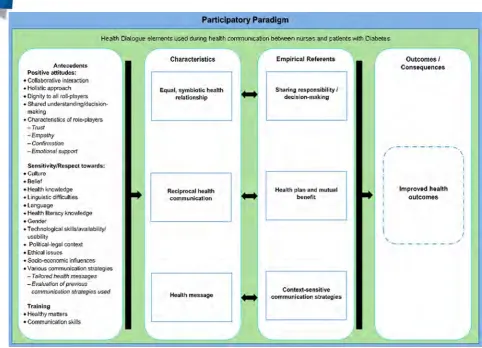
The established elements of health dialogue include “…an equal, symbiotic health relationship between the patient and the healthcare provider, and reciprocal health communication towards reaching an identified health goal via a health message. Antecedents include both patient and healthcare provider presenting with a positive attitude towards health dialogue, display sensitivity towards cultural, contextual and societal factors, and receive training on health matters and communication skills. The consequence is an improved health outcome. Empirical referents comprise sharing an understanding of responsibility/decision-making, establishing a health plan, applying context-sensitive health communication strategies, and declaring mutual benefits received from the health relationship” (Reid, 2015).
Elements of health dialogue are embedded in the participatory paradigm, placing the patient and healthcare provider on equal footing during health communication. Therefore failure to operationalise these elements of health dialogue, confines the transdisciplinary application to a theoretical exercise. Operationalisation creates the opportunity not to be stuck in the “ivory tower” of academia but to respond to the need of healthcare providers to simplify health dialogue with patients.
Insight into the development and evidence of reliability of the OCHDE could provide a possible platform for a generic communication skills assessment tool to be used by healthcare providers entering into health dialogue with patients with any chronic condition.
The two-fold aim of the paper were to describe the phased process followed to develop the Observational Checklist of Health Dialogue Elements (OCHDE), and how evidence of reliability of the checklist was established.
2. METHODS
A concept analysis and quantitative design directed the development of the OCHDE (Phase 1) and evidence of reliability of the checklist (Phase 2). Ethical clearance was obtained (ECUFS 39/2013) and the study complied with the Belmont Report and Singapore Statement on Research Integrity (National Commission for the Protection of Human Subjects of Biomedical and Behavioral Research, 1979; Singapore Statement on Research Integrity, 2010).
Phase 1: Development of the checklist
Figure 1: Elements identified through a concept analysis of Health Dialogue (Reid, 2015).
Two of the four elements namely, antecedents and empirical referents were operationalised in the development of the OCHDE. Characteristics are implicitly part of empirical referents and were therefore not included in the OCHDE. Outcomes depicted in Figure 1 can only be assessed post dialogue after a period of time has lapsed.
Extract of OCHDE observations
Rating Scale: Where applicable use the following scale when rating elements. The healthcare provider and patient should be observed simultaneously.
1 None of the specified elements observed, implying either not applicable or required 2 Element observed, but not consistently displayed/responded to
3 Element consistently displayed/responded to
Characteristics of role players
Healthcare provider Patient
Q23 Trust 1 2 3 Trust 1 2 3
Q24 Empathy 1 2 3 Empathy 1 2 3 Q25 Verification of meaning 1 2 3 Verification of meaning 1 2 3 Q26 Emotional support 1 2 3 Emotional support 1 2 3
Figure 2: Extract of OCHDE observations
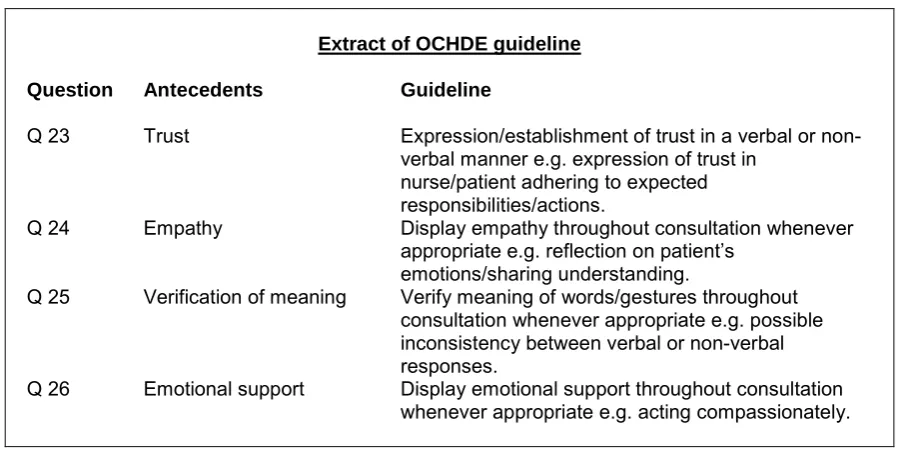
A guideline enhancing consistent observations of health communication between healthcare providers and patients supports the OCHDE. Definitions and examples of antecedents are provided to enhance reliability of the communication skills assessment tool. Refer to Figure 3.
Extract of OCHDE guideline
Question Antecedents Guideline
Q 23 Trust Expression/establishment of trust in a verbal or non-verbal manner e.g. expression of trust in
nurse/patient adhering to expected responsibilities/actions.
Q 24 Empathy Display empathy throughout consultation whenever appropriate e.g. reflection on patient’s
emotions/sharing understanding.
Q 25 Verification of meaning Verify meaning of words/gestures throughout consultation whenever appropriate e.g. possible inconsistency between verbal or non-verbal responses.
Q 26 Emotional support Display emotional support throughout consultation whenever appropriate e.g. acting compassionately.
Figure 3: Extract of OCHDE guideline
Phase 2: Reliability Testing
The reliability testing of the OCHDE required a quantitative research design. The population (N=45) consisted of academics within a Faculty of Health Sciences and a Faculty of Humanities, having a focused interest in health communication between patients and healthcare providers. A convenient sample (n=21) participated in the study. Prior to the pilot study respondents (n=5) received training on the guideline and completion of the checklist. Respondents then observed a videotaped simulated health dialogue between a patient and a healthcare provider. This created the opportunity to identify possible areas of improvement related to the checklist and the guideline. Apart from a few linguistic changes, the rating scale was simplified.
Preceding the main study, respondents (n=21) also received training on the guideline and completion of the checklist. During the main study, respondents individually and simultaneously viewed the videotaped simulation on personal computers and completed the checklist aided by the guideline. The responses of the respondents on observations in the OCHDE were analyzed using the SPSS version 23 to establish evidence of reliability of the checklist.
Rigour was upheld through the selection of respondents with a specific interest in health communication; piloting and refining of OCHDE and guideline and completion of the OCHDE aided by a guideline and SPSS program.
3. RESULTS
Results are also presented in a phased approach.
Phase 1: Development of the checklist
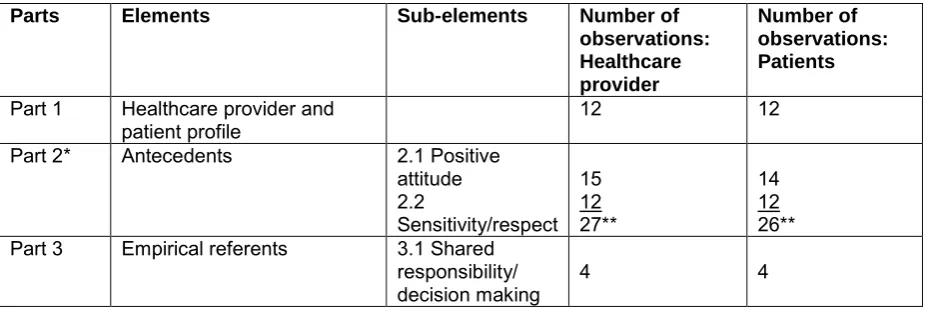
The OCHDE, as a communication skills assessment tool, consists of parts, elements, sub-elements, and observations aligned to the identified antecedents and empirical referents of health dialogue. Part 1 includes a healthcare provider and patient profile and consists of 12 observations per group. Part 2 includes antecedents and two sub-elements. The sub-element positive attitude consists of 15 observations of healthcare providers and 14 observations of patients. The sub-element sensitivity and respect consist of 12 observations per group. Part 3 includes empirical referents. The sub-element shared responsibility/decision making consists of 4 observations per group. Refer to Table 1.
Table 1: OCHDE parts, elements, sub-elements and observations
Parts Elements Sub-elements Number of
observations: Healthcare provider
Number of observations: Patients
Part 1 Healthcare provider and
patient profile 12 12
Part 2* Antecedents 2.1 Positive attitude 2.2
Sensitivity/respect 15
27**
12 14
26** 12
Part 3 Empirical referents 3.1 Shared responsibility/
decision making 4 4
*Reliability testing only performed on Part 2
Phase 2: Reliability Testing
Reliability testing was only performed on antecedents. Empirical referents, consisting of four open-ended questions, could not be observed by means of a videotaped simulated health dialogue since it included post dialogue responses. The antecedents allowed for 27 observations of healthcare providers and 26 of patients.
Cronbach’s alpha, measuring internal consistency, was used to determine the reliability of the OCHDE antecedents. It is important to note that if an element consists of a single observation the reliability of that element cannot be determined. In Table 2 N/A indicates single observations. However, the overall reliability of the OCHDE antecedents including the sub-elements can be determined. It is evident from Table 2 that, the OCHDE antecedents provides a reliable measure for health communication skills related to both healthcare providers (α = .779) and patients (α = .830). Refer to Table 2.
Table 2: Reliability results of OCHDE
Element: Antecedent Healthcare provider Patient
Cronbach’s
alpha Number of Observations
Cronbach’s
alpha Number of Observations
Positive Attitude .730 15 .789 14
Collaborative
interaction N/A 1 N/A 1
Holistic Approach .513 4 .643 4
Dignity .205 2 N/A 1
Shared Understanding .590 4 .663 4 Characteristic of Role
Player .734 4 .694 4
Sensitivity/Respect .775 12 .701 12
Gender sensitivity N/A 1 N/A 1
Language/linguistic
difficulties N/A 1 N/A 1
Culture/beliefs N/A 1 N/A 1
Sensitivity towards
health knowledge .286 2 .528 2
Health Literacy .649 2 .647 2
Technology N/A 1 N/A 1
Political context N/A 1 N/A 1
Ethical issued N/A 1 N/A 1
Socio-Economic
Influences .261 2 .242 2
Total Scale/Checklist (Antecedents)
.779 27 .830 26
Focusing on the reliabilities associated with observations measuring healthcare providers’ communication skills, it is clear that both positive attitude (α = .730) and sensitivity/respect (α =
.775) sub-elements are reliable. More specifically, two of the elements have acceptable reliabilities (α = .6 and higher). The elements being Characteristics of the Role Player (α =.734) and Health Literacy
(α =.649). However, observations related to the elements of Dignity (α = .205), Sensitivity towards Health Knowledge (α = .286), and Socio-Economic Influences (α = .261) are of concern.
In contrast, the majority of elements related to patients’ communication skills have reliability
estimates of .6 and higher. It is clear that both the positive attitude (α = .789) and sensitivity/respect (α = .701) subscales are reliable. Only the elements related to Socio-Economic Influences (α = .242) and
4. DISCUSSION
The discussion follows a phased approach, firstly describing the development of the OCHDE in relation to other communication skills assessment tools and secondly, the reliability of the OCHDE and other tools. This discussion should be viewed against the background that no agreement exists on an ideal assessment tool (Schirmer et al., 2005:185) and no universal set of communication skills is available (Lang, McCord, Harvill & Anderson, 2004:189).
4.1 Development of communication skills assessment tools
The theoretical foundation and aspects related to the format, completion and various influences on usability of these tools are relevant.
4.2 Theoretical foundation
The OCHDE is theoretically founded on a rigorous concept analysis of health dialogue (Reid 2015). Elements identified during the concept analysis guided the operationalisation of these elements within the OCHDE. Refer to Figure 1.
The theoretical foundation of other communication skills assessment tools differs. Previous empirical work guided the Four Habits Model (Frankel & Stein, 1999:79). The Common Ground Instrument (Lang et al., 2004:189) is embedded in the Toronto and Kalamazoo Consensus Statements. Additionally, modification of own work and literature reviews created the foundation for the development of the Calgary-Cambridge Guide (Kurtz, Silverman, Benson & Draper, 2003:802), Health Literacy Communication Skills Checklist (Green et al., 2014:76) and Macy Model (Kalet, Pugneaire, Cole-Kelly, Kanicik, Ferrara, Schwartz, Lipkin Jr & Lazare, 2004:511).
4.3 Formats
The OCHDE distinguishes itself from similar tools by concurrently observing the two-way dialogue between healthcare provider and patient. An observer completes the descriptive 3 - point Likert rating scale, aided by a comprehensive guideline. Refer to Figure 2.
Many tools use checklists rather than rating scales (Schirmer et al., 2005:186). Examples include the Mercy Model (Kalet et al., 2004:511) and Maastricht History-Taking and Advice Checklist (MAAS) (Van Thiel, Kraan & Van der Vleuten 1991:224). However, various formats of checklists do exist. The Calgary-Cambridge guide (Kurtz et al., 2003:802) uses a checklist with comments to respond. Whereas the HCAT (Campbell et al., 2013:e546) is structured according to dichotomous responses and closed items. Examples of tools combining checklists and rating scales are the ComOn Coaching (De Figuierede et al., 2015:online) and Roschester (Epstein, Dannefer, Nofziger, Hansen, Schultz, Jospe, Connard, Meldrum & Henson, 2004:186).
4.4 Usability
The OCHDE is developed for a real life clinical setting, but is also suitable as a tool to train and assess health communication skills or to conduct research. Usability of the OCHDE is dependent on training of observers. A simplified guideline combined with a video-taped scenario supports training. However, using the OCHDE in a real life clinical setting can pose challenges to even a trained observer. Complexities inherent to real life settings and that of observing two-way dialogue being some of these challenges. The OCHDE used a simple response scale as a strategy to address identified challenges.
4.5 Reliability of communication skills assessment tools
Reliability test results of communication skills assessment tools are not readily available. If available, these results reflect the various components of specific tools. Components vary from tool to tool. Most tools further focus on healthcare providers only, whereas data reflecting patients’ perceptions are often obtained through pre-or post-healthcare provider/patient interviews (De Figueiredo et al., 2015: online; Epstein et al., 2004:186). Adding to the complexity of reliability testing of these tools, the OCHDE requires concurrent observation of healthcare provider and patient.
The sub-elements of the OCHDE consisted of positive attitude and sensitivity/respect. Positive attitude of healthcare providers (.73) and patients (.79) as well as sensitivity/respect of healthcare providers (.78) and patients (.70) constituted the total checklist results. The OCHDE is a reliable tool to simultaneously observe health dialogue between healthcare providers (.78) and patients (.83). Refer to Table 2.
Evidently, the MAAS-R assesses nine important communication skills of an effective doctor when interviewing a patient. These skills focused on aspects such as entry, overall orientation, diagnostic planning and management planning. The MAAS was further classified into two dimensions: medical content and basic skills (Van Thiel et al., 1991:226). They found fairly low interrater reliabilities associated with both the total scale (.47) and medical content (.35). However, the basic skills component had a reliability of .63.
Stewart, Brown, Donner, McWhinney, Oates, Weston and Jordan (2000:297) developed an assessment tool of patient-centered communication. The physician-component of their instrument measures three dimensions: exploring the disease and the illness experience, understanding the whole person and finding common ground. They reported an interrater reliability of .73 among the 20 raters. Unfortunately, Stewart et al. (2000:799) did not calculate any reliability estimates for the patient-component of their instrument.
The Rochester Communication Rating Scale (RCS) consists of 19 items and is classified into four factors important to patient-centered communication, namely physician interest in the patient, understanding patients’ experience of illness, attention to context and participation in care. Epstein et al. (2004:190) reported a very high internal consistency of their scale (.91).
The Health Communication Assessment Tool (HCAT) developed by Campbell et al. (2013:e543-e550) assesses six communication factors. Rapport, empathy and avoiding miscommunication are examples of these factors. The factors were further classified into three dimensions: relationship building, education/empowerment and power sharing. The researchers found fairly good levels of internal consistency on relationship building (.87); power sharing (.91) and education/empowerment (.88). However, the authors acknowledged poor inter rater reliability among various researchers.
5. CONCLUSION
The OCHDE is as reliable as other communication skills assessment tools. The two-fold aim of the present paper were to describe the phased process followed to develop the OCHDE, and to establish evidence of reliability of the checklist. Therefore, the researchers built on evidence that this instrument provides an accurate measure of the theoretical construct. The construct health dialogue originated from a concept analysis. The researchers acknowledge that the tentative nature of a concept analysis merits some critique.
Should this identified challenge be overcome, the OCHDE provides a possible platform for a generic communication skills assessment tool to be used by healthcare providers entering into health dialogue with patients with any chronic condition. The nature of the OCHDE lends itself to be used within a training or research environment. Future research could investigate a “golden standard” for health communication assessment tools.
Author’s participation in preparing the manuscript
Dr M Reid: Corresponding author. Development and evidence of reliability of OCHDE Prof A Joubert: Co-author. Development and evidence of reliability of OCHDE Dr P Nel: Co-author. Analysis and interpretation of data
ACKNOWLEDGEMENTS
REFERENCES
Campbell, S.H., Pagano, M.P., O’Shea, E.R., Connery, C. & Caron, C. 2013. Development of the health communication assessment tool: enhancing relationships, empowerment and power-sharing skills. Clinical Simulation in Nursing, 9: e543-e550.
Cubaka, V.K., Schriver, M., Vedsted, P., Makoul, G.& Kallestrup, P. 2018. Measuring patient-provider communication skills in Rwanda: Selection, adaption and assessment of psychometric properties of the Communication Assessment Tool. Patient Education and Counselling, 101: 1601-1610.
De Figueiredo, M.N., Rodolph, B., Bylund, C.L., Goelz, T., Heusser, P., Sattel, H., Fritzsche, K. & Wuensch, A. 2015. ComOn Coaching: Study protocol of a randomized controlled trial to assess the effect of a varied number of coaching sessions on transfer into clinical practice following communication skills training. BMC Cancer, 15:503. DOI 10.1186/s12885-015-1454-z
Epstein, R.M., Dannefer, E.F., Rochester experiment. Teaching and Learning in Medicine, 16(2): 186-196.
Freire, P. 2002. Pedagogy of the oppressed. London: Penguin.
Green, J.A., Gongaza, A.M., Cohen, E.D. & Spagnoletti, C.L. 2014. Addressing health literacy through clear communication: a training program for internal medicine residents. Patient Education and Counseling, 95: 76-82.
Han, H., Papireddy, M.R., Hingle, S.T., Ferguson, J.A., Koschman, T. & Sandstrom, S. 2017. The most common feedback themes in communication skills training in an internal medicine residency program: lessons from the resident audio-recording project. Health Communication,3(May): 1-7. DOI: 10.1080/10410236.2017.1314872
Kalet, A., Pugneaire, M.P., Cole-Kelly, C., Kanicik, R., Ferrara, E., Schwartz, M. D., Lipkin Jr, M. & Lazare, A. 2004. Teaching Communication in Clinical Clerkships: Models from the Macy Initiative in Health Communications. Academic Medicine, 79(6): 511-520.
Kurtz, S., Silverman, J., Benson, J. & Draper, J. 2003. Marrying Content and Process in Clinical Method Teaching: Enhancing the Calgary–Cambridge Guides. Academic Medicine, 78: 802-809.
Lang, F., McCord, R., Harvill, L. & Anderson, D.S. 2004. Communication assessment using the Common Ground Instrument: Psychometric properties. Family Medicine, 36(3): 189-198.
Makoul, G. 2001. The SEGUE Framework for teaching and assessing communication skills. Patient Education and Counseling, 45: 23-34.
National Commission for the Protection of Human Subjects of Biomedical and Behavioral Research 1979. Belmont Report. [Online].Available:
Newcomb, A., Trickey, A.W., Lita, E., Dort, J. 2017. Evaluating surgical residents’ patient-centred communication skills: practical alternatives to the “Apprenticeship Model”. Journal of Surgical Education.https://doi.org/10.1016/j.jsurg.2017.09.011.
Pagano, M. P., O’Shea, E.R., Campbell, S.H., Currie, L.M., Chamberlain, E.& Pates, C.A. 2015. Validating the Health Communication Assessment Tool (HCAT). Clinical Simulation in Nursing, 11: 402-410.
Reid, M. 2015. Health Dialogue: A concept analysis. Paper presented at the Royal College of Nursing International Nursing Research Conference, London, 20-22 April.
Reid, M. 2019. Health Dialogue: A concept analysis. Communitas, (24):1-20. https://dx.doi.org/10.18820/24150525/Comm.v24.1
Rule, P. 2011. Bakhtin and Freire: Dialogue, dialectic and boundary learning. Educational Philosophy and Theory, 43(9): 924-942.
Schirmer, J.M., Mauksch, L., Lang, F., Marvel, M.K., Zoppi, K., Epstein, R.M., Brock, D. & Pryzbylski, M. 2005. Assessing communication competence: a review of current tools. Family Medicine, 37(3): 184-192.
Singapore Statement on Research Integrity. 2nd World Conference on Research Integrity 21-24 July
2010 Singapore [Online]. Available:
2017].
Stewart, M., Brown, J.B., Donner, A., McWhinney, I.R., Oates, J., Weston, W.W. & Jordan, J. 2000. The impact of patient-centered care on outcomes. The Journal of Family Practice, 49: 796-804.
Tomaselli, K. 2011. Paradigm interaction: Some notes on development and communication. In Tomaselli, K. & Chasi, C. (Eds.), Development and public health communication, 1-17. Cape Town: Pearson Education.
Van Thiel, J., Kraan, H.F. & Van der Vleuten, C.P.M. 1991. Reliability and feasibility of measuring medical interviewing skills: The revised Maastricht History-taking and Advice Checklist. Medical Education, 25: 224-229.
Walker, L. O. & Avant, K. C. 2014. Strategies for theory construction in nursing. 5th ed. Boston: