Abstract— Increase in energy demand, stringent emission norms and depletion of oil resources have led the researchers to find alternative fuels for internal combustion engines. The rapidly increasing consumption of fossil fuel and petroleum products has been a matter of concern for the many countries which imports more crude oil. Because it causes huge foreign exchange out-go on the one hand and increasing exhaust emission on the other. Therefore it is necessary for the development of renewable energy sources.
Present an experimental work is conducted to obtain the operating and emission characteristics of Undi Oil Biodiesel on Variable Compression Ratio (VCR) engine run on various blends of biodiesel, compression ratios and load conditions. From the comparison of results, it is inferred that the engine performance is improved with significant reduction in emissions for the chosen oils without any engine modification. Index Terms— Biodiesel, Undi Oil, Transesterification, Fuel Blends, Compression Ratio, Engine Load, Performance and Emissions, VCR CI Engine.
I. INTRODUCTION
The world energy demand has, for the last two decades, witnessed uncertainties in two dimensions. Firstly, the price of conventional fossil fuel is too high and has added burden on the economy of the importing nations. Secondly, combustion of fossil fuels is the main culprit in increasing the global carbon dioxide (CO2) level, a consequence of global warming. The scarcity and depletion of conventional sources are also cases of concern and have prompted research world-wide into alternative energy sources for internal combustion engines. Biofuels appear to be a potential alternative “greener” energy substitute for fossil fuels. It is renewable and available throughout the world. The idea of using vegetable oils as fuel for diesel engines is not new. Rudolph diesel used peanut oil to fuel one of his engines at the Paris Exposition of 1900.
The problem of using neat vegetable oils in diesel engines relates to their high viscosity. The high viscosity will lead to blockage of fuel lines, flters, high nozzle valve opening
Manuscript received Jul , 2014.
Rahul Krishnaji Bawane, PG student, Heat Power, JSPM’s Rajarshi Shahu College of Engineering, Pune, University of Pune., Pune, India, Phone/ Mobile No 8806668536.
SV Chanapattana, Prof. Mechanical Engineering Department, JSPM’s Rajarshi Shahu College of Engineering, Pune, University of Pune.
Abhay A Pawar, Prof. Mechanical Engineering Department, JSPM’s
pressures and poor atomization. One hundred percent vegetable oils cannot be used safely in DI diesel engines. The problems of high fuel viscosity can be overcome by using esters, blending and heating. Vegetable oils exhibit longer combustion duration with moderate rates of pressure rise, unlike petroleum derived fuels. The use of vegetable oils, such as palm, soya bean, sunflower, peanut, and olive oil, as alternative fuels for diesel is being promoted in many countries.
Diesel engines provide important fuel economy and durability advantages for large heavy-duty trucks, buses, and non road equipment and passenger cars. They are often the power plant of choice for heavy-duty applications. While they have many advantages, they also have the disadvantage of emitting significant amounts of particulate matter (PM) and oxides of nitrogen (NOx) and, to a lesser amount, hydrocarbon (HC), carbon monoxide (CO), and toxic air pollutants.
Although several oil bearing trees like Karanja, Mahua, Polang, Kusum, Neem, Simarauba, Sal, Linseed, Castor, Baigaba, Jatropha Curcas etc. are native to India, systematic propagation and processing of these seeds is very important in view of large scale commercial production of bio-fuels.
Undi Oil chosen for the present work of experimental investigation of performance and emission characteristic on VCR diesel engine. Undi is a species of family Guttifereae (Clusiaceae), native to India, East Africa, Southest Asia, Australia and South Pacific. Commonly it is called as „Indian laurel‟, Alexandrian Laurel, Beach calophyllum, Beauty leaf, Pannay tree, Sweet Scented Calophyllum (in English), Undi, Pongnyet, Burmese, Hawaii, Kokani, Nagachampa, (in Marathi), Sultan Champa,Surpan (in Hindi), Nagam, Pinmai, Punnagam, Punnai, Pinnay, Namere (in Tamil).
The main objective of present work is to analyze the engine Performance and Emission characteristics of diesel engines fuelled with biodiesel produced from „Undi Oil‟ and/or its blends with diesel fuel, which will help in both the direction of reducing emission problems and search of alternative fuel for CI engines.
II. MATERIAL AND METHOD
The first stage (acid catalyzed) of the process is to reduce the free fatty acids (FFA) content in oil by esterification with methanol (99% pure) and acid catalyst sulfuric acid (98% pure) in one hour time at 57ºC in a closed reactor vessel. The oil is first heated to
Performance Test of CI Engine fueled with
Undi Oil Biodiesel under Variation in Blend
Proportion, Compression Ratio & Engine Load
and methyl alcohol about 1:6 molar ratio (by molar mass of oil) is added. Methyl alcohol is added in excess amount to speed up the reaction. This reaction was proceeding with stirring at 650 rpm and temperature was controlled at 55-57ºC for 90 min. The fatty ester is separated after natural cooling.
At second level, the separated oil from the separating funnel has to undergo transesterification. Methoxide (methanol + sodium hydroxide) is added with the above ester and heated to 65°C. The same temperature is maintained for 2 hr. with continuous stirring, and then, it undergoes natural cooling for 8 hr. Glycerol will deposit at the bottom of the flask, and it is separated out by a separating funnel. The remnants in the flask are the esterified vegetable oil (biodiesel).
The separated biodiesel from the above-mentioned method contains various impurities like traces of glycerol, unused methanol, soap particles, etc. Water washing is carried out to remove all impurities. Air bubble wash is one of the methods normally recommended in the laboratory level. In this method, the impure biodiesel is placed in a beaker initially. Water is added slowly through the side wall of the beaker (both are immiscible). It is ensured that the equal amount of water is added above the level of biodiesel. Air is made to pass through the biodiesel and the water from the bottom of the beaker with the help of a bubbler (electrically operated).
The air will then take away all impurities from the biodiesel; they will move up as the bubbles move up, and they are added in the water. The unused methanol will be diluted in water. The traces of glycerol and soap particles make the water to become like soap water. Once the water becomes like soap water, the bubbler is stopped. After allowing some time for impurities to settle, the biodiesel is drained from the separating funnel, and pure biodiesel will be directly used, with or without blending, in the engine.
III. METHODOLOGY
The objective of the present work is to study through experiments on the performance and emission characteristics of TOME blends in direct injection (DI) VCR diesel engine at various load.
TABLE I:BIODIESEL BLENDS USED FOR EXPERIMENTATION
Blen d Type Blend IOP in bars Injection Timing in degree bTDC Compression Ratio Engine Load in KW H00 100% Diesel 210 27 14.5 : 1 0.75 H25 25% UOME +75% Diesel 15.5 : 1 1.50 H50 50% UOME +50% Diesel 16.5 : 1 2.25 H75 75% UOME + 25 Diesel 17.5 : 1 3.0
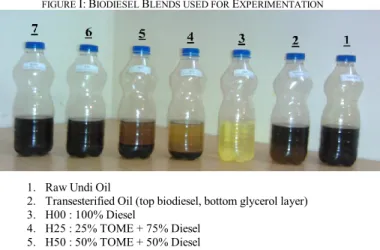
FIGURE I:BIODIESEL BLENDS USED FOR EXPERIMENTATION
1. Raw Undi Oil
2. Transesterified Oil (top biodiesel, bottom glycerol layer) 3. H00 : 100% Diesel
4. H25 : 25% TOME + 75% Diesel 5. H50 : 50% TOME + 50% Diesel 6. H75 : 75% TOME + 25% Diesel 7. H100 : 100% TOME
The properties of H100 (TOME) and Diesel were determined as per the methods approved by Bureau of Indian Standards.
TABLE II:CHARACTERISTICS OF FUEL USED
Parameter Test Standard Diesel (H00) UOME (H100) Raw Undi Oil Density at 15ºC (gm/cc) (P16) 2007 IS 1448 0.835 0.8653 0.9363 Kinematic Viscosity at 40ºC (cst) (P25) 2007 IS 1448 3.5 1.744 51.58 Calorific Value (MJ/Kg) (P6) 2007 IS 1448 43.00 25.74 40.27 Flash Point (ºC) (P69) 2013 IS 1448 44 8.5 220
FIGUREII:ENGINE SETUP
1. Test Engine, 2. Electrical Dynamometer, 3. Fuel Tank,
4. Fuel Burette, 5. Test Bed, 6. Silencer, 7. Smoke Meter, 8. HC/CO/NOx/CO2/O2 Analyzer, 9. Exhaust Temperature Sensor,
FIGURE III:VCR ENGINE
FIGURE IV:INDUS GAS ANALYZER
TABLE III:ENGINE SPECIFICATIONS
Sr.
No. Description Specification
1 Make Rocket Engineering Model VRC-1
2 Bore 80 mm
3 Stroke 110 mm
4 Swept Volume 553 mm
5 RPM 1500
6 Brake Horse Power 5 HP 7 Compression Ratio 17.5 : 1
8 Fuel Oil High Speed Diesel
9 Coefficient of Discharge 0.65
10 Water Flow Transmitter 0 to 10 lit./min. 11 Air Flow Transmitter 0 to 250 wc
12 Piezo Sensor 0 to 5000 psi with low noise cable
13 Software Labview
IV. RESULTS AND DISCUSSION
4.1 Variation of Exhaust Gas Temperature
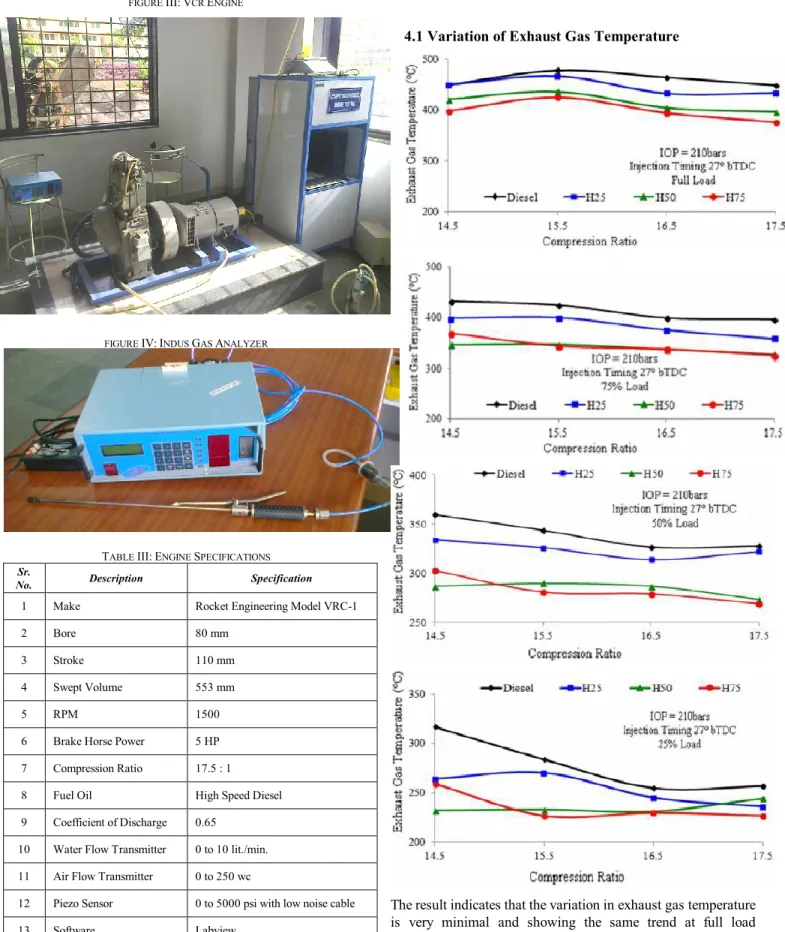
The result indicates that the variation in exhaust gas temperature is very minimal and showing the same trend at full load condition, but partial load condition upto 50% load, is distracted. For full load condition, when the compression ratio is varied from 14.5 to 17.5, the highest temperature obtained is 476°C for diesel, 467°C for H25, 434°C for H50 and 422°C for H75, all are at the compression ratio of 15.5.
The lowest temperature obtained is 446°C for diesel, 434°C for H25, 394°C for H50 and 373°C for H75, all are at the compression ratio of 17.5.
These performance characteristic curves of the biodiesel and its blends have been compared by with the diesel and found at all conditions, as shown in Figure, shows lower Exhaust Gas Temperature. When the load is increased, particularly at high loads. This could be due to low viscosity of biodiesel, which improve the spray formation in combustion chamber and thus leads to a less dominant diffusion combustion phase than diesel. 4.2 Variation of CO Emission
The percentage of CO emission for low compression ratio increases due to the rising temperature in the combustion chamber. The CO emission of the biodiesel and its blends are found to be lower for high compression ratio.
For full load condition, when the compression ratio is varied from 14.5 to 17.5, the highest CO emission obtained is 1.054%
for diesel, 1.585% for H25, 1.938% for H50 and 1.905% for H75, all are at the compression ratio of 14.5.
The lowest CO emission obtained is 0.365% for diesel, 0.06% for H25, 0.066% for H50 and 1.187% for H75, all are at the compression ratio of 17.5.
The effects of compression ratio on CO emissions for all engine load conditions are shown in Figures. The CO emissions are higher at lower compression ratio, however, decreased at higher compression ratio. This is due to relatively complete combustion takes place at higher compression ratio.
The CO emissions for biodiesel and its blends are higher, compared to diesel over the entire range of fuel blends, except H25, due to poor volatility of biodiesel resulting in poor mixing, rich pockets formed in combustion chamber, and consequently, poor combustion, which leads to higher CO emission
From the figures, the biodiesel and its blends emits lower percentage of CO2 as compared to diesel at higher compression ratio, this is because of the vegetable oil contains oxygen contents in it, so the carbon content is relatively lower in the same volume of fuel consumed at the same compression ratio, due to this CO2 emissions would have been decreased compared to diesel.
At lower compression ratio, incomplete combustion of high carbon content diesel fuel causes less CO2 emissions as compared to biodiesel and its blends, but in the present work CO2 emissions of H25 blend which have minimum biodiesel, shows highest CO2. This requires further investigations. For full load condition, the highest CO2 emission obtained is 4.47% for diesel with lowest emission obtained is 0.4% for H25, 2.86% for H50 and 3.19% for H75, all are at the compression ratio of 17.5.
The lowest CO2 emission obtained is 1.96% for diesel, with highest emission obtained is 5.04% for H25, 3.75% for H50 and 4.32% for H75, all are at the compression ratio of 14.5.
4.4 Variation of HC Emission A.
The HC emission decreases with increase in compression ratio for the entire range of fuels, this is due to the complete combustion of fuel at a higher compression ratio, hence less amount of HC will emits.
For the full load condition, the highest HC emission obtained is 103ppm for diesel at compression ratio 15.5, and 100ppm for H25, 214ppm for H50 and 235ppm for H75 , all at compression ration 14.5.
The lowest emission obtained is, 34ppm for diesel, 10ppm for H25, 89ppm for H50, all these at compression ratio 17.5, but 142ppm for H75 at compression ratio 16.5.
The effects of compression ratio on HC emissions are shown in Figures. The HC emissions is higher at lower compression ratio, as expected, this is due to relatively less compression which retard the reactions of combustion, because of poor volatility, the poor spray characteristics, poor mixing, rich pockets formed in combustion chamber.
From the figures, it is observed that the NOx emission for entire range of fuel is higher at the compression ratio 15.5, this is due to highest temperature is observed at this compression ratio. But the expected was, highest NOx emission obtained at highest compression ratio 17.5, as the higher peak temperature observed with higher compression ratio.
For the full load condition, the highest NOx emission obtained is 430ppm for diesel at compression ratio 17.5, and 419ppm for H25, 611ppm for H50 and 629ppm for H75 , all about compression ration 15.5.
The lowest emission obtained is, 166ppm for diesel at compression ratio 14.5, 89ppm for H25 at compression ratio 17.5, and 250ppm for H50, 301ppm for H75, both at compression ratio 14.5.
4.6 Variation of O2 Emission
Figures shows that O2 emission increases continuously with increases in compression ratio, this is due to increases in compression ratio , there is complete combustion thus oxygen requirement is mainly for CO2, but at lower compression ratio, there is more oxygen used in formation of CO, NOx in addition to that of CO2, thus oxygen content in exhaust gases is decreased.
Biodiesel and its blends shown higher O2 emission as compared to diesel for full load conditions, this is because of vegetable oil contains oxygen consent in it, so the overall carbon content is relatively lower, thus excess oxygen is remains in exhaust emissions.
For the full load condition, the highest O2 emission obtained is 13.73% for diesel, 20.87% H25, both at compression ratio 17.5, 17.03% for H50, 14.40% for H75, both at compression ratio 16.5.
The lowest emission obtained is 11.76% for diesel, 12.76% H25, both at compression ratio 14.5, 13.97% for H50, 11.24% for H75, both at compression ratio 15.5.
It has been observed from the figures, there is a steady increase in brake thermal efficiency as compression ratio increases. Biodiesel and its blends results in decreased brake thermal efficiency as compared to diesel over the entire range of compression ratio., which is as per expected, due to oxygen present in the Undi oil molecules improves the combustion characteristics but poor volatility result in poor atomization and poor spray characteristics. The poor spray pattern may affect the homogeneity of air fuel mixture which in turn lower the heat released rate thereby reduction in brake thermal efficiency than diesel.
Also the lower heating value of biodiesel leads to injection of higher quantities of fuel as compared to diesel for the same load conditions hence, decrease in brake thermal efficiency.
For the full load condition, the highest ηbth obtained is 19.70% for diesel, 16.58% for H25, 12.86% for H50 and 9.92% for H75 , all at compression ration 17.5, this is due to higher compression ratio, higher will be peak pressure, and higher conversion of energy into to work., as compared to all other lower compression ratio.
The lowest ηbth obtained is, 10.11% for diesel, 7.92% for H25, 6.48% for H50, and 4.31% for H75, all at compression ratio
4.8 Variation of Brake Specific Fuel Consumption
V. VI. VII. VIII. IX. X.
The brake specific fuel consumption (BSFC) decreases with the increase in compression ratio, as expected. This is because of , at higher compression ratio power generated is more, with respect to fuel consumption rate.
Figures shows that, BSFC for biodiesel and its blends are higher than that of diesel. This is due to lower heating value of biodiesel, lower the power generation for the same fuel consumption rate as compared to diesel.
For the full load condition, the highest BSFC obtained is 1.57Kg/KW-h for diesel, 2.05 Kg/KW-h for H25, 2.72 Kg/KW-h for H50 and 3.14 Kg/KW-h for H75 , all at compression ratio 14.5, this is due to lower compression ratio, lower will be
conversion of energy into to work, and higher will be the fuel consumption as compared to all other higher compression ratio. The lowest BSFC obtained is 0.41Kg/KW-h for diesel, 0.61Kg/KW-h for H25, 0.94Kg/KW-h for H50 and 1.38Kg/KW-h for H75 , all at compression ratio 17.5.
V. CONCLUSIONS
The study aims to evaluate the suitability of using biodiesel as an alternative fuel in VCR engine. Experimental investigations were carried out on the operating characteristics of the engines. The following conclusions are drawn from the investigations,
Biodiesel and its blends results in slightly decreased brake thermal efficiency as compared to diesel over the entire range of compression ratio. – This is due to biodiesel from Undi oil, have poor volatility result in poor atomization and poor spray characteristics, which lead to poor homogeneity of air fuel mixture which in turn lower the heat released rate thereby reduction in brake thermal efficiency than that of diesel.
BSFC for biodiesel and its blends are higher than that of diesel. – This is due to lower heating value of biodiesel, lower the power generation for the same fuel consumption rate as compared to diesel.
Exhaust Gas Temperature, EGT, for the biodiesel and its blends found lower at all conditions as compared to diesel. – This could be due to low viscosity of biodiesel, which improve the spray formation in combustion chamber and thus leads to a less dominant diffusion combustion phase than diesel.
The CO emissions are higher at lower compression ratio, and decreased at higher compression ratio. – This is due to relatively complete combustion takes place at higher compression ratio.
The CO emissions for biodiesel and its blends are higher, compared to diesel over the entire range of fuel blends. – This is due to poor volatility of biodiesel resulting in poor mixing, rich pockets formed in combustion chamber, and consequently, poor combustion, which leads to higher CO emission
The biodiesel and its blends emits lower percentage of CO2 as compared to diesel at higher compression ratio. – This is because of the vegetable oil contains oxygen contents in it, so the carbon content is relatively lower in the same volume of fuel consumed at the same compression ratio.
The HC emission decreases with increase in compression ratio for the entire range of fuels, and for biodiesel and its blend it is higher than diesel. – This is due to the complete combustion of fuel at a higher compression ratio, hence less amount of HC will emits. Biodiesel and its blends, due to poor volatility and poor mixing retard the chemical reaction which results in higher HC emission as compared to diesel.
The NOx emission for entire range of fuel is higher at low compression ratio this is due to highest temperature is observed at this compression ratio. But the expected was, highest NOx emission obtained at
highest compression ratio as the higher peak temperature observed with higher compression ratio. The O2 emission increases continuously with increases
in compression ratio – This is due to increases in compression ratio , there is complete combustion thus oxygen requirement is mainly for CO2, but at lower compression ratio, there is more oxygen used in formation of CO, NOx in addition to that of CO2, thus oxygen content in exhaust gases is decreased.
Biodiesel and its blends shown higher O2 emission as compared to diesel – This is because of vegetable oil contains oxygen consent in it, so the overall carbon content is relatively lower, thus excess oxygen is remains in exhaust emissions.
From the above conclusions, it is proved that the biodiesel could be used as an alternative fuel in VCR engine without any engine modifications.
ACKNOWLEDGMENTS
I have great pleasure in submitting this paper. It give me immense pleasure to record my debt of gratitude and my warmest regards to HOD Mechanical Department, Prof. Abhay A Pawar, and Prof. S V Channapatanafor, JSPM‟s RSCOE, Tathawade, Pune. The various values that tried to learn from her shall remain a source of inspiration for me forever.
Last but not the least, Mrs. Dr. A. V. Patil, Principal, Pad. Dr. DY Patil Institute of Engineering, Management & Research, Akurdi, Pune, for their blessings and support, with the permission to use college facilities and IC engine setup for the above experimental work.
I am thankful to my family for their whole hearted blessings are always for me support and constant encouragement towards the fulfillment of the work.
REFERENCES
[1] BK Venkanna, C Venkataramana Reddy “Performance, Emission And Combustion Characteristics Of Direct Injection Diesel Engine Running On Calophyllum Inophyllum Linn (Honne) Oil”, International Journal Agric & Biol Engineering, 26 March, 2011, Vol. 4 No.1, http://www.ijabe.org.
[2] Chavan S.B., Kumbhar R.R. and Deshmukh R.B. “Calophyllum Inophyllum Linn (Honne) Oil, A Source For Biodiesel Production”, Research Journal of Chemical Sciences, ISSN 2231-606X, Vol. 3(11), 24-31, November (2013) Res. J. Chem. Sci.
[3] H Suresh Babu Rao, DR T Venkateswara Rao and DR K Hema Chandra Reddy, “Palm Oil And Calophyllum Inophyllum Oil Are Potential Feed Stocks For Future Biodiesel In Compression Ignition Engines”, International Journal of Mechanical Engineering and Technology (IJMET), ISSN 0976 –6340(Print), ISSN 0976 – 6359(Online) Volume 4, Issue 5, September - October (2013) © IAEME.
[4] Murugu M. K. K., Mohanraj T. And Rajamohan G “Investigation On The Performance Of Diesel Engine Using Various Bio-Fuels And The Effect Of Temperature Variation” Journal of Sustainable Development,
Volume-2,No.3,November 2009,
www.ccsenet.org/journal.htmlparticles.
[5] G Basavaraj, P Parthasarathy Rao, Ch Ravinder Reddy, A Ashok Kumar, P Srinivasa Rao and BVS Reddy, “A Review Of The National Biofuel Policy In India: A Critique Of The Need To Promote Alternative Feedstocks”, International Crops Research Institute of the Semi-Arid Tropics, Patancheru 502 324, Andhra Pradesh, India.
[6] K.Dilip Kumar, P.Ravindra Kumar, “Experimental Investigation Of Cotton Seed Oil And Neem Methyl Esters As Biodiesel On CI Engine”, International Journal of Modern Engineering Research (IJMER)
www.ijmer.com Vol.2, Issue.4, July-Aug 2012 pp-1741-1746 ISSN: 2249-6645.
[7] K.keerthi, Kiran.C.kariankal, S.sravya, “Performance Characteristics Of Four Stroke Single Cylinder Diesel Engine With 10% Iso Butanol At Different Injection Pressures”, International Journal of Modern Engineering Research (IJMER) www.ijmer.com Vol.3, Issue.1, Jan-Feb. 2013 pp-311-316 ISSN: 2249-6645.
[8] Ashish Jawalkar, Kalyan Mahantesh, M Jagadish, Madhusudhan Merawade, M C Navindgi, “Performance And Emission Characteristics Of Mahua And Linseed Biodiesel Operated At Varying Injection Pressures On Ci Engine”, International Journal of Modern Engineering Research (IJMER), www.ijmer.com Vol.2, Issue.3, May-June 2012 pp-1142-1149 ISSN: 2249-6645.
[9] B Deepanraj, C. Dhanesh, R. Senthil, M. Kannan, A. Santhoshkumar and P. Lawrence, “Use Of Palm Oil Biodiesel Blends As A Fuel For Compression Ignition Engine”, American Journal of Applied Sciences 8 (11): 1154-1158, 2011, ISSN 1546-9239, © 2011 Science Publications. [10] Paresh K. Kasundra, Ashish V. Gohil , “Performance Test Of CI Engine With Different Vegetable Oil As A Fuel”, International Journal of Engineering Trends and Technology- Volume2Issue3- 2011, ISSN: 2231-5381 http://www.internationaljournalssrg.org
[11] K. Naima and A. Liazid, “Waste Oils As Alternative Fuel For Diesel Engine - A Review”, Journal of Petroleum Technology and Alternative Fuels Vol. 4(3), pp. 30-43, March 2013 Available online at http://www.academicjournals.org/JPTAF DOI: 10.5897/JPTAF12.026 ©2013 Academic Journals.
[12] FK Forson, EK Oduro, E Hammond-Donkoh, “Performance Of Jatropha Oil Blends In A Diesel Engine”, Renewable Energy 29 (2004)1135–1145, Elsevier Ltd.doi:10.1016/j.renene.2003.11.002 [13] Hariram V. and G. Mohan Kumar, “Combustion Analysis Of Algal Oil
Methyl Ester In A Direct Injection Compression Ignition Engine”, Journal of Engineering Science and Technology Vol. 8, No. 1 (2013) 77 - 92 © School of Engineering, Taylor‟s University.
[14] Ashish Karnwal, Naveen Kumar, M.M. Hasan, Rajeev Chaudhary, Arshad Noor Siddiquee and Zahid A. Khan. “Production of Biodiesel from Thumba Oil: Optimization of Process Parameters”, Iranica Journal of Energy & Environment 1 (4): 352-358, 2010 ISSN 2079-2115 IJEE an Official Peer Reviewed Journal of Babol Noshirvani University of Technology.
[15] AC Dweck and T Meadowsy, “Undi (Calophyllum inophyllum) – the African, Asian, Polynesian and Pacific Panacea”, International Journal of Cosmetic Science, 2002, 24, 1-8
Rahul Krishanaji Bawane, PG student, Mechanical (Heat Power), JSPM‟s Rajarshi Shahu College of Engineering, Tathawade, Pune University, Pune, India. Born on dated 14th Jan. 1979. He has completed his
graduation in Mechanical Engineering, from BDCOE, Wardha, in the year 2005, secured first class (77.76%), Nagpur University. Also he has completed Diploma in Mechanical Engineering, from ASTS, Pimpri, Wardha, in the year 2000, securing first class (74.42%), MSBTE, Mumbai Board, and ITI diploma in Automobile, from HITI, Pulgaon, Wardha, in the year 1996, securing first class (80.81%). Currently working as a Lecturer in Pad. Dr. DY Patil Institute of Engineering, Management and Research, Akurdi, Pune, (India).
SV Channapattana, Assistance Professor, JSPM‟s Rajarshi Shahu College of Engineering, Tathawade, Pune University, Pune, India. He has completed his PG in Mechanical (Heat Power) And pursuing PhD. He has a 17 years of experience in teaching, and numbers of papers are published in International and National Journals.
Dr. Abhay A Pawar, Ph.D. (Mech. Engg.) Professor & Head Department of Mechanical Engineering, JSPM‟s Rajarshi Shahu College of Engineering, Tathawade, Pune University, Pune, India. He has a 18 years of experience in teaching, and numbers of papers are published in International and National Journals.