VOLUME 6
September 1953
Number 5
In this Issue
Editorials
Our 1953 Student Issue... Joseph F. Pechanec
291
Let's Broaden the Journals Horizons
M.A. MacDonald and C.M Williams
291
National Meetings Are Also for Students
Ellis F. Sedgley
293
Some Notes and Quotes on Range Education
E.J. Dyksterhuis
295
Some Effects of Different Intensities of Grazing on Mixed
Prairies near Hays, Kansas
G.W. Tomanek and F.W. Albertson
299
Range Education form the Rancher's Viewpoint
George E. Weaver
307
Effects of Clipping on Some Range Shrubs
George A. Garrison
309
A Device for Determining Boundaries of Browse Plots
Robert R. Rhodes
318
Effect of Stage of Seedling Development upon Heat
Tolerance of Bromgrasses
Horton M. Laude and B.A. Chaugule
320
Range Management for the Small Ranch
Norwin E. Linnartz
325
The Quandary of Utilization and Preference
C.Wayne Cook and L.A. Stoddart
329
Range Education in the Field
T.Guy Stewart and Chas. L. Terrell
336
Better Cattle Distribution Through the Use of Meal-Salt
Mix ... ... ... ... Fred N. Ares
341
Bluestem Pasture in Summer and Winter for Making Beef
E.F. Smith
347
Technical Notes:
Caucasian Bluestem in Kansas... H. Leo Brown
350
Book Reviews:
The Geography of Hunger (de Castro)
C.L. Forsling
353
An Introduction to Statistical Science in Agriculture
(Finney) ... ... Joseph H. Robertson
354
Hell on Horses and Women (Marriott)
Liter E. Spence
354
Current Literature... ... Robert H. Humphrey
356
Range Student Roundup ... ... ... ... 362
News and Notes . ... ... ... ... 374
With the Sections... ... ... ... 377
Published Quarterly by
e&d
TO MEMBERS
1
Bind your copies of the Journal into Per- manent I-olumes. Green Library Buckram - (1) Name of Journal, (2) Volume (3) Year and (4) your name gold stamped on back. $2.80 per volume, postpaid, in the u. s.
Ship Journals to us parcel post or book post. Send letter with your check or money order, giving name you desire on Volumes. Be sure to include your com- plete address.
Y
VALTERS
AND SONS
382 7 Ravenswood Ave., Chicago 13, Ill.
w
Book Binders for Six Generations
Longmont Seed Co,
Field Seeds & Complete Seed ServiceBuy - Clean - Treat - Sell
Legumes - Grasses - Grain
LONGMONT, COLORADO
SEVENTH
ANNUAL MEETING
Omaha, NebraskaJanuary 26, 27, 28, and 29, 1954
American Society of Range Management
HEADQUARTERS for the meeting will be in the
FONTENELLE HOTEL. The annual banquet will be held on THURSDAY evening, JANUARY 28.
Entertainment plans definitely include the lad- ies, so bring the wives.
The Board of Directors will meet on January 26.
More details regarding the meeting, program, and entertainment will be published in the Nov- ember issue of the Journal.
’
Sendyour extrd
copies of the
JOURNAL OF RANGE MANAGEMENT
TO THE EXECUTIVE SECRETARY
who
will puy you
$1.00
euch
for them.
Volume III, No. 1 . . . .$l.OO Volume V,No. 2.. . . . .$l.OO
Volume IV, No. 1. . . . 1.00 Volume V, No. 3. . . . 1.00
Volume V, No. 1. . . . 1.00 Volume V, No. 4. . . . 1.00
YOU WILL SAVE POSTAGE IF YOU MAIL UNDER THIRD CLASS POSTAGE
OR AS PRINTED MATTER.
MAIL TO:
W. T. WHITE,
Executive Secretary
the Backbone of Agriculture
for debendable wpplies
J I
of
Gnusseeds
look to
MILLER
sP eciulz’st iu
SEED
COMPANY
Western
Range
Gnzsses
NATIVE
GRASSES
TAME GRASSES
Stocks bbtained from the Southern to the
Northern parts of the country. Some of
the seed is harvested by us from selected
fields.
We invite your inquiries and invitations to bid.
THE
AMERICAN SOCIETY
OF RANGE MANAGEMENT
OBJECTIVES
To foster advancement in the science and art of grazing land management, to promote progress in the conservation and greatest sustained use of forage and soil resources, to stimulate discussion and understanding of scientific and practical range and pasture problems, to provide a medium for the exchange of ideas and facts among society members and with allied technologists, and to encourage professional improvement of its members.
MEMBERSHIP
Persons shall be eligible for membership who are interested in or engaged in practicing range or pasture management or animal husbandry; administering grazing lands; or teaching, or conducting research, or engaged in extension activities in range or pasture management or related subjects.
OFFICERS
PRESIDENT: B. W. Allred, U. S. Soil Conservation Service, Fort Worth 1, Texas
VICE-PRESIDENT: Floyd D. Larson, U. S. Bureau of Land Management, 1245 North 29th St., Billings, Montana
EXECUTIVE SECRETARY: W. T. White, 209 S.W. 5th Ave., Portland 4, Oregon
BOARD OF DIRECTORS
PAST PRESIDENT: L. A. Stoddart, Dept. of Range Management, Utah State Agricultural College, Logan, Utah
1951-53
A. P. Atkins, P. 0. Box 270, Guymon, Oklahoma
Fred H. Kennedy, U. S. Forest Service, Federal Center, Bldg. No. 85,
Denver, Colorado 1952-54
E. J. Dyksterhuis, U. S. Soil Conservation Service, Lincoln 1, Nebraska
Harold F. Heady, School of Forestry, University of California, Berkeley 4, California
1953-55
David F. Costello, Pacific Northwest Forest and Range Experiment Station, 423 U. S. Court House, Portland 5, Oregon Vernon A. Young, Department of Range and Forestry, Agricultural
Journal of
Volume 6, Number 5, l September, 1953RANGE
MANAGEMENT
Editorials
Our
1953
Student Issue
T
HIS, our 1953 Student Issue, marks the first step in achieving a goal hoped for by Editor R. S. Campbell in his editorial on page 301 of the 1952 Student Issue of the Journal. The con-s tinued increase in response by students
and schools in contributing worthwhile and interesting information has been exceedingly gratifying.
Under the guidance of Professor Omer E. Sperry, Department of Range and Forestry, Agricultural and Mechanical College of Texas, two student editorials, three articles on range education, three student research articles, and four ab- stracts of theses have been assembled. In addition, thirteen colleges and uni-
Let’s Broaden the Journal’s Horizons
I
N 1948 about 500 far sighted range-men formed the nucleus of the American Society of Range Management, a focal point for those possessing mutual in- terests in Range Management. The general desire for such an organization was immediately indicated by the sponc taneous increase in membership once the objectives of the Society were an- nounced. To foster advancement in the science and art of grazing land manage- ment, to promote progress in the con- servation and greatest sustained use of forage and soil resources, to stimulate discussion and understanding of scientific and practical range and pasture prob-versities have submitted items for the Range Student Roundup and the News and Notes. This issue is a suitable tribute to Professor Sperry’s enthusiastic re- sponse to our request, and his effort in soliciting, assembling and editing material submitted.
It is through the efforts of range stu- dents that have contributed to this issue, and others like them, that the objectives of our Society will continue to be met in years to come. Judging from their will- ingness to work for the Society, and the breadth of their interests, we have much reason for optimism.---Joseph F. Pechanec,
Editor.
lems, to provide a medium for the ex- change of ideas and facts among mem- bers with allied technologists, and to encourage professional improvement of its members; these objectives constitute a very ambitious program indeed. Is this program being undertaken and ful- filled through the medium of this Jour- nal? It is on the subject matter of the Journal that we should like to comment.
Is the Journal as our organ of communi- cation helping to promote the advance- ment of good range management? Is it a medium of exchange of ideas and facts among allied technologists? Let us exam- ine issues of the Journal published to date.
Journal of
Volume 6, Number 5, l September, 1953RANGE
MANAGEMENT
Editorials
Our
1953
Student Issue
T
HIS, our 1953 Student Issue, marks the first step in achieving a goal hoped for by Editor R. S. Campbell in his editorial on page 301 of the 1952 Student Issue of the Journal. The con-s tinued increase in response by students
and schools in contributing worthwhile and interesting information has been exceedingly gratifying.
Under the guidance of Professor Omer E. Sperry, Department of Range and Forestry, Agricultural and Mechanical College of Texas, two student editorials, three articles on range education, three student research articles, and four ab- stracts of theses have been assembled. In addition, thirteen colleges and uni-
Let’s Broaden the Journal’s Horizons
I
N 1948 about 500 far sighted range-men formed the nucleus of the American Society of Range Management, a focal point for those possessing mutual in- terests in Range Management. The general desire for such an organization was immediately indicated by the sponc taneous increase in membership once the objectives of the Society were an- nounced. To foster advancement in the science and art of grazing land manage- ment, to promote progress in the con- servation and greatest sustained use of forage and soil resources, to stimulate discussion and understanding of scientific and practical range and pasture prob-versities have submitted items for the Range Student Roundup and the News and Notes. This issue is a suitable tribute to Professor Sperry’s enthusiastic re- sponse to our request, and his effort in soliciting, assembling and editing material submitted.
It is through the efforts of range stu- dents that have contributed to this issue, and others like them, that the objectives of our Society will continue to be met in years to come. Judging from their will- ingness to work for the Society, and the breadth of their interests, we have much reason for optimism.---Joseph F. Pechanec,
Editor.
lems, to provide a medium for the ex- change of ideas and facts among mem- bers with allied technologists, and to encourage professional improvement of its members; these objectives constitute a very ambitious program indeed. Is this program being undertaken and ful- filled through the medium of this Jour- nal? It is on the subject matter of the Journal that we should like to comment.
Is the Journal as our organ of communi- cation helping to promote the advance- ment of good range management? Is it a medium of exchange of ideas and facts among allied technologists? Let us exam- ine issues of the Journal published to date.
292 EDITORIALS
Coupling careful planning with the new society’s impetuousness of youth, the early editions were filled with in- centive, inspiration, and high ambition. The establishment of a new society in the face of numerous other well founded organizations that deal with certain phases of range management was justi- fied and the principles of the Journal outlined. The response to membership drives and appeals for contributors was excellent permitting the Journal to both increase the size and number of issues per year. To date many phases and prob- lems of Range Management in both Canada and the United States have been reported resulting in technological and management improvements where similar situations existed in other sections of the continent. The increase in Journal size is, therefore, a step toward the fulfillment of the objective to cover adequately all the material that should be printed and made available to society members since many members cannot subscribe to sev- eral other journals and are not located in an area where a library is readily available.
But should we not also increase the scope of the sources of contribution? The reason for such a proposal may be explained by the following two illustra- tions. First, in the FAO report (1951) “Improving the World’s Grasslands” well over half the references listed are from countries outside North America. Without doubt, workers in Australia, New Zealand and South Africa are much farther advanced than we in such phases of range management as pasture fertiliza- tion, biological control of noxious weeds and range parasite control. Surely these problems are not unique to foreign coun- tries. Secondly, at the Sixth International Grassland Congress held at Pennsylvania State College last year, at least sixty percent of the 250 authorities invited to address the various sections of the
Congress were from foreign countries. It is therefore readily seen that ideas and techniques developed in one country may often find employment as such in other countries or form the basis for techniques in solving somewhat similar problems. To what extent have foreign workers been encouraged to publish in our Journal thereby assisting in our accumulation and exchange of new ideas? At this time of writing the Journal has published over 80 papers and editorials. On breaking this down it may be seen that over 70 articles were written in North America involving North American work, 2 were Hawaiian, 5 were written by Americans visiting for- eign countries and only 3 were written by foreign contributors concerning for- eign work. Thus, while more than 50 percent of the outstanding references in the FAO report came from foreign authors only 5 percent of the articles in our Journal fall into that category. By our arithmetic, simple as it may be, that does not constitute much of an exchange of ideas outside our own North American sphere. If this situation persists how with our one Journal, can libraryless members avoid the regressive stagnation resulting from inbred ideas and a narrow view- point?
EDITORIALS 293
National Meetings Are Also for Students
J
KST because you are a student, don’t think you aren’t welcome at the Society’s national meetings. As a student who has attended two national meetings, I can assure you that they are both en- joyable and educational. With a little assistance from your school or some con- servation agency, the meetings are within the financial reach of any student. If you are a typical student, you will probably ask, “What’s in it for me?” In the follow- ing paragraphs I will tell you what I be- lieve is in it for you.During your college career you have undoubtedly been forced to digest vast quantities of technical literature. Per- haps you have suspected that the authors of this material composed it for the sole purpose of confusing range management students. At the national meeting you will find assembled under one roof most of the important men in the field of range management. Names such as Samp- son, Stoddart, Clawson, and Saunderson will no longer be cold names from a book cover. They will instead become per- sonalities-men you have met and talked with.
You will find these men to be warm and friendly. To them the student represents a promise that the work they have de- voted their lives to will be carried on. I will always remember my first meeting with Dr. Sampson. (His students call him Sammy). He left a group of his col- leagues to greet me and my fellow stu- dents. His first remark was, “Isn’t it wonderful that we have so many students who can be here!” This attitude was expressed in one way or another by all of the prominent men I met at the meetings.
The reports and discussions that are presented at the meetings represent the very latest work and philosophies’ of range management. If this information
is important to the recognized authori- ties, it is doubly important to the student. Let’s get away from the academic benefits and review the recreational as- pects. If nothing else, the trip promises a week’s vacation from school. It is a chance to travel through new country and meet new people.
The plant identification contest spon- sored by the society will give you a chance to compete against other students from other schools and perhaps to take home a trophy for your school. If you do not win the first time you will have a little incentive to do better the next year. This incentive will make your taxonomy courses more interesting and profitable. You will certainly enjoy the banquet and alumni meetings. They afford an opportunity to meet influential people on a personal basis. All of us are in- terested in jobs, and these meetings are a good place to find them. For example, last year at the Boise meeting, one of my fellow students made arrangements for graduate study under a fellowship at another college. This year, at Albu- querque, another fellow student acquired a position with the Bureau of Land Management.
In the past, student attendance at the national meetings has been pitifully low. In 1952, six teams representing five schools participated in the plant identi- fication contest. This year only four teams competed.
294 EDITORIALS
THE DIGESTIBLE NUTRIENTS AND METABOLIZABLE ENERGY FOUND IN WINTER RANGE PLANTS
(Abstract of thesis submitted in partial ful$llment for an MS. degree, Range Management Department, Utah State Agri- cultural College, Logan, 1953.)
During the winter grazing season of 1951-52 a study was made to determine the digestibility and metabolizable energy of winter range forages in northwestern Utah for sheep. Desert range plants studied during this period were big sagebrush, black sage, shadscale, Nuttall saltbush, winterfat, squirreltail grass, giant wild-rye, and sand dropseed.
Metabolizable energy was found to be a more accurate index than total digestible nutrients, digestible organic matter, or digestible energy for measuring the energy value of browse species on desert range. This was due to the wastage of energy through urine which is taken into account only in metabolizable energy determina- tions.
It was found that winter diets high in grass usually supply adequate energy, but are considered extremely deficient in protein and phosphorous. Diets high in browse generally supply higher quantities of protein and phosphorous, but are considered comparatively low in energy- supplying qualities. Digestible protein, even in the browse species, was somewhat lower than the recommended allowance but was decidedly higher than in grasses. The results of this study indicate that a diet composed of a mixture of both grass and browse more nearly meets the require- ments of a grazing animal than a diet composed predominantly of either forage class alone. However, from these results, a supplement supplying protein, energy, and phosphorous generally is required to meet the standards suggested by the National Research Council.
Some Notes and Quotes on Range Education
E. J. DYKSTERHUIS
Regional Range Conservationist, U. S. Soil Conservation Service, Lincoln, Nebraska
vv
HEN the Editorial Board re- quested an article on range educa- tion it was necessary to profess great and enduring interest in the subject, but also to admit no knowledge of proven Formulae for giving or receiving range education. When one has lived and worked for years with hundreds of the products of formal range education, in- terest in the subject is inescapable.There is interest in the success of each graduate as employed and then, later, there are tantalizing unanswered questions in trying to relate various de- grees of success and failure on the job, to kinds of education, experience, and per- sonality. Answers to the questions thus raised would virtually eliminate per- plexities in getting the right men to take range curricula in college, and in getting the right men from each graduating class for each kind of job, and in getting the job done.
Psychical and physical examinations have not yet been devised that would permit even moderate accuracy in pre- dicting eventual on-the-job success of a class receiving degrees in range manage- ment. As recently as December 1952,
The Journal of Applied Psychology re- ported that tests might show high validity in prediction of capacity to learn a job, but relatively little validity in predict- ing how well an employee would perform on the job after training was accom- plished.
The seeking of solutions to problems such as these is probably explanation enough for someone outside a college or university having extracted from divers sources over many years certain pas-
sages on education that seemed especially enlightening, as well as appropriate from a rangeman’s viewpoint. This article provides an opportunity to share some of the best of these extracts with you, as well as to record some notes relating to range education.
Thomas Henry Huxley, great English biologist of the 19th century wrote: “Let us ask ourselves, what is education? Above all things, what is our ideal of a thoroughly liberal education?-of that ed- ucation which, if we could begin life again, we would give ourselves-of that educa- tion which, if we could mould the fates to our own will, we would give our chil- dren. Well, I know not what may be your conception upon this matter, but I will tell you mine, and I hope I shall find that our views are not very discrepant.
“Suppose it were perfectly certain that the life and fortune of every one of us would, one day or other, depend upon his winning or losing a game of chess. Don’t you think that we should all con- sider it to be a primary duty to learn at least the names and the moves of the pieces; to have a notion of a gambit, and a keen eye for all the means of giving and getting out of check? . . . it is a very
plain and elementary truth, that the life, the fortune, and the happiness of every one of us, and, more or less, of those who are connected with us, do depend upon our knowing something of the rules of a game infinitely more dif- ficult and complicated than chess. It is a game which has been played for untold ages, every man and woman of us being one of the two players in a game of his or her own. The chess board is the world,
296 E. J. DYKSTERHUIS
the pieces are the phenomena of the uni- verse, the rules of the game are what we call the laws of Nature. The player on the other side is hidden from us. We know that his play is always fair, just, and patient. But also we know, to our cost, that he never overlooks a mistake or makes the smallest allowance for ig- norance. To the man who plays well, the highest stakes are paid, with that sort of overflowing generosity with which the strong shows delight in strength. And one who plays ill is checkmated-with- out haste, but without remorse.
“Well, what I mean by Education is learning the rules of this mighty game. In other words, education is the instruc- tion of the intellect in the laws of Nature, under which name I include not merely things and their forces, but men and their ways ; and the fashioning of the
affections and of the will into an earnest and loving desire to move in harmony with those laws. For me, education means neither more nor less, than this. Anything which professes to call itself education must be tried by this standard . . . .
66
. . . long before we were susceptible
of any other mode of instruction, Nature took us in hand, and every minute of waking life brought its educational in- fluence, shaping our actions into rough accordance with Nature’s laws . . . . Na-
ture’s discipline is not even a word and a blow, and the blow first; but the blow without the word. It is left you to find out why your ears are boxed. . . . Those
who take honors in Nature’s university, who learn the laws which govern men and things and obey them, are the really great and successful men in this world. . . .
“The object of what we commonly call education-that education in which man intervenes and which I shall distinguish as artificial education-is to prepare . . .
to receive Nature’s education, neither
incapably nor ignorantly, nor with wilful disobedience ; and to understand the
preliminary symptoms of her displeasure, without waiting for the box on the ear.
“That man, I think, has had a liberal education, who has been so trained in youth that his body is the ready servant of his will, and does with ease and pleasure all the work that, as a mechanism, it is capable of; whose intellect is a clear, cold, logic engine . . . whose mind is stored
with a knowledge of the great and funda- mental truths of Nature and of the laws of her operations; one who, no stunted as- cetic, is full of life and fire, but whose passions are trained to come to heel by a vigorous will, the servant of a tender conscience; who has learned to love all beauty, whether of Nature or of art, to hate all vileness, and to respect others as himself .”
Might not the foregoing, extracted from a philosophy on liberal education, be adopted for range education? Con- sideration of the meanings and values of range education, though this is philos- ophy, should probably precede considera- tion of the science.
RANGE EDUCATION 297
from range schools. Such an objective is necessary if men with range education are to develop an organized body of range knowledge or a science. Range students may well ask what is entailed in the evolution of a science and what is the goal.
The stages in the development of a science may be likened to the changing interests and aptitudes of any normal boy who might grow to maturity without losing the curiosity of youth. Five stages have been recognized. First the obserua-
tional stage which is comparable to the boy hunting bright seeds, beetles, and stones, in unassorted collection. The second is the classification stage in which collections are placed in order much as knowledge is later made orderly. The third is the
experimental stage when new facts are gained by experience as when the boy explodes his first “22” cartridge with a hammer. The fourth is the theorizing
stage when hypotheses concerning cause and effect are formulated and then tested to form theories. Finally there is the fifth or mathematical stage when opera- tion of the applicable laws of Nature can be expressed with mathematical exact- ness.
A worthy goal for any scientist as well as for science was recently tersely stated by E. C. Stackman who said, “. . . to
help substitute facts for fancies; princi- ples for prejudices; education for propa- ganda; statesmanship for partisian poli- tics ; broad humanitarianism for tribalism ;
the Golden Rule for the law of the jungle. This should be the ultimate goal of science.”
Throughout formal education, range students need occasionally to be reminded or forewarned that college scholastic rat- ings do not rank men according to pro- fessional ability. Grades reflect princi- pally ability to acquire facts. Acquisition of facts must come first! These may be
acquired most efficiently by study and instruction. To those who would depre- cate “book learning” I would say “only a fool has to learn everything by first hand experience.” But, success as or- dinarily measured by college standards is no assurance of success in the profession. While in school, it is difficult for the range student to picture himself in the position of the educator. But educator he certainly must become; whether as a professor, a researcher, a manager of federal range, or a private or public pur- veyor of technical assistance to ranchers. How differently he would listen, read, and observe while a student, if he realized that his future success depended fully as much upon being able to intelligibly express and convince others of range facts learned, as upon himself learning facts!
On the job you will see the good worker obtaining results by what appear to be roundabout methods not recorded in textbooks. The most refined and accurate technical procedure may fail to produce results because application depends upon many people, who must not only want to attain a certain result but must also appreciate or understand the steps to be taken. The zeal with which you work and the ideals toward which you work may carry more weight with your employer than your scientific knowledge and the techniques or methods by which you work. Most range curricula provide for study of climates, soils, vegetation, and livestock. There is a fifth subject that will be inextricably woven into all of your thoughts on these subjects after graduation. That subject is people. Per- haps “men and their ways” should be- come an object of formal as well as in- formal study by range men.
E. J. DYKSTERHUIS
tion. In fact his efforts will often meet with the third and most challenging type of human reaction, namely, habitual. Thus, “fact” knowledge necessary for scholastic standing and despite its ob- vious value, may have less immediate utility than expected in attaining suc- cess as a practicing professional. The ability to move other people to appro- priate action will assume surprising significance even though it be in applica- tion of range facts quite elementary com- pared to complexities mastered while in school. Hence, results usually are more closely related to plain and sustained in- dustry than to brilliant strokes in appli- cation of science, all of which may be mildly or disastrously frustrating, de- pending upon training and personality of the graduate.
Such frustrations occur in the lives of any of us. Unfortunately, we may ra- tionalize the difficulty as lack of appre- ciation, by our employer or organiza-
tion, of our specialized training and un- common talents. On such occasions, and now, whether student or employee, it is well to remember the astute observation of Bourke Cockran, who wrote, “There is but one straight road to success, and that is merit. The man who is successful is the man who is useful. Capacity never lacks opportunity. It can not remain un- discovered, because it is sought by too many anxious to use it.”
Finally, our personal education, as envisaged by Huxley, should never end. The purposes of education were sum- marized by George Tomlinson, completely and simply, as threefold: “. . . to develop
competence, curiosity, and conscience.” The range graduate will find that increasing experience and maturity favors develop- ment of competence, but may, and often does, benumb curiosity and conscience. The continued development of the last two will “take some doing.”
RANGE PLANT IDENTIFICATION CONTEST
At the Seventh Annual Meeting of the American Society of Range Management in Omaha,
Nebraska, January 26 to 29, 1954, a range plant identification contest will be conducted similar to the contests at each of the past three meetings.
Some Effects of Different Intensities of Grazing
von Mixed Prairies near Hays, Kansas
G. W. TOMANEK AND F. W. ALBERTSON
Associate Professor and Professor of Botany, Fort Hays Kansas State College, Hays, Kansas
S
OME sites on mixed prairies near Hays, Kansas are dominated by short grasses while others may be con- trolled by mid or tall grasses depending upon some combination of variations in topography, soil type, soil moisture, and degree of utilization. However, short, mid and tall grasses often form an upper and lower story on the same site.The purpose of this investigation was to determine the effect of different graz- ing intensities during past years on cover, composition and yield of vegetation on three sites. These sites were all on shallow soils and have been designated as ridge- line, hillside and rocky break, according to their topographical location. This basic information may be. helpful in classifying range condition in this part of the mixed prairie.
METHODS OF STUDY
Three pastures were selected for study. Since all study areas were less than one- half mile apart and on similar soils and topography, the environmental factors, with the exception of grazing pressure, were assumed to be equal. The history of grazing intensities for each pasture was well known for many years. One pasture had been stocked very heavily, one moderately and the third had never been more than lightly used since the days of the buffalo. Three sites were selected. in each pasture which differed in their topographical location (ridgeline, hill- side and break) but were similar in slope, soil and parent material. The soil, which
is dark gray, immature, granular and porous, differs in depth and stoniness. The soil on the hillside was a few inches to two feet deep and contained many fragments of limestone. The ridgeline soil was slightly deeper and somewhat less rocky but those of the breaks con- sisted mainly of rock fragments with a thin filler of partially-formed soil. The underlying limestone, however, con- tained many large fissures and crevices filled with clay which were occupied by numerous roots (Albertson 1937).
The vegetation on all three pastures was sampled in 100 square-foot plots on each site which were distributed along lines marked out in such a manner that they crossed the site many times and in all directions. Basal area was estimated at a height of 1.5 inches above the soil. Species composition was also determined by estimating the percentage of the total vegetation represented by each species. The apparatus and method of sampling have been described in detail by Voigt and Weaver (1951).
Seasonal yields of forage were computed for the nongrazed and heavily grazed pastures. These were secured at the end of the growing season by removing the vegetation one inch above the soil from 30 randomly located meter-square quadrats. The forage thus removed was air-dried, weighed, and converted to pounds per acre.
Mulch was collected from square meter quadrats randomly placed in each of the three pastures. The mulch was assumed
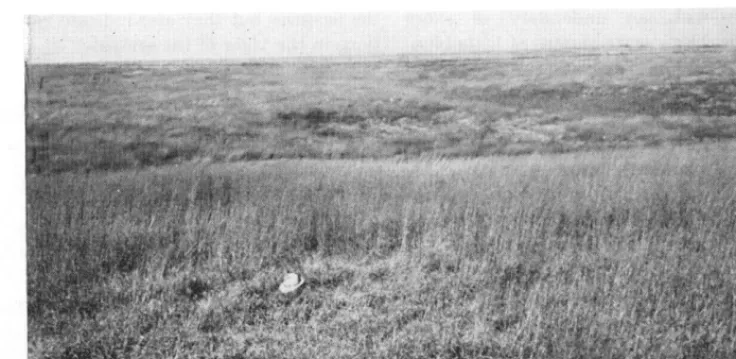
to be all the plant material, besides the tion which are apparent even after eleven current seasonal yield, on top of the years of god. rainfall (Albertson, et al., mineral soil. 1953). General appearance of the vegeta- The vigor maintained by the individual tion in the fall of 1951 resembled that plants in a pasture is very important found before the drought but the com- not only from the standpoint of forage position va.s quite different. Tall grasses, production but also in their ability to especially big bluestem (Anrlropogon ge- withstand climatic and biotic hardships. rardi), had taken over large areas for- It was apparent from casual observation merly occupied by mid grasses [little that the plants showed a marked dif- bluestem (Andropogon scoparius) and ference in stature in relation to the in- side-oats grama (Bout~lozca cwtipenduh)]
tensity of use. In addition to observations numerous measurements of individual plants were made at random to obtain quantitative data on these differences. The number of stems produced by va- rious plants was determined by making stem counts along the hillsides of each pasture on the inside of a sampling ring four inches in diameter. The ring was randomly placed on 50 plants of each of the five dominants.
CoMPosITIoN AND COVER The drought of 1933 to 1940 brought about tremendous changes in the vegeta-
and short grasses (Fig. 1). Big bluestem had become the most abundant grass on both hillsides and ridgelines where the soil was shalloxl- and rocky. Little blue- stem had maintained its dominance on the rocky breaks. Recovery of the pre- ferred bluestems had been hampered in various degrees depending upon the in- tensity of livestock use.
Ungrazed Prairie
EFFK!TS OF GRAZING INTENSITIES 301
TABLE I
Tall grasses 66.1
Big bluestem 64.2
Indian grass. 1.0
Switch grass. _
Mid grasses... 29.6
Little bluestem. 8.6
Side-oats ~.~amit 17.6
Hairy dropseed 1.4
Western wheatgrass... ~
Three-awn grasses... 2.0
Sand dropseed.
Short grxsses .., 4.3
Blue grama ., 4.2
Hairy grama... -
Buffalo grass.... 0.1
Total composition. 100.0
-.
VI cover. ./14.4
AMd. crazed
12.8 12.8
_ 68.1
7.1 60.2
0.1 _
1.7
I(1.1 13.5 2.7 2.9
100.0
26.4
lcQ.( -
34.E 63.0 60.3 2.4 0.3 36.7 26.6 9.4 0.7 _ _
14.8 14.8 _
65.9 9.2 56.1 0.1 _
0.5
19.3 10.4 7.9 1.C
LO0.C -
33.1
0.4 -
62.3 96.3
2.6 81.6
48.9 14.7
0.3 -
0.1 -
0.2 ~
0.2 j ~ 39.9 -
2.9 -
loo.0 1oo.c
_
_
!
“”
III
4.2 / 9.0
4.2 8.0
- I -
100.0
1
loo.04.1 1 8.4 ~___
.‘ (( ..:
cent on the comparatively small, rocky break sites (Table 1).
following the great drought (Fig. 2). It Big bluestem was by far the most im-
302 G. WT. TOMANEK AND F. W. ALBERTSON
(Sorghastrum nutans) occurred in small amounts on the ridgeline and hillside and switch grass (Panicum virgatum) was found infrequently on the hillside.
Next in importance were the mid grasses which made up 29.6, 36.7 and 96.3 percent of the cover on the ridgeline, hillside and rocky break sites, respec- tively. Most of this cover was composed of two dominants, little bluestem and side-oats grama. On the more xeric ridge- line side-oats grama occurred in small, pure stands and was found more fre- quently than little bluestem (17.6 and 8.6 percent, respectively), but on the hill- side little bluestem was nearly three times as plentiful. The rocky break habitat is a favorite one for little bluestem and here it comprised 81.6 percent while side-oats grama, the only other mid grass found made up 14.7 percent of the vegetative cover. Scattered plants of the three-awn grasses (Aristida purpurea and A. longi- seta) and hairy dropseed (Sporobolus pilosus) were found on the ridgeline.
The short grasses formed a minor part of the vegetation on this ungrazed prairie. They were not present on the rocky breaks and composed only 0.3 percent on the hillside and 4.2 percent on the ridge. Blue grama (BouteZoua gracilis)
with one exception, was the only one found. Buff alo grass (Buchloe dactyloides)
made up a meager 0.1 percent of the vegetation on the ridges.
Moderately Grazed Pasture
Under moderate use the tall grasses
were largely replaced by mid and short grasses and furnished only 12.8 percent of the vegetation on the ridgeline, 14.8 percent on the hillside but were absent entirely on the rocky breaks (Table 1). Big bluestem was the only one found in sufficient abundance to be recorded in the sampling.
The major portion of the vegetation on
this moderately grazed range was fur- nished by mid grasses, the most impor- tant of which were side-oats grama and little bluestem. On the ridgeline and hill- side sites side-oats grama made up more than half the cover (59.2 and 56.1 per- cent, respectively). Little bluestem was much less abundant on these two sites but comprised 67.1 percent of the vegeta- tion on the rocky breaks. There were a few scattered plants of hairy dropseed and the three-awn grasses.
Under the influence of moderate graz- ing short grasses became a rather im- portant part of the vegetation. The three short grasses, blue grama, hairy grama
(Bouteloua hirsuta) and buffalo grass, together furnished 19.1 percent of the cover on the ridgeline, 19.3 percent on the hillside but only 4.2 percent on the rocky breaks. Blue grama was the most plentiful of the three on the ridgeline and hillside followed in order of abun- dance by hairy grama and buffalo grass. Hairy grama was the only short grass that grew on the rocky breaks.
Heavily Grazed Pasture
Under heavy utilization tall grasses had practically disappeared and fur- nished only 1.4, 7.8 and 1 .O percent of the cover on the ridgeline, hillside and rocky break sites, respectively (Table 1). Big bluestem again formed the bulk of the tall grass population but occurred only as small, scattered plants about 2 inches in diameter. Isolated and dwarfed plants of Indian grass and switch grass were occasionally found.
EFFECTS OF GRAZING INTENSITIES 303
sites in this heavily utilized range. Over much of the area side-oats grama oc- curred in pure stands 6 to 10 feet in diameter but in other areas it was rather sparse with an understory of short grasses. Degenerate clumps of little blue- stem were thinly scattered throughout the pasture except on the rocky breaks where they still furnished one-half the cover. Other mid grasses of minor importance found here were hairy dropseed, western wheatgrass (Agropyron smithii), sand dropseed (Sporobolus cryptandrus) and the three-awn grasses.
The decrease in the relative amounts of tall and mid grasses under heavy utilization was accompanied by a propor- tionate increase in the short grasses. On the ridgeline 73.4 percent of the basal cover was furnished by the three short grasses, blue grama (23.7), hairy grama (17.3) and buff alo grass (32.4). The more mesic hillside was still dominated (over 60 percent) by tall and mid grasses with only 39.9 percent short grass. A small amount of hairy grama was the only short grass found on the rocky breaks.
Basal Cover
Total basal .cover of the vegetation increased with an increase in grazing pressure on all sites except the rocky break (Table 1). On the ridgeline it was 14.4, 26.4 and 34.5 percent on the non-, moderately and heavily grazed areas, respectively. In the same sequence on the hillside it was 14.0, 33.0 and 44.8 percent. On the rocky breaks cover de- creased with moderate use but increased again under more pressure. The increase in the amount of short grass under greater grazing pressures on all three sites accounted for the general increase in basal cover.
YIELDS AND MULCH
Slightly over a ton of forage was pro-
duced on the nongrazed pasture but only
a little more than one-half ton was har- vested from the heavily grazed location (Table 2). Not only do these yields reflect the difference in species composition in the pastures but they also indicate varia- tions in the vigor of the grasses.
TABLE 2
Forage yield and amount of mulch on the ground in pounds per acre in the fall of 1951
Yield ...
Mulch ...
The amount of mulch blanketing the soil surface is often used as an indicator of range condition and past usage. Its value in protecting the soil from erosive action of raindrops and the loss of water by evaporation is well known. Too much mulch in an area can, however, reduce the forage yield (Weaver and Tomanek 1951). The nongrazed area was protected by nearly seven times as much mulch as the heavily grazed location (Table 2).
The presence of too much old vegeta- tion seemed to limit the production of flower stalks. Many areas, especially in pure stands of big bluestem where the mulch was heavy, did not produce flower stalks while nearby pure stands of the same species without as much mulch were prolific (Fig. 3).
HEIGHTAND NUMBEROF STEMS
304 G. ,I., TOMANEK AND F. w. ALBERTSON
The number of stems counted per unit abundant as the intensity of grazing in-
area was also greater in the pasture that creased. In all five species studied at had not been grazed. They became less least twice as many stems per unit area
TABLE 3
Average heighl in inches ojj%trer stalks oj the principal grasses jound under different in- tensities of grazing nt Ike end of the growing Season
Big bluestem. 54.2 42.3 Little blue&em 30.1 27.2 Side-oats grema. 32.7 23.3 Indian grass. 55.5 - Saitch grass.. ., 63.1 -
TABLE 4
39.2 26.0 28.2
45.0 29.8
and Reid, 1942; Beetle, 1950; Ellison, et al.. 1951) _.
in their study of the true prairie, Weaver and Hansen (1941) listed the plants that decreased, increased and in- vaded in response to grazing. A similar ecological classification of species was used by Dyksterhuis (1949) to provide a quantitative system of range classifica- tion. His system of range condition classification has been widely applied but many more basic studies are needed to
Averagenumberojsfem
of
the principal grasses found in a circle 4 inches in diameterBig bluestem.. 6.0 4.6 3.3
Little bluestom.... 50.0 32.3 19.9
Side-oats grams.... 17.6 9.2 8.7
Indian grass. 6.2 _ 3.6 Switch grass.. 7.0 _ 2.7
‘1
were counted under protection as were found in plants most heavily used (Table 4).
EFFECTS OF GRAZING INTENSITIES 305
supply detailed information on the reac- tion of forage plants on various locations to different intensities of livestock use.
Table 1 reveals how the principal grasses responded to grazing on different sites. However, more data on many separate areas need to be secured before a classification can be safely advanced. Big bluestem and little bluestem both decreased in abundance on all sites with an increase in utilization whereas all three short grasses increased in impor- tance. In fact, buffalo grass occurred in such small amounts in the climax on these sites that it could almost be classed as an invader. The cover in the heavily grazed area had not been sufficiently dis- turbed to allow invasion of exotic plants. Side-oats grama reacted like both a de- creaser and an increaser. On the hill- sides and ridges it became more abundant with moderate use but as the pressure became greater it decreased. On the rocky breaks, however, it increased steadily with greater utilization. These grasses are the key species. for use in determining the effects of grazing upon these sites in native pastures of this area.
Excessive utilization of range plants has a tendency to reduce their vigor. Vigor has long been one of those im- measurable criteria used in judging range condition and trend. Many things indi- cate variations in vigor. The differences in the vigor of plants under the three intensities of grazing are rather clearly shown by a comparison of yields, growth in height and the number of stems or tillers produced per unit area. The greater growth and more numerous stems of plants under nongrazing is reflected by the good yield in that pasture.
SUMMARY
Three pastures were studied near Hays, Kansas to determine the effects of
different grazing intensities upon the vegetation. Three sites which are com- mon in this area were studied in non- grazed, moderately grazed and heavily grazed locations. All three sites had shallow immature soils. The rocky breaks were comprised of mostly rock fragments with only a thin filler of soil and even the soils on the hillside were very shallow and contained many small fragments of rock. The soils of the ridgeline were somewhat deeper and less rocky.
The differences in basal ground cover and species composition were determined by sampling the vegetation with numer- ous square-foot quadrats. Tall grasses, especially big bluestem, were dominant on the ridgeline and hillside sites in the nongrazed pasture. Mid grasses were most prevalent on these two sites in the moderately grazed areas while the bulk of the vegetation on the heavily grazed pasture was made up of short grasses. The rocky break sites were dominated by the two common mid grasses, little bluestem and side-oats grama. However, the pro- portionate amount of little bluestem de- creased and that of side-oats grama in- creased with greater grazing pressures.
The basal ground cover of the vegeta- tion was found to be greatest on the heavily grazed pasture and least on the nongrazed area. The greater amount of short grass found at the former location probably accounts for this variation.
The nongrazed pasture produced 2,296 pounds of forage per acre as compared to 1,323 pounds for the heavily grazed loca- tion.
Over three tons of mulch per acre were collected from the relict area as compared to one and one-half tons on the one moderately used, and less than one-half ton on the heavily grazed location.
306 G. W. TOMANEK AND F. W. ALBERTSON
and number of stems per unit area. The plants from the area which had been heavily used in past years were much shorter and had only about one-half as many stems per unit area as did those of the ungrazed pasture.
BIBLIOGRAPHY
ALBERTSON, F. W. 1937. Ecology of niixed
prairie in west central Kansas. Ecol.
Monog. 7: 481-547.
ALBERTSON, F. W., D. A. RIEGEL, AND JOHN L. LAUNCHBAUGH, JR. 1953. Effects of different intensities of clipping on short gra.ss in west-central Kansas. Ecology 34: l-20.
BEETLE, ALAN A. 1950. Range condition
classes on the Laramie Plains, Wyoming. Univ. of Wyo. Agr. Expt. Sta. Cir. 37.7 pp.
CHOHLIS, G. J. AND L. L. TINSMAN. 1948.
Range condition-a classification of the
sand-bunchgrass and sagebrush-bunch-
grass forage types in the West Benton SoiI Conservation District. U. S. Dept. Agr. Conserv. Ser. unnumbered pamphlet. (Mim- eographed) 20 pp.
COSTELLO, DAVID F. AND GEORGE T. TURNER.
1944. Judging condition and utilization of short grass ranges on the central great plains. U. S. Dept.‘Agr. Farmers’ Bul. 194. 21 PP.
DYKSTERHUIS, E. J. 1949. Condition and
management of range land based on quan- titative ecology. Jour. Range Mangt. 2: 104-115.
ELLISON, LINCOLN, A. R. CROFT, AND REED
BAILEY. 1951. Indicators of condition
and trend on high range watersheds of the
Intermountain region. U. S. Dept. Agr.
Agricultural Handbook No. 19. 66 pp.
GILBERT, C. I,. 1948. Range condition-a classification of the bunchgrass forage type in the South Palouse Soil Conservation District. U. S. Soil Conserv. Ser. unnum-
bered pamphlet. (Mimeographed) 17 pp.
HUMPHREY, R. R. 1949. Field comments on
the range condition method of forage sur- vey. Jour. Range Mangt. 2: l-10. PICKFORD, G. D. AND ELBERT H. REID. 1942.
Basis for judging subalpine grassland
ranges of Oregon and Washington. U. S. Dept. Agr. Cir. 655. 38 pp.
VOIGT, JOHN W. AND J. E. WEAVER. 1951.
Range condition classes of native mid-
western pastures : an ecological analysis. Ecol. Monog. 21: 39-60.
WEAVER, J. E. AND W. W. HANSEN. 1941. Native midwestern pastures; their origin, composition and degeneration. Nebr. Univ. Cons. and Survey Div. Bul. 22. 93 pp.
WEAVER, J. E. AND G. W. TOMANEK. 1951.
Ecological studies in a mid-western range: the vegetation and effects of cattle on its composition and distribution. Nebr. Univ. Cons. and Survey Div. Bul. 31. 82 pp.
Range Education
from the Rancher’s Viewpoint
GEORGE E. WEAVERPinecroft Ranch,, Tivermore, Colorado
F
IELDS of knowledge that the modern range operator may draw on are many and varied. Economic conditions change with great rapidity and require new decisions based upon economic pres- sures alone. Drouth, forage damaging insects, livestock diseases, and other disasters all have a way of striking un- expectedly and at inopportune times.Rangelands, over the long pull, have multiple uses and values but for the current operator their value is largely limited to what they will produce in livestock products. Accordingly, the well being and efficiency of dependent live- stock is uppermost in the operator’s thinking and in his immediate planning. However, most range operators realize that in the long run to be permanently successful the operation must be carried on within the sustained-yield capabilities of the range resource.
Education should provide the back- ground upon which the future range manager may draw in order that his decisions will lead to both economic suc- cess and the perpetuation of the forage potential and basic soil resource.
This is an age of specialization. The study of livestock diseases, their diag- nosis and treatment, make up a full five-year college course of study. Animal husbandry, the biologic sciences, agri- cultural economics, forestry and other lines of study contribute to the science of range management but are specialized fields apart from it.
Prospective students, and our educa- tional institutions, must decide whether specialized training in a limited field or
a more general type of training will produce the better equipped range man- ager. Without some appreciation of economic values the most brilliant sys- tematic botanist cannot possibly qualify as a range manager any more than can the physicist or the economist who knows nothing of the behavior of grazing ani- mals.
For the exceptional student highly specialized training has and will produce the kind of men qualified to carry on badly needed research. It may also fill a limited need for technical specialists to serve governmental land management agencies and a few large landowners. However, the crying need is for better trained range managers for the more usual and typical range operation.
Such a manager must be qualified to evaluate the soil and forage resource; must be able to determine its potential, and to recognize trends either in im- provement or retrogression. He should know the rudiments of animal husbandry including nutritional requirements, breed characteristics, and animal care. Above all he must know values. Many practices in the handling and treatment of lands and of livestock have proved beneficial under certain conditions. The manager should be able, for each situation and set of conditions, to work out the com- bination of practices that will produce the most desirable results ecologically and economically.
308 GEORGE E. WEAVER
graduate. Undergraduate students major- ing in animal husbandry need more training in soils, botany, and economics. Range management majors need more training in animal responses and applied economics.
In addition to the needs for formal education of our future range managers there is a growing fund of new knowledge and understanding which operators and
land managers should be applying in their current operation.
The lag between the time of discovery by research and the time when the find- ings are put to general use can and should be materially shortened. A reexamina- tion of extension methods and an in- tensification of adult education beamed at range managers and operators would be a fruitful field of endeavor.
HALOGETON AND RANGE MANAGEMENT
(Abstract of thesis submitted in partial fulfillment for an N.S. degree, Range Management Department, Utah State Agri-
cultural College, Logan, 1965 .)
A study dealing with the management of halogeton-infested ranges and the effects of prolonged halogeton consump- tion on range animals was conducted on typical winter sheep range during the winter grazing season of 1951-1952, in northwestern Utah.
This study indicated that halogeton was not normally palatable to sheep and that sheep did not eat it for the water or salt content. Hungry animals were more susceptible to halogeton poisoning than animals receiving adequate forage because (1) they were more apt to eat the plant
and (2) it required less of the plant to cause death.
It was determined by force-feeding experiments that 18 ounces of halogeton (8.2 percent soluble oxalates) would be fatal to a mature ewe with a normal fill of forage, but that 12 ounces would be fatal after a 36-hour fast. Sheep grazing under proper management would not eat these amounts.
When calcium was fed with the halogeton the sheep could tolerate almost twice as much halogeton as they could otherwise. Feeding of high-calcium supplements before trailing could be expected to give some protection against losses on the trail.
Effects of Clipping on Some Range Shrubs
.
GEORGE A.GARRISON
Range Conservationist (Research), Pacijk Northwest Forest and Range Experiment Station, U. S. Forest Service, Portland, Oregon
.O
NE of the primary objectives in big game management is to keep game numbers in balance with the forage sup- ply. If an area is supporting less game than the available feed will permit, game managers have a chance to meet demands for game abundance. If the animals are too numerous for the forage supply, a planned reduction of herd size is needed to prevent wasteful reduction in numbers by starvation and disease and, in the long run, serious damage or destruction of the game habitat.Balancing game animals with their food supply has been difficult, however, be- cause little is known about the amount of grazing that important forage plants can withstand, yet maintain themselves in a healthy, productive condition. Signs of a depleted shrub or browse supply for big game are obvious, but indications of use levels that permit sustained produc- tion are not known for many important shrubs.
This article presents the results of clipping studies in eastern Oregon and Washington seeking information on the re- sistance of five commonly browsed shrubs to various intensities of twig removal. Use of this knowledge in connection with utilization checks should help range ad- ministrators and grazing managers keep informed on the status of the game-forage
SUPPlY.
Of the numerous woody species browsed by big game and range livestock, results of clipping experiments have only been reported for a relatively few species.
Utilization studies and clipping projects on the Kaibab National Forest (Julander, 1937) have provided information on some effects of twig removal and on the de- sirable level of use for quaking aspen (Populus tremuloides) and Stansbury cliff- rose (Cowania stansburiana). A study in northern Idaho (Young and Payne, 1948) provided similar information for redstem ceanothus (Ceanothus san-
guineus) , Saskatoon serviceberry (Ame- Zanchier alnifolia), Utah honeysuckle (Lo- nicera utahensis), and rose (Rosa spp.). In these two studies, growth or produc- tion was determined by measuring twig length prior to each annual clipping. Effects of clipping on white cedar (Thuja occidentalis) and nine hardwoods of the Lake States have also been reported (Aldous, 1952). Trends in production (green weight) and sum of harvested twig lengths were the primary observa- tions reported for mountain maple (Acer spicatum), white birch (Betula alba var. papyrifera), beaked hazelnut (Corylus cornuta), mountain ash (Sorbus ameri- canus), redosier dogwood (Cornus stolo- nifera), willow (Salix spp.), black ash (Fraxinus nigra), red-berried elder (Sam- bucus racemosa), and pin cherry (Prunus
pennsylvanica) .
The present study was started in 1945 by the U. S. Forest Service. The objective was to determine the optimum intensity of clipping for five important shrubs :
antelope bitterbrush (Purshia tridentata), snowbrush ceanothus (Ceanothus velu- tinus), rubber rabbitbrush (Chrysotham-
310 GEORGE A. GARRISON nus nauseosus), creambush rockspirea
(Holodiscus discolor), and curlleaf moun- tainmahogany (Cercocarpus Zedifolius) .
METHODS OF STUDY
One-quarter acre game-proof exclo- sures, each containing one of the five species to be studied, were established on the Fremont, Malheur, and Whitman National Forests in Oregon, and the Snoqualmie National Forest in Washing- ton. Each shrub species was studied in from two to five different locations. For all species except curlleaf mountain- mahogany, 15 shrubs were selected per
exclosure and three plants assigned to each of five treatments, including four intensities of clipping current twig growth, and an unclipped group. Clipping treat- ments consisted of 25 percent harvest (lightly clipped), 50 percent harvest (moderately clipped), 75 percent harvest (heavily clipped), and 100 percent harvest (completely clipped). The assigned in- tensity of annual harvest for any plant was applied to every’twig except for the 25 percent harvest. This treatment was performed by clipping 50 percent from only every other twig. Selected shrubs in each exclosure were clipped for at least four successive years; however, those in some exclosures were harvested five times and certain individual plants were clipped seven times.
Curlleaf mountainmahogany, because of its tendency to become treelike, re- ceived somewhat different treatments from the other four shrub species. Or- dinarily, only twig growth up to about
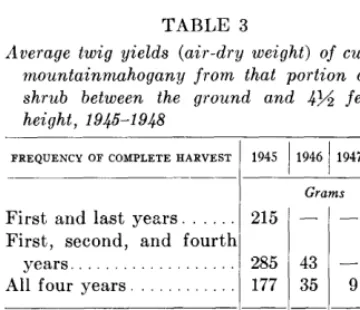
54 inches from the ground is considered available for deer use, so twig clipping was confined here. All three types of harvest consisted of complete twig re- moval in this “pruning zone”, but dif- fered as to frequency of clipping. Three plants were clipped in the first and fourth
. years of the study; three in the first,
second, and fourth years; and three in all four years. A fourth group was left unclipped.
Every species studied was clipped either in the fall, mid-, or late-winter, and the season of harvest assigned each exclosure was used throughout the study. Thus, interference with carbohydrate storage was minimized. Dates of clip- ping coincided with the time that ad- joining ranges were ordinarily used by deer or elk.
Individual plant measurements in- cluded air-dry weights of twigs harvested and average twig length computed from a sample of 40 to 100 twigs per shrub which were measured prior to clipping. Notes were made of flowering vigor, general condition, and growth habit. Photographs were made of typical plants in each clipping intensity group. Total yields for shrubs subjected to less than 100 percent clipping were calculated by use of coefficients developed for each species and clipping intensity. The co- efficients also took into account differ- ences in weight among various portions of the twigs, due to such things as twig taper. To compute total yield of, for example, a moderately (50 percent) clipped plant of rabbitbrush, the weight of the harvested material was multiplied by the coefficient 2.36. Yield data for three intensities of clipping were of this nature, except for the fifth observation on snowbrush ceanothus plots. Yields in this instance were obtained by 100 per- cent harvests for all treatment classes; consequently, no adjustments of twig weights were necessary.