Global firms are facing a talent exodus as world economies return to growth.
Growth is expected to pick up over 2013 and 2014 – we can expect labor markets
to revive and staff turnover to increase >>
off
Organizations therefore need to start thinking now about how to secure the long-term commitment of their workers. Failure to create the right environment will encourage disgruntled employees to take off in search of better conditions.
Hay Group has pinpointed when your staff are most likely to take flight. What’s more, we have identified the
10 9 8 7 6 5 2011 2012 2013 cen tage
Employee turnover to
hit new heights
Workers around the world are already starting to seek new job opportunities as growth returns and labor markets begin to pick up.
In 2018, 49 million more employees will be heading out the door compared to 2012 – a total of 192 million employees worldwide.
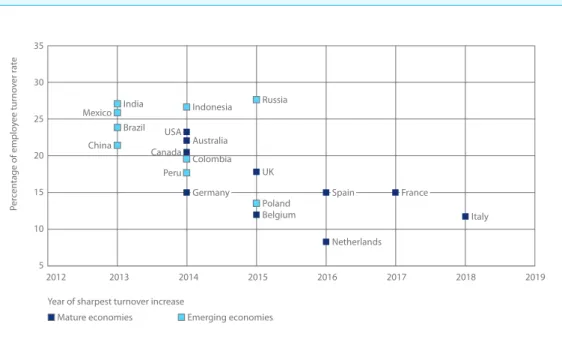
The global employee turnover rate will see the sharpest increase in 2014 (see fig. 2), with the greatest growth happening in that year. But regional economic and job market forecasts show that turnover will spike sooner in emerging economies than in developed (see fig. 3). Emerging economies in Asia and Latin America will spike between now and 2014, while mature markets will peak between 2014 and 2018, led by dominant economies such as Germany and the US.
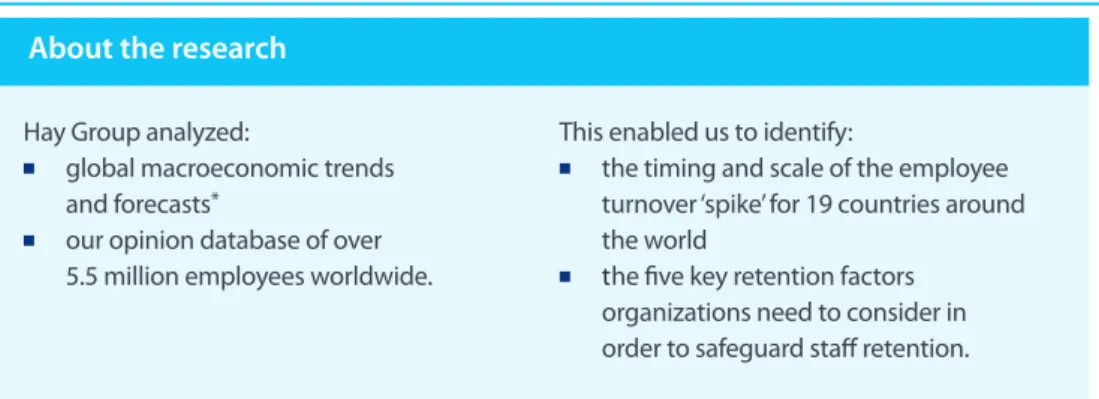
Hay Group analyzed:
n global macroeconomic trends
and forecasts*
n our opinion database of over
5.5 million employees worldwide.
This enabled us to identify:
n the timing and scale of the employee
turnover ‘spike’ for 19 countries around the world
n the five key retention factors
organizations need to consider in order to safeguard staff retention.
About the research
24.0 23.5 23.0 22.5 22.0 21.5 21.0 20.5 20.0 900 850 800 750 700 650 600 550 500 2010 2011 2012 2013 2014 2015 2016 2017 2018
Percentage of employee turnover rate (left axis) Total employees in millions (right axis) Forecast
Fig. 2 Global turnover and number of employees Source: Hay Group Cebr analysis
35 30 25 20 15 10 5 2012 2013 2014 2015 2016 2017 2018 2019 Per cen tage of emplo yee tur no ver r at e
Year of sharpest turnover increase
Emerging economies Mature economies
India Indonesia Russia
UK Poland Belgium USA Australia Canada Colombia Peru Germany
Germany SpainSpain
Netherlands France France Italy Brazil China Mexico
Fig. 3 Timing and scale of the sharpest employee turnover increases by country, 2012–18 Source: Hay Group Cebr analysis
When will the turnover spike hit you?
Region
Drivers of
employee turnover
Turnover spike
Average turnover
rate 2013–2018
World Global economic recovery and growth, especially in
emerging markets 2014 23 per cent
Asia Pacific Ambitious middle class fuelling growth 2013 24 per cent
Latin America Increased spend on infrastructure; World Cup / Olympics
2013 2016
Double spike 25 per cent
North America Recovering housing market; energy production; business services 2014 23 per cent
What makes people stay?
To identify what makes for a committed workforce, we studied Hay Group’s opinion database of over 5.5 million employees worldwide. We compared the views of ‘stayers’ (committed to their companies for more than two years) with those of ‘leavers’ (intending to leave within the next two years). The analysis identified five factors that impact employee retention:
1 Confidence in the organization and leadership
Employees need to feel they work for a well-led organization that is heading in a positive direction. This requires leaders to communicate company strategy clearly, consistently, regularly and with authority.
2 Room for growth
Most people want to reach their potential at work. Employees want to know that there are opportunities to learn, grow and progress. If not, many will begin to wonder if their future lies elsewhere.
3 A fair exchange
Employees need to feel valued if they are to deliver more with less in difficult times. Tapping into employees’ discretionary effort demands a fair balance between the contributions they make and the rewards they receive.
4 An environment for success
Engaging employees is not enough. To sustain commitment, firms also need to enable them to perform at their best. This means placing the right people in the right roles, creating efficient work processes, enabling collaboration and providing a supportive working environment.
5 Authority and influence
Engaged workers want to contribute positively to their organizations and help them to perform better. Firms need to provide staff with the basic authority to allow them to do their jobs and influence how work is done.
How do organizations
measure up?
Significant numbers of employees express doubt over their firms’ ability to provide these retention factors.
1 Confidence in the organization and leadership
n 38 per cent of employees globally voice
concern over their firm’s direction and goals.
n 31 per cent do not have trust and confidence in
their senior managers.
2 Room for growth
n 47 per cent of workers are unsure that they can
achieve their career objectives at their current company.
n Almost as many are seeking more learning and
development opportunities (44 per cent) and greater supervisory support for development (43 per cent).
3 A fair exchange
n 53 per cent of staff express concern about the
fairness of their compensation.
n 43 per cent do not believe that their company
demonstrates care and concern for its workforce.
4 An environment for success
n 60 per cent of the global workforce feel that
their firm is effectively managed and well run.
n But 46 per cent are unhappy with the amount
of collaboration and support between departments in their organization.
5 Authority and influence
n Most employees feel that they have enough
authority to effectively perform their roles and believe that their organizations support creativity and innovation.
to what drives employee commitment,
and where they need to focus to protect
retention as job markets recover.
If you’d like to discuss how Hay Group can help your organization address
employee retention, or if you’d like to know more about our world-class
HR tools, please visit
www.atrium.haygroup.com/ww/retention
Take action now
Make no mistake: we are in the eye of a turnover storm. You must give serious thought to what drives employee commitment, and where you need to prioritize to protect retention as job markets recover.
Those in regions facing an employee turnover spike in the next two years must focus their key potentials, as well as employees with
mission-critical skills and in crucial roles. For firms in the economies with the luxury of a little more time, the calm before the storm should be used to secure the commitment of their core employees.
No matter when the spike hits, the five retention factors add up to an essential roadmap for organizations looking to minimize turnover as the job market recovers.
Can you stop your employees taking flight?