Green cloud computing: A survey
1
Ashis Behera,
2Bikram Kesari Ratha ,
3Srinivas Sethi
1Dept. of Computer Sc & Engg. Padmashree Krutartha Acharya College of Engineering, Bargarh, Odisha 2
Dept. of Computer Sc. & Application, Utkal University, Bhubaneswar, Odisha
3Dept. of Computer Science Engg. & Appl Indira Gandhi Institute of Technology. Sarang, Odisha
,
,[email protected] , [email protected]ABSTRACT
Green cloud computing is energy oriented distributed networking system with the internet. Now days this cutting edge research topic is highly essential to make the system efficient with environment friendly. Using this technology, users can save their energy, money, proper with efficient utilization of infrastructure, etc. This also helps to improve the efficiency of applications, software, infrastructures.
Key words- cloud computing, distributed environment.
INTRODUCTION
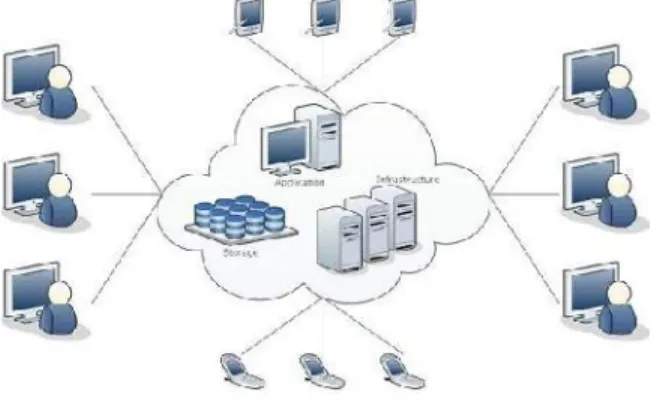
Cloud computing is a distributed internet based computing system which provides all sort of services to the users through internet like storage, processing, sharing resources and software etc on demand. As cited in figure 1.1, cloud computing can provide services like storing the information in the cloud,
Figure 1.1: Cloud Computing
allow us to maintain and manipulate different applications and resources through internet. Also the services which are provided by the cloud are not dependent on particular platform. One of the biggest advantage of cloud computing is that it provides on-demand resource provisioning , so we pay for that part of bandwidth and server resources that we are using. And when the requirement is over, then turn the whole thing off, so we have to pay only for that part you are using.
Two working models Deployment model and Service model of cloud computing which makes it feasible and accessible to the client.
Deployment model define the four type of access to the cloud. In public cloud the services and resources are open to the public. Here the public are benefited by accessing the cloud (services) openly but with less security. The private cloud is confined within an organization. Here the members of that organization can only avail the services of that cloud. The community cloud is confined within a group of organizations. Here the systems and services are accessible to the members of that group of organizations only. The hybrid cloud is a combination of public and private cloud. The private cloud handles the critical activities where as the public cloud handle non critical activities.
Service Model defines three important segments of applications [2]. First one is Software As A Service (SAAS) which provides infrastructure like hardware and network, platform like various operating systems and application software like ERP to the customer through the internet. Second one is
Green cloud computing: A survey
1
Ashis Behera,
2Bikram Kesari Ratha ,
3Srinivas Sethi
1Dept. of Computer Sc & Engg. Padmashree Krutartha Acharya College of Engineering, Bargarh, Odisha 2
Dept. of Computer Sc. & Application, Utkal University, Bhubaneswar, Odisha
3Dept. of Computer Science Engg. & Appl Indira Gandhi Institute of Technology. Sarang, Odisha
,
,[email protected] , [email protected]ABSTRACT
Green cloud computing is energy oriented distributed networking system with the internet. Now days this cutting edge research topic is highly essential to make the system efficient with environment friendly. Using this technology, users can save their energy, money, proper with efficient utilization of infrastructure, etc. This also helps to improve the efficiency of applications, software, infrastructures.
Key words- cloud computing, distributed environment.
INTRODUCTION
Cloud computing is a distributed internet based computing system which provides all sort of services to the users through internet like storage, processing, sharing resources and software etc on demand. As cited in figure 1.1, cloud computing can provide services like storing the information in the cloud,
Figure 1.1: Cloud Computing
allow us to maintain and manipulate different applications and resources through internet. Also the services which are provided by the cloud are not dependent on particular platform. One of the biggest advantage of cloud computing is that it provides on-demand resource provisioning , so we pay for that part of bandwidth and server resources that we are using. And when the requirement is over, then turn the whole thing off, so we have to pay only for that part you are using.
Two working models Deployment model and Service model of cloud computing which makes it feasible and accessible to the client.
Deployment model define the four type of access to the cloud. In public cloud the services and resources are open to the public. Here the public are benefited by accessing the cloud (services) openly but with less security. The private cloud is confined within an organization. Here the members of that organization can only avail the services of that cloud. The community cloud is confined within a group of organizations. Here the systems and services are accessible to the members of that group of organizations only. The hybrid cloud is a combination of public and private cloud. The private cloud handles the critical activities where as the public cloud handle non critical activities.
Service Model defines three important segments of applications [2]. First one is Software As A Service (SAAS) which provides infrastructure like hardware and network, platform like various operating systems and application software like ERP to the customer through the internet. Second one is
Green cloud computing: A survey
1
Ashis Behera,
2Bikram Kesari Ratha ,
3Srinivas Sethi
1Dept. of Computer Sc & Engg. Padmashree Krutartha Acharya College of Engineering, Bargarh, Odisha 2
Dept. of Computer Sc. & Application, Utkal University, Bhubaneswar, Odisha
3Dept. of Computer Science Engg. & Appl Indira Gandhi Institute of Technology. Sarang, Odisha
,
,[email protected] , [email protected]ABSTRACT
Green cloud computing is energy oriented distributed networking system with the internet. Now days this cutting edge research topic is highly essential to make the system efficient with environment friendly. Using this technology, users can save their energy, money, proper with efficient utilization of infrastructure, etc. This also helps to improve the efficiency of applications, software, infrastructures.
Key words- cloud computing, distributed environment.
INTRODUCTION
Cloud computing is a distributed internet based computing system which provides all sort of services to the users through internet like storage, processing, sharing resources and software etc on demand. As cited in figure 1.1, cloud computing can provide services like storing the information in the cloud,
Figure 1.1: Cloud Computing
allow us to maintain and manipulate different applications and resources through internet. Also the services which are provided by the cloud are not dependent on particular platform. One of the biggest advantage of cloud computing is that it provides on-demand resource provisioning , so we pay for that part of bandwidth and server resources that we are using. And when the requirement is over, then turn the whole thing off, so we have to pay only for that part you are using.
Two working models Deployment model and Service model of cloud computing which makes it feasible and accessible to the client.
Deployment model define the four type of access to the cloud. In public cloud the services and resources are open to the public. Here the public are benefited by accessing the cloud (services) openly but with less security. The private cloud is confined within an organization. Here the members of that organization can only avail the services of that cloud. The community cloud is confined within a group of organizations. Here the systems and services are accessible to the members of that group of organizations only. The hybrid cloud is a combination of public and private cloud. The private cloud handles the critical activities where as the public cloud handle non critical activities.
Platform as a Service (PAAS), which provides various infrastructures like hardware network and platform like operating systems to the users through internet. Third one is Infrastructure as a Service (IAAS). Here the customers should use their own platform and application software where as only various infrastructures are provided by third party to the customer through internet.
Some of the benefits of cloud computing are:
-because of virtualization and also proper resource utilization, the total cost incur is optimized.
-A customer avoids capital expenditure of the company.
-It is more reliable because we can retrieve our data from backup when disasters occur.
-Since Cloud computing provides services on demand basis, it eliminates over-provisioning.
-One can access cloud on line through internet from anywhere and anytime.
-Dynamically create and moves the resources.
-It is reliable, portable, scalable, flexible and low cost.
II. GREEN CLOUD COMPUTING
Though the cloud computing brought a revolution in the computing era, it also have some bad impact on the environment. To provide better service to the users through cloud computing, data centers are scaling their infrastructure, purchasing more sophisticated servers and machines. So these data centers need more power to maintain which leads more CO2 emission which is unfriendly to the
environment [1]. According to the Gartner report
2007 “IT industry contributes 2% of world‘s CO2 emissions and will increased rapidly in future.”These cloud computing are enhanced by setting up large number data centers which are equipped with sophisticated high performance many servers, memory with high volume of capacity and sophisticated intelligent hardware and network
resources. To maintain the data centers, more and more advanced infrastructures including high volume of electricity and cooling are needed which are more expensive and also lead to pollute the environment by emitting more carbon dioxide and e-wastages. To reduce the carbon footprint and also the cost, consumption of energy in this data center should be reduced. Green cloud computing model is a model which uses different techniques to meet the bad impact of cloud computing. Green computing is the designing, manufacturing, using and disposing of computers, servers and other resources efficiently and effectively with minimum impact to the environment. This can be accomplished redesigning the infrastructure of the network by reducing number of servers, switches, cables or by applying different power consumption schemes. In this regard, there are certain technologies which are working behind cloud computing to reduce the energy consumption of the data centers and also making cloud computing flexible reliable and usable. Some of these are server consolidation, virtualization, scheduling, resource allocation, routing etc.
III. RESEARCH VIEW IN GREEN CLOUD COMPUTING
1. GREEN CLOUD VIRTUALIZATION
no longer tied with the underlying hardware they can be migrated or shifted to another without losing its integrity. Virtualization runs fewer systems with higher level of utilizations. So by using virtualization we can save enough space, resources and environment [3].
Figure 3.1 Virtualization in Cloud Computing
As shown in figure 3.1 the instances of different operating systems and their associated applications called “virtual machine” or VM are installed on a virtualization layer called hypervisor. This hypervisor makes it possible to run different operating systems and software over one single physical server. Thus it consolidates all similar type servers in the network into a single group of high performance server which reduce the maintenance cost of the data center.
2. GREEN SCHEDULING IN CLOUD
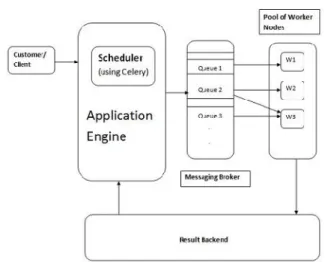
Resource scheduling is a key strategy in cloud computing. Resource scheduling is a way of determining schedule on which activity should be performed. Here large scale of virtual machines needs to be allocated to thousands of distributed users dynamically, fairly and profitably. There are effective schedulers like FCFS scheduler, randomized scheduler, prioritized schedule etc. which can reduce operational cost, reduce queuing waiting time and increase resource utilization. One of the scheduler is Celery which takes care of task scheduling and management in a distributed environment. The basic architecture of celery is shown below.
Figure 3.2 Architecture of celery scheduler
To initiate a task, a client puts a message on the task queue. Each message corresponds to a particular task. A task contains parameter like queue name, countdown timer etc. these parameters are parsed by the workers and saved appropriately for each task. Tasks are assigned to worker nodes as per the scheduling algorithm. The broker then delivered the message to the worker node which listening the queue and on receiving the task adds the task in its own queue and executes it when its turn arrives. In the paper [4] W. Usman, C.Cinzia et al measure the consumption of energy and its impact on each stage of cloud computing and then run an echo-aware scheduler and echo-aware management on it which reduce the emission of CO2 effectively. Another
energy efficient scheduling algorithm Dynamic Voltage & Frequency Scaling (DVFS)[5] which substantially reduce the energy consumption by limiting the work frequency and voltage supply dynamically. The algorithm like MapReduce [6] can improve the energy efficiency of the server by considering the variation of energy consumption of the server and then dynamically adjust the local data.
3. RESOURCE ALLOCATION IN CLOUD
Hence proper resource management is a prime factor for both cloud provider and cloud user.
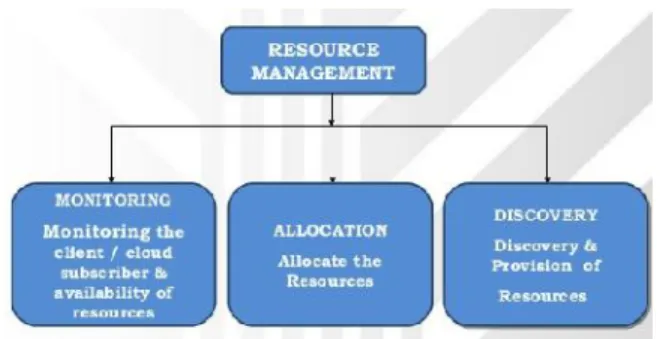
Figure 3.3 Elements in resource management
As cited in the figure 3.3 resource management is done in three sequential steps. First monitor the client request for resources and check whether sufficient resources are available to meet the request or not. If it meets the request then allocation of resources is done. After allocation, if it discovered any resource which is not utilizing properly then it provision back the resources by turning them off or allocation to other users. In the paper [11] the author emphasize that the physical resources like CPU cores, disk spaces, and network bandwidth must be sliced and shared among multiple request through virtualization and provisioning.
Figure 3.4: Resource Monitoring Process
Basically the request for virtualized resources is characterized by three basic things. Disk space, memory and processing. As shown in figure 3.4 the system always monitors the virtualized resources on physical host. If the system crash over provision, then the scheduler suspend the request and migrate all the virtual resources to another physical host otherwise it continue to provide the request on-demand basis. [12]. For any resource allocation software, performance isolation is the key point. And this isolation will be better and transparent if the software has better controls over the resources. The software has also considered the resources like computational and network resources to meet the demand accurately. So resource allocation algorithms or
software addressing the problem constraints by scheduling virtual machines on the servers as well as scheduling network resources [9]. In the paper [10], the authors develop a resource allocation system which avoids the overload on the server as well as support green computing by reducing number of server used. It also uses a concept,”skewness”, which on adjusting utilizes the server evenly.
4. ROUTING IN CLOUD COMPUTING
Cloud computing are recognized for its portability, scalability, reliability and low cost. To make cloud computing resilient, the information or data requested for must incur minimum possible delay to deliver. So the same data or information is resided in the multiple servers in different data center situated in different locations. The processing required to move the data to data center will be reduced if the data centers are located near the power generating sources. Hence reduce the power consumption. However in some cases the network instability makes the cloud less reliable. Here some routing techniques are discussed. In the paper [7] authors discussed join-the shortest-queue routing and power of-two-choice routing algorithm where the user submit the request for resources as virtual machine which represent the amount of resource need. The cloud service provider first queues these requests and then schedule them on physical machine. In [8] two algorithms are proposed which are used to discover efficient routing between broker and cloud. Here the broker calculates optimum route by using S-ORCF where as the cloud maintain the cost factor and computes S-ORM to find optimum route.
IV. CONCLUSION
Cloud computing has various advantages. But the over demanding cloud computing leads to serious side effect on the environment and also on the cost. To leverage cloud computing, organizations and industries are setting up new data centers with more powerful and sophisticated machines. And these machines and servers need more power to maintain and cooling infrastructure which leads more CO2
REFERENCES
1. Matthew Green | Johns Hopkins University “The
Threat in the Cloud” IEEE Computer and
Reliability Societies January/February 2013.
2. Kirk W. Cameron“The Challenges of Energy-Proportional Computing” Publishedby the IEEE Computer Society.
3. Tariq Rahim Soomro, Muhammad Sarwar
“Green Computing: From Current to Future
Trend” International journal of social,
Behavioral, Educational, Economic, business and Industrial Engineering Vol: 6, No: 3, 2012.
4. Usman Wajid, Cinzia Cappiello et al “On
Achieving Energy Efficiency and Reducing CO2
Footprint in Cloud Computing” IEEE
transactions on cloud computing, vol. 4, no. 2, April-June 2016.
5. Chia-Ming Wu ,Ruay-Shiung Chang,Hsin-Yu
Chan “A green energy-efficient scheduling
algorithm using the DVFS technique for cloud datacenters” ScienceDirect Future Generation
Computer Systems July 2014, Vol.37:141-147.
6. W. Xiaoli, W. Yuping, C. Yue “A multi
-objective bi-level programming model for energy
and locality aware multi-job scheduling in cloud computing” Elsevier Future Generation Computer System 36 (2014)91-101.
7. H. Chen and H.Q.Ye. Asymptotic optimality of balance routing, 2010.
8. Raj Gaurav, “An Efficient Broker Cloud
Management System” ACAI’11 Proceedings of
the International Conference on Advances in Computing and Artificial Intelligence ACM New York.
9. Mohamed Abu Sharkh, Manar Jammal, Abdallah Shami, and Abdelkader Ouda ”Resource
Allocation in a Network-Based Cloud
Computing Environment: Design Challenges”
IEEE Communications Magazine November 2013.
10. Zhen Xiao, Senior Member, IEEE, Weijia Song,
and Qi Chen” Dynamic Resource Allocation
Using Virtual Machines for Cloud Computing
Environment”IEEE transactions on parallel and distributed systems, vol. 24, no. 6, June 2013. 11. M Suhail Rehmam, MajdF. Sakr: “Initial
findings for provisioning variation on cloud computing“(IEEE, 2010), pp.42-46.
12. V.V inothina, Sridaran R., A PadmavathiG: “A survey on Rourse Allocation Strategies in Cloud