Under water Image preprocessing by Average filter and a
comparison study
1
Satish Racharla,2V.Ramu 1
Research scholer(M.Tech),2Assistant Professor
Dept. of CSE Kakinada Institute of Engineering & Technology,Korangi.
Abstract
Underwater image pre-processing is extremely essential because, under water images suffer from quality degradation due to low transmission of light. When an underwater image is captured, pre-processing is necessary to correct and adjust the image for further processing. Different filtering techniques are discussed in the literature for pre-processing of underwater images. The filters used normally improve the image quality, suppress the noise, preserves the edges in an image, enhance and smoothen the image. Therefore an effort has been made to evaluate the performance of three filters namely, homomorphic filter, anisotropic diffusion and wavelet denoising by average filter used for under water image pre-processing. Further studied to identify the suitable filters that process the image to preserve the image quality.
1 Introduction
Underwater vision is one of the scientific fields of investigation for researchers. Autonomous Underwater Vehicles (AUV) and Remotely Operated Vehicles (ROV) are usually employed to capture the data such as underwater mines, shipwrecks, coral reefs, pipelines and telecommunication cables from the underwater environment. Underwater images are essentially characterized by their poor visibility because light is exponentially attenuated as it travels in the water, and the scenes result poorly contrasted and hazy. Light attenuation limits the visibility distance at about twenty meters in clear water and five meters or less in turbid water. The light attenuation process is caused by absorption and scattering, which influence the overall performance of underwater imaging systems. Forward scattering generally leads to blur of the image features. On the other hand, backscattering generally limits the contrast of the images, generating a characteristic veil that
superimposes itself on the image and hides the scene. Absorption and scattering effects are not only due to the water itself but also due to the components such as a dissolved organic matter. The visibility range can be increased with artificial illumination of light on the object, but it produces non-uniform of light on the surface of the object and producing a bright spot in the center of the image with poorly illuminated area surrounding it. The amount of light is reduced when go deeper, colors drop off depending on their wavelengths.
2 Existing Method
When an underwater image is captured, pre-processing is necessarily done to correct and adjust the image for further study and processing. Different filtering techniques are available in the literature for pre-processing of underwater images. The filters used normally improve the image quality, suppress the noise, preserves the edges in an image, enhance and smoothen the image. Therefore an attempt has been made to compare and evaluate the performance of three famous filters namely, homomorphic filter, anisotropic diffusion and wavelet denoising by average filter used for under water image pre-processing.
3 Proposed Method
quantitative based criteria such as a gradient magnitude histogram and Peak Signal to Noise Ratio (PSNR). Further, the results are qualitatively to evaluate based on edge detection results. The proposed technique enhances the quality of the underwater images and can be employ prior to apply computer vision techniques.
Pre-Processing Design
4 Architecture Of Proposed System Preprocessing Steps
Figure 4.1Architecture of proposed system
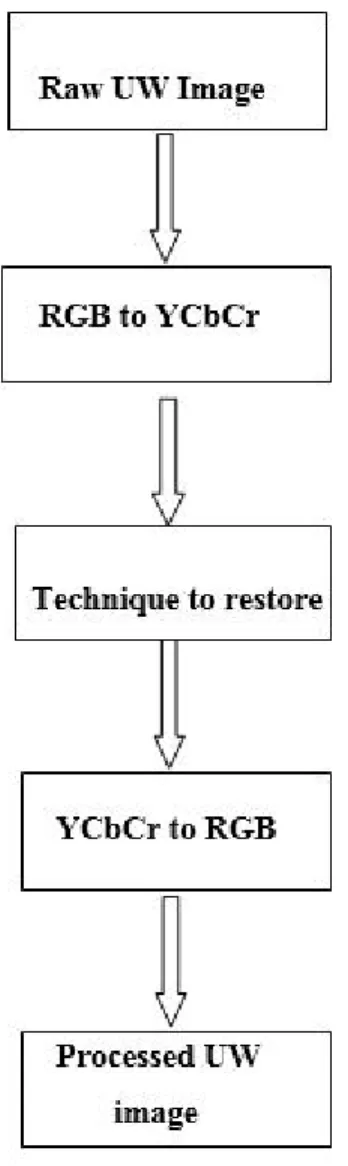
Pre-Processing steps shown in Fig 4.1,is an important stepin image processing technique. The algorithm uses for underwater preprocessing
corrects the underwater perturbation sequentially.The captured images are diminished due tooptical properties of the light in an underwaterenvironment. These images suffer from non-uniformillumination of light, low contrast, blurring and typical noiselevels for underwater conditions. The preprocessingtechnique comprises of homomorphic filtering to correctnon-uniform illumination of light, wavelet denoising toremove additive Gaussian noise present in underwaterimages, bilateral filtering to smooth underwater image andcontrast stretching to normalize the RGB values.
Pre-processing Architecture
Figure4.2Preprocessing Architecture
4.2 Modules Names
Restore the underwater images
Correct non-uniform illumination
Denoising the image
Smoothing the image
Improve the contrast
4.3 Modules Description
4.3.1 Correct non-uniform illumination The filter is uses to correct non-uniformillumination to enhance contrast in the
UW image
RGB to YCbCr Conver
t
RESTORE TECHNIQUES
To restore
Convert
YCbCr
to
Equalizingimage. It is afrequency filtering method. Compareto other filtering techniques, to correct the non uniform lighting and sharpensthe image.In the Illumination-reflectance model, where image isdefined as an intensity illumination and the reflectancefunction.
4.3.2 Denoising the image
One of the fundamental challenges in the field of image processing and computer vision is image denoising, where the underlying goal is to estimate the original image by suppressing noise from a noise-contaminated version of the image. Image noise may be caused by different intrinsic (i.e., sensor) and extrinsic (i.e., environment) conditions which are often not possible to avoid in practical situations. Therefore, image denoising plays an important role in a wide range of applications such as image restoration, visual tracking, image registration, image segmentation, and image classification, where obtaining the original image content is crucial for strong performance. While many algorithms have been proposed for the purpose of image denoising, the problem of image noise suppression remains an open challenge, especially in situations where the images are acquired under poor conditions where the noise level is very high.
4.3.3 Smoothing the image
Bilateral filtering smooth the images while preservingedges, by means of a nonlinear combination of nearby image values. The idea underlying bilateral filtering isto do in the range of an image what traditional filters do inits domain. Two pixels can be close to one another, that is occupy nearby spatial location, or they can be similarto one another, that have nearby values, possibly in aperceptually meaningful fashion. Closeness refers tovicinity in the domain, similarity to vicinity in the range.Traditional filtering is a domain filtering, and enforcescloseness by weighing pixel values with coefficients thatfall off with distance. The range filtering, this averagesimage values with weights that decay with dissimilarity.Range filters are nonlinear because their weights dependon image intensity or color. Computationally, they are nomore complex than standard non-separable filters. Thecombination ofboth domain and range filtering is termedas bilateral filtering.
4.3.4 Improving the contrast
Contrast stretching often called normalization is a simpleimage enhancement technique that attempts to improvethe contrast in
an image by ‘stretching’ the range of intensity
values. Color correction isperformed by equalizing each color means. In underwaterimage colors are rarely balanced correctly, thisprocessing step suppresses prominent blue or green colorwithout taking into account absorption phenomena.
Implementation And Performance Evaluation 5. Implementation
Technique which consists of sequentially applying filters such as homomorphic filtering, wavelet denoising, bilateral filtering and contrast stretching. First, apply homomorphic filter to correct non-uniform illumination of light. Homomorphic filter simultaneously normalizes the brightness across an image and increases contrast. The homomorphic filtering performs in the frequency domain and it adopts the illumination and reflectance model. Wavelet based image denoising techniques are necessary to remove random additive Gaussian noise while retaining as much as possible the important image features. The main objective of these types of random noise removal is to suppress the noise while preserving the original image details. The bilateral filter to smooth the image while preserving edges and enhance them. Finally,Apply contrast stretching for normalizing the RGB values.
The whole of the algorithm used in this project is to be coded in MATLAB. A GUI is to be developed in MATLAB to showcase the processed image after every step.
Implementation of filters
to optical properties of the light in an underwater environment. These images suffer from non-uniform illumination of light, low contrast, blurring and typical noise levels for underwater conditions.
Step 2: Appling the Homomorphic filter.
The homomorphic filtering is used to correct non-uniformillumination to enhance contrast in the image. It is afrequency filtering method. Compared to other filteringtechniques, it corrects non-uniform lighting and sharpensthe image.
Step 3:Appling the Wavelet Denoising filter.
Wavelet based image denoising techniques are necessary to remove random additive Gaussian noise while retaining as much as possible the important image features. The main objective of these types of random noise removal is to suppress the noise while preserving the original image
Step 4:Appling the Bilateral filter
A bilateral filter is a non-linear, edge-preserving and noise reducing smoothing filter for images. The intensity value at each pixel in an image is replaced by a weighted average of intensity values from nearby pixels.
Contrast stretching often called normalization is a simple image enhancement technique that attempts to improve the contrast in an image by‘stretching’ the range of intensity
values.
Step 6: Calculating the PSNR value.
In the last years many different methods for image quality assessment have been proposed and analyzed with the goal of developing a quality metric that correlates with perceived quality measurements.
Figure 6.1: (a) Before diving, diving at a depth of (b) 5 m, (c) 15 m
By acquiring the images in air and water, colors of the corrected image (Fig. 6.1(a)) is clear, while the original acquired image in water (Fig. 6.1(b) and Fig. 6.1(c)) has grave colors because of light attenuation. It is to be verified that the color registration can be executed fairly, when comparing the corrected image with the image in air under the same lighting condition.
An attempt is made to evaluate the performance of the edge preserving filters used for underwater images. Experimental setup, the images are processed using the tool MATLAB.
Comparisons of different filters are done by calculating the Mean Square Error (MSE) & Peak Signal to Noise Ratio (PSNR).The best filter must give its performance high in PSNR value and low MSE value. The results obtained out of the three algorithms for different noise applications. Comparisons of different filters are done by calculating the Mean Square Error (MSE) from Eq. (6.1) and Peak Signal to Noise Ratio (PSNR) from Eq.(6.2). The values are calculated by the following expression.
= ∑ ( ( , ) − ( , )) (6.1)
Peak signal-to-noise ratio:
The ratio between the maximum possible power of a sigal and the power of corrupting noise is given by
= ( )(6.2)
The performances of the filters are to be compared and analyzed by the PSNR and MSE vales for underwater images.
The output of the Underwater Images
Figure: 6.2 First column: original image, second column: after homomorphic filtering, third column: after wavelet denoising, fourth column: after bilateral filtering, last column: after contrast equalization
6.Conclusion
7.Refeerences
[1] Andreas Arnold-Bos , Jean-Philippe
Malkasse , Gilles Kervern, “A Preprocessing Framework For Automatic
Underwater Images Denoising”,in
Proceedings of the IEEE Oceans , pp. 1018–1024, 2006.
[2] Andreas Arnold-Bos, Jean-Philippe Malkasse and Gilles Kervern (2005) in
theProceedings of the European
Conference onPropagation and Systems,
Brest,France.
[3] Bazeille, Isabelle Quidu, Luc Jaulin and Jean-PhillipeMalkasse (2006) inProceedings of
the European Conference
onPropagationand Systems, Brest,France.
[4] Chambah M., Semani D., Renouf A., Courtellemont P. and Rizzi A. (2004) in
colorImaging IX: Processing, Hardcopy, andApplications, vol. 5293 of Proceedings of SPIE, 157-168, San jose, Calif, USA.
[5] CosminAncuti, CodrutaOrnianaAncuti,
Tom Haber,“Enhancing Underwater
Images And Videos By Fusion”,in
Proceedings of computer Vision and Pattern Recognition(CVPR), IEEE 2012. [6] Isabelle Quidu, Luc Jaulin, “Automatic
Underwater Image Pre-Processing”, in
Proceedings of Characterization Du Milieu Marin,CMM’06.
[7] KashifIqbal, Rosalina Abdul Salam, Azam
Osman, “Underwater ImageEnhancement
Using An Integrated Color Model”,
IAENG International Journal of Computer Science, 34:2, IJCS_34, 2012.
[8] Li Zhao and Haixian Wang, “An Efficient Edge-based Bilateral Filter for Restoring
Real Noisy Image Properties”, IEEE
Transactions onConsumer Electronics Vol.No.57, Issue: 2,pp.682 - 686,2011.
Authors:
Mr. Satish Racharla is a student of Kakinada Institute of Engineering & Technology (KIET), Korangi. Currently he is Pursuing his M.Tech (CSE) .From this college.He received his graduation From Kakinada Institute of Engineering & Technology (KIET), Korangi In The year 2012.His Area of interest are Data Mining.