JAVA-BASED REAL-TIME PROGRAMMING
Klas Nilsson
Preface
This work, which should result in a freely available book, documents how to carry out safe1, flexible2, portable3 and free4 programming of embedded systems, such
that the software without modifications can run on both small embedded devices as well as on standard Java platforms. The approach is motivated by and based on the following insights:
• Efficient development of future software will increasingly be made for embed-ded systems with network connections and combined real-time and desktop-like functions. That requires the safe, flexible, and portable software tech-niques.
• The idea of “write once run anywhere” that was formulated for Internet-ready software is highly desirable for embedded software. That is, embedded software must exist in portable form that supports deployment into specific configurations according to application needs.
• It is most suitable to use an object-oriented and industrially accepted lan-guage that fulfills the requirements on safety and flexibility. Java is the most available and portable such language, with possibilities for automatic translation to the Microsoft .NET platform if needed.
• The standard Java platform does not support real-time execution, but it sup-ports concurrency and real-time properties are open to each implementation. By providing run-time solutions for real time, together with compilation to traditional binary code, Java-based real-time would be very attractable. • Each piece of software must be written such that it runs on both standard
desktop computers such as Windows and Linux, as well as on existing and future embedded platforms. A combination of Java and C, supporting li-braries, and multiple models of execution is then needed.
1Software components stay in their so called sandboxes; execution cannot harm unrelated data or code. Here this is accomplished by using the Javalanguageand it's built-in safety.
2Execution adopts to the properties of the underlaying runtime system; concurrency cor-rectness is maintained while real-time performance varies from hard to soft in a flexible manner according to the properties of the OS, managed by supporting classes.
3Developed applications run without recompilation on any type of computer to which the Java platform has been ported, and with recompilation on any type of embedded processor. A C compiler and a set of native functions is then needed for such embedded processors.
• Apart from device drivers that need to be system specific, software needs to be written such that it works concurrently correctly and with appropriate aware timing on the desktop OS, while providing real-time guarantees when run on a real-time OS.
• Real-time requirements should be expressed, and possible to express, in the software. Real-time programming is the 'art' of how to do that. Real-time systems are traditionally built by developing concurrent software, which is then deployed on a real-time platform. The real-time demands can then be fulfilled, but only with extra engineering for each new type of system. That is in many cases not an option, due to market opportunities or since systems may need to be reconfigured "on the field" to unforeseen configurations. • The wide-spread use of programmable devices, or devices including
embed-ded software that may need frequent customization, calls for “technically generally useful” software tools5and platforms, and free software. The
plat-form must permit specific applications built on top of it to be proprietary and closed, to protect business-critical know-how (software patent do not work).
In parallel with this document, free software tools are being developed and made available on the Internet, by our group and due to other efforts. Commercial software can then be developed for specific applications and systems, and since such software is not “technically generally useful” they may very well be propri-etary. Still, the technology, library and tools presented here may be used free of charge(even commercially), but additions and changes must remain free (GNU LGPL).
Note: This document still contains material from other sources without proper references; this will be taken care of before official release. Details of the licenses from Sun Microsystems are also under detailed reviewing.
History
To be written (referring to the LTH research in robotics and embedded real-time systems, and to the developments for the EDA040 course).
This section is subject to special conditions in the GNU license terms.
Licenses and redistribution of copies
This document is (or will be) released under the terms of GNU FDL:
Copyright (c) 2005–2015 Klas Nilsson
Permission is granted to copy, distribute and/or modify this document under the terms of the GNU Free Documentation License, Version 1.2 or any later version published by the Free Software Foundation; with
5That in turn, as expressed by Richard Stallman (the founder of GNU), implies that such software (but not the applications using it) must be free.
no Invariant Sections, no Front-Cover Texts, and no Back-Cover Texts. A copy of the license is included in the section entitled "GNU Free Documentation License".
Contents
Contents
I
Concurrent programming in Java
®9
1 Introduction 11
2 Fundamentals 15
2.1 Software execution is performed sequentially . . . 15
2.2 Our physical world is parallel . . . 16
2.3 Parallel computing . . . 17
2.4 Concurrency . . . 18
2.4.1 Event processing . . . 20
2.4.2 Time and encapsulation . . . 21
2.4.3 Programming of parallel sequences . . . 22
2.5 Interrupts, pre-emption, and reentrance . . . 23
2.5.1 Obtaining the time base . . . 23
2.5.2 Pre-emption . . . 24
2.5.3 Reentrance . . . 25
2.6 Models of concurrent execution . . . 26
2.6.1 Fundamental abstractions . . . 27
2.6.2 Concurrency in Java . . . 29
2.6.3 Processes and interrupts . . . 31
2.7 Multi-process programming . . . 32
2.8 Object interaction and encapsulation . . . 33
2.9 Software issues . . . 34
3 Multi-Threaded Programming 37 3.1 Threads . . . 38
3.1.1 Thread creation . . . 38
3.1.2 Time . . . 39
3.1.3 Sleeping . . . 41
3.1.4 Race conditions . . . 42
3.1.5 Scheduling – Priorities . . . 43
3.1.6 Thread interruption and termination . . . 45
3.1.7 The Thread class . . . 48
3.2 Resources and mutual exclusion – Semaphores . . . 49
3.2.1 Semaphore methods . . . 49
3.2.2 Using semaphores . . . 51
3.2.3 The semaphores package . . . 56
Contents
3.3.1 Synchronized . . . 59
3.3.2 Conditions – wait and notify . . . 65
3.3.3 More on monitor programming . . . 73
3.4 Message-based communication – Mailboxes . . . 75
3.4.1 More on object interaction . . . 76
3.4.2 Events and buffers . . . 76
3.4.3 Threads and event-based communication . . . 83
II Exercises and Labs
87
3.5 Exercise 1 – Semaphores . . . 893.6 Exercise 2 – Lab 1 preparation . . . 93
3.7 Lab 1 – Alarmclock . . . 98
3.8 Exercise 3 - Monitor and Wait/Notify . . . 100
3.9 Exercise 4 - Deadlock analysis and lab 2 preparation . . . 104
3.10 Lab 2 – Lift . . . 109
3.11 Exercise 5 - Mailbox and lab 3 preparation . . . 111
3.12 Exercise 6 - Scheduling analysis . . . 125
3.13 Lab 3 – Washing machine . . . 127
Contents
Part I
Chapter
1
Introduction
Goal:
Understanding of book aims and scope.
Computers, such as microprocessors, are more and more often embedded in products that the user does not perceive as computers. This is the case for both consumer electronics (your CD player, mobile phone, etc.), home supplies (your micro-wave oven, washing machine, etc.), vehicles (the engine control in your car, airplane fly-by-wire control, etc.), building automation (elevator control, temper-ature control, etc.), as well as for industrial equipment. We want these things to be affordable, and we want to be able to trust their operation, in particular when our life depends on them. Additionally, in some cases, we want to be able to reconfigure, upgrade, or even program them, possibly by downloading software components from a trusted supplier via the Internet.
Most people think of a computer as the desktop type of computer (with key-board and display), but the number of embedded computers is bigger than the number of all other types of computers, and the difference is increasing. More-over, the variety of types of processors and operating systems is much larger in the embedded world, which includes the desktop types and many others. Reasons for this variety include optimization to reduce the product price and minimization of energy (from batteries) consumption.
1. Introduction
Java (and partly C#) is such a language. Still, programming in C is appropriate for device drivers, which do need to directly access the hardware. For similar rea-sons of scalability, Microsoft had to go from their Win32+MFC C/C++-oriented standard to the Microsoft®.NET Framework with C# in order to stay competi-tive in the long run. Here, we will go some steps further, considering also small embedded systems and severe timing demands.
Java does not solve all problems, and it is not the best possible solution, but it has the qualities that we need to build higher-level functionality and tools. Furthermore, it is based on open standards and has the desired support and (free) availability. However, there is a common misconception in both industry and academia: The Java language is not suitable for real-time programming. In the sequel it will be explained why this is not true, and how it can and should be done.
Given the nice properties of the Java programming language, such as security and platform independence, we want to exploit the advantages for development of real-time control software, even for systems subject to severe demands on per-formance and predictability. Even though Java from the beginning was intended for programming embedded control devices, some industrially important control aspects were never dealt with, and the major development and success has been within Internet programming of interactive applications such as applets.
We will approach the real-time issues via established web-programming and concurrency techniques, which will reveal a few deficiencies of the standard Java platform. A real-time package (class library) and a few run-time extensions will be presented. The usage of these additions to create high performance real-time control software is then described in a real-time programming chapter which is central the topic of this book. The reader should then gain additional understand-ing and programmunderstand-ing skill by studyunderstand-ing the remainunderstand-ing chapters about schedulunderstand-ing, processes, and applications.
To illustrate the notions of concurrency, real-time, and control (in the order mentioned) two simple application examples now follows.
Example 1: The LEGO®-brick machine
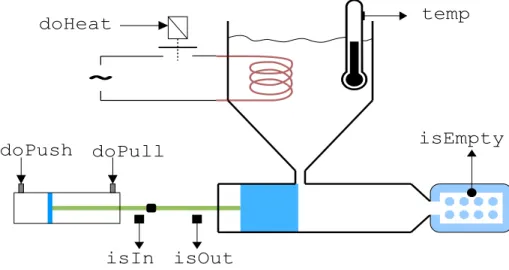
Computer control of a machine for manufacturing LEGO-bricks, as depicted in Figure 1.1, implies two requirements on the software:
1. The temperature of the plastic material should be measured and controlled periodically to prepare the material for casting with the proper quality. 2. The piston of the cylinder should be controlled sequentially to actually
per-form the casting.
Note that the tasks according to items 1 and 2 need to be handled concurrently, and each task has to be carried out in real time. Otherwise the machine will not work.
Item 1 is a simple temperature regulator. Since reading the measured value (temp) and computing the control signal (doHeat) takes some time, such feedback control, when done in software, by necessity has to be carried out periodically. In each period (also called a sample), the controlled system in measured (sampled),
and the computed control signal is sent to the controlled system. For reasons
of control performance, the time between each sample should not be too long. For computing (CPU-load) reasons, we want to have as long sampling period as possible. Hence, a tradeoff between control and computing efficiency has to be made. This type of control istime driven since it is run with respect to (real)
time without waiting for conditions/events.
Item 2 is an example of sequencing control, which isevent driven (execution
advances when certain events occurs and arrives to the software); writing this as a periodic controller would imply unnecessary sampling and evaluation of the state of the application. On the other hand, if execution only advances on incoming events, how should then the temperature control be carried out (in the same program)?
The reader could try to write one sequential program performing both these tasks. Note that neither the temperature control nor the sequencing control may be delayed due to the dynamics of the other part. Furthermore, assume it should be simple (no reprogramming, only altering a data value) to change the sampling period of the temperature control.
A better way is to write two pieces of program, for instance two classes that handle the two control tasks. How should that be done, and what requirements does that put on the programming and run-time system?
Example 2: Bank-account transactions
A familiar example of concurrently occurring actions on the same data item, is bank account transactions. Assume that there are two transactions that are to be carried out at about the same time. One of them, which we call A, consists of taking out $1000 from the account via a money machine. The other transaction, which we call B, is to add a salary of $10000 to the account. Depending on the actual timing, and depending on how the bank computer performs the transac-tions, we obtain different cases. If one transaction is performed before the other,
~
isOut
temp
isIn
doPush
doPull
isEmpty
doHeat
1. Introduction
we have one of the two cases shown in Figure 1.2. Each sequence of operations expresses the way the computer at the bank performs the requested transactions. According to proper software engineering practice, the two sequences are prefer-ably expressed separately as described in the previous example. Furthermore, assume that the run-time system of our computer is capable of interleaving the two sequences in such a way that they appear to be done simultaneously. Since the interleaving is not specified in the individual programs as shown in the figure, it could result in any order of operations depending on the underlying system, and it could possibly be different from time to time. For instance, we may for the above transactions obtain interleavings according to Figure 1.3. Even if au-tomatic interleaving of code sequences often is desired to handle several tasks in parallel, we see that we must be able to specify a sequence of operations to be performed without being interrupted by other sequences manipulating the same (shared) data. We shall learn several ways to solve this type of problem.
// Case 1: Withdraw first
A: Read 5000
A: Amount = 5000 - 1000 A: Write 4000
B: Read 4000
B: Amount = 4000 + 10000 B: Write 14000
// Case 2: Salary first
B: Read 5000
B: Amount = 5000 + 10000 B: Write 15000
A: Read 15000
A: Amount = 15000 - 1000 A: Write 14000
Figure 1.2: Two bank account transactions done in two different orders. In both cases, the original amount was 5000 and the resulting amount is 14000 as expected.
// Timing 2:
A: Read 5000 B: Read 5000 A: Amount = 5000 - 1000
B: Amount = 5000 + 10000 A: Write 4000
B: Write 15000
// Timing 2:
A: Read 5000 B: Read 5000
B: Amount = 5000 + 10000 B: Write 15000
A: Amount = 5000 - 1000 A: Write 4000
Figure 1.3: Execution of the two bank account transactions interleaved in two different ways. With the Timing 1, the resulting amount is 15000, but the result happens to be 4000 in the second case. Hence, the final results are wrong and vary from time to time, which is clearly not acceptable.
Book outline
In the next chapter, we will go though the fundamentals of program execution with special interest in the concurrency issue and in the properties of the Java language. In Chapter 3, the Java language is used for solving concurrent pro-gramming problems. Doing that, however, also reveals some deficiencies of the standard Java platform and classes. Therefore, in Chapter 4, additional classes supporting real-time programming will be presented. Then in Chapter 5, we will learn how to do real-time programming using the classes from Chapter 4.
Chapter
2
Fundamentals
Goal:
Review of basic properties of software execution as a preparation for
dealing with concurrency and real-time issues.
Already having some programming experience means that you, dear reader, have a lot of knowledge about how a computer interprets or executes a computer program. When you know it, it is all natural, and most programmers are not aware of the insights they have gained. We are now about to write programs that behave concurrently even if we only have one processor. Before doing so, it could be a good idea to take a step back and review the basic properties of program execution. This is the first thing that will be done in this chapter. Then, different notions of concurrency in hardware and software will be treated. Finally, we state the duties of the software systems we are about to develop.
The eager and experienced programmer may skip this chapter, but beware, you may be a very skilled programmer without having the profound understanding you think you have.
2.1
Software execution is performed sequentially
To recall the sequential nature of program execution, assume you write an ordinary program to be run on an ordinary computer having one processor (CPU). A piece of the code may look as shown in Figure 2.1, so what value will x have after leaving the loop?
int x = 2; while (x >1) {
if (x ==10) x = 0; x ++;
};
/* What is x now ? */
2. Fundamentals
You know that the resulting value of x will be one. The novice answering zero believes that the loop-condition is continuously evaluated in parallel with evaluation of the expressions in the loop. Thus, the fact that the computer treats our instructions sequentially one after another cannot be considered natural to all of us; some of us have just learned that this is the way it works. Actually, it is a severe restriction that only one thing at a time can be done. Even if computers today are computing quickly enough to do the computations required by a parallel environment (like our real world).
So, when learning to program, we are first forced into the ‘narrow alley’ of sequential execution. Compare this with hardware design where each signal or information flow usually is taken care of by dedicated components ensuring con-tinuous and timely operation. But for reasons of cost and flexibility, we cannot implement everything in hardware, so the problem that we are facing now is that the sequential software execution model does not fit the inherently parallel prob-lems we want to solve. Even when solving parallel probprob-lems, however, some things are still sequential to their nature (like a sequence of control actions to be carried out in the correct order). Then, for such parts of the program, the sequential execution of software will be of great convenience.
2.2
Our physical world is parallel
The object oriented programming (OOP) paradigm, which we want to use for embedded programming, is based on creating software entities modelling our en-vironment. Furthermore, since we aim at computer control of physical devices, some thoughts about the environment to be controlled may be appropriate1.
As we all know, our physical world is inherently parallel. Mathematically, we need sets of coupled differential equations to describe it. Comparing such mathematical expressions with the expressions found in programming languages such as Java, they are not at all expressing the same thing. Basically, this is related to another beginners problem in programming; the notion of equality. When an mathematical expression states that x=y+2, that is an equality which should hold for whatever value x (or y) has. When we in a Java program write x=y+2, we instruct the computer to take the vale of y, add 2, and to store that in x. If we in Java write x==y+2, we test if the value of x equals y+2. The mathematical equality cannot be directly expressed in Java (or in any other widely used programming language like C, C++, etc.). Again, computers operate sequential from a programmers point of view.
For a single (scalar) differential equation, we then have an even harder type of equality. Apart from the previously mentioned problem, we have to compute derivatives of variables (representing physical states) and then we also get trunca-tion and quantificatrunca-tion effects due to the binary representatrunca-tion of data with finite wordlength. Therefore, we can only work with approximations of the real world object, even if its properties would be known exactly.
For a set of coupled differential equations, modelling our real-world objects, the sequencing effect is an even bigger problem since all equations are to hold in parallel. Additionally, state changes may occur at discrete times which cannot be
1This section (1.2) aims at deeper understanding or wider perspectives, but can be skipped by the reader only caring about practical programming issues.
2.3. Parallel computing
exactly represented, and our models may include logical relations. To overcome these problems, the following techniques are used within systems engineering:
1. For less complex dynamics, equations may be solved and only the explicit solution need to be implemented. For instance, a real-time computer game for playing “pinball” includes simulation of the ball dynamics, which can be expressed as a simple type of numeric integration.
2. For systems with low demands on accuracy or performance, we may approx-imate or even omit the model equations. For instance, for soft-stop control of elevator motions we may use manually-tuned open-loop control without any internal model. This is opposed to optimal performance robot motions which require extensive evaluation of motion dynamics.
3. We may use special purpose languages and execution systems that trans-forms declarative descriptions to computable expressions, i.e., a combination of software technology and numerical analysis. For instance, it is well known within the software oriented part of the control community that object ori-ented models of dynamic properties requires declarative languages such as Modelica. Another example is that certain types of logical relations may be conveniently expressed in Prolog.
The computational difficulties are taken care of at ‘system design time’, which means that we use high performance workstations to analyze, simulate, and to determine a control algorithm that is simple to compute in the embedded system. For instance, based on the equations and a dynamic model of a system (like dynamic properties of a vehicle) we may use simulation tools to compute the behaviour (like rotation, position and velocity) when certain actions are applied (like speed and steering wheel commands), and some control design tool help us determine a control law expression which can easily be implemented and computed in the embedded software.
The conclusion from this section is that our real physical world can be quite troublesome from a programming point of view. Therefore, we should not apply object orientation and imperative languages (such as Java) outside their concep-tual limits, and we should design our systems so that algorithmic parts (possibly needing special treatment as mentioned) are encapsulated in classes in such a way that they can be developed separately. And fortunately, that separate treatment can usually be carried out at design time.
We are then left with the much simpler task of standard concurrent and real-time programming which is the topic of this book. In other words, if we exclude ad-vanced systems like certain types of autonomous vehicles and self-learning robots, the parallelity of the physical world is not a problem when programming embed-ded systems since we only communicate with the environment via a finite number of input-output (IO) connections with discrete (limited A/D and D/A resolution) values and in discrete time (sampled when the IO device driver is run).
2.3
Parallel computing
2. Fundamentals
for the last twenty years has then been to build parallel computers. That is, com-puters that contain many processors working in parallel. Today, late nineties, parallel computers with up to 64 processors (CPUs) of the same type sharing a common memory has made it to the market. Then, what are the implications for concurrent programming of embedded systems?First, we should know that the mainstream industrial development of embedded computers is based on either single CPUs, or multiple CPUs that are separately programmed because they contain different (loosely connected) software modules. Modern CPUs are power-ful enough for at least specific and encapsulated parts of the software functions. Hence, programming is still carried out on a single CPU basis, possibly using explicit interfaces between multiple processors.
• The parallellity of real-world models, as described in previous section, shows up in technical computing. Some types of problems can be decomposed into computations that can be done in parallel with each other. However, this is only worthwhile for special problems, and then mainly during system design. There are no indications that parallel computers requiring special program-ming techniques will be widely used for embedded computing. Exceptions may be applications like radar echo processing and computer vision. Such inherently parallel applications are important and demanding, but it is out-side the scope of this book since it employs few programmers.
• The ordinary sequential programming model is so established that computer vendors have to stay with it. Therefore, the parallelity of the hardware is taken care of by special compilers and run-time systems, still maintaining an unchanged view to the programmer. There is even a trend that the par-allelity is fully taken care of by the hardware. Hardware developers talk about the “sequence control barrier” which means that the hardware paral-lelity may not violate the sequencing property of the software execution as described in Section2.1. Thus, even if we should use a PC running Windows on four CPUs, we do not have to care about that when writing our software.
In conclusion, the sequential execution model described earlier is almost always valid even when parallel computers are used. Comments about software interfaces between different processors will be given in a few places in this book, but generally we should think in terms of using a single CPU.
2.4
Concurrency
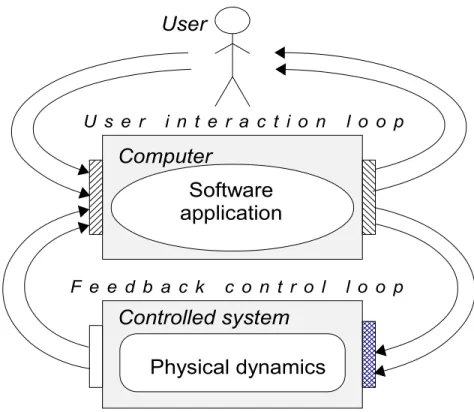
Our software applications interact with users and external equipment via in-put/output interfaces, generally called the IO. The computer receives input data concurrently from sensors and from user input devices like keyboard, mouse, and microphone, as depicted in Figure 2.2. From the user we talk about input events, and from the sensors we talk about samples. Both input events and samples reach our program in form of some kind of data entity or record. For a mouse click, for example, the event typically contains the horizontal and vertical coordinates on the screen and the time when the click occurred. Sampled physical values for feedback control are usually obtained via dedicated IO interfaces with well defined timing and buffering; extra delays in terms of unforeseen buffering could
2.4. Concurrency
Software
application
Computer
Controlled system
Physical dynamics
User
U s e r i n t e r a c t i o n l o o p
F e e d b a c k c o n t r o l l o o p
Figure 2.2: Input in terms of user commands/actions and sampled measurements must be concurrently and timely handled by our software. (Re)computed outputs for user perception and control actuation form two feedback loops.
cause the feedback control to be unstable. There is no clear distinction between the two loops in Figure 2.2 (for instance real-time games only have one type of loop and physics is directly available to the user/driver in vehicles), but it is normally good to be aware of it for engineering purposes. Assume we only know ordinary sequential programming. Even if we use object oriented design and programming, with classes and objects defined according to real-world objects, methods are se-quential and called sese-quentially so we still have the same situation as commented in the beginning of this chapter. Physically, all input may occur in parallel, and we can generally not make any assumptions about the resulting order of the data that is input to our program. The problem with pure sequential programming is that the programmer must define in what order computing should be done, but it is not known in what order input data will arrive, or the program has to waste CPU time on excessive polling and evaluation of conditions that may influence the output.
2. Fundamentals
more attractive approach would be to have the temperature control expressed well separated from the sequencing control of the piston, which also would be natural from an object-oriented programming point of view. The problem is, however, that object orientation by itself does not support concurrency.
The same type of problems show up in interactive software. For example, an applet containing a web animation and a button to select if the animation should be played forward or backward is for the purposes of this treatment equivalent to the LEGO-brick machine. Animation with a certain frame rate corresponds to the periodic temperature control, and handling of the push button corresponds to handling the position sensor. For the purposes of this book, however, we will mainly consider control applications which are subject to more severe demands in later chapters. When we know how to cope with both concurrency and real time for control applications, we will also be able to handle (the simpler) interactive systems.
Behind the term concurrent programming is the fact that our software has to handle concurrently occurring external events. But before making a definition of the term, let us review some alternative approaches to handle the situation.
2.4.1
Event processing
In the simplest case, each input event can be immediately and fully handled before any following events must be taken care of. Then our program may consist of only data structures, so calledevent handlerswhich perform the processing of
each event, and a so calleddispatcher that calls the appropriate event handler for
each incoming event. There would, for example, be one event handler taking care of mouse clicks which then would result in changes of the data structures, usually reflected on the screen. The dispatcher is called in a simple loop which thereby is ‘driving’ the application.
The loop retrieving the events (or messages) and calling the handlers is (in Microsoft terms) called the message pump. When programming user interfaces using popular class libraries like MFC (Microsoft Foundation Classes), AWT (the Java-based Abstract Window Toolkit providing an interface to native graphics and window systems), or JFC (Java Foundation Classes, now known as Swing), the message pump is hidden inside the class library. Application programming then means writing the event handlers/listeners and registering them to the system.
Event processing is easy to program but in most applications, and particularly in control applications like our LEGO-machine, this execution model alone is not sufficient. The reasons are:
• Our single control loop will consume all available CPU time for the successive testing (called polling, or busy wait if nothing else is being done). This is waste of processing power which prevents the computer from simultaneously being used for other tasks.
• Most control functions, but not this one, need a notion of time to work correctly. For example, if there would have been disturbances on our mea-surement signal, or if we would need to predict the temperature some time ahead, sampling and computing would require proper and known timing
2.4. Concurrency
The straightforward solution now is to convert our control function into a form suitable for event processing, and to have control events periodically generated with a certain time period. This is actually a useful method for very small software systems, like software for so called micro-controllers. For our example application this means that we should:
1. Remove the loop statement around the control algorithm and the waiting for next sample to simply get a function computing one new control output based on one single input event.
2. Connect some external timer hardware generating periodic time events to the program. This is built into so called micro-controller chips, and available on (almost) any computer board. The timer should be set up to expire often enough to obtain good control, but seldom enough not to waste CPU time. (To find an appropriate value is a control engineering task which is not covered.)
However, such an interrupt/event-driven technique does not scale up very well. Imagine a control computer handling many control loops with different sampling periods, that would require non-standard timer hardware, and the dispatching of timer events would be troublesome. Further disadvantages will be mentioned below. Thus, event processing as a general mechanism is mainly useful when developing user interfaces or computing functions that can run to completion and return whenever triggered (by time, mouse clicks, etc.). Here we also need other more powerful concepts.
2.4.2
Time and encapsulation
The main limitation with purely event-driven software is that the processing must be completed immediately not to delay processing of the subsequent events. When the required computing takes to long time to complete, we need some means to schedule to work to be done. For instance, the user pushing a button in a web-based application may results in a request for information to be downloaded via Internet. Clearly, we need some means to let the event handler start (or give data to) an ongoing activity taking care of the loading. That activity then needs to be interruptible by other events, and possibly by more important ongoing activities issued by those events.
2. Fundamentals
In Java applets the event handling is performed in functions like action and handleEvent, whereas ongoing activities are (or at least should be) done in func-tions like run. But before we learn how to design and program such funcfunc-tions, there are some things we should observe.
2.4.3
Programming of parallel sequences
The functionality we are aiming at resembles that of an operating system; several programs that run at the same time should be scheduled to share the CPU in order to let each of the programs behave timely. However, the concurrency of complete programs is another topic handled later in this book. For now, we assume that the concurrency stems from the parallelism of a single application or program. It is then a big advantage that separately programmed concurrent activities can share and operate on the same data structures or objects. Otherwise, we would need additional files, pipes, sockets, etc. to exchange data, and that would be slower and much more work to program. Furthermore, assume that our program containing the concurrently executing activities is the only program we are running. (We cannot make assumptions about other programs anyway, and when we load our software into an embedded computer this assumption is normally fulfilled.)
When an ordinary sequential program executes, from entering the main pro-gram until the final end, there is at each time one specific point of execution. We refer to that point in terms of a program counter (PC). We have so far realized that we require the program to be concurrently ongoing, typically executing in several objects simultaneously. That is, the program has to switch between its concurrent activities in such a way that, with the time scale of the application at hand, it appears (to the user and to the controlled system) to run in parallel (on different CPUs). To achieve this, the run-time system has to provide:
1. A function for creating a new concurrently executing activity, i.e., an addi-tional PC and the states comprising the context associated with the point of execution.
2. A scheduler that provides sharing of the CPU in common by interleaving the executions. This should be without requiring the source code to be cluttered with statements not modeling the task to be performed.
3. When concurrent activities share the same data or is dependent on each others computational results, there must be some means of synchronization and communication.
The need for a scheduler is related to the obligations of the operating system for running complete programs, but as mentioned, here we are concerned with the parallel behavior of one program. Assuming that our system is equipped with such a scheduler, interlacing the different points of execution, we may define the following requirement for a concurrent program to be correct:
Definition: The correctness of a concurrent program does not only require each programmed sequence of computation to be correct, the correct result must also be obtained for all possible interleavings.
In terms of the bank example this means that money should not be (virtually) lost or created due to the timing of transactions and computer operations. Even if
2.5. Interrupts, pre-emption, and reentrance
that is an obvious requirement, it is actually a quite severe demand when it comes to verification of the correctness and finding any faults; the task we call test and debugging. Debugging an ordinary sequential program can be done by running the program with all possible sets of input data, and one set of input data gives the same result if the program is run again. For a concurrent program, however, the interleaving depends on external events triggering different sequences of scheduling and execution. With a concurrent program, we can usually not expect to obtain the same execution order twice; an input event occurring just a microsecond later may result in another interleaving which may course an incorrect program to crash. That in turn must not happen for a safety critical application. Hence, we may have severe requirements on correctness but complete testing is almost never possible.
It is interesting to note that the definition of correctness does not say anything about time or timing, but timing is both the main reason for introducing concur-rency and the key aspect for the behavior of an incorrect program. Considering the difficulties writing and testing concurrent software, our hope now is that we can find and follow certain rules for development of such software.
2.5
Interrupts, pre-emption, and reentrance
Just like we did not allow the user program to poll the inputs for possible events (which would be waste of computing power when no new event has arrived), the same applies to the scheduler or scheduling. The invocation of the scheduler and its implications for the software application deserve some comments.
2.5.1
Obtaining the time base
As mentioned, we resort to using hardware interrupts to trigger our software functions, even if the interrupt service routines as such are hidden inside the operating system and device drivers. Of course, we may have input signals which do not generate any interrupt, but then we read that value at certain times, usually periodically when the data is used for feedback control. Therefore, the scheduler should also be able to handle time requests, such as “sleep one second” which then should suspend execution for that activity during that period of time.
Hence, our computer must be equipped with some kind of timer interrupt occurring periodically, thereby providing a time base for the software. Of course, the time in software will then be discrete (incremented one step for each timer interrupt) opposed to the true time which is continuous. Discrete time is, however, inherent to computer control anyway so it suits our purposes well.
Note that if we were only simulating our system, the time variable could be stepwise increased by the scheduler; when all processing is done for one point of time, the scheduler simply lets time jump to the next time referred to by the application. But here we aim at software that interacts with the physical environ-ment which (by the laws of nature) has time as an independent and continuously increasing variable. The time variable in our software is the sampled value of the real time.
in-2. Fundamentals
stance, the Windows-95/98 user may review his/her IRQ settings, typically finding them allocated by the sound card, the game port, the hard disk, etc. (The settings are found by selecting IRQ in the panel found by clicking on Control panel -> System -> Device Manager -> Computer -> Properties.) Then note that the first interrupt (IRQ 00, having the highest priority) is used by the “System Timer” which then provides the time base for the entire operating system. Giving the timer interrupt the highest priority, allowing it to interrupt other interrupts, is to ensure maintenance of the time variable. Otherwise, a too excessive number of interrupts could not be detected.
In embedded computers there are usually also some kind of time-out or stall-alarm interrupt connected to the very highest (unmaskable) interrupt level. It is then the obligation of the so called idle loop (the loop being executed when there are nothing else to do) to reset that timer so it never expires. But if that should happen, the CPU is overloaded and the controlled machine must be shut down because without enough time for the feedback control the system may behave very badly (crazy robot, crashing airplane, etc.). To prevent this, we will use special programming techniques in later chapters. In desktop applications, on the other hand, the user simply has to wait.
2.5.2
Pre-emption
When the scheduler, as a consequence of a timer interrupt, suspends execution of one activity and lets the program resume execution at another point (where execution was suspended at some earlier stage), we call it pre-emption. The term is used also in connection with operating systems; pre-emptive multitasking. Pre-emption means that execution may be suspended even if there is nothing in the executing code that explicitly admits the change of execution point. We may say that the system forces the application to give up the use of the CPU.
The opposite to pre-emptive scheduling is non-pre-emptive scheduling, which means that execution is only suspended when there is some call of scheduling functions or resource allocation. For instance, an attempt to open a network connection may include waiting for name-servers and remote computers to reply. Even if it is not desirable to wait, we know (and the compiler and run-time system knows) that execution may very well be suspended. These so called blocking operations are handled the same when pre-emption is used, but with pre-emption the suspension may also be enforced.
Different types of pre-emption exist. In general terms, there are three alterna-tives for the granularity of execution suspension:
1. The most primitive case is when pre-emption is not supported; execution is only suspended when certain system calls are made. The advantage is efficiency since the state of the execution is well known by the compiler and run-time system. For instance, all temporary registers that by the compiler are assumed to be destroyed by a function call, need not be saved. The disadvantage is that an application (or function) written without considering the need for other activities to execute concurrently will not give up the right to use the CPU, and may therefore lock the system or make response times too long.
2.5. Interrupts, pre-emption, and reentrance
2. Execution may be interrupted/suspended between each line of source code. From a programming point of view, it is very convenient to know that each statement gets fully executed without interrupt. Early-days Basic inter-preters often worked this way. One disadvantage is that complex statements may delay change of activity too long. Not to interfere with other interrupt services, interrupts such as the timer interrupt is served immediately and ongoing execution may be marked for suspension. Another disadvantage is then that the checking between each statement costs processing power. An interesting version of this technique is implemented in the Lund Simula system which by utilization of the hardware (Sun Sparc) performs the check at almost no cost. The key drawback is, however, that concurrency requires support from compiler and run-time system, which means that most avail-able code (written in C/C++) cannot be used when timing requirements are severe.
3. Execution may be interrupted/suspended between each machine instruction. The advantages are that any sequential code (without compiler support) can be interrupted, and that the interrupt and possible rescheduling will be started immediately. There will, however, be some delay since we must save the entire status of the execution (all registers etc.), and that may for some types of hardware be slower than case 2. Another disadvantage is that programming gets more complicated since it may be hard to know from the source code if a statement is atomic or not.
Summing up advantages and disadvantages, and considering the importance of timely operation also when non-concurrent code is used, alternative 3 is the best choice. That solution is assumed in the sequel. In the Java case, it is not clear what we mean by machine level. There are three cases:
• The Java program has been compiled into byte code which is then executed on a Java Virtual Machine (JVM) hardware. Then, the machine instruc-tions actually used are the byte codes, and the program may be interrupted between each byte code which implies that a statement in the source code may be partially evaluated.
• The Java program, again represented by its byte codes, may be run on a JVM implemented in software. Internally in the JVM, there may be a so called JIT (Just In Time) compiler which compiles the byte codes into native machine code. The JVM may then permit pre-emption between byte codes, or between machine instructions when performing a byte code, depending on implementation. In both cases, the Java statements may be partially evaluated.
2. Fundamentals
Thus, from a programming point of view, it does not matter which of these cases that describe the actual situation. The fact to consider is that our sequential execution may be interrupted also in the middle of one Java statement. We will, however, in some situations know that an operation is atomic (one byte code or one machine instruction depending on the case) and then utilize that to simplify the program.
2.5.3
Reentrance
Now when we have multiple points of execution in our program, and we realize that access of shared data requires special care (which will be covered in the next chapter), a good question is: What about shared functions? In other words: what happens if the same function is being called concurrently from several points of execution? We say that we re-enter the function, and if that is permitted and working, we say that the code/class/function is reentrant.
Lack of reentrance is common problem in badly written C programs. The reason is the use of static variables, i.e., variables that are allocated on a fixed place in memory instead of on the stack or on the heap.
In most run-time systems, local variables in functions and blocks are allocated (pushed) on the stack, which means that they are deallocated (popped from the stack) when the PC leaves the scope. Data created dynamically, using operator new in Java or C++, are allocated on the heap which is sometimes called the free store. But also for heap allocation we usually have the reference to the object declared locally in some scope which means that it is put on the stack. This is a proper programming style which means that all data is pushed on the stack of the caller. If, on the other hand, we use static variables, two callers of one function will access the same local data (referred to by absolute addresses in the compiled code of the function).
The real problem is when the one who wrote the function is not aware of con-current programming. Example: A numerical equation solver was implemented in C, and then it was packaged together with other routines in a library. To optimize the code for the hardware at that time, the temporary variables of the algorithm were declared static. The function was then successfully used for years on an old-style UNIX machine, where each program only contains one point of execution (except for the signal handlers). Then, the library was compiled and linked with applications running on the newer so called multi-threaded UNIX dialects, such as Sun Solaris, HP-UX 10 and later, and later versions of IRIX from SGI. It was also used on the Microsoft Win32 platform. In all these cases, when using the equation solver concurrently from different parts of the application, the results were sometimes wrong. In this case, the function was correct as a program, but not correct when used in a concurrent program where some interleavings resulted in undesired mixing of temporary data from different equations.
Also in Java it is easy to declare static variables, but we should only do that for so called class variables needed for the structure of our program, and in that case we should treat them as other types of shared data (which we will return to). Note that when you write an ordinary function, you cannot know if it later will be used concurrently. In conclusion, one should learn concurrent programming before doing any type of professional programming.
2.6. Models of concurrent execution
2.6
Models of concurrent execution
The concurrency issues made our simple sequential execution model (from Section 2.1) more complex because we now have several sequences that interact with each other. With each sequence, there are:
• A PC (the Program Counter) which according to the previous section refers to the next machine instruction to be executed.
• An SP (the Stack Pointer) which refers to the stack of that particular exe-cution sequence. On the stack, there are the activation records of all block-s/functions that are currently entered, as required for reentrant code. • The machine state (of the CPU or some virtual machine depending on the
implementation of the run-time system) holds part of the status of our exe-cution sequence.
• If common resources (like shared data) are reserved in one sequence, that affects the others and should therefore be dealt with somehow.
Continuing our attempt to bring order in the complexity by exploring fundamental properties, some basic terms will now be described. First we have the following two definitions:
Definition: A context is the state of an active program execution, which in-cludes PC, SP, and machine state. From an operating system point of view, exe-cution may also be associated with permission and user privileges which then may be included in the context. In such a case we call it a process context or a heavy-weight context. From this point on, we will use the former minimal definition which is also called a light-weight context.
Definition: A context switch refers to the change of context typically performed by some scheduler or operating system.
Since we aim at appropriate programming methods, there is the question about what support we have from the language and from the programming interfaces (libraries of available classes). This has a great impact on the way we have to write our code. For instance, when programming in C, the language itself does not give any support for handling concurrency which makes the use of special libraries important (and tricky). In Ada there is language support in terms of tasks and rendezvous, but using that support has a significant impact on both
design and implementation. A language with extensive support, like Occam, is in danger of being too special and therefore not being widely used.
2.6.1
Fundamental abstractions
2. Fundamentals
support creation of new threads and specification of how these threads accomplish execution. Furthermore, there must be programming language constructs whose execution causes threads to block and subsequently be made ready for execution. A thread is either blocked or running or ready. A thread is blocked when it is waiting for some event to occur. A thread is running when it is actually executing on a processor. A thread is ready when it is eligible for execution but is not being executed.
Execution state - is the state information needed to permit concurrent execu-tion. An execution state can be active or inactive, depending on whether or not it is currently being used by a thread. An execution state consists of the context and the activation state. These are typically stored (internally in the run-time system) in a data structure, which traditionally has been called process control block/record (PCR). An inactive execution state is then completely stored within the PCR, whereas the hardware related parts (registers, interrupt masks, etc.) of an active execution state are stored in the hardware/CPU. Referring to the con-text as the main item, we call the change between the active and inactive states a context switch. The switch includes storing or restoring the hardware state, and it occurs when the thread transfers from one execution state to another.
Mutual exclusion - is the mechanism that permits an action to be performed on a resource without interruption by other operations on that resource. In a concurrent system, mutual exclusion is required to guarantee consistent genera-tion of results, and it should therefore be supported in a convenient way by the programming language. Furthermore, for efficiency at run time, it needs to be provided as an elementary execution property.
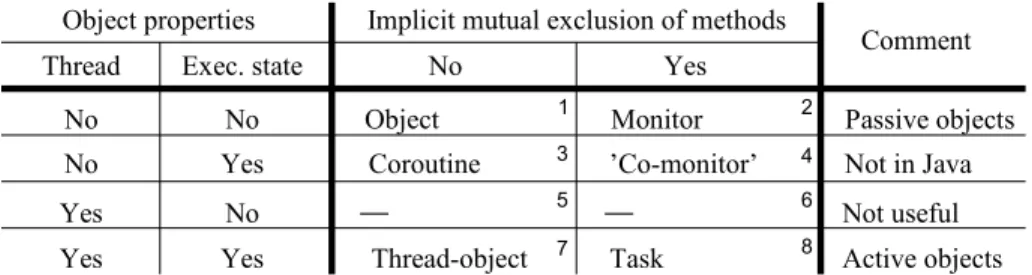
In an object-oriented framework, these three execution properties are proper-ties of objects. Therefore, an object may or may not have/be a thread, it may or may not have an execution state, and it may or may not have/provide mutual exclusion. The latter means that it may or may not exclude concurrent access via call of methods of that object. The next issue is to know: What are the possi-ble and useful combinations of the execution properties? All eight combinations (which would make up a 2 by 2 by 2 cube) is depicted in Figure 2.3. The numbers in that table refers to the following items:
1. This is an ordinary object as known from object oriented programming, or an ordinary piece of code in the case that object orientation is not supported. This is the only case that programmers not acquainted with concurrent programming use. A class programmed in this way can still be useful in an concurrent environment if its member functions are reentrant, which they are if only local data is used and the if language/execution supports recursion (direct or indirect). Since there is neither a thread nor an execution state, we say that the object is a passive object.
2. It is still a passive object if we add mutual exclusion, but only one thread at a time may run the code of the object. This abstraction is called amonitor.
3. Having an execution state without having a thread permanently associated with it forms an abstraction called a coroutine. A coroutine must be used by a thread to advance its execution state. If you have multiple coroutines but only one thread, only one coroutine at a time may execute. This is useful to handle parallellity issues in algorithms or in simulations because there the
2.6. Models of concurrent execution
Object properties Implicit mutual exclusion of methods
Thread Exec. state No Yes Comment No No Object Monitor Passive objects No Yes Coroutine ’Co-monitor’ Not in Java
Yes No Not useful
Yes Yes Thread-object Task Active objects
— —
4 2
5 6
7 8
3 1
Figure 2.3: Fundamental properties of software execution. Language support for an execution property is marked with “yes”. For mutual exclusion to be supported, it must be implicitly obtained from the types or declarations.
(virtual) time of the model can be held or advanced arbitrarily. That is, the real time used by a specific thread for its execution is unimportant, and a single thread using multiple coroutines is appropriate. An implementation based on coroutines can always be rewritten to work without them, but that may require more complex data structures and code. In combination with timer interrupts triggering a scheduler, coroutines can be used to implement thread objects.
4. Adding mutual exclusion to coroutines is not really necessary in the case of just one thread, and in the case that a group of coroutines run by one thread interacts with other threads, this alternative leads to difficult and error-prone programming. The name co-monitor is not established and this case is neither used nor commented in the sequel.
5. A thread without an execution state cannot execute on its own, and bor-rowing another thread for its execution does not provide concurrency. This case it therefore not useful.
6. Also with mutual exclusion, this case is not useful for the reasons mentioned in item 5.
7. An object with both thread and execution state is capable of execution of its own. We call this an active object or a thread object. The problem is that access to the attributes requires explicit mutual exclusion. That has to be simple to express in the program in order to make this alternative useful. Note that even if an active object calls member functions of other (active or passive) objects, the execution of those functions is driven by the calling thread, and the stacked activation records are part of the callers execution state.
8. A thread object with implicit mutual exclusion is called a task. This ab-straction can be found in the Ada language.
2. Fundamentals
threads) to be built. Simula provides coroutines that, together with interrupts checked between each statement, can be used to build a scheduler and thread support. Neither Simula nor Modula support implicit mutual exclusion, which means that shared data must be explicitly reserved by calling certain functions for locking and unlocking. In C and C++, there is no concurrency support at all.
2.6.2
Concurrency in Java
So, what are then the design choices for Java? As with other parts of Java, we find fair engineering choices rather than new unique features.
• There is no implicit mutual exclusion on object level, but individual methods (and even blocks) implicitly provide mutual exclusion by the explicit use of the synchronized keyword. Unfortunately, only code and not the accessed data is synchronized. Some extra programming discipline is therefore still required. Compared to having implicit mutual exclusion fully built into the language, the advantage is that the programmer is more free to tailor his/her code for specific application needs (such as efficiency).
• The notion of a thread object is supported via the object orientation by inheritance from the Thread base-class. When inheritance is rather used for other properties (recall that Java only provides single inheritance), the interface Runnable can be used to add the thread property to an object.
• Coroutines are not supported. Normally, threads are used to achieve the par-allel behavior of coroutines. Therefore, large-scale event-driven simulations may be very inefficient/slow.2 In normal applications, including embedded
systems, thread objects provide almost the same execution efficiency. The major reasons for omitting the coroutines in the Java language are: 1) The language can be kept simpler. 2) Most programmers do not know how to utilize coroutines anyway, particularly not in combination with threads. 3) Having the programmer to use threads instead means that the run-time system is free to let activities run in parallel if there are multiple CPUs available.
• The threads are based on so called native methods, i.e., functions that are implemented external to the JVM. In the case of thread support, native methods may be implemented by the operating system. Thread creation, interaction, and scheduling are then handled by the system functions which are optimized for the actual hardware used (and run in parallel as mentioned in the previous item). Of course there is a lack of elegance compared to a system based on coroutines, having the scheduler implemented as in the language itself. However, for the majority of applications running on an operating system such as the Solaris operating system (the Sun UNIX which supports up to 64 processors), using the native threads boosts performance (without changing the source code).
2To overcome this (unusual) problem, a superset of the Java language and a dedicated compiler and run-time system (replacing the JVM) could be developed. By implementing the language extensions as a translator implemented in Java, generating ordinary Java-code, the application would still be 100% Java when not optimized.
2.6. Models of concurrent execution
In conclusion, Java provides passive objects and active objects. A passive object is either an ordinary object, or it can be an object with no data exposed and all methods synchronized which then functions like a monitor. There are, however, no real monitors in the language; the programmer may expose data to concurrent access and some methods may be left unsynchronized. Active objects are those with the thread property, but we do not have (and we will not talk about) tasks since we do not have threads with implicit mutual exclusion. We will therefore only speak about classes, objects, synchronized methods, and threads. These are our building blocks for concurrent and real-time programming. There is, however, very little support for handling timing requirements, which we will return to in the final chapters.
2.6.3
Processes and interrupts
In the above treatment of programming language support for concurrency, we neglected two aspects, processes and interrupt service routines. In short, a process is the type of concurrent execution we have when we run some program under an operating system such as UNIX or Windows NT, and an interrupt service is the concurrent execution we have when a hardware interrupt starts a new thread of execution. These have to do with the interaction between the Java program and its environment in terms of hardware or other programs. Since this is quite dependent of the specific environment, it is probably a good idea not to provide any language support. Instead, we use classes that provide certain programming interfaces. Here, we will use the term interrupt to denote the execution carried out to service the actual hardware interrupt.
Both a process and an interrupt contain threading and some kind of execution state, but a process is more powerful than a thread whereas an interrupt is less powerful. In more detail:
• A process may contain one or several threads which we then say are internal to the process. The internal threads share a common address space in which they can share data and communicate without having to copy or transfer data via pipes or files. An object reference (or pointer in C/C++) can be used by several threads, but sharing objects between processes requires special techniques. The same applies to calls of member functions. All threads of one process have the same access rights concerning system calls, file access, etc. Different processes, on the other hand, may have different access rights.
The concept of a process makes it possible to isolate execution and data references of one program. By controlling the MMU (Memory Management Unit) accordingly, an illegal data access (due to dereference of a dangling pointer in a C program for instance) can be trapped and handled by the operating system. To the UNIX user, there will be something like a “seg-mentation fault” message. In Windows 95/98, which lacks this support, one application programming error may crash other applications or even hang the operating system.
2. Fundamentals
change execution state (switch context). Second, the interrupt may only start in a static function/method because this type of hardware call does not provide function arguments such as the implicit this pointer. Third, an interrupt may run within the context of another thread because the final restore of used registers and the requirement of “execution until completion” ensures that the context of the interrupted thread will be restored. The priorities of interrupts are managed by the hardware.
Thus, whereas threads will be the most common way to accomplish concurrently executing software entities, an ISR is sometimes more appropriate or even nec-essary (device drivers), or there may be reasons for using (OS) processes instead of threads. Device drivers cannot be (purely) implemented in Java, and such machine-level programming is outside the scope of this book; it is well known how to do that and there are several hardware/OS-specific manuals/books on the topic. The issue of multithreading versus multiprocessing is more relevant, in particular for large complex systems, deserving a more detailed treatment.
2.7
Multi-process programming
Programming languages include constructs for expressing the execution of one program, while interaction between programs are handled via library calls. Exer-cises in basic programming courses are solved by writing one program, possibly in several files that are compiled separately, but linked as one executable unit which is executed within one OS process. Possibly, event handlers (in terms of event listeners or callback routines) or multiple threads are used, but it is one program and one process sharing a common memory space. Note that even if we let dif-ferent OS processes share memory (via system calls such as mmap in UNIX), we have no language support for signaling and mutual exclusion; that too has to be handled via system calls.
Using multiple threads (multi-threaded programming) can, in principle, as mentioned, be used to create any concurrency. Also for utilization of multiple CPUs (with shared memory), threads are enough. So, in real-world systems, what are the reasons for using multiple processes instead of just multiple threads? In short, reasons for dividing a software application into multiple OS processes include the following:
1. Different parts of the applications need to run on different computers which are distributed (not sharing memory).
2. Different parts of the application need different permissions and access rights, or different sets of system resources.
3. In the Java case, different virtual machine properties (such as GC proper-ties) can be desirable for different parts of the system, depending on timing demands etc.
4. If the application consists of (new) Java parts and other (typically old, so called legacy) parts written in other languages like C, these parts can be in-terfaces and linked together using the Java Native Interface (JNI). However,
2.8. Object interaction and encapsulation
if the virtual machine and the legacy code requires specific but different na-tive threading libraries, this may not be possible (resulting in linkage errors). This is solved by using multiple processes.
5. Licensing terms for different parts of the application can forbid execution as one process. For instance, GNU-type of free software (GPL) may not be linked with proprietary software.
6. A large application including code written in an unsafe language (such as C/C++) will be more reliable if it is divided into several executable units, each with its own memory space and with memory accesses checked by the MMU (memory management unit) hardware. Instead of a ’blue-screen’ due to an illegal access, just one part of the application may stop. The use of protected memory is a main reason why large systems have been possible to develop despite unsafe languages. Still, any program may contain fatal bugs, but a safe language such as Java ensures that at least the errors are kept local and exception handling works.
7. Libraries, subsystems, or legacy software in general may not be thread safe. That is, variables (or attributes or fields) for storage of local data within a function (or method or procedure) may be declared static. That used to be a way to speed up programs and to save stack space, but the result is that the function can only be called by one thread at a time. By obtaining concurrency only via OS processes, we do not have to require the software to be thread safe since each process has its own memory allocated by the OS.
Sometimes you may want to develop classes and active objects which can be run either as threads or as a processes, without changing the code. Such issues and the principles of how to design and implement multi-process applications are topics of Chapter 7.
Note that from aconcurrent design point of view, neglecting implementation
issues such as if concurrency should be accomplished by threads or processes, we usually use the termprocess to refer to a (concurrently executing) activity. This
is in line with non-technical vocabulary where a process refers to some ongoing activity that cannot be completed immediately. (Pay attention to how the word is used in the news, in economy, and in management principles.)
2.8
Object interaction and encapsulation
The interaction (information exchange) between objects may be synchronous or asynchronous. It can be built into the programming language, and/or it can be programmed. Synchronous communication can be implemented on top of asyn-chronous communication, or vice versa.