ANTIBIOTIC RESISTANCE OF STAPHYLOCOCCUS AUREUS IN WATERSHEDS WITH AND WITHOUT COMMERICAL HOG OPERATIONS
Lindsay Claire Wickersham
A thesis submitted to the faculty at the University of North Carolina at Chapel Hill in partial fulfillment of the requirements for the degree of Master of Science in the Department of Environmental Science and Engineering in the Gillings School of Global Public Health.
Chapel Hill 2018
Approved by:
Jill Stewart
Courtney Woods
2018
ABSTRACT
Lindsay Claire Wickersham: Antibiotic Resistance of Staphylococcus aureus in Watersheds With and Without Commercial Hog Operations
(Under the direction of Jill Stewart)
Antibiotic use in commercial hog operations (CHOs) can lead to selection of antibiotic
resistant bacteria, which is a concern for zoonotic bacteria such as Staphylococcus aureus.
However, the extent to which antibiotic resistant S. aureus from CHOs contaminates surrounding surface waters is unknown. To determine whether watersheds with CHOs have more multidrug
resistant S. aureus (MDRSA) and livestock-associated S. aureus than watersheds without CHOs,
S. aureus was isolated and characterized from surface water samples (n=44) from sites with CHOs in their watersheds (n=3) and without CHOs (n=3). S. aureus (n=84) was isolated from 100% of CHO sites and 66% of non-CHO sites. MDRSA (n=23) was only recovered from one
CHO site on one sampling event and was positive for markers of livestock-association. No
To my family and friends.
ACKNOWLEDGEMENTS
I would like to recognize the contributions and encouragement of my mentor and friend
Elizabeth Christenson in the creation of this thesis. I would especially like to thank Ms.
Christenson for her help in determining the methods used, introducing me to the sampling sites,
teaching me PCR and other genetic analysis methods, and providing company and mentorship on
long sampling trip and even longer lab days. I would also like to acknowledge Ryan Leighton for
his help in water sample collection during the course of this study. I would also like to thank the
entire Stewart lab for creating a comfortable and cooperative lab atmosphere. I could not have
accomplished this thesis without the combined knowledge of the lab and its members.
I would also like to thank my committee, Jill Stewart, Courtney Woods, and Louise Ball.
Finally, an additional thank you goes to Dr. Jill Stewart for her continued support for the past 3
years, facilitating my passion for microbiology, and providing exceptional advice both in and
TABLE OF CONTENTS
LIST OF TABLES……….……..viii
LIST OF FIGURES………ix
LIST OF ABBREVIATIONS……….….x
CHAPTER 1: INTRODUCTION………1
CHAPTER 2: METHODS……….………..5
2.1 Site Selection………...5
2.2 Processing of Water Samples and S. aureus isolation...………....8
2.3 Confirmation Testing of S. aureus………9
2.4 Antibiotic Susceptibility Testing of S. aureus ………...….10
2.5 Livestock-Associated Markers……….10
CHAPTER 3: RESULTS………...12
3.1 Presence of S. aureus by Sampling Site………...12
3.2 Most Probable Number (MPN) Calculations………...13
3.3 Isolate Analysis from Positive Samples………...15
3.4 Unique Isolate Characterization and Analysis……….16
CHAPTER 4: DISCUSSION……….20
4.1 S. aureus Presence and Seasonality……….20
4.2 Methicillin Resistant S. aureus and Antibiotic Resistance………..21
4.5 Generalizability.………...23
CHAPTER 5: CONCLUSION………..25
LIST OF TABLES
Table 1. Sampling Site Watershed Characteristics………..6
Table 2. Sampling Date and Presence of S. aureus ………..………..6
Table 3. Characteristics of Antibiotics Used in Antibiotic Susceptibility Testing………....11
Table 4. Presence of Staphylococcus aureus by Sampling Site………...……….……….13
Table 5. Staphylococcus aureus Isolate Counts and Percent Positive for Traits of Interest……..16
LIST OF FIGURES
Figure 1. Maps of Sampling Sites and Watershed Information………..……….7
Figure 2. Most Probable Number (MPN) of S. aureus in Surface Water Samples………...14 Figure 3. Antibiotic Resistance Profiles and Livestock-Association
LIST OF ABBREVIATIONS
BK Background
CAFO Concentrated Animal Feeding Operation
CC Clonal Complex
CHO Commercial hog operations
LA Livestock-associated
MDRSA Multidrug resistant Staphylococcus aureus
MPN Most Probable Number
MRSA Methicillin resistant Staphylococcus aureus
MSSA Methicillin susceptible Staphylococcus aureus
pvl Panton–Valentine leukocidin
spa StaphylococcusProtein A
CHAPTER 1: INTRODUCTION
Since 1940, there has been a marked increase in the antibiotic resistance of
Staphylococcus aureus, a zoonotic pathogen that can lead to dermatitis, respiratory and eye infections and bacteremia (Cars, Högberg, & Murray, 2008; van Hal et al., 2012). Of particular
concern is the emergence of methicillin resistant S. aureus (MRSA) labeled by the CDC as a “serious hazard level,” representing an antibiotic resistant threat that will worsen without public
health intervention (CDC 2016). Infection with MRSA has been associated with increased
mortality and morbidity rates compared to infection with methicillin susceptible S. aureus
(MSSA), and often can only be treated with intense antibiotic therapy that may cause harmful side effects to the patient(Cosgrove et al., 2003). In addition to methicillin, S. aureus has
acquired resistance to several other antibiotics including those deemed of “critical importance” to
human medicine by the World Health Organization (WHO) (WHO Advisory Group on
Integrated Surveillance of Antimicrobial Resistance and World Health Organization, 2017.).
Documented cases of resistance to vancomycin in certain S. aureus strains emerged in 2002 (Ventola, 2015). Additionally, ceftaroline resistant strains of S. aureus were documentedin 2011, just one year after the introduction of this critical antibiotic in 2010 (Ventola, 2015).
Despite the erratic and rapid resistance patterns emerging in S. aureus, a large body of research solely investigates the emergence and presence of MRSA in various environments. Limited work
has purposefully investigated the scope of antibiotic resistance of S. aureus to classes of antibiotics outside of methicillin, or even the antibiotic resistance profiles of MSSA.
recently it has also be documented in concentrated animal feeding operations (CAFOs),
particularly in commercial hog operations (CHOs) also known as industrial hog operations
(IHOs) or swine CAFOs. CHOs commonly utilize antibiotics for growth promotion, with swine
production alone accounting for 37% of all medically important antimicrobial drugs used in
food-producing animals in the United States (FDA, 2017). Evidence of emerging antibiotic
resistance not only in livestock but also in humans as a result of this practice has been well
documented (Nadimpalli et al. 2016; Hatcher et al. 2016; Price et al. 2012; Gilchrist et al. 2007;
Köck et al. 2013). Fecal samples from livestock and human workers on CHOs have shown
intestinal flora with resistance to antibiotics without being treated clinically with the same
antibiotic (Gilchrist et al., 2007). Another study investigating Dutch CHOs documented the
transmission of three different MRSA strains from hogs to workers, and then from workers to
their families (Köck et al., 2013).
Antibiotic resistant S. aureus has been isolated from livestock with increasing frequency, indicating the potential for S. aureus to survive in hosts outside of humans (Fitzgerald, 2012). Phenotypic and genetic differences between S. aureus isolated from human and livestock however provide an opportunity for identifying the source of S. aureus isolates (Fitzgerald, 2012). The scn gene for example has been found in low frequency among S. aureus collected from animals (2-35%) compared to humans (90-100%), thus absence of the scn gene can identify
S. aureus isolates with a non-human source (Rinsky et al., 2013). Genetic sequencing and categorization of the Staphylococcus protein a(spa) gene has beenused to categorize and
2005; Hasman et al., 2010; Hau et al., 2018; Pomba et al., 2009; Price et al., 2012; Stegger et al.,
2012; Vestergaard et al., 2012). Tetracycline resistance can also be used to identify LA S. aureus, as tetracycline resistance is highly conserved among LA isolates (Fluit, 2012).
S. aureus and MRSA can also persist in the environment and humans exposure can occur through water systems (Charoenca and Fujioka 1995). Exposure to S. aureus and MRSA has been studied in marine water systems, encompassing potential human exposure through water, sand,
and soil (Plano et al. 2013; Akanbi et al. 2017). While S. aureus has been studiedin marine environments, little work has been done to characterize the presence and survival of S. aureus in freshwater. Several studies have shown that S. aureus can be present in fresh water surface waters in various environments, particularly those with high levels of human traffic (Fogarty et
al., 2015; Levin-Edens et al., 2012; Viau et al., 2011). Yet, few studies have investigated
non-human introduction of S. aureus into freshwater systems. Those that have addressed this topic focused more on the ability of wildlife and other animals to act as a reservoirs for S. aureus,
ratherthan the surrounding environment itself(Wardyn, Kauffman, & Smith, 2012). Literature has further identified the off-site transport of microbes and antibiotic resistance from CHO
lagoons and spray fields into surface waters, yet there is little research investigating the potential
of CHOs to act as sources of antibiotic resistant S. aureus to surrounding water ways (Heaney et al., 2015; Ibekwe et al., 2002; Jokinen et al., 2012). To our knowledge, only one published study
has attempted to detect MRSA in fresh water systems associated with CHOs, despite extensive
evidence that S. aureus is present in freshwater systems, livestock, and in CHOs. Hatcher and her research team were the first to document the presence of MRSA in surface waters near CHOs;
however, this research was not able to account for potential environmental sources of S. aureus
MRSA and did not include intentional analysis of S. aureus isolates without resistance to methicillin.
To further expand the work of Hatcher et al (2016), this study examined surface water
samples from watersheds with and without CHOs for S. aureus. Three background sites, with no CHOs or other known sources of fecal contamination, were included in this study to provide a
baseline for presence of S. aureus in the environment and to serve as a comparison for potential microbial contamination. While MRSA has been widely studied in the literature, there remains
limited research on MSSA and their subsequent resistance profiles to other classes of antibiotics.
Here, we investigated potential emerging antibiotic resistance of S. aureus to a wide variety of antibiotic classes through antibiotic resistance testing of 11 different classes and intentional
isolation of S. aureus instead of strict screening for MRSA. Furthermore, we investigated three different markers of livestock-association (LA) to provide insights into potential contamination
sources: absence of the scn gene, tetracycline resistance, and identification of LA spa types. Our objectives were to 1) determine the presence of S. aureus in surface waters with and without commercial hog operations in their watersheds, 2) analyze S. aureus collected for antibiotic resistance to 11 different mechanistic classes and 3) identify prevalence of three
different livestock-associated markers among S. aureus isolates. This work provides an
CHAPTER 2: METHODS
2.1 Site Selection
Sampling locations were chosen for this study based on a USGS report by Harden (2015).
A subset of three background sites (prefix: “BK”) and three commercial hog operation (CHO)
sites (prefix: “SW”) were chosen for a total of six sampling locations. Background sites are
defined as those without CHOs nor any other type of concentrated animal feeding operations
(CAFO) in their watersheds. CHO sites are defined as sites with CHOs in their watershed but no
other concentrated animal feeding operations (CAFOs). All watersheds sampled did not have any
other known point sources of fecal waste, such as wastewater treatment plants.
The sites selected from Harden’s study were the following: BK03, BK12, BK14, SW04,
SW07, and SW11 (Harden, 2015). These sites were considered representative of their respective
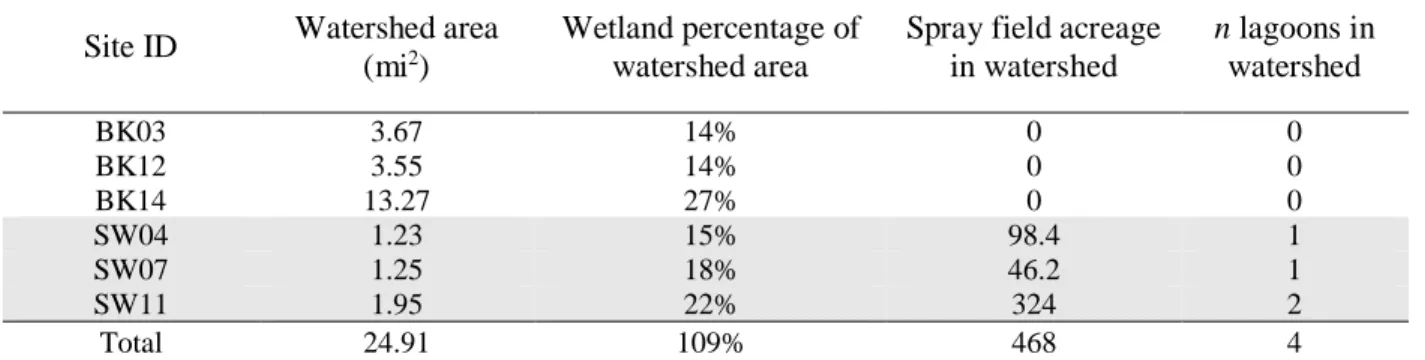
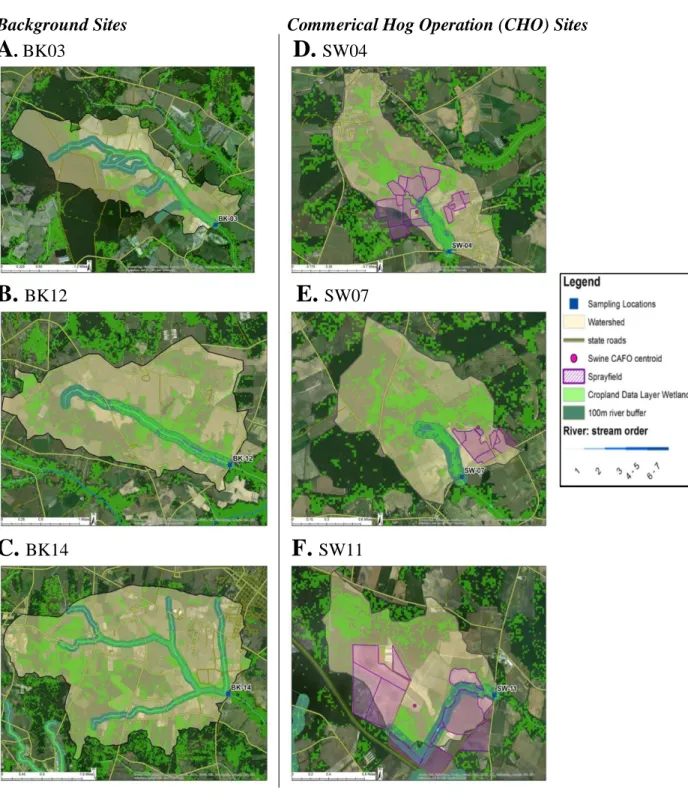
watersheds and vary in physical characteristics such as area and wetland percentage (Figure 1,
Table 1). CHO sites further differed in the number of hog lagoons used for waste storage and
spray field acreage, in which hog waste is sprayed onto fields as a soil conditioner (Figure 1,
Table 1).
Water samples were collected from all sites seven times between December 2016 and
October 2017 and one additional time in November 2016 (n=8) (Table 2). To explore the
seasonal effects of S. aureus presence, water samples were collected twice per season for all sites, except for sites SW04, BK03, BK12, and BK14, for which only one Fall water sample was
collected (Table 2). Seasons were defined according to astronomical definitions for the Northern
Note: Background sites (prefix “BK”) refer to sites without a commercial hog operation (CHO) or other known point source of fecal contamination in their watersheds. CHO sites (prefix “SW”) refer to sites with a CHO in their watersheds but no other concentrated animal feeding operations (CAFOs) or other known point sources of fecal contamination. Data courtesy of Elizabeth Christenson.
Table 1. Sampling Site Watershed Characteristics
Site ID Watershed area (mi2)
Wetland percentage of watershed area
Spray field acreage in watershed
n lagoons in watershed
BK03 3.67 14% 0 0
BK12 3.55 14% 0 0
BK14 13.27 27% 0 0
SW04 1.23 15% 98.4 1
SW07 1.25 18% 46.2 1
SW11 1.95 22% 324 2
Total 24.91 109% 468 4
Table 2. Sampling Dates and Presence of S. aureus
Site ID Sampling Dates
11/28/16* 1/16/17* 2/20/17 4/03/17 5/09/17 6/26/17 8/14/17 10/5/17 BK03 BK12 BK14 SW04 SW07 SW11
Season Fall Winter Winter Spring Spring Summer Summer Fall
Water Sample Collected S. aureus present
*Most probable number (MPN) calculations not performed
Background Sites Commerical Hog Operation (CHO) Sites
A
. BK03D.
SW04B.
BK12E.
SW07C.
BK14F.
SW11Figure 1. Maps of Sampling Sites and Watershed Information
A multi-meter measured ambient air temperature, water temperature, pH, conductivity,
and dissolved oxygen (DO) (mg/L) at each site. One liter of water was collected at the sampling
site from the center of the water bodies using sterilized containers and standard sampling
technique. Water samples were placed on ice for the duration of sampling, and refrigerated at
4°C overnight. Samples were processed within 24 hours.
2.2 Processing of Water Samples and S. aureus Isolation
Water samples were processed using standard membrane filtration technique with 0.45
µm pore size filters (Millipore Sigma, Burlington, Massachusetts). Five volumes of 10 ml and
five volumes of 50 ml samples of water were processed from each site for a total of 10
membranes per sampling site. To enrich the samples, membranes were folded into quarters using
sterile tweezers and submerged in 10 ml of Mueller Hinton broth + 6.5% NaCl contained in a test
tube. Tubes containing broth and membranes were vortexed at medium speed and incubated at
37 C for 24 hours. Tubes were removed from the incubator and vortexed for 3-5 seconds on
medium speed before returning to the incubator for an additional 24 hours. After a total of 48
hours each tube was vortexed and broth from each tube was streaked to isolation on its own 100
mm CHROMagar™ Staph Aureus plate (Chromagar, Springfield, NJ). Biofilms and the
membrane were avoided when transferring the broth to limit the presence of mixed colonies on
plates. Plates were incubated at 37 C for 18-24 hours.
In accordance with the manufacturer’s instructions, pink to mauve colonies with
morphologies indicative of S. aureus were streaked to isolation on 100 mm CHROMagar™ Staph Aureus plates (Chromagar, Springfield, NJ). This process was repeated with up to five
incubated at 37 C for 18-24 hours. Isolates positive for mannitol fermentation as indicated by
yellow growth were considered presumptive S. aureus and transferred to 1 ml of Brain Heart Diffusion Broth with 15% glycerol, vortexed, and frozen at -80 C for further analysis.
Most probable number (MPN) calculations were performed based on the number of
enrichment tubes that were positive for presence of confirmed S. aureus identified by the confirmation testing described below. Calculations were performed in MATLAB™ and
normalized to MPN per 100 ml. The mean seasonal MPNs from CHO and background sites were
compared using a paired t-test in Microsoft Excel to determine significance (𝛼=0.05).
2.3 Confirmation Testing of S. aureus
Biochemical and molecular assays were used to confirm S. aureus. All presumptive isolates were measured for production of catalase using standard methods and subjected to direct
tube coagulase testing using BBL™ Coagulase Plasma Rabbit with EDTA in accordance with
the manufacturer’s protocol (BD, Sparks, MD). Isolates positive for both assays were subjected
to molecular confirmation.
Molecular confirmation was performed on crude DNA extracts from freshly streaked
isolates on TSB agar, as described by Reishcl et al. (2000). A multiplex PCR reaction and gel
electrophoresis was then used to identify the presence of the following 5 genes: Staphylococcus aureus protein A (spa), mecA, mecC,scn, and pvl as described by Steggar et al. (2012) and as adapted by Hatcher et al. (2017). All presumptive isolates positive for the presence of the spa
gene were considered confirmed S. aureus isolates and are henceforth designated simply as isolates. Two different methicillin resistance genes, mecA and mecC were tested to determine the presence of methicillin resistant S. aureus (MRSA) (Hatcher et al. 2017). Presence of two
evasion cluster and the Panton–Valentine leukocidin (pvl) gene associated with the dissemination of community-acquired MRSA (Fluit, 2012; Van Wamel, Rooijakkers, Ruyken, Van Kessel, &
Van Strijp, 2006).
2.4 Antibiotic Susceptibility Testing of S. aureus
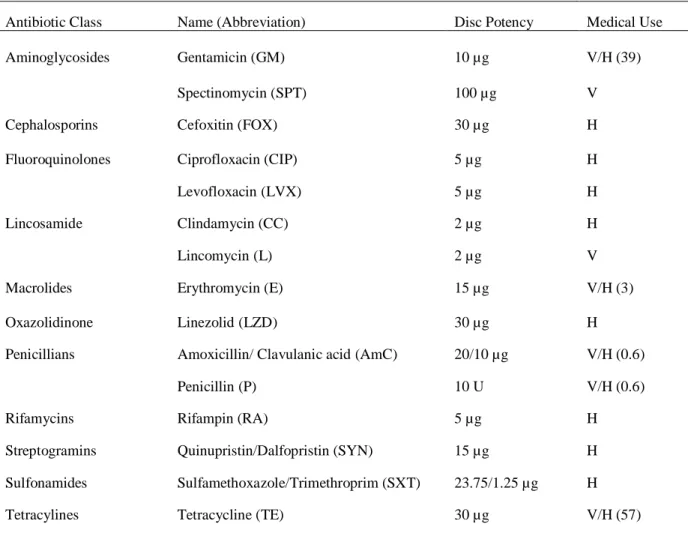
All confirmed S. aureus isolates were measured for phenotypic susceptibility to 15 different antibiotics from 11 classes (Table 3). Antibiotic susceptibility testing was performed
using the Kirby Bauer Disk Diffusion method in accordance with the standardized protocol by
the Clinical and Laboratory Standards Institute (CLSI 2015). All zones of inhibition except for
spectinomycin and linocomyin were interpreted in accordance with the Clinical and Laboratory
Standards Institute (CLSI 2015). Resistance to spectinomycin and lincomyocin was defined as
having no zone of inhibition around antibiotic disks and intermediate resistance was not
measured in this study because CLSI standards are not available for determination of S. aureus
susceptibility for these two antibiotics. In accordance with Magiorakos et al. (2012), isolates that
exhibited resistance to ≥ 1 antibiotic class were classified as antibiotic resistant S. aureus, while
those that exhibited resistance to ≥ 3 antibiotic classes were classified as multidrug resistant S. aureus (MDRSA).
2.5 Livestock-Associated Markers
Three different livestock-associated (LA) markers were assessed to determine the
potential sources of S. aureus to surface waters: tetracycline resistance, absence of scn, and spa
type. Isolates that showed resistance to tetracycline were considered positive for one LA marker
(Nadimpalli et al. 2016; Gilchrist et al. 2007; Hatcher et al. 2017). Isolates that tested negative
marker. Spa-typing of isolates was conducted through Sanger sequencing of PCR products by Eton Biosciences, Inc. (Research Triangle Park, NC) in accordance with Hatcher et al. (2017).
Sequences were then characterized using the Ridom StaphType software and the Ridom
SpaServer (http://spa.ridom.de/index.shtml), and assigned to clonal complexes (CC) based on
existing scientific literature. Spa types belonging to CC9, CC5, CC30, and CC398 were
classified as LA spa types as specified in the literature and considered positive for a putative LA marker (Skallerup et al. 2015; Khanna et al. 2007.).
Table 3. Characteristics of Antibiotics Used in Antibiotic Susceptibility Testing
Antibiotic Class Name (Abbreviation) Disc Potency Medical Use
Aminoglycosides Gentamicin (GM) 10 µg V/H (39)
Spectinomycin (SPT) 100 µg V
Cephalosporins Cefoxitin (FOX) 30 µg H
Fluoroquinolones Ciprofloxacin (CIP) 5 µg H
Levofloxacin (LVX) 5 µg H
Lincosamide Clindamycin (CC) 2 µg H
Lincomycin (L) 2 µg V
Macrolides Erythromycin (E) 15 µg V/H (3)
Oxazolidinone Linezolid (LZD) 30 µg H
Penicillians Amoxicillin/ Clavulanic acid (AmC) 20/10 µg V/H (0.6)
Penicillin (P) 10 U V/H (0.6)
Rifamycins Rifampin (RA) 5 µg H
Streptogramins Quinupristin/Dalfopristin (SYN) 15 µg H
Sulfonamides Sulfamethoxazole/Trimethroprim (SXT) 23.75/1.25 µg H
Tetracylines Tetracycline (TE) 30 µg V/H (57)
CHAPTER 3: RESULTS
3.1 Presence of S. aureus by Sampling Site
To determine the extent of surface water contamination of drug resistant S. aureus as related to CHOs in Eastern North Carolina, water samples were collected from three background
sites (prefix: BK) and three commercial hog operation (CHO) sites (prefix: SW) and analyzed for
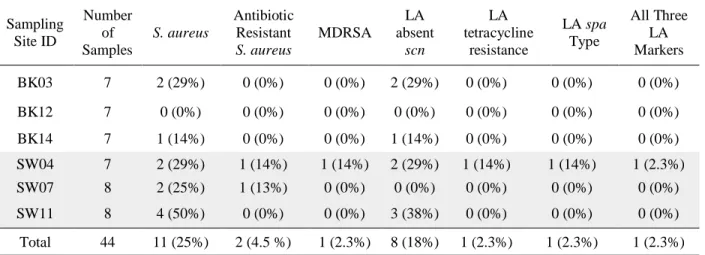
presence of Staphylococcus aureus. S. aureus was recovered in 67% of background sites and in 100% of commercial hog operation (CHO) sites. S. aureus was present in 11 out of the total 44 water samples (25%) at all time points: present in eight samples taken from CHO sites (18%) and
three samples in background sites (6.8%) (Table 2, Table 4). Antibiotic resistant S. aureus (resistant to ≥ 1 antibiotic class) was present in samples twice (4.5%) and multidrug resistant S. aureus (MDRSA; resistant to ≥ three different antibiotic classes) was present once (2.3%) (Table 4). No antibiotic resistant S. aureus or MDRSA was present in samples collected from background sites (Table 4). S. aureus with LA marker absence of scn was present in eight samples (18%): three times in background sites (14%) and five times in CHO sites (22%). S. aureus with LA marker tetracycline resistance was present in samples once (2.3%) and S. aureus
with LA spa types was present in samples once (2.3%) (Table 4). No S. aureus with LA tetracycline resistance or LA spa types were present in background sites (Table 4). S. aureus
positive for all three LA markers was present once in a CHO site and not present in background
Table 4: Presence of Staphylococcus aureus by Sampling Site Sampling Site ID Number of Samples S. aureus Antibiotic Resistant S. aureus MDRSA LA absent scn LA tetracycline resistance LA spa Type All Three LA Markers
BK03 7 2 (29%) 0 (0%) 0 (0%) 2 (29%) 0 (0%) 0 (0%) 0 (0%)
BK12 7 0 (0%) 0 (0%) 0 (0%) 0 (0%) 0 (0%) 0 (0%) 0 (0%)
BK14 7 1 (14%) 0 (0%) 0 (0%) 1 (14%) 0 (0%) 0 (0%) 0 (0%)
SW04 7 2 (29%) 1 (14%) 1 (14%) 2 (29%) 1 (14%) 1 (14%) 1 (2.3%) SW07 8 2 (25%) 1 (13%) 0 (0%) 0 (0%) 0 (0%) 0 (0%) 0 (0%)
SW11 8 4 (50%) 0 (0%) 0 (0%) 3 (38%) 0 (0%) 0 (0%) 0 (0%)
Total 44 11 (25%) 2 (4.5 %) 1 (2.3%) 8 (18%) 1 (2.3%) 1 (2.3%) 1 (2.3%) Note: Background sites (prefix “BK”) refer to sites without a commercial hog operation (CHO) in their
watersheds. CHO sites (prefix “SW”) refer to sites with a CHO in their watersheds but no other concentrated animal feeding operations (CAFOs) or other known point sources of fecal contamination. Antibiotic resistant S. aureus is defined as resistant to ≥ 1 antibiotic class. Multidrug resistant S. aureus (MDRSA) is defined as isolates resistant to ≥ 3 different antibiotic classes. LA is abbreviated for livestock-associated.
3.2 Most Probable Number Calculations
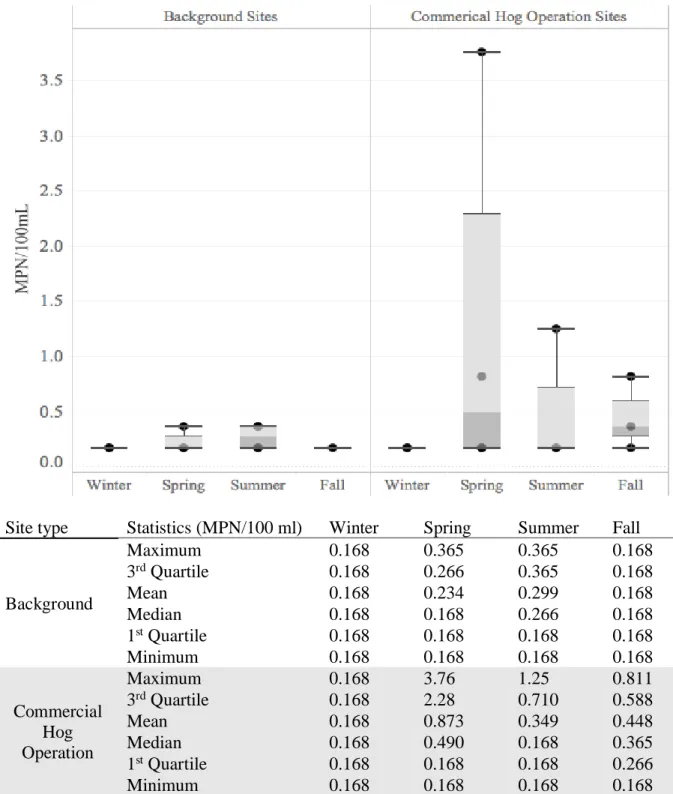
Most probable number (MPN) calculations were used to quantify the presence of S. aureus in sampling sites seasonally. The minimum MPN was <0.168 colony forming units (CFU) per 100 mL and represented zero positive enrichment tubes (Figure 2). Below detect
values were denoted as 0.168 in Figure 2. The maximum MPN measured by this study was 3.76
CFU/100 mL and was measured at a CHO site in the spring (Figure 2). CHO sites had higher 3rd
quartiles and maximum CFUs than background sites for all seasons except winter (Figure 2).
CHO sites had a higher median CFU (0.490, 0.588) in the spring and fall compared to
background sites (<0.168, <0.168) (Figure 2). No significant difference was found between mean
MPNs for background and swine sites during any season (𝛼=0.05; data not shown). Only one
sample from each season were used in the MPN calculation for Fall and Winter. No enrichment
Most Probable Number (MPN) of
S. aureus
in Surface Water Samples
Site type Statistics (MPN/100 ml) Winter Spring Summer Fall
Background
Maximum 0.168 0.365 0.365 0.168
3rd Quartile 0.168 0.266 0.365 0.168
Mean 0.168 0.234 0.299 0.168
Median 0.168 0.168 0.266 0.168
1st Quartile 0.168 0.168 0.168 0.168
Minimum 0.168 0.168 0.168 0.168
Commercial Hog Operation
Maximum 0.168 3.76 1.25 0.811
3rd Quartile 0.168 2.28 0.710 0.588
Mean 0.168 0.873 0.349 0.448
Median 0.168 0.490 0.168 0.365
1st Quartile 0.168 0.168 0.168 0.266
Minimum 0.168 0.168 0.168 0.168
Figure 2. Most Probable Number (MPN) of S. aureus in Surface Water Samples
3.3 Isolate Analysis from Positive Samples
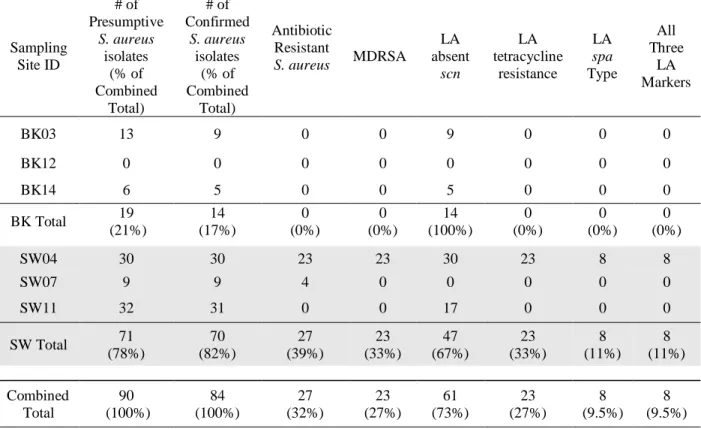
Originally 90 presumptive S. aureus isolates were collected, with up to five isolates being collected per sample (Table 5). This number was reduced to 85 based on results of biochemical
and molecular confirmatory tests and finalized at 84 isolates with the removal of one isolate due
to laboratory error (Table 5). These 84 isolates were subjected to antibiotic testing for 15
antibiotics comprising 11 different mechanistic classes. 70 (82%) of these isolates originated
from CHO sites and 14 (17%) were obtained from background sites (Table 5). 27 (39%) of
isolates from CHO sites exhibited antibiotic resistance to 1 or more antibiotic classes (Table 5).
No antibiotic resistant isolates were obtained from background sites (Table 5). 23 (33%) isolates
from CHO sites were classified as MDRSA and were positive for LA tetracycline resistance, and
eight (11%) were positive for LA spa types (Table 5). Eight isolates (11%) from CHO sites were positive for all three LA markers (Table 5). No isolates from background sites were classified as
3.4 Unique Isolate Characterization and Analysis
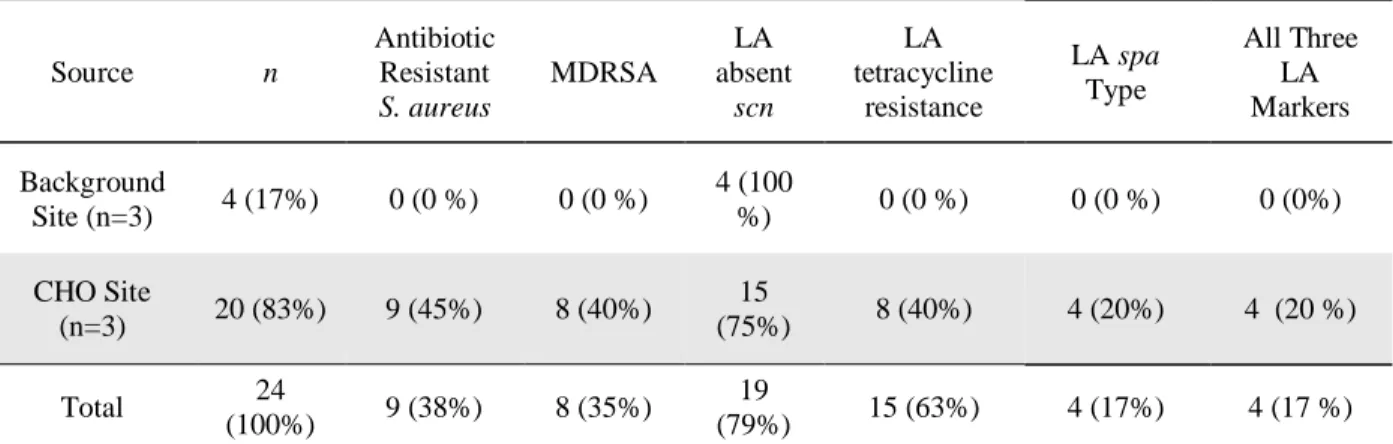
Due to the potential for cloning with enrichment methods, isolates were further
characterized as “unique” if they harbored an original spa type and/or antibiotic resistance
profile for their enrichment tube. By this definition, 24 unique isolates were identified with 20
(77%) obtained from CHO sites and four (17%) obtained from background sites (Table 6). Eight
unique isolates (40%) obtained from the CHO sites were characterized as MDRSA and positive
for LA tetracycline resistance (Table 6). Four unique isolates (20%) obtained from CHO sites
were positive for all three LA markers (Table 6). No MDRSA, tetracycline resistant, nor S. Table 5: Characteristics of Staphylococcus aureus Isolates
Sampling Site ID # of Presumptive S. aureus isolates (% of Combined Total) # of Confirmed S. aureus isolates (% of Combined Total) Antibiotic Resistant
S. aureus MDRSA
LA absent scn LA tetracycline resistance LA spa Type All Three LA Markers
BK03 13 9 0 0 9 0 0 0
BK12 0 0 0 0 0 0 0 0
BK14 6 5 0 0 5 0 0 0
BK Total 19 (21%) 14 (17%) 0 (0%) 0 (0%) 14 (100%) 0 (0%) 0 (0%) 0 (0%)
SW04 30 30 23 23 30 23 8 8
SW07 9 9 4 0 0 0 0 0
SW11 32 31 0 0 17 0 0 0
SW Total 71 (78%) 70 (82%) 27 (39%) 23 (33%) 47 (67%) 23 (33%) 8 (11%) 8 (11%) Combined Total 90 (100%) 84 (100%) 27 (32%) 23 (27%) 61 (73%) 23 (27%) 8 (9.5%) 8 (9.5%)
(%)=Percentage of confirmed isolates for specified site type (unless otherwise specified)
aureus with a LA spa type were isolated from background sites (Table 6). All 14 unique isolates from background sites were absent scn, compared to 15 (75%) of isolates from CHO sites (Table 6). No isolates from background sites presented with all three LA markers (Table 6).
Table 6. Unique Staphylococcus aureus Isolates Counts and Percent Positive For Traits of Interest
Source n
Antibiotic Resistant S. aureus MDRSA LA absent scn LA tetracycline resistance LA spa Type All Three LA Markers Background
Site (n=3) 4 (17%) 0 (0 %) 0 (0 %)
4 (100
%) 0 (0 %) 0 (0 %) 0 (0%)
CHO Site
(n=3) 20 (83%) 9 (45%) 8 (40%)
15
(75%) 8 (40%) 4 (20%) 4 (20 %)
Total 24
(100%) 9 (38%) 8 (35%)
19
(79%) 15 (63%) 4 (17%) 4 (17 %)
Note: Background sites indicate sampling locations without a commercial hog operation (CHO) in their watersheds. CHO sites indicate sampling locations with a CHO in their watersheds but no other concentrated animal feeding operations (CAFOs) or other known point sources of fecal contamination. Antibiotic resistant S. aureus is defined as resistant to ≥ 1 antibiotic class. Multidrug resistant S. aureus (MDRSA) is defined as isolates resistant to ≥ 3 different antibiotic classes. LA is abbreviated for livestock-associated.
Antibiotic resistance profiles of these 24 unique isolates were compared and analyzed.
Resistance to the following nine antibiotics was identified: spectinomycin (SPT) (n=8),
lincomycin (L) (n=8), ciprofloxacin (CIP) (n=7), levofloxacin (LVX) (n=7), clindamycin (CC)
(n=7), erythromycin (E) (n=8), tetracycline (TE) (n=8), gentamicin (GM) (n=1) , and penicillin
(P) (n=9) (Figure 3). All isolates were susceptible to the following six antibiotics: rifampin (RA),
quinupristin-dalfopristin (SYN), sulfamethoxazol-trimethoprim (SXT), linezolid (LZD),
cefoxitin (FOX), and amoxicillin-clavulanate acid(AMC) (Figure 3). All eight unique MDRSA
unique isolates were found on 5/9/17 from one sampling site, SW04. Outside of these eight
unique isolates, only two (7.7%) showed resistance (P, n=1) or intermediate susceptibility (CIP,
Sub-typing of isolates was performed through Sanger genetic sequencing of the
staphylococcal protein A (spa). 12 spa types were identified using the Ridom SpaServer database (http://spa.ridom.de/index.shtml): t002 (n=1), t127 (n=2), , t189 (n=2), t208 (n=2), t273 (n=4),
t324 (n=1), t337 (n=3), t1166 (n=1), t2315 (n=1), t17704 (n=5), t17705 (n=2), and t17706 (n=1)
(Figure 3). Livestock-associated spa types (t337, t2315) were identified in the unique isolates four (17%) times (Figure 3). The following three spa types were identified for the first time in this study and added to the Ridom SpaServer: t17704, t17705, and t17706. Livestock-associated
spa-types were also only found at one sampling time and location, 5/9/17 at SW04.
This study recovered S. aureus (n=84)from surface water samples from 100% of CHO sites (n=3) and 67% of BK sites (n=3). 24 unique isolates were identified from the original 84
isolates and differentiated by their unique resistance profiles and/or spa type within their
enrichment tubes. Regardless of grouping, MDRSA and S. aureus isolates with all three markers of LA were found only on 05/9/17 from site SW04. All isolates with a LA spa type were
MDRSA. The only other antibiotic resistance observed was to penicillin in a CHO isolate and
*= Newly Identified spa type .
Figure 3. Antibiotic Resistance Profiles and Livestock-Association of Unique S. aureus Isolates
.
CHAPTER 4: DISCUSSION
4.1. S. aureus presence and seasonality
This is the first exploratory study to evaluate Staphylococcus aureus from surface water samples from watersheds with and without commercial hog operations (CHOs). Furthermore,
this study considers antibiotic resistant S. aureus broadly rather than exclusively focusing on methicillin resistant S. aureus (MRSA). We identified isolates with and without livestock-associated markers, indicating that multiple sources may be contributing S. aureus to the
environment. While this study does not directly identify sources of contamination, sources could
include septic tanks, wild animals, humans, and or insect and rodent vectors (Hatcher et al.,
2016; Viau et al., 2011; Wardyn et al., 2012). As all S. aureus isolates from background sites did not have scn, it is unlikely that human contamination, such as from septic tanks, is contributing
S. aureus to surface water at these sites.
No S. aureus was present between February 2017 and April 2017 when average water
temperature at sites was 17.2 C and ranged between 13.7 C and 20.7 C. This was higher in
both range and average than winter as whole (8.9C - 16 C; 12.4 C) when S. aureus was still
4.2 Methicillin Resistant S. aureus and Antibiotic Resistance
One unique S. aureus isolate originating from a CHO site showed antibiotic resistance to penicillinoutside of the multidrug resistant S. aureus (MDRSA) identified. The remaining 15 unique isolates from both CHO and background sites were susceptible to all antibiotics tested.
This finding suggests that antibiotic resistant S. aureus was not prominent in the surface waters tested by this study, but occurred episodically in watersheds housing CHOs.
No methicillin resistant S. aureus (MRSA) was identified in this study. Previous studies have solely focused on isolating MRSA in water systems, yet a limited number have purposely
investigated methicillin susceptible S. aureus (MSSA). Designing experiments to isolate MRSA but not MSSA could lead to lower detection of S. aureus in water systems and limit the potential of isolating and documenting MDRSA in the environment.
4.3. Multidrug Resistant S. aureus (MDRSA)
Multidrug resistant S. aureus (MDRSA) was isolated on one occasion from a CHO site that exhibited signs of a hog lagoon spill or discharge. Physical and chemical conditions of the
site were abnormal on the sampling date MDRSA was found and suggested a presumptive hog
lagoon spill. Water appeared pink in appearance, measured conductivity was 3.2 times that of the
average for that site (122.2 SPC compared to 400.5 SPC), the water was exceptionally odorous,
and this site produced the highest most probable number (MPN) of S. aureus identified by this study. Additionally, all MDRSA isolates were scn negative and resistant to tetracycline, two different livestock-associated (LA) markers. MDRSA isolates included three spa types. One unique MDRSA isolate had spa type t2315 and three had spa type t337. These spa types belong to CC9 and CC398 respectively, both of which have a known association with hogs and are
isolates, t17704, was newly identified by this study and therefore has no previous associations.
Four unique isolates from this event were positive for all three LA markers. No other isolates
from this study presented with LA spa types, nor were positive for all three LA markers. MDRSA was only found on this occasion during the span of our study and was not
present again at this site. This finding suggests that MDRSA can be found episodically in surface
water in watersheds containing CHOs. Transfer of antibiotic resistant bacteria from CHOs and
other concentrated animal operations (CAFOs) has been documented through nasal carriage in
workers, air transport, and run off of applied feces to fields (Hatcher et al. 2017; Copeland 2003;
West et al. 2011; Sapkota et al. 2007; Schulz et al. 2012). However, as sampling was limited to
twice per season, it is notable that this presumptive lagoon spill and MDRSA was captured by
our study. This indicates that hog lagoon contamination could be occurring more frequently, and
that more intensive monitoring of this site and of other watersheds could be warranted.
4.4 Study Limitations
There is not one unified method or preferable media for isolation of S. aureus from environmental samples. Through a short pilot study comparing different enrichment methods and
medias for isolation of S. aureus, enrichment in 6.5% NaCl + Muller Hinton broth for 48 hours followed by plating on CHROMagar™ Staph Aureus (Chromagar, Springfield, NJ) was chosen
as the preferable method. The limitations of CHROMagar™ Staph Aureus (Chromagar,
Springfield, NJ) in environmental applications are well documented (Goodwin and Pobuda 2009;
Hatcher et al. 2016; Levin-Edens et al. 2012, 2011). Additionally, the manufacturer’s
instructions provide the vague and widely applicable description of “purple to mauve” to
Springfield, NJ) in order to prevent a high level of false positives: shiny, opaque, bright purple to
dark magenta colonies with a slightly raised circular form.
While selective for S. aureus in clinical samples, CHROMagar™ Staph Aureus
(Chromagar, Springfield, NJ) was not reliably selective for S. aureus in environmental samples, even after enrichment. Mixed colonies were common and competition with other organisms may
have lowered the recoverable number of S. aureus isolates. Thus, S. aureus may have been present in samples, but proved unrecoverable due to the complications and limitations of the
chosen media. As up to five colonies per plate were chosen for analysis by this study, not all S. aureus found was analyzed for antibiotic resistance and LA markers. However, as the majority of isolates collected from an enrichment tube presented with identical spa types and antibiotic resistance patterns, it can be inferred that only minimal characterization was missed by this
constraint.
All isolates fitting the morphology description for S. aureus on CHROMagar S. aureus
plates were secondarily confirmed on BBL™ Mannitol Salt Agar (MSA) (BD, Sparks, MD).
This media further reduced the number of false-positives found, as not all presumptive isolates
were positive for mannitol fermentation on MSA agar. When genetically confirmed, all
presumptive isolates negative for mannitol formation were also negative for the spa gene and therefore were not S. aureus. Based on this study, use of MSA in addition to CHROMagar™ Staph Aureus is highly recommended by this study for the isolation of S. aureus from
environmental samples.
4.5 Generalizability
the potential to identify MRSA in watersheds with CHOs, no comparison was made with
watersheds without CHOs. This study builds on the knowledge that MRSA can be found in
surface waters near CHOs, and adds that MSSA can also be identified in surface waters from
watersheds with and without CHOs. This study further expands the work of Hatcher to include
isolation of S. aureus resistant to many different classes of antibiotics, not only MRSA. Finally, our results show that MDRSA can be present episodically in surface waters from watersheds
CHAPTER 5: CONCLUSION
This research suggests that livestock-associated, multidrug resistant S. aureus (MDRSA) can be present in surface water near CHOs episodically, and most likely occurs when waste
management practices fail. This finding is of critical interest to multiple stakeholders and
community members. While CHO farmers should ensure proper disposal of waste is occurring
on their farms to prevent the spread of MDRSA into surface waters, larger management
contractors and corporations employing the CHO farmers should also ensure that their businesses
are implementing and enforcing best practice waste management. Furthermore, waste
management practices should be improved and implemented such that they consider the potential
for contamination of nearby surface waters with multidrug resistant bacteria. Consumers should
also consider their role in purchasing from companies who routinely use antibiotics for animal
production, as this practice yields consequences for antibiotic resistance, particularly for
zoonotic microbes such as S. aureus. Regulatory agencies should consider using traditional monitoring or alternative markers such as conductivity tests to determine when contamination of
surface water has occurred and to highlight sites in need of interventions. Future work regarding
the presence of S. aureus in the environmentshould more broadly include isolation of S. aureus
and not just that of methicillin resistant S. aureus (MRSA). This technique can produce comprehensive results and insights into microbial contamination in waterways that would
otherwise be missed due to early stage selectivity. Finally, increased cooperation between
contractors, regulatory agencies, researchers, and CHOs can increase our knowledge of microbial
REFERENCES
Akanbi, O. E., Njom, H. A., Fri, J., Otigbu, A. C., & Clarke, A. M. (2017). Antimicrobial susceptibility of Staphylococcus aureus isolated from recreational waters and beach sand in Eastern Cape Province of South Africa. International Journal of Environmental Research and Public Health, 14(9). https://doi.org/10.3390/ijerph14091001
Armand-Lefevre, L., Ruimy, R., & Andremont, A. (2005). Clonal comparison of Staphylococcus from healthy pig farmers, human controls, and pigs. Emerging Infectious Diseases, 11(5), 711–714. https://doi.org/10.3201/eid1105.040866
Cars, O., Högberg, L., & Murray, M. (2008). Meeting the challenge of antibiotic resistance. Bmj, (March).
Charoenca, N., & Fujioka, R. (1995). Association of staphylococcal skin infections and
swimming. Water Science and Technology, 31(5–6), 11–17. https://doi.org/10.1016/0273-1223(95)00233-D
Copeland, C. (2003). Animal Waste and Water Quality: EPA Regulation of Concentrated Animal Feeding Operations (CAFOs).
https://doi.org/http://www.nationalaglawcenter.org/assets/crs/RL31851.pdf
Cosgrove, S., Sakoulas, G., Perencevich, E., Schwaber, M., Karchmer, A., & Carmeli, Y. (2003). Comparison of Mortality Associated with Methicillin Resistant and Methicillin Susceptible Staphylococcus aureus Bacteremia: A Meta-analysis. Clinical Infectious Diseases, 36(1), 53–59. https://doi.org/doi:10.1086/345476
FDA. (2017). 2016 Summary Report on Antimicrobials Sold or Distributed for Use in Food-Producing Animals. Retrieved from
https://www.fda.gov/downloads/ForIndustry/UserFees/AnimalDrugUserFeeActADUFA/U CM588085.pdf
Fitzgerald, J. R. (2012). Livestock-associated Staphylococcus aureus: Origin, evolution and public health threat. Trends in Microbiology. https://doi.org/10.1016/j.tim.2012.01.006
Fluit, A. C. (2012). Livestock-associated Staphylococcus aureus. Clinical Microbiology and Infection, 18, 735–744. https://doi.org/10.1111/j.1469-0691.2012.03846.x
Fogarty, L. R., Haack, S. K., Johnson, H. E., Brennan, A. K., Isaacs, N. M., & Spencer, C. (2015). Staphylococcus aureus and methicillin-resistant s. aureus (MRSA) at ambient freshwater beaches. Journal of Water and Health, 13(3), 680–692.
Gilchrist, M. J., Greko, C., Wallinga, D. B., Beran, G. W., Riley, D. G., & Thorne, P. S. (2007). The potential role of concentrated animal feeding operations in infectious disease epidemics and antibiotic resistance. Environmental Health Perspectives, 115(2), 313–316.
https://doi.org/10.1289/ehp.8837
Goodwin, K. D., & Pobuda, M. (2009). Performance of CHROMagarTM Staph aureus and CHROMagarTM MRSA for detection of Staphylococcus aureus in seawater and beach sand – Comparison of culture, agglutination, and molecular analyses. Water Research, 43(19), 4802–4811. https://doi.org/10.1016/J.WATRES.2009.06.025
Hasman, H., Moodley, A., Guardabassi, L., Stegger, M., Skov, R. L., & Aarestrup, F. M. (2010). spa type distribution in Staphylococcus aureus originating from pigs, cattle and poultry.
Veterinary Microbiology, 141(3–4), 326–331. https://doi.org/10.1016/j.vetmic.2009.09.025
Hatcher, S. , Myers, K. W., Heaney, C. D., Larsen, J., Hall, D., Miller, M. B., & Stewart, J. R. (2016). Occurrence of methicillin-resistant Staphylococcus aureus in surface waters near industrial hog operation spray fields. Science of the Total Environment, 565, 1028–1036. https://doi.org/10.1016/j.scitotenv.2016.05.083
Hatcher, S., Rhodes, S. M., Stewart, J. R., Silbergeld, E., Pisanic, N., Larsen, J., … Heaney, C. D. (2017). The prevalence of antibiotic-resistant Staphylococcus aureus nasal carriage among industrial hog operation workers, community residents, and children living in their households: North carolina, USA. Environmental Health Perspectives, 125(4), 560–569. https://doi.org/10.1289/EHP35
Hau, S. J., Kellner, S., Eberle, K. C., Waack, U., Brockmeier, S. L., Haan, J. S., … Nicholson, T. L. (2018). Methicillin-resistant Staphylococcus aureus sequence type (ST) 5 isolates from health care and agricultural sources adhere equivalently to human keratinocytes. Applied and Environmental Microbiology, 84(2), e02073-17. https://doi.org/10.1128/AEM.02073-17
Heaney, C. D., Myers, K., Wing, S., Hall, D., Baron, D., & Stewart, J. R. (2015). Source tracking swine fecal waste in surface water proximal to swine concentrated animal feeding
operations. Science of the Total Environment, (511), 676–683. https://doi.org/10.1016/j.scitotenv.2014.12.062
Jokinen, C. C., Edge, T. A., Koning, W., Laing, C. R., Lapen, D. R., Miller, J., … Gannon, V. P. J. (2012). Spatial and Temporal Drivers of Zoonotic Pathogen Contamination of an
Agricultural Watershed. Journal of Environment Quality, 41(1), 242. https://doi.org/10.2134/jeq2011.0203
Khanna, T., Friendship, R., Dewey, C., & Weese, J. S. (2007). Methicillin resistant
Staphylococcus aureus colonization in pigs and pig farmers. Veterinary Microbiology,
128(3–4), 298–303. https://doi.org/10.1016/j.vetmic.2007.10.006
Köck, R., Schaumburg, F., Mellmann, A., Köksal, M., Jurke, A., Becker, K., & Friedrich, A. W. (2013). Livestock-Associated Methicillin-Resistant Staphylococcus aureus (MRSA) as Causes of Human Infection and Colonization in Germany. PLoS ONE, 8(2), e55040. https://doi.org/10.1371/journal.pone.0055040
Levin-Edens, E., Bonilla, N., Meschke, J. S., & Roberts, M. C. (2011). Survival of
environmental and clinical strains of methicillin-resistant Staphylococcus aureus [MRSA] in marine and fresh waters. Water Research, 45(17), 5681–5686.
https://doi.org/10.1016/j.watres.2011.08.037
Levin-Edens, E., Soge, O. O., No, D., Stiffarm, A., Meschke, J. S., & Roberts, M. C. (2012). Methicillin-resistant Staphylococcus aureus from Northwest marine and freshwater recreational beaches. FEMS Microbiology Ecology, 79(2), 412–420.
https://doi.org/10.1111/j.1574-6941.2011.01229.x
Magiorakos, A., Srinivasan, A., Carey, R. B., Carmeli, Y., Falagas, M. E., Giske, C. G., … Monnet, D. L. (2012). Multidrug-resistant, extensively drug-resistant and pandrug-resistant bacteria: an international expert proposal for interim standard definitions for acquired resistance. Clinical Microbiology and Infection, 18(3), 268–281.
https://doi.org/10.1111/j.1469-0691.2011.03570.x
Nadimpalli, M., Stewart, J. R., Pierce, E., Pisanic, N., Love, D. C., Hall, D., … Heaney, C. D. (2016). Livestock-associated, antibiotic-resistant Staphylococcus aureus nasal carriage and recent skin and soft tissue infection among industrial HOG operation workers. PLoS ONE,
11(11). https://doi.org/10.1371/journal.pone.0165713
Pomba, C., Hasman, H., Cavaco, L. M., da Fonseca, J. D., & Aarestrup, F. M. (2009, August). First description of meticillin-resistant Staphylococcus aureus (MRSA) CC30 and CC398 from swine in Portugal. International Journal of Antimicrobial Agents.
https://doi.org/10.1016/j.ijantimicag.2009.02.019
Price, L. B., Stegger, M., Hasman, H., Aziz, M., Larsen, J., Andersen, P. S., … Aarestrup, F. M. (2012). Staphylococcus aureus CC398: Host adaptation and emergence of methicillin resistance in livestock. mBio, 3(1), 1–6. https://doi.org/10.1128/mBio.00305-11
Rinsky, J. L., Nadimpalli, M., Wing, S., Hall, D., Baron, D., Price, L. B., … Heaney, C. D. (2013). Livestock-Associated Methicillin and Multidrug Resistant Staphylococcus aureus Is Present among Industrial, Not Antibiotic-Free Livestock Operation Workers in North Carolina. PLoS ONE, 8(7), e67641. https://doi.org/10.1371/journal.pone.0067641
Sapkota, A. R., Curriero, F. C., Gibson, K. E., & Schwab, K. J. (2007). Antibiotic-resistant enterococci and fecal indicators in surface water and groundwater impacted by a
concentrated swine feeding operation. Environmental Health Perspectives, 115(7), 1040– 1045. https://doi.org/10.1289/ehp.9770
Schulz, J., Friese, A., Klees, S., Tenhagen, B. A., Fetsch, A., Rösler, U., & Hartung, J. (2012). Longitudinal study of the contamination of air and of soil surfaces in the vicinity of pig barns by livestock-associated methicillin-resistant Staphylococcus aureus. Applied and Environmental Microbiology, 78(16), 5666–5671. https://doi.org/10.1128/AEM.00550-12
Skallerup, P., Espinosa-Gongora, C., Jørgensen, C. B., Guardabassi, L., & Fredholm, M. (2015). Genome-wide association study reveals a locus for nasal carriage of Staphylococcus aureus in Danish crossbred pigs. BMC Veterinary Research, 11(1), 290.
https://doi.org/10.1186/s12917-015-0599-y
Stegger, M., Andersen, P. S., Kearns, A., Pichon, B., Holmes, M. A., Edwards, G., … Larsen, A. R. (2012). Rapid detection, differentiation and typing of methicillin-resistant
Staphylococcus aureus harbouring either mecA or the new mecA homologue mecALGA251. Clinical Microbiology and Infection, 18(4), 395–400.
https://doi.org/10.1111/j.1469-0691.2011.03715.x
Van Hal, S. J., Jensen, S. O., Vaska, V. L., Espedido, B. A., Paterson, D. L., & Gosbell, I. B. (2012). Predictors of mortality in Staphylococcus aureus Bacteremia. Clinical Microbiology Reviews, 25(2), 362–86. https://doi.org/10.1128/CMR.05022-11
Van Wamel, W. J. B., Rooijakkers, S. H. M., Ruyken, M., Van Kessel, K. P. M., & Van Strijp, J. A. G. (2006). The innate immune modulators staphylococcal complement inhibitor and chemotaxis inhibitory protein of Staphylococcus aureus are located on β-hemolysin-converting bacteriophages. Journal of Bacteriology, 188(4), 1310–1315.
Ventola, C. L. (2015). The antibiotic resistance crisis: part 1: causes and threats. P & T : A
Peer-Reviewed Journal for Formulary Management (2015), 40(4), 277–83. https://doi.org/Article
Vestergaard, M., Cavaco, L. M., Sirichote, P., Unahalekhaka, A., Dangsakul, W., Svendsen, C. A., … Hendriksen, R. S. (2012). Sccmec type IX element in methicillin resistant
Staphylococcus aureus spa type t337 (CC9) isolated from pigs and pork in Thailand.
Frontiers in Microbiology, 3(MAR), 103. https://doi.org/10.3389/fmicb.2012.00103
Viau, E. J., Goodwin, K. D., Yamahara, K. M., Layton, B. A., Sassoubre, L. M., Burns, S. L., … Boehm, A. B. (2011). Bacterial pathogens in Hawaiian coastal streams-Associations with fecal indicators, land cover, and water quality. Water Research, 45(11), 3279–3290. https://doi.org/10.1016/j.watres.2011.03.033
Wardyn, S. E., Kauffman, L. K., & Smith, T. C. (2012). Methicillin-resistant Staphylococcus aureus in Central Iowa Wildlife. Journal of Wildlife Diseases, 48(4), 1069–1073. https://doi.org/10.7589/2011-10-295
West, B. M., Liggit, P., Clemans, D. L., & Francoeur, S. N. (2011). Antibiotic resistance, gene transfer, and water quality patterns observed in waterways near cafo farms and wastewater treatment facilities. Water, Air, and Soil Pollution, 217(1–4), 473–489.
https://doi.org/10.1007/s11270-010-0602-y
WHO Advisory Group on Integrated Surveillance of Antimicrobial Resistance, & World Health Organization. (n.d.). Critically important antimicrobials for human medicine : ranking of