DO WE HAVE CREATIVE DIFFERENCES?
HOW WE CONSTRUE CREATIVITY INFLUENCES THE SALIENCE OF NOVELTY AND USEFULNESS
James W. Berry
A dissertation submitted to the faculty of the University of North Carolina at Chapel Hill in fulfillment of the requirements for the degree of Doctor of Philosophy in the Kenan-Flagler Business School (Department of Organizational Behavior).
Chapel Hill 2012
©2012
ABSTRACT
DO WE HAVE CREATIVE DIFFERENCES?
HOW WE CONSTRUE CREATIVITY INFLUENCES THE SALIENCE OF NOVELTY AND USEFULNESS
(Under the direction of David A. Hofmann, Jeffrey R. Edwards, Alison R. Fragale, Adam M. Grant, Teresa M. Amabile)
ACKNOWLEDGEMENTS
While I take full responsibility for the contents of this dissertation, I cannot take all of the credit. The ideas presented herein were developed through years of discussions with many people. First, I should thank my dissertation chair, David Hofmann, co-chair Adam Grant and the members of my committee - Jeffery Edwards, Alison Fragale, and Teresa Amabile – for their time and effort to provide the guidance that not only shaped this dissertation but should provide a path forward to a fruitful program of research. Each member brought their own strengths and perspectives to this project and contributed in many ways to my personal development as a scholar. I would also like to thank the faculty and staff of the Kenan-Flagler Business School and the members of the
Organizational Behavior area, in particular, for their support and friendship over these last five years. My fellow doctoral students helped me in many ways shape some of these ideas through discussions in class and provided moral support over many lunches and late night sessions. Finally, I would like to thank my family: my wife Shannon for
TABLE OF CONTENTS
I. Introduction ...1
II. Theoretical Creativity ...10
Process Models ...11
External Evaluation ...19
Dimensions ...22
Assumptions ...25
III. Creativity Operationally Considered ...28
IV. Global Measures and Implicit Definitions ...38
Weighting Dimensions...44
V. Psychological Distance ...51
Hypothesis 1 ...55
Hypothesis 2 ...56
VI. Study 1 ...58
Sample ...58
Study Design ...60
Manipulations ...62
Measures ...63
Results ...67
Discussion ...74
VII. Study 2 ...77
Sample ...77
Study Design ...77
Manipulations ...80
Measures ...81
VII. Study 3 ...90
Sample ...90
Study Design ...91
Manipulations ...91
Measures ...92
Results ...93
Discussion ...97
IX. General Discussion ...98
X. Future Research...105
LIST OF TABLES
Table
1. Summary Table of Process Models Highlighting Evaluation
Stage and Creativity Definition ...19 2. Study 1 – Mean Differences in Psychological Distance as
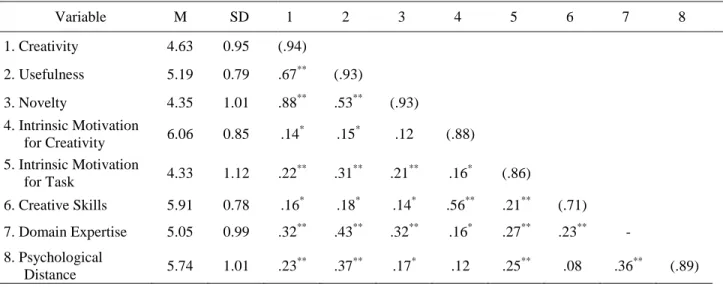
captured by the Manipulation Check ...67 3. Study 1 - Means, Standard Deviations, and Intercorrelations of
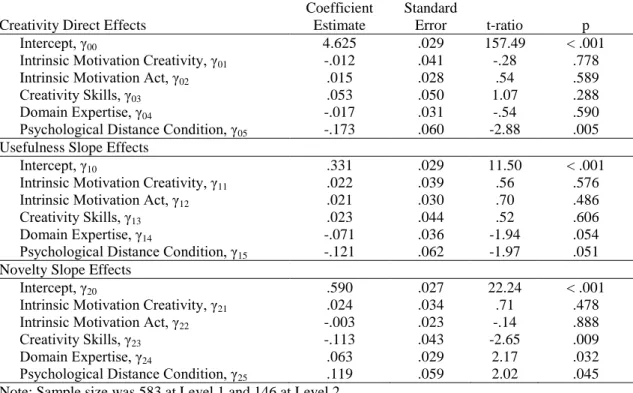
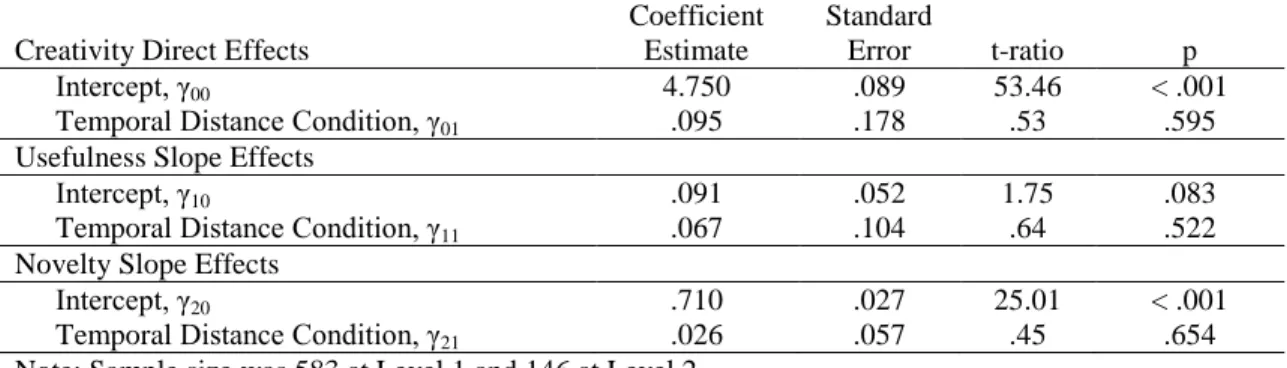
All Variables Included in the Study at the Individual Level ...68 4. Study 1 - Results Hierarchical Linear Modeling Results for
Level 1 Main Effects with no Level 2 predictors ...70 5. Study 1 - Results Hierarchical Linear Modeling Results for
Level 2 Effects ...71 6. Study 1 - Variance explained in Creativity Intercept, Usefulness
and Novelty Slopes between Models 2 and 3 ...73 7. Study 2 – Mean Differences in Perceived Distance as captured
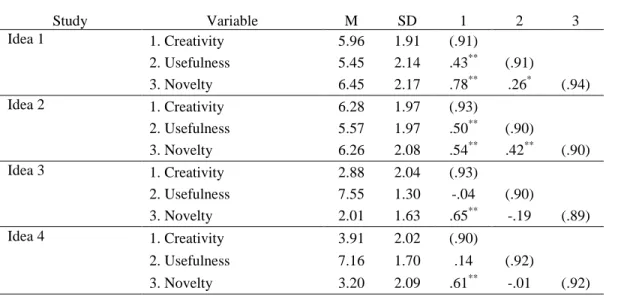
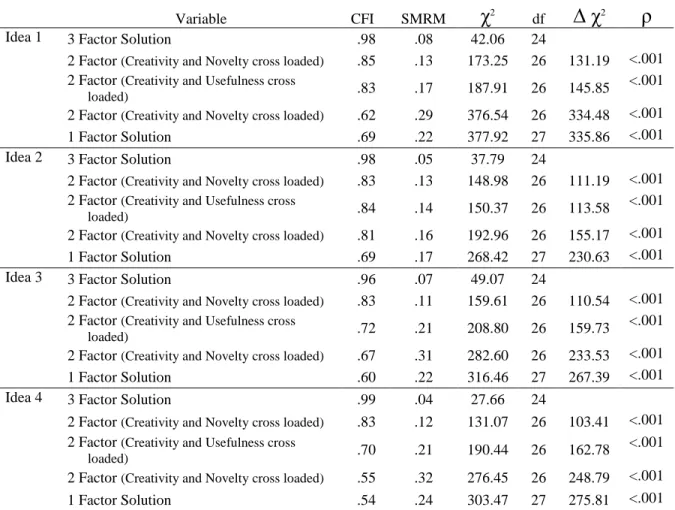
by the Manipulation Checks ...83 8. Study 2 - Means, Standard Deviations at the Idea Level ...83 9. Study 2 – Confirmatory Factor Analysis for Each Idea ...84 10. Study 2 - Results Hierarchical Linear Modeling Results for
Level 1 Main Effects with no Level 2 predictors ...86 11. Study 2 – Variance Components for Level 1 Main Effects with
no Level 2 predictors ...86 12. Study 2 - Results Hierarchical Linear Modeling Results for
Level 2 Effects ...87 13. Study 2 - Variance explained in Creativity Intercept,
Usefulness and Novelty Slopes between Models 2 and 3 ...87 14. Study 3 – Mean Differences in Perceived Distance as captured
by the Manipulation. 15. Study 3 - Means, Standard Deviations
16. Study 3 – Confirmatory Factor Analysis for Each Idea ...95 17. Study 3 - Results Hierarchical Linear Modeling Results for
Level 1 Main Effects with no Level 2 predictors ...96 18. Study 3 – Variance Components for Level 1 Main Effects with
LIST OF FIGURES Figure
1. Theoretical Relationships between Novelty, Usefulness, and
Creativity ...25 2. Proposed Measurement Model between Novelty, Usefulness,
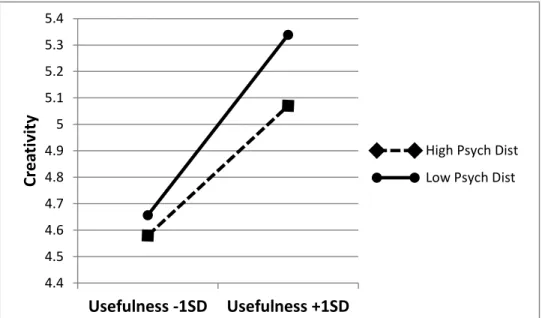
and Creativity ...37 3. Multiplicative and Additive Models‘ Potential Creativity Scores ...40 4. Study 1 - Relationship of Usefulness and Creativity Moderated
by Psychological Distance ...74 5. Study 1 - Relationship of Novelty and Creativity Moderated by
I. INTRODUCTION
Creativity is one of the most popular buzz words being used in society and business today. It has been highly touted as a cure for society‘s ills (Obama, 2011), a foundational requirement for innovation (Scott & Bruce, 1994; West, 2002), and even cited as a key competency in corporate leadership (IBM, 2010). If we are living in an economy driven by creativity (Florida, 2002); it could be important to know how it is that we evaluate ideas, products or people as creative. Researchers use judges to evaluate ideas, products, and people as creative, teachers attempt to stimulate and grade the
creative thinking of their students, and businesses attempt to identify the next top creative talent, product, technology, or service. Yet, what goes into a consideration of whether something is creative or not?
Creativity is in essence, a subjective value judgment; it is best measured through social evaluation (e.g., Amabile, 1996; Csikszentmihalyi, 1996). We rely on external evaluations in our empirical research (for a review see, George, 2007) and in practice (e.g., Elsbach & Kramer, 2003; Tierney & Farmer, 2004; Zhou & Oldham, 2001) to determine if something or someone is creative. While creativity describes the
quintessential generative process, it is through the act of social evaluation that the results of these generative processes are deemed creative. Thus, the act of evaluation is central to any research on creativity and an important factor in understanding what we all are talking about when we refer to creativity in research and practice.
The modern era of creativity research was given a jumpstart in an American Psychological Association Presidential Address in 1950 (e.g., Mumford, 2003; Sternberg, 2006). In this address, Guilford put forward a view of creativity grounded in novelty but ―under some degree of evaluative restraint‖ (1950: 453) to ensure the value or fitness of the creative product. This conceptualization of creativity put novelty in a prime position, limited by some consideration of the utility of the resulting idea or product. This view that creativity is primarily about novelty was reinforced in a follow-up paper on evaluating creative people that started with the sentence: ―One of the most important aspects of creative thinking is originality‖ (Guildford, 1953: 362). There is evidence that novelty may be the prime driver of creativity judgments (Amabile, 1996; Runco & Charles, 1993), so how does usefulness fit into our conceptualization?
usefulness in defining creativity (e.g., Feist, 1998; Zhou & Shalley, 2003) without discussion on how these factors contribute to that creativity judgment. This has the
potential to cause a problem. When researchers define creativity as requiring both novelty and usefulness without specifying how this combination of both factors contributes to judgments of creativity, we lack clarity as to what it meant when something is evaluated to be creative (e.g., George, 2007; Unsworth, 2001). Yet even while researchers define creativity with the two dimensions of novelty and usefulness, most often they are measuring just overall creativity which blurs the contribution of novelty and usefulness. Thus the majority of our research does not inform us as to whether creativity is mostly about novelty or contributions of both novelty and usefulness. Defining creativity as requiring both dimensions and then measuring only overall creativity implies an
assumption that both novelty and usefulness are contributing to the creativity evaluations as captured in much of our research.
novelty and usefulness to creativity may be moderated by context factors as a way to challenge these assumptions and explore when usefulness may be a factor in creativity judgments.
How we weight novelty and usefulness in making judgments of creativity may be critically important to whether specific ideas are accepted and promoted on to others. Creativity is often considered the first stage of the broader process of innovation (Scott & Bruce, 1994; West, 2002) and as organizations struggle to find a balance between novelty dominated exploration and utility focused exploitation (Smith & Tushman, 2005;
Tushman & O‘Reilly, 1996) this focus on the end goal of innovation may necessitate an earlier effort at generating and filtering creative ideas based on those that might fit the type of organizational innovation strategy envisioned. If a manager and his/her director are both working to support employee innovation but each judge creativity focusing primarily on different facets of creativity, they may support and promote different types of ideas. The manager may filter out those ideas lower in his/her own focal facet but extremely high in the opposite. This would leave the director with, in his/her mind, only mediocre ideas at best. This type of selective filtering that is not aligned in how the facets of creativity are prioritized can really hamper an organization‘s flow of innovative ideas just depending on differential weighting of facets (novelty and usefulness) occurring throughout the organization in considering what is creative.
potentially market making concept, may wish to help other investors to look more favorably and consider this idea as more creative by increasing their focus on novelty. If creativity is something we value in society and within our organizations, then how we deem something creative by balancing consideration of novelty and usefulness is important to understand.
Novelty may be a primary driver of creativity but it is necessarily bounded by usefulness (Guilford, 1950). An idea that is original or new may be entirely inappropriate and thus not considered creative. As in the following example, a classic divergent
thinking task is asking participants to ―name all things square‖, a response of baseball (round, not square) would be very rarely reported and thus novel but would not be considered creative because it is inappropriate (Runco & Charles, 1993). ―Outlandish, wild ideas can be creative but they are not necessarily so...‖ (George, 2007: 442), as they must to some extent be seen to create value to be creative. This type of limitation on the relationship between novelty and creativity implies that they should not be equated as synonymous constructs but rather closely related but bound by a limiting factor of utility. Yet how much does usefulness play into these judgments of creativity, if it is somehow required?
associated with creativity, contextual factors may play a role in how strong that
relationship is as well as the strength of any contribution for considerations of usefulness.
I would like to propose that evaluations of creativity are complex judgments and as such, decision making theory and research can inform us as to how in some instances creativity can be almost solely focused on novelty and in other cases novelty and
usefulness both drive the judgments of creativity. In an effort to simplify decisions or judgments, people often limit the criteria considered (e.g., Simon, 1957; Tversky & Kahneman, 1974). Heuristic processing often encourages a focus on the most prominent factor, increasing the salience of this factor in reaching a decision (e.g., Fiedler, 2007; Tversky, Sattah, & Solvic, 1988). With novelty being generally considered the most prominent facet of creativity, perhaps under many circumstances, individuals may simply conflate novelty and creativity, minimizing the role of usefulness in these judgments. Perhaps contextual factors can help focus our attention towards consideration of novelty or usefulness and increase the salience of these factors in making judgments of creativity. A situation that directs one‘s attention to the primary factor of novelty may discount usefulness and in a situation where utility is primed then perhaps usefulness will contribute to judgments of creativity along side of novelty.
the measurement of creativity, ignoring the contributions of these factors. As utility is most often relevant to those who are closer to a task or problem, the contextual nature of psychological distance is used as the construct I propose that may moderate the
relationships of novelty and usefulness with overall creativity judgments. Psychological distance has been conceptualized as the distance one feels from a situation or task as presented in a broader context of Construal Level Theory (Liberman & Trope, 1998; Liberman, Trope, & Wakslak, 2007; Trope & Liberman, 2010). To date, Construal Level Theory has been primarily explored in a laboratory setting. I plan on utilizing a
psychological distance manipulation in the field to test my hypothesis and perhaps contribute to the collective generalizability of this theoretical perspective.
2008). As ideas, processes, and products are not deemed creative in a vacuum but must be relevant within a particular context (e.g., Amabile, 1996; Csikszentmihalyi, 1996), the contextual framing and an individual‘s perceptions of that context may be particularly relevant to how creativity is considered during research activities, as well as within work organizations.
While fields or domains have been considered the fundamental context through which creativity is grounded theoretically, I am seeking to explore how the weighting of novelty and usefulness may vary even within a particular domain or field. If actors in different domains weigh novelty and usefulness differently, say between art and business, this may not be surprising and these results could still fit conceptualization of creativity as stable within a specific domain (Amabile, 1996; Csikszentmihalyi, 1996). However, if within a single problem domain or organization, novelty and usefulness are weighted differently in making judgments of creativity then this may hamper organizational innovation and the traditionally assumed within domain/field contextual stability of creativity may be in question.
While this consideration of the weighting of novelty and usefulness is being examined in this dissertation from an external evaluation perspective, I believe that the salience of novelty and usefulness is an important consideration to how we not only evaluate ideas of others but also how we internally filter our own ideas before submitting them for external evaluation. I would, in the future, hope to broaden this research
Approaching how the dimensions of novelty and usefulness combine to define the construct of creativity needs to be addressed at three levels: theoretically/ conceptually, operationally/ measurement, and implicit/ lay usage. In the next section, I will review several traditional theoretical perspectives on creativity to establish a common foundation from which suggest a return to more flexible considerations of how novelty and
usefulness combine to reach judgments of creativity in our theoretical conceptualizations and operational models. I then explore how creativity has been operationally measured historically by researchers and offer a new approach to considering both facet and global measures. Using this foundation, I attempt to align the theoretical and operational
approaches with how creativity is defined in practice by considering how novelty and usefulness are weighted in contributing to creativity judgments. To explore how novelty and usefulness may be differentially prioritized within the same domain but under
II. THEORETICAL CREATIVITY
As a socially bound construct, evaluation is a key component in process models of creativity (Amabile, 1996; Csikszentmihalyi, 1996; Campbell, 1960; Hogarth, 1980; Staw, 1990; Wallas, 1926). Focusing on how ideas1 are evaluated as creative instead of how they are generated is a departure from the current norm of creativity research (Girotra, Terwiesch, & Ulrich, 2010), as most of the creativity research to date has been focused on creativity production or generation using measures of overall creativity (George, 2007; Shalley & Zhou, 2008; Shalley et al., 2004). Idea generation is but one phase in the creative process with other phases of problem identification and idea
evaluation little researched (Shalley et al., 2004). Evaluation is critical for idea generation and creative productivity from both an internal and external perspective (Mainemelis, 2010; Runco & Smith, 1992). By first looking at how evaluation is incorporated into theoretical models of the creative process, I seek to highlight the internal individual cognitive requirement for evaluation in creative activities. I will then turn to how creative ideas or products have been evaluated as an outcome, to consider how creativity is
Creativity outputs are considered to be both tangible and intangible products. This product
designation includes both actual physical products as well as intangible outputs, such as processes and
ideas. I believe that creative ideas are foundational to creative products or processes. Throughout this
paper, I refer to the output of the creative process as ―creative ideas‖ with the understanding these ideas
externally validated. While I review how both internal and external evaluations are central to creativity and are expressions of how creativity is defined, the studies conducted in this paper focus on external evaluation. I will seek to identify when everyday implicit definitions of creativity used in evaluating the ideas of others may confound creativity theory and research that assumes a stable relationship between the dimensions of novelty and usefulness with respect to overall creativity.
Process Models of Creativity
Creativity has been conceived of as a process, as well as a characteristic of people, products or ideas (e.g., Runco, 2004). Several theoretical models of the creative process have been put forward over the years describing multiple phases in the development of creative ideas or products. As I outline several of the most influential process models, I will direct most of my efforts toward describing the evaluative (internal and external) components and highlighting how the criteria of novelty and usefulness are included in each process model. Often these process models are grounded using explicit conceptual definitions of creativity and in those cases these definitions will be reviewed.
One of the most influential process models of creativity was put forward by Wallas in his book The Art of Thought in 1926. While presenting a treatise on conscious and
aspects of the problem and a gathering of available knowledge and resources. The next stage, Incubation, is described as an unconscious mental exploration of the problem and potential solutions. It is within this stage that novelty is introduced to the process through building a large variety of connections. When this Incubation process generates a
potential solution, this idea is raised to the conscious awareness in a nearly instantaneous flash described by Wallas as the stage of Illumination. Once an idea has been raised to the conscious level, the individual moves to the Verification stage where ―both the validity of the idea was tested, and the idea itself was reduced to exact form‖ (Wallas, 1926: 81). The Verification stage is described as needing discipline, attention, and
conscious consideration of the original problem. It is within this Verification stage that an individual evaluates whether the idea generated through the first three processes is useful by considering if the idea meets the expectations of the prescribed problem.
potential solutions through making diverse associations. The consideration of an idea‘s novelty is encouraged as a means to fight satisficing in accepting the first solution generated (most likely a common one). Once a number of ideas are generated, a systematic examination of whether these potential solutions fit the problem previously identified is conducted. This Evaluation stage is a conscious judgment about the appropriateness of the conceived new ideas. The primary criterion to determine the appropriateness of these ideas is how well the proposed solution fits the initial problem. Hogarth‘s model adds a fourth step of Implementation to the process, extending this model of the creativity process beyond an individual‘s mind to a point where the idea is shared with others in an attempt to gain social support for the creative idea. This
Implementation step implies that relevant others perform an external evaluation of the resulting creativity product in determining whether to support the product.
Amabile‘s texts The Social Psychology of Creativity (1983) and the updated version Creativity in Context (1996) provide a clear statement of how creativity is conceptually defined, as well as a process model of creativity. Her conceptual definition is stated as: ―A product or response will be judged as creative to the extent that (a) it is both a novel and appropriate, useful, correct or valuable response to the task at hand, and (b) the task is heuristic rather than algorithmic‖ (Amabile, 1996: 35). This definition identifies that creativity judgments require both components of novelty and usefulness. Amabile (1996) contends that there is a continuum of creativity from low levels of incremental
Evaluations of novelty and usefulness must be made within some context or field which provides a comparison set for judgment. Consideration of novelty is restrained not by an expression of absolute uniqueness (singularity), but rather the relative newness or rarity of its occurrence within a particular domain and time. Usefulness is bound to the task at hand and the meaning of the particular context. Combined these two factors are
described as the criteria for creativity assessments.
The second part of the definition referring to the nature of the task itself specifies that the solution to the task ―is not completely straight forward‖ (Amabile, 1996: 35) from the perspective of the person generating the solution. Thus, a student making an advanced connection, previously put forward by another unbeknownst to the student, would be said to be acting creatively even if a society of experts hold this connection as accepted knowledge. This view holds that ―...if the task is heuristic for the individual in question, then novel and appropriate solutions generated by the individual can be considered creative‖ (Amabile, 1996: 36). This second part of Amabile‘s definition has often been left out in descriptions of creativity citing this work (e.g., George, 2007; Grant & Berry, 2011; Shalley et al., 2004). However, this part is often presumed in that if the task already had a correct solution available, there would be no need for a creative one to be
generated.
or Task Identification where a problem is either identified internally or externally as requiring the development of a creative solution. Once the problem is defined,
information is gathered in the Preparation step. This information is used in the third step, Response Generation, to help develop response possibilities. This model holds that the more possibilities generated, the more likely that a novel and appropriate solution will be developed. The appropriateness of responses is considered in the fourth step, Response Validation and Communication, where potential ideas are evaluated against the
assessment criteria of the initial problem. This step also includes communication, because creativity cannot be judged unless the problem solver communicates the resultant idea or produces a product to be judged. Finally, the Outcome step is a decision point where the results of step four are considered and the process is terminated (as a success or a failure) or a determination is made that progress has been made and further iterations of earlier steps are in order. Thus this model is designed not just to be linear but potentially iterative.
In 1990, Staw fleshed out an evolutionary approach to creativity by combining the description put forward by Campbell (1960) of how people develop and retain new knowledge with the process model proposed by Amabile (1983). In building this process model Staw ―defines creativity as a product of variation and selective retention
the Variation process in which a programmatic search for options is combined with a process of ‗blind variation‘ or unconscious exploration of randomly connected options to build a number of possible solutions. The usefulness of possible solutions are considered during the Selection Retention process, where from a pool of generated ideas one or more are identified as preferred alternatives by considering the possible solutions against an internal criteria based on their potential ―to solve the problem or personal affinity‖ (Staw, 1990: 293). The selected ideas are then tested either practically or socially. If an idea works or is accepted, it is retained. However, if all ideas are rejected, either the creative process is abandoned or must begin anew.
The final process model I will consider here is one put forward by
Csikszentmihalyi (1996) in his book Creativity: Flow and the Psychology of Discovery and Invention. Csikszentmihalyi (1996: 25) begins his discussion of creativity by defining it as ―to bring into existence something genuinely new that is valued enough to be added to the culture‖. Creativity is further defined as occurring ―when a person...has a new idea or sees a new pattern, and when this novelty is selected by the appropriate field for inclusion into the relevant domain‖ (Csikszentmihalyi, 1996: 28). The person
within that particular domain. If so determined, the article is accepted. This acceptance confers that the author‘s product is Creative.
From this Systems Theory, Csikszentmihalyi (1996) outlines a process model of creativity with five phases. While he holds that the process model as stated is relatively valid and simple, the linear nature as described must not be taken too literally. How in practice the creative process unfolds in reality is more complex, the phases occur in a more recursive and overlapping process, often with multiple iterations of these phases occurring before a creative idea is born. Becoming immersed in a problem either
consciously or unconsciously occurs during Preparation. When a common solution is not readily apparent, creative solutions are sought. The Incubation period occurs when ―ideas churn below the threshold of consciousness‖ (Csikszentmihalyi, 1996: 79) and unusual connections are stimulated. As common, readily available solutions were not sufficient to solve the problem, Incubation seeks new possibilities building a number of novel options. When a potential solution appears to fit the problem, that idea is raised to conscious consideration through a flash of Insight. Evaluation is then applied, as an internal process during which the individual considers whether an idea is worth pursuing by referencing her/his ―internalized criteria of the domain, and the internalized opinion of the field‖ as a basis for considering if the idea is useful in relation to the identified problem
evaluations and rejection from the Field. The final phase of Elaboration usually takes the longest time. During this stage the idea is refined, tested and codified before being shared with others. To be considered creative, the output (idea or product) of the Elaboration phase must become accepted by the Field and have an influence on the focal Domain.
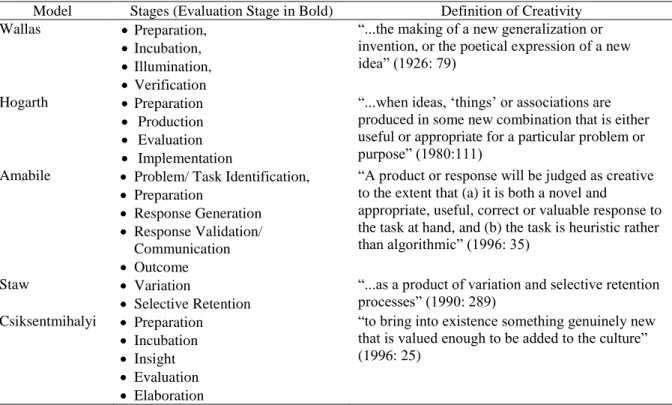
Table 1: Summary Table of Process Models Highlighting Evaluation Stage and Creativity Definition
Model Stages (Evaluation Stage in Bold) Definition of Creativity
Wallas Preparation,
Incubation, Illumination, Verification
―...the making of a new generalization or invention, or the poetical expression of a new idea‖ (1926: 79)
Hogarth Preparation
Production Evaluation Implementation
―...when ideas, ‗things‘ or associations are produced in some new combination that is either useful or appropriate for a particular problem or purpose‖ (1980:111)
Amabile Problem/ Task Identification, Preparation
Response Generation Response Validation/
Communication Outcome
―A product or response will be judged as creative to the extent that (a) it is both a novel and
appropriate, useful, correct or valuable response to the task at hand, and (b) the task is heuristic rather than algorithmic‖ (1996: 35)
Staw Variation
Selective Retention
―...as a product of variation and selective retention processes‖ (1990: 289)
Csiksentmihalyi Preparation Incubation Insight Evaluation Elaboration
―to bring into existence something genuinely new that is valued enough to be added to the culture‖ (1996: 25)
External Evaluation
The evaluation phases in these process models are a filtering process for
determining which ideas meet the criteria for creativity within a particular context. While the evaluation phase discussed in the process models of creativity is often an internal process, many of the conceptual frameworks of creativity developed alongside these process models include an external evaluation component. Hogarth (1980) specifically includes an Implementation phase in which an idea is communicated to others in an effort to build social support (agreement that the idea is a creative solution) for the idea.
Amabile‘s (1983, 1996) conceptual definition relies on external validation of outcomes of the creative process to ultimately determine if the solution proposed is accepted as
evaluating) but the idea is not truly considered creative until it is confirmed by external evaluation. This point is clearly stated by Amabile in that: ―A product or response is creative to the extent that appropriate observers independently agree it is creative‖ (1996: 33). Staw‘s (1990) model for the individual creative process is extended in the same paper to organizations, where Staw identifies that ideas must build support and approval of others to survive and ultimately be accepted within an organization. This concept that ideas are generated individually but then must pass external evaluation and build support to be socially recognized, has been put forward in other works on the relationship
between creativity and innovation (Scott & Bruce, 1994, West , 2002).
Csikszentmihalyi‘s (1996) Systems Model requires that an idea be accepted as creative by an external field of gatekeepers (experts) before it is considered to be creative. In judging whether an idea is new and valuable, a reference to some standard must be applied and for Csikszentmihalyi that standard is a social evaluation; as ―creativity does not happen inside people‘s heads, but rather in the interaction between a person‘s thoughts and a sociocultural context‖ (1996: 22). The likelihood that an individual will develop ideas that are externally (socially) validated as creative is related to the extent to which that person internalizes the criteria used by the external system (e.g., Amabile, 1983, 1996; Csikszentmihalyi, 1996; Campbell, 1960; Staw, 1990).
Evaluation is central to the contextual nature of creativity. During early
concept across potentially incommensurate domains. Shapiro (1968: 15) in offering a practical definition of creativity stated that:
Creativity is a potential capacity by means of which an individual may produce something original that serves to fill a gap in a particular field of human endeavour. The degree of creativity expressed can be roughly gauged by the magnitude of the effect that the product has on the field, in the sense of the changes introduced into the traditional state of knowledge or modes of expression, formerly characterizing that field.
Amabile (1996: 38) stated this contextual bounding of creativity and creativity assessments as:
...creativity assessments must ultimately, be socially, culturally, and historically bound. It is impossible to assess the novelty of a product without some knowledge of what exists in a domain at a particular time. It is impossible to assess appropriateness without some knowledge of utility or meaning in a particular context. And it is impossible for these assessments to be made—or indeed for creative products themselves to be made—in a cultural, social, or historical vacuum.
Without objective criteria to bound creativity, a reliance on social agreement has been put forward as a viable valid substitute in conceptualizations of the construct of creativity (e.g., Amabile, 1982; Csikszentmihalyi, 1996; Shapiro, 1968). This reliance on social agreement is based on the assumption that the criteria being used to externally evaluate an idea, product, or person as creative is common within a particular context. Furthermore, generalizations of creativity across contexts rest on the assumption that these criteria are similar across contexts. This commonality of criteria extends to both the relative levels of novelty and usefulness, as well as the weighting of each dimension as they are combined. While novelty and usefulness are broadly identified as the key
Dimensions
When Guilford refocused psychology research on the topic of creativity in his American Psychological Association Presidential address, he stressed that the novelty component of creativity be bounded ―...under some degree by evaluative restraint‖ (1950: 453). Soon after Guilford‘s call for more investigation into creativity, Stein produced this definition: ―The creative work is a novel work that is accepted as tenable or useful or satisfying by a group in some point in time‖ (1953: 311). To broad agreement, this combination of novelty and usefulness within context has been used as a common theoretical definition for creativity research over the last few decades (Mumford, 2003). Theoretically, the definition of creativity as an output is most often stated as: an idea, product, or process that is both novel and useful (e.g., George, 2007; Runco, 2004; Shalley et al., 2004). How creativity is conceptually defined is critical to understanding what is being judged when a person, product, process, or idea is identified as creative (Kampylis & Valtanen, 2010). This theoretical definition of creativity implies that a judgment of creativity is composed of a combination of evaluations of novelty and usefulness.
The multidimensional nature of creativity, in requiring both novelty and usefulness to be present, complicates this well established theoretical definition. The requirement for both components of novelty and usefulness to be present has been stated very clearly in the literature. George stated that ―...to be considered creative, ideas must be both new and seen as having the potential to create value for organizations...‖ (2007: 441). This
that ―...both originality and usefulness are necessary conditions for an outcome to be considered creative‖. Creativity is not found in ideas that are just novel or just useful; both criteria must be present for an idea to be considered creative (e.g. Amabile, 1996; George, 2007; Shalley et al., 2004). This required combination of novelty and usefulness criteria is also used by the U.S. Patent Office in considering patent applications in that ―patents are provided for a new, nonobvious and useful...‖ invention (U.S. Patent Office, 2011).
interchangeably with each facet as: 1) novel, original, new, unexpected, different, unique, and unconventional and 2) appropriate, useful, valuable, significant, effective, relevant, and functional (Kampylis & Valtanen, 2010).
While these components are clearly part of how creativity is conceptually defined, exactly how these two components of novelty and usefulness combine to render
judgments of creativity is not clear at all (Litchfield, 2008). Using the most often stated definition of creativity, it would appear that evaluations of novelty and usefulness have a fixed relationship with judgments of overall creativity. Yet, exactly what form that relationship takes has not been clearly specified (Shalley & Zhou, 2008; Zhou & Shalley, 2003).
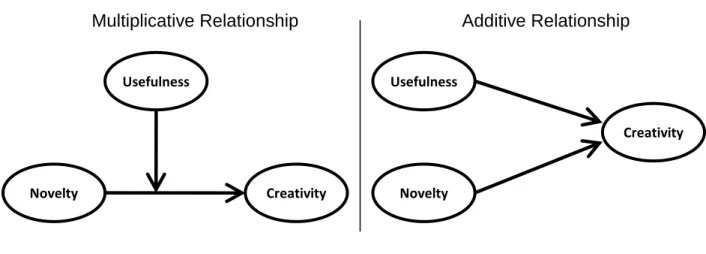
as well as extremely high levels and all points in between (e.g. Amabile, 1996; Guilford, 1950; Torrance, 1965). The second theoretical model that describes a less restrictive relationship is an additive model, in which evaluations of novelty and usefulness contribute independently to judgments of creativity (Ford & Gioia, 2000; Zhou & Shalley, 2003). This model represents separate main effects for both components on creativity as a compensatory model, but does not capture the requirement that both be present unless some sort of threshold approach is considered (Diehl & Stroebe, 1987, 1991). While this model is not as common as the multiplicative model, there is empirical support for this conceptualization of a simple main effects relationship (Paletz & Peng, 2008; Runco & Charles, 1993; Ford & Gioia, 2000).
Figure 1: Theoretical Relationships between Novelty, Usefulness, and Creativity
Assumptions
The ambiguity of how novelty and usefulness are related to overall creativity is a fundamental problem with current theoretical conceptualizations. Amabile (1996: 38) drives this point home when she wrote that, ―essentially, the conceptual definition rests on assumptions about what observers are responding to when they identify a product as
Usefulness
Novelty Creativity
Usefulness
Novelty
Creativity
highly creative‖. When a researcher claims that some practical intervention or factor is related to creativity, how is creativity being defined by that researcher? Is creativity theoretically the same across different situations? If so, then a clarification of how evaluations of novelty and usefulness are combined to render a judgment of creativity should be incorporated into a refined theoretical definition of the construct (Schwab, 1980). However, this appears to be an untested assumption in that, ―...theorizing and research on creativity tends to make the implicit assumption that the same causal factors will operate in a similar manner regardless of the type of creativity that occurs or that researchers are studying...‖ (George, 2007: 442). This implicit assumption hampers a fuller exploration and clearer understanding of creativity as a construct (Plucker et al., 2004; Unsworth, 2001).
This broad conceptual assumption often leaves discourses on creativity
incommensurate as ―researchers may be discussing completely different topics, or at least very different perspectives of creativity‖ (Plucker et al., 2004). While novelty and
usefulness are common components of creativity definitions, these terms are not frequently specified and this ambiguity challenges the clarity of what theorists and researchers mean when they refer to creativity (Kampylis & Valtanen, 2010). There may be strong consensus as to the major components of creativity (e.g. Mumford, 2003; Shalley et al., 2004); however, exactly what creativity means theoretically is far from clear (e.g. George, 2007; Kampylis & Valtanen, 2010; Plucker et al., 2004; Zhou & Shalley, 2003).
factors most often including novelty and usefulness. This puts the definition back in-line with Guildford‘s (1950), of novelty bounded by other considerations. In this way novelty and usefulness are removed from a fixed relationship and are merely the strongest
III. CREATIVITY OPERATIONALLY CONSIDERED
Now that I have considered how novelty and usefulness contribute to creativity theoretically, I would like to explore how these dimensions may be considered
operationally in measuring creativity. Conceptually creativity is a paradox of wide agreement and continuing ambiguity; this paradox carries over to how creativity is most often operationalized. Creativity has been studied from multiple perspectives: from reviewing prominent creative biographies (e.g., Barron, 1968; Mackinnon, 1962; Simonton, 1975), to attempting to identify a creative personality type (Gough, 1979; Torrance & Khatena, 1970; Rimm & Davis, 1976), and assessing creative cognitive processing (Kirton, 1976; Miller, 1986). These attempts to discover a universal creative type have often struggled to build a framework consistent across contexts (Runco, 2004; Shapiro, 1968), and thus the measurement of the output of the creative process has met with more acceptance as a viable avenue for considering creativity (e.g., Amabile, 1996; Shalley & Zhou, 2008). Operationalizing creativity within its context is best achieved by measuring the output of the creative process (e.g., Guilford, 1950; O‘Quin & Besemer, 1989; Sternberg, 1999).
Torrance, 2003). Creativity researchers have explored how individual differences, cognitive processes, types of motivations, and contextual factors relate to creative outcomes based primarily on subjective judgments of overall creativity (e.g., Amabile & Mueller, 2008; Shalley et al., 2004).
When Guilford (1950) refocused creativity research away from a consideration of universal standard creativity trait, comparable to measures of I.Q. and personality, to context dependent evaluations of the outcomes of the creative process, he began a process of operationalizing creativity centered on the product or ideas produced by creative activity. In developing a factorial approach to considering creativity, Guilford (1957) identified a way to operationalize the measurement of creativity through the factors of fluency, flexibility, and originality. He stated that primary mental abilities and motivation are necessary but not sufficient for creative production, while ―the factors of fluency, flexibility, and originality and the like are not only necessary but, when possessed in sufficient amounts, are sufficient‖ (1957: 117). While these factors are associated with creativity, they are most relevant to measuring only one dimension, novelty. Guilford and coauthors (Wilson, Guilford, & Christensen, 1953) focused on the originality of ideas as the basis for his measurement of creativity even though he had earlier included a
usefulness component in the model by restricting his conceptual definition of creativity to new ideas that had relevance within context (Guilford, 1950). This initial measurement model was extended to include elaboration in further descriptions of tasks used to elicit creative products (Guilford, 1967).
Thinking. A description of how these measures are operationalized is noted in an early work from Torrance (1965:669):
The number of relevant responses produced by a subject yields one measure of ideational fluency. The number of shifts in thinking or number of different categories of questions, causes, or consequences gives one measure of flexibility. The statistical infrequency of these questions, causes, or consequences or the extent to which the response represents a mental leap or departure from the obvious and commonplace gives one measure of originality. The detail and specificity incorporated into the questions and hypotheses provide one measure of ability to elaborate.
This operationalization of creativity put forward by Torrance to measure creative potential through examining individual responses to open-ended tasks is heavily focused on the novelty component of creativity with the only nod to usefulness being the word ‗relevant‘ in the measure of fluency. This consideration of counting the breadth of ideas generated as a proxy for creativity without direct measurement of usefulness is based on a belief that the more potential ideas explored the greater the likelihood that a creative response will be generated (e.g., Campbell, 1960; Osborn, 1953; Shalley, 1991). It is also important to note that this approach to measuring creativity, while perhaps appearing objective, is based on a comparison of individual test responses to a large pool of responses provided by others who have taken the test. This norming of the data acts as a subjective societal frame for judging creativity.
behavior of an employee or coworker with a number of questions covering overall creativity, novelty, and usefulness to a lesser extent. These scales are based on the external perceptions of an individual‘s creativity using subjective judgments within the context of the organization and the specific person‘s job. While these scales might use items focused on both the dimensions as well as overall creativity, they are designed to be averaged into one global measure of overall creativity.
This focus on overall creativity is continued in the Consensual Assessment Technique (CAT) as proposed and refined by Amabile (1982, 1983, 1996). This method for measuring creativity operates through the agreement of several independent judges‘ evaluations of creativity as evidenced in products or ideas generated by individuals or groups. This approach was meant to bring theoretical and operational definitions into alignment (Amabile, 1982, 1983). Grounding the CAT is an operational definition stated as; ―A product or response is creative to the extent that appropriate observers
share creativity criteria to a reasonable degree‖ (Amabile, 1996: 42). This assumption is critical in that conceptually creativity is formed by combining separate evaluations of novelty and usefulness, yet these components are not considered directly in the operationalization through expert consensus of overall creativity.
Amabile (1996: 61) revised her requirement that only experts should be used as judges in stating, ―the only requirement is a familiarity with the domain of endeavor in which the product was made‖. This is tempered in that judges are expected to have a level of familiarity with the domain to be judged at or above the level of those whose products are being judged. This contextual framing of creativity judgments is extended using the CAT, in that judges are asked to base evaluations of creativity on a comparison of products or responses generated within the same context (Amabile, 1996). This contextual bounding allows poems written by kindergartners to be evaluated for
creativity relative to other poems written by kindergartners, while judging the creativity of professional authors references a different set of comparables. While this allows creativity to be assessed across the spectrum of human experience, this technique ―does not produce any kind of standardized scoring system that might allow comparisons to be made across settings‖ (Kaufman, Baer, & Cole, 2009: 224).
see if ―judges might be rating something as ‗creative‘ simply because they like it or because they find it to be technically well done‖ (Amabile, 1996: 43). While this is one way to approach the problem of clarifying what is meant by overall creativity, another option gaining acceptance is using multiple measures of creativity by combining CAT ratings, self-ratings, and/or supervisor evaluations with proxies for creative
accomplishment through the counting of patents, publications, or awards (Fiest & Barron, 2003; Hennessey & Amabile, 2010; Plucker, 2004; Runco, 2004).
While the CAT has been extended to include measures of related constructs (Dollinger & Shafran, 2005; Brinkman, 1999), the use of this technique to measure both of creativity‘s components, novelty and usefulness, is rare (Kilgour & Koslow, 2009; Reitzschel, Nijstad, & Stroebe, 2006, 2010; Zhou & Oldham, 2001; Zhou & Shalley, 2003). The Creative Product Semantic Scale (Besemer & O‘Quin, 1986; O‘Quin & Besemer, 1989) was designed to measure three dimensions of creativity when
considering products, but its scales of Novelty, Elaboration/Synthesis, and Resolution do not map clearly onto common conceptual definitions and a recent study using a modified version of this scale found that the two factor (novelty and usefulness) model was a better fit for predicting creativity (Sullivan & Ford, 2010). Connecting the conceptual definition of novelty and usefulness evaluations forming a judgment of creativity to a similar
The results of these few studies have supported the independent nature of the dimensions of novelty and usefulness relating to overall creativity through an independent main effects model.
A modified policy capturing study conducted by Runco and Charles, tested the relationship of originality (novelty) and appropriateness (usefulness) with creativity by having participants rate sets of ideas submitted as answers to a divergent thinking task of ―list all the square things you can think of or list all the things that move on
wheels‖(1993: 540). These findings found consistent support for originality as a predictor of creativity, but only very limited support for a significant relationship between
appropriateness and creativity. Casting doubt on the viability of multiplicative
composites, only one out of fifteen cases evidenced significant support for the interaction of originality and appropriateness. In some cases, there was evidence of an inverse relationship between appropriateness and originality. However, the authors cautioned the generalization of these results ―in part because ideas rather than some more concrete products (e.g. artworks) were being judged‖ (Runco & Charles, 1993: 545).
A study of managerial decision making by Ford and Gioia, found that in ―organizational domains novelty and value are loosely coupled outcomes affected by relatively independent constellations of influences‖ (2000:727). In looking at creative and non-creative decisions reported by senior managers from a broad professional
background, the authors identified seven variables that discriminated decisions at different levels of creativity. When four of these variables influenced the novelty
dimensions are affected by markedly different process that are essentially independent of each other‖ (Ford & Gioia, 2000: 723). By showing that different antecedents drive different dimensions of creativity, it is conceivable that a focus on any antecedent in particular could stress that dimension in making an evaluation of creativity.
The investigation into how novelty and usefulness combine to form judgments of creativity took another important step with the work of Paletz and Peng (2008) applying a cross-cultural lens in considering the American, Japanese and Chinese perspectives. Their research showed that judgments of creativity are in some ways consistent across cultures, in that the influence of novelty on judgments of creativity was stable across cultures. However, the researchers found that appropriateness was more influential in creativity judgments for American and Japanese participants. In considering how both novelty and appropriateness were related to judgments of creativity of a product and desire for that product, this research found that ―novelty was more important overall for creativity and appropriateness was more important for desire‖ (2008: 296). These results appear to indicate a slight difference between cultures in how creativity is implicitly defined and begin to undercut the assumption of a stable relationship of novelty and usefulness to overall creativity.
usefulness measures loaded on separate factors and that these two factors together predicted a better fit to overall creativity than did either a single combined factor or with a third factor of stylistic appeal added to the model. In supporting a multifaceted
conceptualization of creativity as a function of novelty and usefulness evaluations, the authors identified a next step as ―understanding the relative weight of novelty and
usefulness assessments‖ (Sullivan & Ford, 2010: 518). In exploring the multidimensional structure of the construct of creativity, the authors identified ―an apparent inconsistency between how the construct of organizational creativity is defined and how it is measured‖ (2010: 506).
This research and other reviews (e.g, George, 2007; Mumford, 2003; Shapiro, 1968) show that the alignment of theoretical and operational definitions of creativity is far from clear, in that conceptually creativity is presented as a complex construct but that complexity is often ignored operationally. This lack of clarity as to what is being studied conceptually and what is being measured empirically influences the validity of
definitions stated by researchers and the implicit definitions of creativity utilized by judges in experiments and lay persons in practice can also confound our broader understanding of the construct of creativity.
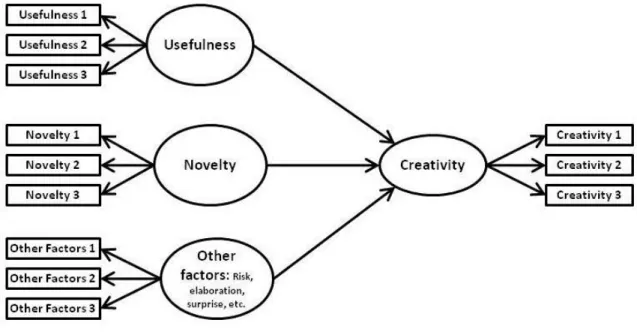
To clarify how this construct is operationalized, one must measure not just one level of the construct (global or facet) but both. I propose a measurement model to capture scales on all three focal variables and any other relevant constructs that are considered to be related to creativity ratings in a particular instance or context. If no additional variables are included the error term will include the unexplained variance not captured by the primary facets of novelty and usefulness. The measurement model I am proposing and using in this study is shown below in Figure 2.
IV. GLOBAL MEASURES AND IMPLICIT DEFINITIONS
Treating creativity as a global construct has led to ambiguity in generalizing findings from one study context to another (Dean, Hender, Rodgers, & Santanen, 2006). There is an ongoing debate about when to consider multidimensional constructs at a global or facet level of measurement, with benefits and drawbacks identified for both approaches (e.g., Bagozzi & Edwards, 1998; Edwards, 2001; Ironson, Smith, Brannick, Gibson, & Paul, 1989; Wanous, Reichers, & Hudy, 1997). Considering creativity as a subjective global construct raises questions about what is being measured and if different creativity studies are measuring the same thing (Ford & Gioia, 2000). ―An intriguing and still unanswered question about the use of subjective judgments is, what, exactly, do judges mean when they call something ‗creative‘?‖ (Amabile, 1996: 31). This lack of operational clarity on how creativity is defined by those providing the subjective
judgments of creativity limits the testing of theory and the programmatic advancement of creativity research (George, 2007; Unsworth, 2001).
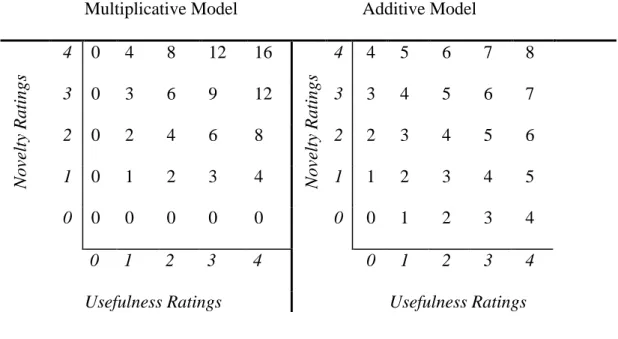
average on usefulness (rating of 2) and Judge 2 believed the same idea was average for novelty (rating of 2) and extremely useful (rating of 4), they would both arrive at identical creativity ratings (8 for the multiplicative and 6 for the additive). Researchers would incorrectly assume that these judges to be in complete agreement as to the how the idea is creative, when in fact there are meaningful differences in how each judge views the idea‘s creativity.
Figure 3: Multiplicative and Additive Models‘ Potential Creativity Scores Resultant Creativity Scores
Multiplicative Model Additive Model
N
ov
elt
y Ratin
gs
4 0 4 8 12 16
N
ov
elt
y Ratin
gs
4 4 5 6 7 8
3 0 3 6 9 12 3 3 4 5 6 7
2 0 2 4 6 8 2 2 3 4 5 6
1 0 1 2 3 4 1 1 2 3 4 5
0 0 0 0 0 0 0 0 1 2 3 4
0 1 2 3 4 0 1 2 3 4
Usefulness Ratings Usefulness Ratings
Utilizing global measures of a multidimensional construct leads to ambiguous findings, in that ―variation in a multidimensional construct may imply variation in any or all of its dimensions‖ (Edwards, 2001: 145). Several reviews have proposed that
use this approach (Besemer & O‘Quin, 1986; O‘Quin & Besemer, 1989). The issue with combining multiple dimensions to form a resulting construct is that this construct will be essentially ambiguous (Edwards, 2011). Additionally, this combinational approach stands in contrast to empirical evidence showing individual main effects for novelty and
usefulness contributing to creativity judgments (Paletz & Peng, 2008; Runco & Charles, 1993) and measured in isolation it is unclear how and with what weights the components should be combined to accurately compute a judgment of creativity. Yet it should be clear that current global operationalizations ―conflate novelty and value‖ in considering creativity (Ford & Gioia, 2000: 723).
There is, however, a potential benefit to measuring overall creativity and not just its components. Criteria beyond novelty and usefulness might be included when people make evaluations of creativity (Amabile, 1996; Runco & Charles, 1993). Overall ratings of creativity as a global measure may be capturing additional criteria specific to a particular context and thus may capture a ―holistic representation of complex
phenomena‖ (Edwards, 2001: 145). Restricting creativity to a combination of measures of novelty and usefulness may oversimplify this construct and omit other relevant facets as has been described with other combinational measures (Scarpello & Campbell, 1983). If we are to agree that creativity is a context dependent social judgment (Amabile, 1996; Sternberg, 1999), then identifying what goes into making those judgments is essential to specifying this construct and generalizing research findings related to creativity.
fixed combination of these two components then why do we need a measure of overall creativity? There are two cases in which we might want to measure both the dimensions of novelty/ usefulness and overall creativity. First, if we are unsure of how novelty and usefulness should be combined (model and weightings) to represent creativity within a particular context then measuring the dimensions and overall creativity could allow us to deduce the combinational formula applicable in that situation. Second, if creativity is more than just a combination of novelty/ usefulness dimensions, measuring overall creativity will capture those unnamed dimensions, while measures of novelty/ usefulness can be used to clarify the contributions of each named dimension and partial out the potential contributions of unmeasured dimensions. It would be important to know if creativity is only a combination of novelty and usefulness, or if something more, how much these two components contribute to an overall judgment of creativity.
studies but begin to offer more specificity and clarity when attempting to generalize our results. The translation of academic findings to inform practitioners and into generalized knowledge is a broad-based goal of organizational research (Rynes, 2007) and this is even more important for creativity researchers as organizations become increasingly dependent on new ideas and innovation for creating value (Kanter, 1988; Tushman & O‘Reilly, 1996; Woodman, Sawyer, & Griffin, 1993).
Understanding how people implicitly define creativity can help clarify what our raters are actually judging when they evaluate something as creative (Amabile, 1996). How novelty and usefulness are combined to render a judgment of creativity might influence whether an idea is supported or rejected within an organizational context (Goldenberg, Lehmann, & Mazursky, 2001; Haradon & Douglas, 2001; March, 2006). While researchers have often assumed that judgments of creativity are generated through evaluations of the ―dimensions of originality and feasibility, this does not mean that ‗lay‘ participants will use these criteria when making their selections‖ (Reitzschel et al., 2010: 49). This assumption gets even more constraining when researchers do not measure how novelty and usefulness combine to generate judgments of creativity, in that this presumes that both dimensions contribute equally or at the very least are related in a stable fashion to overall creativity.
This differential weighting would make any assumption by researchers of a stable relationship between novelty and usefulness across studies problematic. Even between people in the same organization ―it is unwise to assume that multiple goals will survive the communication process intact and in the intervener‘s implicitly desired weighting‖ (Litchfield, 2008: 658). So if the contribution of individual evaluations of novelty and usefulness are not stable in rendering creativity judgments, then what might explain these differences?
Weighting Dimensions
One way to test if the relationships of the dimensions of novelty and usefulness to overall creativity are stable is to explore factors that might moderate those relationships. While plainly manipulating the directions for a task, by explicitly requesting novelty or usefulness, could increase the salience of one dimension or the other, this invocation of dimensions directly is not a fair test of creativity per se but more a test of demand
characteristics. While goal direction and instructions have been a focal area for creativity researchers (e.g., Madjar & Shalley, 2008; Osborn, 1953; Rietzschel et al., 2010; Shalley, 1991), showing that situational framing or contextual factors might impact the weighting of evaluations of novelty and usefulness in determining overall creativity judgments would be a strong case against assuming a stable relationship in defining this construct.
stressed the novelty component‘s association with creativity only bounded by usefulness considerations. Amabile (1996: 38) identified novelty ―as the most important criterion‖ for creativity. In considering criteria for judging an idea‘s creativity, two empirical
studies, one by Runco and Charles (1993) and another by Rietzschel, Nijstad, and Stroebe (2010), found higher correlations between evaluations of novelty and creativity than between usefulness and creativity. While both of these studies used abstract laboratory tasks, it could be assumed that this primacy would carry over to considering the creativity in real world situations although perhaps not to an extreme extent (Ford & Gioia, 2000). In a review of implicit definitions of creativity found in research articles, novelty was the most common characteristic cited (Plucker et al., 2004).
prominent will receive greater weighting in a decision maker‘s judgments (e.g., Fiedler, 2007; Tversky & Kahneman, 1974; Tversky, Sattah, & Solvic, 1988). As novelty is historically the most prominent dimension of creativity, it may be that in most cases or when considering a vast number of situations, evaluations of novelty will have a stronger weighting than evaluations of usefulness in judging the overall creativity of an idea or product. However, the relationship between these two dimensions and creativity while unequal could still be relatively stable. Litchfield (2008) considered novelty and usefulness the dual goals of creativity. Yet if creativity exists beyond these two
dimensions, reaching a judgment on creativity may entail an even more complex decision process. Building off of established decision making theories, particularly those
addressing heuristics and biases in making judgments, could offer a foundation for why the weighting of novelty or usefulness in making creativity judgments might not be stable.
While there is evidence of a more prominent component garnering additional attention and weight during decision making activities (e.g., Tversky & Kahneman, 1974; Tversky et al., 1988), the salience of a given dimension may be made more prominent through the availability of the dimension to be considered or recalled (Tversky &
Khaneman, 1973). More specifically, when people are asked to make a global judgment that may be influenced by multiple criteria, the criteria most recently considered assumes a disproportionately strong weighting in the resultant judgment (Kahneman, Krueger, Schkade, Schwarz, & Stone, 2006; Schkade & Kahneman, 1998). This focusing is not only supported through cognitive decision process but also through motivated
norms favoring novelty or usefulness motivated people to attend to those aspects of creativity. This stronger weighting given to criteria occupying our focal attention is consistent across both cognitive processing and motivational information processing approaches (Kunda, 1990; Nickerson, 1998).
Using this rationale, focusing a person‘s attention on either novelty or usefulness should increase the weighting of that factor when a judgment of creativity is made. Evidence of contextual or individual moderating factors would indicate that judgments of creativity are not comprised of a stable combination of separate evaluations of novelty and usefulness as currently assumed. Clearly stating a preference for one dimension or the other would surely influence that preferred dimensions weighting factor, but also restricts an individual‘s implicit definition explicitly. So what factors might subtly influence the balance with which novelty and usefulness are used to make creativity judgments in an everyday work context?
I am primarily focused in this dissertation on variations in judgments of creativity made within a common domain and am seeking to relate this research to work
Yet in applying a decision making frame on why the weightings of novelty and usefulness may vary in judging creativity through consideration of bounded rationality (Simon, 1958) and resulting information processing shortcuts (for a review see,
Gigerenzer & Gaissmaier, 2011), I wanted to ground the beginning of this research effort in a contextual variable that is central to bounding the contextual frame of creativity evaluation and that consideration is time. Time may provide two powerful limitations on our processing of information related to creativity. First it can provide a limitation on the set of ideas considered to be within context and thus influence the set of possibilities that an idea is compared against. Second it may directly influence how long (and thus the amount) our cognitive resources can be focused on an evaluation of the creativity of an idea. Theoretically time is important from a decision making perspective as a frame and as a resource but it is also central to how creativity has been conceptualized.
Returning to our conceptualization of creativity as being historically bound, time has an important effect on creativity and judgments of creativity (Amabile, 1996). It is noted that often creative ideas are recognized right away but only conferred later on as the ideas become broadly accepted (Csikszentmihalyi, 1996; Mainemelis, 2010). Some of the ideas that revolutionized their fields and continue to impact us today were initially rejected but later found prominence as foundations of their respective fields. Ideas from scientist like Galileo (heliocentrim), Nicola Tesla (alternating current), and Ignaz
Semmelweis (antiseptic washing in medicine), were initially dismissed but later hailed as extremely creative concepts. Time appears to be an important consideration for
compared to in making that judgment. Managers often have control over an employee‘s consideration of time from multiple perspectives through time as a resource with work sequencing and resource allocation, and in considering time as a framing as effort is often directed through the use of short and long-term goals. Thus time is both a central
contextual factor in the workplace and a bounding consideration for evaluation of creative ideas.
In thinking of creativity generation, evaluation, and implementation as part of a broader innovation process, evaluation of potentially creative ideas may be considered an act of forecasting whether a generated idea would be novel and useful upon
implementation (Mumford, Lonergan, & Scott, 2002). Managers seeking to evaluate potential new products or services are essentially making a creative judgment based on anticipated outcomes of implementation. With this in mind it may be helpful to reflect on how far out in time an idea is considered under and how close an individual is to the task or the implementation, when a judgment of its creativity is considered. This concept of focal length with respect to time and distance is also something that is controllable with managerial framing of a task. Organizations often direct activity toward six month
production goals or five year strategic plans. This use of time frames directs attention and may influence creativity evaluations that are necessarily historically bound. Managers often also control assignment so work task and thus can control how closely one is tied to a specific effort or implementation.
creativity. Time and relative responsibility for a task both represent types of distance from an activity. Theoretically, the distance one feels from a situation or task has been conceptualized by Construal Level Theory as psychological distance (Liberman & Trope, 1998; Liberman, Trope, & Wakslak, 2007; Trope & Liberman, 2010) and has been shown to influence the way people attend to and process information. Psychological distance will thus be the potential moderator to be tested in this dissertation.
Thus in an effort to explore the potential instability of the weighting of both novelty and usefulness in making creativity judgments, I would like to test the moderating influence of psychological distance on the salience of the dimensions of novelty and usefulness for judgments of overall creativity. Testing the potential
moderating effects provides a meaningful test of the assumed stability of the dimensions of novelty and usefulness in judgments of creativity, as well as extending the findings of previous research linking psychological distance (Förster et al., 2004; Jai, Hirt, &