Kate E. Trathen. Archives in Context: A Content Analysis of How Archives’ Websites Explain Finding Aids. A Master’s Paper for the M.S. in L.S degree. April, 2020. 27 pages. Advisor: Ryan Shaw
This study is a manifest content analysis of how archives’ websites are explaining finding aids to people who may be unfamiliar with them. I performed a content analysis of
websites and finding aids of 23 archives from the Association of Research Libraries. The findings show that while some websites have information that gives context to finding aids, this context is rarely found on the finding aid itself.
Headings:
Archives
Archives users
Finding aids (library resources)
Online education
ARCHIVES IN CONTEXT: A CONTENT ANALYSIS OF HOW ARCHIVES’ WEBSITES EXPLAIN FINDING AIDS
by Kate E. Trathen
A Master’s paper submitted to the faculty of the School of Information and Library Science of the University of North Carolina at Chapel Hill
in partial fulfillment of the requirements for the degree of Master of Science in
Library Science.
Chapel Hill, North Carolina
April 2020
Approved by
Table of Contents
Introduction ... 2
Literature Review ... 4
1.1 Finding Aid Usability ... 4
1.2 Challenges of a digital environment ... 6
1.3 The importance of context ... 7
Research Questions and Hypotheses ... 9
Methodology ... 10
1.4 Positionality / Researcher Role ... 10
1.5 Sample / Research Participants ... 10
1.6 Data Collection Methods ... 11
1.7 Data Analysis Methods ... 12
Results ... 13
Discussion ... 16
Conclusion ... 18
References ... 21
Introduction
A major concern in the archival profession today is how to be accessible to users
who may not be familiar with how archives work. Archives are often seen as elitist
institutions that are inaccessible and incomprehensible to outsiders. This is a major
problem because archives exist to serve all people, not just people with specialized
knowledge. My study will focus on the ways that archives seek to mitigate this issue by
explaining confusing terms and concepts on their websites. I will do this by looking at
how archives describe finding aids online.
The Society of American Archivists give two definitions for the term “finding
aid.” The first is “a tool that facilitates discovery of information within a collection of
records” and the second is “a description of records that gives the repository physical and
intellectual control over the materials and that assists users to gain access to and
understand the materials.” (Pearce-Moses, 2005, p.168). In essence, finding aids list and
explain the contents of an archival collection. They also often include biographical
information on the creator of the materials. Figure 1 shows an example of an archival
finding aid.
For the professionals who work with finding aids on a daily basis, this
information is commonplace. However, for people who have never had reason to visit an
archive before, finding aids are confusing. This is a major problem because finding aids
are meant to provide access to materials. Archivists create them so that researchers will
researchers don’t understand finding aids, they will not have access to the materials that
they need. In order to properly serve their patrons, archives must communicate these
Literature Review
1.1
Finding Aid Usability
Lots of work has been done on the usability of finding aids. The literature I have
reviewed focuses on novice users of archives. Duff and Johnson (2002) found that
historians, considered expert users of archives, found a lot of value in finding aids
because they were skilled in their use. Clearly, finding aids can be useful to users.
However, inexperienced users struggle to understand many concepts that to archivists are
basic and fundamental, which makes it harder to use finding aids effectively.
One major area of issues for new users is unfamiliarity with archival terminology.
Scheir (2009) and Yakel (2002) both found that finding aids are based on knowledge that
novice users do not have about archives. Terms such as “series,” “scope and content,”
“arrangement,” and “abstract” are not comprehensible to people who have never worked
with archival collections before (Scheir, 2009; Yakel, 2008). Participants in each of these
studies struggled to use finding aids given their insufficient knowledge, and sometimes
needed extra explanations of what each of these terms meant in this context (Yakel,
2002). Chaudhry and Choo (2001) discuss a similar problem with the terminology of
general libraries, and they ultimately recommend balancing the use of specialized jargon
with more colloquial terms to increase the effectiveness of communication.
Research suggests that it is not only the contents of finding aids that are
struggled to navigate finding aids and found the structure confusing. In particular, the
distinction between collection level and the contents list was confusing and hindered
usability. Walton (2017) also found that participants struggled to navigate the structure of
finding aids, and were particularly unfamiliar with where certain pieces of information—
for example, biographical information on the creator or the contents of a certain box—
would be found. Both studies also found breakdowns in the presentation of the hierarchy
of the archival collection. For example, in Walton (2017), the series indicators were not
understandably related to any other content in the finding aid, which made it difficult to
understand the collection in terms of series. Yakel (2008) found that the indentation in
the finding aid was not intuitive to the hierarchical structure of the collection, which
caused confusion in participants. These breakdowns make it difficult for users to
understand how the contents of a collection are related to each other.
Prom (2004) identified some positive aspects of finding aid design that were
useful for novice users. These included alphabetical lists of materials, which helped
people who knew what they wanted; simplicity of design and terminology, which made
the finding aid more intuitive for new users; and keyword searching. Nimer and Daines
(2008) had a similar finding: their users were frustrated with having to browse container
lists for the thing that they wanted, and they wanted an easier way to find the information
they were searching for.
Daniels and Yakel (2010) found some features of finding aids that were intended
to help navigation but were overlooked by users. One of these was a Boolean search
function that searched within the finding aid. Users overlooked this in favor of their
of the screen that shows the sections of the finding aid and allows users to easily
navigate. Daniels and Yakel found that users either did not notice this feature or did not
understand how to use it.
1.2
Challenges of a digital environment
With the rise of personal computers, finding aids have increasingly become
available online. This has many benefits: researchers can access them anywhere or
anytime, and they can be found through a Google search, which increases visibility.
However, this new environment for finding aids also presents new challenges for the
archivists who write them. Namely, there is not a reference archivist nearby to help
researchers who are struggling with the finding aids (Tibbo 2002; Yakel 2008).
Tibbo (2002) describes this challenge in detail. Before the prevalence of the
Internet, researchers would only be able to access finding aids in the reading room, where
reference archivists were readily available to answer questions or offer assistance to
anyone who looked like they were struggling. However, researchers accessing finding
aids through the Internet do not have a reference archivist to guide them through the
process. Therefore, Tibbo argues that archivists need to anticipate the needs of
researchers. She calls on archivists to be proactive in answering questions and explaining
confusing concepts so that novice users can learn how finding aids work without needing
to go to the library and consult an archivist.
Katte (2002) also recognized that the traditional reference interview is difficult to
replicate in an online environment, which is more difficult for novice users who are
struggling. She argues that archives should put more information online in a research
reference interview that would happen in person. Gillispie (2005) found some of these
sorts of resources on archives websites, but critically found that most websites did not
include information on how to understand finding aids.
1.3
The importance of context
There is quite a bit of literature that discusses providing more context as a way of
mitigating these problems that I have been discussing. For example, in Johnson’s (2006)
article about how to make archives less intimidating to undergraduates, he discusses
giving explanations of how archives work and how finding aids can be used in the
research process. He argues that this extra context will increase familiarity with the
archives and make them less intimidating to new users. Clough (2014) also argues that
teaching sessions are an effective way for archives to reach out to undergraduates and
teach them what archives are and how they work. She found that most undergraduates in
her study did not even know what an archives was, but once they learned they agreed that
it was important to have them. This shows a willingness to learn and understand about
archives, and archivists should capitalize on this by reaching out and teaching these
potential users (Clough, 2014).
Scheir (2009) had a similar finding. She asked her participants to locate certain
pieces of information in different finding aids and documented how successful they were
at each task. Although they struggled (as I have discussed at length already), a critical
finding of this study is that they were able to learn over the course of the study. By using
the context given to them by the structure of the finding aid and whatever other clues
novice users. This has significant implications for archives because it shows that extra
context can go a long way in increasing usability of finding aids.
Similarly, Yakel and Torres (2003) discuss the concept of Archival Intelligence,
and argue that a certain level of Archival Intelligence is required to effectively conduct
archival research. They discuss a number of attributes of Archival Intelligence, including
an understanding of rules and an awareness of gaps in knowledge. An important
component that they discuss is an understanding of the language surrounding archives.
For example, many participants in their study did not understand the term “finding aid,”
or in some cases were unaware that finding aids existed. Some other domains included in
Archival Intelligence are an understanding of the rules of archives and an understanding
of how reference archivists can be helpful as well as knowing the limits of their
knowledge (Yakel and Torres, 2003). This finding is significant because it shows that an
understanding of the greater context of how archives work is not only helpful, but
Research Questions and Hypotheses
As shown in my literature review, it is often beneficial—and even necessary—to
give additional context to finding aids so that they are more comprehensible to users.
Novice users of finding aids can and do learn how to use them, but contextual
information is necessary for this learning to occur. My research question is: what
information do the websites of archives give users to contextualize finding aids? I will
ask questions such as: are websites defining key terms for users? Are they explaining
how finding aids are structured? Is this information easily accessible from the finding aid
itself?
This study is important because it will show how archives are succeeding in
explaining concepts to users, as well as identifying places where they could offer more
explanations. It is important for archivists to have a clear understanding of what concepts
are difficult for novice users so that they can effectively communicate with them. This
effective communication is critical to ensure successful archive use. This study will help
archivists to understand what information is and is not being clearly communicated on
websites, so that they can understand what could be communicated better. This will
Methodology
I performed a content analysis on archives websites and finding aids that were
available online. Content analysis was the best way to answer this research question
because it is the ideal way of discovering trends in the websites of multiple archives
(Krippendorf, 2004). In addition, it allowed me to discover a diversity of approaches to
this problem because I examined multiple institutions. I used a manifest content analysis
because I examined features that either were or were not there, rather than the symbolic
meanings of things (Neuendorf, 2002).
1.4
Positionality / Researcher Role
My role in this research project was the researcher. In this role, I consistently
applied my codes to the finding aids in my sample. I did my best to avoid any bias in how
I applied my codes by making decisions about how codes would be applied and sticking
to them throughout the study. Because I was using targeted, focused codes in my study,
this was easier for me to do.
1.5
Sample / Research Participants
To conduct my study, I used a random sample of 23 websites of archives. I used
sampling frame for my study because the members are relatively large institutions from
across the US and Canada. They are likely be doing more to explain finding aids than
smaller institutions that would be excluded from this list. I used a random number
generator to choose 25 websites from the sampling frame. I used a random sample
because it minimizes the chance that my sample is biased or not representative of the
sampling frame. This allows me to generalize my findings to all archives’ websites. Of
these 25 websites, there were two institutions—Smithsonian Libraries and University of
New Mexico Libraries—where I could not find an online finding aid after looking in all
reasonable places. These institutions were excluded from my study, resulting in a final
sample of 23 institutions.
1.6
Data Collection Methods
This study is a content analysis. To conduct my content analysis, I first created a
codebook with 16 codes. I developed these codes based on previous literature as well as
my own observations about archives’ websites during a pilot study. I developed the codes
ahead of time so that they stayed consistent across the whole study. Before applying the
codes to my sample, I conducted a short pilot study consisting of two randomly-selected
websites that were not part of my sample. I tested a draft of my codes on these websites
to make sure they were functional and comprehensive for what I wanted to study. Based
on my observations, I made some adjustments to create the final codes that I applied to
1.7
Data Analysis Methods
I analyzed the data based on the codes. I looked for trends in the data: things that
were common among many different archives. I also looked for situations where there
Results
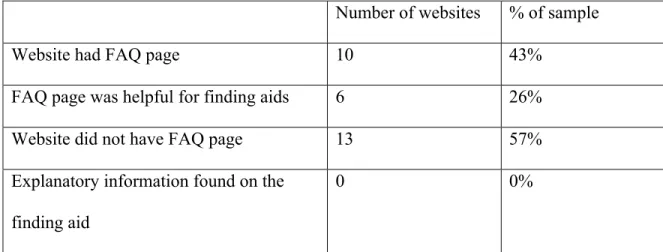
43% of the websites in my sample (10 websites) had an FAQ page or something
similar that was easily identifiable. Of those, 60% (6 websites) had helpful information
about what finding aids are and how to use them. These FAQ pages were most often one
click away from the archive’s home page (80%, 8 websites), but other websites were two
or three clicks away (10% each, 1 website). However, none of the websites in my sample
included this kind of information in the finding aid itself. The only kind of explanatory
information found in the finding aids was a short explanation of the structure of the
finding aid (4 websites, 17% of sample).
Number of websites % of sample
Website had FAQ page 10 43%
FAQ page was helpful for finding aids 6 26%
Website did not have FAQ page 13 57%
Explanatory information found on the
finding aid
0 0%
Table 1: FAQ pages and explanatory information.
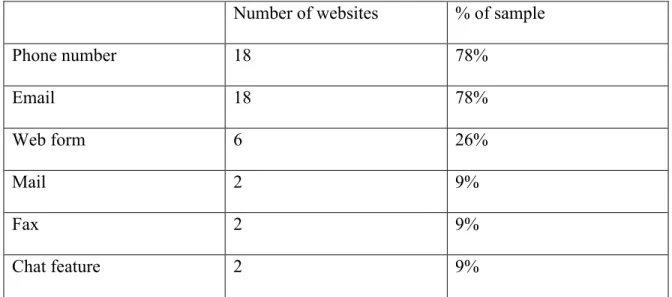
For virtual reference, I found that all 23 websites in my sample had some form of
phone and email. Other options that I observed were web form, mail, fax, and chat
feature. See Table 2 for more information about the virtual reference options displayed on
websites in my sample. In addition, 30% of my sample (7 websites) had virtual reference
resources on the finding aid itself. The most common form of resource here was web
form, followed by phone, email, mail, and fax. Table 3 shows more information about the
types of reference services found directly on finding aids.
Number of websites % of sample
Phone number 18 78%
Email 18 78%
Web form 6 26%
Mail 2 9%
Fax 2 9%
Chat feature 2 9%
Table 2: Types of virtual reference services offered on archives’ websites.
Number of websites % of sample
Web form 4 17%
Phone number 3 13%
Email 3 13%
Mail 1 4%
Fax 1 4%
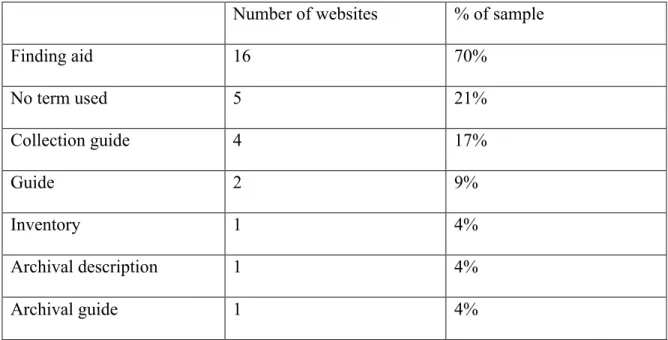
Lastly, the most common term used to refer to finding aids was “finding aid,”
which was used by 70% of my sample. In addition, “collection guide” was used by 17%
of my sample, “guide” was used by 9% of my sample, and “inventory,” “archival
descriptions,” and “archival guide” were used by 4% each. Notably, 21% of my sample
did not use any term to refer to finding aids. See Table 4 for more information about the
different terms used to refer to finding aids.
Number of websites % of sample
Finding aid 16 70%
No term used 5 21%
Collection guide 4 17%
Guide 2 9%
Inventory 1 4%
Archival description 1 4%
Archival guide 1 4%
Discussion
There are several trends to discuss from these results. First, the good news: virtual
reference was offered in all 23 websites in my sample. This is important because it makes
it possible for patrons who are confused to ask questions even if they are not physically in
the reading room with an archivist nearby. The most popular virtual reference options
were phone and email, and other options that I found in my sample were web form,
physical mail, fax, and a chat feature. Almost all of the websites in my sample offered
more than one virtual reference option, so researchers are able to choose the method that
is most comfortable or accessible to them.
However, it was much less common for virtual reference to be found on the
finding aid itself. Only 7 websites in my sample listed virtual reference options on the
finding aid itself. Because all of the websites had these options listed elsewhere on the
website, this is not an urgent problem. However, I would argue that it is more convenient
for users to have this information handy on the finding aid itself, because that is where
they are likely to encounter problems that will require assistance from an archivist.
One important trend to discuss is that there was almost always a scarcity of any
kind of explanatory information on the finding aid itself. Even if there is information
elsewhere on the website, this is problematic. As Tibbo (2002) describes, online
environments are difficult to navigate because there is no one knowledgeable on hand to
according to the literature, that is difficult for an inexperienced researcher to do. It is
crucial for archives to provide helpful resources for researchers who may struggle, and I
argue that it is important to do this at the point of contact. In other words, if a researcher
is struggling to understand a finding aid, they should not have to navigate to a different
webpage to find the information that will help them. From the user’s perspective, it is
much more functional for helpful information to be on the finding aid itself, because that
is where it is needed.
It is important to discuss the FAQ pages that I found on 10 websites in my
sample, or 43%. For the most part, they were labelled as an FAQ page or something
similar, although in two cases the page was not clearly labeled or easy to find. Most, but
not all, of these FAQ pages had information that would help new users understand
finding aids. This is a clear opportunity for many libraries to improve their ability to
make finding aids understandable to the general public. Adding more information about
finding aids and how they work to these FAQ pages would probably benefit many new
users who are unsure of themselves and uncomfortable reaching out to an archivist.
One example of a well-done FAQ page was found on the website for the Clara
Thomas Archives & Special Collections at York University. This website has a LibGuide
devoted to how to read a finding aid, including a definition of the term “finding aid,”
explanations for other confusing terms, and an explanation of how finding aids are
structured. The LibGuide includes screenshots to show examples of finding aids with
annotations explaining the topic at hand. This is a great resource for new users of
archives because it is clear, easy to understand, and touches on many of the topics that the
Lastly, I want to briefly mention the terms that were used to refer to finding aids
in my sample. Unsurprisingly, the overwhelming favorite was “finding aid,” which was
used in 70% of my sample. This term is the most straightforward for archivists to
understand, but literature suggests that users do not always understand what finding aids
are (Yakel & Torres, 2003). Other terms that I found in my sample may be more
comprehensible to inexperienced users. “Collection guide” was the most popular
alternative, and a few other forms of the word “guide” were also used in some
institutions. One puzzling finding was that 5 websites did not use any term at all to refer
to finding aids. From my perspective as an archivist, this is confusing. However, it is
possible that this is actually less confusing for a researcher who is unfamiliar with
archival jargon. They don’t have to navigate a website filled with unfamiliar terms if no
Conclusion
In summary, archives could be doing more to provide explanatory information
about finding aids to users who may need it online. While information may be available
on an FAQ page somewhere on the website, there is rarely any information that is easily
accessible from the finding aid itself. This holds true for definitions of key terms,
explanations of the structure or components of a finding aid, and virtual reference
resources for users who are not physically in the library.
This study has a few limitations. First, because this was a content analysis, I have
relied on previous literature to inform my analysis of how a user would react to the things
that I saw. I can only describe what I saw in this study, but I can’t describe how a user
would react or understand it. There is enough literature for me to fill in some of the gaps,
but not all of them. A future study could incorporate user data to see how users react to
the trends that I have discussed. Another limitation is that because I was doing strictly a
quantitative analysis, I could not study the content of the websites as much as a
qualitative study would have allowed me to do. Future qualitative studies will be
important to have a full picture of what archives’ websites are doing to explain finding
aids to users.
The implications of this study are significant for those who write finding aids.
This study has shown that there is more that we as archivists can do to make finding aids
important, but the finding aids themselves can also be changed to include more
explanatory information so patrons don’t have to search for the information that they
need. As archivists, we want to make our materials accessible to everyone. The first step
References
Chaudhry, A.S. & Choo, M. (2001). Understanding of library jargon in the information
seeking process. Journal of Information Science 27 (5), 343-349.
Clough, L. (2014). Undergraduate use of archives and special collections: Motivations,
barriers, and best practice (Doctoral dissertation). Retrieved from
https://pure.aber.ac.uk/portal/files/26979780/Clough_L.pdf
Daniels, M., & Yakel, E. (2010). Seek and you may find: Successful search in online
finding aid systems. The American Archivist, 73(2), 535-568. Retrieved from
http://www.jstor.org/stable/23290758
Duff, W. M., & Johnson, C. A. (2002). Accidentally found on purpose:
Information-seeking behavior of historians in archives. Library Quarterly, 72(4), 472-498.
Gillispie, J. (2005). An analysis of online user resources in academic archives. Retrieved
from Carolina Digital Repository.
Johnson, G. (2006). Introducing Undergraduate Students to Archives and Special
Collections. College & Undergraduate Libraries 13(2), 91-100.
Katte, J. (2002). Reaching out to researchers: A model for web-based user education
resources for archives and manuscript collections. Retrieved from Carolina
Digital Repository.
Krippendorff, K. (2004). Content Analysis: An Introduction to its Methodology, 2nd ed.
Neuendorf, K. A. (2002). The Content Analysis Guidebook. Thousand Oaks, CA: Sage
Publications.
Nimer, C., & Daines, J. G. (2008). What do you mean it doesn’t make sense?
Redesigning finding aids from the user’s perspective. Journal of Archival
Organization, 6(4), 216-232.
Pearce-Moses, M. (2005). A glossary of archival and records terminology. Chicago: The
Society of American Archivists. Retrieved from
http://files.archivists.org/pubs/free/SAA-Glossary-2005.pdf
Prom, C. J. (2004). User interactions with electronic finding aids in a controlled setting.
The American Archivist, 67(2), 234-268. Retrieved from
https://www.jstor.org/stable/40294278
Scheir, W. (2005). First entry: Report on a qualitative exploratory study of novice user
experience with online finding aids. Journal of Archival Organization, 3(4),
49-85.
Tibbo, H. (2002). Learning to love our users: A challenge to the profession and a model
for practice. Retrieved from
https://ils.unc.edu/tibbo/MAC%20Spring%202002.pdf
Walton, R. (2017). Looking for answers: A usability study of online finding aid
navigation. The American Archivist, 80(1), 30-52.
Yakel, E. (2002). Listening to Users. Archival Issues 26(2), 111-127.
Yakel, E. (2008). Encoded Archival Description: Are Finding Aids Boundary Spanners
Yakel, E. & Torres, D. (2003). AI: Archival Intelligence and User Expertise. The
Appendix A. Codebook
1. What term is used to identify the finding aids? (Finding aid, collection guide, or
something different?)
2. Are the following archival terms used in the finding aid?
a. Finding aid
b. Scope and content note
c. Arrangement
d. Series
3. For the terms that are used, are they clearly defined in the finding aid?
a. Finding aid
b. Scope and content note
c. Arrangement
d. Series
4. Is the structure of the finding aid explained? This could include a description
of the relationship of series, subseries, boxes, and folders.
5. Are users pointed towards any kind of virtual reference resources on the
finding aid itself? This could include a chat feature, or an email address or
phone number.
6. Are users pointed toward virtual reference anywhere on the website?
8. Is there an FAQ page or something similar on the website containing
information about finding aids?
9. Is it clear from the home page of the archive where to find any explanatory
information?
10. Is there any explanatory information easily discoverable within the finding
aid itself?
11. How many clicks does it take to get to any explanatory information from the