pages. Advisor: David Carr.
This paper examines the effectiveness of a specific reference interview technique, the use of open questions, in the context of online synchronous communication (“virtual” or “chat” reference). Virtual reference transcripts from the North Carolina State University Libraries’ “Ask a Librarian LIVE” service were examined to determine whether the librarian had asked open questions or not in the course of the interview. Transcripts were also examined to determine whether the interview had been a success or not; because of the apparently high level of user satisfaction expressed by patrons, a third category of “ambiguous success” was created. The data were then examined for evidence of a correlation between the use of open questions and the success of the interview. No correlation was found, but a generally high level of quality service and patron satisfaction were evident. The study also shows that further research on communication strategies in virtual environments is needed, and suggests some possible future research questions.
Headings:
College and university libraries – Reference services Reference services – evaluation
Reference services – automation
by
Catherine A. Pellegrino
A Master’s paper submitted to the faculty of the school of Information and Library Science of the University of North Carolina at Chapel Hill
in partial fulfillment of the requirements for the degree of Master of Science in
Library Science.
Chapel Hill, North Carolina April 2004
Approved by
Table of Contents
Acknowledgments... 2
Introduction... 3
Defining Virtual Reference... 4
Communication Issues in Virtual Reference ... 6
Research Question ... 9
Literature Review... 10
Virtual Reference... 10
Models for the Reference Interview ... 15
Evaluating Reference Service... 21
Methodology ... 27
Setting ... 27
Gathering the Data... 28
Operational Definitions ... 29
Tabulating the Data... 33
Problems With the Methodology... 33
Results... 36
Open vs. Closed Questions ... 36
Success of Reference Transactions... 36
Correlation Between Questions and Success... 37
Closer Examination of Open Questions ... 38
Discussion ... 45
Research Question ... 45
Future Research ... 50
Concluding Thoughts ... 52
Acknowledgments
I wish to thank a number of people who have helped me to do the research and write this paper, especially the Research and Information Services Department of the North Carolina State University Libraries, who furnished the transcripts that formed the basis of this study. Amy VanScoy, the Assistant Department Head, was particularly gracious in helping me to collect the transcripts. Ted Shearer and Todd Cooper of the Systems Department at the University of North Carolina at Chapel Hill Academic Affairs Library, and Ian Robertson, provided and fine-tuned the Perl script that enabled me to remove personally identifiable information from the transcripts. I am also indebted to my classmates Christie Hull and Jennifer Calvo, who shared their experience with providing virtual reference service and helped me articulate the focus of the research in this study. Dr. Jeffrey Pomerantz generously offered advice, materials, and helpful suggestions.
It goes without saying that a graduate student is indebted to her Master’s paper advisor, so I will merely state that Dr. David Carr’s advice and instruction were invaluable.
Introduction
The field of virtual reference (or “chat reference”) has exploded in the past three to four years, in terms of the number of libraries – including public, academic, and special libraries – offering the service, in terms of the sophistication with which it is being supported, and in terms of the amount of published literature addressing the service. The movement since the mid-1990s towards increasing numbers of online information resources, such as citation databases, full-text journal aggregators, and digital library collections, has meant that librarians can direct patrons to appropriate and
authoritative electronic information more and more often.1
At the same time, the increasing popularity of synchronous online communication (such as instant messaging or chat rooms) for social purposes has led to a new generation of library patrons who are already familiar with the “chat” medium. These patrons sometimes find the relative anonymity of virtual reference less intimidating than approaching the reference desk in person; they also value the convenience of having a librarian available on their desktop, as it were. Finally, the staffing flexibility of virtual reference allows libraries to establish collaborative arrangements whereby staff from several libraries coordinate to answer questions from all the libraries simultaneously; this
1
It should be noted that throughout this paper, the term “librarian” is used to refer to the library staff member who attempts to answer the patron’s reference question. The author recognizes that in many cases, both in the data analyzed here and in reference practice in general, the “librarian” is not in fact a
professional librarian, but rather may be a paraprofessional employee or a graduate assistant, or may have another role entirely in relation to the institution. The term “librarian” is used here primarily for
allows each library to maintain greater hours of service with less commitment of staff time than they could individually.
Through collaborative arrangements, several library systems around the country, including most recently the State Library of North Carolina, have been able to offer virtual reference service twenty-four hours a day, seven days a week. An additional staffing benefit of virtual reference is the ability of one librarian to work with several patrons simultaneously; the overall effectiveness of this practice, however, has yet to be convincingly documented. In fact, despite the growing amount of research and literature on virtual reference, there has been little work on specific communication strategies that facilitate question negotiation with patrons in the online environment.
This research project aims to investigate the use and effects of one particular, widely-accepted communication strategy for question negotiation, the use by the librarian of open questions to gather details from the patron about their specific information need.
Defining Virtual Reference
toward providing customer service functions to online retailers, rather than reference service functions to librarians. Some libraries have experimented with using instant messaging software (for example, America Online’s instant messaging client) to provide reference service, since this particular medium is currently extremely popular among the general online population; however, because of its limited functionality, I have excluded instant messaging from the discussion in this study.
At this time, no clear consensus has been reached as to what exactly to call the provision of reference service in real time over the internet. The two predominant terms as of this writing are “virtual reference” and “chat reference.” Neither is wholly
satisfactory: “virtual reference” seems to imply that the reference service that is provided is somehow not “real,” or that it is almost, but not quite, actual reference service. “Chat reference” has an informality to it that suggests that the patron and the librarian are merely engaged in social chit-chat, rather than dealing with serious reference questions. I have chosen, somewhat arbitrarily, to use the term “virtual reference” in this study, but in doing so I recognize both the shortcomings of the term and the lack of viable alternatives.
As of this writing, most virtual reference software packages share similar technical capabilities. The most obvious of these is the interface where the patron and librarian type messages back and forth, and the entire conversation appears on both parties’ screens. Most packages allow the librarian to “push” web pages to the patron, causing the web page to appear in a larger window on the patron’s screen; many
on links in web pages, causing new pages to load in both parties’ browser windows.2 Most packages save a complete transcript of the conversation, including the URLs of any web pages that were visited during the session so that the patron can go back and access the web pages at a later time; copies are emailed to both parties for reference, and a copy is stored on a server, either locally at the library or on a remote server owned by the company that provides the software. Recognizing that librarians are often responding to more than one patron at a time, software companies have begun providing librarians with “canned” responses, such as “Welcome to Our Library’s reference desk,” “I will be with you in just a moment,” or “Thank you for using Our Library’s reference service. If you have further questions, please log into chat again, or call us at (555) 515-1212” that can be accessed in a single click. Finally, most virtual reference packages require no
software, other than a web browser, to be installed on either the patron’s or the librarian’s computer. This allows patrons to access the service using a wide variety of computer platforms and without having to download client software, and it allows librarians to staff the service from virtually any internet-connected computer.
Communication Issues in Virtual Reference
Both parties, the patron and the librarian, face the same challenges in virtual reference that they do in any text-based communication medium: the absence of body language, non-verbal cues, and verbal inflection. Although media attention has focused on these communication challenges in email and synchronous chat, the same constraints
2
apply to older technologies, including written letters, which have been used for the provision of reference services for years.
Additional challenges specific to the chat environment include the fact that for many (though by no means all) people, talking is a more natural form of communication than typing; the degree of artificiality and mediation created by the typed exchange and the time delay involved even in the fastest chat communication; and the fact that the chat medium can be a considerable obstacle for people who lack sufficient typing or computer skills. Balanced against these challenges is the fact that for many reasons, some people find written communication (whether synchronous or asynchronous) to be easier or more comfortable than in-person or phone communication. The balance of the situation, however, must be seen to fall on the side of the challenges in chat communication. To respond to some of these issues, a number of articles on virtual reference, particularly those that take a “how-to” approach, have included at least some advice for librarians on the conventions of chat communication, such as common abbreviations and
“emoticons.”3
While the difficulties of communication via online chat should not be minimized, there are also considerable opportunities for improving question negotiation and
reference interview techniques inherent in the medium. While chat provides the illusion of immediacy in communication (especially when compared with reference transactions that take place via email), in practice there is actually a great deal more time for the librarian to think and consider his or her interview strategy carefully, when compared with facing a patron in person at the reference desk, or over the phone. Even an
3
See, for example, Jana Ronan, “The reference interview online,” Reference & User Services Quarterly
extremely impatient patron generally gives the librarian more time to answer the question in virtual reference than in face-to-face reference. Provided that the librarian does not feel pressured by the medium itself, and provided that the librarian is not attempting to interact with more patrons simultaneously than he or she is comfortable with (and neither of these possibilities is to be dismissed lightly), virtual reference allows the librarian to engage deliberately in reference interview strategies. It can also allow the librarian to experiment and practice with new techniques and skills, without the awkwardness and necessity for absolutely immediate communication of in-person interaction.
Research Question
The differences, outlined above, between online synchronous communication (virtual reference) and face-to-face verbal communication suggest that assumptions and theories about communication principles in face-to-face settings may not be valid for online chat. In order for reference librarians to provide effective and appropriate service to patrons through virtual reference, we must understand the principles of communication that apply to this medium, and how to use the medium to its best advantage. One of the most widely-accepted principles on which the reference interview is based is the idea that open-ended questions (questions like “What kind of information are you looking for?” that require more than a yes or no answer) facilitate the question-negotiation process and lead to more successful, efficient, and effective reference transactions.4 The research conducted here tested that principle by examining transcripts from virtual reference transactions to see if there was a significant correlation between the librarians’ use of open questions and successful reference transactions.5 Although the data collected in this study came from an academic research library, the conclusions drawn here are not limited to that environment; they are applicable to any context where virtual reference is
practiced.
4
This principle has been to some degree empirically proven in the library and information science literature; see Ethel Auster and Stephen B. Lawton, “Search interview techniques and information gains as antecedents of user satisfaction with online bibliographic retrieval,” JASIS 35 (March 1984): 90-103. 5
Literature Review
The research performed in this study draws on two extremely well-documented areas of library science: the reference interview, and evaluation of reference service, and one very new, and therefore relatively undocumented area: virtual reference. Although some of the studies mentioned below (particularly the literature on virtual reference) cross over the boundaries between research topics, it is useful to examine each facet of the literature separately.
Virtual Reference
Like the technology, the literature on virtual or chat reference is relatively young. While much of the literature takes a “how-to” approach, a few studies that attempt
“How to do it” and “How we did it.” Not surprisingly, much of what has been written about virtual reference at this stage in its development takes a highly practical approach, addressing the question of whether your library should consider establishing a virtual reference service, what is required to set one up, and even step-by-step directions for selecting software, training the staff, and marketing the service.6 Indeed, the
publishing industry has just recently caught up with professional practice, with two major publishing houses – the American Library Association’s in-house publisher, and
Libraries Unlimited – producing book-length how-to guides to chat reference in 2003.7 A close relative of the “how-to” piece is the “how we did it” article, in which the authors chronicle the process of establishing a virtual reference service at their particular library, discuss what they have learned, and offer advice to other librarians.8 Often these articles include findings from a rudimentary evaluation study, usually an optional survey administered to users after the conclusion of the chat session.9 The area of virtual
reference has just barely matured far enough that an article on “how we are continuing to
6
A representative example of this type of article is Steve Coffman, “So you want to do virtual reference?”
Public Libraries 40/5 suppl. (Sept./Oct. 2001): 14-20. Additional information for libraries with more experience providing virtual reference service can be found in the presentations at the fifth annual Virtual Reference Desk Conference, held November 17-18 in San Antonio, TX (presentations online at
http://www.vrd2003.org/proceedings/index.cfm#Technology; accessed 2/5/04). The presentations covered topics such as setting up library staff to provide virtual reference from home, and changing software vendors after you have already established a service.
7
Jana Ronan, Chat reference: a guide to live virtual reference services (Libraries Unlimited, 2003); Steve Coffman, Going live: starting and running a virtual reference service (Chicago: American Library Association, 2003).
8
An example of this type of article is Joshua Boyer, “Virtual reference service at the NCSU Libraries: the first hundred days,” Information technology and libraries 20/3 (Sept. 2001): 122-128.
9
do it” has just recently appeared, written by two librarians at the North Carolina State University Libraries.10
A recent issue of Reference and User Services Quarterly went one step further than the “how to do it” article, with a series of articles on the reference interview and digital reference (reprinted from the RUSA President’s Program at the 2002 ALA conference). These articles, while providing useful practical advice from experienced professionals (some of whom have also published extensively in the field), also serve as a discussion of some of the more difficult issues surrounding the provision of reference services via digital channels. Catherine Sheldrick Ross, in an article that echoes many of the ideas of her “Willingness To Return Project” (discussed below), argues forcefully for the importance of conducting an interview in every reference transaction, including those that occur online.11 Jana Ronan offers advice on how to adapt the usual dialect of the reference interview to the less formal, more abbreviated style of online chat.12 Kathleen Kern argues that patrons who use virtual reference are not necessarily looking for a quick answer and echoes Ross’s call for a quality reference interview.13 And David Tyckoson sums up the collection of articles by articulating the position that although the technology has changed dramatically, the fundamental communicative acts that librarians perform, which are the core of reference service, have not changed at all.14
10
Karen Ciccone and Amy VanScoy, “Managing an Established Virtual Reference Service,” Internet Reference Services Quarterly 8/1-2 (2003): 95-105.
11
Catherine Sheldrick Ross, “The reference interview: why it needs to be used in every (well, almost every) transaction,” Reference & User Services Quarterly 43/1 (Fall 2003): 38-43.
12
Ronan, “The reference interview online,” 43-47. 13
Kathleen Kern, “Communication, patron satisfaction, and the reference interview,” Reference & User Services Quarterly 43/1 (Fall 2003): 47-49.
14
David Tyckoson, “Reference at its core: the reference interview,” Reference & User Services Quarterly
Evaluative research. Now that virtual reference has had a few years to get established, a number of studies that have attempted to evaluate the quality of service provided by virtual reference desks have been published, either in conjunction with pilot programs (in order to justify continuing the service) or independently. Paul Neuhaus and Matthew Marsteller report the results of a fairly rudimentary patron-satisfaction survey they performed when establishing a virtual reference service at Carnegie Mellon University.15 They found strongly positive responses when patrons were asked if they received the information they needed, and if they would use the service again. Jo Kibbee, David Ward, and Wei Ma have reported the results of a similar study done at the
University of Illinois at Urbana-Champaign. 16 In addition to a short patron survey, they provided a detailed analysis of quantitative aspects of the service, including the types of questions asked, average time to it took librarians to answer the questions, and hours where usage was highest. They also began an informal evaluation of the success of transactions taking place via virtual reference.
One of the most detailed studies done to date is a pilot study by Marilyn Domas White, Eileen Abels, and Neil Kaske.17 In preparation for a larger, comprehensive study of virtual reference service at both public and academic libraries, they used unobtrusive testing methods to test accuracy of responses to sample reference questions (the “secret shopper” method; see the section on accuracy below). In addition to measuring the accuracy of librarians’ responses, the researchers also took into account factors such as
15
Neuhaus & Marsteller, “Chat reference at Carnegie Mellon University,” 29-41. 16
Jo Kibbee, David Ward, and Wei Ma, “Virtual service, real data: results of a pilot study,” Reference services review 30/1 (2002): 25-36.
17
the number of conversational “turns” (as a measure of the degree to which the librarian engaged in a reference interview), the length of the session, the wait time before a patron was connected to a librarian, and the amount of “down time” within a session.
Another method for evaluating the quality of service provided by virtual reference is to compare the results of a virtual interaction with a benchmark, or established standard for providing reference service such as the RUSA Guidelines.18 One example of this kind of study is Kristen Bullard’s master’s paper on virtual reference, which uses the Virtual Reference Desk organization’s Facets of Quality for Digital Reference as its benchmark.19 Bullard used unobtrusive testing to evaluate accuracy in addition to quality of service at virtual reference services operated by ten Carnegie Doctoral/Research universities. She found that the same problems of reference quality exist in virtual reference as exist in other modes of service delivery (i.e., in-person, email). She also found a need for standardization in virtual reference and for standards for evaluation that take into account the specific characteristics of live, synchronous virtual reference. Another study that used a benchmark derived from a number of different sources found similar results, and at the same time confirmed once again the “55% rule” for reference accuracy.20
18
“Guidelines for Behavioral Performance of Reference and Information Services Professionals,” RQ 36/2 (Winter 1996): 200-203.
19
Kristen A. Bullard, An application of unobtrusive research methods and the Virtual Reference Desk's Facets of Quality for Digital Reference Service (MSLS Thesis, University of North Carolina at Chapel Hill: 2003). The Virtual Reference Desk’s document can be found at http://www.vrd.org/facets-10-00.shtml (accessed 3/29/04).
20
Neil Kaske and Julie Arnold, “An Unobtrusive Evaluation of Online Real Time Library Reference Services,” paper presented at the Library Research Roundtable, American Library Association national conference: Atlanta, GA, June 15, 2002. Full text available at
An important distinction between the evaluative research discussed above and the research performed in this study is the assumptions of the researchers and the underlying goals of the research. The studies cited above sought to evaluate the quality of reference service as a end in itself, either to aid in making a decision about continuing a pilot program, or to suggest areas of service that could be improved. The assumption, particularly for those studies that used benchmarks, is that fulfilling the requirements of the benchmark necessarily results in more successful reference transactions. The goal of this study was to determine if one specific aspect of a benchmark, namely the use of open questions in the reference interview, did in fact result in more successful reference
transactions. In order to do that, individual transactions had to be identified as successful or unsuccessful, but that was not the aim of the study. The aim of the study was to evaluate the validity of open questions as a predictor of successful reference outcomes.
Models For The Reference Interview
In order to assess the effectiveness of different interview strategies in the virtual environment, it was necessary to identify an appropriate model for the reference
interview to use in classifying the strategies observed in the chat transcripts. Ideally, this model should contain only a few categories of strategies, in order to simplify the
Background. The modern literature on the reference interview generally begins with the work of Robert S. Taylor, and specifically his article on what he called “question negotiation.”21 In Taylor’s terms, the patron’s information need goes through four
distinct phases – the visceral, conscious, formalized, and compromised need – as he or she works with the librarian to answer the patron’s question. The reference interview as we understand it today is the questions that the librarian asks and the statements that he or she makes in order to move the patron through these phases towards a shared
understanding of what it is that the patron needs to know. In addition, the reference interview also comprises Taylor’s five “filters” or aspects of the question that will help the librarian to find the appropriate information for the patron: “1. determination of subject, 2. objective and motivation, 3. personal characteristics of inquirer, 4. relationship of inquiry to file organization, 5. anticipated or acceptable answers.”22 Taylor’s ideas provided a framework for understanding the structure of the reference interview and the experience of the patron who comes to the reference desk, as well as guidance for librarians in what kinds of information to elicit from patrons in order to respond to their information needs in the most appropriate manner possible.
Graesser’s typology of question types. Question-asking and -answering strategies have long been discussed in the communication theory literature, and some of that scholarship has found its way into the library and information science literature as well. Marilyn Domas White used a typology of questions developed by A. C. Graesser
21
Robert S. Taylor, “Question negotiation and information seeking in libraries,” College and research libraries 29/3 (May 1968): 178-194. One of the two essential parts of this article – his four-part hierarchy of information needs – was actually introduced some years earlier in a different journal (see Robert S. Taylor, “The process of asking questions,” American Documentation 13 (Oct. 1962): 391-96), but Taylor’s article in College and research libraries is the one that is almost universally cited in the literature.
22
and others to analyze the questions asked, both by patrons and by librarians, at a
reference desk.23 Graesser’s typology contains 18 separate types of questions, which are generally separated into two groups, short-answer and long-answer. They range in complexity from simple verification (is X true?) to causal antecedent and consequent (why did X happen? what was the result of Y?).24
While White’s use of the typology demonstrates that a classification scheme with this level of detail is valuable in the context of analyzing reference transactions – she finds, among other things, that librarians ask the majority of questions in reference
interviews, and that most questions are of the short-answer variety25 – it is far too detailed to be used in this study. In order to perform a valid chi square test on the data with 18 different categories into which questions could be sorted, a minimum of 360 usable chat transcripts would need to be obtained, far too many for the space and time constraints of this study. However, the correspondence between the broad categories of short- and long-answer questions and open and closed question types suggests that further research into this area may be able to use Graesser’s typology to refine the study of reference interview strategies.
Graesser’s distinction between an interrogative expression and an inquiry is also important to this study.26 An interrogative expression is any statement that,
grammatically, ends with a question mark; it may or may not indicate an actual desire for an answer; an inquiry is any statement, no matter how phrased, that expresses a need for
23
Marilyn Domas White, “Questions in reference interviews,” Journal of Documentation 54/4 (Sept. 1998): 443-65. A.C. Graesser, N.K. Person, and J.D. Huber, “Mechanisms that generate questions,” in
Questions and information systems, ed. T.E. Lauer et al. (Hillsdale, NJ: Erlbaum, 1992): 167-188. 24
Graesser et al., “Mechanisms that generate questions,” 172-73. 25
White, “Questions in reference interviews,” 460-61. 26
information. For example, both of the following are interrogatives: “What is that man’s name?” “Would you please pass the salt?” but only the former is an inquiry. Likewise, both of these statements are inquiries, but only the former is an interrogative expression: “Why do you need this book?” “If you could tell me what you plan to do with this information, that might help me search for it more effectively.” In examining the interview strategies used in virtual reference, I will be studying the inquiries made by librarians, not the interrogative expressions (see the Methodology section below).
Needs-based vs. question-based approaches. Marilyn Domas White has done research defining two different models of reference service, one that she calls “needs-oriented” and the other called “question-oriented.”27 In White’s model, a librarian using the question-oriented model focuses his or her efforts on clarifying exactly what the question is that the patron is asking, and in determining what information will constitute a sufficient answer. A librarian using the needs-oriented model focuses on the patron’s information problem or need, rather than the specific question that the patron asked, and the interview focuses on determining exactly what will address the patron’s information need.
Throughout White’s work, there is a subtle but pervasive bias toward the needs-oriented model, which is underlined by some of her other research.28 There are also methodological difficulties with applying this model to the study of reference interviews. For one thing, the decision of which approach to take depends in large part on
27
Marilyn Domas White, “Different approaches to the reference interview,” in Rothstein on reference, ed. William A. Katz and Charles A. Bunge (New York: Haworth, 1989): 631-46.
28
fundamental assumptions about the role of the librarian (Question Answerer vs.
Information Specialist/Diagnostician) – assumptions that may in some cases be a matter of library policy – and on the amount of faith that the librarian places in the patron’s ability to know what information they need, regardless of their facility in expressing that need. In addition, it seems very possible that different types of patron questions seem naturally to provoke one model or the other. White only provides two sample transcripts in her article, and it is difficult to imagine either question being appropriately answered by the opposite approach. (The question-oriented example is a known-item search for a book review, while the needs-oriented example is a request for information on a broad topic, handicapped children.) Without additional examples and research into the
correlation between question types and approaches taken by librarians, it is hard to state definitively that one approach is better for all types of reference questions. Finally, it is difficult to define in concrete terms that can be operationalized what exactly constitutes a needs-oriented approach to answering a reference question. In purely practical terms, this is an unworkable model for the present research study.
Open, closed, and neutral questions. Every modern guide to conducting the reference interview calls the student’s attention to the distinction between open and closed questions, and most exhort the student to use open questions to elicit essential information from the patron.29 In addition, research has shown that patrons who are asked open questions in reference interviews learn more and are more satisfied with the
29
interview.30 The clear distinction between open and closed question types, the almost universal acknowledgement in the library science community of the value of open questions, and the evidence that open questions are under-utilized in actual reference practice, are all reasons why the open/closed distinction was selected for this research study.
One of the earliest articles describing the difference between the two strategies is by Geraldine B. King, and it is possible that no one has improved upon her description of the differences and her identification of the value of open questions in the reference interview.31 In brief, a closed question is one that demands a “yes or no” or “this or that” response: “have you tried searching the catalog?” “do you want books or journal
articles?” An open question is one that allows patrons to answer in their own words, and invites patrons to disclose further details about their information needs that will be useful in the search process: “what sources have you tried already?” “what kind of information are you looking for?” One complication in the distinction between open and closed questions is the use of what is, in a literal grammatical sense, a closed question, to substitute for an open question: “is there any particular area of biology that you’re most interested in?” This complication will be addressed in the Methodology section below.
Brenda Dervin and others have added a third type of question, the “neutral” or “sense-making” question, to the binary distinction between open and closed questions.32 Neutral questions are a subset of open questions that are specifically designed to help the
30
Auster & Lawton, “Search interview techniques,” 98. 31
Geraldine B. King, “The reference interview: open and closed questions,” Reference quarterly 12/2 (Winter 1972): 157-60.
32
Brenda Dervin and Patricia Dewdney, “Neutral questioning: a new approach to the reference interview,”
librarian understand the question from the patron’s perspective, and to identify the situations in which the information is relevant, gaps in knowledge that the patron is seeking to fill, and uses to which the patron will put the information. Because neutral questions ultimately collapse into the broader category of open questions, and because they seem to be difficult to identify in practice (it is not clear, for instance, what kind of open question is not a neutral question), this study does not take into account the category of neutral questions.
Evaluating Reference Service
Much ink has been spilled on the subject of evaluating the quality of reference transactions and of reference service generally. Most studies have used one of two criteria for measuring quality or effectiveness: accuracy and patron satisfaction.
Accuracy.Accuracy studies generally follow the model of the “secret shopper,” a researcher or accomplice posing as a patron, asking questions with known answers at reference desks, and evaluating the accuracy of the answers obtained.33 Loriene Roy has summarized and evaluated the research on reference accuracy, and considered the question of whether it represents an appropriate measure of service quality.34 Much of the library science literature has discredited the use of accuracy as a valid measure of the quality or success of a reference transaction; at the very least, its use as the sole criterion on which reference services are judged has been rendered extremely suspect.35
33
A comprehensive manual for this evaluative technique is Peter Hernon and Charles R. McClure,
Unobtrusive testing and library reference services (Norwood, NJ: Ablex, 1987). 34
Loriene Roy, “Measures of user success: reference accuracy,” The Reference Librarian 49/50 (1995): 217-228.
35
The principal drawback to using accuracy as a measure of reference success in this study is that questions with known answers tend to be short factual items, and do not represent the full range of possible queries and requests (whether in person or via virtual reference), particularly at an academic library, which can include in-depth assistance for research papers and projects, as well as detailed instructional help with databases and other online reference sources. The fact that this study did not take accuracy into account does not mean that the online medium poses a barrier to its study; in fact, the degree of anonymity made possible by chat reference might make unobtrusive evaluation of reference accuracy easier to conduct.
Patron satisfaction, broadly defined.A number of different facets of library patrons’ satisfaction with the reference assistance provided to them have been studied in the library science literature. Some of the earliest studies of reference quality and accuracy noted that while the “55% rule” for accuracy is apparently valid, the vast majority of patrons came away from reference desks satisfied with the service that they received.36 Clearly some degree of satisfaction was affecting patrons’ views of library services, and subsequent research has focused on identifying more specifically the aspects of satisfaction that are most relevant to libraries’ missions.
User report of success. Marjorie Murfin reviewed the literature surrounding two measures that are often conflated: patrons’ satisfaction with the service they received, and Durrance, “Factors that influence reference success: what makes questioners willing to return?” The Reference Librarian 49/50 (1995): 244-245.
36
patrons’ self-reporting of their success in finding the information they were looking for when they approached the reference desk.37 Murfin argues strongly for patron report of success as a measure with greater validity than accuracy. Murfin also argues that report of success in finding relevant information is a better measure of service quality than simple satisfaction, because while it is important that patrons come away from a reference encounter satisfied with the “customer service” aspects of the interaction, the fundamental purpose of reference is to connect people with information, and if that purpose is not achieved, the encounter cannot be considered wholly successful.
Willingness to return. Several studies have used a methodology that asks
patrons who have visited reference desks with questions whether they would be willing to return to the same staff member with another question at a later time. This method, part of a long-term study known as the “Willingness To Return Project,” was developed by Joan C. Durrance and has been replicated in similar studies over the course of ten years.38 Researchers used the comments of the patrons, as well as scalar evaluation questions (e.g. asking patrons to rate the service on a scale of 1 to 7) to generate a picture of the quality of reference service received by the general public, as well as to call attention to aspects of reference service that the patrons found particularly helpful or unhelpful.
There are two potential pitfalls with the methodologies described above. First, neither Murfin’s patron report of success nor the willingness to return study asks for unprompted reports of success or satisfaction. In Murfin’s model, patrons are surveyed at
37
Murfin, “Evaluation of reference service,” 229-242. 38
Joan C. Durrance, “Reference success: does the 55 percent rule tell the whole story?” Library Journal
114 (April 15, 1989): 31-36; Durrance, “Factors that influence reference success,” 243-265; Patricia Dewdney and Catherine Sheldrick Ross, “Flying a light aircraft: reference service evaluation from a user’s perspective,” Reference Quarterly 34 (Winter 1994): 217-30; Lynda M. Baker and Judith J. Field,
the conclusion of a reference interaction, and in the willingness to return studies, proxies were sent to libraries with the specific task of asking questions and reporting on the service they received. While Murfin cautions that survey instruments must be designed to correct for positive bias in the survey results, both measures introduce a degree of artificiality to the interaction. The method described by Lorri Mon and Joseph Janes below, which focuses attention on unprompted “thank you’s” from patrons, addresses some of these methodological problems.
In addition, the willingness to return studies all use library science graduate students, enrolled in an introductory reference course, as research subjects. These students are specifically sent out on a mission to ask a question at a reference desk of their choice and evaluate the service that they receive. It may be that this is a particularly critical group of subjects, and that if ordinary patrons were asked to report on their willingness to return to the same staff member, they would be somewhat less critical in their evaluation.
expressions of satisfaction by the patrons during the chat session itself; for details, see the methodology section below.
In taking unprompted expressions of satisfaction as indicators of success in the reference transaction, the research undertaken here closely resembles a study performed at the University of Washington, in which researchers examined email reference
encounters where the patron sent an unsolicited “thank you” message to the librarian.39 That study focused on specific aspects of the reference interaction: variables such as length of response from the librarian, the delay between when the question was submitted and when the librarian answered, and so forth. Although Mon and Janes’s study
considered asynchronous email transactions, the methodology – looking for evidence of success and evaluating the variables that correlate with success – is valid for synchronous chat reference as well.
In an article that addresses the issue of “false positives” in satisfaction surveys – patrons who do not get the information they came for, but describe themselves as satisfied anyway – Rachel Applegate defines three levels of satisfaction: material satisfaction, simple emotional satisfaction, and emotional satisfaction along multiple paths. This last level takes into account a number of different factors in asking the patron to evaluate his or her satisfaction, including the patron’s expectations, the setting for the encounter, and many other variables. Applegate points out that researchers should be very careful to define what they are measuring when they measure “satisfaction,” and advocates that researchers move away from short (one- to five-question) satisfaction
39
Lorri Mon and Joseph Janes, “The Thank You Study: Research on User Satisfaction with Digital Reference Services,” paper presented at the Virtual Reference Desk Conference 2003, Nov. 17-18, San Antonio, TX. Abstract and presentation online at
surveys, and “concentrate instead on establishing a real dialogue in which a user’s needs, expectations, knowledge, and emotions can all be communicated.”40 Because the
indicators of satisfaction used in this study are not responses to a survey, but rather unprompted expressions made during the normal course of the reference transaction, as with the “Thank You” study discussed above, the patrons are presumably making an honest and valid expression of their satisfaction. While Applegate’s methodology may eventually be transferable to the field of library science, it rapidly leads the researcher into an extremely complicated definition of satisfaction, one that is far too extensive for the purposes of this study.
40
Methodology
Setting
I conducted my research with transcripts of virtual reference sessions provide by the North Carolina State University Libraries’ “Ask A Librarian LIVE” virtual reference service. The NCSU Libraries uses a software package called the Virtual Reference Toolkit, produced by Library Systems and Services, LLC (LSSI). The NCSU Libraries is the leading library in the Raleigh/Durham/Chapel Hill, North Carolina area in providing virtual reference service, and one of the leading libraries in the country. They were the first major research library in the Triangle to provide virtual reference service, and as of this writing they continue to handle a far greater number of “virtual patrons” than the other area university libraries. Several of their librarians have published articles in the library science literature about their experiences in providing virtual reference service.41
The “Ask a Librarian LIVE” service is staffed Mondays through Thursdays from 9:00 a.m. to midnight, Fridays from 9:00 a.m. to 5:00 p.m., Saturdays from 1:00 p.m. to 5:00 p.m., and Sundays from 1:00 p.m. to midnight. Service from 9:00 p.m. to midnight is provided through a collaborative arrangement with the libraries at Duke University and the University of North Carolina at Chapel Hill, whereby staff monitor the virtual
reference services of all three universities simultaneously. At the time of this writing,
41
UNC and Duke each provided the staffing for one night per week, and NCSU provided the staffing for the remaining three nights. NCSU staff who provide virtual reference service include professional librarians, paraprofessional library staff, and graduate assistants enrolled in library science programs at UNC and North Carolina Central University.
Patrons discover the “Ask a Librarian LIVE” feature of the NCSU Libraries’ web site in a number of ways. Nearly every bibliographic instruction session offered by the library mentions the service and encourages students to use it. Links to the service are present on nearly every web page within the Libraries’ web site, including the search screens of the online catalog, in the header and footer of the web page. In the early days when the service was first being established, prominent graphic links were placed on the Libraries’ home page, and the service is always present on the main left-hand navigation controls on the Libraries’ home page as well.
Unlike many libraries’ virtual reference services, which specify that the service is designed to answer short, fact-based questions and that more detailed, research-oriented questions should be asked in person at the reference desk or via email, the NCSU
Libraries’ “Ask a Librarian LIVE” service accepts and attempts to answer any question a patron might have. While the staff will issue referrals to subject specialist librarians when appropriate, they do not, as a matter of policy, immediately refer complicated or research-based questions to the reference desk.
Gathering the Data
in this study were captured from those logs and saved as text files. I gathered an initial sample of 70 transcripts, beginning at the arbitrarily-chosen point of 10:22 p.m. on February 15, 2004 and continuing until I had 70 transcripts, which took me to 5:07 p.m. on February 10, 2004. (Transcripts are stored in reverse chronological order.) Although the starting point for gathering the transcripts was arbitrarily chosen, I made sure to select a “normal” point in the term: in the middle of the term, neither at the beginning nor the end, and not a period in the middle of an academic break.
To protect the privacy of both the patrons and the librarians, I removed all personally identifiable information from each transcript using a computer program that replaced the name of the patron with the word “Patron” and the name of the librarian with the word “Librarian.” Fourteen transcripts were discarded as unusable, mostly because the patron logged out of the session before the librarian had a chance to log in and begin answering the question. One was discarded due to an error on my part (I copied the same transcript twice), and one was combined with the transcript that immediately followed it in the log, because it was the same patron and librarian, who had gotten accidentally disconnected in one session and had immediately resumed their conversation in the next session. This left a sample size of 56 usable transcripts.
Operational Definitions
Open questions. In the library science literature, “open questions” are generally defined in contrast to “closed questions.” Closed questions are ones that require only a yes/no, or this/that answer from the patron. For example, both “have you searched in the online catalog?” and “are you looking for books or journal articles?” are closed questions. In the transcripts I worked with, sample closed questions included, “does your computer have a firewall?” “Are you a student here at NCSU?” and “[do you see] a Filters folder within Endnote?”
Open questions are questions that require a lengthier response from the patron, and, more importantly for the librarian, encourage the patron to talk at some length about the subject or his or her information need, in order to give the librarian contextual
information about the request and the patron. Examples of open questions of the type usually cited in the literature include “what sources have you tried already?” “what kind of information are you looking for?” and “is there a specific aspect of [broad topic] that you’re particularly interested in?”
his field or maybe general, multi-disciplinary ones)?” (a closed-for-open question), and “what did you find [from a search engine that the librarian couldn’t see] that you can use?”
Another problem with classifying question types was the problem of a question like this one, asked of a patron looking for reserve readings: “who is your instructor?” Unlike a closed question, this question does not give the patron a limited array of possible responses. Unlike an open question, however, it does not really invite the patron to discuss the topic at length; it is more of a procedural or factual question. Questions like this were counted as closed questions.
To summarize, then: true open questions and closed-for-open questions were counted as open, while true closed questions and questions like the one discussed above were counted as closed.
Successful Reference Transactions. As we have seen in the literature review above, deciding what constitutes a successful reference transaction is a complicated process. Because it was impossible, given the constraints of the study, to ask the patrons to evaluate their satisfaction with the service they received, or to ask either the patron or the librarian to evaluate the success of the transaction, clues had to be found within the transcripts themselves. Borrowing the concept of the unsolicited “thank you” from Lorri Mon and Joseph Janes,42 I initially defined a successful reference transaction as one in which the patron thanked the librarian at or near the end of the conversation. An example
42
from one of the transcripts I worked with is this, which comes at the conclusion of a fairly lengthy conversation:43
Patron THAT WORKED PERFECTLY!!!! THANKS SO MUCH!!! :)
Librarian glad to help :)
Patron best wish and thanks again
[Patron - has disconnected]
Librarian have a good day
[Librarian - user has closed this session]
While examples of this kind of success were not hard to find, many other transcripts were less clear.
In a number of cases, the librarian was unable to find the information that the patron was looking for, often because the information simply was not there to be found (the most common example was patrons looking for reserve readings that had not yet been put on electronic reserve), but the patron thanked the librarian for their efforts anyway. In other cases, one or the other party logged out of the session before the question had been fully answered. Most often it was the patron who logged out too soon (thanking the librarian before he or she left), but in one notable case, the patron thanked the librarian for finding a particular database, the librarian logged out of the session, and then the patron asked “ok once i am on search dtabase what do i do?”
Cases like these and others where, despite the fact that the patron thanked the librarian, the success of the transaction would be considered highly doubtful to an experienced reference librarian, led me to create a third category in addition to
“successful” and “unsuccessful” transactions: the “ambiguous success.” Because there
43
were no technically “unsuccessful” transactions in the sample, the ambiguous transcripts were compared with the successful transcripts.
Tabulating the Data
The process of tabulating the data was relatively straightforward; I read through each session transcript, noting whether or not the librarian asked any open questions, any closed questions, or no questions at all; whether the transaction could be classified as successful, an ambiguous success, or not successful; whether the transcript had to be discarded; and taking notes on the content of the transcripts as necessary. Then, because some of the aspects of my operational definitions (such as “ambiguous success”)
developed over the course of analyzing the transcripts, I went back through each one and verified that my initial categorizations had been correct. Several previous decisions were changed in this step, but the result was a more internally consistent classification. After the second round of tabulation, I entered the results of the tabulation process into SPSS, and generated basic summary statistics and correlation tests, including a chi square test for significance of the correlation.
Problems With the Methodology
necessarily blame unsuccessful information searches on the librarian, it nevertheless poses a difficulty for research in this topic.
In retrospect, one potential way around this dilemma would be to administer a short, optional survey to patrons as they exit the virtual reference session, along the lines of Carnegie Mellon University’s survey mentioned above in the literature review.44 Depending on the specific research question being pursued, the questions in the survey could be designed around either Durrance’s “Willingness to Return” model or Murfin’s “patron report of success” model. While this method would reduce the necessity for difficult judgment calls on the part of the researcher, it would probably involve the same problems of sample bias that are encountered in voluntary patron surveys that are left at the circulation or reference desk at many libraries. Depending on the software used to provide the virtual reference service, it may also involve a significant technical
undertaking.
Another issue that may have affected the data collected is the relatively short time period that the study covered. Because of the high volume of virtual reference traffic that the NCSU Libraries receives, I was able to get my initial sample of 70 transcripts from a period of just over five days. As a result, the initial sample may not have been truly representative of the kind of reference service that the NCSU Libraries provide. Some staff members who regularly monitor the virtual reference desk may not have been represented at all in the sample, and others may have had disproportionately large numbers of sessions included in the sample. The simplest way to avoid this problem in the future is to use a larger sample size; given the staffing patterns at this particular
44
Results
Open vs. Closed Questions
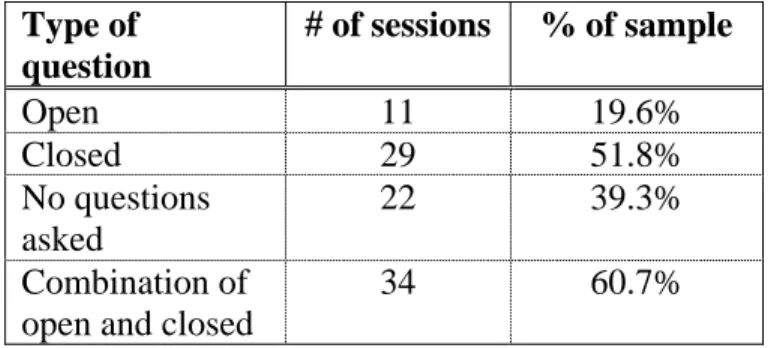
Of the 56 sessions in the study sample, only 11 contained open questions asked by the librarian. Of these, 3 used the “closed-for-open” question formation. Closed
questions were used in 29 of the 56 sessions, and in 22 sessions, no questions were asked (by the librarian) at all. These results are summarized in Table 1.
Type of question
# of sessions % of sample
Open 11 19.6%
Closed 29 51.8%
No questions asked
22 39.3% Combination of
open and closed
34 60.7% Table 1: Open vs. closed questions
As the table shows, the librarians asked some type of question in the majority of
reference sessions, but not by any means in a large majority of sessions. Open questions were used in the smallest group of sessions, amounting to only about 20% of reference interviews.
Success of Reference Transactions
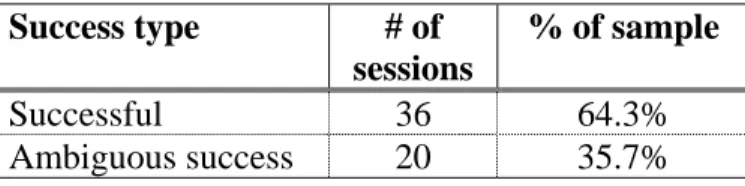
“ambiguous success,” a majority of transactions (36 of the 56 sessions analyzed, or 64.3%) were considered successful. These results are summarized in Table 2.
Success type # of
sessions
% of sample
Successful 36 64.3%
Ambiguous success 20 35.7%
Table 2: Success and ambiguous success
As the table shows, the “success” rate of reference transactions in this sample well
exceeds the so-called “55% rule” of reference accuracy. Although the 55% rule measures accuracy, not satisfaction, the comparison is to some degree valid here, because the modified operational definition of “success” used here takes into account whether or not the patron got the information s/he came for. In any case, it is clear that a sizeable percentage of the transactions in this sample concluded with positive results for the patron, however we might choose to measure those results.
Correlation Between Use of Questions and Success
Successful Ambiguous success
Open questions 5 (45%) 6 (55%)
No open questions 31 (69%) 14 (31%)
Table 3: Crosstabulation of open questions and success.
Because the number of sessions that used open questions was relatively small in this sample, I decided to see if a correlation existed between the use of any type of question – open or closed – and the success of the transaction. Of those sessions where any type of question was asked, 21 (62%) were successful and 13 (38%) were ambiguous successes. Table 4 presents the data from the use of questions and the success of the transaction.
Successful Ambiguous success
Any questions 21 (62%) 13 (38%)
No questions 15 (68%) 7 (32%)
Table 4: Crosstabulation of questions and success
As the table shows, the rate of success for transactions where the librarian asked questions was actually lower than that for transactions where no questions were asked. (However, given the sample size, the difference in success rate is not particularly dramatic and may not be statistically significant.)
A Closer Examination Of Open Questions
Interviews Without Open Questions. Although Catherine Sheldrick Ross argues persuasively that a reference interview should be conducted with nearly all
reference questions, the sample provided a number of examples of transactions where the fact that the librarian did not ask the patron any questions seemed, if not exemplary, then at least understandable and appropriate. For example, in one transcript, the patron’s initial question was, “i'm a distance ed student ordering a book to be delivered. Where it asks ‘latest date needed’ is that the date I need the book or the date I need to send the book back?” The librarian, in response, explained that “latest date needed” meant the date after which the book would be useless, i.e., the date that the assignment was due. In another transcript, the patron asked, “I am trying to find the following article: Stephen Muggleton, Inductive Logic Programming, New Generation Computing, 8(4):295-318, 1991.” The librarian checked the catalog, found that the NCSU Libraries did not have a print or electronic subscription to that journal, and directed the patron to the online form to request an article via Inter-Library Loan. In cases like these, where a simple
explanation or referral is all that is needed, the lack of a reference interview does not significantly detract from the quality of service provided by the librarian.
attempted to find out more about what the patron was looking for, in hopes of suggesting some alternatives. Another example was a session where the patron’s initial question, “i am doing a paper on how gender effects the studing in study groups like all male study groups, all female study groups, and study groups that have both male and females in them i am looking for and article in wilson web that would have something that relates to this topic.” This kind of question, a vaguely-defined request for articles or information, is often a trigger for some kind of reference interview, and especially for open questions, but in this case the librarian responded only with suggestions for other databases and different combinations of keywords to try.
Interviews With Open Questions. Because there were so few transactions in which the librarian asked open questions, I was able to examine each one fairly carefully, looking for common features and similarities among them. I also examined the
transcripts to see what happened as a result of the librarian asking the open question, and whether the open question signaled a turning point in the interview, or had some other noticeable effect on the progress of the interview.
Many of the transactions where librarians used open questions began with a patron asking for “information about” a broad topic. A good example is the reference interview that began with this exchange:
Patron I need help finding sources other than the internet on Mexcian culture and travel
Librarian Hello, Patron.
Patron hi
Librarian What kind of other sources are you looking for? Magazine and journal articles? Books? Have you searched anywhere else yet?
Patron i have tried to search in the database,
that pertains to traveling in mexico and info. about the culture in different regions. it doesnt matter which source i use, it just cant be the internet
The librarian in this session showed the patron how to search using Library of Congress subject headings (the subject used was “Mexico -- Description and travel”). This search yielded 117 books, which the librarian suggested that the patron look through; s/he then made some additional suggestions about using keyword and subject keyword searches as well. In this case, the librarian’s open question (a version of the standard “What kind of information do you need?” question) didn’t help the librarian narrow down the potential sources in terms of format, but did provide some information about the patron’s fluency with the search mechanisms available to him or her.
Another example of this kind of question occurred in a transcript that began:
Patron I am writing a paper on the dialect of Long Islan, New York and am having a bit of
difficulty locating any substantial
information...where might I might this topic?
Librarian Hello, Patron.
Librarian Where have you looked already?
Patron i have searched the library website and looked in the library last night...in all of the books upstairs on the 5th floor
articles that the patron had found, including the distinction between electronic and print subscriptions, and how to request articles through Inter-Library Loan. In other words, this was a very typical “full-service” interview, combining bibliographic instruction with subject searching, suggestions for keywords to use and advice on search term truncation, and navigating the often complex process of getting access to articles once they have been identified.
Unfortunately, the complexity of the information, combined with being cut off twice in mid-conversation and the amount of time the process took (the entire
conversation lasted nearly 50 minutes), apparently took a toll on the patron. Although the librarian consistently provided the patron with good, appropriate information and advice, the patron appeared somewhat frustrated by the conclusion of the session:
Librarian Another database to try, would be Academic Search Elite, or Arts and Humanities Citation Index
Patron ok i will try those
Librarian but you are really in the best database for
linquistics and I would search more there before changing
Librarian the other databases are apt to have very little---
Librarian so, please look some more in the linquistics database
Patron ok thank you...i think i have to take a break---the stress is rising haha...thanks for your help[ tho
Librarian you're welcome. Also, please think about coming to the library and we can show you things
directly
Librarian Good luck with your research. I know it can be stressful!
This is, perhaps, a good example of why some libraries limit their virtual reference service to short answer and ready-reference questions, and generally refer complex research questions like this one to email or the in-person reference desk.
Librarians in this study also used open questions to clarify what patrons were looking for when it appeared that the patron’s initial question was not asking for exactly what s/he was looking for:
Patron How do I search articles using igenta
Librarian Hello, Patron.
Librarian What articles are you searching for?
In this exchange, the patron’s reference to Ingenta served as a red flag for the librarian, since Ingenta is not generally used for bibliographic searching. As the interview
progressed, it turned out that the patron was looking for a particular article, and his or her professor had said that it could be obtained through Ingenta. In this case, the librarian simply needed to show the patron how to get to Ingenta through the library’s web site, and then how to search for an article with a specific title.
In some reference transactions, the patron’s response to an open question indicated that the patron’s real question was actually quite straightforward. Here is an example:
Patron I have a question regarding " finding a paper from a journal"
Librarian Hello, Patron.
Librarian Yes. What details can you provide?
However, the patron’s response to the librarian’s question indicates that the patron’s real question is actually much simpler than that:
Patron Hey Librarian, I am looking for a paper in the following conference. 1991 International
Industrial Engineering Conference Proceedings
Patron How do i go about finding the PDF file for it
Librarian Please hold while I see what I can find.
Patron thanx
Librarian Do you have any other details about the conference, like the city it was held in?
Librarian Or the number of the conference, like the 1st or the 3rd etc..
Unfortunately, the conference proceedings were not in the NCSU Libraries’ collection. The patron logged off before the librarian could explain about Inter-Library Loan options, but the librarian explained the process anyway, knowing that his or her
Discussion
Research Question
Clearly, the hypothesis that drove this research study – that, in the virtual environment, reference interviews where the librarian asked open questions were more likely to end successfully than those where the librarian did not ask open questions – was not supported by the data in the sample. In the short term, this is somewhat
disappointing, because it apparently challenges a fundamental tenet underlying reference practice: that open questions are applicable to most, if not all, reference interviews and are a critical component of an interview’s success.
Positive Results. However, there are positive and potentially useful aspects to the results of the study as well. The most obvious of these is the rate of success, and even ambiguous success, found in the transactions. It is important to note that one of the reasons that the category of “ambiguous success” had to be created was because none of the sessions in the sample could be described as truly “unsuccessful.” Even in cases where the librarian was completely unable to provide the information the patron was looking for, patrons nevertheless consistently thanked their librarians.
URL for an Inter-Library Loan request form when a journal article was not available in the NCSU collection, or suggesting that the patron open up a new browser window when a database wasn’t working through the chat interface. Librarians also continued
providing information and suggestions after a patron had logged out of the session, knowing that the additional information would be included in the transcript that the patron would receive via email. This concern for providing some level of service, even when the patron has given up on the transaction, is to be commended.
Another positive result that the study identified is that in the transactions where the librarian asked no questions at all – where, essentially, no reference interview took place – there were twice as many successful transactions as unsuccessful ones (15 successful transactions, and 7 ambiguously successful; see Table 4 above). Given the literature on the reference interview, it can be easy to assume that a librarian who answers a patron’s question without asking any questions of the patron at all is not providing optimal reference service, but in the context of real reference questions and real librarians’ responses, a full reference interview is clearly not necessary with every question, especially when the technical constraints of the medium may discourage users from making complex inquiries in the first place.