The Chinese Dream:
Cultivating Expansionist Chinese
Nationalism in the South China Sea
and the Role of Weibo
Lydia Field
Senior Honors Thesis
Global Studies
The University of North Carolina at Chapel Hill
April 2018
Approved by:
___________________________________
Table of Contents
Acknowledgements
3
Prologue
4
Chapter One: Introduction
9
The Chinese Dream 9
China’s Complicated History 12
The South China Sea Disputes 15
Conclusion 21
Research Questions and Outline of Thesis 22
Chapter Two: Methodology and Literature Review
24
Methodology 25
Chinese Nationalism 26
Chinese Social Media Communication and Censorship 34
The South China Sea 39
Conclusion 40
Chapter Three: Establishing Anti-Japanese Sentiment as a Transferable
Framework
42
Introduction 42
Introducing the "Century of Humiliation" 43
Anti-Japanese Sentiment 45
The First and Second Sino-Japanese Wars 45
Humiliating History in the National Narrative 49
Chapter Four: The Shadows of History and its Echoes Today
51
Returning to the “Century of Humiliation” 51
The First Opium War (1839-1842) 52
The Second Opium War (1856-1860) 57
The Boxer Rebellion 58
Conclusion 59
Chapter Five: Chinese Cyber Nationalism and the East and South China
Seas
61
The CCP’s Regulation of Weibo and Collective 61
Memory
National Heroes, Anniversaries, and Celebrations 64 of Nationalism
The Senkaku/Diaoyu Islands Dispute 68
The 2012 China Anti-Japanese Demonstrations 71
and Weibo’s Role
The South China Sea within an Anti-Western 75
Framework
A Fortunate Coincidence 78
Summary 87
Chapter Six: Conclusion
88
Acknowledgements
I would like to thank all those who contributed to this thesis and supported me during the research and writing process. A special thanks to my thesis advisor, Professor Klaus Larres, and my second reader, Professor Sara Castro, for their guidance throughout the journey. I am also very grateful for my thesis class peers and Professor Jonathan Weiler, and for all of the feedback they provided me with over the past months.
Prologue
My first memorable exposure to Chinese culture came when I was seven years old and visiting an elementary school which I would be transferring to the following year. My visit coincided with Chinese New Year, and one of the students and her mother had volunteered to speak to the class about the holiday. While her mother distributed oranges and hongbao (red envelopes) filled with chocolate coins, her daughter explained the traditions of the holiday and proudly displayed her beautiful red and golden colored qipao. As a visiting student, the
experience was quite poignant, as I was simultaneously allowed a window into a tightknit class, and learned of new foreign ideas and traditions. In my life I had yet to witness such a willingness to share culture with others and the joy and pride in which it was both conducted and received. The experience sparked my initial interest in the world beyond my limited American vantage point, and especially that of China.
As soon as I had left China in 2013, I began planning on how I would return in the future, and that opportunity arrived in the form of studying abroad in Harbin, China during the summer of 2017. Through the CET Harbin Summer Intensive Language Program at the Harbin Institute of Technology, I spent my summer studying Mandarin, modern Chinese history, and
international business. My objective in studying post-Xinhai Revolution China was to obtain a better understanding of the historical context of how the memory of the “Century of
Humiliation” had shaped modern China. 1 However, I found that my most useful window into
understanding the lingering effects of the “Century of Humiliation” on the ideology of mainland Chinese people (especially youths) came from my discussions with my local Chinese roommates and during our shared adventures in Harbin.
My Chinese roommates were always curious of my studies and would often peer over my shoulder at the Chinese history texts I was studying and translating. They would comment on the topics and/or voice their concerns about their political implications, especially regarding Sino-Japanese relations. We spent many late nights chatting to distract ourselves from the record breaking summer heat in our un-air-conditioned rooms. Our conversations varied from cultural differences between the United States and China, to our hobbies, to politics, to current events, and so on. When I told them that I was considering writing my senior honors thesis on the Chinese Belt and Road Initiative, they were both intrigued and we spent several nights
conversing on the positives and draw backs of the BRI.2 Through our discussions we gradually
learned about each other’s political views and perspectives on nationalism and imperialism, which differed from my original assumptions. Although the BRI is not the chosen focus of my
thesis, our discussions about it allowed me to stumble upon my actual thesis topic: “The Chinese Dream.”
Two of my most memorable weekend outings in Harbin were a trip to the movies and visiting the Unit 731 Museum. Retrospectively, both revolve around different expressions of Chinese nationalism. During the semester before leaving for Harbin, I had taken a history class on the Pacific War, and learned about Sino-Japanese relations and the roots of the painful history between these two nations. In addition to studying the Imperial Japanese Kwantung Army’s involvement in northeastern China before and after 1931, Imperial Japan’s invasion of
On a lighter note, my second memory was when my roommates and I went to go see a movie, and while viewing the commercials, I witnessed an event which ultimately caused me to amend my desired thesis topic. In American movie theaters, the previews are usually trailers for other future movies, but this is slightly different in China. I recall watching several
advertisements, one being for a children’s hospital, as well as other types of advertisements which I would expect to appear during a commercial break while watching television. However, the one which struck me most was a propaganda video called “我们的中国梦” (“Our Chinese
Dream”). It featured several Chinese celebrities talking about and promoting the “Chinese Dream.” As this is a phrase which not only is closely associated with Xi Jinping, but also exudes nationalistic undertones, I was intrigued. A vital aspect of Xi Jinping’s “Chinese Dream” is to encourage young people to diligently work and “contribute to the revitalization of the nation,” which in turn, Xi hopes will bolstered China’s future. 3 Seeing this political ad was initially
somewhat surprising, but I definitely did not anticipate the response from the Chinese audience, which was one of cheering and excitement. Originally, I had thought that this response was elicited due to seeing the celebrities, but on a deeper level, it related to their message.
An ever-growing sense of national pride rooted in historical commemoration of imperial times and emphasizing the suffering of the Chinese people during the “Century of Humiliation” has caused an outward shift in the projection of Chinese nationalism. Xi’s plan to rejuvenate the nation is gradually becoming synonymous with the Belt and Road Initiative and the Nine-Dash Line, and contains undertones and overtones of Chinese territorial expansion to reacquire areas formally under imperial control centuries ago. 4 Instilling the younger generation with
3Xinhua. (2013, May 4). Xi urges youths to contribute to 'Chinese dream'. China Daily.
4 Nine-Dash Line refers to a demarcation line used by the PRC, for their claims over a majority of the South China
Chapter 1: Introduction
The Chinese Dream
The phrase the “Chinese Dream” is closely associated with Xi Jinping, as he first
promoted the phrase while on a high-profile visit to the National Museum of China on November 29, 2012. Xi led the other six members of the newly formed CCP Politburo Standing Committee in visiting the National Museum of China’s “The Road to Rejuvenation” exhibition. The
exhibition focused on China’s national experiences from the First Opium War to the present, with a particular emphasis on the history of the “Century of Humiliation,” in which China was attacked and bullied by foreign imperialists.5 After physically tracing modern Chinese history
extending from China’s humiliating defeat dealt by Great Britain in the First Opium War to the contemporary, Xi announced the “Chinese Dream” as a unifying theme for the Chinese people to achieve a great national revival. The specific language used in Xi’s speech refers to a “national
rejuvenation” and the word “rejuvenation” (复兴 fù xīng) is a historic mobilization tool. 复兴 fù
xīng has been utilized by almost every generation of modern Chinese leaders, including Sun Yet-sen, Chiang Kai-shek, Jiang Zemin, and Hu Jintao.6 CCP leaders have “used the national
humiliation discourse with the goal of rejuvenation to mobilize the Chinese populace to support their revolution or reform,” and now it appears to be Xi Jinping’s turn. 7
Depending on whom and when you ask, the “Chinese/China Dream” represents different ideals. The “Chinese Dream” can embody the aspirations of the world’s largest middle class, and
5Sørensen, C. T. (2015). The Significance of Xi Jinping's" Chinese Dream" for Chinese Foreign Policy: From" Tao
Guang Yang Hui" to" Fen Fa You Wei". Journal of China and International Relations, 3(1). Page 55.
6Wang, Z. (2014). Never forget national humiliation: Historical memory in Chinese politics and foreign relations.
Columbia University Press. Page 2.
their hopes for a better and more prosperous future.89 The “China Dream” as articulated by
retired People’s Liberation Army colonel, Liu Mingfu, conveys a desire to reestablish China’s historical prestige. He emphasized that through the cultivation of “martial spirit” and military power, in addition to the accumulation of wealth, China can successfully reemerge as the most powerful nation in the world.10 Furthermore, he stated that China will represent the rise of a
non-hegemonic and benevolent global power.11 It is important to note that before 2012, these
different views and ambitions were largely divided along Chinese civilian and Chinese military and government elite lines respectively. However, Liu Mingfu’s hawkish position tends to align largely with that of President Xi Jinping, and was echoed in Xi’s speech detailing the military aspects of his vision for the Chinese Dream. 12 President Xi Jinping emphasized that the Chinese
Dream is “‘the dream of a strong military’” and that to “‘achieve the great revival of the Chinese nation…we must ensure there is unison between a prosperous country and a strong military,’” seemingly echoing Liu Mingfu’s worldview. 13 It is uncertain whether or not Xi Jinping read Liu
Mingfu’s book, regardless, the “Chinese Dream” under the care of Xi Jinping has become a hybrid ideal of economic prosperity and military might.
As previously mentioned, former Chinese leaders instituted reforms by framing their
chosen issue as necessary for “rejuvenation” (复兴 fù xīng), and Jiang Zemin used this language
to reform modern Chinese nationalism. In the wake of China’s “reform and opening up” (改革开
8Wang, H. H. (2010). The Chinese dream: The rise of the world's largest middle class and what it means to you.
Bestseller Press.
9McMahon, D. (2018). China's Great Wall of Debt: Shadow Banks, Ghost Cities, Massive Loans, and the End of
the Chinese Miracle. Houghton Mifflin Harcourt.
10Mingfu, L. (2015). The China dream: Great power thinking and strategic posture in the post-American era. New
York, NY: CN Times Books. (The Chinese version was originally published in 2010.)
11 Ibid.
12 Hawkish: advocating for an aggressive or warlike policy, especially in terms of foreign affairs 13Wong, E. (2012, December 14). China’s Communist Party Chief Acts to Bolster Military. The
放Gǎi gé kāi fàng) and the 1989 Tiananmen Square protests, the CCP’s legitimacy needed to be
reaffirmed since the Party’s “official Communist ideology [had] lost credibility.”14 After the
collapse of Communism as a unifying ideology, patriotism and nationalism became the most important tool for garnering support of the Party’s rule, and the CCP instituted a “patriotic education campaign” to promote these feelings. The patriotic education campaign was designed to present Chinese youths with detailed information about China’s traumatic and humiliating experience in the face of Western and Japanese imperialism, and that the CCP-led revolution won national independence and ultimately ended national humiliation.15 Additionally, the CCP
began marketing its new mission as facilitating “the great rejuvenation of the Chinese nation,” and by using the word “rejuvenation,” it framed that the Party’s work as a collective effort to restore China to its former position and glory.16
Under the patriotic education campaign, the new curriculum redirected protest towards foreign enemies, and the previous narrative of ‘‘China as a victor’’ was replaced by ‘‘China as a victim’’ in nationalist discourse.17 Another goal of the patriotic education campaign was to
reinforce the notion that “only the Party [could] develop and rejuvenate China,” to further strengthen CCP legitimacy. 18 Nevertheless, this legitimacy is founded on distortions of Chinese
history, especially regarding the Party’s role in ending China’s “Century of Humiliation,” which requires the CCP to continuously maintain and protect this narrative. Consequently, Jiang
14Wang, Z. (2008). National humiliation, history education, and the politics of historical memory: Patriotic
education campaign in China. International Studies Quarterly, 52(4), 783-806. Page 788.
15 Ibid. Page 791.
16Wang, Z. (2014). The Chinese dream: Concept and context. Journal of Chinese Political Science, 19(1), 1-13.
Page 6.
17Wang, Z. (2008). National humiliation, history education, and the politics of historical memory: Patriotic
education campaign in China. International Studies Quarterly, 52(4), 783-806. Page 792.
Zemin’s sponsored patriotic education campaign was largely responsible for the rapid shift of Chinese social movements from internal-orientated, anti-corruption, and anti-dictatorship democratic movements in the 1980s, to the external-oriented, anti-Western nationalism seen since the 1990s.19 Due to the “rejuvenation” work of his predecessors, especially that of Jiang
Zemin, this allowed for Xi Jinping’s administration to have access to a preexisting foundation of Chinese nationalism and anti-foreign sentiments. Xi has begun to shift this modern Chinese nationalism, and it’s attached anti-Japanese, anti-Western, and anti-imperialist sentiments, into its current expansionist form, in the name of “national rejuvenation” which the “Chinese Dream” encompasses.
China’s Complicated History
To provide context and understanding of the CCP’s cultivation of modern Chinese nationalism through the use of historical distortions of critical events, the chronicle of Chinese history must be examined to clarify the motives of the Party. The fundamental governing system of the modern nation-state of the People’s Republic of China is quite different from that of the divine right dynastic rule of its past; nevertheless, China still views itself as the historical hegemon of the Asia-Pacific region. During Imperial times, China was believed to be the center of the universe and the Emperor of China was considered to be the Son of Heaven. The Emperor,
and his dynasty, maintained legitimacy by receiving the Mandate of Heaven (天命tiān mìng). For a dynasty which had received the Mandate of Heaven, crops were plentiful, there was peace and prosperity among the people, the kingdom lacked many natural disasters and possessed a
well-functioning government. It was said that all lands below heaven (天下 tiān xià) belonged to
the Emperor, and as China saw itself as the center of world, the Emperor’s domain also applied to the kingdoms and people’s beyond China’s borders. When formal foreign relations were established, it was politically beneficial for Chinese Emperors to make nations beyond the Middle Kingdom into tributary states. By prostrating themselves before the Emperor and proclaiming Chinese cultural superiority, foreign dignitaries secured tributary state status for their nation and a beneficial economic relationship with China. In turn, the Middle Kingdom maintained that China was the center of the world and that the Emperor had the Mandate of Heaven, because it appeared as though the Emperor controlled all of the known world.
As the aforementioned tributary state system of Imperial China has been used by the Chinese Communist Party as evidence of China’s past of peaceful and non-imperialistic management of its neighboring nations in the Asia-Pacific, the voyages of Zheng He are also often used in tandem with this argument. The Chinese seafaring exploration under Zheng He during the early 15th century have been subjected to distortions, and it is claimed that Zheng He
established diplomatic relations for China through aweing foreign populations with the massive size of his ships. Consequently, Zheng He has become a symbol of Chinese benevolence,
exploration, and naval excellence. Nevertheless, Zheng He’s armada were actually colossal troop carriers.20 The “awe” that foreign countries felt upon Zheng He’s arrival was the result of
intimidation, causing them to ultimately provided tribute for the Emperor. Zheng He wielded the power of his fleet against those who disrupted and/or disrespected the Emperor’s tributary state system, taking on pirates,21 and even launching a land war against the Kingdom of Kotte in
20French, H. W. (2017). Everything Under the Heavens: How the Past Helps Shape China's Push for Global Power.
Vintage.
present day Sri Lanka.22 However, this aggressive narrative is not the one favored by the Chinese
Communist Party in their attempt to propagate China’s historical peaceful rise and reign. This is one of many examples of distorted memories of history that the CCP has used to justify its expansion.
Due to the uneasy rule of the Chinese Communist Party, the Party is continuously
searching for ways to further its legitimacy. To prevent regime change, the CCP has also adhered to the principle of 内乱外患 (nèi luàn wài huàn), “preventing civil strife and deterring foreign
aggression,” just as their imperial forefathers had. This was particularly evident through the Party’s implementation of an education shift in 1991, after the Tiananmen Square Massacre. The new school curriculum was designed to highlight Chinese suffering at the hands of outsiders, with a particular emphasis on China’s百年国耻 (bǎi nián guó chǐ) “Century of Humiliation” due
to imperialism and the demonization of Japan, as a result of the crimes it had committed against China before and during World War II.23 This national education underscored that China needed
to regain its prestige, which could be actualized through regaining territories lost during “the Century of Humiliation.” The CCP was successful in its desire to misdirect feelings of malcontent away from the Party, and the Chinese people have largely unified around anti-Japanese, anti-Imperialist, and anti-Western sentiments. Consequently, nationalism has surged within China. However, the Chinese Communist Party may have been too successful in its efforts to shape national identity.
22Sien, L. C., & Church, S. K. (2012). Zheng He and the Afro-Asian World. Melaka, Malaysia: Melaka Museums
Corporation (PERZIM) and International Zheng He Society. p. 265.
23French, H. W. (2017). Everything Under the Heavens: How the Past Helps Shape China's Push for Global Power.
The Chinese Communist Party is weary of the population it rules over, as the Chinese people vastly outnumber the ruling elite. Therefore, the CCP cannot risk losing the support of Chinese public opinion. Over the past decade, as China has fully emerged onto the global stage, public pressure has begun to mount for China to use its growing military power to reassert itself and remove the United States from the Asia-Pacific. Nevertheless, by centering modern Chinese history on the demoralizations of “the Century of Humiliation,” the Chinese government must not bring any further “humiliations” to China. Consequently, the Chinese Communist Party has become a prisoner of the nationalism it created, because it is expected to wield China’s power to its fullest to regain its hegemony, and it cannot fail. Thus, China and President Xi Jinping have embarked on a dangerous geopolitical and military expansionist gambit in the South China Sea.
The South China Sea Disputes
The South China Sea is one of the biggest geopolitical flashpoints in Asia. The disputes involve China, many of its neighbors, such as Vietnam, Taiwan, The Philippines, Malaysia, Brunei, and also the United States, which functions as a security guarantee in the region. The South China Sea encompasses an area of 1,400,000 square miles, in which one-third of the world’s shipping passes through, carrying $5 trillion worth of trade a year.24 The South China
Sea contains lucrative fisheries that produce 12 percent of the global catch, and provides food security for millions of people in Southeast Asia and beyond.25 Furthermore, the South China
Sea is estimated to hold 190 trillion cubic feet of natural gas and 11 billion barrels of oil, with much more potentially still undiscovered.26 Whoever controls these resources can influence
24 Page 28. 25 Ibid.
26U.S. Department of Energy, Energy Information Administration, Independent Statistics & Analysis. (2013,
energy, food, and economic security in the broader Asia-Pacific, which increases the geopolitical implications of their distribution. Under the United Nations Convention on the Law of the Sea (UNCLOS), these resources should be divided based on set geographical distances from nations’ coastlines. However, China claims a majority of the South China Sea based on the nation’s “historical rights” over the region, rather than adhering to the geography based method outlined by UNCLOS for maritime entitlements.
UNCLOS prescribed zones to determine which state has special rights and sovereignty regarding exploration and use of marine resources. A nation’s territorial waters extend out to 12 nautical miles, and the state can set laws, regulate the use of these waters, and use any resources found there. Vessels were also given the right of innocent passage through any territorial waters. “Innocent passage” is defined by the convention as passing through waters in a continuous and expeditious manner, and is not "prejudicial to the peace, good order or the security" of the coastal state.27However, UNCLOS allows for innocent passage of foreign ships to be
temporarily suspended in specified areas of a nation’s territorial sea if the suspension is essential for the protection of its security.28 Beyond these initial 12 nautical miles of sovereign territorial
sea, UNCLOS also provides further provisions for detailing “sovereign rights” for maritime entitlements falling under a country’s exclusive economic zone and/or continental shelf.
A state's exclusive economic zone starts at the edge of its territorial sea and extends outward to a distance of 200 nautical miles. Within this area, the nation has sole exploration rights over all natural resources, whether living or non-living, and also has the exclusive right to construct artificial islands, installations, and structures.29 However, these artificial islands,
27 UN General Assembly, Convention on the Law of the Sea, 10 December 1982, Articles 17-19. 28 Ibid. Article 25
installations, and structures do not possess the status of islands and have no territorial sea of their own.30 States also have rights to the seabed and subsoil of its continental shelf, which can extend
up to 350 nautical miles beyond the nation’s territorial sea, but the column of water extending from the seabed to the surface is not part of their exclusive economic zone.31 Due to the
geographical closeness of modern nation-states, especially within smaller swaths of sea, EEZs can overlap and countries can
have legitimate competing claims to territory within these zones. However, a majority of the Chinese territorial claims over the South China Sea, as seen within their Nine-Dash Line in Figure 1, push well beyond this legal limit.
Since 2012, China has engaged in a series of large-scale land reclamation projects in the South China Sea and has created over 3,200 acres of artificial islands.32 The
artificial islands were created
30 Ibid. Article 60. 31 Ibid. Article 76
32Asia Maritime Transparency Initiative. (2016). Island tracker.
by dredging sand onto coral reefs, shoals, and banks, and were then covered with concrete to make into permanent structures, which could be built upon. Many of the reefs and structures that have been part of China’s land reclamation program are also contested between Vietnam, the Philippines, and Malaysia. In 2013, the Philippines brought a case against Chinese “historical claims” over the South China Sea before the Permanent Court of Arbitration at The Hague, and on July 12, 2016 the arbitral tribunal issued its ruling largely in favor of the Philippines. The tribunal ruled that any Chinese historic rights to the resources of the South China Sea were “extinguished [when China became a Party to UNCLOS]” and that it found “no evidence that China had historically
exercised exclusive control over the waters or their resources.”33
This ruling clarified that China had no legal basis for its usage of the Nine-Dash Line. The tribunal found that none of the Spratly Islands could be classified as legal islands because they cannot sustain a stable
33 Permanent Court of Arbitration. (2016, July 12). The South China Sea Arbitration [Press release]. Pages 1-2.
human community or independent economic activities, and therefore only are entitled to territorial seas and not EEZs.34 The tribunal found that Johnson Reef, Cuarteron Reef, Fiery
Cross Reef, Gaven Reef (all a part of the Spratly Islands) and Scarborough Shoal, were rocks and entitled to a 12-nautical-mile territorial sea. However, it found that Hughes Reef and Mischief Reef were below water at high-tide and therefore generated no maritime entitlements of their own.35 It also ruled that Kennan Reef is a low-tide elevation, while Second Thomas Shoal and
Reed Bank are submerged and belong to the Philippine continental shelf.36 These ruling
effectively invalidated any Chinese territorial claims within the Nine-Dash Line, but China rejected the ruling, continued with land-reclamation, and militarized many of the islands
anyways. As many of these islands are not considered “islands” under UNCLOS for the purpose of deciding maritime jurisdiction, the United States has been conducting freedom of navigation operations near these maritime features, to accentuate the view of the international community and UNCLOS (which the United States is not a party to) that China is attempting to enforce illegal Chinese territorial seas and sovereignty.
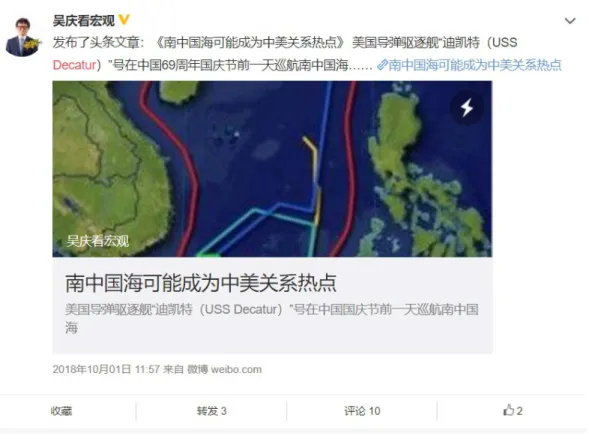
With each passing year, the PLAN has become more aggressive and antagonist in response to US freedom of navigation operations in the South China Sea. On September 30, 2018 the USS Decatur was conducting FON operations in the South China Sea, and traveled within 12 nautical miles of Gaven and Johnson Reefs in the Spratly Islands.37 The USS Decatur
was then approached by the Chinese destroyer Lanzhou, after aggressive maneuvering, the two vessels had a near collision and came within 45 yards of each other.38 In response to the incident,
34Asia Maritime Transparency Initiative. (2016). Philippines v. China: Arbitration Outcomes. 35 Ibid.
36 Ibid.
37 Reuters with the Associated Press. (2018, October 02). US says Chinese destroyer was 'aggressive' and
'unsafe,' coming dangerously close to American ship. CNBC.
China’s Ministry of National Defense spokesperson condemned the American “illegal
provocation in the name of ‘freedom of navigation’” and emphasized that the actions “posed a grave threat to China’s sovereignty and security.”39 Furthermore, the Ministry of National
Defense asserted that “China has indisputable sovereignty over the islands in the South China Sea and their adjacent waters” and that the military will “take all necessary measures to firmly safeguard sovereignty and security.”40 Within a framework of international law, this claim of
indisputable sovereignty does not hold true, but within the context of Chinese nationalism and patriotic education, it has merit. Since the 1940s, generations of Chinese students have learned from their geography textbooks that James Shoal (Zengmu Ansha), a mere 52 miles from the Malaysian coast, is the southernmost point of China’s territory.41 Textbooks in most societies
present an “official” version of events and highlight narratives that shape contemporary
patriotism, the Nine-Dash Line now appears on official Chinese maps and passports, which has both verbally and visually normalized the teaching of the Nine-Dash Line. 42 Additionally, after
the South China Sea ruling was issued, official censors moved quickly to curtail online discussion that seemed to overstep the bounds of acceptable nationalist discourse and censors removed Weibo posts that contradicted the party line.43 From a Chinese perspective, the South
China Sea is Chinese sovereign territory, because a majority of the population have never been taught otherwise.
39Xinhua. (2018, October 2). Chinese military opposes US provocation in South China Sea. Xinhua Net. 40 Ibid.
41Wang, Z. (2014, August 26). The Nine-Dashed Line: 'Engraved in Our Hearts'. The Diplomat.
42Wang, Z. (2008). National humiliation, history education, and the politics of historical memory: Patriotic
education campaign in China. International Studies Quarterly, 52(4), 783-806. Page 786.
43Allen-Ebrahimian, B. (2016, July 12). After South China Sea Ruling, China Censors Online Calls for War.
Conclusion
China’s economic growth is plateauing and the nation is facing mounting social issues, such as its aging population, environmental degradation, and corruption, among other things. Moreover, Xi Jinping has yet to accomplish all the goals and aspirations of his administration regarding the transition of China into a fully-fledged economic and military hegemon. As Xi’s administration has faced criticism and challenges from Chinese elites, it has implemented measures to control these dissenting voices, ranging from anti-corruption campaigns to censorship and regulations to fear. The CCP has been biding its time since 1979 and is now implementing its broader strategy for dethroning the United States’ position as the most powerful nation in the region and the world.44 China has been subtly testing how far it can push the norms
of the Asia-Pacific region in a continuous cycle of mounting tensions and then reducing them (放
手fàng shǒu).45 These cycles are quite easy to distinguish, and some of the most recent
examples of rising tensions are China’s disputes with the Philippines, Vietnam, and other countries over the South China Sea, and clashes with Japan over the Senkaku Islands. Additionally, China’s Belt and Road Initiative and Asian Infrastructure Investment Bank are both examples of cooling tensions. These cycles used to be distinct from each other, but more recently China has been able to simultaneously maintain rising pressures in one area and falling pressures in other, a testament to the success of China’s global integration. The next decade is likely China’s best opportunity to reaffirm itself as the regional hegemon, which will potentially
44 Refers to Deng Xiaoping’s dictum “hide your capabilities, bide your time” and also the use of “reform and
opening up” to provide China the economic tools to gain prosperity and power over time
45MacFarquhar, R. (Ed.). (1997). The Politics of China: the eras of Mao and Deng. Cambridge University Press. p.
make 2020-2030 some of the most dangerous and tension filled years in the region in recent memory.46
Research Questions
This thesis revolves around the following questions: What developments regarding Chinese nationalism have allowed for Chinese expansionism to be a vital part of the “Chinese Dream,” especially within the context of the South China Sea? Additionally, how has social media aided in disseminating and achieving the goals of the “Chinese Dream”?
In this thesis, I will argue that through the use of a glorified imperial hegemonic history and an education curriculum which emphasizes the victimization of China during the “Century of Humiliation,” the Chinese Communist Party has established itself as the instrument through which “national rejuvenation” is possible and is essential to the revitalized Chinese national identity. Consequently, the Chinese Communist Party has bound itself to an aggressive and expansionist form of nationalism which demands that China reassert itself over its former domain and that this identity can be seen through social media, especially within the context of the South China Sea disputes.
Outline of Thesis
After this introduction, my thesis will explain my research methodology and contain a literature review examining the major publications around the topics of Chinese nationalism, Chinese social media and censorship, and the South China Sea and its subsequent conflicts.
46French, H. W. (2017). Everything Under the Heavens: How the Past Helps Shape China's Push for Global Power.
Following the literature review, the third chapter seeks to review major events in the “Century of Humiliation” which engendered lasting anti-Japanese sentiments. This chapter establishes the linkages between mobilizing anti-Japanese sentiment to disputed territory as a transferable framework to the South China Sea disputes.
In the fourth chapter, I trace the historical roots of modern Chinese nationalism and review major events in the “Century of Humiliation” which engendered enduring anti-Western and anti-Imperialist sentiments, and analyzed their implications for the modern context.
In the fifth chapter, I will analyze the role of Chinese social media in fostering and shaping Chinese nationalism in accordance with the goals of the “Chinese Dream.” I will primarily focus on the micro-blogging platform Weibo and how this has allowed for growing support of Chinese expansion in the South China Sea. Additionally, it will use the framework provided by the 2012 Chinese anti-Japanese protests to analyze mobilization around territorial disputes on Weibo.
Lastly, my conclusion will consider the future of the South China Sea region and
Chapter 2: Methodology and Literature Review
Introduction
This chapter describes the methods, sources, and framework utilized to answer my research questions and discuss the impact these inputs had on my research process and the ultimate influence on my findings. First, I will describe the methods and the framework I used to answer my research questions and label the specific types of sources I utilized at each stage. I will then go into depth about the types of sources I applied, decisions I made in selecting
sources, and the subsequent tensions and commonalities between and within different literatures.
In this chapter, I review several foundational and informative works which will support the framework of my thesis. There are many different perspectives on what constitutes the “Chinese Dream” and how it interacts with Chinese identity, social media platforms, and past, current, and future events in the South China Sea. Through my reading, I have discovered several aspects of agreement and several of contention among writers who discuss the “Chinese/China Dream” and its other overlapping topic areas with my thesis. I have narrowed these points down to the following: Chinese Nationalism, Chinese Social Media Communication and Censorship, and the South China Sea. I will engage critically with many sources that examine these themes and offer explanations for the construction of the Chinese Dream within an expansionist
framework47 and how it interacts with Chinese nationalism, Chinese Social Media, and Chinese
actions taken in the South China Sea.
Methodology
To be able to determine the developments surrounding Chinese nationalism which have allowed for Chinese expansionism to be a vital aspect of the “Chinese Dream,” within the context of the South China Sea, I first had to understand the environment in which these events occurred. The methods used for this portion of thesis research were critical readings and analysis of relevant materials. I began by studying elements of the “Chinese Dream” and the links
between Xi Jinping’s original announcement of the “Chinese Dream,” modern Chinese history, and mobilization language. Additionally, after firmly comprehending the background of the South China Sea territorial disputes, I revisited modern Chinese history to locate and understand the sources of Chinese nationalistic motivations for territorial expansion. I was then able to isolate specific events within Chinese history which both cultivated and altered existing Chinese nationalism. I started with the “Century of Humiliation” and progressed chronologically through history, and eventually arrived in the 1990s and learned of the external re-orientation of Chinese nationalism achieved through the CCP’s “patriotic education campaign.”
Additionally, to determine how Chinese social media has aided in dissemination and of the “Chinese Dream,” I studied censorship, the environment of Weibo, Chinese cyberspace policy, and previous examples of Chinese mobilization language and modern Chinese anti-foreign protest movements. I decided to use the 2012 Chinese anti-Japanese demonstrations and the multiple escalatory and de-escalatory roles of Weibo as a framework for understanding Chinese cyber nationalism and expansionist nationalism in response to perceived threats to Chinese territorial sovereignty. The second portion of my thesis research involved actively searching through related Weibo posts and translating them. I used anti-American protest
and conducted many Weibo searches through the use of key terms generated from this protest language. I also studied the role of state-sponsored media sources on Weibo and the actions they took to foster expansionist Chinese nationalism and pro-military feelings in the South China Sea.
Chinese Nationalism
As my thesis pertains to the construction and expression of contemporary Chinese expansionist nationalism, I began with a generalized analysis of Western nationalism and how it differs from Chinese nationalism. The Western theoretical foundations and studies of nationalism can be traced to philosophers such as Locke, Hobbes, Machiavelli, Rousseau, and others who conceptualized the relationship between rulers and individuals, sometimes referred to as a social contract. “Nationalism” is a comparatively newer term when likened with the word “patriotism” and their cognates. These two terms are often used interchangeably within the English language to imply a commitment to one’s country, a desire to ensure its well-being and that of its people, and a readiness to defend it, especially in times of crisis. Nevertheless, a distinction has emerged in the tone and connotation of these words. In addition, to the definition which is similar to “patriotism,” the term “nationalism” has also subsumed and now implies feelings of national superiority.
One of the foundational texts on nationalism which depicts a nation as a socially
constructed community, is Benedict Anderson’s Imagined Communities. I have used this text and his concept of an imagined community to further my understanding of previous historical
campaign” and expansionist Chinese nationalism seen on social media platforms. Benedict Anderson emphasizes that “many different cultures have ‘unified’ by political, military, cultural, economic and social processes.”48 A vital aspect of constructing a unifying “we” is by setting it
against another group or groups who do not belong to that collective and could threaten its existence. Group identities when tied to expansionist military and economic aims, are
contextualized through the schema of nation-state politics. Zhao (2004) argues that under state nationalism, there is a visible convergence of political mobilization and territorial sovereignty issues. Consequently, these identities require constant maintenance and must be continuously refined to highlight in-group similarities and out-group differences.
I have chosen to discuss war time nationalism because several Chinese and Western sources have referred to the conflicts in the South China Sea as “warm” war. While different from both a “cold”49 and “hot”50 war, “warm”51 war does have similarities with traditional
wartime mentalities. During times of war, nationality and ethnicity are valued above all else, for wars are fought between nations, and nations are held together by the perceived and imagined commonalities of its citizens. The most potent military weapons a country can possess are not made of steel or explosives but made of ideals and emotions: nationalism. Having thousands of soldiers whose hearts overflow with patriotic fervor, are much more effective than the forcibly conscripted militiamen of yesteryear. Nationalism is often defined as feelings of pride in one’s nation and/or national identity. There are many different “brands” of nationalism, for nationalism
48Anderson, B. (2006). Imagined communities: Reflections on the origin and spread of nationalism. Verso Books.
Pages 111.
49 Cold war: a period of hostile relations between rivals where direct open warfare is largely avoided 50 Hot war: a conflict in which actual armed fighting occurs between the belligerent parties
51 Warm war: a period when parties are engaging in negotiations for peace, but continue to mobilize forces and
has evolved over the centuries and now rarely stands alone. Jingoism, chauvinism,52 and
xenophobia53 all can be intertwined with nationalism, and are integral to the understanding of
modern nationalism. Furthermore, within the Chinese context, modern Chinese nationalism also has anti-foreign sentiments attached to it.
Wartime expansionist nationalism, as conceived by Western scholars, needs an ethnic identity to attach itself to, for this furthers the idea of unity among a militarized nation’s citizens. This ethnic identity unites those with a shared language, a shared faith, and a shared racial ancestry under a common banner. Often this ethnic identity is first created by defining what the ideal citizen is not. In doing so, a fifth column is created,54 as an in-group cannot exist without
an out-group. Wang (2014) asserts that Chinese Nationalism is a unique case, especially in regard to the identity chosen and utilized to create its modern national self-concept, as the “ideal Chinese citizen” has been rebranded to be those who are “patriotic” and loyal to the CCP.55 The
use of “othering” identities when paired with nationalism provide a foundation for military formation and subsequent racism that stem from these “othering” ethnic identities, serve as the basis for large-scale, militarized violence. Nationalism, paired with attaching an “othering” ethnic identity upon one’s enemies, increases the willingness of such groups to kill and sacrifice, as well as commit atrocities against racialized others. Fortunately, China and the United States have not yet reached this point, and hopefully never will. Nonetheless, tensions have begun to
52 Chauvinism: exaggerated and/or aggressive patriotism which usually appears as excessive or prejudiced loyalty to
one’s cause, group, or gender
53 Xenophobia: fear of foreigners and/or foreign ideas which usually appears in an aggressive way 54 Fifth column: a group of people who seemingly undermine a larger group from within
55Wang, Z. (2014). Never forget national humiliation: Historical memory in Chinese politics and foreign relations.
boil and have manifested in the form of naval brinkmanship in the South China Sea, among other things.
As a modern concept, nationalism was introduced to China by Chinese elites in the late
19th century in an effort to “rejuvenate” (复兴 fù xīng) China. Chinese nationalism played a vital
role in Chinese politics of the 20th century, and much of modern Chinese mobilization is still
initiated by elites in a top-down fashion. Modern Chinese nationalism was cultivated in stages, and were largely reactionary to “humiliations” experienced by China. According to Zhao (2004), the first stage was from the First Opium War (1839-1842) to the First Sino-Japanese War (1894-1895), in which the concept of nationalism was introduced and imported to China through elites. Since the First Opium War, foreign aggression and incursion became a recurring problem for China, and would continue for much of the course of the “Century of Humiliation.” During this time, nationalist consciousness had begun to emerge among Chinese elites and intellectuals, and was later disseminated throughout urban populations. The second stage occurred from the end of the First Sino-Japanese War (1895) to the early years of the Republic of China (1919), and was marked by continued foreign aggression and imperialism and Chinese nationalist movements and revolutions. The third stage consisted of the founding of the Republic of China (1919) and
the “patriotic education campaign” in the 1990s. It is important to revisit the history of the “Century of Humiliation” as it was responsible for the origin of Chinese nationalism, but also conveys how this history is utilized to shape its contemporary form, and I will do so in later chapters.
The discussion and analysis of Chinese foreign policy in the post-1989 era is dynamic and Whiting (1995) suggests separating Chinese nationalism into three types: affirmative, assertive, and aggressive. Affirmative nationalism focuses “exclusively on ‘us’ as a positive in-group referent with pride in attributes and achievements.”56 Assertive nationalism adds a “them”
negative out-group to the previous conversation, which serves to confront the in-group’s interests and identity. Lastly, Whiting (1995) states that aggressive nationalism isolates a foreign nation as its enemy, which seemingly possess an imminent threat to the in-group nation and necessitates action. While different in their ultimate results, each type of nationalism fosters a national self-construct, targeting attitudes, engendering external-oriented anger, and mobilizing behaviors. When domestic politics and external factors challenge the nation’s legitimacy, these types of nationalisms can converge to induce a “siege mentality” that fuels state nationalism. 57 However,
some scholars (Xu, 2007) argue that given China’s ascendance to international power status, the “siege mentality” model does not fully depict contemporary Chinese nationalism and must be further revised. Xu (2007) further divides Chinese nationalism into official or nonofficial
nationalism. The CCP’s responses to ensure its legitimacy after the 1989 Tiananmen protests are largely indicative of official nationalism. According to Xu (2007), official Chinese nationalism includes three themes: sovereignty, territorial reunification, and the continued
opening-up. Additionally, Xu (2007) emphasizes that nonofficial nationalism combines both affirmative and assertive postures, and incorporates glorified Chinese history, national pride, and perceived Western influence and “insults.”
Whiting’s (1995) and Xu’s (2007) broader assessments of Chinese nationalism held true until the 2008 global financial crisis where there was a surging increase in popular nationalist sentiment. According to Zhao (2013) the 2008 global economic crash caused a “convergence of Chinese state nationalism and popular nationalism [that called] for a more muscular Chinese foreign policy.”58 In the time since the economic crash, active duty senior military officers were
allowed to openly pressure the CCP to push back against the US on many sensitive foreign policy issues, such as maritime territorial disputes.59 Additionally, since the CCP has gained a
sense of empowerment through the nation’s new level of wealth and military power, while simultaneously fearing the rise of domestic social, economic, and political tensions, “the communist state has become more willing to play to the popular nationalist gallery in pursuing the so-called core national interests.”60 These popular Chinese nationalist voices share the
government’s “dream of making China a strong and powerful country that could stand up against the bullies of the Western powers, [which causes] popular nationalism [to be] particularly
suspicious about a Western conspiracy and hidden agenda to slow down or even stop China's rise and, therefore, [are] more vocal and emotional than the state in criticism of Western evil
intentions.”61 Galvanized by public pressure and China’s rising power, the CCP expanded the
“core interest issues in 2009 to include the maritime territorial claims in the South China Sea…
58Zhao, S. (2013). Foreign policy implications of Chinese nationalism revisited: The strident turn. Journal of
Contemporary China, 22(82), 535-553. Page. 535.
59 Ibid. 60 Ibid.
[whereas] China's official statements on core interest issues involving sovereignty and territorial integrity had [previously] referred almost exclusively to Taiwan, Tibet and Xinjiang.”62
A majority of the “popular nationalists are young… [and are] connected mostly by new information technology, particularly the Internet, [and] the youth popular nationalist movement gained momentum in the 2000s.”63 These young popular nationalists routinely take to the
Internet and its social media platforms to claim that “the communist state as neither confident enough nor competent enough in safeguarding China's vital national interests and too chummy with Japan and soft in dealing with the United States.”64 These voices cause official CCP
responses to international incidents to concurrently appear “hard” to a foreign observer, while “soft” and conciliatory to the domestic citizen. Furthermore, Zhao (2013) states that “the commercialization of a large portion of the Chinese media pushed newspapers to make money from subscriptions and advertising…and nationalistic expression [became] a powerful approach to attract readers' attention.”65 This caused a majority of Chinese news and media commentators
to criticize “government policy from a hawkish, nationalist direction [rather] than from a moderate, internationalist one.”66 Zhao (2013) asserts that this type of nationalism “makes
compromise extremely difficult if not impossible on issues that China deems as its core interest and thereby push China to adopt increasingly bellicose foreign policies.”67 Under the
administration of Hu Jintao, the CCP emphasized China’s “peaceful rise,” but under the leadership of Xi Jinping, this approach has partially been abandoned in favor of the aggressive
62 Ibid. Page 547. 63 Ibid. Page 539 64 Ibid. Page 540. 65 Ibid. Page 544. 66 Ibid.
and expansionist nationalism which the broader Chinese public and online community had been clamoring for.
Since the 1990s, Chinese nationalism was constructed through the patriotic education campaign orchestrated by the CCP, which used “patriotism” to bolster nationalism and ensure the populous’ loyalty and maintain its legitimacy (Zhao, 2004; Wang, 2014). Wang (2014) asserts that the mass media played an important role in the promotion of state-sponsored
nationalism. By controlling and limiting engagement with international news narratives that were unfavorable to the CCP’s agenda, state controlled media reinforced the construction and
maintenance of anti-foreign sentiments. Chinese foreign policy has assumed a more assertive posture towards the United States and Japan but remains relatively conciliatory towards smaller countries when conflict arises, as a result of the construction of historical memory (Wang, 2014). Wang (2014) shows that when looking to the glories of China’s past, party-approved textbooks engage in selective remembering and forgetting. Furthermore, by selecting which aspects of Chinese history to remember and which parts to erase, the CCP has used historical memory to cultivate a new Chinese national consciousness, which Wang (2014) calls a “Chosen-Myth-Trauma (CMT) complex.”68 Many of these chosen national myths arise from glorified Chinese
imperial history, the CCP’s role in ending the “Century of Humiliation” and the rejuvenation of China. Conversely, a majority of the chosen traumas arise from the “Century of Humiliation” and recent interactions between China, Japan, and the United States where Chinese civilians have died. This has caused concern and debate about the overall benefits of this “CMT
68Wang, Z. (2014). Never forget national humiliation: Historical memory in Chinese politics and foreign relations.
complex,” and the broader implications and impacts of rooting the Chinese population’s national self-concept in the memory of a mythologized past and previous cultural traumas.
Chinese Social Media Communication and Censorship
In addition to nation-state politics, popular media can also create and perpetuate imagined communities. Chinese social media platforms intersects and intermingles with aspects of Chinese identity in several ways, as both a method of communication in a common language and also by proliferating, sharing, and rapidly spreading ideas. Engaging with works about Chinese social media, especially Weibo, is critical to understanding the construction and preservation of modern Chinese nationalism. Many Western articles on Sina Weibo tend to falsely call Weibo a Chinese “Twitter-like-platform” and neglect the diversified communities and viewpoints of users on Weibo. The Internet connects “ethnic Chinese people across national boundaries, leading to the formation of a transnational cultural sphere, within which the meanings of being Chinese are debated and cultivated.”69 Nevertheless, citizens of the PRC have ever more limited access to
online social media and non-CCP approved new sources.
One of the most widely used forms of social media in China is Sina Weibo, which is a micro-blogging platform. Sina Weibo, or simply Weibo (微博), was launched on August 14th,
2009. After the July 2009 Urumqi riots, China blocked most of the domestic and non-China-based microblogging services (such as Twitter and Facebook), which allowed Weibo to rise quickly in popularity after its introduction. The website enables users to send messages and
69Le Han, E. (2016). Micro-blogging memories: Weibo and collective remembering in contemporary China.
multimedia messages to one another, upload photos and videos, which can be shared, and add comments, photos, and videos in the comment section of posts. Sina Weibo was allowed to exist behind the so called “Great Firewall of China” due to adhering to Chinese censorship laws; however, it in its inception, it was considerably freer when compared with other Chinese social media websites. Nevertheless, with the Chinese government’s continued pressure to universally enforce internet regulations, and with the addition of new stricter cybersecurity laws, Weibo’s users were no longer allowed a degree of anonymity.
Eileen Le Han (2016) posits that Weibo is unique when compared to other social media platforms because it “provided a common platform for Chinese-speaking users all over the world” and incidentally drew “globally dispersed Chinese people closer during certain public events despite the existence of the Great Firewall.”70 Weibo is an event oriented platform, and
serves a place where past memories are preserved and can remain present in the consciousness of users. These memories can be itemized through key search terms and hashtags which reinforces “mnemonic activities” and specific phrase associations with those memories.71 Additionally,
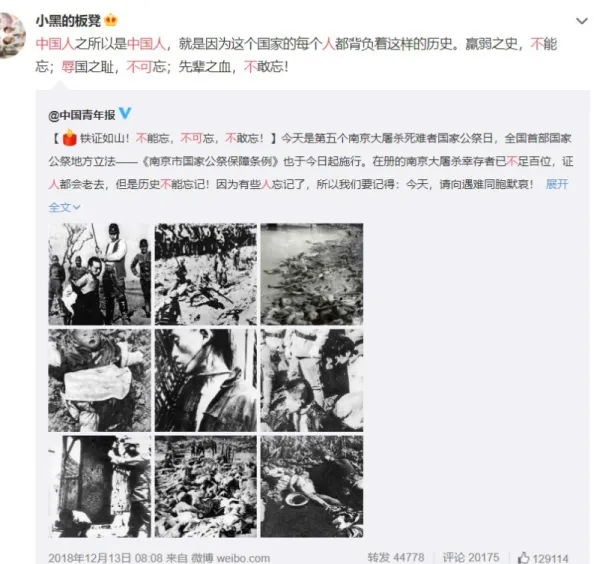
Weibo provides a space where these memories and understandings of historic events can be debated and the official narrative can be challenged. However, in challenging the official narrative this can “also serve to reinforce a sense of nationalism and even be incorporated in the official discourse.”72 Official and verified Chinese media organizations which have a presence
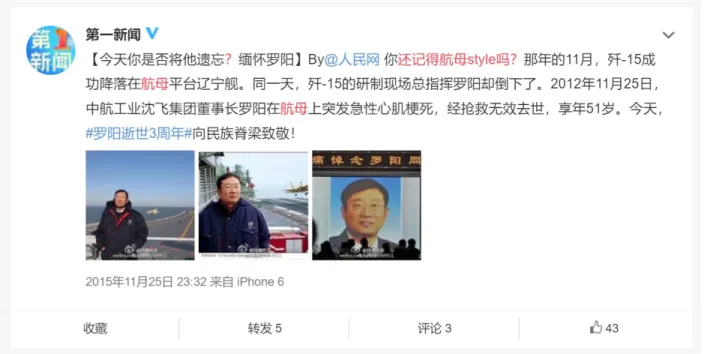
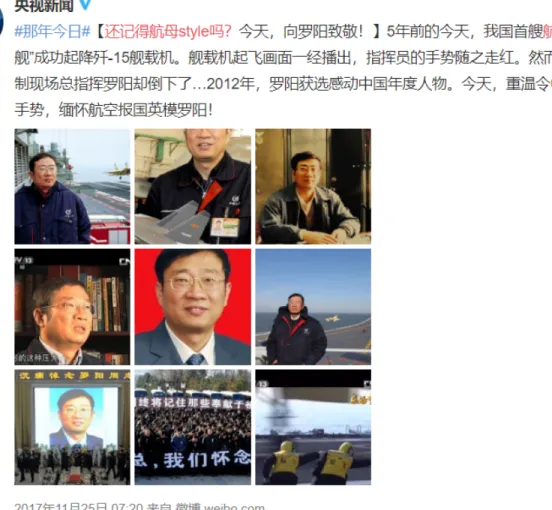
on Weibo have “focused on promoting nationalism during the anniversary commemoration,”73
which “fits into the Chinese government’s nationalism project.”74 Chinese authorities have
begun to use social media platforms to engage with historical narratives, and promote historical revisionism. The contested personal and historical narratives discussed on Weibo have been absorbed “into the maintain stream to [legitimize] narratives of nationalism.”75
Le Han (2016) also provides anecdotal evidence in how Chinese scholars, journalists, and elites on Weibo serve as de-escalatory voices to combat excessive nationalistic tendencies. In the example of the 2012 China anti-Japanese demonstrations, “rational” users made comparisons to the Cultural Revolution to describe the violent nature of some of the protestors. Le Han’s anecdotal evidence is supported by the empirical evidence discovered by Cairns & Carlson (2016) in their study of Weibo posts during the demonstrations. Cairns & Carlson (2016) reported three major findings: firstly, “the censorship rate of online discussion was lower at a critical juncture in August than extant literature would predict.”76 Secondly, that “much of the
netizens' anger was directed at Beijing, not Tokyo.”77 Lastly, that “more moderate voices
appeared to counter these virulent sentiments directly after a broader swath of the public tuned in to online discussion of the dispute in September.”78 Cairns & Carlson (2016) suggest that since
the dispute was still in its early stages in August, the CCP may have been more willing to tolerate some risk to societal order to signal its resolve to Tokyo. Cairns & Carlson (2016) also affirm that the CCP selectively allows nationalist protests, which appear to apply pressure to Beijing during international disputes, so long as protesters do not escalate their actions and turn against their leaders. Furthermore, their “observations raise the possibility that Beijing felt it had to let nationalist-minded netizens ‘blow off steam,’”79 and the protests served to direct the outlet
75 Ibid. Page 112.
76 Cairns, C., & Carlson, A. (2016). Real-world islands in a social media sea: Nationalism and censorship on weibo
during the 2012 Diaoyu/Senkaku crisis. The China Quarterly, 225, 23-49. Page 38.
77 Ibid. 78 Ibid.
of anger elsewhere.However, by September, the demonstrations had escalated and became more destructive. While the CCP may not have been able (or willing) to rein in street demonstrations immediately, it was much more capable of tightening online censorship in order to reduce the spread of information about the destructive acts inflicted by the protestors. Moreover, by avoiding visible censorship (Roberts, 2018), when online users are aware that censorship is occurring, the CCP may have been trying to avoid inducing heightened information-seeking behaviors.
There is “consistent and systematic censorship of content that violates long-standing taboos [in China] on topics such as the Cultural Revolution, the 1989 crackdown on Tiananmen
Square protesters, Taiwanese independence, the repression of minorities in Xinjiang and Tibet,
and the banned spiritual group Falun Gong.”80Online publications regarding Chinese territorial
sovereignty are highly sensitive, and as a result, are often censored if they do not align with the CCP’s position. As I am dealing with censorship, there are likely some limitations in the sources and evidence I could have potentially used, but I have taken steps to ensure that I have access to and have preserved various unorthodox online opinions. Taiwan, Xinjiang, and Tibet are the most sensitive, because these regions are disputed and are also involved with human rights issues. However, based on previous censorship patterns, the level of censorship surrounding the territorial disputes in the East and South China Seas has taken a step closer to that of Taiwan, Xinjiang, and Tibet. Nevertheless, Chinese online censorship is not universal and is actually quite porous. According to Roberts (2018) the censorship methods employed by the Chinese government function more as a tax on information, by “forcing users to pay money or spend
more time if they want to access the censored material.”81 Roberts (2018) employs a formula of
fear, friction, and flooding to explain censorship methods and the types of citizens whom these approaches are designated for. Friction, the act of increasing the costs, either in time or money, of accessing or disseminating information, often diverts citizens’ attention away by imposing barriers to information access.82 Flooding is information that is coordinated as a distraction,
propaganda, or to sow confusion.83 Flooding competes with information that authoritarian
governments would like to censor by diluting it and distracting from it.84 Similar to friction,
flooding also forces the user to spend extra time finding accurate information. China’s “Great Firewall” and its friction and flooding can be circumvented by the use of Virtual Private Network (VPN), but there are economic and social costs attached to this technique. Therefore, the method of fear is designed for the elites who have already bypassed the friction and flooding methods of censorship.85 Moreover, these censorship methods drive a wedge between the elite
and the masses, and have caused Weibo users to be “starkly apolitical” when compared to their elite and educated Chinese counterparts on Twitter. 86 Modern Chinese nationalism is “an
elite-led, top-down political movement,”87 and by separating the elites from the masses, the CCP
prevents the coordination of the masses and the elites and any possible mobilization against government interests.
81Roberts, M. E. (2018). Censored: distraction and diversion inside China's Great Firewall. Princeton University
Press. Page 2.
82 Ibid. Page 6. 83 Ibid. Page 2. 84 Ibid. 85 Ibid. Page 8. 86Ibid. Page 174.
87Wang, Z. (2014). Never forget national humiliation: Historical memory in Chinese politics and foreign relations.
The South China Sea
A majority of the sources I used to further my understanding of the South China Sea echoed each other on the factual information on the territorial disputes, but offered different frameworks for understanding the conflict. Allison (2017) uses the paradigm of Thucydides’ Trap, an observed pattern of international tension when a rising power threatens to displace the current reigning world hegemon, which often results in war, to explain Chinese motivations in the South China Sea. Allison (2017) asserts that Thucydides’ Trap is the best angle for
understanding Sino-American relations in the 21st century, and parallels Xi Jinping’s and Donald
Trump’s ambitions to make their respective countries “great again.” Furthermore, he offers several examples of how the United States and China could easily find themselves at war, one such example being conflict over the South China Sea. I partially agree with Allison over the global tensions that China’s rise has caused, but argue that his approach does not fully account for modern Chinese history, nationalism, and the patriotic education campaign. Miller (2017) utilizes a geopolitical and geo-economic framework for understanding the South China Sea and asserts that China’s “true motivation in the South China Sea is to gain strategic control of its shipping lanes.”88 Moreover, Miller (2017) affirms that “China’s expansionism in the South
China Sea is part of Beijing’s grand strategy to replace the US as the dominant power in Asia.”89
Miller (2017) also believes that “China sees “the rules-based order” as a rigged system designed both to contain its legitimate rise and to prop up the US imperium… [and] the US’s ‘pivot to Asia’ [serves as] proof.”90 I largely agree with Miller’s framework, but also seek to add a
88Miller, T. (2017). China's Asian dream: Empire building along the new silk road. Zed Books Ltd. Page 210. 89 Ibid. 216
framework of Chinese nationalism and education to establish a comprehensive schema for understanding the South China Sea.
Alternatively, French (2017) uses examples found in China’s historical role as the
hegemon of the Asia-Pacific region to expound upon modern happenings in China under the rule of Xi Jinping. Xi’s China uses its history as a seemingly benevolent and non-imperialistic
regional ruler as justification for its desire to return to its place of former power. French (2017) emphasizes that Chinese historical revisionism has helped to cultivate China’s growing sense of national dominance and warns that Imperial China’s rule was not as benign as revisionists have claimed, and suspects much of the same for potential Chinese rule. As the result of China’s sustained and expected further outward projection of economic and military power, French (2017) predicts that due to impending structural challenges within China, such as the
ramifications of the One Child Policy, China’s window to achieve its aims are closing rapidly. French (2017) also infers that the next decade will be turbulent for the world as China attempts to reassert itself in the Asia-Pacific region before its impending population problem begins to unravel. I mostly agree with French, but hesitate to fully brand modern Chinese historical narrative as a form of historical revisionism, especially when considering the “Century of Humiliation.”
Conclusion