DOI: 10.21953/lse.x5pjozvgt5zq
Suggested citation: Lipman, V., Manthorpe, J., & Harris, J. (2018). Does age matter in the social care workforce? Journal of Long-Term Care, September, 1–11. doi:10.21953/lse.x5pjozvgt5zq
The Journal of Long-Term Care is an international, multi- and interdisciplinary, peer-reviewed, online journal established as a focus for advancing the research evidence base for all aspects of long-term care for adults. It is managed by the International Long-Term Care Policy Network at the London School of Economics and Political Science and has received funding from the National Institute for Health Research School for Social Care Research.
The Journal’s range includes empirical papers and theoretical discussions relevant to policy and practice, and methodological papers about improving methods in social care research.
The editorial board welcomes submissions of high quality, original articles that fit with the Journal’s remit. We will consider articles that are also relevant to the care of children and younger people where there is clear relevance for adult care (e.g. concerning issues of families or transitions into adult care). There is no fee for submitting or publishing articles, which will be made available with open access on the journal’s website to encourage maximum impact for all work.
Correspondence and enquiries should be addressed to the managing editor at: Journal.of.Long-Term.Care@lse. ac.uk. Further information is available on the journal website, https://www.ilpnetwork.org/journal/
Executive Editor: Dr Jose-Luis Fernandez, London School of Economics and Political Science Managing Editor: Dr Michael Clark, London School of Economics and Political Science Assistant Editor: Dr Juliette Malley, London School of Economics and Political Science Editorial Officer: Nick Brawn
Editorial Board
Professor David Abbott, University of Bristol Professor Jennifer Beecham, University of Kent
Dr Blanche Le Bihan, École des hautes études en santé publique Professor Yvonne Birks, University of York
Professor John Campbell, University of Michigan Professor David Challis, University of Manchester
Dr Barbara Da Roit, Universiteit van Amsterdam & Università Ca’ Foscari Venezia Professor Julien Forder, University of Kent
Professor Courtney Van Houtven, Duke University Professor Naoki Ikegami, Keio University in Tokyo Dr Lennarth Johansson, Karolinska Institutet
Professor Martin Knapp, London School of Economics and Political Science Dr Giovanni Lamura, Istituto Nazionale di Riposo e Cura per Anziani Professor Jill Manthorpe, King’s College London
Anji Mehta, London School of Economics and Political Science Professor Marthe Nyssens, Université catholique de Louvain Professor Heinz Rothgang, University of Bremen
Professor Ulrike Schneider, Vienna University of Economics and Business Administration Professor Gerdt Sundström, Jönköping University
Journal of Long-Term Care
Does age matter in the social care workforce?
Valerie Lipman, Jill Manthorpe and Jess Harris
Abstract
Context: With the population in England ageing, more people are living with complex physical and mental health needs and need care and support. As a result demand for care workers is increasing.
Objective: This paper presents findings from qualitative re-search in England that aimed to explore the perspectives of frontline care workers, their managers and service users about what difference the age of the care workforce poten-tially makes at an individual, organisational or workforce level.
Method: Interviews, semi-structured and face to face, in four local authority sites in England.
Findings: Age plays a role in the perceived character of the care workforce. A commonly-held view is that life ex-perience is one of the most valuable qualities a care worker brings to their role. While experience is generally valued, it may be framed as experience in care work, or more gener-ally as life experience. Younger care workers may be often seen by older colleagues and service users as less reliable un-til they prove themselves. However, managers often identify enthusiasm and ability to accommodate change among younger care staff. Managers are interested in having an ‘age mix’ of staff beyond retention and sustainability issues. Limitations: The authors acknowledge the risk that the in-terview data may not be generalisable or totally representa-tive of staff or care users; the study did not include directly
employed care workers nor collect health-related informa-tion or personal narratives. Those employers who agreed to participate may be more committed to workforce develop-ment and value their staff. Nonetheless data are sector-wide and there are sizeable numbers of participants. Moreover, the views of users of social care and family carers are also included.
Implications: The article provides views from a range of stakeholders in social care on whether age matters in this workforce. Instances of age discrimination or stereotypes af-fecting different ages were reported but also the opportuni-ties in social care work for people to work in later life and to move to this work after other work or family experiences. The age of the social care workforce needs to be considered as part of workforce planning, tailoring skills development and value-based work commitment among all age groups, reducing physical demands, and providing flexible working conditions.
Keywords: older workers, social care, younger workers, age, employment, care work.
Acknowledgements and declarations
We are most grateful to all those who participated in the research and to the wider study team at the Social Care Workforce Research Unit who include Shereen Hussein, Jo Moriarty, Martin Stevens, Michelle Cornes, Kritika Samsi and Caroline Norrie. This study was funded by the National Institute for Health Research Policy Research Programme. The views expressed in this article are those of the authors alone and should not be interpreted as those of the funder.
V. Lipman, J. Manthorpe (), J. Harris
Highlights
Age matters in the care workforce: strengths and weak-nesses were found to be associated with both young and old workers.
z
z Almost all the service users and family carers interviewed
favoured care workers with some ‘life experience’.
z
z Care workers believe that with age generally come
empa-thy, common sense and reliability.
z
z Younger care workers are seen by their managers as
hav-ing capacity to pick up new ideas and practices more readily.
z
z Younger workers are associated with high staff turnover
leading to poorer continuity of care, and thereby lower care quality.
Introduction
This empirical article considers the implications of the age of people working in English adult social care, the term generally used for long-term care services at home or in care-providing facilities. Drawing on a set of interviews, it reports the qualities and characteristics attributed to older and younger care workers by themselves, their manag-ers, family carers and care usmanag-ers, and considers their views on whether and how the age of care staff play a role in the quality of care provided at an individual, organisational, or workforce level. This research is part of a longitudinal study that is seeking to increase understanding of the different fac-tors that facilitate or constrain recruitment and retention in the adult social care workforce in England (Manthorpe & Harris, 2014). While the focus is on England, the ageing of the social care or long-term care workforce is regarded as a challenge in many other developed countries (Colombo et al., 2011; Butler, 2009).
The adult social care workforce in England stands at an estimated 1.43 million people (Skills for Care, 2016). Social care work mainly takes place in care homes (including care homes providing nursing care), group homes, home (dom-iciliary) care and day centres. Between 2011 and 2014 the number of adult social care jobs in England increased by an estimated 135,000 (Skills for Care, 2015), although the increase has slowed to an extra 12,500 jobs in the period 2014–2015 (Skills for Care, 2016). Nonetheless, the govern-ment prediction that the adult social care sector will require a minimum of two million workers by 2025 (Apprenticeship Alliance Online, 2015), will be challenged by the fact that the present social care workforce has an older age profile than other parts of the economy and retirement could become a significant factor (Skills for Care, 2015a). This cannot be over-emphasised, for the National Minimum Data Set for Social Care (NMDS–SC) revealed a concentrated distribu-tion of frontline care workers between the ages of 25 and 54 years, who constitute 69% of the direct care workforce (Skills for Care, 2015) and the mean age of care workers has
stood at around 42 years of age for about seven years (Skills for Care, 2015). Nonetheless, the contrasting socio-demo-graphic characteristics of those much younger than average and those in older rather than middle aged groups are rel-evant to workforce planners (Hussein & Manthorpe, 2010, 2011).
Several features of the changing pattern of demand for care suggest that the age of the care workforce may need to be addressed as part of workforce planning. For exam-ple, there is growing need for care and support for people who have multiple disabilities or impairments (such as com-plex learning difficulties and physical disabilities), who will continue to need substantial support as they grow older. A growing focus on quality of care and specialist skills, cou-pled with greater expectations that care users will have more say in how their care is provided, and by whom, raise ques-tions about how to attract and retain staff with experience, skills and training (Howat et al., 2015).
Arguments are made for investing in older workers on the grounds that ‘older workers are less likely than younger employees to change jobs and… to use their newly acquired skills and knowledge to leave their organisation’ (CIPD, 2015, p. 26) and that they are needed to sustain the labour market overall (Altmann, 2015). There is a growing body of academic literature exploring the implications of promot-ing work in later life (see, for example, the journal volume edited and introduced by Biggs and colleagues (2016)). In contrast, since the start of the present research project (the Longitudinal Care Work Study (LoCS)) a range of govern-ment employgovern-ment programmes has sought to increase the numbers of younger rather than older people employed in the adult social care workforce, particularly by focusing on efforts to recruit young entrants to the labour pool, such as Health and Care Apprentices, introduced in 2012 (gov.uk, 2012), and Care Ambassadors (Skills for Care, 2011), sug-gesting that the age profile of the current care workforce is problematic.
Little is known however about what the workforce, in managerial or frontline roles, or care users and carers think about the current age profile of the social care workforce. In this paper, we present and discuss findings from inter-views with care workers themselves, their managers, people receiving care and their family members, on what difference is made – if any – by the age of those working in social care.
Methods
Lipman et al. Journal of Long-Term Care (2018) 3
research governance permissions were received from King’s College London and the four participating local authorities. With permissions and informed consent, these semi-struc-tured face-to-face interviews explored views of what contrib-utes to recruitment, retention and quality care (Manthorpe & Harris, 2014). Questions covered relationships between staff, strengths and challenges of the workforce age profile, strategies used in managing recruitment and retention re-lated to age, and the qualities and attributes that people us-ing care services and their family carers identified among the care staff that support them, especially where ascribed to age or similar. In the data reported below identifying fea-tures have been removed from the illustrative quotations of both participants and the research sites to protect anonym-ity. In several interviews participants were not comfortable with responding to questions about their own age and this accounts for some missing data in this regard.
Interviews were audio recorded (with permissions) then transcribed and the transcripts entered into NVivo qualita-tive software to assist with thematic analysis. In a few in-stances where permission to record was not granted, full notes were taken and also imported into NVivo. Thematic analysis permits specific exploration of subjects that were central to the design of the interview schedules and the study’s aims and objectives. Using open coding, the research team initially coded a selection of transcripts from the first wave of transcripts, reading and re-reading this set to en-hance familiarity with the data. The preliminary codes were then discussed and a coding framework developed. This was repeated with further transcripts and the categories iden-tified were refined and synthesised by grouping them to-gether. Following development of the final framework, the subsequent transcripts were coded and the first set recoded if necessary.
Overarching themes and sub-themes from the analysis were determined where they ‘captured something important in relation to the research questions’ (Braun & Clarke, 2006, p. 77). This present paper reports the findings on the theme of age of the care workforce and discusses the implica-tions; further papers have addressed values and recruitment ( Manthorpe et al., 2016); and the impact of personalisation and wage effects (for details please contact the authors). The substantive themes, discussed below, address the age of the workforce, attitudes to age (including discrimination – both positive and negative); and constraints associated with age, including legal, physical and emotional capacity to under-take social care work.
Findings
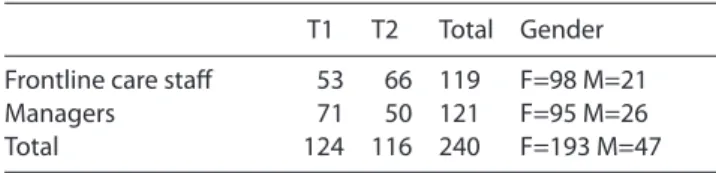
A total of 240 interviews with 119 social care practitioners (frontline staff including home care workers, day centre staff and care home workers but not professionals such as social workers) and 121 managers (home care and care home sen-ior staff with managerial responsibilities) were undertaken
at two time points: Time 1 (T1) (2009–2012) and Time 2 (T2) (2011–2014) (see tables 1 and 2). Fifty-eight people were interviewed at both time points, reflecting the gener-al turnover of staff and of changes in socigener-al care providers. Sixty interviews with care users and their family members were also undertaken (2009–2014) (see tables 3 and 4).
Table 1. Frontline care staff and manager interviews by number, role and gender
T1 T2 Total Gender Frontline care staff 53 66 119 F=98 M=21 Managers 71 50 121 F=95 M=26 Total 124 116 240 F=193 M=47
Table 2. Frontline care staff and manager interviews by service user group worked with (n=240)
Service focus
Learning disabilities 48
Mental health 18
Older people (including people with dementia) 111 Physical disabilities 2 Carers 4
All user groups 57
Total 240
Table 3. Service user and family carer interviews by number and gender (n=60)
Users Carers Total Gender Total 44 16 60 F=40 M=20
Table 4. Service user and family carer interviews by service user group (n=60)
Service user group
Learning disabilities 15
Mental health 15
Older people (including dementia) 29 Physical disabilities 1 Total 60
The age range and age ‘categories’ of the study
The age of the care workers interviewed (see table 5), and the staffing age profiles reported by managers interviewed, ranged from 17 years of age upwards. At an extreme, one care home manager reported that her staff ranged in age from 17 to 84 years old and, as table 5 shows, participants included several people working in their 60s and 70s, from care assistants and support workers, to general managers of large care homes. However, these were exceptions, and most managers described their workforce as tending to cluster around particular age groups, for example ‘in their 30s/40s’, and while the ‘40s/50s’ cluster was most commonly report-ed, others said that most were ‘over 50’.
character of the care workforce, and this was often illus-trated in participants’ language, placing their colleagues or care workers into different age categories. Care worker par-ticipants often described their fellow workers in relation to their age, but used a range of non-chronological terms to do so. The terms used depended substantially on the position and age of the participant and their assessment of their col-leagues’ abilities. The ‘young’ care workforce was sometimes defined by chronological age, but more often by their sta-tus in society – as school leavers, students, apprentices, or ‘starting age’. The use of the terms ‘migrants’ and ‘overseas worker’ tended to be used to refer to younger members of the workforce since these were very often young, although not school leavers. ‘Experienced’ was a defining term for the rest of the workforce. Thus ‘mothers with young children’, ‘housewives’, and those in ‘middle age’ were deemed to be people with experience, and not ‘youngsters’. The terms ‘re-tired’ and the phrase ‘the workforce is getting older’ as used by some participants, appeared to indicate a broad view of older age, rather than a specific age bracket.
Some evidence emerged about whether different care work roles were more appealing to different age groups. While the relationship between age and role was more usu-ally found to be influenced by a willingness or ability to take on training, an individual’s own caring responsibilities or health, or a combination of these, there was evidence that the age of the care worker influenced their choice of client group or type of care service. Instances of role choice based on a preference for a particular client group included a care worker aged 24 years saying she preferred working with people with learning disabilities because they were closer to her age, and you ‘can have a laugh with them, not that you couldn’t with the elderly’.
However, preferences could change with experience or familiarisation with a different user or client group. For ex-ample, one manager described how health and social care trainees often set out thinking that they want to work with children, but then found themselves wanting to work with older people, especially after gaining experience with this client group:
They always come in and I say ‘What would you like to do when you finish?’ ‘Oh, I want to work with children’ … and after a few weeks they say ‘Oh, I’ve changed my mind.’ It’s quite funny … they suddenly realise ‘Oh, older people are not so bad.’ (care home manager, age not given)
Age-related restrictions, limitations and discrimination
Participants identified a number of restrictions or limita-tions related to care workers from different age groups. One longstanding member of staff at a care home, now in her 50s, noted how age requirements had evolved in employ-ment generally: ‘I have worked all my life really since I was 16, nowadays you can’t go into it when you are 16.’ The regu-latory restrictions on the roles and tasks very young people are permitted to do in social care were seen as frustrating by some managers:
There is certain tasks that we can’t let 16 year olds use – hoists and mechanical equipment… makes it difficult, which is a shame. (manager, care home for older people, in her 40s)
Some managers made it clear that they would not con-sider any applicants aged under 21 years, unless they were on student placements. For older workers it was age-related physical limitations that were seen to inhibit an individual’s capacity to enter the workforce, as illustrated by the owner/ manager of a home for people with learning disabilities:
If we are looking for [work with people with] challenging behaviour, we can’t employ really somebody who is over 60 or something like that – they probably can’t run. Some home care workers commented on their own older age as driving their decisions to reduce either their working hours or the geographic scope of their role:
I used to do a half-day on a Tuesday and I knocked that off because I was actually getting over-tired, I mean, if you are my age, you know when you are kind of pushing your limits. (home care worker, in her 60s)
Managers often stated that some of the more ‘ma-ture’ members of their staff could be reluctant to engage in training, although this reluctance could be replaced by enthusiasm:
We tend to have people who are maybe a little bit more mature… we’ve even just taken somebody on who’s 60 and they’re quite reluctant to do training: ‘Oh, I haven’t done anything since I left school and I don’t really want to start now at my age’. And it’s quite surprising that those are usually the people who get a bit of a bug for it really, and they get the certificates with their names on, and they’re really quite proud. (manager, care home for people with learning disabilities, age not provided) The unwillingness of older staff who had been doing the
Table 5. Frontline care staff and manager interviews by age (n=240)
n/a 18–24 25–40 41–50 51–60 61 plus Total Frontline care staff 1 8 31 26 40 13 119
Managers 73 0 9 26 1 12 121
Total 74 8 40 52 41 25 240
Lipman et al. Journal of Long-Term Care (2018) 5
job ‘for years’ to undertake accredited training was also de-scribed by this owner/manager of a care home for older peo-ple who expressed sympathy with their position:
They’re a bit long in the tooth and they’ve been doing it for years… (name) is 63 and doesn’t want to do it, which is fair enough, she might finish next month.
Age discrimination was felt to be in play by a number of respondents, both by frontline staff and managers. This was mostly reported in relation to an individual’s perceived career prospects although there were no reports of it being legally challenged. Some expressed the view that they were regarded as ‘too old’ to progress, while others thought they were seen as ‘too young’. One older care worker reflected that if she wanted to go for promotion she would be required to re-train, and by the time she’d completed this she would likely be over the age threshold to get promotion within her company. Another deputy manager of a private care home for people with learning disabilities commented:
I actually did apply for the position for manager – I didn’t get it and at the time I just accepted it... I’m 61 now, I think age is against me…They will not say ‘It’s because of your age’… but they will say ‘It’s because you don’t have the skills’.
On the other hand, one registered manager of a non-profit care home for older people believed that social care work was less discriminatory against older workers than elsewhere in the job market, assisted by the non-discrimina-tory framing of the job advertisements:
Job Centre Plus [government employment service] is very good at doing things – they have this wording that ‘everybody is welcome to apply and no restriction on the upper age limit’ … the girl who did come and does the job, she’s absolutely wonderful but she’s mid-50s and had been looking for a job for about six months… I’ve talked to a lot of older people who think ‘I can’t get a job. I’m too old’.
Several younger participants expressed discomfort that care users might think they were too young to be doing the job well. One home care service coordinator reported how, when she was in her early 20s an older care home resi-dent had told her: ‘I’m not letting you near me, you are only young’, guessing that she was around 18 years old. A mental health support worker in a local authority day centre, now in her mid 20s, described how age was a factor in how the cen-tre users initially related to her:
I felt like clients were not respecting me … (manager) went through the whole process with me and then, at the end, it worked out… They don’t see me anymore as just the young girl.
Perceptions of age-related qualities and characteristics
The interviews revealed a range of perceptions by service
users and their families, and by care staff themselves and their managers, about age-related qualities and character-istics of care staff, and how these had the potential to in-fluence the quality of care provided. Some comments were presented in terms of what participants thought a service user might deem important, others were in relation to the impact on workforce matters.
Service user and family carer perceptions
Almost all the service users and family carers interviewed favoured having care workers with some ‘life experience’. Interestingly, the wife of an older man with dementia want-ed people who had personal experience of caring, but not so much life experience that they had ‘got a bit rough’:
I find, personally, that the best carers (care workers) are either mothers with young children… they know how to look after a baby and very often, with severe learning difficulties (or) somebody with a dementia, that is what you need. You get somebody who’s, perhaps, middle aged, and they’ve got a bit rough round the edges, they’re heavy-handed and what have you. (female family carer, in her 60s)
One care home resident in her 80s seemed to clearly dif-ferentiate between the younger staff, whom she perceived ‘think they know it all’, and the older workers:
Well I think the older carers work best at this place… the younger ones don’t seem to want to know… they think they know it all, but they don’t. Whereas the older ones do but they don’t like to be pushy, most of them.
An older day centre user was more generous in consider-ing the perspectives of younger care workers, appreciatconsider-ing that some tasks or people may be difficult for them, as it may be hard to ‘put up’ with ‘old people who can be cantanker-ous and cranky’.
More often service users reported that they generally found younger care workers less reliable and less sensitive than the older care workers. A parent of a son with severe learning disabilities, now in her 50s and a paid care worker herself, commented that:
The girls (care workers) were so young, they didn’t really, couldn’t look after (her son) that well, because he had a tendency of holding onto you, the girls didn’t like that. These girls are young... they are on their mobiles (phones), they do things they are not supposed to do, they’re too young. (female family carer, 50s)
Younger workers were also associated by users and family carers with higher staff turnover and thus poorer continuity of care, and thereby lower quality of care. The elderly wife of a 70 year old man with dementia, whose wellbeing improved on moving to a new care home, felt that in his previous care home there had been too much ‘coming and going’ among the staff who were ‘just young people looking for a job’.
carer, in her 60s, could not have been more appreciative of the young care workers looking after her husband with dementia:
I’m blessed at the moment; I’ve got students in from the university… They’ve done the bars, the student bars, and as one young lad said to me, ‘I got fed up of a Saturday job where people are being rude to me… I decided to give this a go and I’m quite shocked – I like doing it!’ She then reflected that care experience could be gained by life circumstances other than parenting and age, such as caring for siblings.
Overall, the younger workforce was described in several ways – some more positive than others – and this seemed dependant on the participant’s experience and rejection of stereotypes. Some managers described the benefits of having the enthusiasm and flexibility of younger workers, but also the value of younger workers with a ‘wise head on young shoulders’. The older workforce acknowledged that younger people may find it emotionally hard to undertake care work, and recognised the difficulties they might experience in en-tering the unknown, dealing with personal care tasks, man-aging ‘difficult’ service users or families and facing dying and death. Further research is needed to see if these challenges play a role in younger workers’ generally perceived lack of reliability or their decisions to leave the sector. Older work-ers sometimes recognised that the younger workforce had ‘young lives to lead’, which might include going out late and changing jobs frequently. This was usually reported without rancour, though with frustration on occasion, because of the need for reliability in care work. Some noted that there are few incentives to join the workforce – pay was poor and there was a lack of status – ‘You’d really want to do the job to join’ and this meant that younger people might leave for these factors, not just the nature of the work.
Care workers’ perceptions of age
The dominant perception expressed by the care workers in-terviewed over T1 and T2 was that a good care worker need-ed to have experience and empathy to deploy. Most believneed-ed that younger workers lack the life experience that provides an understanding of the caring role, emotional stamina, and the ability to carry out the practical tasks of the job. This emerged most strongly in interviews within home care ser-vices where staff worked on their own:
You have to have life experience, because when you go into clients you might see a really lovely person, old lady and great. Next one you might go and see, it might be an alcoholic person who is swearing… throwing stuff at you… you have to take all this. (senior home support worker, in his 30s)
The following reflection from a home care worker in her 50s captures some of the challenges facing older care work-ers but also the appreciation that this was a sector where they were needed:
I came into care because I was too old to start studying again and go back to college. I am at the age where a lot of people don’t want you… I’m quite happy stopping in the care sector, and while my health will allow me to get on the floor and wash feet and then be able to stand up again without pressing somebody’s lifeline (personal alarm), then I’m happy to go on doing it.
Older workers reported that it was often people using their services who wanted older staff rather than ‘young ones’ who could be a ‘bit flighty’ (home care support worker, in her 60s).
Older care workers sometimes cited their own age, and experiences from their own lives, as evidence of their ability to empathise with care users:
A lot of the time the clients… say things to us that they won’t say to the family... because we are all of a certain age… we’ve had families and we’ve dealt with our parents being old and had children and had medical emergencies all through our lives. We have got that bit of confidence. (home care worker, in her 50s)
Younger staff also recognised that younger colleagues in a given role may need more training in broader life skills than older workers new to the role but who brought their own skills and experience:
We are doing a bit of retraining, especially with the young lasses, who seem nowadays don’t know how to cook more than a ‘ready meal’ [pre-prepared], we are showing them how to do quick meals. (senior home care worker, in his 30s)
Another participant in her 40s commented on what she saw as changing times, feeling that young people had less time for the older generation today and were fussier about the tasks they do such as personal care:
There is a lot of tasks that aren’t very pleasant, let’s face it… You’ve got to want to do it and take that as part of the job. I think now, a lot of young ones, they just don’t want it… the overall family unit isn’t the same, is it? senior care worker, care home for older people, in her 40s)
The impact on service users of high turnover among their younger colleagues was remarked on by some older care workers. For example, a home care worker in her 50s talked about how many young people ‘were never there five min-utes’. She continued: ‘it’s very, very rapid the turnover. It’s not good for the clients. The young ones haven’t built up that life experience, so it doesn’t come naturally to them.’ Others de-scribed how younger adults between 18 and 25 were some-times less responsible, citing how they might just not turn up to work. One home care worker (one of the few male par-ticipants) in his 30s felt ‘it’s not a young person’s job… before 21, don’t even think about it!’ and explained his views:
Lipman et al. Journal of Long-Term Care (2018) 7
going to change somebody’s [continence] pad’ they run a mile. … We do get young lasses at 18, 19 … they are not reliable on a Sunday morning or a Saturday morning because they have been out the night before.
Some younger care workers were described as taking on poorly paid care work for lack of an alternative, or the offer of a basic income when job security was not a priority:
Certain of the youngsters, if they’re getting paid £6 per hour, they don’t really care what they do. Some youngsters have said to me, ‘Oh well, if I get the sack from that rubbish job I can always go into another £6 job’. (care worker, in her 50s, respite home for older people, interviewed when £6 was around the minimum wage)
Managers’ perceptions of age
Life circumstances, such as early retirement from a previ-ous career and a lack of need for full-time employment, were seen as valuable by employers such as home care agency managers who knew that user demand could be unpredict-able. Managers, such as this home care manager, thus un-surprisingly described the value of having older, qualified, experienced, ‘solid’ members of staff:
…maybe they are early retired and they’ve always got that sort of nursing background, we’ve got some solid people like that, which are very useful.
On the other hand, some managers also reported that they were recruiting increasing numbers of older workers without any background in care work. Here ‘life skills’ were prioritised over care work experience:
We are probably getting quite a few more over 50 … we are not always looking for people with a social care background. We are looking for people with life skills, practical, and being able to manage people, and confidence. They usually work out really, really well. (manager, home care service, age not provided)
Importantly, many managers expressed positive points about having young people in the workforce. There was no notable change in this viewpoint over the period of this study. The strengths expressed related to both a young per-son’s ability to fulfil the required role, and their broader atti-tude to work in general. One manager of a home care agency, in her 50s, reported that over the last few years her work-force had been getting younger ‘which was quite refreshing’ This pattern continued over time, as she noted a couple of years later ‘a lot of younger, much younger people applying’: We’ve got three, four, really excellent young carers, who have got a wise head on young shoulders, they really have, and we capitalise on these, because they’re so enthusiastic, they want to care for people. These are like in their 20s, 21, 22, who want to go out and make a difference to people’s lives… in the beginning, we had lots of ‘resistance’ is probably too big a word but older people saying ‘Oh, she’s ever so young to come in and bath me’
but as time’s gone on, and I’ve got quotes from people saying… how good they are.
A different home care service manager, in his 30s, re-ported purposefully setting out to recruit younger people in order to train them up to do the job:
Young people I employed a few years ago, completely fresh for the sector, and are fantastic. We provide the training … I’ve got a few young women they have just started, being 19, and they are the best staff I can imagine. Younger people were seen as coming to roles with the ability to pick up new ideas and practices more readily:
It’s always quite difficult when you take somebody who has got a long history in care, but person-centred planning wasn’t there then to try and change people’s attitudes. Whereas young people, you know, you can teach them person-centred planning and that’s what they understand straightaway. (manager, home care, age not provided)
The ‘age-balanced’ workforce
Unsurprisingly, in response to the qualities and characteris-tics associated with younger and older care workers, outlined above, managers often advocated a balance in the overall age make-up of their workforce. The need for a mixed-aged team able to respond to the stated preferences of service us-ers was also an emerging recurrent theme. For example, one home care manager noted: ‘It’s what the clients dictate. You have to offer them the choice, a balance of ages.’
Learning from each other was often raised by managers when advocating the benefits of a mixed-aged workforce:
You get a different age range who get on well together. Some of the younger ones help the older ones. Some of the older ones are a bit wiser than the younger ones. We’ve found it’s quite a happy mix. (owner and manager, in her 40s, care home for people with mental health problems) Some managers reported recruiting selectively in order to balance staff’s age mix:
I wanted somebody who was at the other end of the age range because our group was very young and I felt we needed a bit of maturity in there as well, and because of the age of the residents as well. (manager, care home for older people)
In contrast, another care home manager, in her 40s, com-mented that younger people were less keen to work with people with dementia and so getting a mixed staff group was challenging:
I find that it’s not difficult to get mature people to work with the dementia and Alzheimer’s. I find it difficult to get the younger members of staff working with them. I don’t know if it’s just when you are in your very early twenties if some of them find it quite scary.
outlined by another care home manager who was seeking to recruit more younger staff since they were perceived to bring about a positive ‘attitude difference’ when working with people with dementia, which was of direct benefit to service users:
We tend to find they’re actually very good with people with dementia and challenging behaviour. I think they’re a bit less judgemental and they don’t come with any preconceived ideas… they’ll take you to the supermarket and if you have an issue in the supermarket, they just deal with it, I think whereas maybe older people get a bit embarrassed by that and they’re a wee bit more reluctant to go out with residents. So I think there is an attitude difference. (head of dementia, care home)
Personality not age
It is important to note that some managers and employers of care workers resisted all characterisation of staff by age. They were adamant that age was not an issue in making a good care worker:
I don’t think age comes into it. I don’t think age makes any difference at all. You do go into it thinking you can help and care, and you do care. (manager, home care service, age not provided)
Other managers felt that good social care depended on the personality not the age of the individual:
I don’t think age really [matters] … it’s more on the person themselves, because you can get a younger person that’s very wilful, and then a younger person that’s very subservient… it depends on their personality, rather than the age. (manager, supported living service for adults with learning disabilities, age not provided)
Discussion
The study has increased the body of evidence on the impli-cations of the age of the adult social care workforce when viewed from the perspective of the sector. Of significance were the differences of views about whether and how age matters in specific ways for organisers, frontline staff, and care recipients. Overall, the findings indicate the benefits to be gained from a mixed age workforce, but also the impor-tance of caution about making age-related assumptions or embedding discriminatory practices within social care. Such evidence needs to be considered in the light of these findings that it is not just one facet of staffing characteristics that im-pacts on care quality (Castle & Engberg, 2007) but combina-tions of multi-level factors.
Before moving to a broader discussion of our findings, we acknowledge the limitations of this study. A range of staff were interviewed, but not directly employed care work-ers (pwork-ersonal assistants employed by service uswork-ers or carwork-ers or self-employed) who may have different experiences and age-related expectations. Qualitative data were collected but
not health-related information or personal narratives, such as that related to possible age-related long-term conditions, which may throw light on individual health status and work-place capability. There would be room for research to explore care workers’ own perceptions of how their own ageing is af-fecting their employment decisions and performance, their attitudes and resilience. Further, there is a risk of bias in that the employers who provided access to their staff may be or-ganisations who are committed to workforce development and value their staff. Nonetheless data are sector-wide and the sizeable numbers of participants means that the findings may be generalisable. Moreover, we include the views of us-ers of social care as well as those providing it and integrate these different perspectives.
Matching care worker age and care role
The age of the workforce matters because some users and their families may increasingly or initially want a care work-er of an age that they believe suits their needs or prefwork-erences. This may be because of physical requirements, shared inter-ests, or compatible personalities, but our study suggests that older workers are more often desired because age is seen to accompany experience. An older person may not want a young person whom they regard as potentially ‘flighty’ meeting their care needs, although some may wish for a care worker who is more ‘spirited’. The challenge remains of max-imising continuity of care and relationships where younger care workers are more likely to leave. Those who preferred someone older associated age with life-related experienc-es that they believed would tend to a better understanding of their needs, although an older care worker may not al-ways have the physical capacity to carry out all care tasks or want work-related travel. Examples of workers whose age was seen as appropriate to the client were provided by those working with people with learning disabilities or peo-ple with dementia that have distressing behaviour: if the care user was physically strong or active there were expressed ad-vantages in having a younger, fitter, care worker. The gener-alisability of this imputed relationship needs to be assessed. Some younger workers also shared hobbies or interests with care users and potentially saw this as a more appropriate peer relationship. There has been some interest in exploring the theoretical concept of homophily, the tendency to asso-ciate with people who are similar (Kossinets & Watts, 2009), and its implications for social care, but this has explored eth-nicity rather than age (Manthorpe et al., 2012).
Workforce matters
Lipman et al. Journal of Long-Term Care (2018) 9
become computerised, tensions may arise between young-er workyoung-ers for whom these may seem the norm, and oldyoung-er workers for whom these may present new challenges. More specialist training and technical expectations may appear threatening to experienced older staff. On the other hand, there was some wariness about investing in the small num-bers of very young people who are not permitted to do the full range of job tasks, but this was overshadowed by the in-vestment wasted in providing younger staff with training who then leave, as well as overall problems of reliability that were thought to relate to age. Employers may wish to high-light reliability as an important attribute in their recruitment processes whether these are formalised or rely on word of mouth or the values conveyed in general publicity. A fur-ther article drawing on this data set has explored the defini-tion and use of values-based recruitment in which skills and competence are addressed as part of personal attributes. This found no clear relationships but some willingness to consid-er values at recruitment stage (Manthorpe et al., 2016).
In contrast, the need to maximise the work lives and con-tribution of older workers remains, as identified interna-tionally (King et al., 2012) and the flexibility of home care work in particular seems prized by many working in this part of the sector in England and beyond (Sweet et al., 2010). While in some contexts the older workforce is sometimes re-ferred to as ‘vulnerable’ in terms of lack of qualifications, low status and poor pay (see Jorgensen et al., 2009, p. 15), our interviews generally revealed a more confident older work-force who were pleased to have their life experiences valued. Different strategies may be needed to recruit older workers from outside the sector, but also to retain and retrain experi-enced social care workers.
Age-friendly work
In many arenas age-friendly work refers to the inclusion and encouragement of older workers in various jobs. McNair (2010) reported that many older people would welcome staying in work if it could be more flexible and concluded that care work offers opportunities to older workers that other sectors do not. This highlights some of the challeng-es facing older care workers, in particular how they main-tain their health and their ability to keep up with the often physical demands of the job. Work is needed on what role better workplace design, equipment, information and assis-tive technology can play in addressing such demands and also on job flexibility, moving from physical tasks to more relationship-based care perhaps. The care sector’s response to the National Institute for Health and Care Excellence (NICE) guidance (NICE, 2016) on promoting healthy work-places is unknown. The implications of the requirement for ongoing training, and addressing the possibility of age-ism within the workforce also need consideration if there is to remain a balanced-age workforce. However, it is im-portant to differentiate between ‘older workers’: some have considerable social care experience while others are newly
recruited to the sector and bring different experiences – rel-evant or not, and good, bad or mixed. The social care sector has generally been perceived as a sector with very difficult recruitment problems, far less is it seen as a sector which successfully recruits older workers (Manthorpe & Moriarty, 2008). It may have much to show other parts of the labour market in this regard, having been an age-diversity ‘pioneer’ long before other sectors (Baldwin & Strebler, 2007).
How to present recruitment to social care to older as well as younger people and how to promote and maintain a mixed workforce involve a series of strategic considerations for employers and sector stakeholders. These are not con-fined to England; but England has particular problems of workforce recruitment and retention, with care worker turn-over standing at 33.5% (Skills for Care, 2016). Specific to age are the size of the cohorts approaching retirement age and other employment opportunities in many parts of the coun-try, meaning that other options exist for care workers and particularly nurses needed by care homes providing nursing care (Care Quality Commission, 2014). The increase in di-rectly employed workers in social care, prompted by personal budgets for care users eligible for government funding and by the growth in people employing their own care workers through private arrangements, may exacerbate recruitment challenges if such employers offer higher wages and more at-tractive terms and conditions are negotiated. Investment in training in social care, such as the new Care Certificate, may (since this qualification is transferable across sectors) un-intentionally encourage care workers to seek work in other better paid sectors such as nursing or health care assistant work (Skills for Health, 2015). Further data collection in this present study will explore such questions and whether the discourse of a ‘problem’ of older care workers remains with the parallel solution tending to concentrate on recruiting ‘the young’. Social care provides an example of an employ-ment sector that may need to think about the age-friendli-ness of its workforce in respect of younger people, as some of the observations and experiences reported in this study have illustrated.
References
Altmann, R. (2015). A New Vision for Older Workers: Retain, Retrain, Recruit, London: Department for Work and Pensions, https://www.gov.uk/government/uploads/ system/uploads/attachment_data/file/411420/a-new-vision-for-older-workers.pdf (accessed 18 October 2016). Apprenticeships Alliance Online. (2015). Health and social
care, http://afo.sscalliance.org/frameworkslibrary/index. cfm?id=FR03963 (accessed 16 December 2016).
mp80.pdf (accessed 9 January 2017).
Biggs, S., Bowman, D., Kimberley, H., & McGann, M. (2016). Introduction: Policy responses to ageing and the extension of working lives. Social Policy and Society, 15(4), 607–610.
Braun, V., & Clarke, V. (2006). Using thematic analysis in psychology, Qualitative Research in Psychology, 3(2), 77– 101.
Butler, S. (2009). Women still taking care: The experiences of older home care workers, Journal of Gerontological Social Work, 52(3), 277–293.
Care Quality Commission. (2014). State of Care 2013–14. London: Care Quality Commission.
Castle, N.G., & Engberg, J. (2007). The influence of staffing characteristics on quality of care in nursing homes. Health Services Research, 42(5), 1822–1847.
Chartered Institute of Personnel and Development (CIPD) (2015) Avoiding the demographic crunch: Labour supply and the ageing workforce, policy report. London: CIPD & International Longevity Centre UK.
Colombo, F., Llena-Nozal, A., Mercier, M., & Tjadens, F. (Eds.) (2011). Help Wanted?: Providing and Paying for Long-Term Care. Paris: OECD Publishing. http:// dx.doi.org/10.1787/9789264097759-10-en (accessed 27 December 2016).
Cory, G. (2012). Unfinished Business: Barriers and opportunities for older workers. London: Resolution Foundation. http://www.resolutionfoundation.org/ publications/unfinished-business-barriers-opportunities-older-workers/ (accessed 9 January 2017).
Department of Health. (2012). Caring for our future: reforming care and support. London: Department of Health.
Department for Work and Pensions (DWP). (2012). Impacts and Costs and Benefits of the Future Jobs Fund. London: Department for Work and Pensions.
Franklin, B. (2014). The future care workforce. London: Anchor and International Longevity Centre UK.
gov.uk (2012). Become an apprentice. https://www.gov. uk/guidance/health-and-social-care-apprenticeships (accessed 9 January 2017).
Howat, C., Lawrie, M., & Sutton, R. (2015). Sector insights: skills and performance challenges in the health and social care sector, Evidence Report 91. Rotherham: UK Commission for Employment and Skills. https:// www.gov.uk/government/uploads/system/uploads/ attachment_data/file/430137/Skills_and_Performance_ Challenges_in_Health_and_Social_Care.pdf (accessed 27 December 2016).
Hussein, S., & Manthorpe, J. (2010). Attracting young adults (18–25 years) to work in social care in England: How secondary data analysis may assist policy makers and providers, Diversity in Health and Care, 7(4), 229–238. Hussein, S., & Manthorpe, J. (2011). Third-age’ workers caring
for adults and older people in England: Findings from
secondary analysis of the National Minimum Data Set for Social Care. Diversity in Health and Care, 8(2), 103–112. Hwalek, M., Straub, V., & Kosniewski, K. (2008). Older
workers: An opportunity to expand the long-term care/ direct care labor force. The Gerontologist, 48(1), 90–103. Jorgensen, D.M., Parsons, M.J.G., Gundersen-Reid, M.P.M.,
Weidenbohm, K.A., Parsons, J.G.M., & Jacobs, S.P. (2009). The providers’ profile of the disability support workforce in New Zealand. Health & Social Care in the Community, 17(4),
396–405.-King, D., Mavromaras, K., Wei, Z., He, B., Healy J., Macaitis, K., ... Smith, L. (2012). The Aged Care Workforce, 2012: Final Report. Canberra: Department of Health and Ageing. https://agedcare.health.gov.au/sites/g/files/ net1426/f/documents/11_2014/rdp004-nacwcas-report. pdf (accessed 18 October 2016).
Kossinets, G., & Watts, D.J. (2009). Origins of homophily in an evolving social network. American Journal of Sociology, 115(2), 405–450.
Loretto, W., Vickerstaff, S., & White, P. (2005). Older workers and options for flexible work. Manchester: Equal Opportunities Commission.
Manthorpe, J., & Harris, J. (Eds.) (2014). Longitudinal Care Work Study (LoCS) Expert Seminar. London: King’s College London. www.kcl.ac.uk/sspp/policy-institute/ scwru/pubs/2014/reports/SCWRU-Report-of-LoCS-Expert-Seminar-24sep14.pdf
Manthorpe, J., Harris, J., Samsi, K., & Moriarty, J. (2016). Doing, being and becoming a valued care worker: User and family carer views. Ethics and Social Welfare. 10.1080/17496535.2016.1247904.
Manthorpe, J., Hussein, S., Stevens, M., & Moriarty, J. (2012). User and carer experiences of international social care workers in England: Listening to their accounts of choice and control. Australian Social Work, 65(4), 442–456. Manthorpe, J., & Moriarty, J. (2008). Older workers in social
care: undervalued and overlooked?’. In A. Chiva & J. Manthorpe (Eds.), Older Workers in Europe (pp. 69–93). Maidenhead: Open University Press.
McNair, S. (2010). A sense of a future: A study of training and work in later life. Leicester: National Institute for Adult Continuing Education.
National Institute for Health and Care Excellence (NICE) (2016) Workplace health: management practices, NICE guideline [NG13]. London: NICE. https://www.nice.org. uk/guidance/ng13 (accessed 9 January 2017).
Ruddick, G., & Helm T. (2015) Cash crisis ‘could close 50% of UK care homes’ The Guardian, 31 October, http://www. theguardian.com/society/2015/oct/31/half-care-homes-could-close-cash-crisis (accessed 9 January 2017). Skills for Care. (2011). Adult social care – recruitment and retention
Lipman et al. Journal of Long-Term Care (2018) 11
Skills for Care. (2015). The state of the adult social care sector and workforce in England. Leeds, Skills for Care.
Skills for Care. (2016). The state of the adult social care sector and workforce in England, 2016. Leeds: Skills for Care. https://www.nmds-sc-online.org.uk/Get.aspx?id=980099 (accessed 9 January 2017).
Skills for Health. (2015). The Care Certificate – Setting the standards for frontline care. http://www.skillsforhealth.
org.uk/news/blog/item/173-the-care-certificate (accessed 9 January 2017).