Vol. 18, No. 2, 2020, 19-32
Introduction of the Methods and Models of University Website Evaluation
Monireh Gharibe Niazi
Ph.D. candidate of knowledge and Information Science, Department of knowledge and Information Science, Faculty of Education and
Psychology, Alzahra University, Tehran, Iran [email protected]
Masumeh Karbala Aghaei Kamran
Assistant Prof. Department of knowledge and Information Science, Faculty of Education and Psychology, Alzahra University, Tehran, Iran Corresponding Author: [email protected]
Amir Ghaebi
Associate Prof. Department of knowledge and
Information Science, Faculty of Education and Psychology, Alzahra University, Tehran, Iran
Received: 18 April 2019 Accepted: 02 March 2020
Abstract
Among different tools, university website is one of the cost-effective and convenient methods for communicating with users; it is also a platform for institutions or organizations to achieve their goals. Universities should work on their websites to keep positive images in their public minds. This study aimed to introduce overlapping various types of university website evaluation methods and models. Therefore, content analysis was adopted as the research methodology. Then, scientific databases were searched using the related keywords and extracting the published articles in the context of the university website evaluation. The results of this study showed that university website evaluation models and methods included Quality Web Model Development, Webqem, WAI, Webometrics, E-Qual, University Websites Evaluation and Credibility (UWEAC), University Website Evaluation Framework (UWEF), Development and Validation of the University Website Evaluation Scale (UWES), a Web Usability Evaluation Model for Higher Education (WUEM), University Websites Quality Web Model Development, University Portals Data Quality assessment Framework (UPDQAF), and the University Website Usability Evaluation checklist (UWUE): An exploratory study. In fact, webometrics is the only method that is distinct from other assessment methods. Moreover, UWEAC model with the highest average (0.194) has the most overlap with others. Since the University Websites Evaluation and Credibility (UWEAC) are the comprehensive model, university website designers and evaluators could consider this approach as a preferable model in the university website evaluation but they should ensure that most of the evaluation criteria are considered.
Introduction
Universities and educational and research centers around the world are among the organizations with the greatest use of the World Wide Web. Using the excessive and wide-ranging capabilities of the Internet, academics are working to develop and complete their own knowledge and information. In addition, one of the most useful actions by universities around the world is to set up their own websites to provide information about themselves to visitors and enthusiasts.
Websites are like a gateway, from which the users view organization and the first interactions between organization and clients are established through their websites. Therefore, websites play a very influential role in improving the scientific, academic, and educational competencies of universities (Fink & Nyaga, 2009). Moreover, provision of virtual educational and research services has led to the development of knowledge of educational institutions beyond their physical boundaries. On the one hand, many educational organizations and institutions use websites to communicate effectively with their users. Hence, the effectiveness of the website is the focus of the researchers' attention. Furthermore, the university websites are a way to attract students, researchers, and investors and promote social image of the educational institutions around the world. Such incentives have provoked universities in the world for competition to develop more attractive websites, and improve their position in world-class competition with the global standards (Ortega, Aguillo, Cothey, & Scharnhorst, 2007). Consequently, the increased information in the academic websites (especially inattention to the assessment criteria and standards) have caused many problems in achieving usable educational and research information. Therefore, there are many models and views for evaluating the academic websites. On the other hand, the academic websites cannot be easily evaluated and thus there are many views in this context (Rababah & Masoud, 2010).
As stated, website has been an important part of the Internet and has become a key tool for promoting academic, practical, and educational skills of universities. Websites can be used to attract students and scholars. Moreover, they can raise funds from other sources and credibility of the educational organizations around the world. As a result, they make competition between universities to achieve the desired visibility to improve their position in the search engine (Ortega et al., 2007). According to the studies, a website is a place on the web that has become one of the most useful information resources available in the world. Web-based rapid changes make universities more comfortable with this technology, because the Web often involves communication and collaboration with countless individuals, including faculty members, employees, and students (Doherty, 2008). Therefore, these rapid changes in the Web technology provide a wide range of opportunities for universities and improve their communication with each other (Ramasubramanian, Gyure, & Mursi, 2003). Universities are also aware of the Web ability to provide academic information such as basic statistical data, university history, academic information, library, and administrative information.
Web Quality Evaluation Method (WebQEM), and webometrics for evaluating the Iranian state university websites. The results indicated that the Iranian state university websites were in a good condition in WebQEM model and WAI model, but it was in a very good condition according to the webometrics checklist ( Gharibeniazi, Karbala Aghaei Kamran, & Ghaebi, 2015). Additionally, some differences can be seen in ranking the university websites. Only Ferdowsi University of Mashhad was in the first place in terms of three assessment methods. The hypotheses assumed that there was a positive correlation between WebQEM, WAI, and webometrics. Therefore, university websites provide necessary information and technology for students to take full advantage of the university-provided services (Kang & Norton, 2006). Many universities provide their users with their website. The key to success in the use of the university website is to attract users' attention and create a positive image of the university through their website. The home page of each website plays an essential role in achieving this goal (Yoo & Jin, 2004). However, increasing scientific connectivity has become very important with the advent of the web as a new platform for achieving the latest research findings. As the full mirror of the scientific and research progress of the country, universities and research centers of Iran are committed to try to have an immersive presence in the web and thus increase their visibility and climb in the world university ranking. Some of the benefits of the presence of universities and research centers on the World Wide Web include attending a global academic market, finding new markets for scientific and research products or services, setting up virtual education courses with international students, participating in international competitions, enhancing global visibility, performing the traditional tasks of universities (i.e., education and research), using the digital world facilities, and creating more content with far fewer costs. Therefore, the use of evaluation methods will be useful for the evaluation of the academic websites based on the progress of the existing Web technologies (Nourozi, 2005). Many universities offer their scientific information through their websites. The main key to success in using the university's website is to provide positive image of the university through their website. There are many models and methods for evaluating university websites. Each of them has its own special attributes that can examine and evaluate university websites from the same perspective (Albhaishi, Wahsheh, & Alghamdi, 2014; Andalib & Danaee, 2013; Galinium, Herwanto, & Purnama, 2016; Kaur, Kaur, & Kaur, 2016; Korkuvi, 2015). The present study aimed to examine each of the models and methods in evaluating academic websites and determine their overlap with each other. This helps university website evaluators in selecting the most appropriate and complete academic website assessment method.
Materials and Methods
Academic Website Usability or University Website Usability, Academic Website Quality or University Website Quality, Academic Website Effectiveness or University Website Effectiveness, Academic Website Efficiency or University Website Efficiency, Academic Website Evaluation (Evaluation) Methods or University Website Evaluation (Evaluation) Methods or a combination of these keywords. Thus, 143 sources (34 sources in Persian and 109 in English) related to the university website evaluation were collected. After preliminary review, summarization, and exclusion of articles and overlapping resources, 11 related sources were extracted in the field of university website evaluation. The overlapping formula (fuzzy relations) and Excel software were used to calculate the overlap between each of the university website evaluation models and methods (Formula 1). This index was derived from accumulating the dual overlap between the selected dimensions. In this context, the concepts of fuzzy intersections and unions were used.
𝐷𝑢𝑎𝑙𝑂𝑣𝑒𝑟𝑙𝑎𝑝(𝑃𝑖, 𝑃𝑗) =
𝑃𝑖 ∩ 𝑃𝑗 𝑃𝑖 ∪ 𝑃𝑗 Formula 1: Computing the overlap of criteria with each other
Pi and Pj are two main dimensions that are introduced in the P set as two main dimensions and are compared with each other. Like the functionality dimension and the content dimension
Results
The results showed the existence of a variety of university website evaluation models and models.
Website Quality Evaluation Method (QEM) (WebQEM Model)
Table 1
Quality characteristics and attributes for the academic site domain Main
dimensions Components
Usability Global Site Understandability( Global Organization Scheme, Quality of Labeling System, Student-oriented Guided Tour, Image Map ,)Feedback and Help Features( Addresses Directory, Quality of Help Features, Web-site Last Update Indicator, FAQ Feature, FAQ Feature ,)Interface and Aesthetic Features( Cohesiveness by Grouping Main Control Objects, Presentation Permanence and Stability of Main Controls, Style Issues)., Miscellaneous Features(Foreign Language Support, What’s New Feature, Screen Resolution Indicator)
Functionality Searching and Retrieving Issues( Web-site Search Mechanisms, Retrieve Mechanisms ,)Navigation and Browsing Issues( Navigability, Navigational Control Objects, Navigational Prediction ,)Student-oriented Domain Features( Academic Unit Information, Enrollment Information, Degree Information, Student Services Information, Academic Infrastructure Information, On-line Services)
Reliability Non-deficiency(Link Errors, Miscellaneous Errors or Drawbacks)
Efficiency Performance(Quick Access Page), Accessibility(Information Accessibility(Support for text-only version, Readability by deactivating Browser Image Feature), Window Accessibility)
A New Web assessment index (WAI)
Mateos et al. (Table 2) introduced a new index for university website evaluation that was used to examine the extent of the use of the Internet resources by different organizations. This model has been applied for the first time in the evaluation of Spanish university websites. It is based on the research conducted by Selz & Schubert (1997), Evan & King (1999), Bauer & Scharl (2000), and Nielsen (2000). The focus of WAI mainly is to use quantitative and statistical methods for university website evaluation (Buenadicha Mateos, Chamorro Mera, Miranda González, & Rodrigo González López, 2001). Marincas et al. offered a wider profile to WAI in five main categories of accessibility, speed, navigability, content, and reliability, and stated that reliability is a key criterion for evaluating websites for both visitors and academics. For each of the main categories, the most important sub-criteria and features of the websites were considered from users' point of view. The WAI in this research was based on the WAI provided by Marincas with five main categories, including accessibility, speed, navigability, content quality, and reliability (Vultur & Marincas, 2007).
Table2
Web Assessment Index with the five category (Marincas,Vultur,2007) Main
dimensions Components
Accessibility Presence in search engine ،Link popularity Speed Access speed
Navigability Permanent menu ،Site map ،Search function Content
quality
Informational level (General faculty information, Entrance, educational forms, University degree, Financial information, Syllabus, timetable). Scientific research level (Conferences, symposiums, Journals, magazines, Scholarship). Services level (Digital library, Marks centralization, Symposium, Magazines). Communicational level(Address, telephone, E-mail, Form-based feedback)
Webometrics
A research group of the Spanish National Research Council (CSIC) conducted the Webometric Ranking (WR) of World Universities at Cybermetrics Lab in 2004 (Ortega et al., 2007). The institute examined universities and research and education centers based on their websites around the world every six months. The evaluation indices of this system were categorized into two groups and assigned to each weight group proportional to its importance. One of its objectives was to show the degree of the attention of institutions and universities towards online publish supporting Open Access initiatives in order to increase the knowledge transfer by the presence of university in cyberspace, as a mirror of the university in real space. Table 3 presents the WR criteria.
Table 3
Evaluation criterion in webometrics
Main dimensions Descriptions
Impact Visibility The number of inbound links or backlinks detected by Majestic SEO and ahrefs search engines
Activity: Presence The number of pages indexed from the website, by search engine Google Activity: OPENNESS The number of pdf, doc, docx, ppt articles detected by Google Scholar
Activity: EXCELLENCE
The number of articles in 10% most cited scientific references based on the Scimago wesite
Web Usability Evaluation Model (WUEM)
The WUEM Model or the Usability Evaluation Model of University Websites was created by Manzoor and Hussian (Table 4) to evaluate the usability of the Asian universities' websites. The basis behind this model was the global standard of WCAG 2.0 and Nissel for usability (Neilsen, 2001). This model provided a quick evaluation of the websites. The main goal of the university website was to provide information to users through a well-organized web design. This model had four main criteria of web design, page design, navigation, and usability (Manzoor & Hussain, 2012).
Table 4
Web Usability Evaluation Model (Manzoor & Hussain, 2012) Main
dimensions Components
Web Design Sitemap, Contact information, Multiple Language support, Clear News & Events, URL clarity, Print option
Page Design Accurate Page title, Page headings, Page scrolling, Consistent Design Style
Navigation Navigation, Clear & concise navigation labeling, Link logo to homepage, Provide Link of Home page in main menu
Accessibility Adequate text to background contrast, Proper font size/spacing, Images having appropriate ALT tags
E-Qual Model
(1989), and usability model of Nielsen (1999) and Spool et al. (1999). They first reviewed the new version of the WebQual model and then depicted the efficiency of this model in the university website evaluation. In terms of the model efficiency and its adaptation to the academic communities, this research has been able to apply new dimensions of the quality of the electronic services of the university websites (Tate, Evermann, Hope, & Barnes, 2007).
Table 5
E-Qual Model (Tate et al., 2007) Main
dimensions Components
Content quality Accuracy, Believability, Timeliness, Relevance, Ease of understanding, Appropriate level of detail, Appropriate format
Usability
Easy to learn to operate, Clear and understandable, Easy to navigate, Easy to use, Attractive appearance, Design appropriate for site, Sense of competency, Positive experience, Feel in control, Response time acceptable
Service interaction quality
Good reputation, Security of personal information, Sense of community, Easy to communicate with the Organization, Confident, Enjoyability or entertainment, Managing and integrating roles and relationships, Modify and update content, Multi-lingual capability, Push notifications.
Transaction quality and safety
Transaction safety, Platform-infrastructure reliability, Technical security (e.g. virus protection)
Development and Validation of the University Website Evaluation Scale (UWES):
Colonna designed this model into a dissertation (Table 6). It possesses two main evaluation criteria of heuristic and systematic cues. The model was designed based on the theories of information and technology (Innovation Promotion (Rogers, 2003)), Theory of Reasoned Action (TRA), Technology Acceptance Model (Davis, Bagozzi, & Warshaw 1989), Elaboration-Likelihood Model (Petty & Cacioppo, 1986) and heuristic-systematic model (HSM) (Chaiken, 1980), followed by the introduction of the main dimensions of the heuristic evaluation and systematic evaluation with their components (Colonna, 2012).
Table 6
Development and Validation of the University Website Evaluation Scale (Colonna, 2012) Main
dimensions Components
Heuristic cues Interactive Links (Easy to navigate, Links lead me, Logically structured, Well organized), Visual appeal (Colors/graphics fit nicely, Liked graphics, Colors warm and inviting, Images, Font/headers), Readability, Layout of website
Systematic cues
University Website Evaluation Framework (UWEF)
Mebrate designed a framework for university website evaluation from the perspective of students in the form of a dissertation (Table 7). The framework was designed with a combination of website quality models (WebQAM, 2QCV3Q, Mail (MiLE (Milano-Lugano)), Network Model for the Evaluation of Digital Activities (MINERVA (MINERVA (Networking for Valorizing Activities in Digitization)), Web site design guide (Neilsen, 2001; Schneiderman, 2003; Pearrow, 2007). This model included five main criteria for usability, content, reliability, efficiency, and functionality (Mebrate, 2010).
Table 7
University Website Evaluation Framework (Mebrate, 2010) Main
dimensions Components
Usability Understandability (structure of the website, Terminologies), Learnability, Operability (easy to find information), Interactivity, Multiple language support Content Accuracy, Relevance, Up-to-date information, Authority, Identity
Reliability Fault tolerance, Recoverability, Availability
Efficiency Time behavior (It is possible to find what I want in a reasonable time), Accessibility (proprietary software, access the website from favorite browser)
Functionality Navigation, Suitability, Search
University Websites Evaluation and Credibility (UWEAC)
This model was presented by Kothainayaki (Table 8) within the PhD dissertation, based on the ISO/IEC 9126-1 standard. The proposed model had three main dimensions of website design, website credibility, and website content (Kothainayaki, 2014).
Table 8
The main dimensions and components of the university website evaluation and credibility (Kothainayaki, 2014)
Main
dimensions Components
Website design
Feature of URL, Navigation, Searchable, Common features (Use of website, Website informs, Learning to use, Exploring new features, Performing the tasks, Website loading, Design for all users), Design(Views of website, Images, Structure of website, Reading the Characters, Organization of information, Sequence of pages, Terminology, Position of message), General features(Opinion on website, use of terms, Prompts of input, error messages, Help messages, Correcting mistakes)
Web content
User interface (Attractive, Comfortable, Have a consistent feel and look, Few web advertisement, Easy to learn), Efficiency(Ease of use, Navigation, Provide clear and useful message, Good design, click, content organization), Effectiveness(Less time to download, Assess to website all of times, Updated links,) Relativity(Valid URL)
Web credibility
University Websites Quality Web Model Development
This model was provided by Kaur and Goyal for validating the web quality model for evaluation of Punjabi and Hindi University website (Table 9). This model, which has been related to the university websites, had been developed in accordance with the dimensions set out in ISO 250-10 guidelines. It consisted of ten main dimensions. This would include student hostel information, university-related images, and facilities, university research details, university news and press releases, placement companies visited, placement details of previous years students, course syllabus, library/labs/workshop information, Admission Form Online, and Fees On-Line Information (Kaur & Goyal, 2013).
Table 9
University Websites Quality Web Model Development (Kaur & Goyal, 2013)
Main dimensions Main dimensions
Student Hostel Information Placement Details Previous Years Students
Course Syllabus Hostel Number Images
Infrastructure/Library/Laboratory/Workshop Information
Research Details
Admission Form Online Fill News and Press Releases
Fees On-Line Information Placement Companies Visited
University Portals Data Quality assessment Framework (UPDQAF)
This evaluation framework was designed by Michel (Table 10) within PhD dissertation based on the data quality model of Naumann (2002), Wang and Strong (1996), Bovee et al. (2001), the PSP/IQ model of Caro et al. (2006) and Lee et al. (2006). The main dimensions of this university portal evaluation framework are classified into four categories. This categorization of data quality dimensions based on the classification of the quality framework for data introduced by Lee and Strong (2004) has fifteen dimensions in terms of the user's perspective. The framework has been selected as one of the most important and most popular categorizations of the academic data quality dimensions in the classification of the data quality dimensions. According to the definition of each data quality class in accordance with Lee and Strong (2004), dimensions of the data quality in this framework are divided into four categories of intrinsic, representational, contextual, and accessibility dimensions (Michel, 2010).
Table 10
University Portals Data Quality assessment Framework (Michel, 2010) Main
dimensions Components
Intrinsic Believability, Accuracy, Objectivity, Reputation, Objectivity, Currency, Expiration, Completeness, Confidentiality, Timeliness
Representational Interpretability, Concise representation, Consistent representation, Understandability, Organization, Readability, Documentation
Contextual
Value-added, Validity, Relevance, Appropriate amount of data, Flexibility, Provenance
Novelty, Verifiability, Completeness, Reliability, Data Clarity
University Website Usability Evaluation checklist (UWUE): An Exploratory Study Usability checklist was used by Sweatt (Table 11) to assess the usability evaluation of the Faculty websites of Alabama University, which was provided by the usability toolkit of Cornell University Website and also applied as a similar assessment in a national sample of faculties and universities. This checklist is based on the usability tool of the Cornell University website and the usability principles of Nielsen (2000) and includes five main dimensions of usability, functional hyperlinks, ease of navigation, site organization, and critical information of the university (Sweatt, 2014).
Table 11
University Website Usability Evaluation checklist (Sweatt, 2014)
Main dimensions Components
Crucial information Degree programs and fields, class schedule, Social media sites hyperlinked on the home page,
Financial aid, Contact information. Ease of navigation
Functional hyperlinks Organization by target audience
The comparison of the overlapping of evaluation methods and models is shown in Table 12.
Table 12
Comparison of university website evaluation methods and models
WebQem WAI Webometrics E-Qual UWEM UWEAC UWES UWEF UPDQAF UWUE
WebQem 1 0.027 0 0.05 0.11 0.22 0.07 0.23 0.1 0.07
WAI 0.02 1 0.02 0.07 0.08 0.11 0.07 0.11 0.08 0.07
Webometrics 0 0.021 1 0 0 0 0 0 0 0
E-Qual 0.05 0.07 0 1 0.05 0.15 0.06 0.11 0.24 0.04
UWEM 0.11 0.08 0 0.05 1 0.05 0.08 0.06 0.05 0.03
UWEAC 0.22 0.11 0 0.15 0.05 1 0.1 0.12 0.15 0.04
UWES 0.07 0.07 0 0.06 0.08 0.1 1 0.07 0.04 0.03
UWEF 0.23 0.11 0 0.11 0.06 0.12 0.07 1 0.15 0.07
UPDQAF 0.1 0.08 0 0.24 0.05 0.15 0.04 0.15 1 0.04
UWUE 0.07 0.12 0 0.04 0.03 0.04 0.03 0.07 0.04 1
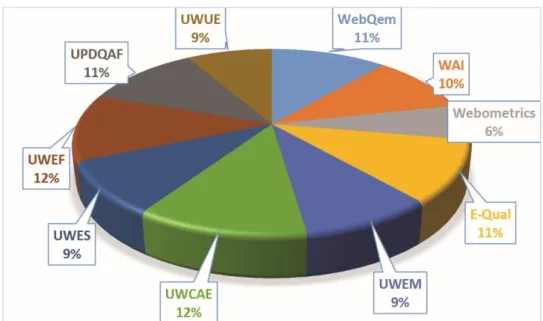
As shown in the table, UWEAC model accounts for the highest overlap percentage with WebQem (0.22). WebQem model has the most overlap with UWEAC (0.22) and UWEF (0.23). Moreover, UPDQAF model has the most overlap (0.24) with the E-Qual model; Out of which, the UWEAC model has the highest mean overlap (0.194) with others. The following chart illustrates this overlap (Figure 1).
Each of the valuated models, which used the overlap formula ((P_i∩ P_j) / (P_i∪ P_j)), and the shares of each of the two models divided by the community by each of them were calculated.
Figure 1: Comparison of the overlap of university website evaluation methods and models
Discussion and Conclusion
Websites have developed for different purposes in a variety of areas such as education in recent years. Apparently, the field of science in the websites is one of the most widely used domains in today's websites. Moreover, educational and research centers and organizations are influenced by virtual environments and are trying to use the World Wide Web to introduce themselves and provide their services to the users. In addition, eeducational organizations and universities use websites for various purposes such as dissemination of educational and research information, online education, students' facilities, and educational and research programs (Alexander & Tate, 1999).
A large number of websites have been launched so that their poor design reduced the number of the users and decreased reputation of the parent organization (Tan & Tung, 2003). Therefore, a proper design of the websites made them useful, user-friendly, accessible, accurate, reliable information, design, and appearance-friendly for enhancing the positive features of websites (Hartmann, De Angeli, & Sutcliffe, 2008). This objective could be achieved by defining the criteria for website evaluation (Gledec, 2005). The evaluation process showed the organization values and objectives and derivation of the evaluation criteria from the core of the organization's objectives. It is notable that the evaluation process has been frequently transformed into the classification process of values and thus helped the managers to take important steps for correcting their educational goals (Kellaghan & Stufflebeam, 2012).
According to some studies, there are many models and methods for evaluating the university website that are unique in terms of features and have specific concepts (Asadi, Nourmohammadi, & Ardali, 2017; Gharibeniazi, Karbala Aghaie Kamran, & Ghaebi, 2015; Sherafat & Davoodi, 2018).
methods for academic websites. Therefore, each of them was represented in this study.
Each of the methods and models of the university website assessment had its own characteristics that could evaluate the university websites in terms of their own characteristics. In each of these methods and models of the university website evaluation, the results showed that some of the main criteria in an evaluation method or model were the subcomponent in another evaluation method or model. Hence, the methods and models for assessing the university websites were Webqem, A new Web assessment index (WAI), Webometrics, E-Qual, Web Usability Evaluation Model(WUEM), Development and Validation of the University Website Evaluation Scale (UWES), University Websites Evaluation and Credibility (UWEAC), University Websites Quality Web Model Development, and University Website Usability Evaluation checklist (UWUE): An exploratory study. the main dimensions in the university website evaluation were usability, functionality, efficiency, accessibility, navigability, speed, content quality, reliability, heuristic-systematic evaluation, web design, validation, web content, usability, content, transaction quality and safety and service interaction quality, impact visibility, excellence, free access and web presence, web design, page design, navigation, accessibility, usability, content quality, reliability, efficiency and functionality, services (student hostel, library information and labs, and workshops) and introduction of the employment agencies), placement information (student information from previous years in colleges, images of the university and its facilities, course syllabus, news, and online admission forms, fess online information), research (information on university research and academic publications), intrinsic dimension, representational and contextual information, accessibility, and usability. Moreover, webometrics was the only method with dimensions of visibility, excellence, free access, and web presence that were distinct from other assessment methods. Other evaluation methods had dimensions and components with overlap. Of these, the UWEAC model with the highest average (0.194) had the most overlap with others.
Therefore, it could be taken into consideration by designers and evaluators of the university websites as a comprehensive model in the university website evaluation. The design principles of the university evaluation were designed to help managers and developers in the processes and criteria that website designers should take to evaluate a university website. These techniques and methods provided an insight into the necessary features and characteristics of the university website and improved the assessment of the university websites. It also helped to detect missing features or poor performance requirements.
Acknowledgement
The authors would like to thank all colleagues in the Department of Knowledge and Information Science, Faculty of Education and Psychology, Alzahra University.
Conflict of Interest The authors declare no conflict of interest.
References
Alexander, J., & Tate, M. (1999). WEB Wisdom. How to Evaluate and Create Information Quality on the WEB. Wolfgram Memorial Library Widener University. Laurence Erlbaum Associates Publishens. Lodon. Mahwah. New Jersey. Apéndice A y B.
Andalib, Z., & Danaee, H. (2013). A study on measuring the quality of university website. Management Science Letters, 3(7), 1955-1960.
Asadi, S., Nourmohammadi, H., & Ardali, M. O. (2017). Evaluation and ranking of book social network websites. International Journal of Information Science and Management, 15(1), 95-108.
Buenadicha Mateos, M., Chamorro Mera, A., Miranda González, F. J., & Rodrigo González López, Ó. (2001). A new Web assessment index: Spanish universities analysis. Internet research, 11(3), 226-234.
Colonna, J.(2012). Development and validation of the University Website Evaluation Scale (UWES): A tool for assessing website user experience on a university website (doctoral dissertation). Retrieved from ProQuest Dissertations and Theses. (3541260)
Doherty, G. D. (2008). On quality in education. Quality Assurance in Education, 16(3), 255-265. doi: doi:10.1108/09684880810886268
Fink, D., & Nyaga, C. (2009). Evaluating web site quality: the value of a multi paradigm approach. Benchmarking: an international journal, 16(2), 259-273.
Galinium, M., Herwanto, P. D., & Purnama, J. (2016). Website Quality Assessment using Gap Analysis: Case Study: SGU Website & SGU Student Portal. International Journal of Applied Engineering Research, 11(15), 8662-8667.
Gharibeniazi, M., Kamran, M. K. A., & Ghaebi, A. (2015). Iranian state university websites. International Journal of Information Science and Management, 13(1), 71-85.
Gledec, G. (2005). Quality Model for the World Wide Web. Paper presented at the 8th International Conference on Telecommunications-ConTEL2005 Zagreb, Croatia.
Hartmann, J., De Angeli, A., & Sutcliffe, A. (2008, April). Framing the user experience: information biases on website quality judgement. In Proceedings of the SIGCHI Conference on Human Factors in Computing Systems (pp. 855-864).
Kang, S., & Norton, H. E. (2006). Colleges and universities’ use of the World Wide Web: A public relations tool for the digital age. Public Relations Review, 32(4), 426-428.
Kaur, R. P., & Goyal, V. (2013, December). Empirically validating a web quality model for academic websites developed in Punjabi and Hindi: A case study. In International Conference on Innovations in Engineering and Technology, International Institute of Engineers (IEE), Bangkok, Thailand (pp. 978-993).
Kaur, S., Kaur, K., & Kaur, P. (2016). An empirical performance evaluation of Universities Website. International Journal of Computer Applications, 146(15), 10-16.
Kellaghan, T., & Stufflebeam, D. L. (2012). International Handbook of Educational Evaluation: Part One: Perspectives/Part Two: Practice (Vol. 9): Springer Science & Business Media.
Korkuvi, L. M. (2015). Dialogic Properties of University Websites: A Case Study of the University of Ghana Website. (Doctoral dissertation, University of Ghana)
Kothainayaki, S. (2014). Web credibility and evaluation of academic websites in Chennai (Doctorate dissertation), Faculty of Science and Humanities, Kancheepuram and Tiruvallur districts of Tamil Nadu.
providing Universities of Asia. Science, Technology and Development, 31(2), 183-192. Mebrate, T. (2010). A framework for evaluating academic website's quality from students'
perspective. (Master thesis, The Netherlands)
Michel, A. M. (2010). A Framework to assess Data Quality in university web portals. (Master thesisi), Delft University of Technology Delft, Netherlands.
Nourozi, A. (2005). Web impact factor and its measurement in some Iranian academic websites. Eduacational& Psychology studied in Ferdowsi Mashhad university, 2(5), 105-121. Olsina, L., & Rossi, G. (2002). A quantitative method for quality evaluation of web sites and
applications. IEEE multimedia, 9(4), 20-29.
Ortega, J., Aguillo, I., Cothey, V., & Scharnhorst, A. (2007). Maps of the academic web in the European Higher Education Area-an exploration of visual web indicators. Scientometrics, 74(2), 295-308.
Rababah, O. M. A., & Masoud, F. A. (2010). Key factors for developing a successful e-commerce website. Communications of the IBIMA. Article ID 763461, 1-9. Retrieved from https://ibimapublishing.com/articles/CIBIMA/2010/763461/763461.pdf
Ramasubramanian, S., Gyure, J. F., & Mursi, N. M. (2003). Impact of internet images: Impression-formation effects of university web site images. Journal of Marketing for Higher Education, 12(2), 49-68.
Sherafat, A., & Davoodi, S. M. R. (2018). Designing a new model for organizational websites evaluation. International Journal of Information Science and Management, 16(1), 49-69. Sweatt, W. W. (2014). The usability of the websites of Alabama's community colleges: an
exploratory study. (Doctoral Dissertation) University of Alabama Libraries.
Tan, F. B., & Tung, L. (2003). Exploring website evaluation criteria using the repertory grid technique: A web designers' perspective. SIGHCI 2003 Proceedings. 10.
https://aisel.aisnet.org/sighci2003/10
Tate, M., Evermann, J., Hope, B., & Barnes, S. (2007, January). Perceived service quality in a university web portal: revising the e-qual instrument. In 2007 40th Annual Hawaii International Conference on System Sciences (HICSS'07) (pp. 147b-147b). IEEE.
Vultur, S. O., & Marincas, D. A. (2007). Web Site Projects Evaluation–A Case Study of Romanian Faculties of Economics Web Sites. Journal of Applied Quantitative Methods, 2(3), 289-301.