An Analytical Approach for Mobility
Load Balancing in Wireless Networks
Sarhan M. Musa
1and Nader F. Mir
21Roy G. Perry College of Engineering, Prairie View A&M University, Prairie View, Texas, USA 2Department of Electrical Engineering, San Jose State University, California, USA
Management of mobility especially balancing the load of handoff for wireless networks is an essential parameter for wireless network design and traffic study. In this paper, we present analytical mobility management in high speed wireless mobile networks focusing on factors such as the number of channel slots and offered load. We demonstrate the performance of handoffs with mo-bility consideration using several metrics including the alteration of states prior to reaching a cell boundary, the speed of mobile terminal, and the distance between a mobile terminal and a cell boundary. We mainly focus on the performance evaluation for the factor of mobility with taking into account the high speed status of a user. Keywords: wireless mobile networks, handoff, mobility management
1. Introduction
With substantial growth in system development for mobile analog and digital cellular telephony, radio paging, and microwave satellite broad-casting, next generation wireless communica-tions systems will require supporting the seam-less delivery of multiple class of traffic. These systems have varying traffic characteristics, end-to-end performance requirement and bandwidth needs. Types of traffic include voice, data, and video in the forms of constants bit rate, avail-able bit rate, variavail-able bit rate, and unspecified bit rate with high quality. Handoff manage-ment wireless mobile communications guaran-teed within networks have become a key factor in the development of mobile networks. While a user moves to a new cell, a wireless termi-nal requests a handoff for new channel in the new cell. Due to that movement, some of the challenging issues are developed such as the in-crease in traffic volumes and demand for high
speed wireless mobile communications call for fast, seamless and high performance handoff in wireless mobile networks. When a wireless terminal moves from one base station cell to another, handoff protocols reroute the existing active connections in the new cell. The future challenges in the next generation of high speed wireless mobile networks are to minimize the packet loss and to provide efficient use of the network resources while maintaining quality of service assurances. Therefore, the performance of efficient management and a successful hand-off operation in mobile wireless networks be-come an important issue.
High performance handoff in wireless systems and successful handoff operation requirements for certain criteria to be achieved was discussed in [1-3]. Issues of quality of service (QoS)
optimiz-ing the QoS of high speed movoptimiz-ing terminals and handoff calls in cellular networks was dis-cussed in[10]. The effect of different mobility patterns on the handoff probability was studied in [11].The purpose of this paper is to present evaluation of handoff probabilities of traffic in next generation of high speed wireless mobile networks.
2. Performance Model and Evaluations
When a wireless terminal moves to a new cell, a handoff request for a new channel is needed. When all of the channels are used or none of them are available for any other reasons, the handoff call has to be terminated or blocked in telecommunication terms. Obviously, blocking probability of a handoff call has become one of the important issues in wireless networks and depends on various factors, such as the availabil-ity of channels, the call arrival rate, the holding time for exchange of channels, etc. However, we use stochastic modeling to analyse the hand-off process. In the handhand-off in non-mobilized situation we categorize all types of traffic intoi
types. There is a considerable area where a call can be handled by base stations in any of the ad-jacent cells[12]. We consider only calls within the handoff area. The handoff process can be modeled by considering the random inter-arrival call time, exponential service time(or holding time of a channel),cchannels and a number of handoff calls and non-handoff calls. Within the base-station, no queuing was considered in the sense that any arrival packets have either to be serviced or to be turned away.
The current manuscript extends our previously published work [13]. In this paper, we de-velop equations to further demonstrate the per-formance of handoffs with mobility considera-tion using several metrics and different realistic mobile speeds including the alteration of states prior to reaching a cell boundary, the speed of mobile terminal, and the distance between a mo-bile terminal and a cell boundary.
Let (λi) be the handoff request rate for traffic
type i ∈ {0,1. . . ,n}which follows a Poisson process, and 1/μi be the mean holding time of
a channel or mean channel exchange time for traffic typeiwithin an exponential distribution.
When (j) channels are busy, handoff calls de-part at ratejμi. When the number of requested
channels reaches the total number of channels available(si), i.e.,j =si, then(si)all channels
are in use and the channel exchange rate issiμi.
In this situation, any new arriving handoff call is blocked since there is no room in the wireless system.
AssumePj is the probability thatjchannel
ex-changes are requested for traffic typei.
Therefore,P0is the probability that no channel exchange is requested for traffic typei, andP1 is the probability that one channel exchange is requested for traffic typei.
Now, the global balance equations can be:λiP0 = μiPi for j = 0 and λiPj−1 = jμiPj for 0 <
j < si. It then follows that: P1 = ρiP0 and
Pj = ρiPjj−1 = ρ j iP0
j! , where ρi =
λi
μi is the
offer load of the system. Knowing that the sum of the probabilities must be one, then,
P0 = s 1 i
j=0 ρji
j!
. Now, by combining P0 and Pj
we can get: Pj = ρ
j i
j!si
j=0 ρji
j!
, so when j = si, all
the channels are busy and any handoff call gets blocked. Thus, the handoff blocking probabi-lity,Pci, is expressed by:
Psi = ρ
si
i
si! si
j=0 ρsi
i j!
. (1)
From equation 1, it is evident that the hand-off blocking probability,Psi, is directly propor-tional to the mean channel exchange time. As the mean holding time increases, the perfor-mance reaches its ideal value. Also, the handoff blocking probability,Psi, can be dropped when the number of available channels increases. This means that the more bandwidth is available in a cell, the less chance a handoff call is blocked. Suppose that a base-station switch in a wireless mobile network supports multiple-class traffic
i in which each traffic type (i) may belong to cluster {0,1, . . . ,n}. To handle differentQoS
frame. Each slot denoted by(si)in a frame
rep-resents the reserved bandwidth for traffic type
(i). Let parameter (k) be the number of active calls in class (i) in (a) independent Bernoulli calls, then the probabilities ofkare given by the binomial probability:
ψi(l) =
a l
ρl
i(1−ρi)a−l, l=0, ...,a, (2)
whereψi(l)is the probability of(k)calls being
active in(a)independent calls for class-itraffic andρi= λi
μi is the offered load of the system in
which(λi)and(μi)are the arrival rate and the
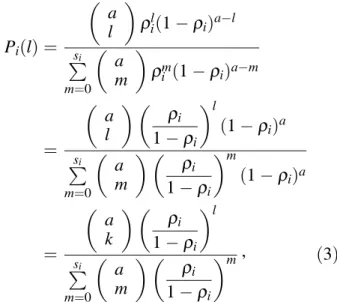
service rate for a call respectively. Since our system is a finite source system, a parameter known astime congestion is introduced. Time congestion is defined as the probability that all the channels in a system are busy[14]. The time congestion or the probability when(l)channels are in use,Pi(l), is the ratio of the probability of
(l)calls of class(i)being active to all the possi-ble probabilities that the number of slot(si)are in use. It can be presented as:
Pi(l) =
a l
ρl
i(1−ρi)a−l
si
m=0
a m
ρm
i (1−ρi)a−m
=
a
l 1−ρiρi
l
(1−ρi)a
si
m=0
a
m 1−ρiρi
m
(1−ρi)a
=
a
k 1−ρiρi
l
si
m=0
a
m 1−ρiρi
m, (3)
wherePi(l), is the probability thatkchannels in class-itraffic are busy.
Using the fact that when all slots of reserved bandwidth (si) are occupied, any new call is
blocked, we can determine the blocking prob-ability of a class-i call by setting k = si as
follows:
Pi(si) =
a si
ρi
1−ρi
si
si
m=0
a
m 1−ρiρi
m , (4)
whichPi(si)is known as the blocking
probabil-ity of class-icalls.
Figure 1 shows the blocking probability of
class-i calls in terms of available number of slots in a frame. We assume the number of calls (a)
in traffic type (i)to be 100 and the number of slots(si)varies from 0 to 100. We observe that
the blocking probabilities can be improved by increasing the number of reserved bandwidth. Also, we know that the effect of decreasing blocking probability can be improved by reduc-ing the offered load as the number of occupied channels can be reduced this way.
Figure 1.Channel blocking probabilityPi(si), versus the available number of slotssi
The blocking probability as a function of sys-tem offered load is shown in Figure 2. Differ-ent pairs of numbers of calls (a) and number
of reserved bandwidths (si) are selected. The
results show obviously that large group sizes can greatly reduce the blocking probabilities for class-icall.
Now, we can consider handoff with mobility situation. Analytical results confirm that the chance of requirement for handoff is dependent on the speed of the mobile terminals and the dis-tance between a mobile user and its cell bound-aries[15-16]. Besides, the fluctuation of states for a mobile unit, whether it is still or mov-ing while carrymov-ing a call in progress, has to be considered for handoff analysis.
In this work, we assume that our handoff model is free of signal strength difficulties and when the vehicle prior to reaching a cell boundary, a vehicle that has a call in progress alternates between periods of being still(at rest or Stop-state)and periods of moving(Go-state). Now, let us define the following:
• State 0 = avehicle is at rest, but has a call in progress.
• State 1 = a vehicle moves with an
aver-age speed ofkmph(m/h)and has a call in progress.
• βxy = the rate at which a system with x
states moves from state x to state y, where
x,y∈ {0,1}follows an exponential random process.
• βx
x = the rate at which the system leaves
statexand remains in statex.
• Px(t) =the probability that a vehicle having
a call in progress is in statexat timet, where
x∈ {0,1}.
• Px(0) =the initial probability of the vehicle
at timet=0.
• Px
x(τ) = the probability that the system
re-mains in statexduring a very short period of timeτ.
• Pyx(τ) =the probability that the system leaves
statex, and then the system enters stateyand remains in stateyduringτ.
• v=the average speed of the vehicle(v=0 in state 0 andv=kin state 1).
• db =the distance a vehicle takes to reach a
cell boundary, ranging from−15 miles to 15 miles.
• o(t) =the vehicle’s position at timet, where
o(0) =0.
• Px(t,db) =the probability that a vehicle in
state x with a call in progress is at the cell boundary at timet, wherex∈ {0,1}.
• P(o(t)≥db) = the probability that a
ve-hicle reaches a cell boundary with speed v
undergoing state 0 and state 1.
The alternation of stop (state 0) and go (state 1) states can be modeled, using a simple state machine with continuous-time Markov chain. For our analysis, we useβ00 = −β1
0 and β11 =
−β0
1. The time in state 0 is an exponential ran-dom variable with mean, 1/β1
0. Also, the time in state 1 is an exponential random variable, with mean, 1/β0
1.
In a continuous-time Markov chain based on a random process, O(t), the transition probabili-ties occur in a very short period of time,(τ).
Pxx(τ) =P(Tx>τ) =eβxxτ
=1− βxxτ
1! +
(βx xτ)2
2! − · · · ≈1−βxxτ.
(5) When the vehicle leaves state (x), the system enters state (y)with probability ϕxy. Thus, the
probability that the system remains in state(y)
during(τ)is:
Pyx(τ) = (1−Pxx(τ))ϕxy. (6) Combining equations(5)and(6), we derive:
Pyx(τ) =βx
xτϕxy =βxyτ. (7)
If we divide equations (5) and(7) by (τ) and take the limit, we get
lim τ→0
Px
x(τ)−1
τ
=−βx x,
and lim
τ→0
Py
x(τ)
τ
=βxy.
(8)
Now, if Py(t)is the state(y) probability of the process at a given timet,Py(t) = P[O(t) = y],
then
Py(t+τ) =P[O(t+τ) =y] =
x P[O(t+τ) =y|O(t) =x]P[O(t) =x] =
x P
y xPx(t).
By subtracting Py(t)from both sides of
equa-tion (9), dividing them by (τ), taking limit of
τ → ∞, and applying the equations in(8), we can derive the Chapman-Kolmogorov equation on continuous-time Markov chain as:
dPy(t) dt =
x=y
βy
xPx(t), (10)
where dPy(t)
dt is the time differential of relative
state(y)probability. The Chapman-Kolmogorov equation for continuous-time Markov chain states that when an exponential random process moves from state(x)to state(y)at a rateβxyand moves
from state(y)to state(x)at rateβx
y, then it will
be given as in equation(10). Now, by applying equation (10) for a system with two states, 0 and 1, we have
dP0(t)
dt =−β01P0(t) +β10P1(t), (11) dP1(t)
dt =β
1
0P0(t)−β10P1(t), (12) where P0(t) and P1(t) are the probability that a vehicle having a call in progress is in state 0 and state 1, respectively, at time t. Knowing the P0(t) + P1(t) = 1, equation (11) can be combined as
dP0(t)
dt + (β
1
0 +β10)P0(t) =β10,P0(0) =P0.
(13)
By knowing that the total solution to the dif-ferential equation consists of a homogenous so-lution,P0h(t), and a particular solution,P0p(t).
Also, dP0h(t)
dt + (β01+β10)P0h(t) = 0, where P0h(0) =P0(0), we can form the general solu-tion of equasolu-tion(13)by:
P0(t) =P0p(t) +P0h(t)
= β10
β1 0 +β10
+
P0(0)− β 0 1 β1
0 +β10
e−(β01+β10)t,
(14) where P0(t) is the probability that the vehicle with a call in progress is in state 0 at timet.
P1(t) =P1p(t) +P1h(t)
= β01
β1 0 +β10
+
P1(0)− β 1 0 β1
0 +β10
e−(β01+β10)t,
(15)
whereP1(t)is the probability that a vehicle with a call in progress is in state 1 at time(t). In the situation for the vehicle to change states be-tween resting and moving, a vehicle moves and stops on a congested path until reaching a cell boundary so,P0(0) =0 andP1(0) =1.
Now, let us consider mobility and handoff in cel-lular networks to show the probability of a call to reach a cell boundary with an average speed
kmph with vehicle at rest and a vehicle moves or the probability requiring a handoff. We as-sume the high speed mobility in miles per hour
(mph)for the interval 65mph ≤k ≤ 100mph. Let us assume that time(t)is a random variable representing a channel holding time, or the time a vehicle takes to reach a cell boundary,db
v , and (db) be the distance a vehicle takes to reach a
cell boundary, ranging from −15 miles to 15 miles. Therefore, the probability that a vehicle reaches a cell boundary with speedvundergoing Stop and Go states(states 0-and-1)is
P(o(t)≥db) =P0
t,db;at t=dvb,v=0
+P1
t,db;at t=dvb,v= k
,
(16)
where
P0
t,db;at t=dvb,v=0
= β10 β1
0 +β10
, (17)
and
P1
t,db; at t= dvb,v=k
= β01 β1
0 +β10
+
P1(0)− β 1 0 β1
0 +β10
e−(β
1 0+β10)db
k .
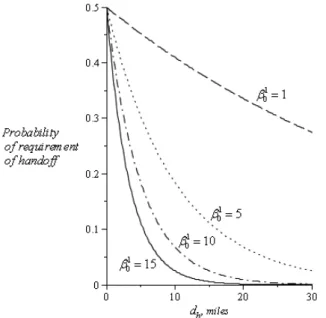
Figure 3.The probability of requiring handoff versus the speed of vehicle versusdbwhenk=65 mph
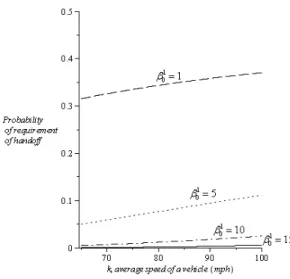
Figure 4.The probability of requiring handoff versus the speed of vehicle versusdbwhenk=100 mph
It is clear from Figures 3 and 4, that, as the cell size increases, the probability of reaching a boundary decreases in an exponential approach. Figures 5 through 8 show the probabilities of requiring handoff versus the speed of vehicle whendb=1, 5, 10, and 15 miles respectively.
The probability of reaching a cell boundary is proportional to the vehicle’s speed. This is true since the increase in vehicle’s speed increases the chance of reaching a cell boundary. Also, from the figures, we observe that as the distance
Figure 5.The probability of requiring handoff versus the speed of vehicle whendb=1 miles
Figure 6.The probability of requiring handoff versus the speed of vehicle whendb=5 miles
Figure 8.The probability of requiring handoff versus the speed of vehicle whendb=15 miles
a vehicle takes to reach a cell boundary, db
in-creases, the probability of requiring a handoff decreases. In addition, from the figures, as β1 0 increases, the probability of requiring a handoff decreases.
3. Conclusion
We presented analytical mobility management and load balancing model of handoff in high speed wireless mobile networks focusing on factors such as the number of channel slots and offered load. The performance results in terms of state probabilities and the probability that a mobile terminal reached a cell boundary were investigated. The mobilized analysis involved a number of issues such as the alternation of states before a mobile unit reached a cell boundary, the distance between the mobile terminal and a cell boundary and the speed of the vehicle. The blocking probabilities can be improved by increasing the number of reserved bandwidth. The effect of decreasing blocking probability can be improved by reducing the offered load. Performance results were also analyzed show-ing that for a vehicle that experienced the change of states, the outcome chance of reaching a cell boundary was proportional to the distance in between the mobile terminal and a cell bound-ary and inversely proportional to the speed of the vehicle. Our other observation was that the probability of handoff blocking reduced with increased number of available channels.
References
[1] J. NAYLON, D. GILMURRAY, J. PORTER, A. HOPPER.
Low-latency handover in a wireless ATM LAN. IEEE Journal on Selected Areas in Communication, 16(1998), pp. 909–921.
[2] A. ACHARYA, S. BISWAS, L. FRENCH, J. LI, D. RAY
-CHAUDHURI. Handoff and location management in mobile ATM networks. Proceedings of the 3rd International Conference on Mobile Multimedia Communication,September(1996).
[3] A. ACHARYA, J. LI, B. RAJAGOPALOAN, D. RAY -CHAUDHURI. Mobility management in wireless
ATM networks.IEEE Communications Magazine, (1997), pp. 100–109.
[4] Y. FEI, V. W. WONG, V. C. LEUNG.Efficient QoS
provisioning for adaptive multimedia in mobile communication networks by learning.Mobile Net-works and Applications,11(2006), pp. 101–110. [5] J. G. GUZMAN, J. M. BAUSET, V. PLA. Performance
bounds for mobile cellular networks with handover prediction, Management of Multimedia Networks and Services, Springer Berlin/Heidelberg,(2005), pp. 35–46.
[6] R. ZANDER, J. M. KALSSON. Combining bandwidth
borrowing and reservation in cellular networks. International Journal of Wireless Information Net-works,12(2005), pp. 187–201.
[7] G. H. MA, A. Y. ZOMAYA. An efficient channel allocation scheme for cellular network using max-imum channel packing.Wireless Communications and Mobile Computing, 4(2004), pp. 683–692. [8] K. Q. TIAN, D. C. COX. Mobility management in
wireless networks: data replication strategies and applications, Kluwer Academic Publishers, New York,(2004).
[9] A. R. MOMEN, P. AZMI. Stochastic vehicle mobility with environmental condition adaption capability. Wireless Communications and Mobile Computing, 9(2008), pp. 1070–1080.
[10] K. IOANNOU, S. KOTSOPOULO, P. STAVROULAKIS.
Optimizing the QoS of high speed moving termi-nals in cellular networks.International Journal of Communications systems,16(2003), pp. 851–863. [11] D. BANSAL, A. CHANDRA, R. SHOREY, A. KUL
-SHRESHTHA, M. GUPTA. Mobility models for cellular
systems: cell topography and handoff probability. Proceedings of IEEE 49thConference on Vehicle Technology,(1999), pp. 1794–1798.
[12] Y. LIN, S. MOHAN, A. NOERPEL. Queueing
prior-ity channel assignment strategies for PCS handoff and initial access.IEEE Transactions on Vehicular Technology, 43(1994), pp. 704–712.
[13] M. Y. CHOY, N. F. MIR. Performance modeling of
[14] J. BELLAMY. Digital Telephony,John Wiley& Sons,
Inc.,(1991), pp. 495–496.
[15] S. S. RAPPAPORT. The Multiple-call hand-off prob-lem in high-capacity cellular communication Sys-tem. IEEE Transactions on Vehicular Technology, 40(1991), pp. 546–557.
[16] S. NANDA. Teletraffic models for urban and
subur-ban microcells: cell sizes and handoff rates.IEEE Transactions on Vehicular Technology, 42(1993), pp. 673–682.
Received:June, 2010
Revised:April, 2011
Accepted: October, 2011
Contact addresses:
Sarhan M. Musa Roy G. Perry College of Engineering Prairie View A&M University Prairie View Texas e-mail:[email protected]
Nader F. Mir Department of Electrical Engineering San Jose State University California e-mail:[email protected]
SARHANM. MUSAearned his Ph. D. degree in Electrical Engineering from City University of New York, NY. Dr. Musa is currently an as-sociate professor in the Engineering Technology department of Prairie View A&M University, Texas. He has been director of Prairie View Networking Academy(PVNA), Texas since 2004. From 2009 to 2010, Dr. Musa was a visiting professor in the Department of Electrical and Computer Engineering at Rice University, Texas. His research interests include computational methods in nanotechnology, computer commu-nication networks, and numerical modeling of electromagnetic systems. He currently serves on the Editorial Board of Journal of Modern Ap-plied Science, and he is a senior member of the Institute of Electrical and Electronics Engineers(IEEE). He is also a 2010 Boeing Welliver Fellow.
NADERF. MIRis currently a Professor, and has served as the Associate Chairman, at the Electrical Engineering Department of San Jose State University, California. In the meantime, he serves as the Director of MSE Program in optical sensors and networks for Lockheed-Martin Space Systems Corporation for the University. He is also an expert in intellectual property development and a consultant for patent liti-gation cases in the areas of communications, telecommunications and computer networks at both the protocol and hardware levels. Prior to his current position, he was an associate professor at his cur-rent school, and assistant professor at the University of Kentucky in Lexington. From 1994 to 1996, he was a research scientist at the Ad-vanced Telecommunications Institute, Stevens Institute of Technology in New Jersey working on design of advanced communication systems and high-speed computer networks. From 1990 to 1994 he was with the Computer and Communications Research Center at Washington University in St. Louis and worked as a research assistant on design and analysis of high-speed switching systems project. From 1985 to 1988, he was with Telecommunication Research & Development Cen-ter(TRDC), Surrey, and as a telecommunications system research & development engineer, participated in the design of a high-speed digi-tal telephone Private Branch Exchange"(PBX), and received the best “design/idea” award.
Professor Mir is internationally known through his research, scholarly work, and his books in the areas of: analysis of computer communi-cation networks, internet applicommuni-cations of voice over IP and multimedia networks, design and analysis of networking devices and high-speed routers, wireless and mobile networks and wireless sensor networks, applications of integrated circuits in computer communications. Dr. Mir has published two successful books, one of which is a world-wide adopted university text-book entitled “Computer & Communica-tion Networks” published by Prentice Hall Publishing Co. He has also published numerous refereed technical journal and conference papers, all in the field of communications and networking.
He was granted a successful U.S. Patent in 2006, claiming an invention related to hardware/protocol for use in high-speed computer commu-nication networks.
He has several journal editorial positions such as: the Editor of Journal of Computing and Information Technology, a Guest Editor for Com-puter Networking at CIT Journal(in 2008), the Editorial Board Member of the International Journal of Internet Technology and Secured Trans-actions(in 2005), and the technical Editor of IEEE Communication Magazine. He is a senior member of the IEEE and has also served as the member of technical program committee and steering committee for a number of major IEEE communications and networking conferences such as WCNC, GLOBECOM, and ICC.
Dr. Mir has received a number of prestigious national and university awards and research grants. He is also the recipient of a university teaching recognition award and a research excellence award. He is also the recipient of a number of outstanding presentation awards from leading international conferences.