Dr A.Kalyani et al JMSCR Volume 07 Issue 12 December 2019 Page 183
Management and Outcome of Acute Abdomen
Authors
Dr A.Kalyani1, Dr G.Sree Lakshmi Prasanna2, Dr Y.Vamsee Priya3, Dr K.Vamsi Krishna4
1
Associate Professor, 2,3,4Postgraduate
Department of Surgery, Andhra Medical College, Visakhapatnam, Andhra Pradesh, India Abstract
Background: The term acute abdomen refers to symptoms and signs of intraabdominal diseases usually treated best by surgical procedure. Some diseases, which do not require surgical treatment, produce abdominal pain, so we should evaluate the patients with abdominal pain methodically and carefully. Treatment of patients with acute abdominal pain requires an accurate decision about the need for surgical procedure. The term “acute abdomen” doesn't always imply that it should be managed by a surgical procedure. An accurate diagnosis can be made usually only after surgery. The majority of cases of severe abdominal pains that seen in patients who have been apparently well recently, and that last more than six hours, are caused by conditions of surgical importance.
Materials and Methods: This study includes 70 patients presenting with acute abdominal pain. Sampling was done to study the incidence of non-traumatic causes of acute abdominal conditions presenting to the emergency department. Inclusion criteria were patients who gave consent to participate in the study, patients with a history of acute onset of abdominal pain, positive findings on ultrasonography of abdomen, and X-ray erect abdomen.
Results: All patients presented with acute pain abdomen The males outnumbered the females in the ratio of 3.11:1.
Maximum number of cases 18 (25.71 %) occurred in the age group 41-50 years.
The common cause of acute abdomen was hollow viscus perforation in 25 cases (35.71 %).All patients who underwent emergency laparotomy and were managed according to the etiology. There was significant postoperative wound infection in 11 cases (15.71 %).There was mortality in 5 cases (7.14%) of the total 70 patients that were studied. Delayed presentation of the patient with hypotension, comorbid diseases increases the rate of morbidity and mortality.
Conclusion: Acute abdomen is one of the common surgical emergency encountered by any surgeon. Appropriate approach to diagnose is mandatory. Acute appendicitis is the most common cause of abdominal surgical emergency.
Keywords: Acute abdomen, Emergency surgery, Complications.
Introduction
Acute abdomen results due to acute change in the condition of any of the intraabdominal organs, usually related to infection or inflammation, demands urgent and accurate diagnosis in those presenting with acute abdominal pain for less than 6-8 hours.
It accounts for about 5-10% of all emergency department visits.
Cope in 1921 wrote, ‘The majority of severe abdominal pain which ensure in patients who have been previously fairly well and which lasts atleast 6 hours are caused by conditions of surgical importance’.
Dr A.Kalyani et al JMSCR Volume 07 Issue 12 December 2019 Page 184 Good outcome in the treatment of acute abdomen
depends largely on early diagnosis with early intervention and good post-operative care.
The syndrome of acute abdominal pain generates a large number of hospital visits and may affect any age, either sex and any socio-economic group. History remains the most useful tools in the diagnosis of gastrointestinal disease, and the art of physical examination is of great importance in the diagnosis of abdominal pain.
Assessment of the patient who has an acute abdomen culminates in deciding whether the patient should be subjected to the risk of general anesthesia for the open operation.
The aim of the study is to know the various modes of clinical presentation of acute abdomen and their surgical management with postoperative complications.
Aims & Objectives
➢ To study age and sex distribution.
➢ To study the various etiologies & modes of clinical presentation of acute abdomen. ➢ To study the diagnosis & surgical
management and postoperative
complications.
Materials & Methods
All the patients attending OP with ACUTE ABDOMEN and admitted to surgery wards in Andhra Medical College, King George Hospital , Visakhapatnam .
This study comprises a detailed clinical cross sectional study of 70 patients consecutively operated for acute abdomen of different etiologies. The materials for the clinical study were collected from cases admitted in King George Hospital, Visakhapatnam. The study was conducted from January 2017 to April 2018.
Patients in age group of 18 years and above of either sex were selected, who were consecutively operated, excludingtraumatic, gynecological causes.
Inclusion Criteria
➢ Patients presenting with symptoms and signs of acute abdomen.
➢ Adults (patients above age 18 years). ➢ Of these patients only those who need
surgery were included.
➢ HIV, HBs Ag patients and other vulnerable patients included in this study
Exclusion Criteria
➢ Children below 18 years age. ➢ Acute abdomen due to trauma.
➢ Obstetric and gynecological cases were excluded from this study.
➢ Adult patients who were managed conservatively, who refuses Operative treatment were excluded in the study. ➢ Medical causes of acute abdomen ➢ Cases managed conservatively.
These patients with history of sudden onset of pain abdomen, vomiting, fever were examined. They were found to have tenderness/guarding/ rigidity, distension of abdomen are diagnosed as acute abdomen and subjected for evaluation. The investigation done in the cases selected for study were the following:
1) Routine blood examination including Hb%, TC, DC, ESR, blood groping, HIV / HBSAg. 2) RBS, blood urea, serum creatinine and serum
electrolytes.
3) Urine examination including albumin, sugar and microscopy.
4) X-ray erect abdomen to detect free gas under diaphragm or multiple air fluid levels or ground glass appearance.
5) 4 quadrant abdominal paracentesis.
Dr A.Kalyani et al JMSCR Volume 07 Issue 12 December 2019 Page 185 Results
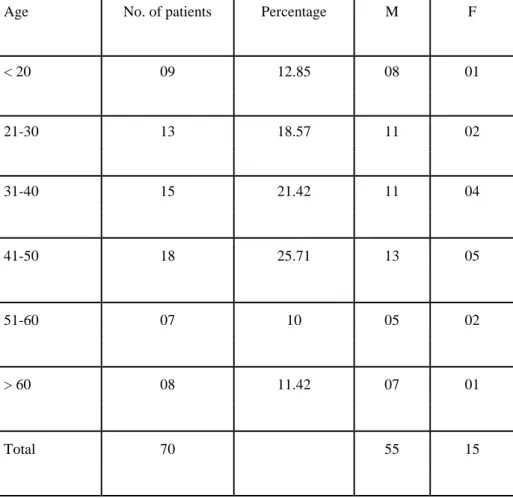
This clinical study of 70 cases of acute abdomen were analysed as follows: Table 1 : Age Distribution in acute abdomen:
Age No. of patients Percentage M F
< 20 09 12.85 08 01
21-30 13 18.57 11 02
31-40 15 21.42 11 04
41-50 18 25.71 13 05
51-60 07 10 05 02
> 60 08 11.42 07 01
Total 70 55 15
Interpretation
In our study the common age group was between 41-50 year (25.71%) of 18cases followed by 31-40 years (21.42%) of 15 cases and 21-30 years
(18.57%) of 13 cases and < 20 year (12.85%) of 09 cases. 65% of patients were between 21-50 years.
12.85
18.57
21.42
25.71
10. 11.42
0. 17.5 35. 52.5 70.
< 20 21-30 31-40 41-50 51-60 > 60
F M
Dr A.Kalyani et al JMSCR Volume 07 Issue 12 December 2019 Page 186 Table 2 : Sex Distribution in acute abdomen
Sex No. of cases Percentage
Male 55 78.5
Female 15 21.5
Total 70 100
Interpretation
In our study male constituted 55 cases (78.5%) and female 15 cases (21.5%) with sex ratio 3.66:1 (Male : Female).
Table 4 : Etiology of acute abdomen
Etiology No. of cases Percentage
Perforation
DU 15 21.42
Gastric 6 8.57
Ileal 4 5.71
Appendicitis 23 32.8
Male 78% Fem
Dr A.Kalyani et al JMSCR Volume 07 Issue 12 December 2019 Page 187
Intestinal obstruction
SBO 13 18.57
LBO 6 8.57
Meckels diverticulitis 3 4.28
Total 70 100
DU : Duodenal ulcer perforation, ILEAL: Ileal perforation,
GUP :Gastric perforation,
SBO : Small bowel obstruction, LBO: large bowel obstruction.
In our study perforation of the hollow viscus is the commonest cause of acute abdomen with 25 cases (35.71%) which comprises of DU perforation 15
cases (21.42%), gastric perforation 6 cases (8.57%) and ileal perforation 4 cases (5.71%). Acute appendicitis were 23 cases (32.8%) and intestinal obstruction 19 cases (27.14%) which included small bowel obstruction 13 cases 18.57% and large bowel obstruction 6 cases 8.57%. Meckels diverticulitis was found in 3 cases with 4.28%.
35.7
32.8
27.14
4.28 0.
17.5 35. 52.5 70.
Perforation Appendicitis Intestinal obstruction Meckels diverticulitis
Dr A.Kalyani et al JMSCR Volume 07 Issue 12 December 2019 Page 188 Table 8: Treatment of various acute abdomen
Etiology Operations No. of cases Percentage
D.U.P Closure of perforation with omental 15 100
Patch
G.U.P Closure of perforation with omental 6 100
Patch
I.P Closure of perforation with omental 4 100
Patch
Appendicitis Appendicectomy:open 23 100
Intestinal Resection anastomosis 8 42.1
Obstruction Band release 3 15.78
Ileo-transverse anastomosis 4 21.05
Adhesiolysis 4 21.05
Meckels
diverticulitis Resection and anastomosis 3 100
Interpretation
In our study of acute abdomen which included 15 cases of DUP and all underwent (100%) closure of perforation with omental patch, 6 cases of GUP and all underwent closure of perforation with omental patch (100%), 4 cases of ileal perforation and all underwent closure of perforation with omental patch (100%), Out of 23 cases of acute appendicitis all underwent open appendicectomy 100%.
Out of 19 cases of intestinal obstruction 8 patients underwent resection anastomosis (42.1%), 3 patient band release (15.78%), and 4 patient with ileo-transverse anastomosis (21.05%) and 4 patients underwent adhesiolysis (21.05%).
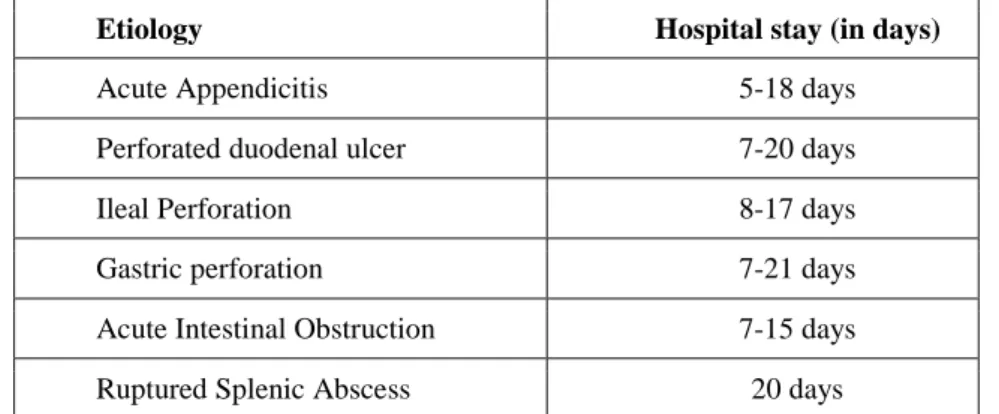
Dr A.Kalyani et al JMSCR Volume 07 Issue 12 December 2019 Page 189 Table –5: Duration of hospital stay:
Etiology Hospital stay (in days)
Acute Appendicitis 5-18 days
Perforated duodenal ulcer 7-20 days
Ileal Perforation 8-17 days
Gastric perforation 7-21 days
Acute Intestinal Obstruction 7-15 days
Ruptured Splenic Abscess 20 days
Table 10: Postoperative complications in acute abdomen
Aetiology
No. of Wound Respiratory Incisional Intestinal
Hypotensi on
Fecal
Septicae cmia
Mortalit y
cases infection infection Hernia obstruction fistula
D.U.P 15 6 2 02 - 2 - 1 1
GUP 6 2 2 - - - 1
IP 4 1 - - - 1 1 2 1
Appendicitis 23 2 - - - -
Intestinal 19 - - 03 - - - 2 2
obstruction
Meckel’s
diverticulitis 3 - - - -
Total 70 11 4 5 - 3 1 5 5
Interpretation
In our study morbidity of operated cases of acute abdomen in the form of wound infection in 11 cases (15.71%), respiratory infection 4 cases (5.71%), hypotensive shock in 3 cases (4.28%), incisional hernia in 5 cases (7.14%). Fecal fistula
in 1 case (1.42%), septicaemia in 5 cases (7.14%). Intestinal obstruction was not observed.
Dr A.Kalyani et al JMSCR Volume 07 Issue 12 December 2019 Page 190 were explored. Patients with respiratory tract
infection were treated conservatively.
Discussion
This was a clinical cross sectional study of 70 operated cases of acute abdomen admitted to KingGeorge Hospital, Visakhapatnam. The study was conducted from January 2017 to April 2018.
All patients presented with acute pain abdomen.
The males outnumbered the females in the ratio of 3.11:1.
Maximum number of cases 18 (25.71 %) occurred in the age group 41-50 years. Common cause of acute abdomen was hollow viscus perforation in 25 cases (35.71 %).
All patients underwent emergency laparotomy and were managed according to the etiology.
There was significant postoperative wound infection in 11 cases (15.71 %).
There was mortality in 5 cases (7.14%) of the total 70 patient that were studied. Delayed presentation of the patient with hypotension, comorbid diseases,Increases the rate of morbidity and mortality.
Hollow Viscus Perforation
Age incidence of hollow viscus perforation Dandapat et al (1991) studied 340 cases of
perforation and analysed the age incidence as < 20 year (14.71%) 21-30 year (22.94%), 31-40 year (38.24%) and >40 years (24.12%).
In our study of 25 Hollow viscus perforation occurred in 20 years age group were 2 (8%), 21-30 year 3 patient (12%), 31-40 year were 8 cases (32%) and > 40 years were 12 cases (48%) comparable to previous study.
Sex incidence in cases of hollow viscus perforation
Dandapat et al (1991) stated that out of 340 case there were 304 male patient (89.41 %) and 36 female patient (10.59 %) with sex ratio of 8.4:1. In our study of
perforation there were 20 male patients (80 %) and 5 female patient (20 %). In the sex ratio of 4:1.
Post operative complications in cases of hollow viscus perforation
S.K. Nair et al in 1981 studied post operative complications of hollow viscus perforation there were wound infection in 52%, respiratory infection 4%, intestinal obstruction in 4%, fecal fistula in 16% and septicaemia in 8%.
In our study of 25 cases of hollow viscus perforation there were 9 cases with wound infection (36%), respiratory infection in 4 cases (16%), incisional hernia 2 cases (8%), hypotension in 3 cases (12%), faecal fistula in 1 case (4%) and septicemia in 3 cases (12%).
Intestinal Obstruction a) Age incidence
In the present series out of 19 intestinal obstruction the age distribution in the form of < 20 yrs 1 case (5.26%), 31-40 yrs 5 cases (26.3%), 41-50 yrs consist of 6 cases (31.57%), 51-60 yrs with 7 cases (36.8).
b) Sex incidence:
In our study out of 19 cases of intestinal obstruction there were 13 male patients (68.42%) and 6 female patients (31.57%) with male : female ratio of 2.16:1.Which was compared to following study Shakeeb et al (1975) who has stated the sex ratio at 3 : 1. K.P. Rao et al (1982) stated at 3.7: 1. C) Causes of intestinal obstruction:
Shakeeb et al stated the various causes of intestinal obstruction at adhesion 32.7%, hernia 17.5%, K.P. Rao et al stated volvulus (14.5%) and strangulation
In the present study we had 8 cases of adhesions (42.10%), 2 cases of hernia (10.52%), 7 case of volvulus (36.8%) and 2 case of strangulation (10.52%)
Acute Appendicitis
a) Age incidence in appendicitis
Dr A.Kalyani et al JMSCR Volume 07 Issue 12 December 2019 Page 191 In our study there were 10 cases below 20 yrs
(43.4%), 7 cases between 21-30 yrs (30.4%), 3 cases between 31-40yrs (13.4%), 2 case between 41-50 yrs (8.69%) and 1 case > 50 yrs (4.34%). b) Sex incidence
In our study of 23 cases of acute appendicitis there were 18 male case (78.26%) and 5 female cases (21.73%) the sex ratio male to female was 3.6 : 1.
Which was compared to Bhatnagar reports at 3 : 1.
Conclusion
➢ From our study of 70 clinical cross sectional operated cases of acute abdomen following can be concluded.
➢ Most common age group seen in 41-50 years .
➢ There was male preponderance with male : female ratio of 3.11:1.
➢ The most common symptoms - signs are pain abdomen, vomiting and guarding, rigidity.Hollow viscus perforation was the most common condition seen in our study with 25 cases (35.7 %) in that duodenal perforation was common.
➢ Other causes includes acute appendicitis (23) intestinal abstraction (19) Meckel’s diverticulitis (3).
➢ Use of x-ray erect abdomen along with USG of the abdomen helps in clinching the diagnosis in acute abdomen.
➢ Patients who presented late, with poor general condition and hypotension, undergoing delayed surgery have increased the morbidity and mortality.
➢ Our clinical diagnosis proved correct intraoperatively. Therefore, exception in 9 cases, we consider clinical diagnosis is accurate in 88% of acute abdomen.
➢ From this study it is found that early presentation, early diagnosis, good pre-operative resuscitation, timely surgical intervention, good post operative care is
essential in all cases of acute abdomen to reduce mortality.
References
1. Kauffman GL, Jr. Acute abdomen In : Corson JD Williamson RCN. editors surgery Mosby, UK 2001;3:3.1 to 3:3.14. 2. Cordell WH, Keenek K, Gilles BK et al.
The high prevalence of pain in emergency medical care. Am J Emerg Med 2002;20:1965-1969.
3. Burke, Michel, Hosp Med 2002;Feb:104-105.
4. Beniwal Udai Singh et al. Comparative study of operative procedure in typhoid perforation. Indian J Surg 2003;65(2):172-76.
5. Das S. A manual on clinical surgery 5th edition. Dr. S. Das Calcutta. 2003;382-395.
6. Glasgow RE, Milvihill SJ. Abdominal including the acute abdomen In : Feldman M, Friedman LS, Slersenger MH.
Sleisenger and Fordtram’s.
Gastrointestinal and liver diseas pathophysiology/diagnosis/management, Saunders Pennsylvania. 2002;71-83. 7. Brown SP. The peritoneum, the mesentery
and the greater omentum and acute abdomen. In: Burnand KG, Young AE. The new airds companion in surgical studies. Churchill living stone Great Britain 1998;693-762.
8. Mayumi T, et al. The Practice Guidelines for Primary Care of Acute Abdomen2015. Jpn J Radiol., 2015 Dec 18. (Epub ahead of print)
9. Hagos M. Acute abdomen in adults: A two year experience in Mekelle, Ethiopia. Ethiop Med J., 2015; 53: 19-24.
Dr A.Kalyani et al JMSCR Volume 07 Issue 12 December 2019 Page 192 doi: 10.1136/emermed-2015-204754.
(Epub ahead of print)
11.Frei P. Differential diagnosis of abdominal pain. Praxis, 2015; 104: 959-65.
12.Żyluk A, Jagielski W. An Uncommon Course of Acute Appendicitis with Sepsis - A Case Report. Pol Przegl Chir., 2015; 87: 272-6.
13.Sule AZ, Ajibade A. Adult large bowel obstruction: a review of clinical experience. Ann Afr Med., 2011; 10: 45-50.
14.Haridimos Markogiannakis, Evangelos Messaris, Dimitrios Dardamanis. Acute Mechanical Bowel Obstruction: Clinical presentation, etiology, management and
outcome. World journal of
Gastroenterology, 2007; 13: 432-437. 15.Gatsoulis N, Roukounakis N, Kafetzis I,
Mavrakis G. Surgical management of large bowel obstruction due to colonic cancer. Tech colo- proctol., 2004; 8: s82-4.