original article
Mucus Clearance and Lung Function
in Cystic Fibrosis with Hypertonic Saline
Scott H. Donaldson, M.D., William D. Bennett, Ph.D., Kirby L. Zeman, Ph.D., Michael R. Knowles, M.D., Robert Tarran, Ph.D., and Richard C. Boucher, M.D.
Fromthe University of North Carolina at
Chapel Hill Cystic Fibrosis Research and Treatment Center (S.H.D., W.D.B., M.R.K., R.T., R.C.B.) and the Center for Environ-mental Medicine, Asthma and Lung Biol-ogy (W.D.B., K.L.Z.) — both in Chapel Hill. Address reprint requests to Dr. Donaldson at 6019 Thurston Bowles Bldg., CB# 7248, University of North Carolina at Chapel Hill Research and Treatment Center, Chapel Hill, NC 27599, or at scott_donaldson@med. unc.edu.
Drs. Donaldson and Bennett contributed equally to this article.
N Engl J Med 2006;354:241-50. Copyright © 2006 Massachusetts Medical Society. A B S T R A C T
background
Abnormal homeostasis of the volume of airway surface liquid in patients with cys-tic fibrosis is thought to produce defects in mucus clearance and airway defense. Through osmotic forces, hypertonic saline may increase the volume of airway sur-face liquid, restore mucus clearance, and improve lung function.
methods
A total of 24 patients with cystic fibrosis were randomly assigned to receive treat-ment with inhaled hypertonic saline (5 ml of 7 percent sodium chloride) four times daily with or without pretreatment with amiloride. Mucus clearance and lung func-tion were measured during 14-day baseline and treatment periods.
results
Long-term inhalation of hypertonic saline without pretreatment with amiloride (i.e., with placebo pretreatment) resulted in a sustained (≥8 hours) increase in 1-hour rates of mucus clearance, as compared with those with amiloride pretreatment (14.0±2.0 vs. 7.0±1.5 percent, respectively; P = 0.02) and increased 24-hour rates of mucus clearance over baseline. Furthermore, inhalation of hypertonic saline with placebo improved the forced expiratory volume in one second (FEV1) between the base-line period and the treatment period (mean difference, 6.62 percent; 95 percent confidence interval, 1.6 to 11.7; P = 0.02), whereas hypertonic saline with amiloride did not improve FEV1 (mean difference, 2.9 percent; 95 percent confidence interval, −2.2 to 8.0; P = 0.23). Forced vital capacity (FVC), the forced expiratory flow between 25 and 75 percent of FVC (FEF25–75), and respiratory symptoms also significantly im-proved in patients treated with hypertonic saline and placebo, whereas the residual volume as a proportion of total lung capacity (RV:TLC) did not change in either group. A comparison of the changes in lung function in the two groups showed no significant difference. In vitro data suggested that sustained hydration of airway surfaces was responsible for the sustained improvement in mucus clearance, where-as inhibition of osmotically driven water transport by amiloride accounted for the observed loss of clinical benefit.
conclusions
M
ucus clearance defends the lung against inhaled bacteria. The efficiency of mucus clearance depends on an ade-quate volume of airway surface liquid (i.e., hydra-tion).1One hypothesis for the pathogenesis of lung disease in patients with cystic fibrosis is that a lack of regulation of sodium absorption and chloride secretion causes depletion of airway sur-face liquid, slows mucus clearance, and promotes the formation of adherent mucus plaques on air-way surfaces. Mucus plaques and plugs obstruct airways and provide the nidus for infection.2,3
On the basis of this hypothesis, therapies that increase the volume of airway surface liquid, and hence mucus clearance, should improve lung dis-ease in patients with cystic fibrosis. Inhaled hy-pertonic saline has been shown to produce short-term stimulation of mucus clearance4,5
and, in separate studies, to improve lung function.6,7
In vitro studies with normal human airway epithelia demonstrated that hypertonic saline increases the volume of airway surface liquid, but the ef-fects were transient and, therefore, predicted to be of limited therapeutic benefit.8
These in vitro studies, however, demonstrated that slowing the absorption of sodium with amiloride, a sodium-channel blocker, significantly extended the dura-tion of the increase in the volume of airway surface liquid. We tested the hypothesis that pretreatment with amiloride would extend the duration of hypertonic saline–induced accelera-tion of mucus clearance and enhance improve-ment in lung function in patients with cystic fibrosis.
m e t h o d s
study design
The study protocol was approved by the Univer-sity of North Carolina Committee on the Protec-tion of Rights of Human Subjects, and written informed consent was obtained. Patients were enrolled between January 2001 and February 2004. Inclusion criteria included an established diag-nosis of cystic fibrosis, an age of at least 14 years, and a forced expiratory volume in one second (FEV1) of 50 percent or more of the predicted value after bronchodilation. Exclusion criteria in-cluded unstable lung disease (as evidenced by the administration of intravenous antibiotics within four weeks before screening, a change of medical regimen within two weeks before screening, or
an FEV1 ≥15 percent below the best clinical value during the previous six months), evidence of re-active airways (>15 percent response to broncho-dilation or clinical diagnosis of asthma), and the use of hypertonic saline within two weeks before screening. (For details, see the Supplementary Appendix, which is available with the full text of this article at www.nejm.org.)
After screening, patients with cystic fibrosis entered a 14-day baseline observation period (Fig. 1), after which they were randomly assigned in a 1:1 distribution to pretreatment with either amiloride (at a dose of 1 mg per milliliter in 4.5 ml of 0.12 percent sodium chloride [Sifavitor]) or taste-masked placebo (at a dose of 0.25 mg of quinine sulfate per milliliter in 4.5 ml of 0.12 percent sodium chloride [DSM Minera]) before the administration of 7 percent sodium chloride (at a dose of 5 ml). Aerosols were delivered four times daily with the use of a Pari LC Star nebu-lizer and Pari Proneb Ultra compressor (Pari). Albuterol (at a dose of 180 μg) was administered with a metered-dose inhaler with a spacer 30 to 60 minutes before the administration of study medications.
study outcomes
The prespecified outcomes of the primary study were the percentage changes in FEV1 and forced vital capacity (FVC) during the treatment period. Secondary outcomes were the rates of mucus clearance, the forced expiratory flow between 25 and 75 percent of FVC (FEF25–75), the ratio of re-sidual volume to total lung capacity (RV:TLC), and quality of life. The latter was measured with the Cystic Fibrosis Questionnaire for teens and adults, in which domain scores range from 0 to 100, with higher scores reflecting better perceived health status.9
Whole-lung mucus clearance was measured, as previously described,10,11 four times during the
clear-ance, calculated from the average of measurements at 10-minute intervals, served as the primary index of mucociliary clearance. Patients returned 24 hours after the administration of radioisotopes to measure the cumulative mucus clearance.
For comparison, data describing mucus clear-ance were collected from 15 healthy, nonsmoking adults (mean [±SD] age, 25.6±3.9 years; FEV1, 103±9.8 percent of the predicted value) with the use of identical techniques, except that healthy subjects received pretreatment with normal sa-line (2.5 ml over a period of 30 minutes, delivered by de Vilbiss 646 nebulizer), rather than with alb-uterol. Neither the administration of albuterol in patients with cystic fibrosis nor saline by nebu-lizer in controls was expected to affect mucus clearance.12
Spirometric and plethysmographic measure-ments of lung volumes were performed accord-ing to American Thoracic Society standards,13
and the percentage changes during baseline and treatment periods were calculated. Spirometric measurement was also performed two hours af-ter the administration of study medications on day 15 and day 28 and compared with values be-fore administration. Quantitative sputum cultures and serum chemical profiles were performed be-fore and at completion of the treatment period.
In vitro experiments were performed using bronchial epithelia obtained and cultured as pre-viously described.2 Airway surface liquid was
la-beled with 2 mg of Texas red dextran per milli-liter in 20 μl of phosphate-buffered saline, and the volume of airway surface liquid was moni-tored by axial confocal microscopy.2 Sodium
chloride (at a dose of 0.8 mg) with or without amiloride (final concentration, 400 μM) was added (in perfluorocarbon) to the mucosal surface of epithelial cultures from patients with cystic fibrosis and from controls. The volume of airway surface liquid was serially measured before and after the addition of sodium chloride. The con-tribution of chloride transport by the cystic fibro-sis transmembrane conductance regulator (CFTR) to the change in the volume of airway surface liquid in normal epithelia after the administra-tion of sodium chloride was assessed by pretreat-ing cultures with a CFTR inhibitor (CFTRinh-172 at a concentration of 5 μM)14 or by substituting
the impermeant anion gluconate for chloride (3.0 mg of sodium gluconate with 20 mM of cal-cium chloride to maintain calcal-cium activity15).
The effect of amiloride on transepithelial water transport was measured by the addition of mannitol (at a concentration of 300 mM in 100 μl of phosphate-buffered saline) with or without amiloride (at a concentration of 400 μM) to the apical surface of airway epithelial cultures from patients with cystic fibrosis to generate an os-motic driving force. Water flow was quantitated by measuring the resulting change in serosal bath fluorescence.16 (Additional in vitro methods are
described in the Supplementary Appendix.)
statistic al analysis
Sample size was based on the ability to detect a treatment effect equal to 1 SD of the FEV1. A sam-ple size of 16 patients per group provided 80 per-cent power to detect this treatment effect with the use of a two-sided test (α = 0.05). We antici-pated a reduced variance and an increase in power because two FEV1 measures were averaged to produce each end of interval values.
Univariate data analyses were performed with the use of paired or unpaired two-sided t-tests, as appropriate, with a P value of 0.05 or less ac-cepted as indicating significance. Patients who had undergone randomization and who had re-ceived at least one dose of study medication and contributed any data during the treatment inter-val were included in a modified intention-to-treat analysis.
For studies of mucus clearance, the ratio of particle deposition in central regions of the lung, as compared with peripheral regions (C:P ratio), was calculated for each mucus-clearance scan. The 1-hour and 24-hour mucus-clearance rates were calculated and compared with use of paired and unpaired t-tests, as appropriate. The effect of study treatments on mucus clearance was also
Spirometric and microbiologic analysis
Basal MC Lung-function measures; QOL survey
Lung-function measures; QOL survey
MC after first dose
Spirometric and micro-biologic analysis
Durability of MC
MC after last dose
Lung-function measures
Day 1 13 15 26 28
Baseline Interval Treatment Interval
Figure 1. Design of the Clinical Study.
tested with a mixed-model analysis of three com-ponents of variance that included the study visit, group assignment, and the C:P ratio as explana-tory variables. Differences that are reported as significant were supported by both statistical methods.
R e s u l t s
demographic characteristics
Of the 29 patients who underwent screening, 27 met eligibility criteria and were enrolled. Three subjects were withdrawn before randomization because of pulmonary exacerbations (two patients) or hyperkalemia (one patient). At baseline, the treatment groups were well matched (Table 1). Three patients who underwent randomization did not contribute data to treatment-interval end points owing to adverse events and were not in-cluded in the modified intention-to-treat analysis. These events included a pulmonary exacerbation (in the group receiving hypertonic saline with placebo); probable abdominal sepsis in a patient with immunosuppression after liver transplanta-tion (in the group receiving hypertonic saline with
amiloride); and an 18.6 percent drop in the FEV1 two hours after the administration of the first dose of study drugs (in the group receiving hyper-tonic saline with amiloride), which was a predefined criterion for exclusion. Other adverse events were rare or mild in severity (as listed in the Supple-mentary Appendix).
basal mucus clearance
The mean (±SE) one-hour mucus-clearance rate, which is dominated by large-airway clearance, did not differ significantly between patients with cystic fibrosis (9.3±1.1 percent) and controls (10.0±1.7 percent) (mean difference, 0.6; 95 per-cent confidence interval, −3.3 to 4.7; P = 0.73) (Fig. 2A and 2B). However, mucus clearance at 24 hours was reduced in patients with cystic fibrosis, as compared with controls (40.7±2.5 vs. 53.5±2.8 percent, P<0.001). This difference in the 24-hour measure did not reflect altered tracer deposition, as the C:P mean (±SE) ratios of particle deposi-tion did not differ significantly between patients with cystic fibrosis (1.48±0.05) and controls (1.57± 0.06) (mean difference, 0.09; 95 percent confi-dence interval, −0.07 to 0.25; P = 0.26).
Table 1. Characteristics of the Patients at Baseline.*
Hypertonic Saline with Amiloride
(N = 12)
Hypertonic Saline with Placebo
(N = 12)
Male sex — no. of patients 6 4
Age — yr 25±7 27±10
ΔF508 homozygosity — no. of patients (%) 6 (50) 7 (58)
FVC — % of predicted value 90±15 90±13
FEV1 — % of predicted value 78±18 78±19
FEF25–75 — % of predicted value 59±36 62±41
Concomitant therapies — no. of patients (%)
Recombinant human deoxyribonuclease 4 (33) 4 (33)
Long-term macrolides 3 (25) 3 (25)
Inhaled steroids 6 (50) 6 (50)
Previous use of hypertonic saline 2 (17) 2 (17)
Coexisting illness — no. of patients (%)
Liver disease 2 (17)† 2 (17)
Diabetes 2 (17) 2 (17)
Exocrine pancreatic insufficiency 12 (100) 10 (83)
* Plus–minus values are means ±SD. FVC denotes forced vital capacity, FEV1 forced expiratory volume in one second,
effec t of hypertonic saline with or without
amiloride
Baseline 1-hour mucus-clearance rates and cumu-lative mucus clearance at 24 hours (on day 13) did not differ in the two treatment groups (Fig. 2).
The one-hour mucus-clearance rate that was mea-sured immediately after the first dose of study medications (on day 15) was significantly increased relative to baseline in both groups (P = 0.01 and P=0.05 in groups receiving hypertonic saline with
Mucus Clearance with Hypertonic
Saline and Amiloride (%)
30 35
25
20
10
5 15
0
30 35
25
20
10
5 15
0
30 35
25
20
10
5 15
0
0 10 20 30 40 50 60 0 10 20 30 40 50 60
0 10 20 30 40 50 60
Minutes
A B
C D
50 60
40
30
10 20
0
Mucus Clearance with Hypertonic
Saline and Placebo (%)
Minutes
Durability of Mucus Clearance
with Study Drugs (%)
Minutes
24-Hr Clearance with Study
Drugs (%)
Hypertonic Saline with Amiloride
Hypertonic Saline with Placebo
Figure 2. Effect of Study Medications on Mucus Clearance.
amiloride and with placebo, respectively) (Fig. 2A and 2B). The one-hour mucus-clearance rate that was measured immediately after study med-ications on the final day of treatment (on day 28) was similarly increased relative to basal mucus clearance, suggesting no diminution in the peak effects on mucus clearance over this two-week period (Fig. 2A and 2B).
There were two important differences in the effects of treatment regimen on mucus clearance during long-term administration. First, the assess-ment of the durability of mucus clearance re-vealed a significantly faster one-hour mucus-clearance rate in the group receiving hypertonic saline with placebo than in the group receiving hypertonic saline with amiloride (14.0±2.0 vs. 7.0±1.5 percent, P = 0.02) (Fig. 2C). This differ-ence reflected the fact that only hypertonic sa-line with placebo produced a sustained increase (≥8 hours) in the durability measurement of one-hour mucus clearance (14.0±2.0 percent) versus that for the basal measurement of mucus clear-ance (9.3±1.6 percent; P = 0.04) (Fig. 2C). Second, although the cumulative 24-hour mucus-clear-ance rate was not significantly higher in the group that received hypertonic saline with pla-cebo at the durability-of-mucus-clearance scan (mean difference, 4.6 percent; 95 percent confi-dence interval, −5.9 to 15.1; P = 0.36), long-term administration of hypertonic saline with placebo increased the 24-hour rate as compared with pre-treatment values (P = 0.04), whereas long-term ad-ministration of hypertonic saline with amiloride did not increase the rate (P = 0.49) (Fig. 2D).
lung func tion
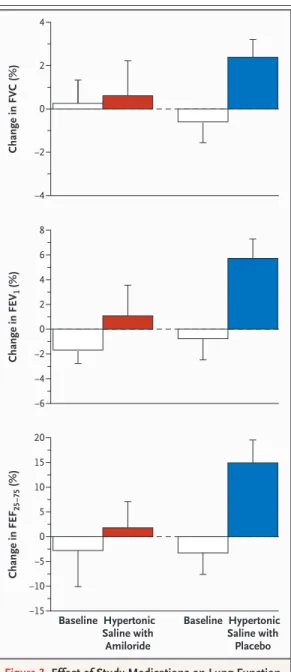
Similar small changes in lung function were ob-served during the baseline interval in both treat-ment groups (Fig. 3). The absolute percentage changes in lung function during the treatment interval favored the group that received hyper-tonic saline with placebo but were not signifi-cantly different (mean FEV1 difference, 4.7 per-cent; 95 percent confidence interval, −1.3 to 10.6; P = 0.12; mean FVC difference, 1.8 percent; 95 per-cent confidence interval, −1.9 to 5.5; P = 0.23; mean FEF25–75 difference, 13.1 percent; 95 per-cent confidence interval, −1.4 to 27.7; P = 0.07). The corresponding absolute increases in FEV1 re-sulting from treatment were 147±39 ml for the group receiving hypertonic saline with placebo and 34±66 ml for the group receiving hypertonic
saline with amiloride (mean difference, 113 ml; 95 percent confidence interval, −44 to 271). However, comparisons of changes in lung func-tion during the treatment and baseline intervals revealed significant improvements in FVC (P = 0.05), FEV1 (P = 0.02), and FEF25–75 (P = 0.02) in the group
Change in FVC (%)
0 2
¡2
¡4 4
Change in FEV
1
(%)
0 2 4 6
¡2
¡6 ¡4 8
Hypertonic Saline with Amiloride
Hypertonic Saline with Placebo
Change in FEF
2
5–7
5
(%)
0 15
10
5
¡10 ¡5
¡15
Baseline
20
Baseline
that received hypertonic saline with placebo but no differences in the group that received hyper-tonic saline with amiloride (P = 0.83, P = 0.23, and P = 0.55, respectively) (Fig. 3). No significant dif-ferences were observed in RV:TLC ratios.
qualit y of life
The mean (±SE) respiratory symptom score as measured after the treatment interval was signifi-cantly better in the group that received hyper-tonic saline with placebo than in the group that received hypertonic saline with amiloride (82.3±3.1 vs. 70.0±3.1, P = 0.01). Significant improvement in respiratory symptoms but a higher perceived work-load or burden related to medical treatment was also observed in a comparison of scores at base-line and during treatment in the group that re-ceived placebo but not in the group that rere-ceived amiloride (complete questionnaire results are avail-able in the Supplementary Appendix).
safet y and adverse events
No treatment-related serious adverse events oc-curred. Mean (±SE) absolute changes in FEV1 two hours after the administration of study medica-tion on day 15 (0.85±3.79 percent in the placebo group and –2.47±6.66 percent in the amiloride group) and on day 28 (–0.55±4.46 percent in the placebo group and –1.39±3.85 percent in the amiloride group) were small and not significant-ly different between groups. Serum chemical anal-yses, hematologic values, and quantitative sputum cultures (for total bacteria and pseudomonas) did not change with either treatment (see the Supple-mentary Appendix).
in vitro response to hypertonic saline
The addition of sodium chloride to the mucosal surface of airway epithelial cultures, simulating deposition of 7 percent sodium chloride,10
pro-duced a much larger and more sustained increase in the volume of airway surface liquid in airway cultures from patients with cystic fibrosis than in cultures from controls (Fig. 4A and 4B). We tested the hypothesis that the sustained response in cultures from patients with cystic fibrosis re-flected the absence of the CFTR chloride channel as a route for transcellular salt absorption. Con-trol cultures had a significantly increased response in the volume of airway surface liquid to hyper-tonic challenge when pretreated with a CFTR chloride-channel blocker (CFTRinh-172) or with
replacement of chloride in the apical hypertonic solution with an impermeant anion (Fig. 4B). These data indicate that chloride transport through CFTR is a key determinant of the response in the volume of airway surface liquid to the adminis-tration of hypertonic saline.
inhibition of transepithelial water
transport by amiloride
The capacity of hypertonic saline to produce large and prolonged increases in the volume of airway surface liquid in airway epithelial cultures of patients with cystic fibrosis was markedly re-duced by pretreatment with amiloride (Fig. 4A and 4C). The slower increase in serosal fluores-cence in response to an apical hyperosmolar man-nitol solution suggested that the reduced response in the volume of airway surface liquid to hyper-tonic saline after amiloride pretreatment reflect-ed a block of transepithelial water flow (Fig. 4D). This effect was not specific to epithelia from pa-tients with cystic fibrosis, since amiloride also slowed osmotically driven water flow in control epithelia; the rate of increase in fluorescence was reduced by 74.6±4.0 percent in controls, as com-pared with 89.8±2.3 percent in patients with cystic fibrosis (P = 0.01).
The action of amiloride to block the water permeability of airways was further character-ized. First, the 50 percent inhibitory concentra-tion (IC50) for amiloride inhibition of water per-meability was 6 μM, a value that is less potent by a factor of 10 than that for inhibition of the epithelial sodium channel. Second, a cellular site of action was indicated by experiments in which a blocker of cellular aquaporins, mercuric chlo-ride, mimicked the blockade by amiloride of hypertonic saline–induced expansion of airway surface liquid; amiloride also inhibited hyper-tonic saline–induced cell shrinkage. Finally, the amiloride blockade was pharmacologically spe-cific, since an analogue that more potently in-hibits the epithelial sodium channel (benzamil) was active, whereas an analogue more specific for the sodium–hydrogen exchanger (dimethyl-amiloride) was not (additional in vitro data are available in the Supplementary Appendix).
D i s c u s s i o n
re-sulted in a sustained increase in the one-hour mucus-clearance rate and was associated with improvements in lung function and respiratory symptoms over baseline values. In contrast, pa-tients who were treated with hypertonic saline after amiloride had no sustained increase in mu-cus clearance and no improvement in lung func-tion or respiratory symptoms. The relative effec-tiveness of hypertonic saline treatment alone, as compared with the administration of hypertonic saline after pretreatment with amiloride, was con-trary to our hypothesis. These findings raised two questions: Why was the effect of hypertonic
saline on mucus clearance so prolonged in pa-tients with cystic fibrosis as compared with con-trols?8 And why did amiloride blunt the ability of
hypertonic saline to produce sustained increases in mucus clearance? We investigated these ques-tions in airway cultures because a tight linkage between the volume of airway surface liquid and mucus transport has been demonstrated in this model system.1
The administration of hypertonic saline in vi-tro produced a larger and more sustained increase in the volume of airway surface liquid in cul-tures from patients with cystic fibrosis than in
*
*
* *
*
A B
C D
Airway Surface Liquid Height (μm)
80 90
70 60
40 30
10 50
20
0
0 10 20 30 40 50 60
Minutes
100
** *
Airway Surface Liquid Height (μm)
80 90
70 60
40 30
10 50
20
0
0 40 80 120 160 200 240
Minutes
100
Airway Surface Liquid Height (μm)
80
60
40
20
0
0 40 80 120 160 200 240
Minutes
100
Serosal Fluorescence (%)
130 140
120
110
100
0
0 10 20 30 40 50 60
Seconds
*
Figure 4. Effects of Hypertonic Saline with or without Amiloride on the Amount of Airway Surface Liquid in Epithelia Cultured from Patients with Cystic Fibrosis and Controls.
cultures from controls (Fig. 4A and 4B). The role of CFTR in the dissipation of the high luminal salt concentration that is generated by hypertonic saline deposition was revealed with pharmaco-logic blockade of CFTR and chloride-replacement studies (Fig. 4B). The resulting prolongation of an osmotic driving force would draw more water onto the airway surface in patients with cystic fibrosis, increase the volume of airway surface liquid, and produce a sustained increase in mu-cus clearance.
The effect of amiloride in blunting clinical improvements with hypertonic saline might also be explained by effects on the volume of airway surface liquid. In vitro experiments revealed markedly reduced expansion of airway surface liquid in response to the administration of hyper-tonic saline after pretreatment with amiloride (Fig. 4C) owing to the blockade of apical mem-brane water permeability (Fig. 4D and the Sup-plementary Appendix). As a result, the adminis-tration of hypertonic saline with amiloride may increase the tonicity of airway surface liquid, which through electrostatic effects on mucins may account for the acute increase in mucus clearance.17,18 It also may limit the expansion in
the volume of airway surface liquid, preventing the sustained increase in mucus clearance and improvement in lung function observed with hy-pertonic saline alone.
In another article in this issue of the Journal, Elkins et al.19 also observed a modest
improve-ment in lung function with inhaled hypertonic saline but observed a striking reduction in pulmo-nary exacerbations. We propose that hypertonic saline produced the sustained airway surface hy-dration required to clear retained mucus, but its efficacy was limited by its failure to reach many obstructed airways, as evidenced by the moderate resulting increase in FEV1.19 In contrast, effective
delivery of hypertonic saline to relatively
nonob-structed airways produced supranormal 1-hour mucus-clearance rates and improved cumulative 24-hour mucus-clearance rates. We speculate that the durable increase in mucus clearance protected relatively nonobstructed lung regions from exog-enous insults (e.g., viral infections20,21) that slow
mucus clearance and hence promote intrapulmo-nary spread of bacterial infection or the develop-ment of new mucus obstruction, thus accounting for the large reduction in the exacerbation rate observed by Elkins et al.
In summary, inhalation of hypertonic saline four times daily provides a modest improvement in lung function and respiratory symptoms with-out substantial adverse events. On the basis of studies of airway epithelia in vitro, it appears likely that the mechanism of action of hyper-tonic saline is to provide long-term hydration of airway surfaces and promote a sustained increase in mucus clearance. This study points to a vital therapeutic role for the restoration of hydration to airway surfaces in patients with cystic fibrosis and suggests that measures of sustained mucus clearance may serve as a useful surrogate out-come for future drug development.
Supported by a grant (DONALD00A0, to Dr. Donaldson) from the Cystic Fibrosis Foundation, by National Institutes of Health (NIH) grants (1K08 HL68617, P50-HL060280, and 5-P01-HL34322), and by an NIH grant (RR00046) from the General Clinical Research Center program of the Division of Research Resources.
Drs. Knowles and Boucher report having received consulting fees from Inspire Pharmaceuticals and having equity interests in Inspire Pharmaceuticals and Parion Sciences. Dr. Boucher reports having an equity interest in Respirics. Dr. Boucher was named coinventor on a patent for dry-powder amiloride, which was sub-sequently licensed to Parion Sciences. He also holds multiple other patents on compounds designed to treat lung diseases. No other potential conflict of interest relevant to this article was re-ported.
We are indebted to Drs. Paul Stewart and Lisa LaVange of the Biostatistics Department at the University of North Carolina School of Public Health, who provided biostatistical support for this study; to Ashley Kairalla and Douglas Parker for research coordination; to Lisa Brown for assistance with manuscript prepa-ration; and to Pari Respiratory Equipment for supplying nebulizers and compressors used in this study.
Tarran R, Grubb BR, Gatzy JT, Davis CW, Boucher RC. The relative roles of pas-sive surface forces and active ion transport in the modulation of airway surface liquid volume and composition. J Gen Physiol 2001;118:223-36.
Matsui H, Grubb B, Tarran R, et al. Evidence for periciliary liquid layer deple-tion, not abnormal ion composideple-tion, in the 1.
2.
pathogenesis of cystic fibrosis airways disease. Cell 1998;95:1005-15.
Mall M, Grubb BR, Harkema JR, O’Neal WK, Boucher RC. Increased air-way epithelial Na+ absorption produces cystic fibrosis-like lung disease in mice. Nat Med 2004;10:487-93.
Robinson M, Regnis JA, Bailey DL, King M, Bautovich GJ, Bye PT. Effect of 3.
4.
hypertonic saline, amiloride, and cough on mucociliary clearance in patients with cystic fibrosis. Am J Respir Crit Care Med 1996;153:1503-9.
Robinson M, Hemming AL, Regnis JA, et al. Effect of increasing doses of hyper-tonic saline on mucociliary clearance in patients with cystic fibrosis. Thorax 1997; 52:900-3.
Eng PA, Morton J, Douglass JA, Ried-ler J, Wilson J, Robertson CF. Short-term efficacy of ultrasonically nebulized hyper-tonic saline in cystic fibrosis. Pediatr Pul-monol 1996;21:77-83.
Ballmann M, von der Hardt H. Hy-pertonic saline and recombinant human DNase: a randomised cross-over pilot study in patients with cystic fibrosis. J Cyst Fibros 2002;1:35-7.
Tarran R, Grubb BR, Parsons D, et al. The CF salt controversy: in vivo observa-tions and therapeutic approaches. Mol Cell 2001;8:149-58.
Quittner AL, Sweeny S, Watrous M, et al. Translation and linguistic validation of a disease-specific quality of life mea-sure for cystic fibrosis. J Pediatr Psychol 2000;25:403-14.
Sood N, Bennett WD, Zeman K, et al. Increasing concentration of inhaled saline with or without amiloride: effect on mu-cociliary clearance in normal subjects. Am J Respir Crit Care Med 2003;167:158-63.
Alexis NE, Hu SC, Zeman K, Alter T, 6.
7.
8.
9.
10.
11.
Bennett WD. Induced sputum derives from the central airways: confirmation us-ing a radiolabeled aerosol bolus delivery technique. Am J Respir Crit Care Med 2001;164:1964-70.
Mortensen J, Hansen A, Falk M, Niel-sen IK, Groth S. Reduced effect of inhaled beta 2-adrenergic agonists on lung muco-ciliary clearance in patients with cystic fibrosis. Chest 1993;103:805-11.
American Thoracic Society. Stan-dardization of spirometry, 1994 update. Am J Respir Crit Care Med 1995;152:1107-36.
Ma T, Thiagarajah JR, Yang H, et al. Thiazolidinone CFTR inhibitor identified by high-throughput screening blocks chol-era toxin-induced intestinal fluid secre-tion. J Clin Invest 2002;110:1651-8.
Narvarte J, Finn AL. Anion-sensitive sodium conductance in the apical mem-brane of toad urinary bladder. J Gen Physi-ol 1980;76:69-81.
Matsui H, Davis CW, Tarran R, Bouch-er RC. Osmotic watBouch-er pBouch-ermeabilities of 12.
13.
14.
15.
16.
cultured, well-differentiated normal and cystic fibrosis airway epithelia. J Clin In-vest 2000;105:1419-27.
Wills PJ, Hall RL, Chan W, Cole PJ. Sodium chloride increases the ciliary transportability of cystic fibrosis and bron-chiectasis sputum on the mucus-depleted bovine trachea. J Clin Invest 1997;99:9-13.
Verdugo P. Mucin exocytosis. Am Rev Respir Dis 1991;144:S33-S37.
Elkins MR, Robinson M, Rose BR, et al. A controlled trial of long-term inhaled hypertonic saline in patients with cystic fibrosis. N Engl J Med 2006;354:229-40.
Tarran R, Button B, Picher M, et al. Normal and cystic fibrosis airway surface liquid homeostasis: the effects of phasic shear stress and viral infections. J Biol Chem 2005;280:35751-9.
Camner P, Jarstrand C, Philipson K. Tracheobronchial clearance in patients with influenza. Am Rev Respir Dis 1973; 108:131-5.
Copyright © 2006 Massachusetts Medical Society.
17.
18.
19.
20.
21.
CLINICALTRIALREGISTRATION
The Journal encourages investigators to register their clinical trials in a public trials registry. The members of the International Committee of Medical Journal Editors plan to consider clinical trials for publication
only if they have been registered (see N Engl J Med 2004;351:1250-1). The National Library of Medicine’s www.clinicaltrials.gov is a free registry,