General Description
The MAX6877/MAX6878/MAX6879 multivoltage power trackers/sequencers/supervisors monitor up to three system voltages and provide proper power-up and power-down control for systems requiring voltage track-ing or sequenctrack-ing. These devices ensure controlled voltage tracking within a specified range or sequencing in the proper order as system power supplies are enabled. The MAX6877/MAX6878/MAX6879 generate all required voltages and timing to control up to three external n-channel pass FETs for the OUT1/OUT2/ OUT3 supply voltages (see the Selector Guide for dif-ferent features of each device).The MAX6877/MAX6878/MAX6879 feature adjustable undervoltage thresholds for each input supply. When all the voltages are above these adjustable thresholds, the devices turn on the external n-channel MOSFETs to either sequence or track the voltages to the system. During voltage-tracking mode, the voltage at the GATE of each MOSFET is increased to slowly bring up all supplies at a controlled slew rate. The MAX6877/ MAX6878/MAX6879 feature an autoretry or latch-off mode with capacitor-adjusted timing.
These devices also provide a controlled power-down (tracking mode) when the system shuts off in an orderly manner. When an unexpected fault occurs, the outputs are all pulled down simultaneously with an internal 100Ω pulldown to help discharge capactive loads at the MOSFET’s source. The MAX6877/MAX6878/ MAX6879 feature independent internal charge pumps to fully enhance the external FETs for low-voltage drop at highpass current. The MAX6877 and MAX6878 also feature a power-good output with a selectable timeout period that can be used for system reset.
The MAX6877/MAX6878/MAX6879 are available in small 4mm x 4mm 24-pin and 16-pin thin QFN pack-ages and are fully specified over the -40°C to +85°C extended operating temperature range.
Applications
Multivoltage SystemsNetworking Systems
Features
♦ Pin-Selectable Tracking or Sequencing Controlfor Up to Three Supply Voltages
♦ Capacitor-Adjustable Power-Up/Down Tracking Slew Rate
♦ Capacitor-Adjustable Power-Up Sequencing Delay ♦ Internal Charge Pumps to Enhance External
n-Channel FETs
♦ Capacitor-Adjustable Timeout Period Power-Good Output (MAX6877/MAX6878)
♦ Adjustable Undervoltage Lockout or Logic-Enable Input
♦ Internal 100ΩPulldown for Each Output to Discharge Capacitive Load Quickly ♦ 0.5V to 5.5V Nominal IN_/OUT_ Range ♦ 2.7V to 5.5V Operating Voltage Range ♦ Immune to Short Voltage Transients
♦ Small 4mm x 4mm 24-Pin or 16-Pin Thin QFN Packages
MAX6877/MAX6878/MAX6879
Trackers/Sequencers/Supervisors
23 22 21 8 9 10 GATE3 FAULT PG/RST OUT2 MARGIN IN3 17 18 16 14 13 IN2 TIMEOUT SLEW DELAY EP* + MAX6877 OUT3 15 GATE1 20 11 LTCH/RTR OUT1 19 12 TRK/SEQ GATE2 TOP VIEWPin Configurations
Ordering Information
Ordering Information continued at end of data sheet.
+Denotes lead-free package.
PART TEMP RANGE PIN-PACKAGE
PKG CODE MAX6877ETG+ -40°C to +85°C 24 Thin QFN T2444-4
MAX6877/MAX6878/MAX6879
ELECTRICAL CHARACTERISTICS
(VCC, IN1, IN2, or IN3 = +2.7V to +5.5V, EN/UV= MARGIN= ABP, TA= -40°C to +85°C, unless otherwise specified. Typical values
are at TA= +25°C, unless otherwise noted.) (Note 1)
Stresses beyond those listed under “Absolute Maximum Ratings” may cause permanent damage to the device. These are stress ratings only, and functional operation of the device at these or any other conditions beyond those indicated in the operational sections of the specifications is not implied. Exposure to absolute maximum rating conditions for extended periods may affect device reliability.
IN1, IN2, IN3, VCC...-0.3V to +6V
ABP
...-0.3V to the highest of VIN1 - VIN3 or VCC
SET1, SET2, SET3 ...-0.3V to +6V GATE1, GATE2, GATE3 ...-0.3V to +12V OUT1, OUT2, OUT3 ...-0.3V to +6V
LTCH/RTR, TRK/SEQ, MARGIN...-0.3V to +6V
FAULT, PG/RST, EN/UV...-0.3V to +6V DELAY, SLEW, TIMEOUT ...-0.3V to +6V OUT_ Current...±50mA GND Current...±50mA
Input/Output Current (all pins except
OUT_ and GND) ...±20mA
Continuous Power Dissipation (TA= +70°C)
16-Pin 4mm x 4mm Thin QFN
(derate 16.9mW/°C above +70°C) ...1349mW 24-Pin 4mm x 4mm Thin QFN
(derate 20.8mW/°C above +70°C) ...1667mW Operating Temperature Range ...-40°C to +85°C Storage Temperature Range ...-65°C to +150°C Maximum Junction Temperature ...+150°C Lead Temperature (soldering, 10s) ...+300°C
PARAMETER SYMBOL CONDITIONS MIN TYP MAX UNITS
Voltage on ABP (the highest of VCC or IN_)
to ensure that PG/RST and FAULT are valid
and GATE_ = 0V
1.4
Operating Voltage Range VCC
Voltage on ABP (the highest of VCC or IN_)
to ensure the device is fully operational 2.7 5.5
V
Supply Current ICC V C C = 5.5V , IN 1 = IN 2 = IN 3 = 3.3V , no l oad 1.1 1.8 mA
SET_ falling, TA = +25oC 0.4925 0.5 0.5075
SET_ Threshold Range VTH
SET_ falling, TA = -40oC to +85oC 0.4875 0.5 0.5125
V
SET_ Threshold Hysteresis VTH_HYS SET_ rising 0.5 %
SET_ Input Current ISET SET_ = 0.5V -100 +100 nA
VEN_R Input rising 1.286
EN/UV Input Voltage
VEN_F Input falling 1.22 1.25 1.28
V
EN/UV Input Current IEN -5 +5 µA
EN/UV Input Pulse Width tEN EN/UV falling, 100mV overdrive 7 µs
DELAY, TIMEOUT Output Current ID (Notes 2, 3) 2.12 2.5 2.88 µA
DELAY, TIMEOUT Threshold
Voltage V C C = 3.3V 1.25 V
SLEW Output Current (Note 4) IS 22.5 25 27.5 µA
Track/Sequence Slew-Rate
Timebase Accuracy SR CSLEW = 200pF (Note 4) -15 +15 %
MAX6877/MAX6878/MAX6879
Note 1:Specifications guaranteed for the stated global conditions. 100% production tested at TA = +25°C and TA = +85°C.
Specifications at TA= -40°C to +85°C are guaranteed by design. These devices meet the parameters specified when at
least one of VCC, IN1/IN2/IN3 is between 2.7V to 5.5V, while the remaining IN1/IN2/IN3 are between 0 and 5.5V.
ELECTRICAL CHARACTERISTICS (continued)
(VCC, IN1, IN2, or IN3 = +2.7V to +5.5V, EN/UV= MARGIN= ABP, TA= -40°C to +85°C, unless otherwise specified. Typical values
are at TA= +25°C, unless otherwise noted.) (Note 1)
PARAMETER SYMBOL CONDITIONS MIN TYP MAX UNITS
Power-Good Threshold Hysteresis VHYS_PG VOUT_ rising 0.5 %
GATE_ Output High VGOH ISOURCE = 0.5µA IN_ +
4.2
IN_ + 5.0
IN_ +
5.8 V
GATE_ Pullup Current IGUP During power-up and power-down,
VGATE_ = 1V 2.5 4 µA
IGD During power-up and power-down,
VGATE_ = 5V 2.5 4 µA
When disabled, VGATE_ = 5V, VIN_≥ 2.7V 9.5
GATE_ Pulldown Current
IGDS
When disabled, VGATE_ = 5V, VIN_≥ 4V 20
mA
SET_ to GATE_ Delay tD-GATE SET falling, 25mV overdrive 6 µs
VIN_≥ 2.7V, ISINK = 1mA, output asserted 0.3
FAULT, PG/RST Output Low VOL
VIN_≥ 4.0V, ISINK = 4mA, output asserted 0.4
V
Tracking Differential Voltage Stop
Ramp VTRK
Differential between each of the OUT_ and the ramp voltage during power-up and power-down, Figure 10 (Note 5)
75 125 180 mV
Tracking Differential Fault Voltage VTRK_F Differential between each of the OUT_ and
the ramp voltage, Figure 10 (Note 5) 200 250 310 mV
Tracking Differential Voltage
Hysteresis 20 %
Power-Low Threshold VTH_PL OUT_ falling 125 142 170 mV
Power-Low Hysteresis VTH_PLHYS OUT_ rising 10 mV
OUT to GND Pulldown Impedance VABP > 2.7V (Note 6) 100 Ω
MARGIN, TRK/SEQ, LTCH/RTR
Pullup Current IIN 7 10 13 µA
VIL 0.8 MARGIN, TRK/SEQ, LTCH/RTR Input Voltage VIH 2.0 V MARGIN, TRK/SEQ, LTCH/RTR Glitch Rejection 100 ns
MAX6877/MAX6878/MAX6879
EN/UV
VEN_R VEN_F
EN/UV
BUS VOLTAGE MONITORED THROUGH EN/UV INPUT
IN_ IN1 = 2.5V IN2 = 1.8V IN3 = 0.7V OUT_ OUT1 = 2.5V OUT2 = 1.8V OUT3 = 0.7V CAPACITOR-ADJUSTED SLEW RATE PG/RST
MONITORED THROUGH SET THRESHOLDS ON SET_ INPUTS
tDELAY
tTIMEOUT
EN/UV
MAX6877/MAX6878/MAX6879
EN/UV VEN_R
BUS VOLTAGE MONITORED THROUGH EN/UV INPUT
IN_ IN1 = 2.5V IN2 = 1.8V IN3 = 0.7V OUT_ OUT1 = 2.5V OUT2 = 1.8V OUT3 = 0.7V CAPACITOR-ADJUSTED SLEW RATE PG/RST FAULT = HIGH
MONITORED THROUGH SET THRESHOLDS ON SET_ INPUTS
tDELAY
tTIMEOUT
EN/UV
IN1 GOES BELOW SET1 THRESHOLD VEN_F
FORCED INTO QUICK SHUTDOWN AFTER NORMAL SHUTDOWN WHEN IN1 GOES BELOW ITS SET VOLTAGE
MAX6877/MAX6878/MAX6879
EN/UV
BUS VOLTAGE MONITORED THROUGH EN/UV INPUT
IN_ IN1 = 2.5V IN2 = 1.8V IN3 = 0.7V OUT_ OUT1 = 2.5V OUT2 = 1.8V OUT3 = 0.7V CAPACITOR-ADJUSTED SLEW RATE PG/RST
MONITORED THROUGH SET THRESHOLDS ON SET_ INPUTS
tDELAY tDELAY tDELAY tTIMEOUT EN/UV VEN_R VEN_F
MAX6877/MAX6878/MAX6879
IN_
IN1 = 2.5V
IN2 = 1.8V IN3 = 0.7V
MONITORED THROUGH SET THRESHOLDS ON SET_ INPUTS
OUT_
OUT2 = 1.8V OUT3 = 0.7V OUT1 = 3.3V
EN/UV EN/UV
BUS VOLTAGE MONITORED THROUGH EN/UV INPUT
FORCED INTO QUICK SHUTDOWN WHEN OUT1 FALLS BELOW 92.5% of IN1
OUT_ FORCED BELOW VTH_PG CAPACITOR-ADJUSTED SLEW RATE PG/RST FAULT tDELAY tDELAY tDELAY tTIMEOUT VEN_R
MAX6877/MAX6878/MAX6879
EN/UV
VEN_R VEN_F
BUS VOLTAGE MONITORED THROUGH EN/UV INPUT
IN_ IN1 = 2.5V IN2 = 1.8V IN3 = 0.7V OUT_ OUT1 = 2.5V OUT2 = 1.8V OUT3 = 0.7V CAPACITOR-ADJUSTED SLEW RATE PG/RST = LOW
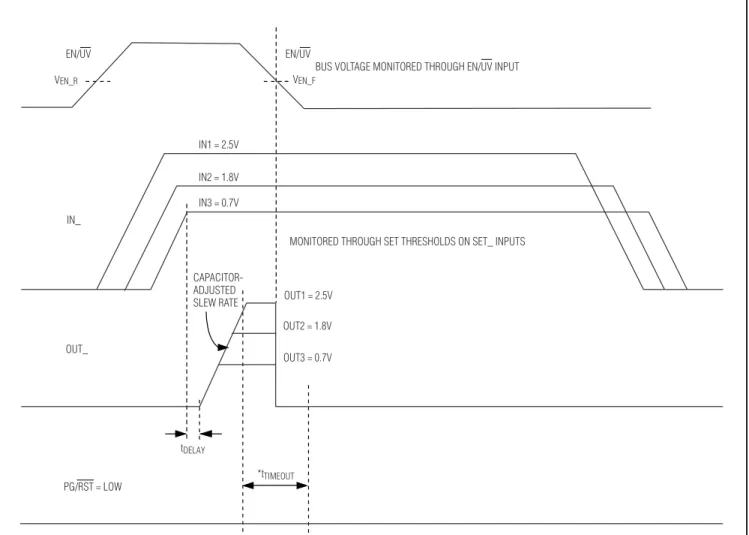
*ANY POWER-DOWN CONDITION BEFORE tTIMEOUT (PG/RST ASSERTED) CAUSES A SHUTDOWN.
MONITORED THROUGH SET THRESHOLDS ON SET_ INPUTS
tDELAY
*tTIMEOUT EN/UV
MAX6877/MAX6878/MAX6879
BUS VOLTAGE MONITORED THROUGH EN/UV INPUT
IN_ IN1 = 2.5V IN2 = 1.8V IN3 = 0.7V OUT_ OUT1 = 2.5V OUT2 = 1.8V OUT3 = 0.7V
MONITORED THROUGH SET THRESHOLDS ON SET_ INPUTS
EN/UV EN/UV PG/RST = LOW CAPACITOR-ADJUSTED SLEW RATE tDELAY t DELAY tDELAY *tTIMEOUT
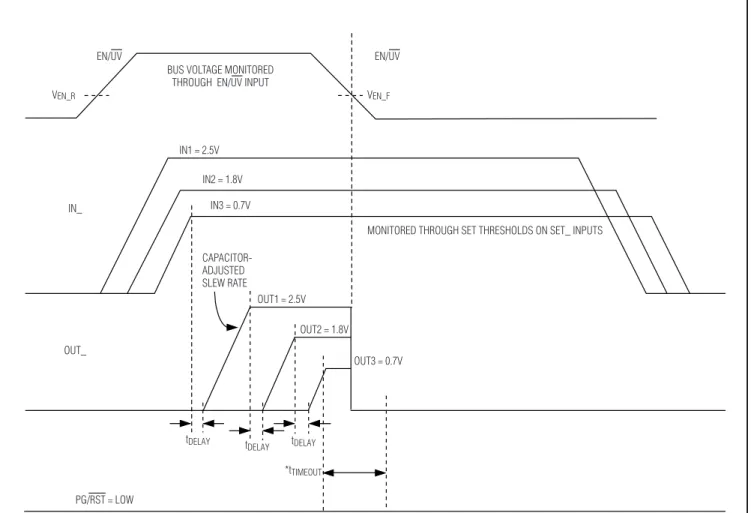
*ANY POWER-DOWN CONDITION BEFORE tTIMEOUT (PG/RST ASSERTED) CAUSES A SHUTDOWN.
VEN_R VEN_F
MAX6877/MAX6878/MAX6879
OUT1 OUT2 OUT3 IS SLOW OUT_ OUT1 OUT2 OUT3 IS SLOW tDELAY tDELAY tDELAY tDELAY tDELAY tFAULTtFAULT AND tRETRY NOT TO SCALE ALL SET_ > 0.5V AND VCC OR IN_ ≥ 2.7V
tFAULT tRETRY
tDELAY EN/UV
FAULT
Figure 8. tFAULT and tRETRY Timing Diagram in Sequencing tFAULT AND tRETRY NOT TO SCALE
ALL SET_ > 0.5V AND VCC OR IN_ ≥ 2.7V
tFAULT tFAULT tRETRY tDELAY tDELAY EN/UV VEN_R OUT_
OUT2 AND OUT3 ARE WAITING OUT1 IS SLOW
OUT2 AND OUT3 ARE WAITING OUT1 IS SLOW
FAULT
125mV
MAX6877/MAX6878/MAX6879
NORMALIZED POWER-GOOD TIMEOUT vs. TEMPERATURE
MAX6877 toc02
TEMPERATURE (°C)
NORMALIZED POWER-GOOD TIMEOUT
60 35 -15 10 0.80 0.85 0.90 0.95 1.00 1.05 1.10 1.15 0.75 -40 85 POWER-GOOD TIMEOUT vs. CTIMEOUT MAX6877 toc03 CTIMEOUT (µF) POWER-GOOD TIMEOUT (ms) 0.1 0.01 0.001 1 10 100 1000 0.1 0.0001 1
NORMALIZED DELAY TIMEOUT vs. TEMPERATURE
MAX6877 toc05
TEMPERATURE (°C)
NORMALIZED DELAY TIMEOUT
60 35 10 -15 0.80 0.85 0.90 0.95 1.00 1.05 1.10 1.15 1.20 1.25 0.75 -40 85 SLEW RATE vs. CSLEW MAX6877 toc06 CSLEW (pF) SLEW RATE (V/s) 100 1000 100 1000 10,000 10 10 10,000 DELAY TIMEOUT vs. CDELAY MAX6877 toc07 1000 VCC SUPPLY CURRENT vs. INPUT VOLTAGE MAX6877 toc01 INPUT VOLTAGE (V) VCC
SUPPLY CURRENT (mA)
5.0 4.5 4.0 3.5 3.0 0.9 1.0 1.1 1.2 1.3 1.4 0.8 2.5 5.5 TA = +85°C TA = -40°C TA = +25°C
NORMALIZED SET_ THRESHOLD vs. TEMPERATURE
MAX6877 toc04
TEMPERATURE (°C)
NORMALIZED SET_ THRESHOLD
60 35 10 -15 0.996 0.997 0.998 0.999 1.000 1.001 1.002 1.003 1.004 1.005 0.995 -40 85
NORMALIZED EN/UV THRESHOLD vs. TEMPERATURE
MAX6877 toc08
1.003 1.004 1.005
IN_ TRANSIENT DURATION vs. IN_ THRESHOLD OVERDRIVE
MAX6877 toc09 µ s) 24 27 30 IN_ = 3.3V
Typical Operating Characteristics
MAX6877/MAX6878/MAX6879
GATE_ OUTPUT VOLTAGE HIGH vs. GATE SOURCE CURRENT
MAX6877 toc11
GATE SOURCE CURRENT (µA)
GATE_ VOLTAGE HIGH (V)
2.5 2.0 1.5 1.0 0.5 1 2 3 4 5 6 7 8 9 10 0 0 3.0 TRACKING MODE MAX6877 toc12 10ms/div OUT1 OUT2 1V/div EN/UV 2V/div OUT3 SEQUENCING MODE MAX6877 toc13 20ms/div OUT1 OUT2 1V/div EN/UV 2V/div OUT3 FAST SHUTDOWN MAX6877 toc14 40ms/div OUT1 OUT2 1V/div EN/UV 2V/div OUT3 FAULT 2V/div
GATE_ VOLTAGE LOW vs. GATE SINK CURRENT
MAX6877 toc10
GATE SINK CURRENT (mA)
GATE_ VOLTAGE LOW (V)
9 8 1 2 3 4 5 6 7 0.2 0.4 0.6 0.8 1.0 1.2 1.4 1.6 0 0 10
FAST SHUTDOWN WITH RETRY
MAX6877 toc15 OUT2 2V/div OUT1 2V/div OUT3 THRESHOLD ERROR AT OUT1, OUT1 PULLED BELOW 92.5% OF IN1
MAX6877/MAX6878/MAX6879
Pin Description
PIN
MAX6877 MAX6878 MAX6879 NAME FUNCTION
1 1 — VCC
Optional Supply Voltage Input. Connect VCC to an alternate (i.e., always-on)
supply if desired. Leave VCC unconnected, if not used. VCC allows IN_
supplies less than UVLO to be tracked. VCC is internally pulled down by a
100kΩ resistor.
2 2 1 ABP Internal Supply Bypass Input. Bypass ABP with a 1µF capacitor to GND. ABP
maintains the device supply voltage during rapid power-down conditions.
3 — — SET3
4 4 2 SET2
5 5 3 SET1
Externally Adjusted IN_ Undervoltage Lockout Threshold. Connect SET_ to an external resistor-divider network to set the desired undervoltage threshold
for each IN_ supply (see the Typical Application Circuit). All SET_ inputs
must be above the internal SET_ threshold (0.5V) to enable tracking or sequencing functionality.
— 3, 16, 17,
22 — N.C. No Connection. Not internally connected.
6 6 4 EN/UV
Logic-Enable Input or Undervoltage Lockout Monitor Input. EN/UV must be
high (EN/UV > VEN_R) to enable voltage tracking or sequencing power-up
operation. OUT_ begins tracking down when EN/UV < VEN_F. Connect EN/UV
to an external resistor-divider network to set the external UVLO threshold.
7 7 5 GND Ground
8 8 6 DELAY
Tracking Startup/Sequence Delay Select Input. Connect a capacitor from DELAY to GND to select the desired delay period before tracking is enabled
(after all SET_ inputs and EN/UV are above their respective thresholds) or
between supply sequences. Leave DELAY unconnected for the default 200µs delay period.
9 9 7 SLEW Slew-Rate Adjustment Input. Connect a capacitor from SLEW to GND to
select the desired OUT_ slew rate.
10 10 — TIMEOUT
PG/RST Timeout Period Adjust Input. PG/RST asserts high after the timeout
period when all OUT_ exceed their IN_ referenced threshold. Connect a capacitor from TIMEOUT to GND to set the desired timeout period. Leave TIMEOUT unconnected for the default 200µs delay period.
11 11 8 LTCH/RTR
Latch/Autor etr y S el ecti on Inp ut. D r i ve L TC H/RTR l ow to sel ect the l atch m od e.
C onnect L TC H/RTR to ABP or l eave unconnected to sel ect autor etr y m od e.
MAX6877/MAX6878/MAX6879
MAX6877 MAX6878 MAX6879 NAME FUNCTION
14 14 — PG/RST Power-Good Output, Open-Drain. PG_RST asserts high tTIMEOUT after all
OUT_ voltages exceed the VTH_PG thresholds.
15 15 10 FAULT
Tracking Fault Alert Output, Active Low, Open-Drain. FAULT asserts low if a
tracking failure is present for longer than the selected fault period or if
tracking voltages fail by more than ±250mV. FAULT asserts low if any OUT_
falls below the corresponding IN_ voltage.
16 — — OUT3 Channel 3 Monitored Output Voltage. Connect OUT3 to the source of an
n-channel FET. A fault condition activates a 100Ω pulldown to ground.
17 — — GATE3
Gate Drive for External n-Channel FET. An internal charge pump boosts
GATE3 to VIN3 + 5V to fully enhance the external n-channel FET when
power-up is complete.
18 18 11 OUT2 Channel 2 Monitored Output Voltage. Connect OUT2 to the source of an
n-channel FET. A fault condition activates a 100Ω pulldown to ground.
19 19 12 GATE2
Gate Drive for External n-Channel FET. An internal charge pump boosts
GATE2 to VIN2 + 5V to fully enhance the external n-channel FET when
power-up is complete.
20 20 13 OUT1 Channel 1 Monitored Output Voltage. Connect OUT1 to the source of an
n-channel FET. A fault condition activates a 100Ω pulldown to ground.
21 21 14 GATE1
Gate Drive for External n-Channel FET. An internal charge pump boosts
GATE1 to VIN1 + 5V to fully enhance the external n-channel FET when
power-up is complete.
22 — — IN3
23 23 15 IN2
24 24 16 IN1
Supply Input Voltage. IN1, IN2, or IN3 must be greater than the internal
undervoltage lockout (VABP = 2.7V) to enable the tracking or sequencing
functionality. Each IN_ input is simultaneously monitored by SET_ inputs to ensure all supplies have stabilized before power-up is enabled. If IN_ is connected to ground or left unconnected and SET_ is above 0.5V, then no-sequencing control is performed on that channel. Each IN_ is internally
pulled down by a 100kΩ resistor.
MAX6877/MAX6878/MAX6879
CONTROL LOGIC TRACKING MONITORS PG CIRCUIT CHARGE PUMP GATE CONTROLLER OUT1 OUT2 OUT3 IN1 IN2 IN3 VREF IN1 IN1 IN2 VCC IN3ABP GATE1 OUT1
GATE2 OUT2 GATE3 OUT3 PG/RST DELAY SLEW MARGIN VBUS EN/UVLO SET3 SET2 IN2 SET1 GND CSLEW TIMEOUT CTIMEOUT TO LOAD IN1 MAX6877 IN3 FAULT COMP COMP COMP COMP IN3 TO OUT3 CONTROL BLOCK IN2 TO OUT2 CONTROL BLOCK RAMP GENERATOR INTERNAL VCC/UVLO
Functional Diagram
MAX6877/MAX6878/MAX6879
trackers/sequencers/supervisors monitor up to three system voltages and provide proper power-up and power-down control for systems requiring voltage tracking or sequencing. These devices ensure con-trolled voltage tracking with a specified range or sequencing in the proper order as system power sup-plies are enabled. The MAX6877/MAX6878/MAX6879 generate all required voltages and timing to control up to three external n-channel pass FETs for the OUT1/OUT2/OUT3 supply voltages (see the Selector Guidefor different features of each device.)
The MAX6877/MAX6878/MAX6879 feature adjustable undervoltage thresholds for each input supply. When all the voltages are above these adjusted thresholds, the devices turn on the external n-channel MOSFETs to either sequence or track the voltages to the system. During the voltage-tracking mode, the voltage at the GATE of each MOSFET is increased to slowly bring up all supplies at a controlled slew rate. The voltage at the source (output) of each MOSFET is internally compared to a control ramp to maintain a low differential between each monitored supply. Tracking is dynamically adjust-ed to force all outputs to track within 125mV of the ref-erence ramp. If for any reason any supplies fail to track within ±250mV of the reference ramp, the FAULT out-put is asserted, the power-up mode is terminated, and all outputs are quickly powered off. In sequencing mode, the outputs are turned on one after the other, OUT1 first and OUT3 last. The MAX6877/MAX6878/ MAX6879 feature an autoretry or latch-off mode with capacitor-adjusted timing.
These devices also provide a controlled power-down (tracking mode) when the system shuts off in an orderly manner. When an unexpected fault occurs, the outputs are all pulled down simultaneously with an internal 100Ω pulldown to help discharge capacitive loads at the MOSFET’s source.
The MAX6877/MAX6878/MAX6879 feature independent internal charge pumps to fully enhance the external FETs for low-voltage drops at highpass currents. The MAX6877/MAX6878 also feature a power-good output with a selectable timeout period that can be used for system reset.
The MAX6877/MAX6878/MAX6879 monitor up to three voltages. Devices may be configured to exclude any
Powering the MAX6877/MAX6878/MAX6879
These devices derive power from either the IN1, IN2, or IN3 voltage inputs or VCC(see the Functional Diagram).
VCCor one of the IN_ inputs must be at least +2.7V to
ensure full device operation.
The highest input voltage on IN1/IN2/IN3 or VCC
sup-plies power to the devices. Internal hysteresis ensures that the supply input that initially powers these devices continues to power the MAX6877/MAX6878/MAX6879 when multiple input voltages are within 100mV (typ) of each other.
ABP
ABP powers the analog circuitry. Bypass ABP to GND with a 1µF ceramic capacitor installed as close to the device as possible. ABP takes the highest voltage of IN_ or VCC. Do not use ABP to provide power to exter-nal circuitry. ABP maintains the device supply voltage during rapid power-down conditions.
Tracking and Sequencing Modes (TRK/SEQ) To enable the power-up/power-down voltage-tracking operation, drive TRK/SEQ low (connect TRK/SEQ to GND). To enable up sequencing and power-down tracking functions, drive TRK/SEQ high (connect TRK/SEQ to ABP) or leave it unconnected. TRK/SEQ is internally pulled to ABP through a 10µA current source (see Figures 1 and 3).
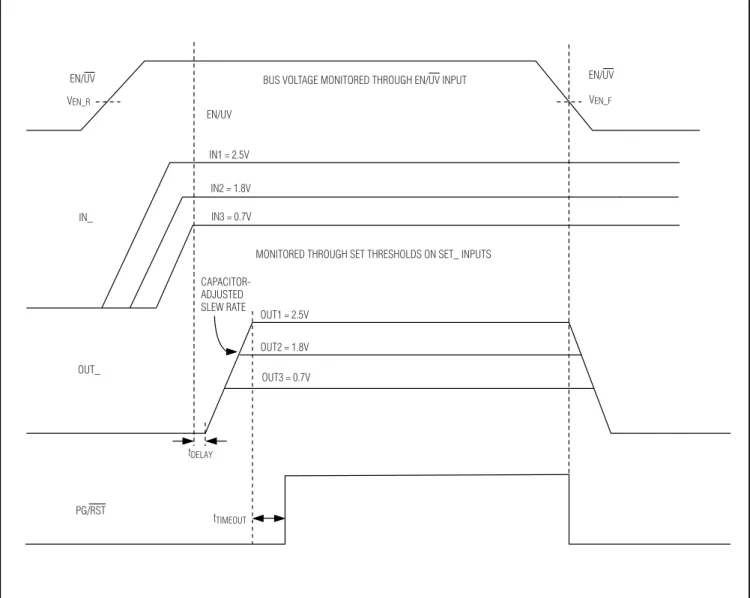
Tracking To operate in tracking mode, connect TRK/SEQ to GND. When VEN/UV > 1.25V and all SET_ inputs are above the internal SET_ threshold (0.5V), the tracking process is initiated. The MAX6877/MAX6878/MAX6879 generate an internal reference ramp voltage that drives the control loops for the tracked voltages. The tracking functionality is monitored with a comparator control block for each output (see the Functional Diagram). The comparators monitor each OUT_ voltage with respect to the common reference ramp voltage to ensure the OUT_ voltages stay within 125mV of the ref-erence ramp, monitor each tracked output voltage with respect to its source input voltage, and monitor each
MAX6877/MAX6878/MAX6879
During ramp up, if an OUT_ voltage is less than theref-erence ramp voltage by more than 125mV, the control loop dynamically stops the control ramp voltage from rising until the slow OUT_ voltage catches up. If an OUT_ voltage is greater or less than the reference ramp voltage by more than 250mV, a fault is signaled and a power-down phase is initiated.
The slew rate for the reference ramp voltage is capaci-tor adjustable. Connect a capacicapaci-tor from SLEW to ground to select the desired OUT_ slew rate. When all OUT_ voltages have exceeded the VTH_PGpercentage
of the IN_ voltage (external n-channel FET is saturated), PG/RSTasserts high after tTIMEOUTindicating
success-ful tracking.
Sequencing
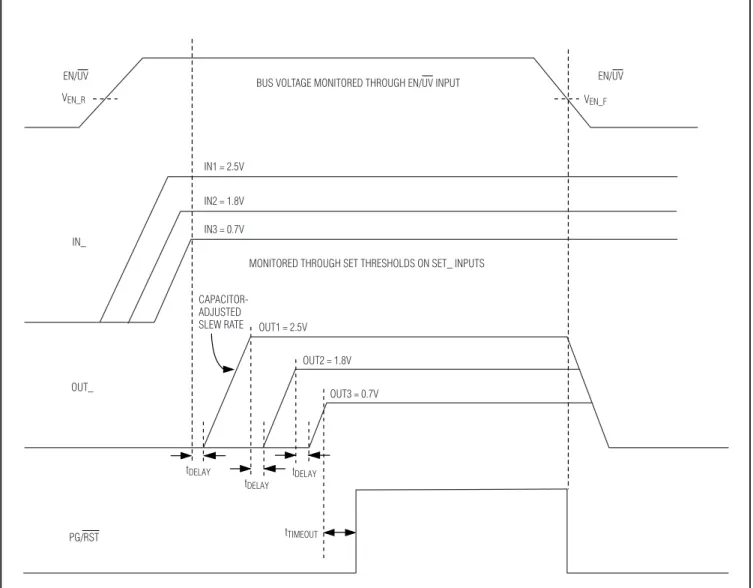
The sequencing operation can be initiated after all input conditions for power-up are met VEN/UV> 1.25V and all SET_ inputs are above the internal SET_ thresh-old (0.5V). In sequencing mode, the outputs are turned on sequentially, OUT1 first and OUT3 last. Before turn-ing on each channel, a delay period occurs as in Figure 3 (programmable by connecting a capacitor from DELAY to ground). The power-up phase for each channel ends when its output voltage exceeds a fixed percentage (VTH_PG) of the corresponding IN_ voltage.
When all channels have exceeded these thresholds, PG/RST asserts high after tTIMEOUT, indicating a suc-cessful sequence.
If there is a fault condition during the initial power-up sequence, the process is aborted.
When powering down, all outputs turn off simultaneous-ly, tracking each other. No reverse power-down sequencing occurs.
Power-Up and Power-Down
During power-up, the OUT_ is forced to follow the internal reference ramp voltage by an internal loop that controls the GATE_ of the external MOSFET. This phase must be completed within the adjustable fault timeout period; oth-erwise, the part forces a shutdown on all GATE_.
Once the power-up is completed, a power-down phase
or less than the reference ramp voltage by more than
VTRK_F, a fault is signaled and the fast-shutdown mode
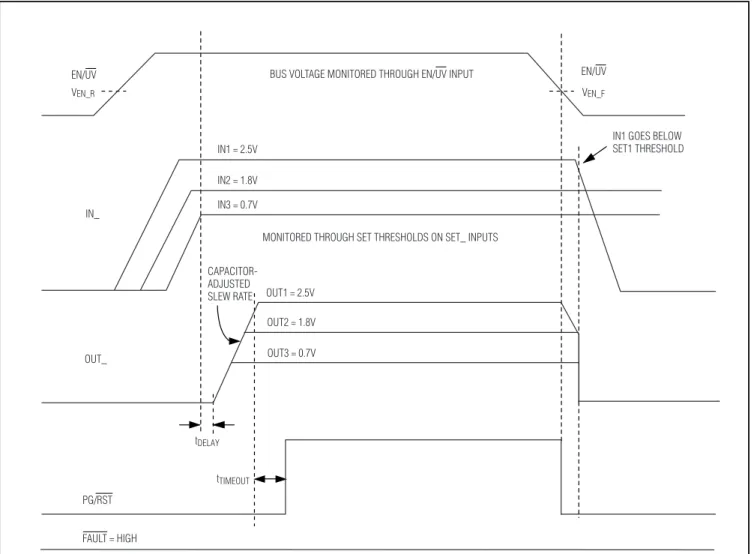
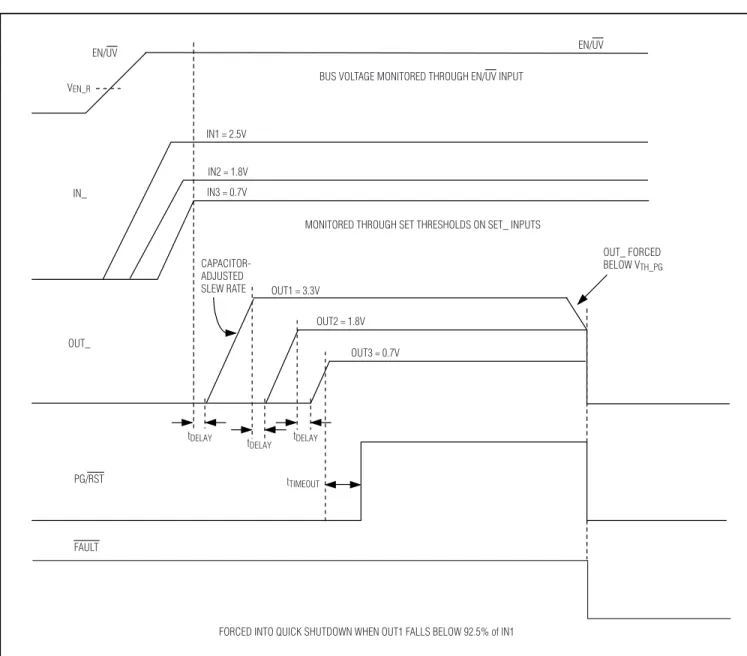
is initiated. In fast-shutdown mode, a 100Ω pulldown resistor is connected from OUT_ to GND to quickly dis-charge capacitance at OUT_ and GATE _ is pulled low with a strong IGDScurrent (see Figures 2 and 4).
Figures 5 and 6 show aborted tracking and sequencing modes. When EN/UV goes low before tTIMEOUT
expires, all the outputs go low and the device goes into fast shutdown.
Internal Pulldown
To ensure that the OUT_ voltages are not held high by a large output capacitance after a fault has occurred, there is a 100Ω internal pulldown at OUT_. The pull-down ensures that all OUT_ voltages are below VTH_PL
(referenced to GND) before power-up cycling is initiat-ed. The internal pulldown also ensures a fast discharge of the output capacitor during fast shutdown and fault modes. The pulldowns are not present during normal operation.
Stability Comment
No external compensation is required for tracking or slew-rate control.
Inputs
IN1/IN2/IN3
The highest voltage on VCC, IN1, IN2, or IN3 supplies
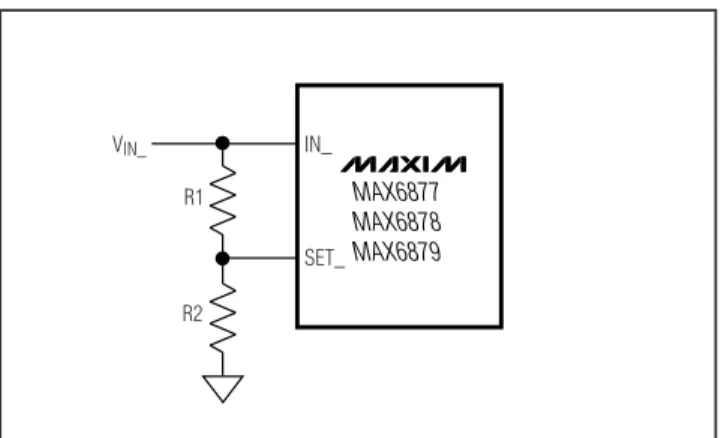
power to the device. The undervoltage threshold for each IN_ supply is set with an external resistor-divider from each IN_ to SET_ to ground.
Undervoltage Lockout Threshold Inputs (SET_)
The MAX6877 features three and the MAX6878/ MAX6879 feature two externally adjustable IN_ under-voltage lockout (UVLO) thresholds (SET1, SET2, SET3) to enable sequencing/tracking functionality. The undervolt-age threshold for each IN_ supply is set with an exter-nal resistor-divider from each IN_ to SET_ to ground (see Figure 9). All SET_ inputs must be above the inter-nal SET_ threshold (0.5V) to enable tracking/sequenc-ing functionality. Use the followtracking/sequenc-ing formula to set the
MAX6877/MAX6878/MAX6879
voltages below the adjusted thresholds to avoid signal-ing an error. The state of PG/RST and FAULT outputs does not change while MARGIN is low. PG/RST, FAULT, and all monitoring functions are disabled while MARGIN is low. MARGIN makes it possible to vary the supplies without a need to adjust the thresholds to pre-vent tracker/sequencer alerts or faults. Drive MARGIN high or leave it unconnected for normal operating mode.
Slew-Rate Control Input (SLEW)
The reference ramp voltage slew rate during any con-trolled power-up/down phase can be programmed in the 90V/s to 950V/s range by connecting a capacitor (CSLEW) from SLEW to ground. Use the following for-mula to calculate the typical slew rate:
Slew Rate = (9.35 x 10⁻⁸)/ CSLEW where slew rate is in V/s and CSLEWis in farads.
The capacitor at CSLEW also sets the FAULT timeout period (tFAULT) and FAULT retry timeout period
(tRETRY) (see Table 1).
For example, if CSLEW = 100pF, we have tRETRY = 350ms, tFAULT = 21.91ms, slew rate = 935V/s. For
example, if CSLEW = 1nF, we have tRETRY = 3.5s,
tFAULT= 219ms, slew rate = 93.5V/s.
CSLEWis the capacitor on the SLEW pad, and must be
large enough to make the parasitic capacitance negli-gible. CSLEW should be in the range of 100pF <
CSLEW< 1nF.
charge the load capacitor at the outputs (OUT_). Using the programmed slew rate, limit the inrush current by using the following formula:
IINRUSH= COUTx SR
where IINRUSHis in amperes, COUTis in farads, and SR
is in V/s.
Delay Time Input (DELAY)
To adjust the desired delay period (tDELAY) before
tracking/sequencing is enabled, connect a capacitor
(CDELAY) between DELAY to ground (see Figures 1 to 8).
The selected delay time is also enforced when EN/UV rises from low to high when all the input voltages (IN1/IN2/IN3) are present. Use the following formula to calculate the delay time:
tDELAY = 200µs + (500kΩx CDELAY)
where tDELAY is in µs and CDELAYis in farads. Leave
DELAY unconnected for the default 200µs delay.
Timeout Period Input (TIMEOUT)
These devices feature a PG/RST timeout period. Connect a capacitor (CTIMEOUT) from TIMEOUT to
ground to program the PG/RSTtimeout period. After all OUT_ outputs exceed their IN_ referenced thresholds
(VTH_PG), PG/RSTremains low for the selected timeout
period, tTIMEOUT(see Figure 3):
tTIMEOUT = 200µs + (500kΩx CTIMEOUT)
where tTIMEOUT is in µs and CTIMEOUT is in farads.
Leave TIMEOUT unconnected for the default 200µs timeout delay.
Logic-Enable Input (EN/UV)
Drive logic EN/UVinput above VEN_Rto initiate voltage
tracking/sequencing during the power-up operation. Drive logic EN/UV below VEN_F to initiate tracking
power-down operation. Connect EN/UV to an external resistor-divider network to set the external undervoltage lockout threshold.
OUT1/OUT2/OUT3 The MAX6877 monitors three and MAX6878/MAX6879 monitor two OUT_ outputs to control the tracking/ sequencing performance. After the internal supply (ABP) exceeds the minimum voltage (2.7V) require-ments, EN/UV> V , and IN1/IN2/IN3 are all greater
Table 1. C
SLEWTiming Formulas
IN_ R1 R2 VIN_ SET_ MAX6877 MAX6878 MAX6879
MAX6877/MAX6878/MAX6879
During fault conditions, an internal pulldown resistor(100Ω) on OUT_ is enabled to help discharge load capacitance (100Ω is connected for fast power-down control).
Outputs
GATE_
The MAX6877/MAX6878/MAX6879 feature up to three GATE_ outputs to drive up to three external n-channel FET gates. The following conditions must be met before GATE_ begins enhancing the external n-channel FET_: 1) All SET_ inputs (SET1–SET3) are above their 0.5V
thresholds.
2) At least one IN_ input or VCCis above the minimum
operating voltage (2.7V). 3) EN/UV> 1.25V.
At power-up mode, GATE_ voltages are enhanced by control loops so that all OUT_ voltages track together at a capacitor-adjusted slew rate. Each GATE_ is internal-ly pulled up to 5V above its relative IN_ voltage to fulinternal-ly enhance the external n-channel FET when power-up is complete.
FAULT
The MAX6877/MAX6878/MAX6879 include an open-drain, active-low tracking fault alarm output (FAULT). FAULTasserts low when a power-up phase is not com-pleted within the specified fault period or if OUT_ volt-ages are more than VTRK_F.
The fault time period (tFAULT) is set through the
capaci-tor at SLEW (CSLEW). Use the following formula to
esti-mate the fault timeout period:
tFAULT = 2.191 x 10⁸x CSLEW
Power-supply tracking operation should be completed within the selected fault timeout period (tFAULT). The
total tracking time is extended when the devices must vary the control slew rate to allow slow supplies to catch up. If the external FET is too small (RDS is too
high for the selected load current and IN_ source cur-rent), the OUT_ voltage may never reach the control ramp voltage. For a slew rate of 935V/s, a fault is sig-naled if all outputs have not stabilized within 22ms. For a slew rate of 93.5V/s, a fault is signaled if tracking takes too long (more than 219ms).
During powerup, only the condition, OUT_ < ramp -VTRK, is monitored in order to stop the ramp. However,
both conditions OUT < ramp - VTRK_F and OUT_ >
ramp + VTRK_Fcause a fault. During power-down, only
the condition OUT > ramp + VTRKis checked in order
to stop the ramp. However, both conditions OUT_ < ramp - VTRK_F and OUT_ > ramp + VTRK_F cause a
fault (see Figure 10). OUT1, OUT2, and OUT3 are tracked within VTRK_F (mV) (power-up tracking and
power-down), and if they differ by more than 2 x VTRK_F
a fault condition is asserted.
Retry time period (tRETRY) is defined as 16 x tFAULT. To
calculate the retry time period use the following formula:
tRETRY= 3.506 x 10⁹x CSLEW
where tRETRYis in µs and CSLEWis in farads.
Autoretry and Latch-Off Functions (LTCH/RTR)
The MAX6877/MAX6878/MAX6879 feature latch-off or autoretry modes to power-on again after a fault condi-tion has been detected. Connect LTCH/RTR to ground to set the latch-off mode. To select autoretry mode, connect LTCH/RTR to ABP or leave unconnected.
250mV UP = FAULT THRESHOLD 250mV UP =
MAX6877/MAX6878/MAX6879
retries power-up if all power-up conditions are met (see Figure 8). These include all VSET_ > 0.5V, EN/UV >
VEN_R, OUT_ voltages < VTH_PL. The autoretry period,
tRETRY, is a function of CSLEW; see Table 1.
When the device is in latch mode and a fault occurs, FAULT asserts and all outputs are latched off. To unlatch OUT_ after a fault disappears, cycle EN/UV or cycle VCC and the inputs (IN_) below the 2.7V UVLO
threshold. After EN/UV goes high, the device waits a
tRETRYperiod then tries to power-up again. If VCCand
all IN_ are cycled below 2.7V, the device tries to power-up immediately.
Power-Good Output (PG/RST)
The MAX6877/MAX6878 include a power-good (PG/RST) output. PG/RSTis an open-drain output and requires an external pullup resistor.
All the OUT_ outputs must exceed their IN_ referenced thresholds (IN_ x VTH_PG) for the selected reset timeout
period tTIMEOUT (see the TIMEOUT Period Input
sec-tion) before PG/RSTasserts high. PG/RSTstays low for the selected reset timeout period (tTIMEOUT) after all
the OUT_ voltages exceed their IN_ referenced thresh-olds. PG/RSTgoes low when VSET_< VTHor VEN/UV< VEN_R(see Figure 3).
The external pass MOSFET is connected in series with the sequenced power-supply source. Since the load current and the MOSFET drain-to-source impedance (RDS) determine the voltage drop, the on
characteris-tics of the MOSFET affect the load supply accuracy. The MAX6877/MAX6878/MAX6879 fully enhance the external MOSFET out of its linear range to ensure the lowest drain-to-source on-impedance. For highest sup-ply accuracy/lowest voltage drop, select a MOSFET with an appropriate drain-to-source on-impedance with a gate-to-source bias of 4.5V to 6.0V.
Layout and Bypassing
For better noise immunity, bypass each of the IN_ inputs to GND with 0.1µF capacitors installed as close to the device as possible. Bypass ABP to GND with a 1µF capacitor installed as close to the device as possi-ble. ABP is an internally generated voltage and must not be used to supply power to external circuitry.
Selector Guide
PART CHANNEL TIMEOUT
SELECTABLE PG/RST MARGIN VCC
MAX6877 3 Yes Yes Yes Yes
MAX6878 2 Yes Yes Yes Yes
MAX6877/MAX6878/MAX6879
SET1 IN1 0.1µF 0.1µF 0.1µF 1µF IN1 IN2 IN3 SET2 SET3 EN/UV OUT1 OUT1 OUT2 OUT3ABP SLEW GND TRK/SEQ DELAY TIMEOUT OUT2
OUT3
FAULT
PG/RST VBUS
IN2 IN3 GATE1 GATE2 GATE3
MARGIN LTCH/RTR
VCC
MAX6877
MAX6877/MAX6878/MAX6879
4mm x 4mm THIN QFN TOP VIEW 4mm x 4mm THIN QFN 15 16 14 13 6 5 7 SET2 EN/UV 8 ABP OUT2 TRK/SEQ GATE2 1 2 GATE1 4 12 11 9 IN2 IN1 LTCH/RTR SLEW DELAY GND MAX6879 SET1 FAULT 3 10 OUT1*EXPOSED PADDLE CONNECTED TO GND.
EP* EP* 23 24 22 21 8 7 9
ABP SET2 SET1
EN/UV 10 VCC N.C. FAULT PG/RST OUT2 MARGIN 1 2 N.C. 4 5 6 17 18 16 14 13 IN2 IN1 TIMEOUT SLEW DELAY GND MAX6878 N.C. N.C. 3 15 GATE1 20 11 LTCH/RTR OUT1 19 12 TRK/SEQ GATE2 + +
Pin Configurations (continued)
PART TEMP RANGE
PACKAGE CODE MAX6878ETG+ -40°C to +85°C 24 Thin QFN T2444-4
MAX6879ETE+ -40°C to +85°C 16 Thin QFN T1644-4 +Denotes lead-free package.
MAX6877/MAX6878/MAX6879
Package Information
(The package drawing(s) in this data sheet may not reflect the most current specifications. For the latest package outline information,
go to www.maxim-ic.com/packages.)
24L QFN THIN.EPS
PACKAGE OUTLINE,
21-0139 E 12 12, 16, 20, 24, 28L THIN QFN, 4x4x0.8mm
MAX6877/MAX6878/MAX6879
PACKAGE OUTLINE,
21-0139 E 22 12, 16, 20, 24, 28L THIN QFN, 4x4x0.8mm