Available online through
ISSN 2229 – 5046EFFECTS OF THERMAL RADIATION AND HEAT SOURCE ON MHD FREE CONVECTION
OVER A VERTICAL PLATE WITH THERMAL DIFFUSION AND DIFFUSION THERMO
B. SHANKAR GOUD
*, M. N. RAJA SHEKAR
*Department of Mathematics,
JNTUH College of Engineering Kukatpally, Hyderabad- 085, TS, India.
Department of Mathematics,
JNTUH College of Engineering Nachupally, Karimnagar -505501, TS, India.
(Received On: 18-06-16; Revised & Accepted On: 30-06-16)
ABSTRACT
I
n the present paper, an analysis is carried out the thermal radiation and heat source effects on an unsteady magnetohydrodynamic free convection flow past an infinite vertical porous plate in the presence of thermal diffusion and diffusion thermo. A uniform magnetic field acts perpendicular to the porous surface. The Rosseland approximation has been used to describe the radiative heat flux in energy equation. The dimensionless governing equations are solved numerically using Galerkin finite element method. The effects of the different physical flow parameters on these respective flow fields are discussed through graphs and results are physically interpreted.Keywords: Thermal radiation, Heat source, Thermal diffusion, Diffusion thermo, MHD, Free convection, Vertical
plate, Galerkin finite element method.
NOMENCLATURE
A
Small positive parameter wT
′
Wall temperatureT
∞′
Reference temperature
U
′
Dimensional free stream velocityt
′
Dimensional timeg
Acceleration due to gravity0
w
′
Dimensional suction velocity( ,
u w
′ ′
)
Dimensional velocity components( , )
x y
′ ′
Dimensional Cartesian coordinates2 0
H
′
Constant transverse magnetic field𝑲𝑲′ Dimensional porosity parameter p
c
Specific heat capacity sc
Concentration susceptibility2
M
Non – dimensional Hartmann numberPr
Prandtl numberGr
Grashof numberGc
Modified Grashof numberSc
Schmidt numberSr
Soret numberDu
Soret numberD
Chemical diffusivity mD
Molecular diffusivity Tk
Mean absorption coefficient C′ ConcentrationC
Dimensionless concentration wC′
Concentration near the plate∞
′
C
Concentration in the fluid far away from the plate2
R
Radiation parameter0
U
Mean velocity ofU
′
( )
t
′
zq
′
Radiative heat fluxS
Heat source GREEK SYMBOLSε
Small positive parameterβ
Coefficient of Volume expansion*
β
Volumetric Coefficient of Expansion with Concentration
C
σ
Electrical conductivityµ
Permeabilityρ
Fluid densityω
′
Dimensional free stream frequency of oscillation*
k
Thermal conductivity2
α
Absorption coefficient2
χ
Darcy numberδ
Radiation absorption coefficient1. INTRODUCTION
In recent years, the flows of fluid through porous media are of principal interest because these are quite prevalent in nature. Such flows have attracted the attention of a number of scholars due to their application in many branches of science and technology, viz., in the field of agriculture engineering to study the underground water resources, seepage of water in river –beds, in petroleum technology to study the movement of natural gas, oil and water through oil reservoirs, in chemical engineering for filtration and purification processes. The convection problem in porous medium has also important applications in geothermal reservoirs and geothermal energy extractions. A comprehensive review of the studies of convective heat transfer mechanism through porous media has been made by Nield and Bejan [1]. Hiremath and Patil [2] studied the effect on free convection currents on the oscillatory flow through a porous medium, which is bounded by vertical plane surface of constant temperature. Fluctuating heat and mass transfer on three dimensional flow through a porous medium with variable permeability has been discussed by Sharma et al. [3]. Magnetohydrodynamics is currently undergoing a period of great enlargement and differentiation of subject matter. The interest in these new problems generates from their importance in liquid metals, electrolytes and ionized gases. Unsteady hydromagnetic free convection flow of Newtonian fluid has been investigated by Helmy [4]. Chaudhary and Sharma [5] considered combined heat and mass transfer by laminar mixed convection flow from a vertical surface with induced magnetic field. Hydromagnetic unsteady mixed convection and mass transfer flow past a vertical porous plate immersed in a porous medium was investigated by Sharma and Chaudhary [6]. El – Amin [7] considered the MHD free convection and mass transfer flow in a micropolar fluid over a stationary vertical plate with constant suction. Combined heat and mass transfer problems with chemical reaction are of importance in many processes and have, therefore, received a considerable amount of attention in recent years. In processes such as drying, evaporation at the surface of water body, energy transfer in wet cooling tower and the flow in a desert cooler, heat and mass transfer occur simultaneously.
Chemical reaction can be codified as either homogeneous or heterogeneous processes. A homogeneous reaction is one that occurs uniformly through a given phase. In contrast, a heterogeneous reaction takes place in a restricted region or within the boundary of a phase. A reaction is said to be first order, if the rate of reaction is directly proportional to the concentration itself which has many applications in different chemical engineering processes and other industrial applications such as polymer production, manufacturing of ceramics or glassware and food processing [8]. Das et al.
[9] considered the effects of first order chemical reaction on the flow past an impulsively started infinite vertical plate with constant heat flux and mass transfer. Muthucumarswamy and Ganesan [10] and Muthucumarswamy [11] studied first order homogeneous chemical reaction on flow past infinite vertical plate. In the above mentioned studies the effects of heat sources/sinks and radiation have not been considered. Due to its great applicability to ceramic tiles production problems, the study of heat transfer in the presence of a source/sink has acquired newer dimensions. Actually, many processes in new engineering areas occur at high temperature and knowledge of radiation heat transfer becomes imperative for the design of the pertinent equipment. Kandasamy et al. [12] discussed heat and mass transfer effect along a wedge with heat source and concentration in the presence of suction/injection taking into account the chemical reaction of first order. Sharma et al. [13, 14] have reported on the radiation effect with simultaneous thermal and mass diffusion in MHD mixed convection flow from a vertical surface. Sharma et al. [15, 16] discussed radiation effect on free convective flow along a uniform moving porous vertical plate in the presence of heat source/sink and transverse magnetic field.
effect of thermal radiation and heat source on an unsteady MHD free convective flow past an infinite vertical plate with thermal diffusion and diffusion thermo. Mukhopadhyay [27] performed an analysis to investigate the effects of thermal radiation on unsteady mixed convection flow and heat transfer over a porous stretching surface in porous medium. Osalusi et al. [28] investigated thermal diffusion and diffusion thermo effects on combined heat and mass transfer of a steady hydromagnetic convective and slip flow due to a rotating disk in the presence of viscous dissipation and Ohmic heating. Pal and Talukdar and chemical reaction on MHD flow of viscous and electrically conducting fluid past a vertical permeable surface embedded in a porous medium is analyzed. Postelnicu [30] studied simultaneous heat and mass transfer by natural convection from a vertical plate embedded in electrically conducting fluid saturated porous medium, using Darcy – Boussinesq’s model including Soret, and Dufour effects. The interaction of buoyancy with thermal radiation has increased greatly during the last decade due to its importance in many practical applications. The thermal radiation effect is important under many isothermal and non – isothermal situations. If the entire system involving the polymer extrusion process is placed in a thermally controlled environment, then thermal radiation could be important. The knowledge of radiation heat transfer in the system can, perhaps, lead to a desired product with sought characteristics. Motivated by the above referenced work and the numerous possible industrial applications of the problem (like in isotope separation), it is of paramount interest in this study to investigate the effects of thermal radiation, heat source on unsteady MHD free convective flow past an infinite vertical plate in presence of thermal diffusion and diffusion thermo. None of the above investigations simultaneously studied the effects of thermal radiation, heat source, thermal diffusion and diffusion thermo unsteady MHD free convective flow past an infinite vertical plate. Hence, the purpose of this paper is to extend Israel – Cookey et al. [24] to study the more general problem which includes thermal radiation, heat source, thermal diffusion and diffusion thermo unsteady MHD free convective flow past an infinite vertical plate. The momentum, thermal, and solutal boundary layer equations are transformed into a set of ordinary differential equations and then solved using Galerkin finite element method. The analysis of the results obtained in the present work shows that the flow field is appreciably influenced by Dufour and Soret numbers, heat source and thermal radiation parameters. To reveal the tendency of the solutions, selected results for the velocity components, temperature, and concentration are graphically depicted. The rest of the paper is structured as follows. In Section problem in Section Section
2. MATHEMATICAL FORMULATION
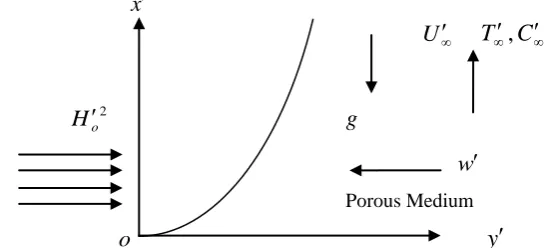
We consider the unsteady flow of an incompressible viscous, radiating hydro magnetic fluid past an infinite porous heated vertical plate with time – dependent suction in an optically thin environment. The physical model and the coordinate system are shown in figure 1. The
x
′
−
axis is taken along the vertical infinite porous plate in the upward direction and they
′
−
axis normal to the plate.x′
U
∞′
T
∞′
,
C
∞′
2
o
H
′
g
w′ Porous Medium
o
y
′
Figure 1: The physical model and coordinate system of the problem
At time
t
′
=
0
, the plate is maintained at a temperatureT
w′
, which is high enough to initiate radiative heat transfer. A constant magnetic fieldH
o′
2 is maintained in they′
direction and the plate moves uniformly along the positivex′
direction with velocityU
0. Under Boussinesq's approximation the flow is governed by the following equations:0
=
′
∂
′
∂
y
w
(1)
(
)
(
)
(
)
2 2
2
* 0
2 '
C
H
u
u
u
U
w
u
U
g
T
T
g
C
C
t
y
y
t
K
µ σ
ν
ν
β
β
ρ
∞ ∞′
′
′
′
′
∂
+
′
∂
=
∂
+
∂
−
+
′
−
′
+
′
−
′
+
′
−
′
′
′
′
′
2 2
2 ( ) 2
o m T
z
P P S P
Q D k
T T k T C
w q T T
t y
ρ
c yρ
c ∞ c c y′ ′ ′ ′
∂ + ′∂ = ∂ − ∇ ′ − ′− ′ + ∂
′ ′ ′ ′
∂ ∂ ∂ ∂ (3) 2
2 3
2
3
16
0
z
z
q
T
q
T
y
α
α σ
∞y
′
′
∂
−
′
−
∂
=
′
′
∂
∂
(4)2 2
2 2
m T
m
D k
C
C
C
T
w
D
t
y
y
T
y
′
′
′
′
∂
+
′
∂
=
∂
+
∂
′
′
′
′
∂
∂
∂
∂
(5)The boundary conditions are
(
)
,
0
0 , 0
( ) 1 , ,
w w
i t
u T T C C on y
u U t w εeω′ ′ T T∞ C C as y∞
′= ′= ′ ′= ′ ′=
′= ′ ′ = ′ + ′= ′ ′= ′ ′→ ∞ (6)
Since the medium is optically thin with relatively low density and
α
<<
1
the radiative heat flux given by equation (4)in the spirit of Cogley et al. [23] becomes
(
′
−
∞′
)
=
′
∂
′
∂
T
T
y
q
z 24
α
(7)Where
∫
∞
′
∂
∂
=
0 2T
B
δλ
α
(8)Here
λ
is a frequency. Further, from equation (1) it is clear thatw′
is a constant or a function of time only and so weassume
w
′
=
−
w
0′
(
1
+
ε
Ae
iω′t′)
(9)Such that
ε
A
<<
1
,
and the negative sign indicates that the suction velocity is towards the plate. Inview of equations(4), (8) and (9), equations (2), (3) and (5) become
(
)
M
u
U
Gr
GcC
y
u
t
U
y
u
e
A
t
u
i t+
+
−
+
−
∂
∂
+
∂
∂
=
∂
∂
+
−
∂
∂
ε
ωχ
θ
)
)(
(
4
1
1
4
1
2 22 2 (10)
( )
( )
(
)
( )( ) ( )( )
∂
∂
+
−
−
∂
∂
=
∂
∂
+
−
∂
∂
2 2 2 2 2Pr
Pr
1
Pr
Pr
4
1
y
C
Du
S
R
y
y
e
A
t
ti
θ
θ
θ
ε
θ
ω (11)( )
( )
(
)
∂
∂
+
∂
∂
=
∂
∂
+
−
∂
∂
2 2 2 2)
)(
(
1
4
1
y
Sr
Sc
y
C
y
C
e
A
Sc
t
C
Sc
ε
iωtθ
(12) Where we have used the following dimensionless variables:
(
)
(
)
2 2
2
0 0
2 ' 2 *
0 0 0 0
* 2
2
2 2 * 2 2
0 0 0 0 0 0
2 2
2 0
2 0
4
,
,
,
,
,
,
, Pr
4
4
,
,
(
) ,
,
(
)
,
p ww w o
w
P p
C m T w
o m w
c
w t
w y
u
U
T
T
t
y
u
w
U
U
w
U
T
T
K w
k
g
T
T
g
C
C
Q
Gr
Gc
R
T
T
S
U w
U w
c k w
c w
H
D k T
T
M
Sr
w
w T
C
µ
νω
θ
χ
ν
ν
ν
β ν
β ν
α
ν
ρ
ρ
µ σ
ρ
∞ ∞ ∞ ∞ ∞ ∞′ ′
′ ′
′
′
′
′
−
′
=
=
=
=
=
=
=
=
′
′
−
′
′
′
−
′
′
−
′
′
′
=
=
=
−
=
′
′
′
′
′
′
−
′
=
=
′
(
′
)
(
)
(
)
(
(
)
)
,
m T w,
o,
S P w w
D k
C
C
w
C
C
Du
Sc
C
C
c c
T
T
D
C
C
∞ ∞ ∞ ∞ ∞
′
−
′
′
−
′
=
=
=
′
′
′
′
′
−
−
−
(13)Equations (10), (11) and (12) are now subject to the boundary conditions
∞
→
→
→
+
→
=
=
=
=
y
as
C
e
u
y
on
C
u
t i0
,
0
,
1
0
1
,
1
,
0
θ
ε
θ
3. METHOD OF SOLUTION
By applying Galerkin finite element method for equation (10) over the element
(
e
)
,(
y
j≤
y
≤
y
k)
is:2 ( ) ( ) ( )
( ) ( )
2
4
4
0
k
j
y e e e
e T e
y
u
u
u
N
B
Du
P
dy
y
t
y
∂
∂
∂
−
+
−
+
=
∂
∂
∂
∫
(15)Where
4
(
Gr
)
4
(
Gc
)
C
DU
,
t
U
P
+
+
+
∂
∂
=
θ
B
=
1
+
ε
Ae
iωt,
D
=
4
(
M
2+
χ
2)
; Integrating the first term in equation (15) by parts one obtains0
4
4
4
( )) ( ) ( ) ( ) ( ) ( ) ( ) (
=
−
+
∂
∂
−
∂
∂
+
∂
∂
∂
∂
−
∂
∂
∫
Du
P
dy
y
u
B
t
u
N
y
u
y
N
y
u
N
k j k j y y e e e T e e T e y y e T e (16)Neglecting the first term in equation (16), one gets:
0
4
4
( )) ( ) ( ) ( ) ( ) (
=
−
+
∂
∂
−
∂
∂
+
∂
∂
∂
∂
∫
Du
P
dy
y
u
B
t
u
N
y
u
y
N
k j y y e e e T e e T eLet
u
(e)=
N
(e)φ
(e) be the linear piecewise approximation solution over the element(
e
)
(y
j≤
y
≤
y
k) where[
]
[
]
Tk j e k j e
u
u
N
N
N
( )=
,
φ
( )=
andj k j k j k k j
y
y
y
y
N
y
y
y
y
N
−
−
=
−
−
=
,
are the basis functions. One obtains:dy
u
u
N
N
N
N
N
N
N
N
B
dy
u
u
N
N
N
N
N
N
N
N
dy
u
u
N
N
N
N
N
N
N
N
k j k j k j y y k j k k k j k j j j y y k j k k k j k j j j y y k j k k k j k j j j∫
∫
∫
−
+
• • ' ' ' ' ' ' ' ' ' ' ' '4
4
dy
N
N
P
dy
u
u
N
N
N
N
N
N
N
N
D
k j k j y y k j y y k j k k k j k j j j∫
∫
=
+
Simplifying we get
=
+
−
−
−
+
−
−
• •1
1
2
2
1
1
2
6
1
1
1
1
2
4
2
1
1
2
6
1
1
1
1
1
4
) ( ) ( 2P
u
u
D
u
u
l
B
u
u
u
u
l
k j k j e k j k j eWhere prime and dot are denotes differentiation w.r.t
y
and timet
respectively. Assembling the element equations for two consecutive elements(
y
i−1≤
y
≤
y
i)
and(
y
i≤
y
≤
y
i+1)
following is obtained:2 1 1 1 ( ) ( ) 1 1 1
1 1 0 2 1 0 1 1 0
4 1 4
1 2 1 1 4 1 1 0 1
6 2
0 1 1 0 1 2 0 1 1
i
i i
i
i e i
e i i i u u u B
u u u
l l u u u • − − • − • + + + − − − − + − − − − 1 1
2
1
0
1
1
4
1
2
6
2
0
1
2
1
i i i
u
D
P
u
u
− +
+
=
(17)Now put row corresponding to the node
i
to zero, from equation (17) the difference schemes withl
(e)=
h
is:[
]
[
u
u
]
D
[
u
u
u
]
P
h
B
u
u
u
u
u
u
h
i i i i i i
−
−
i+
i+
i+
i+
i=
+
+
+
−
+
−
+ − + − + • • − • +−1 1 1 1 1 1 1 1
Applying the trapezoidal rule, following system of equations in Crank – Nicholson method are obtained: * 1 6 5 1 4 1 1 3 1 2 1 1
1
u
A
u
A
u
A
u
A
u
A
u
P
A
n i n i n i n i n i ni
+
+
=
−+
+
++
+ + +
+
− (19)
Now from equations (11) and (12) following equations are obtained:
* 1 6 5 1 4 1 1 3 1 2 1 1
1
B
B
B
B
B
Q
B
θ
in−++
θ
in++
θ
in++=
θ
in−+
θ
in+
θ
in++
(20) * 1 6 5 1 4 1 1 3 1 2 1 1
1
C
C
C
C
C
C
C
C
C
C
C
R
C
in−++
in++
in++=
in−+
in+
in++
(21) Where
A
1=
2
−
12
Brh
−
Dk
−
24
r
,
A
2=
8
+
4
Dk
+
48
r
,
A
3=
2
+
12
Brh
+
Dk
−
24
r
,
,
24
12
2
4
Brh
Dk
r
A
=
−
−
+
A
5=
8
−
4
Dk
−
48
r
,
A
6=
2
+
12
Brh
+
Dk
+
24
r
,
,
(Pr)
4
24
4
(Pr)
12
(Pr)
2
21
Brh
R
k
r
Sk
B
=
−
−
−
−
B
2=
8
(Pr)
+
48
r
+
16
R
2k
+
16
(Pr)
Sk
,
,
(Pr)
4
24
4
(Pr)
12
(Pr)
2
23
Brh
R
k
r
Sk
B
=
+
+
−
+
,
(Pr)
4
24
4
(Pr)
12
(Pr)
2
24
Brh
R
k
r
Sk
B
=
−
−
+
−
,
(Pr)
16
16
48
(Pr)
8
25
r
R
k
Sk
B
=
−
−
−
B
6=
2
(Pr)
+
12
(Pr)
Brh
−
4
R
2k
+
24
r
−
4
(Pr)
Sk
,
,
24
(Pr)
12
)
(
2
1
Sc
Brh
r
C
=
−
−
C
2=
8
(
Sc
)
+
48
r
,
C
3=
2
(
Sc
)
+
12
(
Sc
)
Brh
−
24
r
,
,
24
)
(
12
)
(
2
4
Sc
Sc
Brh
r
C
=
−
+
C
5=
8
(
Sc
)
−
48
r
,
C
6=
2
(
Sc
)
+
12
(
Sc
)
Brh
+
24
r
,
,
)
(
4
12
12
*
+
+
∂
∂
=
=
Gr
DU
t
U
k
Pk
P
θ
12
48
(Pr)
(
)
2,
2 *
∂
∂
=
=
y
C
Du
k
Qk
Q
;
)
)(
(
48
12
2 2 * * *
∂
∂
=
=
y
k
Sr
Sc
k
R
R
θ
Here r= 2
h
k
and
h
,
k
are mesh sizes alongy
– direction and time – direction respectively. Indexi
refers to space andj
refers to the time. In the equations (19), (20) and (21), takingi
=
1
(
1
)
n
and using boundary conditions (14), then the following system of equations are obtained:n
i
B
X
A
i i=
i=
1
(
1
)
(22) whereA
i's are matrices of ordern
andX
i,B
i's are column matrices havingn
– components. The solutions of above system of equations are obtained by using Thomas algorithm for velocity, temperature and concentration. Also, numerical solutions for these equations are obtained byC
– programme. In order to prove the convergence and stability of Galerkin finite element method, the sameC
– programme was run with smaller values ofh
andk
no significant change was observed in the values ofu
,
θ
andC
. Hence the Galerkin finite element method is stable and convergent.4. RESULTS AND DISCUSSIONS
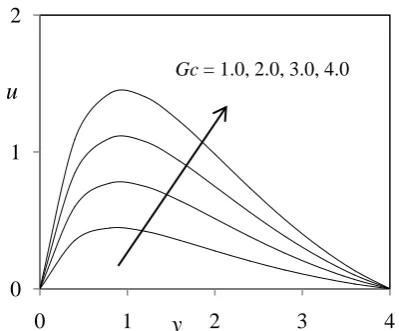
Figure 2: Velocity profiles for different values of Gr Figure 3: Velocity profiles for different values of Gc
0 0.5 1
0 1 2 3 4
Gr= 1.0, 2.0, 3.0, 4.0
u
y
0 1 2
0 1 2 3 4
Gc= 1.0, 2.0, 3.0, 4.0
u
In the previous sections, we have formulated and solved the problem of an unsteady MHD free convection flow past an infinite heated vertical plate in a porous medium with thermal diffusion, diffusion thermo, radiation and heat source. By invoking, the optically thin differential approximation for the radiative heat flux in the energy equation. In the numerical computation, the Prandtl number (
Pr
=
0
.
71
) which corresponds to air and various values of the material parameters are used. In addition, the boundary conditiony
→
∞
is approximated byy
max=
4
, which is sufficiently large for the velocity to approach the relevant stream velocity. The temperature and the species concentration are coupled to the velocity via Grashof number(
Gr
)
and Modified Grashof number(
Gc
)
as seen in equation (10). For various values of Grashof number and Modified Grashof number, the velocity profilesu
are plotted in figures (2) and (3). The Grashof number(
Gr
)
signifies the relative effect of the thermal buoyancy force to the viscous hydrodynamic force in the boundary layer. As expected, it is observed that there is a rise in the velocity due to the enhancement of thermal buoyancy force. Also, asGr
increases, the peak values of the velocity increases rapidly near the porous plate and then decays smoothly to the free stream velocity. The Modified Grashof number(
Gc
)
defines the ratio of the species buoyancy force to the viscous hydrodynamic force. As expected, the fluid velocity increases and the peak value is more distinctive due to increase in the species buoyancy force. The velocity distribution attains a distinctive maximum value in the vicinity of the plate and then decreases properly to approach the free stream value. It is noticed that the velocity increases with increasing values of Modified Grashof number(
Gc
)
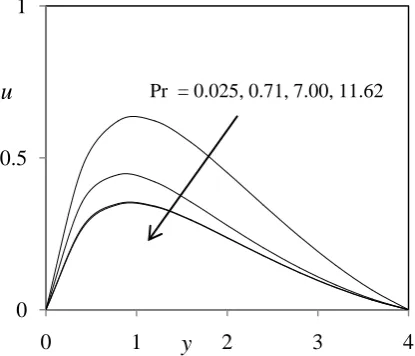
.Figure 4: Velocity profiles for different values of Pr Figure 5: Velocity profiles for different values of Sc
Figure 6: Velocity profiles for different values of
M
2 Figure 7: Velocity profiles for different values of Du Figure (4) illustrate the velocity profiles for different values of Prandtl numberPr
. The numerical results show that the effect of increasing values of Prandtl number result in decreasing velocity. The nature of velocity profiles in presence of foreign species such as Hydrogen (Sc
= 0.22), Helium (Sc
= 0.22), Oxygen(Sc
= 0.60) and Water vapour (Sc
= 0.66) are shown in figure (5). The flow field suffers a decrease in primary velocity at all points in presence of heavier diffusing species. The effect of the magnetic field parameterM
2 is shown in figure (6) in case of cooling of the plate.0 0.5 1
0 1 2 3 4
Pr = 0.025, 0.71, 7.00, 11.62
u
y
0 0.3 0.6
0 1 2 3 4
Sc= 0.22, 0.30, 0.60, 0.66
u
y
0 0.2 0.4
0 1 2 3 4
M2= 1.0, 2.0, 3.0, 4.0
u
y
00.4 0.8
0 1 2 3 4
Du= 1.0, 2.0, 3.0, 4.0
u
It is observed that the velocity of the fluid decreases with the increase of the magnetic field parameter values. The decrease in the velocity as the Hartmann number
M
2 increases is because the presence of a magnetic field in an electrically conducting fluid introduces a force called the Lorentz force, which acts against the flow if the magnetic field is applied in the normal direction, as in the present study. This resistive force slows down the fluid velocity component as shown in figure (6).Figure 8: Velocity profiles for different values of
R
2Figure 10: Velocity profiles for different values of
χ
2Figure 9: Velocity profiles for different values of S
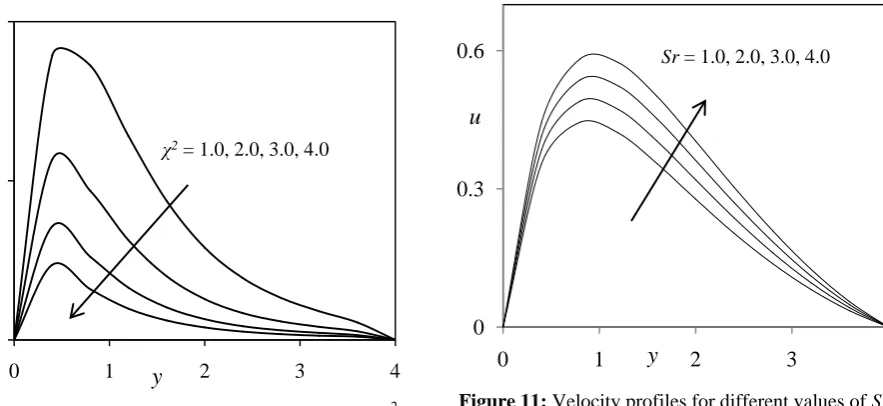
Figure 11: Velocity profiles for different values of Sr The variations of velocity distribution with
y
for different values of the Dufour number(
Du
)
and Soret number)
(
Sr
are shown in figure (7) and (11). It can be clearly seen that the velocity distribution in the boundary layer increases with the Dufour and Soret numbers. The effect of the thermal radiation parameterR
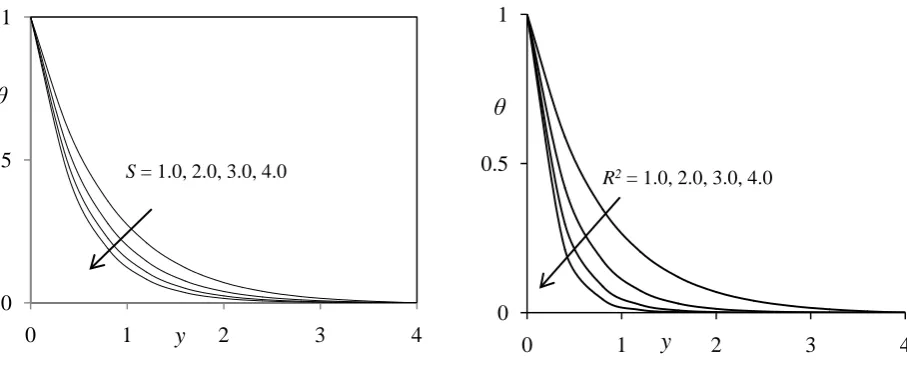
2 on the primary velocity and temperature profiles in the boundary layer are illustrated in figures (8) and (15) respectively. Increasing the thermal radiation parameterR
2produces significant increase in the thermal condition of the fluid and its thermal boundary layer. This increase in the fluid temperature induces more flow in the boundary layer causing the velocity of the fluid there to increase. Figure (9) and (14) has been plotted to depict the variation of velocity and temperature profiles againsty
for different values of heat source parameter S by fixing other physical parameters. From this Graph we observe that velocity and temperature decrease with increase in the heat source parameter S because when heat is absorbed, the buoyancy force decreases the temperature profiles.0 0.05
0 1 2 3 4
R2= 1.0, 2.0, 3.0, 4.0
u
y
0 0.05 0.1
0 1 2 3 4
χ2= 1.0, 2.0, 3.0, 4.0
y
u
0 0.2 0.4
0 1 2 3 4
S= 1.0, 2.0, 3.0, 4.0
u
y
0 0.3 0.6
0 1 2 3 4
Sr= 1.0, 2.0, 3.0, 4.0
u
Figure 12: Temperature profiles for different values of Pr Figure 13: Temperature profiles for different values of Du
Figure 14: Temperature profiles for different values of S
Figure 15: Temperature profiles for different values of
R
2Figure (10) shows the effects of Darcy number
χ
2 on the velocity profiles for cooling as well as heating of the plate. For a cooling plate fluid velocity increases, whereas for a heating plate it decreases with increase ofχ
2. Darcy number is the measurement of the porosity of the medium. As the porosity of the medium increases, the value ofχ
2 increases. For large porosity of the medium fluid gets more space to flow as a consequence its velocity increases. Figure (12) illustrate the temperature profiles for different values of Prandtl numberPr
. It is observed that the temperature decrease as an increasing the Prandtl number. The reason is that smaller values of Pr are equivalent to increase in the thermal conductivity of the fluid and therefore heat is able to diffuse away from the heated surface more rapidly for higher values of Pr. Hence in the case of smaller Prandtl number the thermal boundary layer is thicker and the rate of heat transfer is reduced. The Dufour number(
Du
)
does not enter directly into the momentum and mass equations. Thus the effect of Dufour number on velocity and mass profiles is not apparent.0 0.5 1
0 1 2 3 4
Pr = 0.025, 0.71, 7.0, 11.62
θ
y
0 0.5 1
0 1 2 3 4
Du= 1.0, 2.0, 3.0, 4.0
θ
y
0 0.5 1
0 1 2 3 4
S= 1.0, 2.0, 3.0, 4.0
θ
y
0 0.5 1
0 1 2 3 4
R2= 1.0, 2.0, 3.0, 4.0
θ
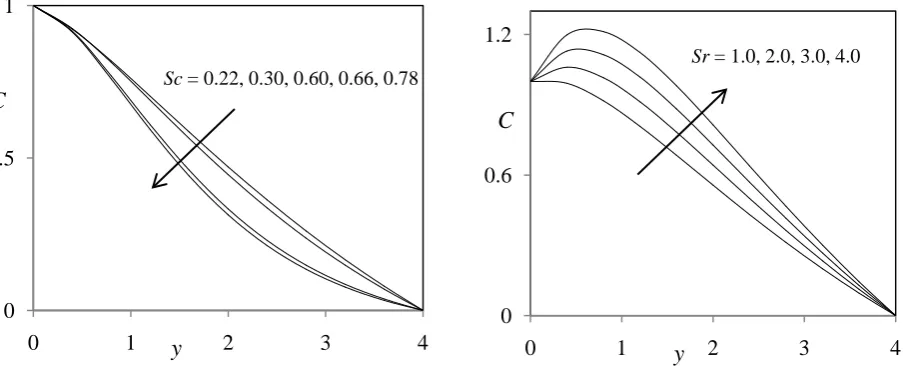
Figure 16: Concentration profiles for different values of Sc Figure 17: Concentration profiles for different values of Sr
Figure (13) shows the variation of temperature profiles for different values of
Du
. The parameterDu
has marked effects on the temperature profiles. It is observed that the temperature profiles increase with the increasing values ofDu
. It is also observed from this figure that whenDu
= 1.0, that is, when the ratio between temperature and concentration gradient is very small the temperature profile shows its usual trend of gradual decay. As Dufour numberDu
becomes large the profiles overshoot the uniform temperature close to the boundary. The effects of Schmidt number(
Sc
)
and Soret number(
Sr
)
on the concentration field are presented in figures (16) and (17). Figure (16) shows the concentration field due to variation in Schmidt number(
Sc
)
for the gasses Hydrogen, Helium, Water – vapour, Oxygen and Ammonia. It is observed that concentration field is steadily for Hydrogen and falls rapidly for Oxygen and Ammonia in comparison to Water – vapour. Thus Hydrogen can be used for maintaining effective concentration field and Water – vapour can be used for maintaining normal concentration field. In figure (17), it is observed that an increase in the Soret number(
Sr
)
leads to increase in the concentration field.5. CONCLUSIONS
In conclusion therefore, the flow of an unsteady MHD free convection past an infinite heated vertical plate in a porous medium under the simultaneous effects of thermal diffusion, diffusion thermo, radiation and heat source is affected by the material parameters. The governing equations are approximated to a system of linear partial differential equations by using Galerkin finite element method. The results are presented graphically and we can conclude that the flow field and the quantities of physical interest are significantly influenced by these parameters.
1. The velocity increases as Grashof number
Gr
,
Modified Grashof numberGc
,
Dufour number Du and Soret number Sr increases. However, the velocity was found to decreases as the Hartmann numberM
,
Prandtlnumber
Pr,
Schmidt numberSc
,
Thermal radiation parameterR
2Heat source parameter S and Darcy parameterχ
2 increases.2. The fluid temperature was found to decreases as the thermal radiation parameter
R
2, Heat source parameter S and Prandtl numberPr
increases and found to increase as Dufour number Du increases.3. The fluid concentration was found to decreases as the Schmidt number Sc and increases as the Soret number Sr increases.
REFERENCES
1. Nield, D. N. and Bejan, A., (1998). Convection in Porous Media, 2nd Edition, Springer – Verlag, Berlin. 2. Hiremath, P. S. and Patil, P. M., (1993). Free convection effects on oscillatory flow of couple stress field
through a porous medium, Acta Mechanica, Vol. 98, No. 1 – 4, pp. 143 – 158. doi:10.1007/BF01174299. 3. Sharma, B. K., Chaudhary, R. C. and Sharma, P. K., (2007). Fluctuating mass transfer on three dimensional
flow through a porous medium with variable permeability, Advances in Theoretical and Applied Mathematics, Vol. 2, No. 3, pp. 257 – 267.
4. Helmy, K. A., (1998). MHD unsteady free convection flow past a vertical porous plate, ZAMM, Vol. 98, No. 4, pp. 255 – 270.
0 0.5 1
0 1 2 3 4
Sc= 0.22, 0.30, 0.60, 0.66, 0.78
C
y
0 0.6 1.2
0 1 2 3 4
Sr= 1.0, 2.0, 3.0, 4.0
C
5. Chaudhary, R. C. and Sharma, B. K., (2006). Combined heat and mass transfer by laminar mixed convection flow from a vertical surface with induced magnetic field, Journal of Applied Physics, Vol. 99, No. 3, pp. 34901 – 3410, doi:10.1063/1.2161817.
6. Sharma, B. K. and Chaudhary, R. C., (2008). Hydromagnetic unsteady mixed convection and mass transfer flow past a vertical porous plate immersed in a porous medium with hall effect, Engineering Transactions, Vol. 56, No. 1, pp. 3 – 23.
7. El–Amin, M. F., (2001). Magnetohydrodynamic free convection and mass transfer flow in micropolar fluid with constant suction, Journal of Magnetism and Magnetic Materials, Vol. 234, No. 3, pp. 567 – 574, doi:10.1016/S0304–8853(01)00374–2.
8. Cussler, E. L., (1998). Diffusion mass transfer in fluid systems, 2nd Edition, Cambridge University Press, Cambridge.
9. Das, U. N., Deka, R. K. and Soundalgekar, V. M., (1994). Effects of mass transfer on flow past an impulsively started infinite vertical plate with constant heat flux and chemical reaction, Forschung im Ingenieurwesen, Vol. 60, No. 10, pp. 284 – 287. doi:10.1007/BF02601318.
10. Muthucumarswamy, R. and Ganesan, P., (2001). First order chemical reaction on flow past an impulsively started vertical plate with uniform heat and mass flux, Acta Mechanica, Vol. 147, No. 1 – 4, pp. 45 – 57. doi:10.1007/BF01182351.
11. Muthucumarswamy, R., (2002). Effects of a chemical reaction on moving isothermal vertical surface with suction, Acta Mechanica, Vol. 155, No. 1 – 2, pp. 65 – 70. doi:10.1007/BF01170840.
12. Kandasamy, R., Periasamy, K. and Prashu Sivagnana, K. K., (2005). Effects of chemical reaction, heat and mass transfer along wedge with heat source and concentration in the presence of suction or injection,
International Journal of Heat and Mass transfer, Vol. 48, No. 7, pp. 1388 – 1394.
13. Sharma, B. K., Jha, A. K. and Chaudhary, R. C., (2006). Radiation effect with simultaneous thermal and mass diffusion in MHD mixed convection flow from a vertical surface with Ohmic heating, Romania Journal of Physics, Vol. 51, No. 7 – 8, pp. 715 – 727.
14. Sharma, B. K., Agarwal, M. and Chaudhary, R. C., (2006). MHD fluctuating free convective flow with radiation embedded in porous medium having variable permeability and heat source/sink, Journal of Technical Physics, Vol. 47, No. 1, pp. 47 – 58.
15. Sharma, B. K., Chaudhary, R. C. and Agarwal, M., (2007). Radiation effect on temperature distribution in three dimensional Couette flow with injection or suction, Applied Mathematics and Mechanics, Vol. 28, No. 3, pp. 309 – 316.
16. Sharma, B. K., Chaudhary, R. C. and Agarwal, M., (2008). Radiation effect on steady free convective flow along a uniform moving porous vertical plate in presence of heat source/sink and transverse magnetic field,
Bulletin of Calcutta Mathematical Society, Vol. 100, pp. 529 – 538.
17. Eckert, E. R. G. and Drake, R. M., (1972). Analysis of heat and mass transfer, McGraw–Hill, New York. 18. Dursunkaya, Z. and Worek, W. M., (1992). Diffusion thermo and thermal diffusion effects in transient and
steady natural convection from vertical surface, International Journal of Heat and Mass Transfer, Vol. 35, No. 8, pp. 2060 – 2065, doi:10.1016/0017–9310(92)90208–A
19. Anghel, M., Takhar, H. S. and Pop, I., (2000). Dufour and soret effects on free convection boundary layer over a vertical surface embedded in a porous medium, Studia Universitatis Babes–Bolyai: Mathematica, Vol. XLV, No. 4, pp. 11 – 21.
20. Postelnicu, A., (2004). Influence of a magnetic field on heat and mass transfer by natural convection from vertical surfaces in porous media considering Soret and Dufour effects, International Journal of Heat and Mass Transfer, Vol. 47, No. 6 – 7, pp. 1467 – 1472. doi:10.1016/j.ijheatmasstransfer.2003.09.017.
21. Alam, M. S. and Rahman, M. M., (2005). Dufour and Soret effects on MHD free convective heat and mass transfer flow past a vertical flat plate embedded in a porous medium, Journal of Naval Architecture and Marine Engineering, Vol. 2, No. 1, pp. 55 – 65.
22. Anand Rao, J. and Srinivasa Raju, R., (2011). The effects of Hall currents, Soret and Dufour on MHD flow and heat transfer along a porous flat plate with mass transfer, Journal of Energy, Heat and Mass Transfer, Vol. 33, pp. 351 – 372.
23. Cogley, A. C., Vincenti, W. G. and Gilles, S. E., (1968). Differential approximation for radiative transfer in a Non – grey gas near equilibrium, American Institute of Aeronautics and Astronautics, Vol. 6, pp. 551 – 553. 24. Israel – Cookey C., Ogulu, A. and Omubo – Pepple, V. B., (2003). Influence of viscous dissipation and
radiation on unsteady MHD free convection flow past an infinite heated vertical plate in a porous medium with time – dependent suction, International Journal of Heat and Mass Transfer, Vol. 46 pp. 2305 – 2311.
25. Mansour, M. A., El – Anssary, N. F., and Aly, A. M., (2008). Effects of chemical reaction and thermal stratification on MHD free convective heat and mass transfer over a vertical stretching surface embedded in a porous media considering Soret and Dufour numbers, Journal of Chemical Engineering, Vol. 145, No. 2, pp. 340 – 345.
26. Motsa, S. S., (2008). On the onset of convection in a porous layer in the presence of Dufour and Soret effects, SAMSA Journal of Pure and Applied Mathematics, Vol. 3, pp. 58 – 65.
28. Osalusi, E., Side, J. and Harris, R., (2008). Thermal diffusion and diffusion thermo effects on combined heat and mass transfer of a steady MHD convective and slip flow due to a rotating disk with viscous dissipation and Ohmic heating, International Communications in Heat and Mass Transfer, Vol. 35, No. 8, pp. 908 – 915. 29. Pal, D. and Talukdar, B., (2010). Buoyancy and chemical reaction effects on MHD mixed convection heat and
mass transfer in a porous medium with thermal radiation and Ohmic heating, Communications in Nonlinear Science and Numerical Simulation, Vol. 15, No.10, pp. 2878 – 2893.
30. Postelnicu, A., (2004). Influence of a magnetic field on heat and mass transfer by natural convection from vertical surfaces in porous media considering Soret and Dufour effects, International Journal of Heat and Mass Transfer, Vol. 47, No. 6 – 7, pp. 1467 – 1472.
31. Anand Rao, J., Srinivasa Raju, R. and Sivaiah, S., 2012. Finite Element Solution of Heat and Mass transfer in past an impulsively started infinite vertical plate with Hall Effect, Journal of Energy, Heat and Mass Transfer, Vol. 34, pp. 121 – 142.
Source of support: Nil, Conflict of interest: None Declared
[Copy right © 2016. This is an Open Access article distributed under the terms of the International Journal of Mathematical Archive (IJMA), which permits unrestricted use, distribution, and reproduction in any medium, provided the original work is properly cited.]
Corresponding Author: B. Shankar Goud*