ARTIGO ORIGINAL
RESUMO
Introdução: As técnicas de procriação medicamente assistida em ciclo natural têm sido investigadas, sobretudo em mulheres com má resposta à estimulação ovárica convencional, observando-se melhor recetividade endometrial, custo inferior e possibilidade de reali-zação de ciclos sucessivos. Como desvantagens salientam-se: menor eficácia por ciclo de tratamento e maior taxa de cancelamento. O objetivo definido para este trabalho foi determinar a taxa de gravidez evolutiva em mulheres inférteis, submetidas a procriação medicamente assistida em ciclo natural.
Material e Métodos: Estudo retrospetivo de 149 ciclos de procriação medicamente assistida sem estimulação ovárica de 50 mulheres inférteis, entre janeiro de 2011 e outubro de 2014.
Resultados: As mulheres submetidas a procriação medicamente assistida em ciclo natural tinham, em média, 36,1 anos. Aproximada-mente metade (46,0%) dos ciclos realizaram-se em más respondedoras. No dia do desencadeamento da ovulação o diâmetro médio do folículo foi 17,5 mm. Cancelaram-se 23 ciclos (15,4%) previamente ao desencadeamento. Em 8 ciclos (5,3%) ocorreu ovulação entre o desencadeamento e a punção folicular. Na maioria dos ciclos (n = 118; 79,2%) efetuou-se punção folicular, realizando-se téc-nica de procriação medicamente assistida em 71 (47,6%), maioritariamente injeção intracitoplasmática. A taxa de fecundação global foi 63,8%. Em 40 ciclos (26,8%) houve transferência embrionária. A taxa de implantação e de gravidez evolutiva por transferência embrionária foram de 35,0% e 25,0%, respetivamente. A maioria das gestações ocorreu em más respondedoras, conforme critérios de Bolonha.
Discussão: Apesar de a taxa de gravidez por ciclo iniciado ser de 6,7%, a taxa de gravidez evolutiva por transferência embrionária é bastante satisfatória, sendo mulheres com respostas desfavoráveis em tratamentos prévios. As taxas relativamente elevadas de cancelamento do ciclo são atenuadas pela simplicidade e menor custo destes ciclos.
Conclusão: Os resultados obtidos neste trabalho demonstram que as técnicas de procriação medicamente assistida em ciclo natural podem ser uma alternativa de tratamento à estimulação ovárica em doentes com mau prognóstico, cuja alternativa seria o recurso à doação de ovócitos.
Palavras-chave: Ciclo Menstrual; Gravidez; Técnicas de Reprodução Assistida
Medically Assisted Reproduction in Natural Cycle: Outcome
Evaluation of a Reproductive Medicine Department
Procriação Medicamente Assistida em Ciclo Natural:
Avaliação dos Resultados de um Departamento de
Medicina da Reprodução
1. Serviço de Ginecologia e Obstetrícia. Hospital de Santa Luzia. Unidade Local de Saúde do Alto Minho. Viana do Castelo. Portugal. 2. Serviço de Ginecologia. Maternidade Bissaya Barreto. Coimbra. Portugal.
3. Serviço de Reprodução Humana. Centro Hospitalar e Universitário de Coimbra. Coimbra. Portugal.
4. Laboratório de Procriação Medicamente Assistida. Serviço de Reprodução Humana. Centro Hospitalar e Universitário de Coimbra. Coimbra. Portugal. 5. Departamento de Ginecologia/Obstetrícia. Faculdade de Medicina. Universidade de Coimbra. Coimbra. Portugal.
Autor correspondente: Mariana Carlos Alves. [email protected]
Recebido: 06 de janeiro de 2018 - Aceite: 26 de setembro de 2018 | Copyright © Ordem dos Médicos 2019
Mariana Carlos ALVES1, Andreia Leitão MARQUES2,3, Helena Barros LEITE2,3, Ana Paula SOUSA4,
Teresa ALMEIDA-SANTOS3,5
Acta Med Port 2019 Jan;32(1):25-29 ▪ https://doi.org/10.20344/amp.10195 ABSTRACT
Introduction: Medically assisted reproduction in natural cycle has been investigated, especially in women with poor response to conventional ovarian stimulation, with endometrial receptivity improvement, lower cost and possibility of successive cycles. The disadvantages are: lower profitability per treatment cycle and higher cancellation rate. The aim of this study was to determine the rate of clinical pregnancy in infertile women subjected to medically assisted reproduction in natural cycle.
Material and Methods: Retrospective study of 149 medically assisted reproduction without ovarian stimulation of 50 infertile women, between January/2011 and October/2014.
Results: The mean age of women undergoing medically assisted reproduction in natural cycle was 36.1 years. Approximately half (46.0%) of the cycles were performed in poor responders. On the day of ovulation trigger, the mean diameter of the follicle was 17.5 mm. Twenty-three cycles (15.4%) were canceled prior to ovulation trigger. In 8 cycles (5.3%), ovulation occurred between ovulation trigger and oocyte retrieval. In the majority of cycles (n = 118; 79.2%) oocyte retrieval was executed, a medically assisted reproduction technique was performed in 71 (47.6%), mostly intracytoplasmic injection. The overall fertilization rate was 77.5%. In 40 cycles (26.8%) there was embryo transfer. The implantation rate and the clinical pregnancy rate by embryo transfer was 35.0% and 25.0%, respectively. Most pregnancies occurred in poor responders, according to Bologna criteria.
Discussion: Although the pregnancy rate per cycle started was 6.7%, the rate of clinical pregnancy per embryo transfer is quite satisfactory, being a group of women with unfavorable responses in previous treatments. The relatively high rates of cycle cancellation are mitigated by the greater simplicity and lower cost of these cycles.
Conclusion: The results obtained in this study demonstrate that Medically Assisted Reproduction in natural cycle may be an alternative treatment for ovarian stimulation in patients with poor prognosis, whose only alternative would be oocyte donation.
ARTIGO ORIGINAL INTRODUCTIONThe retrieval of multiple oocytes and multiple follicular growth leading to higher profitability and success rate are affected by controlled ovarian stimulation, a relevant com-ponent of medically assisted reproduction (MAR).1 Ovarian
stimulation protocols combining agonists or antagonists of gonadotropin-releasing hormone (GnRH) with follicle-stim-ulating hormone (FSH) are most frequently used2,3 even
though involving some complications4 including the ovarian
hyperstimulation syndrome5 and high levels of stress,1,2,7-9
apart from being an expensive treatment.6 In addition, some
doubts remain regarding long-term risks, namely the risk of developing ovarian cancer.1,2,10 A potential negative
ef-fect of supra-physiological levels of steroids on endometrial receptivity has also been described, as well as on embryo quality and on an increasing incidence of obstetric compli-cations.11-13
Monitoring of a spontaneous cycle, going without the standard ovarian stimulation, aimed at egg retrieval imme-diately upon luteinising hormone (LH) surge are involved in MAR in a natural ovulatory cycle.2,5,14 This is a less
expen-sive procedure, less physically demanding and can be car-ried out in consecutive cycles.15-17 Apart from these
advan-tages, it is not associated with the risk of ovarian hyperstim-ulation syndrome, with an apparently higher endometrial receptivity.5,18-21 However, high cycle cancellation rates have
been found, mostly due to the presence of ovulation prior to egg retrieval20 leading to lower pregnancy rates.9 The fact
that only one embryo is usually obtained corresponds to another disadvantage associated with MAR in a natural cy-cle, corresponding to a lower pregnancy rate per cycle.2 No
major advances have emerged regarding an increasing ef-ficacy of MAR in poor responder patients. According to the Bologna criteria (European Society of Human Reproduction and Embryology - ESHRE),22 the presence of at least two
out of the following three characteristics will be enough to consider a patient as poor responder: advanced maternal age (aged 40 or older) or another risk factor for poor ovarian response, poor ovarian response (retrieval of three or less oocytes with standard stimulation protocols) and / or ab-normal ovarian reserve testing (antral follicle count <5-7 or anti-Mullerian hormone level < 0.5 – 1.1 ng/mL). A classifi-cation of low prognosis patients in MAR into four subgroups has recently been proposed by the POSEIDON stratifica-tion (Humaidan et al.)23 based on ovarian quantitative and
qualitative parameters, including patients with poor ovarian response in addition to those with sub-optimal response. No therapeutic alternative has emerged over the past few years for this group of patients with lower success rates in MAR when compared to other patient subgroups.24 MAR
in a natural cycle is a relevant alternative in this subgroup of patients.6,25
This study was aimed at assessing the pregnancy rate in infertile patients submitted to MAR in a natural cycle.
MATERIAL AND METHODS
This was a retrospective study of 149 natural cycles in
50 infertile patients attending the Human Reproduction De-partment (Serviço de Reprodução Humana) at the Centro Hospitalar e Universitário de Coimbra from Jan 2011 to Oct 2014. Patients included in the study had previously under-gone unsuccessful MAR treatment corresponding to poor responder patients, classified according to the Bologna criteria, in addition to poor outcome patients having under-gone at least one MAR cycle with standard ovarian stimu-lation and systematically obtaining poor oocyte quality or transfer cancellation due to poor embryo quality. All patients having undergone MAR in a natural cycle throughout this period of time were included in the study.
According to the natural cycle protocol in use at the de-partment, an ultrasound was performed on day 2-3 and on day 9-10 of the cycle, in addition to LH and estradiol levels in case of the development of a dominant follicle (follicle ≥ 10 mm); all patients were ideally given 5,000 IU i.m. of hCG, except with LH level > 20 IU/L; egg retrieval was performed without sedoanalgesia 24-36 hours upon the administra-tion of hCG and/or with spontaneous LH surge, defined by a LH level ≥ 20 mIU/mL). A luteal phase supplementation with intravaginal progesterone was started from the day of egg retrieval (200 mg, 3 x /day). Embryo grading into three levels was carried out, according to morphological criteria (number, size and blastomere regularity, degree of frag-mentation, multinucleation and cytoplasmic appearance) and grade 1 and 2 embryos were considered as having good quality.
The following parameters were considered: mean age, rate of poor respondent patients, number of cycles, average follicle diameter at the time of ovulation triggering, number of cancelled cycles prior to triggering, number of cycles submitted to egg retrieval (ET), number of eggs retrieved, number of cycles in which a MAR treatment has been car-ried out, total fertility rate, number of cycles with embryo transfer, grade and type of transferred embryos, implanta-tion rate, ongoing pregnancy rate – defined as the presence of intrauterine pregnancy with an embryo with heart beat at 7-8 weeks and pregnancy number in poor respondent patients. The classification of a patient as poor respondent was made according to the Bologna criteria.4
Data were obtained from the review of patient’s clinical record and were processed with the Statistical Package for the Social Sciences (SPSS®, version 21) software and
ana-lysed with the use of descriptive statistics.
RESULTS
A mean age of 36.7 years was found in our group of patients having undergone MAR in a natural cycle (SD = 2.6). A total of 30 patients (60%) were considered as poor responders in 69 cycles (46.3%). The remaining 20 patients (40.0%) were considered as poor outcome patients in 80 cycles (53.7%).
ARTIGO ORIGINAL A 17.5 mm mean follicular diameter has been found at
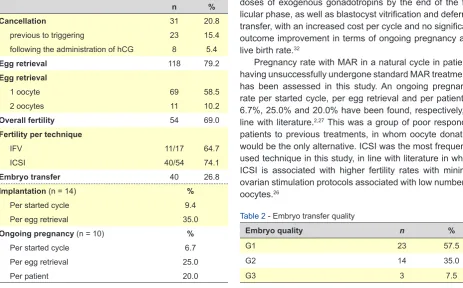
the day of ovulation induction (SD = 2.1). Cycle cancella-tions have occurred due to (i) absence of follicular domi-nance found in ultrasound monitoring performed at day 9-10 of the cycle (n = 4), (ii) presence of functional ovarian cyst (n = 2) (diameter >22 mm) or (iii) spontaneous ovula-tion prior to ultrasound monitoring (performed in a day to be defined according to the size of the follicle at day 9-10) (n = 17). Ovulation was obtained in eight cycles (5.4%) fol-lowing the administration of hCG and before egg retrieval. No complications were found in any patient regarding egg retrieval and the procedure was well tolerated, even though no pain scores were ever used in pain assessment. MAR treatment was used in 71 cycles (47.6%), including in vitro fertilisation (IVF) in 17 (23.9%) and intracytoplasmic sperm injection (ICSI) in 54 cycles (76.1%). A 69.0% fertility rate has been found, with embryo transfer in 26.8% (n = 40) and a 35.0% and 9.4% implantation rate per embryo transferred and per started cycle were obtained (n = 14), respectively. An ongoing pregnancy rate per started cycle of 6.7% (n = 10) has been found, with a pregnancy rate per ET and per patient of 25.0% and 20.0%, respectively. A pregnancy was achieved by 13.3% (n = 4) of poor responder patients, with a lower ongoing pregnancy rate (10.0%; n = 3). Results are shown in Table 1 while transferred embryo quality is shown in Table 2.
DISCUSSION
No major advances in terms of increased efficacy of medically-assisted reproduction in poor responder pa-tients have been found. MAR in a natural cycle seems an
adequate alternative to ovarian stimulation, due to the fact of being more user-friendly, less expensive and free from the complications associated with ovarian stimula-tion.15,16,28,29 The fact that no sedoanalgesia is required in
egg retrieval is an additional advantage.30 It is also known
that, in order to improve its efficacy, MAR in a natural cycle can be performed in consecutive cycles, involving no risk for patients.2,17,29 As no more than one embryo is usually
obtained with these treatment protocols, a strong decline in multiple pregnancy rate has been found,9 which is still
a major issue associated with MAR with ovarian stimula-tion. However, MAR in a natural cycle is associated with high cancellation rates due to premature LH surge, with the subsequent loss of the single follicle usually in develop-ment within each cycle.20 On the other hand, it has been
suggested that oocytes of a worse quality may be recruited under high doses of gonadotropins that are used in cycles with ovarian stimulation that would not have been selected in a natural cycle, which is a particularly important issue in poor responder patients. Therefore, better oocyte quality seems to exist in natural cycle, which is due to the natural selection of a dominant follicle.31 Some authors have
de-scribed modified natural cycles using GnRH antagonist as an alternative to natural cycles in poor responder patients, as these are associated with a lower incidence of premature LH surge and subsequent lower cycle cancellation rate.24,32
The use of oral progesterone from day 3 of the cycle in poor responder patients have been suggested in recent stud-ies in order to avoid spontaneous LH surge and premature ovulation, not affecting oocyte quality.32 A reduction in the
incidence of LH surge and subsequent reduction in cycle cancellation rate are the main benefits of progestin-primed ovarian stimulation. This means however the use of low doses of exogenous gonadotropins by the end of the fol-licular phase, as well as blastocyst vitrification and deferred transfer, with an increased cost per cycle and no significant outcome improvement in terms of ongoing pregnancy and live birth rate.32
Pregnancy rate with MAR in a natural cycle in patients having unsuccessfully undergone standard MAR treatments has been assessed in this study. An ongoing pregnancy rate per started cycle, per egg retrieval and per patient of 6.7%, 25.0% and 20.0% have been found, respectively, in line with literature.2,27 This was a group of poor responder
patients to previous treatments, in whom oocyte donation would be the only alternative. ICSI was the most frequently used technique in this study, in line with literature in which ICSI is associated with higher fertility rates with minimal ovarian stimulation protocols associated with low number of oocytes.26
Table 1 - Outcome with MAR in a natural cycle
n %
Cancellation 31 20.8
previous to triggering 23 15.4
following the administration of hCG 8 5.4
Egg retrieval 118 79.2
Egg retrieval
1 oocyte 69 58.5
2 oocytes 11 10.2
Overall fertility 54 69.0
Fertility per technique
IFV 11/17 64.7
ICSI 40/54 74.1
Embryo transfer 40 26.8
Implantation (n= 14) %
Per started cycle 9.4
Per egg retrieval 35.0
Ongoing pregnancy (n = 10) %
Per started cycle 6.7
Per egg retrieval 25.0
Per patient 20.0
Table 2 - Embryo transfer quality
Embryo quality n %
G1 23 57.5
G2 14 35.0
ARTIGO ORIGINAL
REFERENCES
1. Papolu RD, CharulataC, Rajyalakshmi A, Navatha P, Farah A. A friendly IVF protocol. J Obstet Gynaecol.2011;61:77-80.
2. Verberg MG, Macklon NS, Nargund G, Frydman R, Devroey P, Broekmans FJ, et al. Mild ovarian stimulation for IVF. Hum Reprod Update. 2009;15:13-29.
3. Fauser BC, Devroey P, Macklon NS. Multiple birth resulting from ovarian stimulation for subfertility treatment. Lancet. 2005;365:1807–16. 4. Allersma T, Farquhar C, Cantineau AE. Natural cycle in vitro
fertilisation (IVF) for subfertile couples. Cochrane Database Syst Rev. 2013:CD010550.
5. Gordon JD, DiMattina M, Reh A, Botes A, Celia G, Payson M. Utilization and success rates of unstimulated in vitro fertilization in the United States: an analysis of the Society for Assisted Reproductive Technology database. Fertil Steril. 2013;100:392– 5.
6. Shahin AY. The problem of IVF cost in developing countries: has natural cycle IVF a place? Reprod Biomed Online. 2007;15:51-6.
7. Fauser B, Nargund G, Andersen AN, Norman R, Tarlatzis B, Boivin J, et al. Mild ovarian stimulation for IVF: 10 years later. Hum Reprod. 2010;25:2678-84.
8. Macklon NS, Stouffer RL, Giudice LC. The science behind 25 years of ovarian stimulation for in vitro fertilization. Endocr Rev. 2006;27:170– 207.
9. Pelinck MJ, Hoek A, Simons AH, Heineman MJ. Efficacy of natural cycle IVF: a review of the literature. Hum Reprod. 2002;8:129–39.
10. Diergaarde B, Kurta ML.Use of fertility drugs and risk of ovarian cancer. Curr Opin Obstet Gynecol. 2014;26:125-9.
11. Simon C, Cano F, Valbuena D, Remohi J, Pellicer A. Clinical evidence Improved embryo quality has been found in this group of patients when compared to what has been obtained in previous treatments (as described, these were patients in whom transfer had been cancelled due to poor oocyte qual-ity and / or no transfer had been planned due to poor em-bryo quality). Oocyte quality (namely as regards aneuploidy rate) does not seem to be affected by standard stimulation. However, only a group of oocyte donors (young and non-infertile patients) has been analysed by the most relevant studies33 or cryopreserved embryos were compared with
embryos obtained within a modified natural cycle in a group of infertile patients,34 not reflecting the reality of our group of
patients.
An increased risk of low birthweight associated with MAR with ovarian stimulation has been found in studies aimed at assessing perinatal outcome.35-37 Improved
peri-natal outcome has been found by Mak et al. in patients under MAR in a natural cycle, when compared to those having undergone standard ovarian stimulation, raising the hypothesis that more physiological levels of estradiol and progesterone during the follicular phase and at the moment of implantation can have an important role.37 In addition,
supernumerary oocytes recruited with ovarian stimulation may show worst quality when compared to a single follicle / oocyte selected within a natural cycle, as suggested by the authors.37 Therefore, the assessment of these results will
certainly be relevant in further studies.
Some limitations of this study have been found, mainly regarding its retrospective nature. In addition, the fact that a heterogeneous group of patients has been selected, with similar unsuccessful outcome with standard MAR treat-ments even though regarding different aetiologies is worth mentioning as a limitation. Further prospective studies are
required in order to control some biases and to compare the cumulative results of these cycles with the different ovarian stimulation protocols, aimed at reaching a definition of the most adequate protocol for specific populations from the dif-ferent ovarian stimulation protocols currently in use.
CONCLUSION
MAR in a natural cycle may be a reasonable alterna-tive in poor outcome patients, with previous unsuccessful outcomes with standard ovarian stimulation, namely in poor responder patients. The results of this study have shown that a chance of pregnancy can exist even in this group of patients, in whom oocyte donation would be the only alter-native.
HUMAN AND ANIMAL PROTECTION
The authors declare that the followed procedures were according to regulations established by the Ethics and Clini-cal Research Committee and according to the Helsinki Dec-laration of the World Medical Association.
DATA CONFIDENTIALITY
The authors declare that they have followed the proto-cols of their work centre on the publication of patient data.
CONFLICTS OF INTEREST
The authors declare that there were no conflicts of inter-est in writing this manuscript.
FINANCIAL SUPPORT
The authors declare that there was no financial support in writing this manuscript.
for a detrimental effect on uterine receptivity of high serum estradiol concentrations in high and normal responder patients. Hum Reprod. 1995;10:2432-7.
12. Fatemi HM, Popovic-Todorovic B.Implantation in assisted reproduction: a look at endometrial receptivity. Reprod Biomed Online. 2013;27:530-8. 13. Devroey P, Bourgain C, Macklon NS, Fauser BC.Reproductive biology
and IVF: ovarian stimulation and endometrial receptivity. Trends Endocrinol Metab. 2004;15:84-90.
14. Gonda KJ, Domar AD, Gleicher N, Marrs RP. Insights from clinical experience in treating IVF poor responders. Reprod Biomed Online. 2018;36:12-9.
15. Polyzos NP, Blockeel C, Verpoest W, De Vos M, Stoop D, Vloeberghs V, et al. Live birth rates following natural cycle IVF in women with poor ovarian response according to the Bologna criteria. Hum Reprod. 2012;27:3481–6.
16. Revelli A, Casano S, Salvagno F, Delle Piane L. Milder is better? advantages and disadvantages of “mild” ovarian stimulation for human in vitro fertilization. Reprod Biol Endocrinol. 2011;9:25.
17. Phillips SJ, Kadoch IJ, Lapensée L, Couturier B, Hemmings R, Bissonnette F. Controlled natural cycle IVF: experience in a world of stimulation. Reprod Biomed Online. 2007;14:356-9.
18. Morgia F, Sbracia M, Schimberni M, Giallonardo A, Piscitelli C, Giannini P, et al. A controlled trial of natural cycle versus microdose gonadotropin-releasing hormone analog flare cycles in poor responders undergoing in vitro fertilization. Fertil Steril. 2004;81:1542–7.
ARTIGO ORIGINAL cycles for poor responder patients cause more harm than benefit? Hum
Fertil. 2016;19:97-101.
20. Reyftmann L, Déchaud H, Loup V, Anahory T, Brunet-Joyeux C, Lacroix N, et al. Natural cycle in vitro fertilization cycle in poor responders. Gynecol Obstet Fertil. 2007;35:352-8.
21. Blumenfeld Z. Why more is less and less is more when it comes to ovarian stimulation. J Assist Reprod Genet. 2015;32:1713–19. 22. Ferraretti AP, La Marca A, Fauser BC, Tarlatzis B, Nargund G, Gianaroli
L, et al. ESHRE consensus on the definition of ‘poor response’ to ovarian stimulation for in vitro fertilization: the Bologna criteria. Hum Reprod. 2011;26:1616–24.
23. Humaidan P, Alviggi C, Fischer R, Esteves SC. The novel POSEIDON stratification of “Low prognosis patients in Assisted Reproductive Technology” and its proposed marker of successful outcome. F1000Res. 2016;5:2911.
24. Lainas TG, Sfontouris IA, Venetis CA, Lainas GT, Zorzovilis IZ, Tarlatzis BC, et al. Live birth rates after modified natural cycle compared with high-dose FSH stimulation using GnRH antagonists in poor responders. Hum Reprod. 2015;30:2321–30.
25. Papaleo E, De Santis L, Fusi F, Doldi N, Brigante C, Marelli G, et al. Natural cycle as first approach in aged patients with elevated follicle-stimulating hormone undergoing intracytoplasmic sperm injection: a pilot study. Gynecol Endocrinol. 2006;22:351-4.
26. Kato K, Takehara Y, Segawa T, Kawachiya S, Okuno T, Kobayashi T, et al. Minimal ovarian stimulation combined with elective single embryo transfer policy: age-specific results of a large, single-centre, Japanese cohort. Reprod Biol Endocrinol. 2012;10:35.
27. Son WY, Chung JT, Das M, Buckett W, Demirtas E, Holzer H. Fertilization, embryo development, and clinical outcome of immature oocytes obtained from natural cycle in vitro fertilization. J Assist Reprod Genet. 2013;30:43–7.
28. Kadoch IJ. Natural cycle IVF (nIVF) in women with implantation failure.
J Gynecol Obstet Biol Reprod. 2004;33:S33-5.
29. Nargund G, Waterstone J, Bland J, Philips Z, Parsons J, Campbell S. Cumulative conception and live birth rates in natural (unstimulated) IVF cycles. Hum Reprod. 2001;16:259-62.
30. Ramsewak SS, Kumar A, Welsby R, Mowforth A, Lenton EA, Cooke ID. Is analgesia required for transvaginal single-follicle aspiration in in vitro fertilization? A double-blind study. J In Vitro Fert Embryo Transf. 1990;7:103-6.
31. Ho JR, Paulson RJ. Modified natural cycle in in vitro fertilization. Fertil Steril. 2017;108:572-6.
32. Chen Q, Wang Y, Sun L, Zhang S, Chai W, Hong Q, et al. Controlled ovulation of the dominant follicle using progestin in minimal stimulation in poor responders. Reprod. Biol Endocrinol. 2017;15:1-9.
33. Labarta E, Bosch E, Alamá P, Rubio C, Rodrigo L, Pellicer A. Moderate ovarian stimulation does not increase the incidence of human embryo chromosomal abnormalities in in vitro fertilization cycles. J Clin Endocrinol Metab. 2012;97:E1987-94.
34. Ziebe S, Bangsbøll S, Schmidt KL, Loft A, Lindhard A, Nyboe Andersen
A. Embryo quality in natural versus stimulated IVF cycles. Hum Reprod. 2004;19:1457-60.
35. Pelinck MJ, Keizer MH, Hoek A, Simons AH, Schelling K, Middelburg K, et al. Perinatal outcome in singletons after modified natural cycle IVF and standard IVF with ovarian stimulation. Eur J Obstet Gynecol Reprod Biol. 2010;148:56–61.
36. Nakashima A, Araki R, Tani H, Ishihara O, Kuwahara A, Irahara M, et al. Implications of assisted reproductive technologies on term singleton birth weight: an analysis of 25,777 children in the national assisted reproduction registry of Japan. Fertil Steril. 2013;99:450–5.