ONE POT SYNTHESIS OF PYRANOPYRAZOLES USING
SODIUM LACTATE AS AN EFFICIENT CATALYST
J. P. Sonar,
[a]S. D. Pardeshi,
[a]S. A. Dokhe,
[a]G. M. Bhavar,
[a]S. U. Tekale,
[c]A.
M. Zine
[b]and S. N. Thore
[c]*Keywords: catalyst; green synthesis; one pot; pyranopyrazole; sodium lactate.
An efficient one pot synthesis of pyranopyrazoles has been achieved by the four-component condensation of hydrazine hydrate, ethyl acetoacetate, aldehydes and malononitrile using sodium lactate as a catalyst in aqueous ethanolic medium under reflux condition. The method is simple and green to afford pyranopyrazoles in a short time. It provides a new base catalyst that readily gives product from moderate to excellent yields.
* Corresponding Authors Fax: +91 240 2367301
E-Mail: [email protected]
[a] Department of Chemistry, Vinayakrao Patil Mahavidyalaya, Vaijapur, Aurangabad-423701, Maharashtra, India. [b] Department of Chemistry, Majalgaon Arts, Science and
Commerce College, Majalgaon, Dist. Beed- 431131, Maharashtra, India.
[c] Department of Chemistry, Deogiri College, Station Road, Aurangabad- 431 005, Maharashtra, India.
Introduction
Addition of three or more starting materials in one pot and their transformation to final product without isolation of intermediate provides a significant tool for organic synthesis. After the Strecker’s amino acid synthesis, many successful attempts were made for organic transformations such as the synthesis of pyranopyrazoles which is one of themost important heterocycles of great biological significance. Pyranopyrazolescaffolds are reported for various biological activities such as analgesic, anti-inflammatory,1
anti-bacterial,2 anti-microbial,3andantitumor activity.4
Many methods are reported for the synthesis of pyranopyrazoles involving the use of three or four component condensation using CeCl3,5 InCl3,6 La(NO3)3,7
ionic liquids such as [(CH2)4SO3HMIM][HSO4],8
[H-NMP][MeSO3],9 cetyltrimethylammonium chloride,10
amino acids such as glycine,11 L-tyrosine,12 nano-particles
such as CuI,13 Fe
3O4,14 Fe3O4@SiO2,15
1,3,5-triazine-2,4,6-triamine modified nano rice husk silica,16 MgO,17 ZnO,18,19
and vitamin B1 on silica coated ferrite (Fe2O3@SiO2)
nanoparticles.20 Some heterogeneous catalysts like cerium
(IV) carboxymethylcellulose,21 acidic montmorillonite K-10
clay22 are also documented for the one pot synthesis of
pyranopyrazoles. Organic acids catalysing the synthesis of these heterocycles include citric acid, 23 and L-Proline.24
Pyranopyrazoles can also be synthesized by using organic base catalysts like triethyl amine,25-27 triethanol amine,28
piperazine, piperidine, pyrrolidine and morpholine,29 salts
like ammonium chloride,30 and sodium benzoate.31
However many of these methods have several drawbacks such as costly catalysts, harsh reaction condition and poor yields. In addition, the problem of waste remains an environmental question. In the present work, we report
sodium lactate as a new environmentally benign base catalyst for the four-component synthesis of pyranopyrazoles from hydrazine hydrate, ethyl acetoacetate, malononitrile and various aldehydes (Scheme1).
Scheme 1. Four component pyranopyrazole synthesis.
Experimental
Melting points were recorded in open capillaries and are uncorrected. Structures of the synthesized products were assigned on the basis of spectral analysis. IR spectra were recorded on Shimadzu IR Affinity 1 spectrophotometer using KBr pellets. 1H NMR spectra were recorded in
DMSO-d6 on a BRUKER AVANCE II 400 MHz
spectrometer and the chemical shifts were expressed in ppm relative to TMS. Mass spectra were recorded on a Macro mass spectrometer by Electron Spray technique. Sodium lactate (60 %) solution was purchased from Loba Chemicals Pvt. Ltd. Progress of the reaction was monitored on silica pre-coated TLC plates in 40 % ethyl acetate: n-hexane.
General procedure
A mixture of ethyl acetoacetate (1 mmol), hydrazine hydrate (1 mmol) and sodium actate solution (10 mol %) was mixed thoroughly. To it 40 % aqueous ethanol (5 mL) was added followed by aldehyde (1 mmol) and malononitrile (1mmol) and the resulting mixture was stirred for a while and then refluxed for appropriate time (Table 1). After completion of reaction, as monitored by TLC, the reaction mixture was allowed to cool and poured onto 50 g
O N
N H
CN
NH2
+ CH2(CN)2
N2H4.H2O
O
COOEt
Sodium Lactate (10 mol%) Ethanol -water
(4:6)
(1) (2) (3)
5(a-l)
Ar-CHO
4(a-l)
Ar
of crushed ice. The solid obtained was then filtered, dried and recrystallized from ethanol.
Table 1. Synthesis of pyranopyrazoles.
Product Ar Time
(min.)
Yield (%)*
M. P. (oC)
5a 4-OMe-C6H4 10 94 210-211
5b C6H5 15 90 244-245
5c 4-Cl-C6H4 10 91 233-234
5d 2-Cl-C6H4 10 90 245-246
5e 4-OH-C6H4 15 84 222-223
5f 4-Br-C6H4 10 85 178-180
5g 4-NO2-C6H4 10 86 253-254
5h 3-NO2-C6H4 15 82 190-192
5i 4-Me-C6H4 15 83 207-208
5j 3-OMe-4-OH-C6H3 20 79 234-235
5k 2-Furyl 20 85 216-218
5l 4-(Piperidin-1-yl)-C6H4
15 74 167-169
*Anisaldehyde (1 mmol), ethyl acetoacetate (1 mmol),
malononitrile (1 mmol), hydrazine hydrate (1 mmol), 5 mL of 40 % ethanol solution.
Results and Discussion
Commonly, sodium lactate is used for medical applications and is obtained by the treatment of sodium hydroxide with lactic acid. Lactic acid is considered as a green chemical in organic synthesis. Hence we selected its sodium salt for the one pot four component syntheses of pyranopyrazoles. From literature survey, most of the condensation reactions are reported under basic conditions. An aqueous solution of sodium lactate being basic in nature, we used it for the one pot four component condensation purposes.
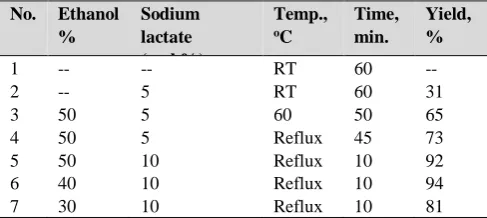
Table 2. Optimization of reaction conditions for the model reaction.
No. Ethanol %
Sodium lactate (mol %)
Temp., oC
Time, min.
Yield, %
1 -- -- RT 60 --
2 -- 5 RT 60 31
3 50 5 60 50 65
4 50 5 Reflux 45 73
5 50 10 Reflux 10 92
6 40 10 Reflux 10 94
7 30 10 Reflux 10 81
In order to optimize the reaction conditions, we selected anisaldehyde as a prototype aldehyde. The first attempt was carried out under solvent free condition using anisaldehyde (1 mmol), hydrazine hydrate (1 mmol), malononitrile (1mmol), ethyl acetoacetate (1 mmol) and sodium lactate (5 mol %) at room temperature, which resulted in poor yield of the corresponding product. Then we switched to the use of aqueous ethanol as an environmentally benign and easily available solvent. Ethanol-water system provides an ease for the dissolution for the reactants. To find the effective solvent and optimum catalyst amount, the model reaction was tried with varied solvent proportions and different amounts of sodium lactate. Initially 50 % aqueous-ethanol
medium was used under catalyst free condition and a trace product formation was observed at room temperature. Later addition of 5 mol % of sodium lactate improved the yield at but only to a small extent (Table 2, Entry 2).
To improve yield of the model reaction, the reaction mass was heated at 60oC and then to reflux condition. Reflux
condition afforded better yield than at 60o C (Table 2, Entry
3 and 4) and thus good yield was obtained under reflux condition. To improve the yield, we increased the amount of sodium lactate to 10 mol % which resulted in an excellent yield of the desired product up to 92 %. To achieve the principles of green chemistry, we tried to reduce percentage of ethanol in the solvent system and found nearly the same efficiency in 40 % ethanol (Table 2, Entry 6). Further decrease in ethanol percentage resulted in decrease in yield of the desired product (Table 2, Entry 7). Hence, 40 % ethanol in water was found to the appropriate and used for further reactions in the presence of 10 mol % sodium lactate.
6-Amino-1,4-dihydro-4-(4-methoxyphenyl)-3-methylpyra-no[2,3-c]pyrazole-5-carbonitrile (5a)
IR (KBr, cm-1): 1516, 1600, 2191 (CN), 3117, 3266 (NH 2),
3484 (NH). 1H NMR (400 MHz, DMSO-d
6,) δ = 1.80 (s, 3H,
Ar-CH3), 3.74 (s, 3H, OCH3), 4.55 (s, 1H, CH), 6.82-6.88
(m, 4H, Ar-H), 7.09 (s, 2H, NH2), 12.08 (s, 1H, NH); 13C
NMR (100 MHz, DMSO-d6) δ = 9.71, 35.43, 54.95, 57.61, 97.85, 113.72, 120.80, 128.46, 135.54, 136.45, 154.73, 157.93, 160.66. MS (ESI) m/z 283.5 (M+1).
6-Amino-1,4-dihydro-3-methyl-4-phenylpyrano[2,3-c]pyrazole-5-carbonitrile (5b)
IR (KBr, cm-1): 1512, 1593, 2194 (CN), 3167, 3356 (NH 2),
3410 (NH). 1H NMR (400 MHz, DMSO-d
6) δ = 1.78 (s, 3H,
Ar-CH3), 4.60 (s, 1H, CH), 6.85 (s, 2H, NH2), 7.10-7.40 (m,
5H, Ar-H), 12.10 (s, 1H, NH); 13C NMR (100 MHz, DMSO-d6) δ = 9.5, 26.8, 42.4, 48.6, 97.86, 113.1, 126.1, 127.46, 128.5, 138.40, 159.50, 174.1. MS (ESI) m/z 253 (M+1).
6-Amino-4-(4-chlorophenyl)-1,4-dihydro-3-methyl pyrano[2,3-c]pyrazole-5-carbonitrile (5c)
IR (KBr, cm-1): 1510, 1595, 2191 (CN), 3117, 3255 (NH 2),
3483 (NH). 1H NMR (400 MHz, DMSO-d
6) δ = 1.80 (s, 3H,
Ar-CH3), 4.64 (s, 1H, CH), 6.94 (s, 2H, NH2), 7.20 (d, J=8Hz, 2Ar-H), 7.37 (d, J=8Hz, 2Ar-H), 12.15 (s, 1H, NH);
13C NMR (100 MHz, DMSO-d6) δ = 9.70, 35.56, 56.79,
97.17, 120.61, 128.42, 129.33, 131.22, 135.67, 143.44, 154.69, 160.89. MS (ESI) m/z 287.4 (M+1).
6-Amino-4-(2-chlorophenyl)-1,4-dihydro-3-methylpyrano[2,3-c]pyrazole-5-carbonitrile (5d)
IR (KBr, cm-1): 1523, 1611, 2195 (CN), 3120, 3265 (NH 2),
3480 (NH); 1H NMR (400 MHz, DMSO-d
6,) δ = 1.81 (s, 3H,
Ar-CH3), 4.65 (s, 1H, CH), 6.98 (s, 2H, NH2), 7.24-7.37 (m,
Scheme 2. Possible mechanism for the synthesis of pyranopyrazoles using sodium lactate.
6-Amino-1,4-dihydro-4-(4-hydroxyphenyl)-3-methylpyra-no[2,3-c]pyrazole-5-carbonitrile (5e)
IR (KBr, cm-1): 1582, 1642, 2220 (CN), 3059, 3340 (NH 2),
3415 (NH). 1H NMR (400 MHz, DMSO-d
6,) δ = 1.99 (s, 3H,
Ar-CH3), 4.50 (s, 1H, CH), 6.10 (d, J= 8 Hz, 2H, Ar-H),
6.42 (s, 2H, NH2), 7.00 (d, J= 8 Hz, 2H, Ar-H), 11.12 (s, 1H,
OH); 12.07 (s, 1H, NH); 13C NMR (100 MHz, DMSO-d6) δ
= 12.1, 25.43, 71.90, 113.22, 119.5, 127.72, 130.80, 141.40, 144.0, 153.04, 154.44, 159.84. MS (ESI) m/z 269.10 (M+1).
6-Amino-4-(4-bromophenyl)-1,4-dihydro-3-methylpyrano[2,3-c]pyrazole-5-carbonitrile (5f)
IR (KBr, cm-1): 1512, 1640, 2220 (CN), 3075, 3280 (NH 2),
3411 (NH).1H NMR (400 MHz, DMSO-d
6) δ = 1.92 (s, 3H,
Ar-CH3), 4.45 (s, 1H, CH), 6.45 (s, 2H, NH2), 7.04 (d, J= 8 Hz, 2H, Ar-H), 7.43 (d, J= 8 Hz, 2H, Ar-H), 12.08 (s, 1H, NH); 13C NMR (100 MHz, DMSO-d6) δ = 11.12, 24.14,
70.76, 112.14, 119.11, 128.39, 120.80, 130.18, 135.01, 143.90, 153.73, 159.10. MS (ESI) m/z 331.2 (M+1).
6-Amino-1,4-dihydro-3-methyl-4-(4-nitrophenyl)pyrano[2,3-c]pyrazole-5-carbonitrile (5g)
IR (KBr, cm-1): 1512, 1610, 2198 (CN), 3277, 3380 (NH 2),
3474 (NH). 1H NMR (400 MHz, DMSO-d
6) δ = 2.02 (s, 3H,
Ar-CH3), 4.71 (s, 1H, CH), 6.24 (s, 2H, NH2), 7.49 (d, J=8Hz, 2Ar-H), 8.16 (d, J=8Hz, 2Ar-H), 12.18 (s, 1H, NH);
13C NMR (100 MHz, DMSO-d6) δ = 11.33, 25.50, 56.79,
97.17, 120.61, 128.42, 129.33, 131.22, 135.67, 143.44, 154.69, 160.89. MS (ESI) m/z 298.3 (M+1).
6-Amino-1,4-dihydro-3-methyl-4-(3-nitrophenyl)pyrano[2,3-c]pyrazole-5-carbonitrile (5h)
IR (KBr, cm-1): 1509, 1624, 2192 (CN), 3271, 3385 (NH 2),
3470 (NH). 1H NMR (400 MHz, DMSO-d
6) δ=2.02 (s, 3H,
Ar-CH3), 4.74 (s, 1H, CH), 6.37 (s, 2H, NH2), 7.53-7.63 (m,
2H, 2Ar-H), 8.02-8.07 (m, 1H, Ar-H), 8.11 (s, 1H, Ar-H), 12.19 (s, 1H, NH); 13C NMR (100 MHz, DMSO-d6): 11.10,
26.3, 72.1, 112.4, 121.2, 127.6, 129.48, 133.11, 135.21,
NH NH H
HO O
O
H
HO O
O HO
O O H O O O
N HN
OH O
H
HO O O
HO O O H
N HN
O
+
HO
O O
NC O
O HO
CN NC
Ar
H O
H O
O
HO HO
O O
NC NC
H
NC NC
OH Ar H
O O
HO
HO
O O H +
N
N N H
O H
N HN
O Ar
N CN
HO O O H
N N
H O
Ar
NH CN H
O O
HO
HO O
O H
N N
H O
Ar
NH2
CN +
HO O
O N
HN
O
Ar
Aq. EtOH
Ar
CN NC
HO
O O HO
142.7, 147.1, 151.3, 154.3, 160.67. MS (ESI) m/z 298.11 (M+1).
6-Amino-1,4-dihydro-3-methyl-4-p-tolylpyrano[2,3-c]pyrazole-5-carbonitrile (5i)
IR (KBr, cm-1): 1507, 1621, 2184 (CN), 3109, 3260 (NH 2),
3453 (NH); 1H NMR (400 MHz, DMSO-d
6) δ = 2.02 (s, 3H,
Ar-CH3), 2.49 (s, 3H, CH3), 4.72 (s, 1H, CH), 5.72 (s, 2H,
NH2), 7.24 (d, 2H, J=8 Hz, 2Ar-H), 7.61 (d, 2H, J=8 Hz,
2Ar-H), 11.92 (s, 1H, NH); 13C NMR (100 MHz, DMSO-d6)
δ = 9.7, 20.4, 35.7, 55.1, 97.7, 117.7, 120.7, 127.6, 128.9, 135.3, 141.6, 154.7, 160.7; MS (ESI) m/z 267.1 (M+1).
6-Amino-1,4-dihydro-4-(4-hydroxy-3-methoxyphenyl)-3-meth-ylpyrano[2,3-c]pyrazole-5-carbonitrile (5j)
IR (KBr, cm-1): 1472, 1581, 2154 (CN), 3162, 3370 (NH 2),
3481 (NH). 1H NMR (400 MHz, DMSO-d
6) δ = 1.63 (s, 3H,
Ar-CH3), 3.42 (s, 3H, OCH3), 4.58 (s, 1H, CH), 6.72 (s, 2H,
NH2), 6.93 (d, 1H, Ar-H), 7.38-7.43 (m, 2H, Ar-H), 10.42 (s,
1H, OH), 12.78 (s, 1H, NH); 13C NMR (100 MHz, DMSO-d6) δ = 9.7, 34.25, 53.64, 56.64, 97.72, 104.57, 113.61, 115,16, 119.70, 128.12, 134.39, 135.86, 153.62, 157.59, 160.58. MS (ESI) m/z 299.12 (M+1).
6-Amino-4-(furan-2-yl)-1,4-dihydro-3-methylpyrano[2,3-c]py-razole-5-carbonitrile (5k)
IR (KBr, cm-1): 1502, 1613, 2214 (CN), 3221, 3385 (NH 2),
3427 (NH); 1H NMR (400 MHz, DMSO-d
6) δ = 1.88 (s, 3H,
Ar-CH3), 4.56 (s, 1H, CH), 6.52 (s, 2H, NH2), 6.84 (m, 1H,
Ar-H), 7.04 (m, 1H, Ar-H), 7.33(m, 1H, Ar-H), 12.17 (s, 1H, NH); 13C NMR (100 MHz, DMSO-d6) δ = 9.76, 34.19,
58.92, 57.61, 104.84, 110.63, 117.94, 138.44, 145.52, 155.12, 158.18, 163.70. MS (ESI) m/z 243.2 (M+1).
6-Amino-1,4-dihydro-3-methyl-4-(4-(piperidin-1-yl)phenyl)py-rano[2,3-c]pyrazole-5-carbonitrile (5l)
IR (KBr, cm-1): 1540, 1620, 2230 (CN), 3140,3252 (NH 2),
3470 (NH). 1H NMR (400 MHz, DMSO-d
6) δ = 1.51-1.61
(m, 6H, 3CH2), 1.80 (s, 3H, Ar-CH3), 3.09 (t, 4H, 2CH2),
4.47 (s, 1H, CH), 6.76 (s, 2H, NH2), 6.85 (d, J= 8Hz, 2H,
Ar-H), 6.98 (d, J= 8Hz, 2H, Ar-H), 12.04 (s, 1H, NH); 13C
NMR (100 MHz, DMSO-d6) δ = 9.75, 23.83, 25.33, 35.38,
49.55, 57.73, 98.02, 115.67, 120.91, 127.87, 134.31, 135.45, 150.37, 154.75, 160.63. MS (ESI) m/z 336.5 (M+1).
Possible mechanism
The lactate anion helps to accumulate a negative charge on nitrogen to get condensed with ethyl acetoacetate affording pyrazolone (I). Simultaneously, aldehyde and malononitrile undergo Knoevenagel condensation to give arylidine intermediate (II). The reaction of deprotonated pyrazolone with the arylidine intermediate (II), followed by cyclization and tautomerization gives the desired pyranopyrazole product and with regeneration of the lactate anion (Scheme 2).
Conclusion
The present investigation underlines the efficiency of sodium lactate as a base catalyst and the ease of its handling in the experiments. The work up of reaction is quite simple and easy. Sodium lactate acts as a catalyst for the one pot four component syntheses of pyranopyrazoles in aqueous ethanol as an environmentally benign solvent. Thus, this protocol is simples, fast, efficient and serves as a green route for the one pot four component syntheses of pyranopyrazoles.
Acknowledgements
Authors are thankful to The Principal, Vinayakrao Patil College, Vaijapur and The Principal, Deogiri College, Aurangabad for providing necessary laboratory facilities. The authors are also thankful to The Director, Sophistictaed Analytical Instrumentation Facilities (SAIF), Chandigarh, India for providing the spectral data.
References
1Zaki, M. E. A., Morsy, E.M., Abdel-Motti, F. M., Ab-del Megeid,
F. M. E., Pyrazolopyranopyrimidines as a Class of Anti-Inflammatory Agents, Heterocycl. Comm., 2004, 10, 97-102.
doi.org/10.1515/znc-2006-1-201
2El-Tamany, E. S., El-Sahed, F. A., Mohamed, B. H., Synthesis of
some pyrazolo[3,4-d]pyrimidines and their fused triazole and tetrazole derivatives, J. Serb. Chem. Soc., 1999, 64, 9-18.
doi.org/10.2298/jsc9911655s
3El-Assiery, S. A., Sayed, G. H., Fouda, A., Synthesis of some new
annulated pyrazolo-pyrido (or pyrano) pyrimidine, pyrazolopyridine and pyranopyrazole derivatives. Acta Pharm,2004, 54, 143–150.
4Hafez, H. N., El-Gazzar, A. –R. B. A., Synthesis of
pyranopyrazolo N-glycosideand pyrazolopyranopyrimidine C-glycoside derivatives as promising antitumor and antimicrobial agents, Acta Pharm, 2015, 65, 215–233.
doi.org/10.1515/acph-2015-0022
5Ablajan, K., Wang, L., Maimaiti, Z., Lu, Y. T., CeCl
3-promoted
one-pot synthesis of multisubstitutedbispyrano[2,3-c]pyrazole derivatives,Monatsh. Chem., 2014, 145, 491-496.doi.org/10.1007/s00706-013-1104-6
6Survase, D. N., Chavan, H. V., Dongare, S. B., Ganapure, S. D.,
Helavi, V. B., Indium chloride (InCl3) catalysed domino
protocol for the regioselective synthesis of highly functionalized pyranopyrazoles under mild conditions, Iran. Chem. Commun.,2017, 5, 105-114.
7Khandare, P. M., Ingale, R. D., Taware, A. S., Shisodia, S. U.,
Pawar, S. S., Kotai, L., Pawar, R. P., One Pot Synthesis and Biological Evaluation of Pyranopyrazole in Aqueous Medium ,Eur. Chem. Bull., 2017, 6(9), 410-414.
doi.org/10.17628/ecb.2017.6.410-414
8Ebrahimi, J., Mohammadi, A., Pakjoo, V., Bahramzade, E.,
Habibi, A. Highly efficient solvent-free synthesis of pyranopyrazoles by a Brønsted-acidic ionic liquid as a green and reusable catalyst, J. Chem. Sci., 2012, 124 (5), 1013– 1017. doi.org/10.1007/s12039-012-0310-9
9Deshmukh, S. M., Hiwarale, D. P., Ionic Liquid Catalyzed One
10Wu, M., Feng, Q., Wan, D., Ma, J.,CTACl as Catalyst for
Four-Component, One-Pot Synthesis of Pyranopyrazole Derivatives in Aqueous Medium. Syn. Comm.,2013, 43, 1721-1726. doi.org/10.1080/00397911.2012.666315
11Reddy, M. B. M., Jayashankara, V. P., Pasha, M. A.,
Glycine-Catalyzed Efficient Synthesis of Pyranopyrazoles via One-Pot Multicomponent Reaction, Syn. Comm., 2010, 40, 2930-2934. doi.org/10.1080/00397910903340686
12Rupnar, B. D., Pagore, V. P., Tekale, S. U., Shisodia, S. U.,
Pawar, R. P., L-Tyrosine Catalyzed Mild and Efficient Synthesis of Dihydropyrano[2,3c] pyrazole under Microwave Irradiation,Der ChemicaSinica, 2017, 8(2), 229-234.
13Safaei-Ghomi, J., Ziarati, A., Tamimi, M.,A novel method for the
one-pot five-component synthesis of highly functionalized pyranopyrazoles catalyzed by CuI nanoparticles,ActaChim. Slov.2013, 60 (2), 403–410.
14aHeravi, M. M., Ghobadi, N., Nano-magnetite as an Eco-friendly
and Magnetically Separable Catalyst for a One-pot Synthesis of Pyrano [2, 3-c]pyrazoles and Bis(4-hydroxycoumarin-3-yl)methane Derivatives, Scientia Iranica C, 2015,22(3), 911-918.
14bAleem, M. A. E.,El-Remaily, A. A.,Synthesis of
pyranopyrazoles using magnetic Fe3O4 nanoparticles as
efficient and reusable catalyst, Tetrahedron,2014, 70(18), 2971–2975. doi.org/10.1016/j.tet.2014.03.024
15Soleimani, E., Jafarzadeh, M., Norouzi, P., Dayou, J., Sipaut, C.
S., Mansa, R. F., Saei, P., Synthesis of Pyranopyrazoles Using Magnetically Recyclable Heterogeneous Iron Oxide-silica Core-shell Nanocatalyst, J. Chin. Chem. Soc., 2015, 62(12), 1155-1162.doi.org/10.1002/jccs.201400387
16Davapanah, J., Khoram, R., Synthesis of Pyranopyrazole
Compounds Using Heterogeneous Base Catalyst Based on 1, 3, 5-Triazine-2, 4,6-Triamine Modified Nano Rice Husk Silica, Nanoanalysis J., 2017, 4(1), 20-30 doi.org/10.22034/JNA.2017.01.003
17Babaie, M., Sheibani, H.,Nanosized magnesium oxide as a highly
effective heterogeneous base catalyst for the rapid synthesis of pyranopyrazoles via a tandem four-component reaction.
Arab. J. Chem., 2011, 4, 159–162.
doi.org/10.1016/j.arabjc.2010.06.032
18Tekale, S. U., Kauthale, S. S., Jadhav, K. M., Pawar, R.
P.,Nano-ZnO Catalyzed Green and Efficient One-Pot Four-Component Synthesis of Pyranopyrazoles, J. Chem., 2013, Article ID 840954, 1-8. doi.org/10.1155/2013/840954
19Sachdeva, H., Saroj, R.ZnO Nanoparticles as an Efficient,
Heterogeneous, Reusable, and Ecofriendly Catalyst for Four-Component One-Pot Green Synthesis of Pyranopyrazole Derivatives in Water, Sci. World J., 2013, Article ID 680671, 1-8. doi.org/10.1155/2013/680671
20Rahman, N., Nongthombam, G. S., Rani, J. W. S., Nongrum, R.,
Kharmawlong, G. K., Nongkhlaw, R.,An Environment-Friendly Magnetic Organo-Nanomaterial as a Potent Catalyst in Synthesis of Pyranopyrazole Derivatives, Curr. Organocatal., 2018, 5, 150-161.
doi.org/10.2174/2213337205666180731095751
21Patil, R. M., Rajput, A. P., Synthesis of 6-Amino-2,
4-Dihydropyrano-[2, 3-c]Pyrazol5-Carbonitriles Catalyzed by Cerium(IV)carboxymethylcellulose under Solvent-Free Conditions, J. Appli. Chem., 2018, 7(3), 552-558.
22Reddy, G. M., Garcia, J. R., Synthesis of Pyranopyrazoles under
Ecofriendly Approach by Using Acid Catalysis, J. Heterocyclic Chem.,2017, 54, 89-94.
doi.org/10.1002/jhet.2544
23Pawar, P. B., Jadhav, S. D., Patil, B. M., Shejwal, R. V., Patil, S.,
Rapid one-pot four component synthesis of bioactive pyranopyrazoles using citric acid as a mild organocatalyst,
Arch. Applied Sci. Res., 2014, 6(1), 150-158
24Mecadon, H., Rohman, M. R., Kharbangar, I., Laloo, B. M.,
Kharkongor, I., Rajbangshi, M., Myrboh, B., L-Proline as an efficicent catalyst for the multi-component synthesis of 6-
amino-4-alkyl/aryl-3-methyl-2,4-dihydropyrano[2,3-c]pyrazole-5-carbonitriles in water, Tet. Lett., 2011, 52, 3228-3231. doi.org/10.1016/j.tetlet.2011.04.048
25Samy, A. E. A., A simple and clean method for four-component
synthesis of pyrano[2,3-c]pyrazole derivatives. Der Pharma Chem., 2011, 3(5), 81-86.
26Sharanin, Y. A., Sharanina, L. G., Puzanova, V. V., Zh. Org. Khim., 1983, 19, 2609
27Sharanin, Y. A., Sharanina, L. G., Puzanova, V. V., J. Org. Chem. USSR, 1983, 221
28Sonar, J. P., Pardeshi, S. D., Dokhe, S. A., Zine, A. M., Pawar, R.
P., Thore, S. N., A simple, expeditious and green process for Knoevenagel condensation of pyrazole aldehydes in aqueous media, Arc. Org. Inorg. Chem. Sci., 2018, 3(1), 314-317.10.17628/ecb.2017.6.69-72
29Vasuki, G., Kumaravel, K., Rapid four-component reactions in
water: synthesis of pyranopyrazoles,Tet. Lett., 2008, 49(39), 5636-5638. 10.1016/j.tetlet.2008.07.055
30Pagore, V. P., Rupnar, B. D., Tekale, S. U., Pawar, R. P., Green
and efficient synthesis of pyranopyrazoles catalyzed by ammonium chloride in water, Der Pharma Chem., 2015, 7(6), 312-317.
31Kiyani, H., Samimi, H. A., Ghorbani, F., Esmaieli, S., One-pot,
four-component synthesis of pyrano[2,3-c]pyrazoles catalyzed by sodium benzoate in aqueous medium, Curr. Chem. Lett., 2013,2, 197–206.
doi.org/10.5267/j.ccl.2013.07.002
Received: 11.03.2019