Available online throug
ISSN 2229 – 5046
A TYPE OF FUZZY TOPOLOGY ON A GROUP
G. VASANTHAKANNAN*
1, K. INDIRANI
21
Assistant Professor,
Department of Mathematics,
RVS college of Arts and Science, Coimbatore, India.
2
Associate Professor and Head of Department,
Nirmala College for Women, Coimbatore, India.
Received On: 09-06-17; Revised & Accepted On: 27-06-17)
ABSTRACT
I
n this paper, we will introduce fuzzy prime topology on a group and also will investigate the concepts of fuzzy contra continuous, fuzzy contra open, fuzzy contra closed, fuzzy supra contra continuous, fuzzy supra contra open, fuzzy supra closed, via fuzzy topology and fuzzy supra topology on a group.Keywords: fuzzy topology, fuzzy continuous, fuzzy supra topology, Group theory.
1. INTRODUCTION
Fuzzy set theory [13] was started in the year 1965 after the publication on the seminar work on fuzzy sets by Lotfi Asker Zadeh’s (Professor of electrical engineering at the University of California in Berkeley). The basis of the fuzzification of mathematical concepts are based on the generalization of these concepts from characteristics function to membership function. Fuzzy sets theory is much wider than the classical set theory. Fuzzy topology in such a branch, combing order structure will topological structure. This branch has emerged from the background processing fuzziness and locate theory, proposed from the angle of pure mathematics by Ehresmann.
Change [3], Wang [12], Lowen [9] and others applied some basic concepts from the general topology to fuzzy sets and develop a fuzzy topological spaces. Foster [5] combined the structure of a fuzzy topological spaces with that of fuzzy group (introduced bt Rosenfeld [11]) to formulate the elements of the theory of fuzzy topological groups. Mash hour et aai[10] introduced the concepts os supra topological spaces. In 1987, M.E Abd, E.L – Monsef and A.E Ramadan [1] introduced the fuzzy supra topological spaces. N. Kuroki has studied fuzzy ideas and bi ideas in a semi group [8]. Many classes of semi groups were studied and discussed further by using fuzzy ideas. For example, Kuroki characterized intra-regular semi groups by fuzzy prime ideas.
2. PRELIMINARIES
Definition 2.1 [2]: Let 𝐺 be a nonempty set. A mapping 𝜇:𝐺 →[0,1] is called a fuzzy set of𝐺.
Definition 2.2 [2]: Let 𝐺 be a nonempty set. A fuzzy topology on 𝐺 is a family 𝜏 of fuzzy sets in 𝐺 which satisfices the following conditions
1. For any 𝑐 ∈[0,1] , the fuzzy set 𝜇𝑐(𝑥) =𝑐∀𝑥 ∈ 𝐺,is in 𝜏.
2. If 𝐴,𝐵 ∈ 𝜏 then (𝐴 ∩ 𝐵), where (𝐴 ∩ 𝐵) (𝑥) = min{𝐴(𝑥),𝐵(𝑥0}
3. If 𝐴𝑗∈ 𝜏 for 𝑗 ∈ 𝐽 then ∪𝑗∈𝐽𝐴𝑗 ∈ 𝜏 where ∪𝑗∈𝐽 𝐴𝑗(𝑥) = sup𝑗∈𝐽{𝐴𝑗(𝑥)}.
Definition 2.3 [2]: Let 𝐺 and 𝐻 be two nonempty set, 𝑓 ∶ 𝐺 → 𝐻 a mapping and 𝜇 a fuzzy sets in𝐻. The pre image of
𝜇 under 𝑓 by 𝑓−1(𝜇) (𝑜𝑟𝜇𝑓) a fuzzy set of 𝐺 defined by 𝑓−1(𝜇)(𝑥) = 𝜇𝑓(𝑥) = 𝜇�𝑓(𝑥)� for all 𝑥 ∈ 𝐺.
© 2017, IJMA. All Rights Reserved 103
Definition 2.4 [2]: Let 𝜇 be a fuzzy set in a 𝐺and, 𝑓 ∶ 𝐺 → 𝐻 a mapping. The mapping, 𝑓 (𝜇):𝐻 →[0,1] defined by
𝑓(𝜇)(𝑦) = sup𝑥∈𝑓−1(𝑦){𝜇(𝑥)} 𝑖𝑓𝑓−1(𝑦)≠ ∅ and 𝑓(𝜇)(y) = 0
If 𝑓−1(𝑦)≠ ∅ is called the image of 𝜇 under 𝑓, where𝑓−1 (𝑦) = {𝑥 ∈ 𝐺 ∶ 𝑓(𝑥) =𝑦 }.
Definition 2.5 [2]: Let (𝐺,𝜏), (𝐻,𝜎) be two fuzzy topological spaces. A mapping 𝑓of (𝐺,𝜏), into (𝐻,𝜎) is fuzzy continuous if for each open fuzzy set 𝑉 ∈ 𝜎 the inverse image 𝑓−1(𝑉) is in𝜏. If 𝑓 is said to be fuzzy open if for each
𝑈 ∈ 𝜏.𝑓is said to be open if for each 𝑈 ∈ 𝜏,𝑓(𝑈)∈ 𝜎.
Definition 2.6 [6]: If (𝐺, . )𝑎𝑛𝑑 (𝐻, . ) are any two groups then the function 𝑓 ∶ 𝐺 → 𝐻 is called a group homomorphism if 𝑓 (𝑥𝑦) =𝑓(𝑥)𝑓(𝑦)𝑓𝑜𝑟𝑎𝑙𝑙𝑥,𝑦 ∈ 𝐺.
Definition 2.7 [7]: A fuzzy set (fuzzy sets) 𝜇 of a group G is called a fuzzy prime ideal if for all 𝑥,𝑦 ∈ 𝐺, 𝜇(𝑥𝑦) =
𝜇(𝑥) 𝑜𝑟𝜇(𝑥,𝑦) = 𝜇(𝑦)
Definition 2.8 [2]: Let 𝐺 and 𝐻 be two nonempty sets, 𝑓 ∶ 𝐺 → 𝐻 be a mapping, and A be a fuzzy set in G. Then A is said to be 𝑓 invariant if for each 𝑥,𝑦 ∈ 𝐺 such that𝑓(𝑥) =𝑓(𝑦), we have 𝐴(𝑥) =𝐴(𝑦).
Definition 2.9 [4]: A function 𝑓 from a fuzzy topological space (𝐺,𝜏) to fuzzy topological space (𝐻,𝜎) is called fuzzy contra continuous if 𝑓−1(𝜆) is fuzzy closed in (𝐺,𝜏) for every fuzzy open set 𝜆 of (𝐻,𝜎).
3. ON FUZZY PRIME TOPOLOGY AND FUZZY TOPOLOGY ON A GROUP
Let (𝐺, . ) be a group and 𝜏 is a family of fuzzy sets in (𝐺, . ) satisfying the conditions in Definition 2.2, then 𝜏 is a fuzzy
topology on group G and (𝐺,𝜏) is a fuzzy topological spaces.
Example 3.1: Let (𝐺, . ) be a group and let 𝜏: { 𝜇:𝐺 →[0,1]:𝜇(𝑥𝑦) = 𝜇(𝑥); ∀𝑥,𝑢 ∈ 𝐺}.
To check whether if the family 𝜏 satisfies the conditions of a fuzzy topology. First we have to prove that the fuzzy sets
𝜇𝑐∈ 𝜏 where 𝜇𝑐(𝑥) =𝑐𝑓𝑜𝑟𝑐 ∈[0,1].
Now, let 𝑥,𝑦 ∈ 𝐺.
Then 𝜇𝑐(𝑥𝑦) =𝑐=𝜇𝑐(𝑥) 𝑡ℎ𝑒𝑛𝜇𝑐∈ 𝜏
Next, let, 𝜆,𝜇 ∈ 𝜏
Then (𝜆 ⋂ 𝜇)(𝑥𝑦) = 𝑚𝑖𝑛{𝜆(𝑥𝑦),𝜇(𝑥𝑦)}
= 𝑚𝑖𝑛{𝜆(𝑥),𝜇(𝑥)}
= (𝜆 � 𝜇) (𝑥)
Then (𝜆 ⋂ 𝜇) ∈ 𝜏. Finally, let 𝜇𝑖∈ 𝜏,𝜏𝑖 ∈ 𝐼 Then ⋃ 𝜇𝑖∈𝐼 𝑖(𝑥𝑦)= sup𝑖∈𝐼{𝜇𝑖(𝑥𝑦)}
= sup
𝑖∈𝐼 {𝜇𝑖(𝑥𝑦)}
= � 𝜇𝑖(𝑥)
𝑖∈𝐼 .
Thus ⋃ 𝜇𝑖∈𝐼 𝑖 ∈ 𝜏 and so 𝜏is a fuzzy topology on 𝐺.
Definition 3.2: The family 𝜏in example 3.1 is called the fuzzy prime topology in𝐺.
Theorem 3.3: Let (𝐺,𝜏), (𝐻,𝜎) be two fuzzy topological spaces, 𝜏is the fuzzy prime topology in 𝐺 and 𝑓: (𝐺,𝜏)→ (𝐻,𝜎)be an epimorphism of group𝐺. If 𝑓 is fuzzy continuous, then any fuzzy subset𝜂 in H such that 𝜂 ∈ 𝜎 is a fuzzy prime topology.
Since 𝜂 is a fuzzy subset of H, we are omitting the regularity method. Now, let 𝑦1,𝑦2∈ 𝐻. since 𝑓 is onto there exist
𝑥1,𝑥2∈ 𝐺 such that 𝑓(𝑥1) = 𝑦1 𝑎𝑛𝑑 𝑓(𝑥1) =𝑓(𝑦2) such that
𝜂(𝑦1𝑦2) = 𝜂((𝑓(𝑦1))𝜂(𝑓(𝑦2))
= 𝜂(𝑓(𝑥1𝑥2))
=𝜂𝑓(𝑥1 𝑥
2)
= 𝑓−1(𝜂)(𝑥1 𝑥2)
Lemma 3.4: Let X and Y be two nonempty sets, 𝑓:𝑋 → 𝑌mapping and A be an F-invariant fuzzy set in X. Then
𝑓−1�𝑓(𝐴)�=𝐴.
Corollary 3.5: Let 𝜏𝑎𝑛𝑑𝜎 be the fuzzy prime topology on G and H respectively. If 𝑓is epimorphism and every fuzzy set in G is 𝑓 is fuzzy open.
Proof: Suppose that 𝑓 is onto homomorphism and every fuzzy set G is 𝑓 invariant and let ∪∈ 𝜏 and 𝑦1,𝑦2∈ 𝐻 , then exist 𝑥1,𝑥2∈ 𝐺 such that 𝑓(𝑥1) =𝑦1 𝑎𝑛𝑑𝑓(𝑥2) =𝑦2 so that
𝑓(𝑈)(𝑦1𝑦2) =𝑓(𝑈)(𝑓(𝑥1)𝑓(𝑥2))
=𝑓(𝑈)(𝑓(𝑥1)(𝑥2))
= 𝑓−1(𝑓(𝑈))(𝑥
1𝑥2)
Since U is𝑓 invariant, by lemma 3.4. Hence
𝑓(𝑈)(𝑦1𝑦2) =𝑈 (𝑥1𝑥2)
=𝑈(𝑥1)
= 𝑓(𝑈)(𝑓((𝑥1))
=𝑓(𝑈)(𝑦1)
Definition 3.6: Let (𝐺, . ) be a group. Let (𝐺,𝜏) be a fuzzy topological spaces and 𝐴 fuzzy set in G. Then the induced fuzzy topology on G, denoted by 𝜏𝐴= { 𝐴 ∩ 𝑆 ∶ 𝑆 ∈ 𝜏}. the pair (𝐴,𝜏𝐴) is called the fuzzy subspaces of (𝐺,𝜏).
Example 3.7: Consider the set 𝐺= { 1,−1,𝑖,−𝑖} with following caley table (Table).Then (𝐺, . ) is a group. Let the fuzzy subset 𝜇𝑖:𝐺 →[0,1],𝑖= 1, 2, 3, 4, 5, 6 be given by
𝜇1(𝑥) = �
. 7 𝑖 𝑓𝑥= 1
. 5 𝑖𝑓𝑥= −1,𝑖
. 4 𝑖 𝑓𝑥=−𝑖
𝜇2(𝑥) = �
. 6 𝑖 𝑓𝑥= 1
. 3 𝑖𝑓𝑥= −1,𝑖
. 2 𝑖 𝑓𝑥=−𝑖
𝜇3(𝑥) = �. 6 . 2 𝑖𝑖 𝑓𝑥𝑓𝑥= = 1 −1,𝑖
. 1 𝑖 𝑓𝑥=−𝑖
𝜇4(𝑥) = �
. 0 𝑖 𝑓𝑥= 1
. 2 𝑖𝑓𝑥= −1,𝑖
. 1 𝑖 𝑓𝑥=−𝑖
𝜇5(𝑥) = �. 7 . 4 𝑖𝑖 𝑓𝑥𝑓𝑥= = 1 −1,𝑖
. 2 𝑖 𝑓𝑥=−𝑖
𝜇6(𝑥) = �
. 6 𝑖 𝑓𝑥= 1
. 4 𝑖𝑓𝑥= −1,𝑖
. 1 𝑖 𝑓𝑥=−𝑖
Then the collection 𝜏= { ∅ .𝐺,𝜇1,𝜇2,𝜇3,𝜇4,𝜇5} is a fuzzy topology on G. Hence (𝐺,𝜏) is a fuzzy topological spaces. Let 𝐴= 𝜇6. Then 𝜏𝐴= { ∅ ,𝜇2,𝜇3,𝜇4,𝜇5} and 𝐴= (𝜇6.𝜏𝐴) is a fuzzy topological subspaces of (𝐺,𝜏)
Definition 3.8: Let (𝐺, . ), (𝐻, . ) be two groups. A function 𝑓 from fuzzy topological spaces (𝐺,𝜏) to fuzzy topological space (𝐻,𝜎) is called fuzzy contra continuous if 𝑓−1(𝜂) is fuzzy closed in (𝐺,𝜏) for every fuzzy open 𝜂 in (𝐻,𝜎).
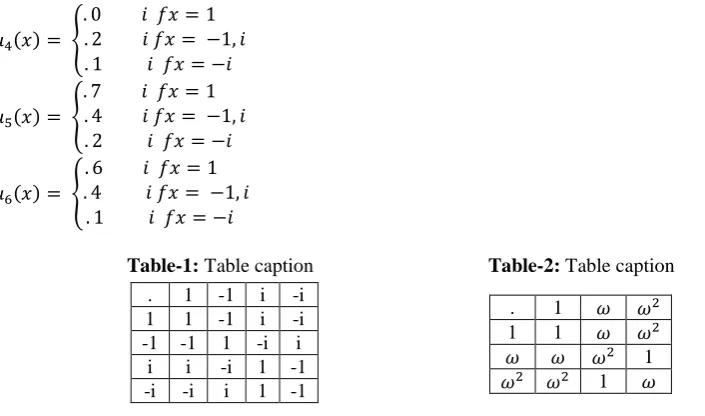
Example 3.9: Consider the set 𝐺= {1,−1,𝑖,−𝑖} with the following caley table (Table 1).Then (𝐺, . ) is a group. Let the fuzzy subsets 𝜇𝑖:𝐺 →[0,1],𝑖= 1,2,3,4,5,6 be given by
𝜇1(𝑥) = �
. 7 𝑖 𝑓𝑥= 1
. 5 𝑖𝑓𝑥= −1,𝑖
. 4 𝑖 𝑓𝑥=−𝑖
𝜇2(𝑥) = �
. 6 𝑖 𝑓𝑥= 1
. 3 𝑖𝑓𝑥= −1,𝑖
. 2 𝑖 𝑓𝑥=−𝑖
𝜇3(𝑥) = �
. 6 𝑖 𝑓𝑥= 1
. 2 𝑖𝑓𝑥= −1,𝑖
© 2017, IJMA. All Rights Reserved 105
𝜇4(𝑥) = �
. 0 𝑖 𝑓𝑥= 1
. 2 𝑖𝑓𝑥= −1,𝑖
. 1 𝑖 𝑓𝑥=−𝑖
𝜇5(𝑥) = �. 7 . 4 𝑖𝑖 𝑓𝑥𝑓𝑥= = 1 −1,𝑖
. 2 𝑖 𝑓𝑥=−𝑖
𝜇6(𝑥) = �
. 6 𝑖 𝑓𝑥= 1
. 4 𝑖𝑓𝑥= −1,𝑖
. 1 𝑖 𝑓𝑥=−𝑖
Table-1: Table caption Table-2: Table caption
Then the collection 𝜏= { ∅ .𝐺,𝜇1,𝜇2,𝜇3,𝜇4,𝜇5} is a fuzzy topology on G. Hence (𝐺,𝜏) is a fuzzy topological space. The member of 𝜏 are fuzzy open sets in(𝐺,𝜏).
Now the complement of 𝜏= { ∅,𝜇1′,𝜇2′,𝜇3′,𝜇4′,𝜇5′} are fuzzy closed set in (𝐺,𝜏)., where
𝜇1′(𝑥) = �
. 3 𝑖 𝑓𝑥= 1
. 6 𝑖𝑓𝑥= −1,𝑖
. 5 𝑖 𝑓𝑥=−𝑖
𝜇2′(𝑥) = �
. 4 𝑖 𝑓𝑥= 1
. 7 𝑖𝑓𝑥= −1,𝑖
. 8 𝑖 𝑓𝑥=−𝑖
𝜇3′(𝑥) = �
. 4 𝑖 𝑓𝑥= 1
. 8 𝑖𝑓𝑥= −1,𝑖
. 9 𝑖 𝑓𝑥=−𝑖
𝜇4′(𝑥) = �
. 1 𝑖 𝑓𝑥= 1
. 8 𝑖𝑓𝑥= −1,𝑖
. 9 𝑖 𝑓𝑥=−𝑖
𝜇5′(𝑥) = �
. 3 𝑖 𝑓𝑥= 1
. 6 𝑖𝑓𝑥= −1,𝑖
. 8 𝑖 𝑓𝑥=−𝑖
𝜇6′(𝑥) = �
. 4 𝑖 𝑓𝑥= 1
. 6 𝑖𝑓𝑥= −1,𝑖
. 9 𝑖 𝑓𝑥=−𝑖
Consider the set 𝐻= {1,𝜔,𝜔2} with the following caley table (Table 2)
Let the fuzzy subset 𝜂𝑖∶ 𝐻 →,𝑖= 1,2,3,4 be given by
𝜂1(𝑦) = �
. 3 𝑖𝑓𝑦= 1
. 8 𝑖𝑓𝑦= 𝜔
.6 𝑖𝑓𝑦= 𝜔2
𝜂2(𝑦) = �
. 4 𝑖𝑓𝑦= 1
. 9 𝑖𝑓𝑦= 𝜔
.8 𝑖𝑓𝑦= 𝜔2
𝜂3(𝑦) = �
. 3 𝑖𝑓𝑦= 1
. 6 𝑖𝑓𝑦= 𝜔
.5 𝑖𝑓𝑦= 𝜔2
𝜂4(𝑦) = �
. 4 𝑖𝑓𝑦= 1
. 8 𝑖𝑓𝑦= 𝜔
.7 𝑖𝑓𝑦= 𝜔2
. 1 -1 i -i 1 1 -1 i -i -1 -1 1 -i i i i -i 1 -1 -i -i i 1 -1
. 1 𝜔 𝜔2
1 1 𝜔 𝜔2
𝜔 𝜔 𝜔2 1
Then the collection 𝜎= { ∅,𝐻,𝜂1,𝜂2,𝜂3,𝜂4} is a fuzzy topology on H. Hence (𝐻,𝜎) is a fuzzy topological space. Let
𝑓:𝐺 → 𝐻 be a function given by𝑓(1) = 1,𝑓(−1) = 𝜔2,𝑓(𝑖) = 𝜔2,𝑓(−𝑖) = . then 𝑓−1(𝜂)(𝑥) = 𝜂�𝑓(𝑥)� for all
𝑥 ∈ 𝐺 for any𝜂 ∈ 𝐻.
𝑓−1(𝜂1)(𝑥) = 𝜇5,′ 𝑓−1(𝜂2)(𝑥) = 𝜇3,′ 𝑓−1(𝜂3)(𝑥) = 𝜇1,′
𝑓−1(𝜂4)(𝑥) = 𝜇2,.′ Hence 𝑓−1(𝜂) is fuzzy closed in (𝐺,𝜏) for every fuzzy open set 𝜂in (𝐺,𝜏)
Definition 3.10: Let(𝐺, . ), (𝐻, . ) be two groups. Let (𝐺,𝜏), (𝐻,𝜎) be fuzzy topological spaces. A mapping 𝑓: (𝐺,𝜏) into (𝐻,𝜎) is fuzzy contra open iff the mapping of each 𝜏 open fuzzy set is 𝜎 closed fuzzy set.
Example 3.11: Consider the groups(𝐺, . ), (𝐻, . ) as in the example 3.9. Let the fuzzy subsets 𝜇𝑖:𝐺 →, [0,1],𝑖= 1, 2,3,4 be given by
𝜇1(𝑥) = �
. 7 𝑖 𝑓𝑥= 1
. 5 𝑖𝑓𝑥= −1,𝑖
. 4 𝑖 𝑓𝑥=−𝑖
𝜇2(𝑥) = �
. 6 𝑖 𝑓𝑥= 1
. 3 𝑖𝑓𝑥= −1,𝑖
. 2 𝑖 𝑓𝑥=−𝑖
𝜇3(𝑥) = �
. 6 𝑖 𝑓𝑥= 1
. 2 𝑖𝑓𝑥= −1,𝑖
. 1 𝑖 𝑓𝑥=−𝑖
𝜇4(𝑥) = �
. 0 𝑖 𝑓𝑥= 1
. 2 𝑖𝑓𝑥= −1,𝑖
. 1 𝑖 𝑓𝑥=−𝑖
Then the collection 𝜏= { ∅,𝐺,𝜇1,𝜇2,𝜇3,𝜇4} is a fuzzy topology on G. Hence (𝐺,𝜏) is a fuzzy topological space.
Consider the group as in the example 3.9.Let the fuzzy subsets 𝜂𝑖:𝐻 →, [0,1], 𝑖= 1, 2,3,4 be given by
𝜂1(𝑦) = �
. 3 𝑖𝑓𝑦= 1
. 8 𝑖𝑓𝑦= 𝜔
.6 𝑖𝑓𝑦= 𝜔2
𝜂2(𝑦) = �
. 4 𝑖𝑓𝑦= 1
. 9 𝑖𝑓𝑦= 𝜔
.8 𝑖𝑓𝑦= 𝜔2
𝜂3(𝑦) = �
. 3 𝑖𝑓𝑦= 1
. 6 𝑖𝑓𝑦= 𝜔
.5 𝑖𝑓𝑦= 𝜔2
𝜂4(𝑦) = �
. 4 𝑖𝑓𝑦= 1
. 8 𝑖𝑓𝑦= 𝜔
.7 𝑖𝑓𝑦= 𝜔2
𝜂5(𝑦) = �
. 1 𝑖𝑓𝑦= 1
. 9 𝑖𝑓𝑦= 𝜔
.8 𝑖𝑓𝑦= 𝜔2
Then the collection 𝜎= { ∅,𝐻,𝜂1,𝜂2,𝜂3,𝜂4,𝜂5} is a fuzzy topology on H. Hence (𝐻,𝜎) is a fuzzy topological space. The member in 𝜎 are called as fuzzy open set in (𝐻,𝜎) Now the complement of 𝜎=�∅,𝐻,𝜂′1,𝜂′2,𝜂′3,𝜂′4,𝜂′5� are fuzzy closed in (𝐻,𝜎), where
𝜂′
1(𝑦) = �
. 7 𝑖𝑓𝑦= 1
. 2 𝑖𝑓𝑦= 𝜔
.4 𝑖𝑓𝑦= 𝜔2
𝜂′
2(𝑦) = �
. 6 𝑖𝑓𝑦= 1
. 1 𝑖𝑓𝑦= 𝜔
.2 𝑖𝑓𝑦= 𝜔2
𝜂′
3(𝑦) = �
. 7 𝑖𝑓𝑦= 1
. 4 𝑖𝑓𝑦= 𝜔
.5 𝑖𝑓𝑦= 𝜔2
𝜂′
4(𝑦) = �
. 6 𝑖𝑓𝑦= 1
. 2 𝑖𝑓𝑦= 𝜔
© 2017, IJMA. All Rights Reserved 107 𝜂′
5(𝑦) = �
. 0 𝑖𝑓𝑦= 1
. 1 𝑖𝑓𝑦= 𝜔
.2 𝑖𝑓𝑦= 𝜔2
Let 𝑓:𝐺 → 𝐻 be a function given by 𝑓(1) = 1,𝑓(−1) = 𝜔2,𝑓(𝑖) = 𝜔2𝑓(−𝑖) =𝜔. Then
𝑓−1(1) = 1,𝑓−1(𝜔2) = −1, 𝑓−1(𝜔2) = 𝑖 ,𝑓−1(𝜔) = −𝑖 .
Let 𝑓(𝜇1) = 𝜂′3, 𝑓(𝜇2) = 𝜂′4, 𝑓(𝜇3) = 𝜂′2, 𝑓(𝜇4) = 𝜂′5. Hence the image of each 𝜏open fuzzy set is𝜎 closed
fuzzy set.
Definition 3.12: Let(𝐺, . ), (𝐻, . ) be two groups. Let (𝐺,𝜏), (𝐻,𝜎) be fuzzy topological spaces. A mapping 𝑓: (𝐺,𝜏) into (𝐻,𝜎) is fuzzy contra closed iff the image of each 𝜏 closed fuzzy set is 𝜎 open fuzzy set.
Example 3.13: Consider the groups(𝐺, . ) as in the example 3.9. Let the fuzzy subsets 𝜇𝑖:𝐺 →, [0,1],𝑖= 1, 2,3,4 be given by
𝜇1(𝑥) = �
. 7 𝑖 𝑓𝑥= 1
. 5 𝑖𝑓𝑥= −1,𝑖
. 4 𝑖 𝑓𝑥=−𝑖
𝜇2(𝑥) = �
. 6 𝑖 𝑓𝑥= 1
. 3 𝑖𝑓𝑥= −1,𝑖
. 2 𝑖 𝑓𝑥=−𝑖
𝜇3(𝑥) = �. 6 . 2 𝑖𝑖 𝑓𝑥𝑓𝑥= = 1 −1,𝑖
. 1 𝑖 𝑓𝑥=−𝑖
𝜇4(𝑥) = �
. 0 𝑖 𝑓𝑥= 1
. 2 𝑖𝑓𝑥= −1,𝑖
. 1 𝑖 𝑓𝑥=−𝑖
Then the collection 𝜏= { ∅ .𝐺,𝜇1,𝜇2,𝜇3,𝜇4,𝜇5} is a fuzzy topology on G. Hence (𝐺,𝜏) is a fuzzy topological spaces.
The member of 𝜏 are fuzzy open set in (𝐺,𝜏). Now the complement of 𝜏= { ∅,𝐺,𝜇1′,𝜇2′,𝜇3′,𝜇4′} are fuzzy closed set in(𝐺,𝜏), where
𝜇1′(𝑥) = �
. 3 𝑖 𝑓𝑥= 1
. 6 𝑖𝑓𝑥= −1,𝑖
. 5 𝑖 𝑓𝑥=−𝑖
𝜇2′(𝑥) = �
. 4 𝑖 𝑓𝑥= 1
. 7 𝑖𝑓𝑥= −1,𝑖
. 8 𝑖 𝑓𝑥=−𝑖
𝜇3′(𝑥) = �
. 4 𝑖 𝑓𝑥= 1
. 8 𝑖𝑓𝑥= −1,𝑖
. 9 𝑖 𝑓𝑥=−𝑖
𝜇4′(𝑥) = �
. 1 𝑖 𝑓𝑥= 1
. 8 𝑖𝑓𝑥= −1,𝑖
. 9 𝑖 𝑓𝑥=−𝑖
Consider the group as in the example 3.9. Let the fuzzy subsets 𝜂𝑖:𝐻 →, [0,1], 𝑖= 1, 2,3,4 be given by
𝜂1(𝑦) = �
. 3 𝑖𝑓𝑦= 1
. 8 𝑖𝑓𝑦= 𝜔
.6 𝑖𝑓𝑦= 𝜔2
𝜂2(𝑦) = �
. 4 𝑖𝑓𝑦= 1
. 9 𝑖𝑓𝑦= 𝜔
.8 𝑖𝑓𝑦= 𝜔2
𝜂3(𝑦) = �
. 3 𝑖𝑓𝑦= 1
. 6 𝑖𝑓𝑦= 𝜔
.5 𝑖𝑓𝑦= 𝜔2
𝜂4(𝑦) = �
. 4 𝑖𝑓𝑦= 1
. 8 𝑖𝑓𝑦= 𝜔
𝜂5(𝑦) = �
. 1 𝑖𝑓𝑦= 1
. 9 𝑖𝑓𝑦= 𝜔
.8 𝑖𝑓𝑦= 𝜔2
Then the collection 𝜎= { ∅,𝐻,𝜂1,𝜂2,𝜂3,𝜂4,𝜂5} is a fuzzy topology on H. Hence (𝐻,𝜎) is a fuzzy topological space. Let 𝑓:𝐺 → 𝐻 be a function given by𝑓(1) = 1,𝑓(−1) = 𝜔2,𝑓(𝑖) = 𝜔2,𝑓(−𝑖) = . then 𝑓−1(1) = 1,𝑓−1(𝜔2) = −1,
𝑓−1(𝜔2) = 𝑖 ,𝑓−1(𝜔) = −𝑖.
𝑓(𝜇1′) = 𝜂3, 𝑓(𝜇2′) = 𝜂4,𝑓(𝜇3′) = 𝜂2,𝑓(𝜇4′) = 𝜂5. Hence the image of each 𝜏 closed fuzzy set is 𝜎 open fuzzy
set.
4. FUZZY SUPRA TOPOLOGICAL SPACE ON A GROUP
Definition 4.1: let (𝐺, . ) be a group. A fuzzy supra topology on G is a family of fuzzy sets in G which satisfies the following conditions
1. ∅,𝐺 ∈ 𝜏
2. If 𝐴𝑖∈ 𝜏 for 𝑖 ∈ 𝐼𝑡ℎ𝑒𝑛 ⋃ 𝐴𝑖∈𝐼 𝑖 ∈ 𝜏 where I is an index set. The pair (𝐺,𝜏) is called a fuzzy supra topological space and the member of 𝜏 are called fuzzy supra open set.
Definition 4.2: Let(𝐺, . ), (𝐻, . ) be two groups. A function 𝑓from fuzzy supra topological space (𝐺,𝜏) to fuzzy supra topological spaces (𝐻,𝜎) is called fuzzy supra contra continuous if 𝑓−1(𝜂) is fuzzy supra closed in (𝐺,𝜏) foe every fuzzy supra open set 𝜂 in (𝐻,𝜎)
Example 4.3: Consider the group(𝐺, . ) as in example 3.9. Let the fuzzy subset 𝜇𝑖:𝐺 →, [0,1],𝑖= 1, 2,3,4,5,6 be given by
𝜇1(𝑥) = �
. 6 𝑖 𝑓𝑥= 1
. 4 𝑖𝑓𝑥= −1,𝑖
. 3 𝑖 𝑓𝑥=−𝑖
𝜇2(𝑥) = �
. 7 𝑖 𝑓𝑥= 1
. 6 𝑖𝑓𝑥= −1,𝑖
. 9 𝑖 𝑓𝑥=−𝑖
𝜇3(𝑥) = �
. 5 𝑖 𝑓𝑥= 1
. 4 𝑖𝑓𝑥= −1,𝑖
. 6 𝑖 𝑓𝑥=−𝑖
𝜇4(𝑥) = �
. 3 𝑖 𝑓𝑥= 1
. 5 𝑖𝑓𝑥= −1,𝑖
. 4 𝑖 𝑓𝑥=−𝑖
𝜇5(𝑥) = �
. 4 𝑖 𝑓𝑥= 1
. 5 𝑖𝑓𝑥= −1,𝑖
. 3 𝑖 𝑓𝑥=−𝑖
𝜇6(𝑥) = �
. 1 𝑖 𝑓𝑥= 1
. 2 𝑖𝑓𝑥= −1,𝑖
. 3 𝑖 𝑓𝑥=−𝑖
Then the collection 𝜏= { ∅ .𝐺,𝜇1,𝜇2,𝜇3,𝜇4,𝜇5,𝜇6} is a fuzzy topology on G. Hence (𝐺,𝜏) is a fuzzy supra topological spaces.
The member of 𝜏 are fuzzy supra open set in (𝐺,𝜏). Now the complement of 𝜏= { ∅,𝐺,𝜇1′,𝜇2′,𝜇3′,𝜇4′} are fuzzy closed set in(𝐺,𝜏), where
𝜇1′(𝑥) = �
. 4 𝑖 𝑓𝑥= 1
. 6 𝑖𝑓𝑥= −1,𝑖
. 7 𝑖 𝑓𝑥=−𝑖
𝜇2′(𝑥) = �
. 3 𝑖 𝑓𝑥= 1
. 4 𝑖𝑓𝑥= −1,𝑖
. 1 𝑖 𝑓𝑥=−𝑖
𝜇3′(𝑥) = �
. 5 𝑖 𝑓𝑥= 1
. 6 𝑖𝑓𝑥= −1,𝑖
© 2017, IJMA. All Rights Reserved 109
𝜇4′(𝑥) = �
. 7 𝑖 𝑓𝑥= 1
. 5 𝑖𝑓𝑥= −1,𝑖
. 6 𝑖 𝑓𝑥=−𝑖
𝜇5′(𝑥) = �
. 6 𝑖 𝑓𝑥= 1
. 5 𝑖𝑓𝑥= −1,𝑖
. 7 𝑖 𝑓𝑥=−𝑖
𝜇6′(𝑥) = �
. 9 𝑖 𝑓𝑥= 1
. 8 𝑖𝑓𝑥= −1,𝑖
. 7 𝑖 𝑓𝑥=−𝑖
Consider the group (𝐻, . ) as in example 3.9. Let the fuzzy subsets 𝜂𝑖:𝐻 →, [0,1], 𝑖= 1, 2,3,4 be given by
𝜂1(𝑦) = �
. 4 𝑖𝑓𝑦= 1
. 3 𝑖𝑓𝑦= 𝜔
.1 𝑖𝑓𝑦= 𝜔2
𝜂2(𝑦) = �
. 6 𝑖𝑓𝑦= 1
. 5 𝑖𝑓𝑦= 𝜔
.4 𝑖𝑓𝑦= 𝜔2
𝜂3(𝑦) = �
. 5 𝑖𝑓𝑦= 1
. 6 𝑖𝑓𝑦= 𝜔
.7 𝑖𝑓𝑦= 𝜔2
𝜂4(𝑦) = � . 8 . 9 𝑖𝑖𝑓𝑦𝑓𝑦= = 1 𝜔
.7 𝑖𝑓𝑦= 𝜔2
Then the collection 𝜎=�∅,𝐻,𝜂1,𝜂2,𝜂3,𝜂4,� is a fuzzy supra topology on H. Hence (𝐻,𝜎) is a fuzzy supra topological space. Let 𝑓:𝐺 → 𝐻 be a function given 𝑓(1) =𝜔, 𝑓(−1) = 1 , 𝑓(𝑖) = 1,𝑓(−𝑖) = 𝜔2 . then𝑓−1(𝜂)(𝑥) =
𝜂�𝑓(𝑥)�𝑓𝑜𝑟𝑎𝑙𝑙𝑥 ∈ 𝐺 for any fuzzy subset 𝜂 ∈ 𝐻.
𝑓−1(𝜂1) =𝜇
2′, 𝑓−1(𝜂2) =𝜇3′ ,𝑓−1(𝜂3) =𝜇5′ ,𝑓−1(𝜂4) =𝜇6′ . Hence 𝑓−1(𝜂) is fuzzy supra closed in (𝐺,𝜏) for
every fuzzy supra open set 𝜂 in (𝐻,𝜎)
Definition 4.4: Let(𝐺, . ), (𝐻, . ) be two groups. Let (𝐺,𝜏), (𝐻,𝜎) be fuzzy supra topological spaces. A mapping
𝑓: (𝐺,𝜏) into (𝐻,𝜎) is fuzzy supra contra open iff the image of each 𝜏 open fuzzy supra set is 𝜎 closed fuzzy supra set.
Example 4.5: Consider the group(𝐺, . ) as in the example 3.9. Let the fuzzy subset 𝜇𝑖:𝐺 →, [0,1],𝑖= 1, 2,3,4,5,6 be given by
𝜇1(𝑥) = �
. 6 𝑖 𝑓𝑥= 1
. 4 𝑖𝑓𝑥= −1,𝑖
. 3 𝑖 𝑓𝑥=−𝑖
𝜇2(𝑥) = �
. 7 𝑖 𝑓𝑥= 1
. 6 𝑖𝑓𝑥= −1,𝑖
. 9 𝑖 𝑓𝑥=−𝑖
𝜇3(𝑥) = �
. 5 𝑖 𝑓𝑥= 1
. 4 𝑖𝑓𝑥= −1,𝑖
. 6 𝑖 𝑓𝑥=−𝑖
𝜇4(𝑥) = �
. 3 𝑖 𝑓𝑥= 1
. 5 𝑖𝑓𝑥= −1,𝑖
. 4 𝑖 𝑓𝑥=−𝑖
Then the collection 𝜏= { ∅ .𝐺,𝜇1,𝜇2,𝜇3,𝜇4,𝜇5} is a fuzzy supra topology on G. Hence (𝐺,𝜏) is a fuzzy supra topological spaces.
Consider the group(𝐻, . ) as in the example 3.9. Let the fuzzy subset 𝜂𝑖:𝐻 →, [0,1],𝑖= 1, 2,3,4,5, be given by
𝜂1(𝑦) = �
. 6 𝑖𝑓𝑦= 1
.5 𝑖𝑓𝑦= 𝜔
.4 𝑖𝑓𝑦= 𝜔2
𝜂2(𝑦) = �
. 5 𝑖𝑓𝑦= 1
.7 𝑖𝑓𝑦= 𝜔
𝜂3(𝑦) = �
. 4 𝑖𝑓𝑦= 1
. 3 𝑖𝑓𝑦= 𝜔
.1 𝑖𝑓𝑦= 𝜔2
𝜂4(𝑦) = � . 7 . 8 𝑖𝑖𝑓𝑦𝑓𝑦= = 1 𝜔
.9 𝑖𝑓𝑦= 𝜔2
𝜂5(𝑦) = �
. 6 𝑖𝑓𝑦= 1
. 4 𝑖𝑓𝑦= 𝜔
.7 𝑖𝑓𝑦= 𝜔2
Then the collection 𝜎= { ∅,𝐻,𝜂1,𝜂2,𝜂3,𝜂4,𝜂5} is a fuzzy supra topological on H. Hence (𝐻,𝜎) is a fuzzy supra
topological space. The member in 𝜎 are called as fuzzy supra open set in (𝐻,𝜎) Now the complement of
𝜎=�∅,𝐻,𝜂′
1,𝜂′2,𝜂′3,𝜂′4,𝜂′5� are fuzzy supra closed set in (𝐻,𝜎), where
𝜂′
1(𝑦) = �
. 4 𝑖𝑓𝑦= 1
. 5 𝑖𝑓𝑦= 𝜔
.6 𝑖𝑓𝑦= 𝜔2
𝜂′
2(𝑦) = �
. 5 𝑖𝑓𝑦= 1
. 3 𝑖𝑓𝑦= 𝜔
. 4 𝑖𝑓𝑦= 𝜔2
𝜂′
3(𝑦) = �
. 6 𝑖𝑓𝑦= 1
. 7 𝑖𝑓𝑦= 𝜔
.9 𝑖𝑓𝑦= 𝜔2
𝜂′
4(𝑦) = �
. 2 𝑖𝑓𝑦= 1
. 3 𝑖𝑓𝑦= 𝜔
.1 𝑖𝑓𝑦= 𝜔2
𝜂′
5(𝑦) = �
. 4 𝑖𝑓𝑦= 1
. 6 𝑖𝑓𝑦= 𝜔
.3 𝑖𝑓𝑦= 𝜔2
Consider the group (𝐻, . ) as in example 3.9. Let the fuzzy subsets 𝜂𝑖:𝐻 →, [0,1], 𝑖= 1, 2,3,4 be given by
𝜂1(𝑦) = �
. 6 𝑖𝑓𝑦= 1
.8 𝑖𝑓𝑦= 𝜔
.7 𝑖𝑓𝑦= 𝜔2
𝜂2(𝑦) = �
. 5 𝑖𝑓𝑦= 1
.7 𝑖𝑓𝑦= 𝜔
.6 𝑖𝑓𝑦= 𝜔2
𝜂3(𝑦) = �
. 6 𝑖𝑓𝑦= 1
. 4 𝑖𝑓𝑦= 𝜔
.5 𝑖𝑓𝑦= 𝜔2
𝜂4(𝑦) = �
. 4 𝑖𝑓𝑦= 1
. 3 𝑖𝑓𝑦= 𝜔
.1 𝑖𝑓𝑦= 𝜔2
𝜂5(𝑦) = �
. 1 𝑖𝑓𝑦= 1
. 2 𝑖𝑓𝑦= 𝜔
.3 𝑖𝑓𝑦= 𝜔2
Then the collection 𝜎= { ∅,𝐻,𝜂1,𝜂2,𝜂3,𝜂4,𝜂5} is a fuzzy supra topological on H. Hence (𝐻,𝜎) is a fuzzy supra topological space.
REFERENCES
1. M.E.Abd,EL-Monesf and A.E.Ramadan, Fuzzy supra topological spaces, Indian Journal of Pure and Applied Mathematics, 18(4), 1987, (322-329).
2. BAO-TING LERNER, On Fuzzy (Right- Topology) semi-groups, Journal of Mathematics Analysis and Applications, 134,1988, (306-311).
3. C.L.Chang, Fuzzy Topological spaces, Journal of Mathematics Analysis and Application, 24, 1968, (182-190). 4. E.Etienne, Erdal, Ekici and Kerre, On Fuzzy contra-continuous, Advanced in Fuzzy Mathematics, 1(1), 2006,
© 2017, IJMA. All Rights Reserved 111
5. D.H.FOSTER, Fuzzy Topology Groups, J.Math.Anal.App, 67, 1979, (549-564).
6. K.Jeyaraman and A.Sheik Abdullah, The Homomorphism and Anti Homomorphism of Level Sub groups of Fuzzy sub groups, International Mathematical Forum,5(46), 2010, (2293-2298).
7. O.Kazanci and B.Davvaz, On the Structure of rough prime (primary) ideals and rough fuzzy prime (primary) ideals in commutative rings, Information Sciences, 5(46), 2010, (35-44).
8. N.Kuroki, Fuzzy semi-prime ideals in semi groups, Fuzzy sets and systems, 8, 1982, (71-79). 9. R.Lowen, Fuzzy Topology Spaces and Compactness, J.Math.Anal.App. 56, 1976, (621-633).
10. A.S.Mashour, A.A.Allam and F.S>Mahmound and F.H.Khedr, Supratopological Spaces, Indian Journal of Pure and Applied Mathematics, 14, 1984, (592-610).
11. A.Rosenfield, Fuzzy groups, J. Math. Anal. Appl, 35, 1971 (512-521).
12. C.K Wang Fuzzy topology Product and quotient thermos, J. Math. Anal. Appl, 45, 1984, (512-517). 13. L.A. Zadeh, Fuzzy sets, Inform and control, 8, 1965, (338-353).
Source of support: Nil, Conflict of interest: None Declared.
[Copy right © 2017. This is an Open Access article distributed under the terms of the International Journal of Mathematical Archive (IJMA), which permits unrestricted use, distribution, and reproduction in any medium, provided the original work is properly cited.]