EEPR-OLSR: An Energy Efficient and Path
Reliability Protocol for Proactive Mobile Ad-hoc
Network Routing
Abdelkabir Sahnoun
1, Ahmed Habbani
2and Jamal El Abbadi
11
LEC Lab, EMI, Mohammed V University, Rabat, Morocco
2
SIME Lab, ENSIAS, Mohammed V University, Rabat, Morocco
Abstract: Routing in Mobile Ad-hoc Networks has received a lot of attention due to the challenges posed by the self-organizing nature of the network, the dynamic topology, and the unreliable wireless medium. One of the most critical issues for MANETs is how to increase network lifetime, since nodes are typically battery powered. In this paper we consider the proactive MANET protocol OLSR to improve the network lifetime, we propose a novel multiple metric routing scheme for MANET, based on energy efficient and path reliability metrics, integrating it to standard OLSR, named Energy Efficient and Path Reliability OLSR (EEPR-OLSR), in which we investigate cross layer parameters that effect the network lifetime and a prediction-based link availability estimation is introduced. Simulation results, by NS3 simulator, show that the proposed EEPR-OLSR provides significant performance gains in both the network lifetime and packet delivery ration (PDR), compared to the standard OLSR.
Keywords: Energy Efficient, MANET, OLSR, Path Reliability
1.
Introduction
The use of mobile wireless networks is growing fast as a result of the emergence of wireless local area network technologies, these technologies are impose new challenges such as connecting mobile wireless nodes without any infrastructure. Mobile Ad-hoc Networks (MANETs) is a self-configured, infrastructure-less, network of mobile devices connected by wireless links. Individual devices in a mobile ad hoc network are free to move in any direction and frequently devices links changes occur. The MANETs are differentiated with other wireless networks due to their characteristics like dynamic topology configuration, mobility of nodes, infrastructure-less, frequently node failure, distrusted multi-hop forwarding and limited energy power. Since MANETs are infrastructure-less, self-organizing, rapidly deployable wireless networks, they are highly suitable for applications involving special outdoor events, communications in regions with no wireless infrastructure, emergencies and natural disasters, and military operations [1]-[2]. Routing is one of the key issues in MANETs due to their highly dynamic and distributed nature, in recent years, many routing protocols have been proposed for MANETs. These protocols can be classified into three different groups: proactive, reactive and hybrid. In proactive routing protocols such as DSDV [3] and OLSR [4], the routes to all the destination (or parts of the network) are determined at the start up, and maintained by using a periodic route update process. In reactive protocols such as AODV [5] and DSR [6] routes are
determined when they are required by the source using a route discovery process. Hybrid routing protocols combines the basic properties of the first two classes of protocols into one.
Several works have been focused on the problem of QoS routing for mobile Ad hoc networks. Generally the routing protocols for the MANETs don’t consider QoS while generating routes from sources to destinations. The number of hops is the most common criterion adopted by such proposed routing protocols. For some applications, these kinds of routing protocols are inadequate, such as video conferencing, which often require guaranteed QoS. QoS routing requires not only finding a route from a source to a destination, but a route that satisfies the end-to-end QoS requirement, often given in terms of bandwidth, delay or energy. Due to MANETs characteristics such as sharing the wireless bandwidth among adjacent nodes, changing the nodes topology as the node change and limited energy power. QoS is more difficult to guarantee than in most other type of networks [7]. A survey of QoS aware routing protocols for MANETs show that most of them take into consideration one or two metrics. But this is not sufficient since the topology of the MANET is determined by many factors such as link stability, node mobility and battery power of the mobile devices [8]. The network must be able to adaptively alter the routing paths to alleviate any of these QoS requirements, the important feature in MANET is to support robust and efficient operation by incorporating routing functionality into mobile nodes. Such networks are forecasted to have dynamic, sometimes rapidly changing, random, multi-hop topologies, which are likely composed of relatively bandwidth constrained wireless links. To benefit from these different metrics, the different layers of the IP stack and the way in which they exchange information between each other have to be modified. With regard to the latter point, it has been recognized that cross layer optimization represents a mechanism which can bring several benefits in terms of performance [9]. Cross-layer optimization is an approach consisting in breaking the inter-layer communication approach of the Open System Interconnection model, and allowing protocols at the different levels to share information.
reliable path in MANETs that can last longer is a crucial issue for routing, since mobility may cause radio links to break frequently. The reliability of a path depends on the availability of the links constituting the path [10]. The link state routing approach makes available detailed information about the connectivity and the topology found in the network. Moreover, it increases the chances that a node will be able to generate a route that meets a specified set of requirement constraints. OLSR protocol is an optimization over the classical link state protocol for the mobile Ad hoc networks.
In this work, we present a novel multiple metric routing scheme for MANET, based on energy efficient and path reliability metrics, integrating it to standard Optimized Link State Routing Protocol (OLSR), named Energy Efficient and Path Reliability OLSR (EEPR-OLSR), to examine its effectiveness. The EEPR-OLSR combines these metrics between each node and its neighbors having direct and symmetric link. These metrics information are stored in the routing table and used to select the optimal paths.
The remainder of this paper is organized as follows. In section 2 we shortly describe the related work. Section 3 discusses our proposed routing scheme EEPR-OLSR. The performance of the EEPR-OLSR is evaluated by extensive simulation; which is presented in Section 4. Finally the conclusion remarks are given in Section 5.
2.
Related Work
One of the most challenging issues related to MANETs is by no doubt represented by QoS support. To better understand the capabilities of routing on a given network topology, a pre-requisite is to know the bounds that can be achieved with respect to multiple performance criteria. These bounds can highlight the interdependence and compromises existing between the performances metrics considered. As a consequence, defining a unified framework capable of capturing the trade-offs existing between multiple performance metrics of the routing problem becomes predominant. Most of the works proposed in the literature on the performance evaluation of wireless ad hoc networks usually consider one or sometimes two objectives at a time. In [11] Basarkod and Manvi proposed a mobility and quality of service aware anycast routing scheme in MANETs (MQAR) that employs three models: (1) node movement stability, (2) channel congestion, and (3) link/route expiry time. These models coupled with Dynamic Source Routing (DSR) protocol are used in the route discovery process to select nearest k-servers. A server among k-servers is selected based on less congestion, route expiry time, number of hops, and better stability. In [12] Mandhare and Thool proposed a new approach for cache updating using distributed route cache update algorithm. In conventional approach only the nodes involved in the routing path knows about the route error and those node only update their cache. But in their updating scheme applied in Dynamic Source Routing Protocol, by following distributed cache replacement algorithm, source node broadcasts the route error information of size 60 bytes to all its neighbors. Hence all neighbors replace the stale route in their cache. In [13] Yakine and Idrissi explored the energy-aware Topology Control in
Carvalho et al proposed a new cross-layer routing mechanism is set out to make an improvement in the main routing protocols. This involves adding decision metrics to all the network layers in a fuzzy-based mechanism with QoS and QoE guarantees, mobility indexes and energy parameters, by choosing the best path with an efficient way to use energy. The proposal has been evaluated in a network simulator which demonstrates the efficiency of increasing energy awareness and maximizing the life time of the network. In [19] Kumar and Satyanarayana proposed a Multipath QoS Routing protocol for traffic splitting in MANET. In this protocol, multiple disjoint paths are discovered and the data packets are transmitted through the path which satisfies the routing constraints based on bandwidth, delay and path stability. If the path does not satisfy the routing constraints, then the traffic can be distributed along the multiple disjoint paths, using the Traffic Splitting algorithm. In [20] Bhardwaj in order to overcome the problem of limited power supply in MANETs, he presented a technique to wirelessly charge the existing network and Energy-Efficient Position Based Routing protocol (EEPBR) using Backpressure technique for Mobile Ad Hoc Networks. The protocol deals with four parameters as Residual Energy, Bandwidth, Load and Hop Count for route discovery. The problem of the link failure in the channel during the call in progress thus leads to the degradation of the QoS (Quality of Service), this work uses a Witricity and Backpressure Technique. In [21] V.Sowmya Devi and Nagaratna P.Hegde presented an energy efficient multipath routing protocol for MANET for enhancing QoS and QoE metrics (EMRP-QQ), in order to decrease packet loss and hence there liability of the mobile nodes and the overall network, in their proposed method an energy efficient clustering is performed using particle swarm optimization (PSO), where all the nodes are clustered without any residual nodes left in the system, using the appropriate selection of CH and SCH the overall networks overhead utilization is reduced and hence the QoS of the network is enhanced. In [22] S. M. Kamruzzaman et al, proposed an energy aware on-demand multipath routing (EOMR) protocol for mobile Cognitive radio networks, to ensure the robustness and to improve the throughput, taking into account the constraints on residual energy of each Cognitive Radio user and reliability, their proposed routing scheme involves energy efficient multipath route selection and spectrum allocation jointly. In [23] Tyagi et al examined the basic AODV a reactive routing protocol of MANET, with all its positive and negative characteristics. AODV is also examined for Quality of Service (QoS) provisioning. They proposed a Reliability aware variant of AODV, This reliability aware variant of AODV (RA-AODV) is based on conferring stability to routes. The chosen routes are constrained with End-to-End Delay and Bandwidth parameters to provide quality services to application layer. After that to enhance the reliability speed of intermediate nodes is taken into account, if node moves with slow speed stability of route is not hampered but if not, high speed node has to adjust some of its neighboring node which can act on its behalf as a part of ongoing route part. In [24] Ahmad et al established the dependency of delay on buffer size and packet size, and presented a delay
optimization approach for multimedia traffic in MANETs. They use Knapsack algorithm for buffer management to maximize the in-order packets and minimize the out-of-order packets simultaneously, this approach exploits the buffer internals and dynamically adjusts the buffer usage so that a node transmits the packets in the desired order to its successive nodes. Careful estimation of packet size and buffer size helps in minimizing the delay, improving the capability of receiving packets in the correct order and reducing out-of-order packets in the buffer at intermediate nodes, this approach also controls the loss of multimedia data packets during transmission. In [25] Bakhouya et al evaluated and compared an adaptive information dissemination (AID) algorithm with other MANETs broadcasting protocols with respect to the energy efficiency. In AID, each node can dynamically adjust the values of its local parameters using information from neighboring nodes without requiring any additional effort, such as distance measurements or exact location-determination of nodes. In [26] Ramachandran and Dinakaran proposed a signal strength and residual power based optimum Transmission Power Routing approach which use variable transmission power model with measured Received Signal Strength and low residual power parameters to achieve energy efficiency, and to increase the network lifetime and connectivity. In [27] Abdulwahid et al proposed a scheduled-links multicast routing protocol (SLMRP) based on mobility prediction. SLMRP constructs multiple scheduled paths between multicast sources and receivers. SLMRP scheduled paths are subject to reliability and quality of service requirements in load-balance strategy. Multiple loop-free and node-disjoint paths are constructed for each source–receiver pair during route discovery process. To control the activation and deactivation of these paths, they introduced multicast routing activation timer (MRAT) and path timeout timer (PTT). MRAT and PTT are computed according to the route expiration time for the set of the discovering paths.
To improve the routing performance, we need to consider the impact of node mobility on link availability in routing protocols, link availability [28] is used to effectively reduce the frequency of route discovery, average packet delay, and link instability under different mobility models. Link availability can be estimated at real-time so that link quality can be maintained during routing. For example, these protocols can significantly reduce the link breakages caused by mobility, and thus the number of error messages sent over the network, the amount of control traffic, and the time spent in reestablishing a connection once a link breaks. In this way, routing performance can be significantly improved.
In our contribution, we propose a new approach to select more stable, durable path with the help of residual energy, queuing capacity of the node, node degree and link stability, when node movement is predicted corresponding to other nodes. To demonstrate our contribution, we introduced this approach in OLSR protocol, which is proactive in nature.
3.
EEPR-OLSR Routing Algorithm
After analyzing the related work, we eventually arrive at the core contribution of this paper. We herein propose a new module we designed and implemented in the OLSR protocol so as to enable it to perform both link stability and energy-aware routing. We have investigated a combination of multiple network parameters that indicate link stability and energy depletion, in order to enable effective prediction of path availability. We aim to modify OLSR to make routing decisions according to these parameters and measure the performance improvement of our approach compared with the standard OLSR, using various performance metrics. The OLSR [4] is table-driven protocol, developed for mobile ad hoc networks. Nodes exchange topology information with other nodes of the network regularly. Nodes determine their one-hop neighbors by transmitting Hello messages and then selects a set of them as "multipoint relays" (MPR). In OLSR, only these nodes forward topological information, providing every other node with partial information about the network. Furthermore, only these MPRs will generate link state information to be forwarded throughout the network. MPRs provide an efficient mechanism for flooding control traffic by reducing the number of transmissions required. Nodes, selected as MPRs, also have a special responsibility when declaring link state information in the network. Indeed, the only requirement for OLSR to provide shortest path routes to all destinations is that MPR nodes declare link-state information for their MPR selectors. Additional available link-state information may be utilized, e.g., for redundancy. Nodes which have been selected as multipoint relays by some neighbor node(s) announce this information periodically in their control messages. Thereby a node announces to the network, that it has reachability to the nodes which have selected it as an MPR. In route calculation, the MPRs are used to form the route from a given node to any destination in the network. Furthermore, the protocol uses the MPRs to facilitate efficient flooding of control messages in the network.
By these optimizations, the amount of retransmission is minimized, thereby reducing overhead as compared to link state routing protocols. Each node will then use this topological information, along with the collected Hello messages, to compute optimal routes to all nodes in the network. The protocol is particularly suitable for large and dense networks, since the MPRs technique works well in such as context.
Since the dynamic topology changes frequently in MANETs, the reliability of a path depends on the stability of each link of this path, we adopt the duration of time between two neighbors in order to estimate that two neighbors remain connected or not by using the motion parameters such as speed, direction and distance.
The measure used in this research to represent the time for which two mobile nodes can remain in contact with each other is the link expiration time (LET). To find the estimated LET in our proposed routing metric, we used the following
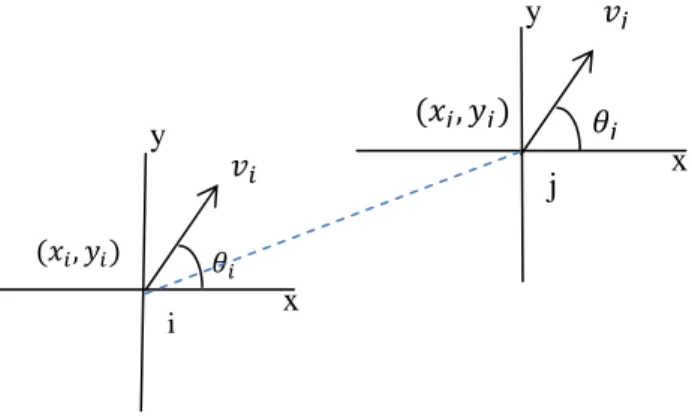
formula as given in [31]. Let i and j be two mobile nodes within the transmission range r of each other, let x , y and
x , y be the coordinate of i and j. Also let v , θ be the speed and the moving direction of the node i, and v , θ be the speed and the moving direction of the node j (Fig. 1). then the amount of time two mobile nodes i and j will stay connected LET(i,j) is predicted by:
, = (1)
Where
= cos " − $cos "$, % = & − &$,
' = sin " − $sin "$, * = + − +$.
This information can be obtained if the mobile nodes are equipped with a GPS system. Note that when v = v and
θ = θ, LET i, j becomes ∞.
Figure 1. Link Expiration Time Architecture
When a source node sends a request packet, the packet appends its location, direction and speed. The next hop neighbor of the source node that receives the request packet will be able to compute the duration of time between itself and the source node.
Assume that P is a routing path between source and destination, and (P2, P3, … , P5) is the set of all the links along P. then we try to estimate the probability L LET i, j that the link between two nodes i and j will last to LET i, j , with regards to the randomly changes in the nodes’ movement occurring during LET period. It is difficult to give an accurate calculation of L LET i, j , however we think a reasonable estimation of L LET i, j can be still helpful for link selection in terms of reliability. The basic assumptions for the proposed estimation algorithm are similar to those used in the literature such as [32] and [33], that is the mobility epoch lengths, during which a node moves in a constant direction at a constant speed, are exponentially distributed with mean λ 2, i.e.,
& = 78 9:'ℎ <=>?@ℎ ≤ &B
= 1 − = DE (2)
We use this definition to estimate the probability that a link between two mobile nodes i and j will be continuously available during LET i, j. Since nodes’ movements are independent of each other, L LET i, j is given by
& , +
&
$, +
$i
j
x
y
y
x
"
, = F1 − , G3
= = 3DHIJ ,$ (3)
The path stability S(P) is the minimum of the L LET P along the path ( i ∈ 1,2, … , , k )
N 7 = O >P 2,3,…,Q 7 (4)
With regard to energy aware, for increasing the network lifetime without loss of performance, we take into account cross layer parameters which contain residual energy of nodes and network congestion parameters, and then modify OLSR in order to make routing decisions according to these parameters. We combine these metrics to compute an energetic cost for each node i, as shown in Equation 5.
R = VWSTU
XYZ+ \1 −
]IU
^IXYZ_ (5)
Where `7 is the number of packets in the MAC queue and
a is the residual energy at each time. bcd E is the maximum considered MAC queue size and e d E is the initial energy of a node.
The path energetic cost EC(P) is the sum of EC along the path ( i ∈ 1,2, … , , k ),
R 7 = ∑ STU
VWXYZ+ \1 −
]IU
^IXYZ_
Q
h2 (6)
We intended to select a more stable path with lower consumption energy cost to achieve reduction in packet lost and prolonged lifetime of the network along with QoS support. The stability S P of the path is obtained from Equation (4) and lower cost based on Equation (6), to get the best possible path with higher link stability and lower energetic cost, we represented the path cost by divide the energetic cost of the path EC P by the path stability S(P), when as the EC P decreases and the S(P) increases, the path cost cost P will increases. The path that minimizes the cost value cost P is preferred.
':k@ 7 =∑ lmU
noXYZ \2 rqXYZpqU _ s
Utu
d vUw u, ,…,s HIJ TU (7) In order to not increasing network overhead, we embed links costs to the TC packet that are periodically generated by each node. So TC packet is extended to include the field for the updated costs, which is locally computed using Equations (3) and (5) of the originator node. And the Topology tuples are also extended to take a new field for the cost of the originator node. In the last step, based on the path costs computed from the links costs, routing tables should be updated rather than on number of hops. And should also include path costs to the destination address instead of the number of hops, where path cost is define as shown in Equation (7), hence a new algorithm have been proposed that assigns cost equal to 1 to paths towards the 1-hope neighbors. Next is examines the topology tuples given by the topology table and three cases are considered to update the routing table. The first one occurs when there is an entry in the routing table for the originator node of the topology tuple. In this case, a new
entry is added to the routing table for the destination node of TC with cost equal to the sum of the cost corresponding to route to the originator node and the link cost from the originator node to the final node. The second case, occurs when there are entries for both the originator and the destination node of the topology tuple. Then, the algorithm chooses greedily the new path detected through the originator node or it maintains the old path, by comparing their costs. Finally, in the case where there aren’t entries neither for the originator node nor the destination node, no new entry is created.
4.
Simulation Results and Analysis
We used NS3 network simulator to evaluate our modified version of OLSR. We considered three performance metrics to evaluate this proposition, which are:
• Average Node Residual Energy : total residual energy[J]/number of nodes
• Packet Delivery Ratio (PDR): the ratio of the number of packets delivered to the destination nodes over the number of packets sent by the source nodes.
• Network Lifetime: the time until the battery of a mobile node depletes.
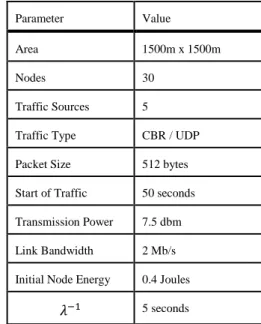
We simulated a MANET with 30 nodes in a dense 1500 x 1500 meter square area. There are 5 UDP sources generating packets of 512 bytes with different data rates. We executed the simulations to evaluate the performance of our modified routing scheme compared to the standard OLSR. The common simulation parameters of the two variations are summarized in Table 1 below.
Table 1. Simulation Parameters
Parameter Value
Area 1500m x 1500m
Nodes 30
Traffic Sources 5
Traffic Type CBR / UDP
Packet Size 512 bytes
Start of Traffic 50 seconds
Transmission Power 7.5 dbm
Link Bandwidth 2 Mb/s
Initial Node Energy 0.4 Joules
x 2 5 seconds
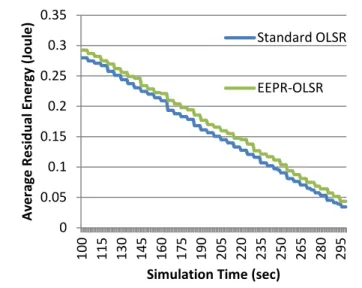
In the first setup, to evaluate the change of the average residual energy over time, we consider a mobile scenario where mobile nodes move in the area based on a Random Walk-based Mobility model, In this model, a node first selects a direction uniformly from a given space and a speed uniformly from an interval of speeds for its next movement, then the length of the epoch for the above movement is selected according to an exponential distribution with mean
‘moving-out’ is forced to the given space in order to maintain node density. With the parameters described in Table 1, in this first simulation, the source nodes send 10 packets/sec, the simulation time is set to 300 sec, and the speed is between 0 and 20 m/s. The purpose is to perform an energy analysis of the behavior of our modified scheme EEPR-OLSR in comparison with standard OLSR. Hence, we examine the Average Node Residual Energy vs Time. We present the results in Fig.2. It’s obvious that our modified scheme get the most average residual energy. We notice that at the end of the simulation, by our protocol EEPR-OLSR there are about 24% energy savings compared to the standard OLSR, Thus, this indicates that EEPR-OLSR achieves more uniform utilization of network resources by adjusting the paths costs and dispersing the traffic through different paths to reduce energy consumption. On the other hand, the standard OLSR selects the same paths to the destination nodes and utilizes the same intermediate nodes, which leads to fast depletion of their energy.
Figure 2. Average Residual Energy
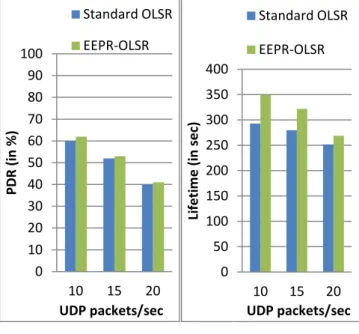
Note that the efficiency of a protocol is to not enhance the performance of a specific at the expense of the others, in the second setup we aim to evaluate the increase of both the network lifetime and the PDR value. For that we consider three different scenarios in terms of mobility: low, medium and high mobility. In the low mobility scenario, mobile nodes move based on a Random Walk-based Mobility model with speed varying randomly in a range of 0 to 10 m/sec. In the medium mobility scenario, nodes move with a speed varying randomly in a range of 10 to 20 m/sec. And in the high mobility scenario, nodes move with a speed varying randomly in a range of 20 to 30 m/sec. These scenarios have common parameters described in Table 1. The simulations are done with 3 different traffic rates, which are: 10 packets/sec, 15 packets/sec and 20 packets/sec, to study the effect of traffic rate. For network lifetime measurement, we execute the simulations until a node is completely depleted. In Fig.3b we observe that EEPR-OLSR outperform the standard OLSR in network lifetime, in the case of low mobility scenario, thus we obtain a gain that achieves over 24% compared to the standard OLSR, The reason is that the native version uses the hop-count metric, without taking into account the residual energy of the nodes in the network, with EEPR-OLSR instead, each node in the network selects paths
which exclude low energy nodes and the more stable links as much as possible to avoid the break link that results lost packets and rebroadcasting which request more energy consumption, we notice that, in case of energy-aware routing, nodes are exploited for the data forwarding in an almost uniform way. In the other case, some nodes are used more than others and this reduces the network lifetime, although the chosen path maybe longer that another which have less sum residual energy of their nodes. In term of PDR we have also a bit little improvement that may reach to 8% as observed in Fig.3a, due to the fact that the concept of the network congestion which was taken on consideration when we make the cost of node through the MAC queue utilization, thus larger cost was assigned to nodes with high MAC queue utilization, which means the congested nodes, moreover the EEPR-OLSR tries to choose the more stable path by Prediction-based Link Availability Estimation, and we know that the congestion and break links are the most important cause of packet loss. In the medium mobility scenario case ( Fig.4) we attain closely the same results as in the low mobility speed, with a bit little decrease in both gain in network lifetime and PDR due to the fact that the nodes move faster. In the high mobility scenario (Fig.5) is obviously expected that the performance be lower in comparison with the precedent cases, the packet delivery rate is reduced with increasing mobility due to more link breaks. This resulted in both the protocols. When the mobility is low, the broadcast structure was mostly static and therefore the packet delivery ratio is high. When the speed increases, the links between two nodes more often break, then there are more packet losses and thus, fewer packets delivered to the destination. In standard OLSR hop count is considered as the only QoS metric for routing decision. Whereas in EEPR-OLSR the paths with less congested nodes are taken into account and the most stable path is also identified with maximum N 7 which in turn increases the packet delivery ratio 2–8%compared to standard OLSR.
Figure 3. Low Mobility Scenario
0 0.05 0.1 0.15 0.2 0.25 0.3 0.35 1 0 0 1 1 5 1 3 0 1 4 5 1 6 0 1 7 5 1 9 0 2 0 5 2 2 0 2 3 5 2 5 0 2 6 5 2 8 0 2 9 5 A v e rag e R e si d u al E n e rg y ( Jo u le )
Simulation Time (sec)
Standard OLSR EEPR-OLSR 0 10 20 30 40 50 60 70 80 90 100
10 15 20
P D R ( in % ) UDP packets/sec Standard OLSR EEPR-OLSR 0 50 100 150 200 250 300 350
10 15 20
Li fe ti m e ( in s e c) UDP packets/sec Standard OLSR EEPR-OLSR
(a)PDR for various traffic rates
Figure 4. Medium Mobility Scenario
Figure 5. High Mobility Scenario
5.
Conclusions
This work has demonstrated ways to optimize total energy consumption in Mobile Ad-hoc Networks, using the proactive routing protocol OLSR, by a mechanism that aim to increase network lifetime and enhance performance. We are interested in integrating appropriate routing metrics in the routing decision scheme to reduce effects of reason that lead to more energy consumption, via adopting residual energy and network, then we have proposed and investigated a prediction-based link availability estimation, this algorithm tries to predict the probability that an active link between two nodes will be continuously available for a predicted period. By choosing those metrics, congestion and less reliable links
can be avoided. In fact proposed scheme EEPR-OLSR has a positive impact both on network lifetime and PDR. In particular, energy-aware routing allows for a prolonged duration of the network nodes, when compared to the native OLSR implementation based on shortest path routing. We evaluated the modified OLSR under a range of different scenarios, varying traffic load and mobility pattern, we compared the EEPR-OLSR, in terms of network lifetime and PDR, with the standard OLSR. Our simulation showed that our EEPR-OLSR is able to prolong network lifetime pretty more than precedent work without significant loss of PDR. Different extensions can be considered as future work. The most natural one is to find a way to consider energy, link stability and delay, in the path selection policy. This requires defining a multi-objective model and subsequently designing a proper heuristic to solve it in a feasible way.
References
[1] Jubin J, Tornow J, “The DARPA Packet Radio Network Protocols,” Proceedings of the IEEE 1987, 75(1):21-32.
[2] Perkins C, “Ad Hoc Networking,” AddisonWesley, pp. 1-28, 2001.
[3] C. E. Perkins, P. Bhagwat, “Highly dynamic Destination-Sequenced Distance-Vector routing (DSDV) for mobile computers,” Proceedings of the SIGCOMM ’94 Conference on Communications Architectures, Protocols and Applications, pp. 234–244, 1994.
[4] T. Clausen, P. Jacquet, “Optimized Link State Routing Protocol (OLSR),” RFC 3626, IETF Network Working Group, October 2003.
[5] C. E. Perkins, E. M. Royer, “Ad Hoc On-demand Distance Vector Routing,” Proceedings of the 2nd IEEE Workshop on Mobile Computing Systems and Applications, pp. 90-100, 1999.
[6] D. B. Johnson, D. A. Maltz, “Dynamic Source Routing in Ad-Hoc Ad hoc Networks,” Mobile Computing, pp. 153-181, 1996.
[7] Sun BL, Li LY, “A distributed QoS multicast routing protocol in ad hoc networks,” J Syst Eng Electron, 17(3):692–8, 2006.
[8] Lian Lin, Li Layuan, “A multi-constraint QoS routing with routerequest selection based on mobile predicting in MANET,” International conference on computational intelligence and security workshop, 2007.
[9] Conti M, Giordano S, Maselli G, Turi G, “Crosslayering in mobile ad hoc network design,” IEEE Computer, Special Issue on Ad Hoc Networks, 2004.
[10] S. Jiang, D. He, J. Rao, “A prediction-based link availability estimation for mobile ad hoc networks,” IEEE INFOCOM, 2001.
[11] P.I. Basarkod, S.S. Manvi, “Mobility and QoS aware anycast routing in Mobile ad hoc Networks,” Computers & Electrical Engineering, Vol. 48, pp. 86-99, November 2015.
[12] V.V. Mandhare, R.C. Thool, “Improving QoS of Mobile Ad-hoc Network Using Cache Update Scheme in Dynamic Source Routing Protocol,” Procedia Computer Science, Vol. 79, pp. 692-699, 2016.
[13] Fadoua Yakine, Abdellah Idrissi, “Energy-Aware Topology Control And Qos Routing In Ad-Hoc 0
10 20 30 40 50 60 70 80 90 100
10 15 20
P
D
R
(
in
%
)
UDP packets/sec Standard OLSR
EEPR-OLSR
0 50 100 150 200 250 300 350 400
10 15 20
Li
fe
ti
m
e
(
in
s
e
c)
UDP packets/sec Standard OLSR
EEPR-OLSR
0 10 20 30 40 50 60 70 80 90 100
10 15 20
P
D
R
(
in
%
)
UDP packets/sec Standard OLSR
EEPR-OLSR
0 50 100 150 200 250 300 350 400 450
10 15 20
Li
fe
ti
m
e
(
in
s
e
c)
UDP packets/sec Standard OLSR
EEPR-OLSR (a)PDR for various traffic
rates
(b)Network Lifetime for various traffic rates
(a)PDR for various traffic rates
Networks,” Procedia Computer Science, Vol. 56, pp. 309-316, 2015.
[14] Wilder E. Castellanos, Juan C. Guerri, Pau Arce, “A QoS-aware routing protocol with adaptive feedback scheme for video streaming for mobile networks,” Computer Communications, Vol. 77, pp. 10-25, March 2016.
[15] Lahouari Ghouti, “Mobility prediction in mobile ad hoc networks using neural learning machines,” Simulation Modelling Practice and Theory, Vol. 66, pp. 104-121, August 2016.
[16] Shilpa Shashikant Chaudhari, Rajashekhar C. Biradar, “Traffic and mobility aware resource prediction using cognitive agent in mobile ad hoc networks,” Journal of Network and Computer Applications, Vol. 72, pp. 87-103, September 2016.
[17] Chi Trung Ngo, Hoon Oh, “TLSR: A tree link state routing protocol using message aggregation based on a skewed wait time assignment for infrastructure-based mobile ad hoc networks,” Computer Communications, Vol. 74, pp. 87-100, 15 January 2016.
[18] Tássio Carvalho, José Jailton Júnior, Renato Francês, “A new cross-layer routing with energy awareness in hybrid mobile ad hoc networks: A fuzzy-based mechanism,” Simulation Modelling Practice and Theory, Vol. 63, pp. 1-22, April 2016.
[19] Ch. Niranjan Kumar, N. Satyanarayana, “Multipath QoS Routing for Traffic Splitting in MANETs,” Procedia Computer Science, Vol. 48, pp. 414-426, 2015.
[20] Manish Bhardwaj, “Enhance Life Time of Mobile Ad-hoc Network Using WiTriCity and Backpressure Technique,” Procedia Computer Science, Vol. 57, pp. 1342-1350, 2015.
[21] V.Sowmaya Devi, Nagaratna P.Hegde, “Energy Efficient Multipath Routing Protocol for Enhancing QoS and QoE in Multimedia Applications for MANETs,” International Journal of Communication Networks and Information Security (IJCNIS), Vol. 8, No. 3, pp. 158-170, December 2016.
[22] S. M. Kamruzzaman, Xavier Fernando and Mohammad Jaseemuddin, “Energy Aware Multipath Routing Protocol for Cognitive Radio Ad Hoc Networks,” International Journal of Communication Networks and Information Security (IJCNIS), Vol. 8, No. 3, pp. 187-196, December 2016.
[23] Shobha Tyagi, Subhranil Som, Q.P. Rana, “A Reliability based Variant of AODV in MANETs: Proposal, Analysis and Comparison,” Procedia Computer Science, Vol. 79, pp. 903-911, 2016.
[24] Syed Jalal Ahmad, V.S.K. Reddy, A. Damodaram, P. Radha Krishna, “Delay optimization using Knapsack algorithm for multimedia traffic over MANETs,” Expert Systems with Applications, Vol. 42, Issue 20, pp. 6819-6827, November 2015.
[25] M. Bakhouya, J. Gaber, P. Lorenz, “Energy evaluation of AID protocol in Mobile Ad Hoc Networks,” Journal of Network and Computer Applications, Vol. 58, pp. 287-293, December 2015.
[26] Pushparaj Ramachandran, M. Dinakaran, “Signal Strength and Residual Power Based Optimum Transmission Power Routing for Mobile Ad hoc
Networks,” Procedia Computer Science, Vol. 92, pp. 168-174, 2016.
[27] Hasan Abdulwahid, Bin Dai, Benxiong Huang, Zijing Chen, “Scheduled-links multicast routing protocol in MANETs,” Journal of Network and Computer Applications, Vol. 63, pp. 56-67, March 2016.
[28] G. Carofiglio, C.-F . Chiasserini, M. Garetto, E. M. Leonardi, “Route stability in MANETs under random direction mobility model,” IEEE Trans. on Mobile Computing, vol. 8, no. 9, pp. 1167–1179, Sept. 2009. [29] Xi Hu, Jinkuan Wang, Cuirong Wang, “Link stability
prediction and its application to routing in mobile ad hoc networks,” 2nd International Conference on Power Electronics and Intelligent Transportation System (PEITS), 2009.
[30] Shiqiang Wang, Qingyang Song, Jianxin Feng, Xingwei Wang, “Predicting the link stability based on link connectivity changes in mobile ad hoc networks,” IEEE International Conference on Wireless Communications, Networking and Information Security (WCNIS), 2010. [31] Su, W., Lee, S.-J., Gerla, M., “Mobility prediction in
wireless networks,” Proceedings of the IEEE Military Commu., Conference (MILCOM), Los Angeles, pp. 91– 195, October 2000.
[32] A. Bruce McDonald, T.F. Znabi, “A path availability model for wireless ad hoc networks,” Proc. IEEE WCNC, New Orlean, USA, pp.35-40, 1999.