Leaf Disease Identification using CNN and
Raspberry PI
Akshita Arora1, Nazim Khan2, Shefali Gupta3, Samikchha Singh4, Ms Maansi Gupta5
1, 2, 3, 4,
5GGSIPU, BPIT, Delhi, India
Abstract: Identification of leaf disease is very important in agriculture field nowadays. Leaf disease detection requires huge amount of work, knowledge in the plant field. So we can use image processing for identification of leaf disease using PYTHON. This paper holds leaf diseases detection using CNN and Image Processing. It has three basic steps: Preprocessing the dataset, Training it, Validation and Testing the model using raspberry pi camera connected through raspberry pi 3. Revealing the CNN to extract the learned feature as an interpretable form not only ensures its reliability but also enables the validation of the model authenticity and the training dataset by human intervention. In this study, a variety of neuron-wise and layer-wise visualization methods were applied using a CNN, trained with a publicly available plant disease image dataset. This paper showed that neural networks can capture the textures of lesions specific to respective diseases upon diagnosis, which resembles human decision-making.
While several visualization methods were used as they are, others had to be optimized to target a specific layer that fully captures the features to generate consequential outputs. Moreover, by interpreting the generated attention maps, we identified several layers that were not contributing to inference and removed such layers inside the network, decreasing the number of parameters without affecting the classification accuracy.
The results provide an impetus for the CNN users in the field of plant science to better understand the diagnosis process and lead to further efficient use of deep learning for plant disease diagnosis.
Keywords: Raspberry Pi, Python, Image processing, Leaf Disease Detection, Convolutional Neural Network (CNN).
I. INTRODUCTION
Identification of the plant diseases is the key to preventing the losses in the yield and quantity of the agricultural product. The studies of the plant diseases mean the studies of visually observable patterns seen on the plant. Health monitoring and disease detection on plant is very critical for sustainable agriculture. It is very difficult to monitor the plant diseases manually. It requires tremendous amount of work, expertize in the plant diseases, and also require the excessive processing time. Hence, image processing is used for the detection of plant diseases.
It has the following features:
Disease detection involves the steps like image pre-processing, image segmentation, feature extraction and classification.
II. LITERATURE REVIEW
This paper focuses on proposing an automated system for diagnosis of common leaf diseases by making use of convolution neural network and feature extraction. Accordingly, it states that system should have an application which can operate for specific disease diagnosis using rule based model of data mining technique. Also it focuses on proposing a model that provides automatic method to find out leaf diseases by inspecting if an image which is subjected to examination in the system has been affected by any disease or not.
They are generated by using different image segmentation and thereby obtaining the optimized results. However, the work carried out , emphasizes to determine the nitrogen deficiency and further anticipate the right quantity of fertilizers required for the type of area using feature extraction.
III. CONVOLUTIONAL NEURAL NETWORK
[image:2.612.191.419.216.275.2]Deep learning is a class of machine learning algorithms that has sequential layers. Each layer uses the output of the preceding layer as input. The learning process can be unsupervised, supervised or semi-supervised. LeCun et al. define the deep learning as a representation learning method. Representation learning algorithms makes optimizations to find the most convenient way to represent the data. Deep learning does not have to divide the feature extraction and the classification because the model automatically extracts the features while training the model. It is used in many research areas such as image processing, image restoration, speech recognition, natural language processing and bioinformatics. CNN is preferred as a deep learning method in this study. CNN, which can easily identify and classify objects with minimal pre-processing, is successful in analyzing visual images and can easily separate the required features with its multi-layered structure. It consists of four main layers: convolutional layer, pooling layer, activation function layer and fully connected layer. Fig. 1 shows a general CNN architecture.
Fig. 1. A general CNN architecture
A. Convolutional Layer
[image:2.612.205.404.375.547.2]CNN takes its name from the convolution layer. In this layer, a series of mathematical operations are performed to extract the feature map of the input image. The input image is reduced to a smaller size using a filter. The filter is shifted step by step starting from the upper left corner of the image. At each step, the values in the image are multiplied by the values of the filter and the result is summed. A new matrix with a smaller size is created from the input image. Fig. 2 shows the convolution operation in the convolution layer for a 5x5 input image and a 3x3 filter.
Fig. 2. Convolution operation for 5x5 input image and 3x3 filter.
B. Pooling Layer
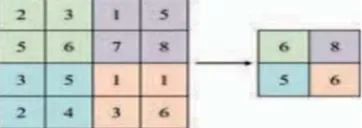
The pooling layer is usually applied after the convolution layer. The size of the output matrix obtained from the convolution layer is reduced in this layer. Although filters of different sizes can be used in the pooling layer, generally 2x2 size filter is used. Several functions such as max pooling, average pooling and L2-norm pooling can be used in this layer.
Max pooling is done by selecting the largest value in the sub windows and this value is transferred to in a new matrix. Fig. 3 shows an example pooling operation.
[image:2.612.216.397.658.722.2]C. Activation Layer
In artificial neural networks, the activation function provides a curvilinear relationship between the input and output layers. It affects the network performance. Non-linear learning of the network occurs through the activation function. Several activation functions, such as linear, sigmoid, hyperbolic tangent, exist, but the nonlinear ReLU (Rectified Linear Unit) activation function is usually used in CNN. In ReLU, values less than zero are changed to zero, while values greater than zero are unchanged .
f(x) = 0, if x < 0. f(x) = x, otherwise. D. Fully Connected Layer
The last obtained matrix, after finishing the convolution, pooling and activation operations, is fed into the fully connected layer as input. Recognition and classification are performed in this layer.
IV. SYSTEM DESIGN AND ARCHITECTURE MATERIALS AND METHODS
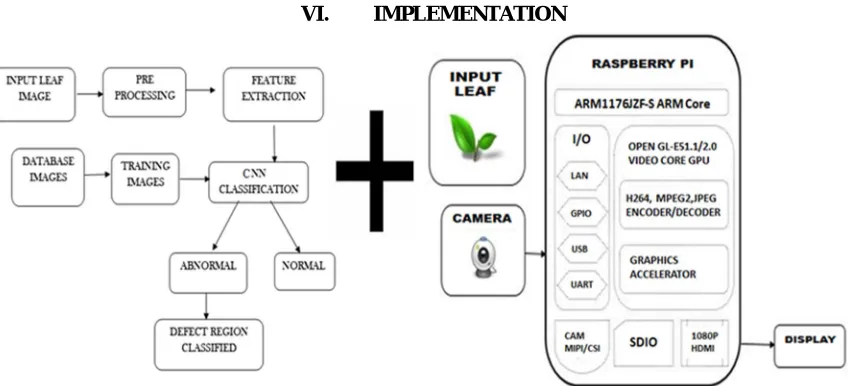
[image:3.612.176.441.502.703.2]In order to develop a model for leaf disease detection, the approach used is deep CNN. 1. DATASET For the purpose of image-based identification which includes, training phase to evaluation phase where the performance of classification algorithms are evaluated, it is necessary to have huge data sets. Subsequently, there is a need to enhance the dataset by adding the images that are augmented. This paper further train the network to learn features that differentiates one class from other. Correspondingly, a database comprising of more than 5000 images are used to train and around 1000 images are further used to validate the same. 2. PROCESS AND LABEL OF IMAGES Several samples of images are collected which are spread across in several formats having varying levels of resolutions and hence the variations in quality. Thus, to acquire a reasonable feature extraction, the final images are used as input data for classifier which are then pre-processed to achieve consistency. It is further ensured that at the time of data collection, those of the images whose resolution is smaller and which has a dimension less than 500px is not taken into consideration as valid images for the dataset. As such, images having higher resolution form the potential candidates for this investigation purpose. Consequently, images are ascertained to contain all the required information for feature learning. Accordingly, images used for the dataset were image resized to 50 X 50. This ensures that there is a reduction of the time required for training and automatically computes it using written script in Python, using the OpenCV framework. Pre-processing images involves outsourcing background noise, intensity normalization of individual image particles, removing reflections and masking portions of images. The dataset of the plant leaf, various diseases, pests and soil images are trained in python tool and classified into various clusters which classifies various labels. Convolution Neural Networks is designed for accurate analysis. Unsupervised Learning classification is used since the input image is unknown and new to the algorithm. Most of the real time applications need unsupervised learning data since the input is always unknown to the algorithm. Machine Learning algorithm: Based on the feature extraction parameters, the algorithm predicts whether the crop is going to get any pest and disease attacks in future. Fig. 4 shows the main aforementioned steps used in the process of detection.
The parameters of completely disease and pest infected plants, partially infected disease and pest plants and healthy plant images are taken as image dataset. These values are trained and clustered based on their respective categories. Right from healthy to partially to completely disease and pest infected plants are classified into separate labels. The values are trained in accordance with the Learning algorithm. The input image taken called as test image, after the extraction of features of it, each feature gets compared with the trained data features. Therefore, a centroid is formed where the nearest corresponding feature cluster is selected. The label under nearest corresponding label gets displayed like “Disease X and Pest Y”. This phase is Disease/Pest Detecting part. The Neural Network here is the creation of Convolution Neural Network (CNN) used for Non-Linear Regression models. An artificial neuron gets created having several hidden layers in it.
V. TECHNOLOGIES/COMPONENTS
A. OpenCV
OpenCV represents Computer Vision Open Source. It contains the library of programming capacities for is AI programming. Open CV is required for picture handling applications continuously. OpenCV is created generally in C, C++ and its guideline interface is in C++ language, yet regardless of all that it holds a less no matter how you look at it yet wide C language interface.
B. Python
It is simple to learn. It is required for raspberry Pi - related code programming. Python is a language that supports both as packages and modules. Besides the standard library, it also has a Python interpreter. They are available to all platforms free of charge in both source and binary form, and can be unreservedly disseminated to everyone. Python is a language scripting that empowers line - by - line execution of the code that USB association.
C. Camera
Used to catch a yield picture, it is legitimately associated with the Pi 3 Model B raspberry. There are two different ways to associate the camera to the Pi 3 display B raspberry. The first is by means of USB port and the second is a 15pin header for raspberry Pi3 camera interface.
D. Raspberry PI
Raspberry Pi is a little PC like module. The camera caught picture will be sent to the Raspberry Pi.Using Open CV library; Raspberry Pi forms the picture and recognizes it.
E. Display
It features a display to show the output of the model generated using neural networks on test leaf input’s image captured by the came connected through the raspberry pi 3 Model B.
[image:4.612.95.519.520.713.2]VI. IMPLEMENTATION
A. Neural Network Training
[image:5.612.178.436.290.499.2]This paper put forth a model which is used to train CNN in order to identify leaf disease. Tenser flow, an open source library is used to carry out numerical computations in neural networks along with data flow graphs. Nodes represent mathematical operations while graph edges represent multidimensional data arrays. Convolution neural network in machine learning is a type of feed forward artificial neural network in which neurons are associated in a pattern that is stimulated by the organization of animal visual cortex. Receptive field which happens to be restricted region of space is the location where individual cortical neurons respond to stimuli. Different neurons in the respective fields partially overlap so as to tile the visual field. Individual neurons react to the stimuli within its field. Convolution operation approximates this scenario mathematically. These are stimulated by biological process and variations of multilayer perceptron that are intended to use pre-processing in minimal amounts. Consequently, applications in image and video recognition, natural language processing and recommender systems are large in number. Convolution networks may include global or local pooling layers which combines output of neuron clusters. The first convolution layer filters the input image with 32 kernels of size 3x3. After max pooling is applied, the output is given as an input for the second convolution layer with 64 kernels of size 4x4. The last convolution layer has 128 kernels of size 1x1 followed by a fully connected layer of 512 neurons. The output of this layer is given to softmax function which produces a probability distribution of the four output classes. Fig. 6: Sample images from the database a) healthy leaf image taken under a constant background b) healthy leaf image taken under uncontrolled environment [c-e] leaf imagesfrom a plant affected by: c) septorial leaf blight d) frogeye leaf spot e) downy mildew
Fig 6: Sample segmented images resized to 64x64pixels a) healthy leaf image taken under a constant background b) healthy leaf image taken in uncontrolled environment [ce] leaf images from a plant affected by: c) septorial leaf blight d) frogeye leaf spot e)
downy mildew
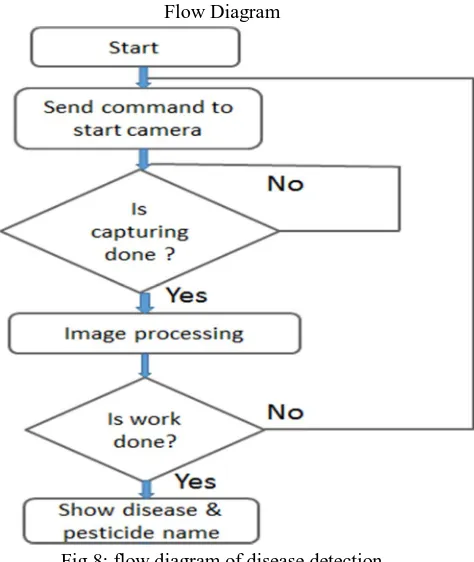
Flow Diagram
Fig 8: flow diagram of disease detection
VII. RESULTS
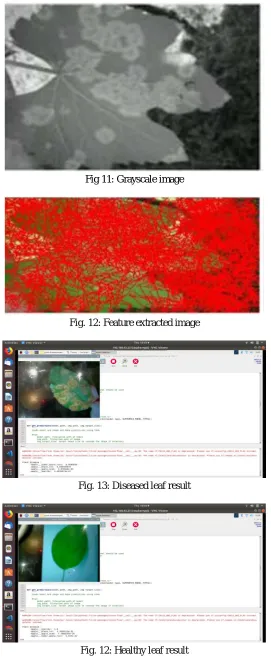
Leaves of illnesses are chosen for recognition as fine buildup, fleece mold, dark Dot. The server makes the database for solid leaves and sick leaves. To contrast the pictures and wiped out and solid leaves, this is essential. The sort of illness is along these lines arranged by examination. Figure 10, Figure 11, Figure 12 demonstrates the normal yield, which incorporates for the most part portioned picture, grayscale picture, removed picture highlight of Fig 9.
[image:6.612.173.437.437.719.2]Fig. 9: Downy mildew
Fig 11: Grayscale image
Fig. 12: Feature extracted image
[image:7.612.172.443.75.732.2]Fig. 13: Diseased leaf result
VIII. CONCLUSION
There are essentially three fundamental kinds of Leaf ailment, Bacterial, Fungal and Viral. The precision of plant ailment recognition is essential in plant ailment location, however the procedure ought to be rapid in the meantime . The aim of this paper is to help the farmers to protect his farm from any kind of pests and disease attacks and eliminate them without disturbing the decorum of the soil and untouched parts of other plants. Mostly in India, farmers use manual monitoring and some apps which have huge database limitations and are only bound to detection part. Since, Prevention is better than cure, this paper aims at detection of attack of pests/diseases in future thereby making farmer to prevent such attacks.
IX. FUTURE SCOPE
A. Using Reinforcement learning through time to time feedbacks to improve the accuracy of our product.
B. Work can be stretched out by utilizing quad copter at field level to catch pictures of the leaves of the different plants in the farm C. For further handling, this framework can be associated with the server.
D. Group leaf ailments utilizing picture preparing instruments and send all data about the sickness through the GSM module to the farmer's mobile phone.
E. Using machine learning algorithms ,recommendation system can be build for various remedies associated with particular leaf
disease.
REFERENCES
[1] M. Reyalat, Al Hiary, Braik, Bani Ahmad, and Z. Rahamneh, "Fast and accurate plant disease detection and classification."International journal of Computer Applications(0975-8887),Vol-17,No1,March 2017
[2] Smith J S., Camargo A., "An algorithm based on image processing to automatically identify visual symptoms of plant disease."
[3] S A Ali,Sulaiman, N., Mustapha,"K means accuracy clustering.” Information technology journal 1256-1262,2009, ISSN 1812-56322009 Asian network for scientific Information
[4] Tapas kanungo, David Mount, "Efficient k means Clustering Algorithm: Analysis and Implementation."IEEE Transactions on Pattern Analysis and Machine Intelligence,Vol 24,No 7,July 2002
[5] Color Space Conversions, Ford A., Robert,.August 11,1998
[6] C M Procopiuc, P. K. Agarwal, "Clustering Algorithms Exact and Approximate.".Algorithmica(2002) 33;201-226.
[7] Devendra P. Marathe, V. A. Patil, V. D. Chaudhari, "Reliable transfer of massage to alternative methods, i.e. Wi fiBluetooth, ZigBee, Internet, M edia GPRS / GSM, IJET, vol 5, issue 7. Pp 2015.
[8] Kiran R. Gavhale, and U. Gawande, “An Overview of the Research on Plant Leaves International Journal of Pure and Applied Mathematics Special Issue 882 Disease detection using Image Processing Techniques,” IOSR J. of Compu. Eng. (IOSRJCE),vol. 16, PP 10-16, Jan. 2014.
[9] Y. Q. Xia, Y. Li, and C. Li, “Intelligent Diagnose System of Wheat Diseases Based on Android Phone,” J. of Infor. & Compu. Sci., vol. 12, pp.6845-6852, Dec. 2015.
[10] K. Padmavathi, and K. Thangadurai, “Implementation of RGB and Gray scale images in plant leaves disease detection –comparative study,” Indian J. of Sci. and Tech., vol. 9, pp. 1- 6,Feb. 2016.
[11] Sachin D. Khirade and A. B. Patil. “Plant Disease Detection Using Image Processing.” International Conference on Computing Communication Control and Automation (ICCUBEA), 2015 International Conference on,pp. 768-771. IEEE, 2015.
[12] Sannakki, Sanjeev S., Vijay S. Rajpurohit, V. B. Nargund, and Parag Kulkarni. “Diagnosis and classification of grape leaf diseases using neural networks.” In computing, communications and Networking Technologies (ICCCNT), 2013 Fourth International conference on, pp. 1-5 IEEE, 2013
[13] Kutty, Suhaili Beeran, Noor Ezan Abdullah, Habibah Hashim, and Aida Sulinda. “Classification of Watermelon Leaf Diseases Using Neural Network Analysis.” In Business Engineering and Industrial Applications Colloquium (BELAC), 2013 IEEE, pp. 459-464. IEEE, 2013.
[14] Rothe, P. R., and R. V. Kshirsagar. “Cotton Leaf Disease Identification using Pattern Recognition Techniques.” In Pervasive Computing (ICPC), 2015 International Conference on, pp. 1-6. IEEE, 2015.
[15] H. Park, J. S. Eun and S. H. Kim, “Image-based disease diagnosing and predicting of the crops through the deep learning mechanism”, In Information and Communication Technology Convergence (ICTC), IEEE 2017 International Conference on, pp. 129-131, 2017.

![Fig 6: Sample segmented images resized to 64x64pixels a) healthy leaf image taken under a constant background b) healthy leaf image taken in uncontrolled environment [ce] leaf images from a plant affected by: c) septorial leaf blight d) frogeye leaf spot e) downy mildew](https://thumb-us.123doks.com/thumbv2/123dok_us/1231982.648511/5.612.178.436.290.499/segmented-healthy-constant-background-uncontrolled-environment-affected-septorial.webp)