Mining Informal Language from Chinese Microtext:
Joint Word Recognition and Segmentation
Aobo Wang1 Min-Yen Kan1,2∗
1 Web IR / NLP Group (WING)
2Interactive and Digital Media Institute (IDMI)
National University of Singapore 13 Computing Link, Singapore 117590
{wangaobo,kanmy}@comp.nus.edu.sg
Abstract
We address the problem of informal word recognition in Chinese microblogs. A key problem is the lack of word delimiters in Chinese. We exploit this reliance as an opportunity: recognizing the relation be-tween informal word recognition and Chi-nese word segmentation, we propose to model the two tasks jointly. Our joint in-ference method significantly outperforms baseline systems that conduct the tasks in-dividually or sequentially.
1 Introduction
User generated content (UGC) – including mi-croblogs, comments, SMS, chat and instant mes-saging – collectively referred to as microtext by Gouwset et al. (2011) or network informal lan-guageby Xiaet al. (2005), is the hallmark of the participatory Web.
While a rich source that many applications are interested in mining for knowledge, microtext pro-cessing is difficult to process. One key reason for this difficulty is the ubiquitous presence of informal words – anomalous terms that manifest as ad hoc abbreviations, neologisms, unconven-tional spellings and phonetic substitutions. Such informality is often present in oral conversation, and user-generated microblogs reflect this infor-mality. Natural language processing (NLP) tools largely fail to work properly on microtext, as they have largely been trained on formally written text (i.e., newswire). Recent work has started to ad-dress these shortcomings (Xia and Wong, 2006; Kobus et al., 2008; Han and Baldwin, 2011). In-formal words and their usage in microtext evolves quickly, following social trends and news events.
∗This research is supported by the Singapore National
Research Foundation under its International Research Centre @ Singapore Funding Initiative and administered by the IDM Programme Office.
These characteristics make it difficult for lexicog-raphers to compile lexica to keep with the pace of language change.
We focus on this problem in the Chinese lan-guage. Through our analysis of a gathered Chinese microblog corpus, we observe that Chinese infor-mal words originate from three primary sources, as given in Table 1.
But unlike noisy words in English, Chinese in-formal words are more difficult to mechanically recognize for two critical reasons: first, Chinese does not employ word delimiters; second, Chinese informal words combine numbers, alphabetic let-ters and Chinese characlet-ters. Techniques for En-glish informal word detection that rely on word boundaries and informal word orthography need to be adapted for Chinese. Consider the micro-text “ •g †” (meaning “Don’t tell me the
spoilers (to a movie or joke)”, also in Table 1). If “ •” (“don’t”) and “†” (past tense marker) are correctly recognized as two words, we may predict the previously unseen characters “g ”
(“tell spoilers”) as an informal word, based on the learned Chinese language patterns. However, state-of-the-art Chinese segmenters1 incorrectly
yield “ • g †”, preferring to chunk “ †” (“thoroughly”) as a word, as they do not
con-sider the possibility that “g ” (“spoiler”) could
be an informal word. This example illustrates the mutual dependency between Chinese word seg-mentation (henceforth, CWS) and informal word recognition (IWR) that should be solved jointly.
Hence, rather than pipeline the two processes serially as previous work, we formulate it as a two-layer sequential labeling problem. We employ fac-torial conditional random field (FCRF) to solve both CWS and IWR jointly. To our best knowl-edge, this is the first work that shows how Chi-nese microtext can be analyzed from raw text to
1http://www.ictclas.org/index.html
Table 1: Our classification of Chinese informal words as originating from three primary sources. For
Phonetic Substitutions, pronunciation is indicated by the phonetic Pinyin transcription system.
Informal Word Formal Word Example Sentence English Translation
1) Phonetic
( (mu4you3) ¡ (mei2you3) Ñ:((( úßf Notaxi in the development area Substitutions
i¸ì(hai2zhi3men) iPì(hai2zimen) wŠ†iii¸¸¸ììì Get upkids
bs Æ(bi shi) bs` Idespiseyou
2) Abbreviation gL8 LgbÅ82 e•LLLggg888'† Let’s play board gamesDon’ttell (me) the spoilers 3) Neologisms ÙÒ@› ň-pÒ ¦ÙÙÙÒÒÒ›J››@@@ƒ SoQuickly purchaseawesome! it
derive joint solutions for both problems of CWS and IWR. We also propose novel features for in-put to the joint inference. Our techniques signif-icantly outperform both research and commercial state-of-the-art for these problems, including two-step linear CRF baselines which perform the two tasks sequentially.
We detail our methods in Section 2. In Sec-tion 3, we first describe the details of our dataset and baseline systems, followed by demonstrating two sets of experiments for CWS and IWR, re-spectively. Section 4 offers the discussion on error analysis and limitations. We discuss related work in Section 5, before concluding our paper.
2 Methodology
Given an input Chinese microblog post, our method simultaneously segments the sentences into words (the Chinese Word Segmentation, CWS, task), and marks the component words as informal or formal ones (the Informal Word Re-congition, IWR, task).
2.1 Problem Formalization
The two tasks are simple to formalize. The IWR task labels each Chinese character with either anF
(part of a formal word) orIF(informal word). For the CWS task, we follow the widely-used BIES
coding scheme (Low et al., 2005; Hai et al., 2006), where B, I, E and S stand for beginning of a word, inside a word, end of a word and single-character word, respectively. As a result, we have two (hidden) labels to associate with each (ob-servable) character. Figure 1 illustrates an exam-ple microblog post graphically, where the labels are in circles and the observations are in squares. The two informal words in the example post are “( ” (normalized form: “¡ ”; English gloss: “no”) and “rp” (“ºÁ<”; “luck”).
2.2 Conditional Random Field Models
Given the general performance and discrimi-native framework, Conditional Random Fields (CRFs) (Lafferty et al., 2001) is a suitable frame-work for tackling sequence labeling problems. Other alternative frameworks such as Markov Logic Networks (MLNs) and Integer Linear Pro-gramming (ILP) could also be considered. How-ever, we feel that for this task, formulating effi-cient global formulas (constraints) for MLN (ILP) is comparatively less straightforward than in other tasks (e.g, compared to Semantic Role Labeling, where the rules may come directly from grammat-ical constraints). CRFs represent a basic, simple and well-understood framework for sequence la-beling, making it a suitable framework for adapt-ing to perform joint inference.
2.2.1 Linear-Chain CRF
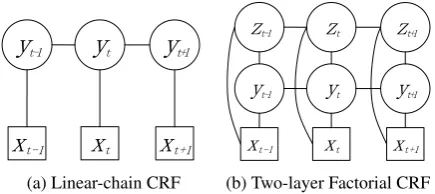
A linear-chain CRF (LCRF; Figure 2a) predicts the output label based on feature functions pro-vided by the scientist on the input. In fact, the LCRF has been used for the exact problem of CWS (Sun and Xu, 2011), garnering state-of-the-art performance, and as such, validate it as a strong baseline for comparison.
2.2.2 Factorial CRF
开 发 区 没 有 出 租 车 , 人 品 值 低 啊
F F IF IF F F F F IF IF F F
F F
I E B E B I E S B I E S
B S
开 发 区 木 有 出 租 车 , r p 值 低 啊
[image:3.595.77.525.59.206.2]There is no taxi in the development zone , how poor my character is
Figure 1: A Chinese microtext (bottom layer) with annotations for IWR (top layer) and CWS (middle layer). The bottom three lines give the normalized Chinese form, its pronuniciation in Pinyin and aligned English translation.
yt
x
tyt+1
x
t+1y
t-1x
t-1(a) Linear-chain CRF
y
txt
y
t+1xt+1
y
t-1xt-1
z
tz
t+1z
t-1(b) Two-layer Factorial CRF
Figure 2: Graphical representations of the two types of CRFs used in this work. yt denotes the
1st layer label,z
tdenotes the2nd layer label, and xtdenotes the observation sequence.
Although the FCRF can be collapsed into a LCRF whose state space is the cross-product of the outcomes of the state variables (i.e., 8 labels
in this case), Suttonet al.(2007) noted that such a LCRF requires not only more parameters in the number of variables, but also more training data to achieve equivalent performance with an FCRF. Given the limited scale of the state space and train-ing data, we follow the FCRF model, ustrain-ing exact Junction Tree (Jensen, 1996) inference and decod-ing algorithm to perform prediction.
2.3 CRF Features
We use three broad feature classes – lexical, dictionary-based and statistical features – aiming to distinguish the output classes for the CWS and IRW problems. Character-based sequence label-ing is employed for word segmentation due to its simplicity and robustness to the unknown word problem (Xue, 2003).
A key contribution of our work is also to propose novel features for joint inference. We
propose new features for the dictionary-based and statistical feature classes, which we have marked in the discussion below with “(*)”. We later examine their efficacy in Section 3.
Lexical Features. As a foundation, we employ lexical (n-gram) features informed by the previous state-of-the-art for CWS (Sun and Xu, 2011; Low et al., 2005). These features are listed below2:
• Character 1-gram:Ck(i−4< k < i+ 4)
• Character 2-gram:CkCk+1(i−4< k < i+
3)
• Character 3-gram: CkCk+1Ck+2(i− 3 < k < i+ 2)
• Character lexicon:C−1C1
This feature is used to capture the common indicators in Chinese interrogative sentences. (e.g., “/ /” (“whether or not”), “} }”
(“OK or not”))
• WhetherCk andCk+1 are identical, fori−
4< k < i+ 3.
This feature is used to capture the words of employing character doubling in Chinese. (e.g., “Ü Ü” (“see you”), “) )” (“every
day”))
Dictionary-based Features. We use features that indicate whether the input character sequence
2For notational convenience, we denote a candidate
char-acter tokenCias having a context...Ci−1CiCi+1.... We use
[image:3.595.73.291.278.375.2]matches entries in certain lexica. We use the on-line dictionary from Peking University as the for-mal lexicon and the compiled inforfor-mal word list from our training instances as the informal lex-icon. In addition, we employ additional online word lists3to distinguish named entities and
func-tion words from potential informal words.
As shown in Table 1, alphabetic sequences in microblogs may refer to Chinese Pinyin or Pinyin abbreviations, rather than English (e.g., “bs” for
bi shi; “to despise”). Hence, we added dictionary-based features to indicate the presence of Pinyin initials, finals and standard Pinyin expansions, us-ing a UK English word list4. The final list of
dictionary-based features employed are:
• If Ck(i−4 < k < i+ 4) is a surname:
Surname@k
• (*) IfCk(i−4< k < i+ 4)is a stop word:
StopW@k
• (*) IfCk(i−4< k < i+ 4)is a noun-suffix:
NSuffix@k
• (*) If Ck(i−4 < k < i+ 4) is a Pinyin Initial:Initial@k
• (*) IfCk(i−4< k < i+4)is a Pinyin Final:
Final@k
• IfCk(i−4< k < i+ 4)is a English letter:
En@k
• IfCm:n(i−4< m < n < i+4,0< n−m <
5)matches one entry in the Peking University
dictionary:
FW@m:n; len@offset; FW-Ck@b-offset,
FW-Ck@n-offsetorFW-Ck@e-offset
• (*) IfCm:n(i−4 < m < n < i+ 4,0 < n−m < 5)matches one entry in the
infor-mal word list:
IFW@m:n; len@offset; IFW-Ck@b-offset,
IFW-Ck@n-offsetorIFW-Ck@e-offset
• (*) IfCm:n(i−4 < m < n < i+ 4,0 < n−m < 5)matches one entry in the valid
Pinyin list:
PY@m:n; len@offset; PY-Ck@b-offset, PY-Ck@n-offsetorPY-Ck@e-offset
Statistical Features. We use pointwise mutual information (PMI) variant (Church and Hanks,
3Resources are available at http://www.sogou.
com/labs/resources.html
4http://www.bckelk.uklinux.net/menu.
html
1990) to account for global, corpus-wide informa-tion. This measures the difference between the ob-served probability of an event (i.e., several charac-ters combined as an informal word) and its expec-tation, based on the probabilities of the individual events (i.e., the probability of the individual char-acters occurring in the corpus). Compared with other standard association measures such as MI, PMI tends to assign rare events higher scores. This makes it a useful signal for IWR, as it is sensi-tive to informal words which often have low fre-quency. However, the word frequency alone is not reliable enough to distinguish informal words from uncommon but formal words.
In response to these difficulties in differentiat-ing ldifferentiat-inguistic registers, we compute two different PMI scores for character-based bigrams from two large corpora representing news and microblogs as features. We also use the difference between the two PMI scores as a differential feature. In ad-dition, we also convert all the character-based bi-grams into Pinyin-based bibi-grams (ignoring tones5)
and compute the Pinyin-level PMI in the same way. These features capture inconsistent use of the bigram across the two domains, which assists to distinguish informal words. Note that we es-chew smoothing in our computation of PMI, as it is important to capture the inconsistent character bigrams usage between the two domains. For ex-ample, the word“rp”appears in the microblog do-main, but not in news. If smoothing is conducted, the character bigram“rp”will be given a non-zero probability in both domains, not reflective of ac-tual use. For each character Ci, we incorporate the PMI of the character bigrams as follows:
• (*) IfCkCk+1(i−4 < k < i+ 4)is not a Chinese word recorded in dictionaries:
CPMI-N@k+i; CPMI-M@k+i; CDiff@k+i;
PYPMI-N@k+i; PYPMI-M@k+i;
PYD-iff@k+i
3 Experiment
We discuss the dataset, baseline systems and ex-periments results in detail in the following.
3.1 Data Preparation
We utilize the Chinese social media archive, PrEV (Cui et al., 2012), to obtain Chinese
mi-5The informal word may have the same Pinyin
croblog posts from the public timeline of Sina Weibo6. Sina Weibo is the largest microblogging
in China, where over 100 million Chinese mi-croblog posts are posted daily (Cao, 2012), likely the largest public source of informal and daily Chinese language use. Our dataset has a total of 6,678,021 messages, covering two months from June to July of 2011. To annotate the corpus, we employ Zhubajie7, one of China mainland’s
largest crowdsourcing (Wang et al., 2010) plat-forms to obtain informal word annotations. In total, we spent US$110 on assembling a
sub-set of 5,500 posts (12,446 sentences) in which 1,658unique informal words are annotated within
five weeks via Zhubajie. Each post was anno-tated by three annotators with moderate (0.57)
inter-annotator agreement measured by Fleiss’ κ (Joseph, 1971), and conflicts were resolved by majority voting.
We divided the annotated corpus, taking4,000
posts for training, and the remainder (1,500) for
testing. Through inspection, we note that 79.8% of the informal words annotated in the testing set are not covered by the training set. We also follow Wanget al.(2012)’s conventions and apply rule-sets to preprocess the corpus’ URLs, emoticons,
“@usernames” and Hashtags as pre-segmented words, before input to CWS and IWR. For the CWS task, the first author manually labelled the same corpus following the segmentation guide-lines published with theSIGHAN-58MSR dataset.
3.2 Baseline Systems
We implemented several baseline systems to com-pare with proposed FCRF joint inference method.
Existing Systems. We re-implemented Xia and Wong (2008)’s extended Support Vector Machine (SVM) based microtext IWR system to compare with our method. Their system only does IWR, using the CWS and POS tagging otuput of the ICTCLAS segmenter (Zhang et al., 2003) as in-put. To compare our joint inference versus other learning models, we also employed a decision tree (DT) learner, equipped with the same feature set as our FCRF. Both the SVM and DT models are provided by the Weka3 (Hall et al., 2009) toolkit, using its default configuration.
To evaluate CWS performance, we compare with two recent segmenters. Sun and Xu (2011)’s
6http://open.weibo.com 7http://www.zhubajie.com 8http://www.sighan.org
work achieves state-of-the-art performance and is publicly available. They employ a LCRF taking as input both lexical and statistical fea-tures derived from unlabeled data. As a sec-ond baseline, we also evaluate against a widely-used, commercially-available alternative, the re-cently released 2011 ICTCLAS segmenter9.
Two-stage Sequential Systems. To benchmark the improvement that the factorial CRF model has by doing the two tasks jointly, we com-pare with a LCRF solution that chains these two tasks together. For completeness, we test pipelin-ing in both directions – CWS feedpipelin-ing features for IWR (LCRFcwsLCRFiwr), and the reverse (LCRFiwrLCRFcws). We modify the open-source Mallet GRMM package (Sutton, 2006) to implement both this sequential LCRF model and our proposed FCRF model. Both models take the whole feature set described in Section 2.3.
Upper Bound Systems. To measure the upper-bound achievable with perfect support from the complementary task, we also provided gold stan-dard labels of one task (e.g., IWR) as an input feature to the other task (e.g., CWS). These sys-tems (hereafter denoted as LCRFLCRF-UB and FCRF-UB) are meant for reference only, as they have access to answers for the opposing tasks.
Adapted SVM for Joint Classification. For completeness, we also compared our work against the standard SVM classification model that per-forms both tasks by predicting the cross-product of the CWS and IWR individual classes (in to-tal, 8 classes). We train the SVM classifier on the same set of features as the FCRF, by providing the cross-product of two layer labels as gold labels. This system (hereafter denoted as SVM-JC) was implemented using the LibSVM package (Chang and Lin, 2011).
3.3 Evaluation Metrics
We use the standard metrics of precision, recall and F1 for the IWR task. Only words that exactly match the manually-annotated labels are consid-ered correct. For example given the sentence “
HËËHËHH} b” (“ HÙÙÙHHH} b”; “How
deli-cious it is”), if the IWR component identifies “Ë H” as an informal word, it will be considered
cor-rect, whereas both “ËH}” and “Ë” are deemed
incorrect. For CWS evaluation, we employ the conventional scoring script provided in
5, which also provides out-of-vocabulary recall (OOVR).
To determine statistical significance of the im-provements, we also compute paired, one-tailed
t tests. As pointed out by Yeh and Alexan-der (2000), the randomization method is more re-liable in measuring the significance ofF1through handling non-linear functions of random variables. Thus we employ Pad´o (2006)’s implementation of randomization algorithm to measure the signifi-cance ofF1.
3.4 Experimental Results
The goal of our experiments is to answer the fol-lowing research questions:
RQ1 Do the two tasks of CWS and IWR benefit from each other?
RQ2 Is jointly modeling both tasks more efficient than conducting each task separately or se-quentially?
RQ3 What is the upper bound improvement that can be achieved with perfect support from the opposing task?
RQ4 Are the features we designed for the joint inference method effective?
RQ5 Is there a significant difference between the performance of the joint inference of a cross-product SVM and our proposed FCRF?
3.4.1 CWS Performance
Table 2: Performance comparison on the CWS task. The two bottom-most rows show upper bound performance. ‘‡’(‘∗’) in the top four lines
indicates statistical significance at p < 0.001
(0.05) when compared with the previous row. Symbols in the bottom two lines indicate signifi-cant difference between upper bound systems and their corresponding counterparts.
Pre Rec F1 OOVR ICTCLAS (2003) 0.640 0.767 0.698 0.551 Sun and Xu (2011) 0.661‡0.691‡0.675 0.572‡
LCRFiwrLCRFcws 0.741‡0.775‡0.758∗0.607∗
FCRF 0.757‡0.801‡0.778∗0.633∗
LCRFiwrLCRFcws-UB 0.807‡0.815‡0.811∗0.731‡
FCRF-UB 0.820‡0.833‡0.826∗0.758‡
In general, our FCRF yields the best perfor-mance among all systems (top portion of Table 2),
answering RQ1. Given microblog posts as test data, the F1 of ICTCLAS drops from 0.98510 to
0.698, clearly showing the difficulty of
process-ing microtext. The sequential LCRF model and FCRF model both outperform the baselines, which means with the novel features shared by the two tasks, CWS benefits significantly from the results of IWR. Hence our segmenter outperforms the ex-isting segmenters by tackling one of the bottle-necks of recognizing informal words in Chinese microtext.
To illustrate, the sequence “... ((( º...”
(“... ¡¡¡ º...”; “...is there anyone...”), is
cor-rectly labeled as BIES by our FCRF model but mislabeled by baseline systems as SSBE. This is likely due to the ignorance of the informal word “ ( ”, leading baseline systems to keep the formal word “ º” (“someone”) as a segment.
More importantly, by jointly optimizing the probabilities of labels on both layers, the FCRF model slightly but significantly improves over the sequential LCRF method, answering RQ2. Thus we conclude that jointly modeling both tasks is more effective than performing the tasks sequen-tially.
For RQ3, the last two rows presents the upper-bound systems that have access to gold standard labels for IWR. Both upper-bound systems sta-tistically outperform their counterparts, indicating that there is still room to improve CWS perfor-mance with better IWR as input. This also vali-dates our assumption that CWS can benefit from joint consideration of IWR. Taking the best pre-vious work as our lower bound (0.69 F1), we see that our FCRF methodology (0.77) makes signifi-cant progress towards the upper bound (0.82).
3.4.2 IWR Performance
For RQ1 and RQ2, Table 3 compares the per-formance of our method with the baseline sys-tems on the IWR task. Overall, the FCRF method again outperforms all the baseline sys-tems. We note that the CRF based models achieve much higher precision score than baseline sys-tems, which means that the CRF based models can make accurate predictions without enlarging the scope of prospective informal words. Com-pared with the CRF based models, the SVM and DT both over-predict informal words, incurring a larger precision penalty. Studying this
phe-10Self-declared segmentation accuracy on formal
Table 3: Performance comparison on the IWR task. ‘‡’ or ‘∗’ in the top four rows indicates
sta-tistical significance atp < 0.001or< 0.05
com-pared with the previous row. Symbols in the bot-tom two rows indicate differences between upper bound systems and their counterparts.
Pre Rec F1
SVM 0.382 0.621 0.473
DT 0.402∗ 0.714∗ 0.514∗
LCRFcwsLCRFiwr 0.858‡ 0.591‡ 0.699∗
FCRF 0.877∗ 0.655∗ 0.750∗
LCRFcwsLCRFiwr-UB 0.840 0.726∗ 0.779∗
FCRF-UB 0.878 0.752∗ 0.810∗
nomenon more closely, we find it is difficult for the baseline systems to classify segments mixed with formal and informal characters. Taking the microblog “ HËËËHHH} b” (“ HÙÙÙHHH} b”; “how delicious it is”) as an example,
with-out considering the possible word boundaries sug-gested by the contextual formal words – i.e., “
H” (“how”) and “} ” (“delicious”) – the
base-lines chunk the informal words (i.e., “ËH”)
to-gether with adjacent characters mistakenly as “Ë H}” or, “HËH”.
As indicated by the bold figures in Table 3, the FCRF performs slightly better than the sequential LCRF (p < 0.05) – a weaker trend when
com-pared with the CWS case. As an example, the se-quential LCRF method fails to recognize “1¯” (“iPhone”) as an informal word in the sentence “ „111¯¯¯}©” (“my iPhone is fun”), where the
FCRF succeeds. Inspecting the output, the LCRF segmenter mislabels “1¯” asSS. By jointly con-sidering the probabilities of the two layers, the FCRF model infers better quality segmentation la-bels, which in turn enhances the FCRF’s capabil-ity to recognize the sequence of two characters as an informal word. This is further validated by the significant performance gulf between the up-per bound and the basic system shown in the lower half of the table.
For RQ3, interestingly, the difference in perfor-mance between the LCRF and FCRF upper-bound systems is not significant. However, these are up-per bounds, and we expect on real-world data that CWS performance will not be perfect. As such, we still recommend using the FCRF model, as the joint process is more robust to noisy input from one channel.
Table 4: F1 comparison between FCRF and FCRF−new. (‘∗’) indicates statistical significance atp <0.05when compared with the previous row.
CWS IWR
FCRF−new 0.690 0.552
FCRF 0.778∗ 0.750∗
3.4.3 Feature set evaluation
For RQ4, to evaluate the effectiveness of our newly-introduced feature sets (those marked with “*” in Section 2.3), we also test a FCRF (FCRF−new) without our new features. Accord-ing to Table 4, performance drops by a signifi-cant amount: 0.088 F1 on CWS and 0.198 F1 on IWR.FCRF−newmakes many mistakes identical to the baselines: segmenting informal words into several single-character words and chunking ad-jacent characters from informal and formal words together.
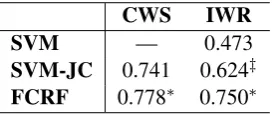
3.4.4 Adapted SVM-JC vs. FCRF
Table 5: F1 comparison between SVM, SVM-JC and FCRF. ‘‡’(‘∗’) indicates statistical significance
atp < 0.001(0.05) when compared with the
pre-vious row.
CWS IWR
SVM — 0.473
SVM-JC 0.741 0.624‡
FCRF 0.778∗ 0.750∗
For RQ5, according to Table 5, our SVM trained to predict the cross-product CWS/IWR classifica-tion (SVM-JC) performs quite well on its own. Unsurprisingly, it does not outperform our pro-posed FCRF, which has access to more struc-tural correlation among the CWS and IWR labels. SVM-JC significantly (p < 0.001) outperforms
the baseline SVM system by 0.151 in the IWR task, which we think is partially explained by its good performance (0.761) on the CWS task. The
over-prediction tendency of the individual SVM is largely solved by simultaneously modeling the CWS task, whereas FCRF turns out to be more effective in solving joint inference problem, al-though in a weaker trend in terms of the statistical significance (p <0.05).
[image:7.595.349.486.439.496.2]4 Discussion
We wish to understand the causes of errors in our models so that we may better understand its weak-nesses. Manually inspecting the errors of our sys-tem, we found three major categories of errors which we dissect here.
For IWR, the major source of error, accounting for more than60%of all errors, is caused by what
we term thepartially observed informal word phe-nomenon. This refers to informal words contain-ing multiple characters, where some of its compo-nents have appeared in the training data as infor-mal words individually. For instance, the single-character informal word, “à” (“ˆ”; “very”)
ap-pears in training multiple times, thus the unseen informal word “àE” (“ˆE”; “long time”) is a partially observedinformal word. In this case, the model incorrectly labels the known, single charac-ter “à” withIF Sas an informal word, instead of
labeling the unseen sequence “àE” with correct
labelsIF B IF E. Errors then result in both tasks. This observation motivates the use of the rela-tion between the known informal word and its for-mal counterpart in order to inform the model to better predict in cases of partial observations. Fol-lowing the same example, given that “à” is an
in-formal word, if the model also considers the prob-ability of normalizing “à” to “ˆ”, while
con-sidering the higher probability that the character sequence “ˆE” could be a formal word, there
would be a higher likelihood of correctly predict-ing the sequence “àE” as an informal word. So
informal word normalization is also an intrinsic component of IWR and CWS, and we believe it is an interesting direction for future work.
Another source of error is a side effect of mi-crotext being extremely short. For example, in the sentence “¥¥¥¶¶¶ */† ” (“ÞÞÞ¶¶¶ * /† ”; “Go home! Exhausted.”), the
un-seen informal word “¥¶” itself forms a short sentence. Although it has a subsequent sentence “*/† ” (“Exhausted”) as context, and
the two are pragmatically related, (i.e., “I am ex-hausted! [And as a result,] I want to go home.”), the lexical relationship between the sentences is weak; i.e., “*/† ” appears frequently as
the context of various sentences, making the con-text difficult to utilize. These phenomena makes it difficult to recognize “¥¶” as an informal word. A possible solution could factor in proximity, similar to density-based matching, as in Tellexet
Table 6: Sample Chinese freestyle named entities that are usernames.
Freestyle Named
Entity Explanation
“´²êš ” “´²” (“durian”), “ê” (“snow”), “š ” (“charming lady”)
“É•” It is short for the cartoon name “w
õ••”.
“dj‡e”, “•pp” Usernames mixed of Chinese and al-phabetic characters
al.(2003). We can assign a higher weight to fea-tures related to characters closer to the current target character. In particular, for this example, given the current target character “¥”, we can
as-sign higher weight to features generated from fea-tures from the proximal context “¥¶”, and lower weight to features extracted from distal contexts.
Another major group of errors come from what we termfreestyle named entitiesas exemplified in Table 6; i.e., person names in the form of user IDs and nicknames, that have less constraint on form in terms of length, canonical structure (not sur-names with given sur-names; as is standard in Chinese names) and may mix alphabetic characters. Most of these belong to the category of Person Name
(PER), as defined in CoNLL-200311 Named
En-tity Recognition shared task. Such freestyle en-tities are often misrecognized as informal words, as they share some of the same stylistic markings, and are not marked by features used to recognize previous Chinese named entity recognition meth-ods (Gao et al., 2005; Zhao and Kit, 2008) that work on news or general domain text. We recog-nize this as a challenge in Chinese microtext, but beyond the scope of our current work.
5 Related Work
In English, IWR has typically been investigated alongside normalization. Several recent works (Han and Baldwin, 2011; Gouws et al., 2011; Han et al., 2012) aim to produce informal/formal word lexicons and mappings. These works are based on distributional similarity and string similarity that address concerns of lexical variation and spelling. These methods propose two-step unsupervised ap-proaches to first detect and then normalize de-tected informal words using dictionaries.
In processing Chinese informal language, work conducted by Xia and Wong address the problem
11http://www.cnts.ua.ac.be/conll2003/
of in bulletin board system (BBS) chats. They em-ploy pattern matching and SVM-based classifica-tion to recognize Chinese informal sentences (not individual words) chat (Xia et al., 2005). Both methods had their advantages: the learning-based method did better on recall, while the pattern matching performed better on precision. To obtain consistent performance on new unseen data, they further employed an error-driven method which performed more consistently over time-varying data (Xia and Wong, 2006). In contrast, our work identifies individual informal words, a finer-grained (and more difficult) task.
While seminal, we feel that the difference in scope (informal sentence detection rather than word detection) shows the limitation of their work for microblog IWR. Their chats cover only 651
unique informal words, as opposed to our study covering almost triple the word types (1,658).
Our corpus demonstrates a higher ratio of infor-mal word use (a new inforinfor-mal word appears in
1,658
12,446 = 13%of sentences, as opposed to22,400651 =
2% in their BBS corpus). Further analysis of their corpus reveals that phonetic substitution is the primary origin of informal words in their cor-pus –99.2%as reported in (Wong and Xia, 2008).
In contrast, the origin for informal words in mi-croblogs is more varied, where phonetic substitu-tions abbreviasubstitu-tions and neologisms, account for 53.1%, 21.4% and 18.7% of the informal word types, respectively. Their method is best suited for phonetic substitution, thus performing well on their corpus but poorly on ours.
More closely related, Li and Yarowsky (2008) tackle Chinese IWR. They bootstrap 500 infor-mal/formal word pairs by using manually-tuned queries to find definition sentences on the Web. The resulting noisy list is further re-ranked based on n-gram co-occurrence. However, their method makes a basic assumption that informal/formal word pairs co-occur within a definition sentence (i.e., “<informal word>means<formal word>”) may not hold in microblog data, as microbloggers largely do not define the words they use.
Closely related to our work is the task of Chinese new word detection, normally treated as a separate process from word segmentation in most previous works (Chen and Bai, 1998; Wu and Jiang, 2000; Chen and Ma, 2002; Gao et al., 2005). Aiming to improve both tasks, work by Penget al. (2004) and Sunet al.(2012) conduct
segmentation and detection sequentially, but in an iterative manner rather than joint. This is a weakness as their linear CRF model requires re-training. Their method also requires thresholds to be set through heuristic tuning, as to whether the segmented words are indeed new words. We note that the task of new word detection refers to out-of-vocabulary (OOV) detection, and is distinctly different from IWR (new words could be both formal or informal words).
6 Conclusion
There is a close dependency between Chinese word segmentation (CWS) and informal word recognition (IWR). To leverage this, we employ a factorial conditional random field to perform both tasks of CWS and IWR jointly.
We propose novel features including statistical and lexical features that improve the performance of the inference process. We evaluate our method on a manually-constructed data set and compare it with multiple research and industrial baselines that perform CWS and IWR individually or sequen-tially. Our experimental results show our joint inference model yields significantly better F1 for both tasks. For analysis, we also construct upper bound systems to assess the potential maximal im-provement, by feeding one task with the gold stan-dard labels from the complementary task. These experiments further verify the necessity and ef-fectiveness of modeling the two tasks jointly, and point to the possibility of even better performance with improved per-task performance.
Analyzing the classes of errors made by our sys-tem, we identify a promising future work topic to handle errors arising from partially observed in-formal words – where parts of a multi-character informal word have been observed before. We be-lieve incorporating informal word normalization into the inference process may help address this important source of error.
Acknowledgments
References
Belinda Cao. 2012. Sina’s weibo outlook buoys inter-net stock gains: China overnight.
Chih-Chung Chang and Chih-Jen Lin. 2011. LIB-SVM: A library for support vector machines. ACM Transactions on Intelligent Systems and Technology, pages 27:1–27:27.
Keh-Jiann Chen and Ming-Hong Bai. 1998. Un-known Word Detection for Chinese by a Corpus-Based Learning Method. International Journal of Computational Linguistics and Chinese Language Processing, pages 27–44.
Keh-Jiann Chen and Wei-Yun Ma. 2002. Unknown Word Extraction for Chinese Documents. In Pro-ceedings of the 19th international conference on Computational linguistics, pages 1–7.
Kenneth Ward Church and Patrick Hanks. 1990. Word Association Norms, Mutual Information, and Lexi-cography. Computional Linguistic, pages 22–29.
Anqi Cui, Liner Yang, Dejun Hou, Min-Yen Kan, Yiqun Liu, Min Zhang, and Shaoping Ma. 2012. PrEV: Preservation Explorer and Vault for Web 2.0 User-Generated Content. Theory and Practice of Digital Libraries, pages 101–112.
Jianfeng Gao, Mu Li, Andi Wu, and Chang-Ning Huang. 2005. Chinese Word Segmentation and Named Entity Recognition: A Pragmatic Approach. Computitional Linguistic, pages 531–574.
Stephan Gouws, Donald Metzler, Congxing Cai, and Eduard Hovy. 2011. Contextual Bearing on Lin-guistic Variation in Social Media. InProceedings of the Workshop on Language in Social Media, pages 20–29.
Zhao Hai, Huang Chang-Ning, Li Mu, and Lu Bao-Liang. 2006. Effective Tag Set Selection in Chi-nese Word Segmentation via Conditional Random Field Modeling. The 20th Pacific Asia Conference on Language, Information and Computation, pages pp.87–94.
Mark Hall, Eibe Frank, Geoffrey Holmes, Bern-hard Pfahringer Pfahringer, Peter Reutemann, and Ian H. Witten. 2009. The WEKA Data Mining Software: An Update. ACM Special Interest Groups on Knowledge Discovery and Data Mining Explo-rations Newsletter, pages 10–18.
Bo Han and Timothy Baldwin. 2011. Lexical Normal-isation of Short Text Messages: Makn Sens a #twit-ter. InProceedings of the 49th Annual Meeting of the Association for Computational Linguistics: Hu-man Language Technologies, pages 368–378.
Bo Han, Paul Cook, and Timothy Baldwin. 2012. Automatically Constructing a Normalisation Dictio-nary for Microblogs. In Proceedings of the 2012 Joint Conference on Empirical Methods in Natural
Language Processing and Computational Natural Language Learning, pages 421–432.
Finn V Jensen. 1996. An Introduction to Bayesian Networks, volume 74.
Fleiss L Joseph. 1971. Measuring nominal scale agreement among many raters. Psychological bul-letin, pages 378–382.
Catherine Kobus, Franc¸ois Yvon, and G´eraldine
Damnati. 2008. Normalizing SMS: Are Two
Metaphors Better Than One? InInternational Con-ference on Computational Linguistics, pages 441– 448.
John D. Lafferty, Andrew McCallum, and Fernando C. N. Pereira. 2001. Conditional Random Fields: Probabilistic Models for Segmenting and Labeling Sequence Data. InProceedings of the Eighteenth In-ternational Conference on Machine Learning, pages 282–289.
Zhifei Li and David Yarowsky. 2008. Mining and Modeling Relations between Formal and Informal Chinese Phrases from Web Corpora. InProceedings of the Conference on Empirical Methods in Natural Language Processing, pages 1031–1040.
Jin Kiat Low, Hwee Tou Ng, and Wenyuan Guo. 2005. A Maximum Entropy Approach to Chinese Word Segmentation. Proceedings of the Fourth SIGHAN Workshop on Chinese Language Processing.
Sebastian Pad´o, 2006. User’s Guide toSIGF: Signifi-cance Testing by Approximate Randomisation.
Fuchun Peng, Fangfang Feng, and Andrew McCallum. 2004. Chinese Segmentation and New Word Detec-tion Using CondiDetec-tional Random Fields. In Proceed-ings of the 20th international conference on Compu-tational Linguistics, page 562.
Weiwei Sun and Jia Xu. 2011. Enhancing Chinese Word Segmentation Using Unlabeled Data. In Pro-ceedings of the Conference on Empirical Methods in Natural Language Processing, pages 970–979.
Xu Sun, Houfeng Wang, and Wenjie Li. 2012. Fast Online Training with Frequency-Adaptive Learn-ing Rates for Chinese Word Segmentation and New Word Detection. InProceedings of the 50th Annual Meeting of the Association for Computational Lin-guistics, pages 253–262.
Charles Sutton, Andrew McCallum, and Khashayar Rohanimanesh. 2007. Dynamic Conditional Ran-dom Fields: Factorized Probabilistic Models for La-beling and Segmenting Sequence Data. Journal of Machine Learning Research, pages 693–723.
Stephanie Tellex, Boris Katz, Jimmy Lin, Aaron Fer-nandes, and Gregory Marton. 2003. Quantitative evaluation of passage retrieval algorithms for ques-tion answering. InProceedings of the 26th annual international ACM SIGIR conference on Research and Development in Information Retrieval, pages 41–47.
Aobo. Wang, Cong Duy Vu Hoang, and Min-Yen Kan. 2010. Perspectives on Crowdsourcing Annotations for Natural Language Processing, journal = Lan-guage Resources and Evaluation. pages 1–23.
Aobo Wang, Tao Chen, and Min-Yen Kan. 2012. Re-tweeting From A Linguistic Perspective. In Pro-ceedings of the Second Workshop on Language in Social Media, pages 46–55.
Kam-Fai Wong and Yunqing Xia. 2008. Normal-ization of Chinese Chat Language. Language Re-sources and Evaluation, pages 219–242.
Andi Wu and Zixin Jiang. 2000. Statistically-Enhanced New Word Identification in A Rule-based Chinese Aystem. In Proceedings of the second workshop on Chinese Language Processing, pages 46–51.
Yunqing Xia and Kam-Fai Wong. 2006. Anomaly De-tecting within Dynamic Chinese Chat Text. NEW TEXT Wikis and blogs and other dynamic text sources, page 48.
Yunqing Xia, Kam-Fai Wong, and Wei Gao. 2005. NIL Is Not Nothing: Recognition of Chinese Net-work Informal Language Expressions. In 4th SIGHAN Workshop on Chinese Language Process-ing, volume 5.
Nianwen Xue. 2003. Chinese Word Segmentation as Character Tagging. Computational Linguistics and Chinese Language Processing, pages 29–48.
Alexander Yeh. 2000. More accurate tests for the sta-tistical significance of result differences. In Pro-ceedings of the 18th conference on Computational linguistics - Volume 2, pages 947–953.
Hua-Ping Zhang, Hong-Kui Yu, De-Yi Xiong, and Qun Liu. 2003. HHMM-based Chinese Lexical An-alyzer ICTCLAS. In Proceedings of the second SIGHAN workshop on Chinese language process-ing, pages 184–187.