An Iteratively-Trained Segmentation-Free Phrase Translation Model
for Statistical Machine Translation
Robert C. Moore Chris Quirk Microsoft Research
Redmond, WA 98052, USA
{bobmoore,chrisq}@microsoft.com
Abstract
Attempts to estimate phrase translation probablities for statistical machine transla-tion using iteratively-trained models have repeatedly failed to produce translations as good as those obtained by estimating phrase translation probablities from surface statis-tics of bilingual word alignments as de-scribed by Koehn, et al. (2003). We pro-pose a new iteratively-trained phrase trans-lation model that produces transtrans-lations of quality equal to or better than those pro-duced by Koehn, et al.’s model. Moreover, with the new model, translation quality de-grades much more slowly as pruning is tigh-tend to reduce translation time.
1 Introduction
Estimates of conditional phrase translation probabil-ities provide a major source of translation knowl-edge in phrase-based statistical machine translation (SMT) systems. The most widely used method for estimating these probabilities is that of Koehn, et al. (2003), in which phrase pairs are extracted from word-aligned bilingual sentence pairs, and their translation probabilities estimated heuristically from surface statistics of the extracted phrase pairs. We will refer to this approach as “the standard model”.
There have been several attempts to estimate phrase translation probabilities directly, using gen-erative models trained itgen-eratively on a parallel cor-pus using the Expectation Maximization (EM) algo-rithm. The first of these models, that of Marcu and
Wong (2002), was found by Koehn, et al. (2003), to produce translations not quite as good as their method. Recently, Birch et al. (2006) tried the Marcu and Wong model constrained by a word alignment and also found that Koehn, et al.’s model worked better, with the advantage of the standard model increasing as more features were added to the overall translation model. DeNero et al. (2006) tried a different generative phrase translation model anal-ogous to IBM word-translation Model 3 (Brown et al., 1993), and again found that the standard model outperformed their generative model.
DeNero et al. (2006) attribute the inferiority of their model and the Marcu and Wong model to a hid-den segmentation variable, which enables the EM algorithm to maximize the probability of the train-ing data without really improvtrain-ing the quality of the model. We propose an iteratively-trained phrase translation model that does not require different seg-mentations to compete against one another, and we show that this produces translations of quality equal to or better than those produced by the standard model. We find, moreover, that with the new model, translation quality degrades much more slowly as pruning is tightend to reduce translation time.
Decoding efficiency is usually considered only in the design and implementation of decoding algo-rithms, or the choice of model structures to support faster decoding algorithms. We are not aware of any attention previously having been paid to the effect of different methods of parameter estimation on trans-lation efficiency for a given model structure.
The time required for decoding is of great im-portance in the practical application of SMT
nology. One of the criticisms of SMT often made by adherents of rule-based machine translation is that SMT is too slow for practical application. The rapidly falling price of computer hardware has ame-liorated this problem to a great extent, but the fact re-mains that every factor of 2 improvement in transla-tion efficiency means a factor of 2 decrease in hard-ware cost for intensive applications of SMT, such as a web-based translation service (“Translate this page”). SMT surely needs all the help in can get in this regard.
2 Previous Approaches
Koehn, et al.’s (2003) method of estimating phrase-translation probabilities is very simple. They start with an automatically word-aligned corpus of bilin-gual sentence pairs, in which certain words are linked, indicating that they are translations of each other, or that they are parts of phrases that are trans-lations of each other. They extract every possi-ble phrase pair (up to a given length limit) that (a) contains at least one pair of linked words, and (b) does not contain any words that have links to other words not included in the phrase pair.1 In other words, word alignment links cannot cross phrase pair boundaries. Phrase translation probabilities are estimated simply by marginalizing the counts of phrase instances:
p(x|y) = PC(x, y)
x0C(x0, y)
This method is used to estimate the conditional probabilities of both target phrases give source phrases and source phrases given target phrases.
In contrast to the standard model, DeNero, et al. (2006) estimate phrase translation probabilities ac-cording to the following generative model:
1. Begin with a source sentencea.
2. Stochastically segmentainto some number of phrases.
3. For each selected phrase in a, stochastically choose a phrase position in the target sentence
bthat is being generated.
1This method of phrase pair extraction was originally
de-scribed by Och et al. (1999).
4. For each selected phrase in a and the corre-sponding phrase position in b, stochastically choose a target phrase.
5. Read off the target sentence b from the se-quence of target phrases.
DeNero et al.’s analysis of why their model per-forms relatively poorly hinges on the fact that the segmentation probabilities used in step 2 are, in fact, not trained, but simply assumed to be uniform. Given complete freedom to select whatever segmen-tation maximizes the likelihood of any given sen-tence pair, EM tends to favor segmentations that yield source phrases with as few occurrences as pos-sible, since more of the associated conditional prob-ability mass can be concentrated on the target phrase alignments that are possible in the sentence at hand. Thus EM tends to maximize the probability of the training data by concentrating probability mass on the rarest source phrases it can construct to cover the training data. The resulting probability estimates thus have less generalizability to unseen data than if probability mass were concentrated on more fre-quently occurring source phrases.
3 A Segmentation-Free Model
To avoid the problem identified by DeNero et al., we propose an iteratively-trained model that does not assume a segmentation of the training data into non-overlapping phrase pairs. We refer to our model as “iteratively-trained” rather than “generative” be-cause we have not proved any of the mathematical properties usually associated with generative mod-els; e.g., that the training procedure maximizes the likelihood of the training data. We will motivate the model, however, with a generative story as to how phrase alignments are produced, given a pair of source and target sentences. Our model extends to phrase alignment the concept of a sentence pair gen-erating a word alignment developed by Cherry and Lin (2003).
Our model is defined in terms of two stochastic processes, selection and alignment, as follows:
2. Each source phrase instance that is included in any of the possible phrase pair instances inde-pendently selects one of the target phrase stances that it forms a possible phrase pair in-stance with.
3. Each target phrase instance that is included in any of the possible phrase pair instances inde-pendently selects one of the source phrase stances that it forms a possible phrase pair in-stance with.
4. A source phrase instance is aligned to a target phrase instance, if and only if each selects the other.
Given a set of selection probability distributions and a word-aligned parallel corpus, we can eas-ily compute the expected number of alignment in-stances for a given phrase pair type. The probability of a pair of phrase instancesxandybeing aligned is simplyps(x|y)×ps(y|x), whereps is the
applica-ble selection probability distribution. The expected number of instances of alignment, E(x, y), for the pair of phrasesxandy, is just the sum of the align-ment probabilities of all the possible instances of that phrase pair type.
From the expected number of alignments and the total number of occurrences of each source and tar-get phrase type in the corpus (whether or not they particpate in possible phrase pairs), we estimate the conditional phrase translation probabilities as
pt(y|x) =
E(x, y)
C(x) , pt(x|y) =
E(x, y)
C(y) ,
where E denotes expected counts, and C denotes observed counts.
The use of the total observed counts of particu-lar source and target phrases (instead of marginal-ized expected joint counts) in estimating the condi-tional phrase translation probabilities, together with the multiplication of selection probabilities in com-puting the alignment probability of particular phrase pair instances, causes the conditional phrase transla-tion probability distributransla-tions generally to sum to less than1.0. We interpret the missing probability mass as the probability that a given word sequence does not translate as any contiguous word sequence in the other language.
We have seen how to derive phrase translation probabilities from the selection probabilities, but where do the latter come from? We answer this question by adding the following constraint to the model:
The probabilty of a phrase y selecting a phrasexis proportional to the probability ofxtranslating asy, normalized over the possible non-null choices forx presented by the word-aligned sentence pair.
Symbolically, we can express this as
ps(x|y) =
pt(y|x) P
x0pt(y|x0)
where ps denotes selection probability, pt denotes
translation probability, andx0ranges over the phrase instances that could possibly align toy. We are, in effect, inverting and renormalizing translation prob-abilities to get selection probprob-abilities. The reason for the inversion may not be immediately apparent, but it in fact simply generalizes the e-step formula in the EM training for IBM Model 1 from words to phrases.
This model immediately suggests (and, in fact, was designed to suggest) the following EM-like training procedure:
1. Initialize the translation probability distribu-tions to be uniform. (It doesn’t matter at this point whether the possibility of no translation is included or not.)
2. E step: Compute the expected phrase alignment counts according to the model, deriving the se-lection probabilities from the current estimates of the translation probabilities as described.
3. M step: Re-estimate the phrase translation probabilities according to the expected phrase alignment counts as described.
4. Repeat the E and M steps, until the desired de-gree of convergence is obtained.
the procedure maximizes the likelihood of anything, although we find empirically that each iteration de-creases the conditional entropy of the phrase trans-lation model. In any case, the training procedure seems to work well in practice. It is also very simi-lar to the joint training procedure for HMM word-alignment models in both directions described by Liang et al. (2006), which was the original inspira-tion for our training procedure.
4 Experimental Set-Up and Data
We evaluated our phrase translation model com-pared to the standard model of Koehn et al. in the context of a fairly typical end-to-end phrase-based SMT system. The overall translation model score consists of a weighted sum of the following eight ag-gregated feature values for each translation hypoth-esis:
• the sum of the log probabilities of each source phrase in the hypothesis given the correspond-ing target phrase, computed either by our model or the standard model,
• the sum of the log probabilities of each tar-get phrase in the hypothesis given the corre-sponding source phrase, computed either by our model or the standard model,
• the sum of lexical scores for each source phrase given the corresponding target phrase,
• the sum of lexical scores for each target phrase given the corresponding source phrase,
• the log of the target language model probability for the sequence of target phrases in the hypoth-esis,
• the total number of words in the target phrases in the hypothesis,
• the total number of source/target phrase pairs composing the hypothesis,
• the distortion penalty as implemented in the Pharaoh decoder (Koehn, 2003).
The lexical scores are computed as the (unnor-malized) log probability of the Viterbi alignment for a phrase pair under IBM word-translation Model 1
(Brown et al., 1993). The feature weights for the overall translation models were trained using Och’s (2003) minimum-error-rate training procedure. The weights were optimized separately for our model and for the standard phrase translation model. Our decoder is a reimplementation in Perl of the algo-rithm used by the Pharaoh decoder as described by Koehn (2003).2
The data we used comes from an English-French bilingual corpus of Canadian Hansards parliamen-tary proceedings supplied for the bilingual word alignment workshop held at HLT-NAACL 2003 (Mihalcea and Pedersen, 2003). Automatic sentence alignment of this data was provided by Ulrich Ger-mann. We used 500,000 sentences pairs from this corpus for training both the phrase translation mod-els and IBM Model 1 lexical scores. These 500,000 sentence pairs were word-aligned using a state-of-the-art word-alignment method (Moore et al., 2006). A separate set of 500 sentence pairs was used to train the translation model weights, and two additional held-out sets of 2000 sentence pairs each were used as test data.
The two phrase translation models were trained using the same set of possible phrase pairs extracted from the word-aligned 500,000 sentence pair cor-pus, finding all possible phrase pairs permitted by the criteria followed by Koehn et al., up to a phrase length of seven words. This produced approximately 69 million distinct phrase pair types. No pruning of the set of possible phrase pairs was done during or before training the phrase translation models. Our phrase translation model and IBM Model 1 were both trained for five iterations. The training pro-cedure for our phrase translation model trains mod-els in both directions simultaneously, but for IBM Model 1, models were trained separately in each di-rection. The models were then pruned to include only phrase pairs that matched the source sides of the small training and test sets.
5 Entropy Measurements
To verify that our iterative training procedure was behaving as expected, after each training iteration
2Since Perl is a byte-code interpreted language, absolute
we measured the conditional entropy of the model in predicting English phrases given French phrases, according to the formula
H(E|F) =X
f
p(f)X
e
pt(e|f) log2pt(e|f),
where e and f range over the English and French phrases that occur in the extracted phrase pairs, and
p(f) was estimated according to the relative fre-quency of these French phrases in a 2000 sentence sample of the French sentences from the 500,000 word-aligned sentence pairs. Over the five train-ing iterations, we obtained a monotonically decreas-ing sequence of entropy measurements in bits per phrase: 1.329, 1.177, 1.146, 1.140, 1.136.
We also compared the conditional entropy of the standard model to the final iteration of our model, estimatingp(f)using the first of our 2000 sentence pair test sets. For this data, our model measured 1.38 bits per phrase, and the standard model measured 4.30 bits per phrase. DeNero et al. obtained corre-sponding measurements of 1.55 bits per phrase and 3.76 bits per phrase, for their model and the stan-dard model, using a different data set and a slightly different estimation method.
6 Translation Experiments
We wanted to look at the trade-off between decod-ing time and translation quality for our new phrase translation model compared to the standard model. Since this trade-off is also affected by the settings of various pruning parameters, we compared decoding time and translation quality, as measured by BLEU score (Papineni et al, 2002), for the two models on our first test set over a broad range of settings for the decoder pruning parameters.
The Pharaoh decoding algorithm, has five pruning parameters that affect decoding time:
• Distortion limit
• Translation table limit
• Translation table threshold
• Beam limit
• Beam threshold
The distortion limit is the maximum distance al-lowed between two source phrases that produce ad-jacent target phrases in the decoder output. The dis-tortion limit can be viewed as a model parameter, as well as a pruning paramter, because setting it to an optimum value usually improves translation qual-ity over leaving it unrestricted. We carried out ex-periments with the distortion limit set to 1, which seemed to produce the highest BLEUscores on our data set with the standard model, and also set to 5, which is perhaps a more typical value for phrase-based SMT systems. Translation model weights were trained separately for these two settings, be-cause the greater the distortion limit, the higher the distortion penalty weight needed for optimal trans-lation quality.
The translation table limit and translation table threshold are applied statically to the phrase trans-lation table, which combines all components of the overall translation model score that can be com-puted for each phrase pair in isolation. This in-cludes all information except the distortion penalty score and the part of the language model score that looks atn-grams that cross target phrase boundaries. The translation table limit is the maximum number of translations allowed in the table for any given source phrase. The translation table threshold is the maximum difference in combined translation ta-ble score allowed between the highest scoring trans-lation and lowest scoring transtrans-lation for any given source phrase. The beam limit and beam threshold are defined similarly, but they apply dynamically to the sets of competing partial hypotheses that cover the same number of source words in the beam search for the highest scoring translation.
For each of the two distortion limits we tried, we carried out a systematic search for combinations of settings of the other four pruning parameters that gave the best trade-offs between decoding time and BLEU score. Starting at a setting of 0.5 for the threshold parameters3and 5 for the limit parameters we performed a hill-climbing search over step-wise relaxations of all combinations of the four
parame-3
30.2 30.3 30.4 30.5
0.1 1 10 100
B
LE
U
[%
]
[image:6.612.72.548.55.372.2]milliseconds per word
Figure 1: BLEU vs Decoding Time (DL = 1)
re-estimated phrase table
standard phrase table
re-estimated phrase table convex hull
standard phrase table convex hull
29.4 29.6 29.8 30 30.2 30.4 30.6
1 10 100 1000
B
LEU
[%
]
milliseconds per word
Figure 2: BLEU vs Decoding Time (DL = 5)
re-estimated phrase table
standard phrase table
re-estimated phrase table convex hull
standard phrase table convex hull
ters, incrementing the threshold parameters by 0.5 and the limit parameters by 5 at each step. For each resulting point that provided the best BLEUscore yet seen for the amount of decoding time used, we iter-ated the search.
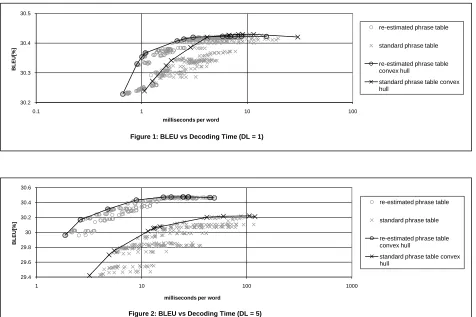
The resulting possible combinations of BLEU score and decoding time for the two phrase trans-lation models are displayed in Figure 1, for a distor-tion limit of 1, and Figure 2, for a distordistor-tion limit of 5. BLEU score is reported on a scale of 1–100 (BLEU[%]), and decoding time is measured in mil-liseconds per word. Note that the decoding time axis is presented on a log scale.
The points that represent pruning parameter set-tings one might consider using in a practical system are those on or near the upper convex hull of the set of points for each model. These upper-convex-hull points are highlighted in the figures. Points far from these boundaries represent settings of one or more of the parameters that are too restrictive to ob-tain good translation quality, together with settings of other parameters that are too permissive to obtain
good translation time.
Examining the results for a distortion limit of 1, we found that the BLEU score obtained with the loosest pruning parameter settings (2.5 for both threshold paramters, and 25 for both limit parame-ters) were essentially identical for the two mod-els: 30.42 BLEU[%]. As the pruning parameters are tightened to reduce decoding time, however, the new model performs much better. At a decod-ing time almost 6 times faster than for the settdecod-ings that produced the highest BLEU score, the change in score was only −0.07 BLEU[%] with the new model. To obtain a slightly worse4 BLEU score (−0.08 BLEU[%]) using the standard model took 90% more decoding time.
It does appear, however, that the best BLEUscore for the standard model is slightly better than the best BLEU score for the new model: 30.43 vs. 30.42. It is in fact currious that there seem to be numer-ous points where the standard model gets a slightly
4Points on the convex hulls with exactly comparable B
better BLEU score than it does with with the loos-est pruning settings, which should have the lowloos-est search error.
We conjectured that this might be an artifact of our test procedure. If a model is at all reasonable, most search errors will reduce the ultimate objec-tive function, in our case the BLEU score, but oc-casionally a search error will increase the objective function just by chance. The smaller the number of search errors in a particular test, the greater the like-lihood that, by chance, more search errors will in-crease the objective function than dein-crease it. Since we are sampling a fairly large number of combi-nations of pruning parameter settings (179 for the standard model with a distortion limit of 1), it is possible that a small number of these have more “good” search errors than “bad” search errors sim-ply by chance, and that this accounts for the small number of points (13) at which the BLEUscore ex-ceeds that of the point which should have the fewest search errors. This effect may be more pronounced with the standard model than with the new model, simply because there is more noise in the standard model.
To test the hypothesis that the BLEU scores greater than the score for the loosest pruning set-tings simply represent noise in the data, we col-lected all the pruning settings that produced BLEU scores greater than or equal to the the one for the loosest pruning settings, and evaluated the standard model at those settings on our second held-out test set. We then looked at the correlation between the BLEU scores for these settings on the two test sets, and found that it was very small and negative, with
r=−0.099. The standard F-test for the significance
of a correlation yielded p = 0.74; in other words, completely insignificant. This strongly suggests that the apparent improvement in BLEUscore for certain tighter pruning settings is illusory.
As a sanity check, we tested the BLEUscore cor-relation between the two test sets for the points on the upper convex hull of the plot for the standard model, between the point with the fastest decod-ing time and the point with the highest BLEUscore. That correlation was very high, with r = 0.94, which was significant at the level p = 0.0004 ac-cording to the F-test. Thus the BLEU score differ-ences along most of the upper convex hull seem to
reflect reality, but not in the region where they equal or exceed the score for the loosest pruning settings.
At a distortion limit of 5, there seems no question that the new model performs better than the standard model. The difference BLEU scores for the upper-convex-hull points ranges from about 0.8 to 0.2 BLEU[%] for comparable decoding times. Again, the advantage of the new model is greater at shorter decoding times. Compared to the results with a dis-tortion limit of 1, the standard model loses transla-tion quality, with a change of about−0.2BLEU[%] for the loosest pruning settings, while the new model gains very slightly (+0.04BLEU[%]).
7 Conclusions
This study seems to confirm DeNero et al.’s diagno-sis that the main reason for poor performance of pre-vious iteratively-trained phrase translation models, compared to Koehn et al.’s model, is the effect of the hidden segmentation variable in these models. We have developed an iteratively-trained phrase transla-tion model that is segmentatransla-tion free, and shown that, at a minimum, it eliminates the shortfall in BLEU score compared to the standard model. With a larger distortion limit, the new model produced transla-tions with a noticably better BLEUscore.
From a practical point of view, the main result is probably that BLEU score degrades much more slowly with our model than with the standard model, when the decoding search is tuned for speed. For some settings that appear reasonable, this difference is close to a factor of 2, even if there is no differ-ence in the translation quality obtainable when prun-ing is loosened. For high-demand applications like web page translation, roughly half of the investment in translation servers could be saved while provid-ing this level of translation quality with the same re-sponse time.
Acknowledgement
The authors would like to thank Mark Johnson for many valuable discussions of how to analyze and present the results obtained in this study.
References
Constrain-ing the Phrase-Based, Joint Probability Statistical Translation Model. In Proceedings of the
HLT-NAACL 06 Workshop, Statistical Machine Trans-lation, pp. 154–157, New York City, New York,
USA.
Peter F. Brown, Stephen A. Della Pietra, Vincent J. Della Pietra, and Robert L. Mercer. 1993. The Mathematics of Statistical Machine Translation: Parameter Estimation. Computational Linguis-tics, 19(2):263–311.
Colin Cherry and Dekang Lin. 2003. A Probabil-ity Model to Improve Word Alignment. In
Pro-ceedings of the 41st Annual Meeting of the ACL,
pp. 88–95, Sapporo, Japan.
John DeNero, Dan Gillick, James Zhang, and Dan Klein. 2006. Why Generative Phrase Models Underperform Surface Heuristics. In
Proceed-ings of the HLT-NAACL 06 Workshop, Statistical Machine Translation, pp. 31–38, New York City,
New York, USA.
Philipp Koehn. 2003. Noun Phrase Translation. PhD Dissertation, Computer Science, University of Southern California, Los Angeles, California, USA.
Philipp Koehn, Franz Joseph Och, and Daniel Marcu. 2003. Statistical Phrase-Based Trans-lation. In Proceedings of the Human Language
Technology Conference of the North American Chapter of the Association for Computational Linguistics, pp. 127–133, Edmonton, Alberta,
Canada.
Percy Liang, Ben Taskar, and Dan Klein. 2006. Alignment by Agreement. In Proceedings of
the Human Language Technology Conference of the North American Chapter of the Association for Computational Linguistics, pp. 104–111, New
York City, New York, USA.
Daniel Marcu and William Wong. 2002. A Phrase-Based, Joint Probability Model for Statistical Ma-chine Translation. In Proceedings of the 2002
Conference on Empirical Methods in Natural Language Processing, pp. 133–139, Philadelphia,
Pennsylvania, USA.
Rada Mihalcea and Ted Pedersen. 2003. An Evalu-ation Exercise for Word Alignment. In
Proceed-ings of the HLT-NAACL 2003 Workshop, Building and Using Parallel Texts: Data Driven Machine Translation and Beyond, pp. 1–6, Edmonton,
Al-berta, Canada.
Robert C. Moore, Wen-tau Yih, and Andreas Bode. 2006. Improved Discriminative Bilingual Word Alignment. In Proceedings of the 21st
Interna-tional Conference on ComputaInterna-tional Linguistics and 44th Annual Meeting of the Association for Computational Linguistics, pp. 513-520, Sydney,
Australia.
Franz Joseph Och, Christoff Tillmann, and Hermann Ney. 1999. Improved Alignment Models for Sta-tistical Machine Translation. In Proceedings of
the 1999 Joint SIGDAT Conference on Empiri-cal Methods in Natural Language Processing and Very Large Corpora, pp. 20–28, College Park,
Maryland, USA.
Franz Joseph Och. 2003. Minimum Error Rate Training in Statistical Machine Translation. In
Proceedings of the 41st Annual Meeting of the ACL, pp. 160–167, Sapporo, Japan.
Kishore Papineni, Salim Roukos, Todd Ward, and Wei-Jing Zhu. 2002. BLEU: a Method for Auto-matic Evaluation of Machine Translation. In
Pro-ceedings of the 40th Annual Meeting of the Asso-ciation for Computational Linguistics, pp. 311–