A Fast and Accurate Method for Approximate String Search
Ziqi Wang∗
School of EECS Peking University Beijing 100871, China [email protected]
Gu Xu
Microsoft Research Asia Building 2, No.5 Danling Street,
Beijing 100080, China [email protected]
Hang Li
Microsoft Research Asia Building 2, No.5 Danling Street,
Beijing 100080, China [email protected]
Ming Zhang
School of EECS Peking University Beijing 100871, China [email protected]
Abstract
This paper proposes a new method for ap-proximate string search, specifically candidate generation in spelling error correction, which is a task as follows. Given a misspelled word, the system finds words in a dictionary, which are most “similar” to the misspelled word. The paper proposes a probabilistic approach to the task, which is both accurate and efficient. The approach includes the use of a log linear model, a method for training the model, and an algorithm for finding the topkcandidates. The log linear model is defined as a condi-tional probability distribution of a corrected word and a rule set for the correction con-ditioned on the misspelled word. The learn-ing method employs the criterion in candidate generation as loss function. The retrieval al-gorithm is efficient and is guaranteed to find the optimal k candidates. Experimental re-sults on large scale data show that the pro-posed approach improves upon existing meth-ods in terms of accuracy in different settings.
1 Introduction
This paper addresses the following problem,
re-ferred to as approximate string search. Given a
query string, a dictionary of strings (vocabulary), and a set of operators, the system returns the top
kstrings in the dictionary that can be transformed
from the query string by applying several operators in the operator set. Here each operator is a rule that can replace a substring in the query string with
another substring. The topk results are defined in
∗Contribution during internship at Microsoft Research Asia.
terms of an evaluation measure employed in a spe-cific application. The requirement is that the task must be conducted very efficiently.
Approximate string search is useful in many ap-plications including spelling error correction, sim-ilar terminology retrieval, duplicate detection, etc. Although certain progress has been made for ad-dressing the problem, further investigation on the task is still necessary, particularly from the
view-point ofenhancing both accuracy and efficiency.
Without loss of generality, in this paper we ad-dress candidate generation in spelling error correc-tion. Candidate generation is to find the most pos-sible corrections of a misspelled word. In such a problem, strings are words, and the operators rep-resent insertion, deletion, and substitution of char-acters with or without surrounding charchar-acters, for
example, “a”→“e” and “lly”→“ly”. Note that
can-didate generation is concerned with a single word; after candidate generation, the words surrounding it in the text can be further leveraged to make the final
candidate selection, e.g., Li et al. (2006), Golding and Roth (1999).
In spelling error correction, Brill and Moore (2000) proposed employing a generative model for candidate generation and a hierarchy of trie struc-tures for fast candidate retrieval. Our approach is a discriminative approach and is aimed at
improv-ing Brill and Moore’s method. Okazakiet al.(2008)
proposed using a logistic regression model for ap-proximate dictionary matching. Their method is also a discriminative approach, but it is largely differ-ent from our approach in the following points. It formalizes the problem as binary classification and
assumes that there is only one rule applicable each time in candidate generation. Efficiency is also not a major concern for them, because it is for offline text mining.
There are two fundamental problems in research on approximate string search: (1) how to build a model that can archive both high accuracy and ef-ficiency, and (2) how to develop a data structure and algorithm that can facilitate efficient retrieval of the
topkcandidates.
In this paper, we propose a probabilistic approach to the task. Our approach is novel and unique in the following aspects. It employs (a) a log-linear (discriminative) model for candidate generation, (b) an effective algorithm for model learning, and (c) an efficient algorithm for candidate retrieval.
The log linear model is defined as a conditional probability distribution of a corrected word and a rule set for the correction given the misspelled word. The learning method employs, in the training pro-cess, a criterion that represents the goal of mak-ing both accurate and efficient prediction (candidate
generation). As a result, the model is optimally
trained toward its objective. The retrieval algorithm uses special data structures and efficiently performs
the topkcandidates finding. It is guaranteed to find
the best k candidates without enumerating all the
possible ones.
We empirically evaluated the proposed method in spelling error correction of web search queries. The experimental results have verified that the accuracy of the top candidates given by our method is signifi-cantly higher than those given by the baseline meth-ods. Our method is more accurate than the baseline methods in different settings such as large rule sets and large vocabulary sizes. The efficiency of our method is also very high in different experimental settings.
2 Related Work
Approximate string search has been studied by many researchers. Previous work mainly focused on effi-ciency rather than model. Usually, it is assumed that the model (similarity distance) is fixed and the goal is to efficiently find all the strings in the collection whose similarity distances are within a threshold.
Most existing methods employn-gram based
algo-rithms (Behm et al., 2009; Li et al., 2007; Yang et al., 2008) or filtering algorithms (Mihov and Schulz, 2004; Li et al., 2008). Instead of finding all the can-didates in a fixed range, methods for finding the top
k candidates have also been developed. For
exam-ple, the method by Vernica and Li (2009) utilized
n-gram based inverted lists as index structure and
a similarity function based onn-gram overlaps and
word frequencies. Yang et al. (2010) presented a
general framework for top k retrieval based on n
-grams. In contrast, our work in this paper aims to learn a ranking function which can achieve both high accuracy and efficiency.
Spelling error correction normally consists of candidate generation and candidate final selection. The former task is an example of approximate string search. Note that candidate generation is only con-cerned with a single word. For single-word candi-date generation, rule-based approach is commonly used. The use of edit distance is a typical exam-ple, which exploits operations of character deletion, insertion and substitution. Some methods generate candidates within a fixed range of edit distance or different ranges for strings with different lengths (Li et al., 2006; Whitelaw et al., 2009). Other meth-ods make use of weighted edit distance to enhance the representation power of edit distance (Ristad and Yianilos, 1998; Oncina and Sebban, 2005; McCal-lum et al., 2005; Ahmad and Kondrak, 2005).
Conventional edit distance does not take in con-sideration context information. For example, peo-ple tend to misspell “c” to “s” or “k” depending on contexts, and a straightforward application of edit distance cannot deal with the problem. To ad-dress the challenge, some researchers proposed us-ing a large number of substitution rules containus-ing context information (at character level). For exam-ple, Brill and Moore (2000) developed a genera-tive model including contextual substitution rules; and Toutanova and Moore (2002) further improved the model by adding pronunciation factors into
the model. Schaback and Li (2007) proposed a
multi-level feature-based framework for spelling er-ror correction including a modification of Brill and Moore’s model (2000). Okazaki et al. (2008) uti-lized substring substitution rules and incorporated
the rules into a L1-regularized logistic regression
from the model proposed in this paper, although both of them are discriminative models. Their model is a binary classification model and it is assumed that only a single rule is applied in candidate generation.
Since users’ behavior of misspelling and correc-tion can be frequently observed in web search log data, it has been proposed to mine spelling-error and correction pairs by using search log data. The mined pairs can be directly used in spelling error correction. Methods of selecting spelling and cor-rection pairs with maximum entropy model (Chen et al., 2007) or similarity functions (Islam and Inkpen, 2009; Jones et al., 2006) have been developed. The
mined pairscan only be used in candidate
genera-tion of high frequency typos, however. In this paper,
we work on candidate generationat the character
level, which can be applied to spelling error correc-tion for both high and low frequency words.
3 Model for Candidate Generation
As an example of approximate string search, we consider candidate generation in spelling correction.
Suppose that there is a vocabulary V and a
mis-spelled word, the objective of candidate generation is to select the best corrections from the vocabulary
V. We care about both accuracy and efficiency of the
process. The problem is very challenging when the size of vocabulary is large, because there are a large number of potential candidates to be verified.
In this paper, we propose a probabilistic approach to candidate generation, which can achieve both high accuracy and efficiency, and is particularly powerful when the scale is large.
In our approach, it is assumed that a large num-ber of misspelled words and their best corrections are given as training data. A probabilistic model is then trained by using the training data, which can assign ranking scores to candidates. The best can-didates for correction of a misspelled word are thus defined as those candidates having the highest prob-abilistic scores with respect to the training data and the operators.
Hereafter, we will describe the probabilistic model for candidate generation, as well as training and exploitation of the model.
n i c o s o o f t
^ $
Derived rules
Edit-distance based aligment
Expended rules with context
m i c r o s o f t
^ $
Figure 1: Example of rule extraction from word pair
3.1 Model
The operators (rules) represent insertion, deletion, and substitution of characters in a word with or without surrounding context (characters), which are similar to those defined in (Brill and Moore, 2000; Okazaki et al., 2008). An operator is formally
rep-resented a ruleα→ βthat replaces a substringαin
a misspelled word with β, where α, β ∈ {s|s =
t, s = ˆt, or s = t$} and t ∈ Σ∗ is the set of
all possible strings over the alphabet. Obviously,
V ⊂ Σ∗. We actually derive all the possible rules
from the training data using a similar approach to (Brill and Moore, 2000) as shown in Fig. 1. First we conduct the letter alignment based on the min-imum edit-distance, and then derive the rules from the alignment. Furthermore we expand the derived rules with surrounding words. Without loss of
gen-erality, we only consider using +2,+1,0,−1,−2
characters as contexts in this paper.
If we can apply a set of rules to transform the
mis-spelled wordwm to a correct wordwcin the
vocab-ulary, then we call the rule set a “transformation”
for the word pairwm andwc. Note that for a given
word pair, it is likely that there are multiple possible
transformations for it. For example, both “n”→“m”
and “ni”→“mi” can transform “nicrosoft” to
“mi-crosoft”.
Without loss of generality, we set the maximum number of rules applicable to a word pair to be a fixed number. As a result, the number of possible transformations for a word pair is finite, and usually limited. This is equivalent to the assumption that the number of spelling errors in a word is small.
Given word pair(wm, wc), letR(wm, wc)denote
wm towc. We consider that there is a probabilistic
mapping between the misspelled wordwm and
cor-rect word wc plus transformationR(wm, wc). We
define the conditional probability distribution ofwc
andR(wm, wc)givenwmas the following log linear
model:
P(wc, R(wm, wc)|wm) (1)
=
exp(∑r∈R(wm,wc)λr )
∑
(wc′,R(wm,w′c))∈Z(wm)exp
(∑
o∈R(wm,w′c)λo
)
whererorodenotes a rule in rule setR,λrorλo
de-notes a weight, and the normalization is carried over
Z(wm), all pairs of word w′cin V and
transforma-tion R(wm, wc′), such thatwm can be transformed
tow′cbyR(wm, w′c). The log linear model actually
uses binary features indicating whether or not a rule is applied.
In general, the weights in Equ. (1) can be any real numbers. To improve efficiency in retrieval, we fur-ther assume that all the weights are non-positive, i.e.,
∀λr ≤0. It introduces monotonicity in rule
applica-tion and implies that applying addiapplica-tional rules can-not lead to generation of better candidates. For ex-ample, both “office” and “officer” are correct candi-dates of “ofice”. We view “office” a better candidate (with higher probability) than “officer”, as it needs one less rule. The assumption is reasonable because the chance of making more errors should be lower than that of making less errors. Our experimental results have shown that the change in accuracy by making the assumption is negligible, but the gain in efficiency is very large.
3.2 Training of Model
Training data is given as a set of pairs T =
{
(wmi , wci)}Ni=1, wherewimis a misspelled word and
wci ∈ Vis a correction ofwmi . The objective of
train-ing would be to maximize the conditional
probabil-ityP(wic, R(wmi , wic)|wim)over the training data.
This is not a trivial problem, however, because
the “true” transformationR∗(wim, wic)for each word
pairwmi andwciis not given in the training data. It is
often the case that there are multiple transformations applicable, and it is not realistic to assume that such information can be provided by humans or automat-ically derived. (It is relatively easy to automatautomat-ically
find the pairs wim and wci as explained in Section
5.1).
In this paper, we assume that the transformation that actually generates the correction among all the possible transformations is the one that can give the maximum conditional probability; the exactly same criterion is also used for fast prediction. Therefore we have the following objective function
λ∗ = arg max
λ
L(λ) (2)
= arg max
λ ∑
i
max
R(wi m,wic)
logP(wic, R(wmi , wic)|wim)
whereλdenotes the weight parameters and themax
is taken over the set of transformations that can
transformwimtowci.
We employ gradient ascent in the optimization in Equ. (2). At each step, we first find the best trans-formation for each word pair based on the current
parametersλ(t)
R∗(wim, wci) (3)
= arg max
R(wi m,wic)
logPλ(t)(wic, R(wim, wic)|wim)
Next, we calculate the gradients,
∂L ∂λr
= ∑
ilogPλ(t)(wic, R∗(wim, wic)|wim) ∂λr
(4)
In this paper, we employ the bounded L-BFGS (Behm et al., 2009) algorithm for the optimization task, which works well even when the number of
weightsλis large.
3.3 Candidate Generation
In candidate generation, given a misspelled word
wm, we find the k candidates from the
vocabu-lary, that can be transformed fromwm and have the
largest probabilities assigned by the learned model. We only need to utilize the following ranking
function to rank a candidatewc given a misspelled
wordwm, by taking into account Equs. (1) and (2)
rank(wc|wm) = max
R(wm,wc)
∑
r∈R(wm,wc) λr
(5)
aa
a
NULLNULL ...
...
...
... ... ... ___
___ e s
a 0.0
-0.3
-0.1 failure link
leaf node link
Aho Corasick Tree
a e a s
aa a
e
[image:5.612.93.273.57.162.2]ea
Figure 2: Rule Index based on Aho Corasick Tree.
4 Efficient Retrieval Algorithm
In this section, we introduce how to efficiently
per-form topkcandidate generation. Our retrieval
algo-rithm is guaranteed to find the optimalkcandidates
with some “pruning” techniques. We first introduce the data structures and then the retrieval algorithm.
4.1 Data Structures
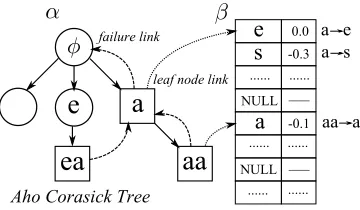
We exploit two data structures for candidate genera-tion. One is a trie for storing and matching words in the vocabulary, referred to as vocabulary trie, and the other based on what we call an Aho-Corasick tree (AC tree) (Aho and Corasick, 1975), which is used for storing and applying correction rules, referred to as rule index. The vocabulary trie is the same as that used in existing work and it will be traversed when
searching the topkcandidates.
Our rule index is unique because it indexes all the rules based on an AC tree. The AC tree is a trie with “failure links”, on which the Aho-Corasick string matching algorithm can be executed. Aho-Corasick algorithm is a well known dictionary-matching al-gorithm which can quickly locate all the words in a dictionary within an input string. Time complexity of the algorithm is of linear order in length of input string plus number of matched entries.
We index all theα’s in the rules on the AC tree.
Eachαcorresponds to a leaf node, and theβ’s of the
αare stored in an associated list in decreasing order
of rule weightsλ, as illustrated in Fig. 2.1
1
One may further improve the index structure by using a trie rather than a ranking list to storeβs associated with the same
α. However the improvement would not be significant because the number ofβs associated with eachαis usually very small.
4.2 Algorithm
One could employ a naive algorithm that applies all
the possible combinations of rules (α’s) to the
cur-rent wordwm, verifies whether the resulting words
(candidates) are in the vocabulary, uses the function in Equ. (5) to calculate the ranking scores of the
can-didates, and find the top k candidates. This
algo-rithm is clearly inefficient.
Our algorithm first employs the Aho-Corasick
al-gorithm to locate all the applicableα’s within the
in-put wordwm, from the rule index. The
correspond-ingβ’s are retrieved as well. Then all the applicable
rules are identified and indexed by the applied
posi-tions of wordwm.
Our algorithm next traverses the vocabulary trie
and searches the topkcandidates with some pruning
techniques. The algorithm starts from the root node of the vocabulary trie. At each step, it has multiple search branches. It tries to match at the next position
ofwm, or apply a rule at the current position ofwm.
The following two pruning criteria are employed to significantly accelerate the search process.
1) If the current sum of weights of applied rules
is smaller than the smallest weight in the topk
list, the search branch is pruned. This criterion is derived from the non-negative constraint on
rule weightsλ. It is easy to verify that the sum
of weights will not become larger if one contin-ues to search the branch because all the weights are non-positive.
2) If two search branches merge at the same node in the vocabulary trie as well as the same
po-sition onwm, the search branches with smaller
sum of weights will be pruned. It is based on the dynamic programming technique because
we takemaxin the ranking function in Equ. 5.
It is not difficult to prove that our algorithm is
guar-anteed to find the best kcandidates in terms of the
ranking scores, because we only prune those candi-dates that cannot give better scores than the ones in
the current topklist. Due to the limitation of space,
we omit the proof of the theorem that if the weights
of rulesλare non-positive and the ranking function
is defined as in Equ. 5, then the topkcandidates
ob-tained with the pruning criteria are the same as the
5 Experimental Results
We have experimentally evaluated our approach in spelling error correction of queries in web search. The problem is more challenging than usual due to the following reasons. (1) The vocabulary of queries in web search is extremely large due to the scale, di-versity, and dynamics of the Internet. (2) Efficiency is critically important, because the response time of
topkcandidate retrieval for web search must be kept
very low. Our approach for candidate generation is in fact motivated by the application.
5.1 Word Pair Mining
In web search, a search session is comprised of a se-quence of queries from the same user within a time period. It is easy to observe from search session data that there are many spelling errors and their correc-tions occurring in the same sessions. We employed heuristics to automatically mine training pairs from search session data at a commercial search engine.
First, we segmented the query sequence from each user into sessions. If two queries were issued more than 5 minutes apart, then we put a session boundary between them. We used short sessions here because we found that search users usually cor-rect their misspelled queries very quickly after they find the misspellings. Then the following heuristics were employed to identify pairs of misspelled words and their corrections from two consecutive queries within a session:
1) Two queries have the same number of words. 2) There is only one word difference between two
queries.
3) For the two distinct words, the word in the first query is considered as misspelled and the sec-ond one as its correction.
Finally, we aggregated the identified training pairs across sessions and users and discarded the pairs with low frequencies. Table 1 shows some examples of the mined word pairs.
5.2 Experiments on Accuracy
Two representative methods were used as baselines: the generative model proposed by (Brill and Moore,
2000) referred to asgenerative and the logistic
re-gression model proposed by (Okazaki et al., 2008)
Misspelled Correct Misspelled Correct aacoustic acoustic chevorle chevrolet liyerature literature tournemen tournament shinngle shingle newpape newspaper finlad finland ccomponet component reteive retrieve olimpick olympic
Table 1: Examples of Word Pairs
referred to as logistic. Note that Okazaki et al.
(2008)’s model is not particularly for spelling error correction, but it can be employed in the task. When using their method for ranking, we used outputs of the logistic regression model as rank scores.
We compared our method with the two baselines
in terms of topkaccuracy, which is ratio of the true
corrections among the topkcandidates generated by
a method. All the methods shared the same settings: 973,902 words in the vocabulary, 10,597 rules for correction, and up to two rules used in one transfor-mation. We made use of 100,000 word pairs mined from query sessions for training, and 10,000 word pairs for testing.
The experimental results are shown in Fig. 3. We can see that our method always performs the best when compared with the baselines and the
improve-ments are statistically significant (p < 0.01). The
logisticmethod works better thangenerative, when
k is small, but its performance becomes saturated,
when k is large. Usually a discriminative model
works better than a generative model, and that seems
to be what happens with smallk’s. However,
logis-ticcannot work so well for largek’s, because it only
allows the use of one rule each time. We observe that there are many word pairs in the data that need to be transformed with multiple rules.
Next, we conducted experiments to investigate
how the topkaccuracy changes with different sizes
of vocabularies, maximum numbers of applicable rules and sizes of rule set for the three methods. The experimental results are shown in Fig. 4, Fig. 5 and Fig. 6.
de-0 5 10 15 20 25 30 40%
50% 60% 70% 80% 90% 100%
top k
A
ccu
r
a
cy
[image:7.612.76.268.56.206.2]Generative Logistic Our Method
Figure 3: Accuracy Comparison between Our Method and Baselines
cline. However, the drop of accuracy by our method
is much smaller than that by generative, which
means our method is more powerful when the vo-cabulary is large, e.g., for web search. For the exper-iment in Fig. 5, we changed the maximum number of rules that can be applied to a transformation from 2
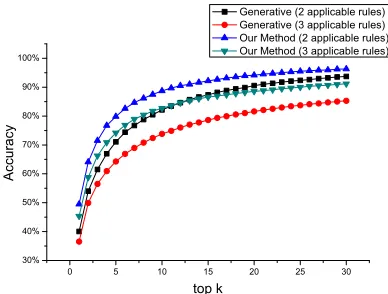
to 3. Becauselogisticcan only use one rule at a time,
it is not included in this experiment. When there are more applicable rules, more candidates can be generated and thus ranking of them becomes more challenging. The accuracies of both methods drop,
but our method is constantly better thangenerative.
Moreover, the decrease in accuracy by our method
is clearly less than that by generative. For the
ex-periment in Fig. 6, we enlarged the number of rules from 10,497 (smallRuleNum) to 24,054 (largeRu-leNum). The performance of our method and those of the two baselines did not change so much, and our method still visibly outperform the baselines when more rules are exploited.
5.3 Experiments on Efficiency
We have also experimentally evaluated the effi-ciency of our approach. Because most existing work uses a predefined ranking function, it is not fair to make a comparison with them. Moreover, Okazaki et al.’ method does not consider efficiency, and Brill and Moore’s method is based a complicated retrieve algorithm which is very hard to implement. Instead of making comparison with the existing methods in terms of efficiency, we evaluated the efficiency of our method by looking at how efficient it becomes with its data structure and pruning technique.
0 5 10 15 20 25 30
30% 40% 50% 60% 70% 80% 90% 100%
top k
A
ccu
r
a
cy
[image:7.612.318.509.60.207.2]Generativ e (smallVocab) Generativ e (largeVocab) Logistic (smallVocab) Logistic (largeVocab) Our Method (smallVocab) Our Method (largeVocab)
Figure 4: Accuracy Comparisons between Baselines and Our Method with Different Vocabulary Sizes
0 5 10 15 20 25 30 30%
40% 50% 60% 70% 80% 90% 100%
top k
A
ccu
r
a
cy
Generative (2 applicable rules) Generative (3 applicable rules) Our Method (2 applicable rules) Our Method (3 applicable rules)
Figure 5: Accuracy Comparison between Generative and Our Method with Different Maximum Numbers of Ap-plicable Rules
0 5 10 15 20 25 30
40% 50% 60% 70% 80% 90% 100%
A
ccu
r
a
cy
top k
Generative (largeRuleSet) Generative (smallRuleSet) Logistic (largeRuleSet) Logistic (smallRuleSet) Our Method (largeRuleSet) Our Method (smallRuleSet)
Figure 6: Accuracy Comparison between Baselines and Our Method with Different Numbers of Rules
[image:7.612.316.510.260.407.2] [image:7.612.318.528.472.626.2]0 5000 10000 15000 20000 25000 2 4 6 8 10 12 14 16 18 20 22 24 26 28 30 32
Number of Rules
W ord Length
[image:8.612.78.288.60.208.2]N u m b e r o f M a t ch i n g R u l e s 4 5 6 7 8 9 10
Figure 7: Number of Matching Rules v.s. Number of Rules
time complexity of Aho-Corasick algorithm is de-termined by the lengths of query strings and the number of matches, we examined how the number of matches on query strings with different lengths changes when the number of rules increases. The experimental results are shown in Fig. 7. We can see that the number of matches is not largely affected by the number of rules in the rule index. It implies that the time for searching applicable rules is close to a constant and does not change much with different numbers of rules.
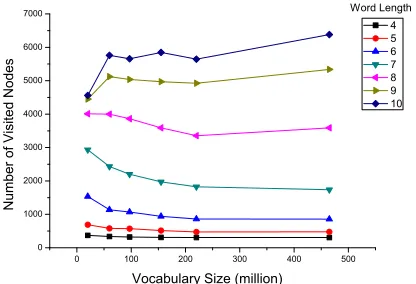
Next, since the running time of our method is proportional to the number of visited nodes on the vocabulary trie, we evaluated the efficiency of our method in terms of number of visited nodes. The
result reported here is that whenkis 10.
Specifically, we tested how the number of visited nodes changes according to three factors: maximum number of applicable rules in a transformation, vo-cabulary size and rule set size. The experimental re-sults are shown in Fig. 8, Fig. 9 and Fig. 10 respec-tively. From Fig. 8, with increasing maximum num-ber of applicable rules in a transformation, numnum-ber of visited nodes increases first and then stabilizes, especially when the words are long. Note that prun-ing becomes even more effective because number of visited nodes without pruning grows much faster. It demonstrates that our method is very efficient when compared to the non-pruning method. Admittedly, the efficiency of our method also deteriorates some-what. This would not cause a noticeable issue in real applications, however. In the previous section,
1 2 3 4 5 6 7
0 2000 4000 6000 8000 10000 12000 14000 16000 18000
Maximum Number of Applicable Rules
N u m b e r o f V i si t e d N o d e s
W ord Length 4 5 6 7 8 9 10
Figure 8: Efficiency Evaluation with Different Maximum Numbers of Applicable Rules
0 100 200 300 400 500 0 1000 2000 3000 4000 5000 6000 7000
Vocabulary Size (million)
N u m b e r o f V i si t e d N o d e s
[image:8.612.318.527.64.208.2]W ord Length 4 5 6 7 8 9 10
Figure 9: Efficiency Evaluation with Different Sizes of Vocabulary
we have seen that using up to two rules in a transfor-mation can bring a very high accuracy. From Fig. 8 and Fig. 9, we can conclude that the numbers of vis-ited nodes are stable and thus the efficiency of our method keeps high with larger vocabulary size and number of rules. It indicates that our pruning strat-egy is very effective. From all the figures, we can see that our method is always efficient especially when the words are relatively short.
5.4 Experiments on Model Constraints
In Section 3.1, we introduce the non-positive
con-straints on the parameters, i.e., ∀λr ≤ 0, to
en-able the pruning technique for efficient top k
re-trieval. We experimentally verified the impact of the constraints to both the accuracy and efficiency. For ease of reference, we name the model with the
[image:8.612.318.526.263.405.2]origi-5000 10000 15000 20000 25000 0
1000 2000 3000 4000 5000 6000 7000
Number of Rules
N
u
m
b
e
r
o
f
V
i
si
t
e
d
N
o
d
e
s
[image:9.612.317.514.58.205.2]W ord Length 4 5 6 7 8 9 10
Figure 10: Efficiency Evaluation with Different Number of Rules
0 5 10 15 20 25 30
40% 50% 60% 70% 80% 90% 100%
top k
A
ccu
r
a
cy
[image:9.612.79.289.64.207.2]Bounded Unbounded
Figure 11: Accuracy Comparison between Bounded and Unbounded Models
nal model asunbounded. The experimental results
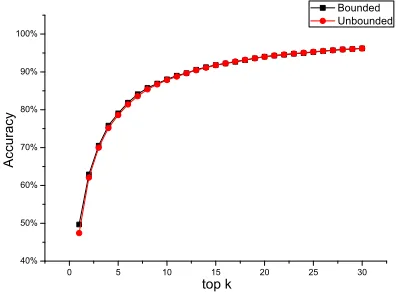
are shown in Fig. 11 and Fig. 12. All the experi-ments were conducted based on the typical setting of our experiments: 973,902 words in the vocabu-lary, 10,597 rules, and up to two rules in one trans-formation. In Fig. 11, we can see that the
differ-ence betweenbounded andunbounded in terms of
accuracy is negligible, and we can draw a conclu-sion that adding the constraints does not hurt the
ac-curacy. From Fig. 12, it is easy to note thatbounded
is much faster thanunboundedbecause our pruning
strategy can be applied tobounded.
6 Conclusion
In this paper, we have proposed a new method for approximate string search, including spelling error correction, which is both accurate and efficient. Our method is novel and unique in its model, learning
4 6 8 10 12
0 1000 2000 3000 4000 5000 6000 7000 8000 9000 10000
N
u
m
b
e
r
o
f
V
i
si
t
e
d
N
o
d
e
s
W ord Length
Bounded Unbounded
Figure 12: Efficiency Comparison between Bounded and Unbounded Models
algorithm, and retrieval algorithm. Experimental re-sults on a large data set show that our method im-proves upon existing methods in terms of accuracy, and particularly our method can perform better when the dictionary is large and when there are many rules. Experimental results have also verified the high efficiency of our method. As future work, we plan to add contextual features into the model and apply our method to other data sets in other tasks.
References
Farooq Ahmad and Grzegorz Kondrak. 2005. Learning a spelling error model from search query logs. In Pro-ceedings of the conference on Human Language Tech-nology and Empirical Methods in Natural Language Processing, HLT ’05, pages 955–962, Morristown, NJ, USA. Association for Computational Linguistics. Alfred V. Aho and Margaret J. Corasick. 1975. Efficient
string matching: an aid to bibliographic search. Com-mun. ACM, 18:333–340, June.
Alexander Behm, Shengyue Ji, Chen Li, and Jiaheng Lu. 2009. Space-constrained gram-based indexing for effi-cient approximate string search. InProceedings of the 2009 IEEE International Conference on Data Engi-neering, pages 604–615, Washington, DC, USA. IEEE Computer Society.
Eric Brill and Robert C. Moore. 2000. An improved error model for noisy channel spelling correction. In
Proceedings of the 38th Annual Meeting on Associa-tion for ComputaAssocia-tional Linguistics, ACL ’00, pages 286–293, Morristown, NJ, USA. Association for Com-putational Linguistics.
[image:9.612.77.276.258.404.2]re-sults. In Proceedings of the 2007 Joint Conference on Empirical Methods in Natural Language Process-ing and Computational Natural Language LearnProcess-ing, pages 181–189.
Andrew R. Golding and Dan Roth. 1999. A winnow-based approach to context-sensitive spelling correc-tion.Mach. Learn., 34:107–130, February.
Aminul Islam and Diana Inkpen. 2009. Real-word spelling correction using google web it 3-grams. In
Proceedings of the 2009 Conference on Empirical Methods in Natural Language Processing: Volume 3 - Volume 3, EMNLP ’09, pages 1241–1249, Morris-town, NJ, USA. Association for Computational Lin-guistics.
Rosie Jones, Benjamin Rey, Omid Madani, and Wiley Greiner. 2006. Generating query substitutions. In
Proceedings of the 15th international conference on World Wide Web, WWW ’06, pages 387–396, New York, NY, USA. ACM.
Mu Li, Yang Zhang, Muhua Zhu, and Ming Zhou. 2006. Exploring distributional similarity based models for query spelling correction. InProceedings of the 21st International Conference on Computational Linguis-tics and the 44th annual meeting of the Association for Computational Linguistics, ACL-44, pages 1025– 1032, Morristown, NJ, USA. Association for Compu-tational Linguistics.
Chen Li, Bin Wang, and Xiaochun Yang. 2007. Vgram: improving performance of approximate queries on string collections using variable-length grams. In Pro-ceedings of the 33rd international conference on Very large data bases, VLDB ’07, pages 303–314. VLDB Endowment.
Chen Li, Jiaheng Lu, and Yiming Lu. 2008. Effi-cient merging and filtering algorithms for approximate string searches. InProceedings of the 2008 IEEE 24th International Conference on Data Engineering, pages 257–266, Washington, DC, USA. IEEE Computer So-ciety.
Andrew McCallum, Kedar Bellare, and Fernando Pereira. 2005. A conditional random field for discriminatively-trained finite-state string edit distance. InConference on Uncertainty in AI (UAI).
Stoyan Mihov and Klaus U. Schulz. 2004. Fast approx-imate search in large dictionaries. Comput. Linguist., 30:451–477, December.
Naoaki Okazaki, Yoshimasa Tsuruoka, Sophia Anani-adou, and Jun’ichi Tsujii. 2008. A discriminative
candidate generator for string transformations. In
Proceedings of the Conference on Empirical Methods in Natural Language Processing, EMNLP ’08, pages 447–456, Morristown, NJ, USA. Association for Com-putational Linguistics.
Jose Oncina and Marc Sebban. 2005. Learning unbiased stochastic edit distance in the form of a memoryless finite-state transducer. InInternational Joint Confer-ence on Machine Learning (2005). Workshop: Gram-matical Inference Applications: Successes and Future Challenges.
Eric Sven Ristad and Peter N. Yianilos. 1998. Learning string-edit distance. IEEE Trans. Pattern Anal. Mach. Intell., 20:522–532, May.
Johannes Schaback and Fang Li. 2007. Multi-level fea-ture extraction for spelling correction. InIJCAI-2007 Workshop on Analytics for Noisy Unstructured Text Data, pages 79–86, Hyderabad, India.
Kristina Toutanova and Robert C. Moore. 2002. Pro-nunciation modeling for improved spelling correction. InProceedings of the 40th Annual Meeting on Associ-ation for ComputAssoci-ational Linguistics, ACL ’02, pages 144–151, Morristown, NJ, USA. Association for Com-putational Linguistics.
Rares Vernica and Chen Li. 2009. Efficient top-k algo-rithms for fuzzy search in string collections. In Pro-ceedings of the First International Workshop on Key-word Search on Structured Data, KEYS ’09, pages 9– 14, New York, NY, USA. ACM.
Casey Whitelaw, Ben Hutchinson, Grace Y. Chung, and Gerard Ellis. 2009. Using the web for language in-dependent spellchecking and autocorrection. In Pro-ceedings of the 2009 Conference on Empirical Meth-ods in Natural Language Processing: Volume 2 - Vol-ume 2, EMNLP ’09, pages 890–899, Morristown, NJ, USA. Association for Computational Linguistics. Xiaochun Yang, Bin Wang, and Chen Li. 2008.
Cost-based variable-length-gram selection for string collec-tions to support approximate queries efficiently. In
Proceedings of the 2008 ACM SIGMOD international conference on Management of data, SIGMOD ’08, pages 353–364, New York, NY, USA. ACM.