Aligning the topic of FCA with existing module learning
outcomes
ANDREWS, Simon <http://orcid.org/0000-0003-2094-7456>
Available from Sheffield Hallam University Research Archive (SHURA) at:
http://shura.shu.ac.uk/3690/
This document is the author deposited version. You are advised to consult the
publisher's version if you wish to cite from it.
Published version
ANDREWS, Simon (2010). Aligning the topic of FCA with existing module learning
outcomes. In: POLOVINA, Simon, ANDREWS, Simon, HILL, Richard, SCHARFE,
Henrik and ØHRSTRØM, Peter, (eds.) Proceedings of the International Workshop
CS-LTA 2010 : The First Conceptual Structures – Learning, Teaching and
Assessment Workshop. Mimos Berhad, 1-12.
Copyright and re-use policy
See
http://shura.shu.ac.uk/information.html
Sheffield Hallam University Research Archive
Aligning the Topic of FCA with Existing Module
Learning Outcomes
Simon Andrews
Centre For Excellence in Teaching and Learning Centre For Promoting Learner Autonomy Sheffield Hallam University, Sheffield, UK
Abstract. Although Formal Concept Analysis is worthy of study on computing courses, it is not always possible or practical to dedicate a whole module to it. It may, however, fit into an existing module as a topic but require some careful design of teaching and assessment ac-tivities to properly align it to the intended learning outcomes of the module. This paper describes and evaluates a three year project to align the teaching and assessment of FCA with the learning outcomes of a final-year undergraduate Smart Applications module at Sheffield Hal-lam University. Biggs’ constructive alignment was used, incorporating an adapted version of Yin’s case study research method, in an iterative process; progressively modifying teaching and assessment activities to align them more closely with the prescribed learning outcomes. The pro-cess involved examining conclusions made by students, from carrying out FCA case study assignments, to draw cross-case conclusions about the learning outcomes achieved, and how they deviated from the prescribed ones. These cross-case conclusions were used to feed back into the design of learning and assessment activities for the next delivery of the module. After three cycles, the learning outcomes achieved closely matched the prescribed learning outcomes of the module.
1
Introduction
At Sheffield Hallam University, a project was undertaken to introduce FCA as a topic to an existing undergraduate computing module, called Smart Ap-plications. It was felt that that the applications of FCA, particularly in the semantic search and knowledge organisation areas, made it an interesting topic for the module. To monitor the success of its introduction and make modifi-cations where it was found to be not properly aligned to the existing learning outcomes, an iterative approach was used, applying the constructive alignment
model of Biggs [1]
2
Biggs Constructive Alignment
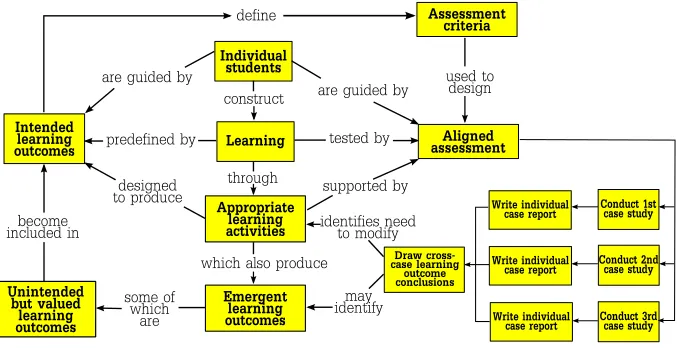
The purpose of Biggs’ constructive alignment is to design learning activities and assessment tasks so that they are aligned with the learning outcomes that are intended (figure 1). The method includes modification of learning activities based on the outcomes of assessment. It is essential that the learning outcomes are assessed and a proven way of doing this is by criteria-based assessment where grades are awarded according to how well students meet the intended learning outcomes [2]. The problem here, with the introduction of a new topic into an existing scheme, is that the intended learning outcomes of the module will have probably been devised with an idea of the curriculum to be delivered, and not with the new topic in mind. A means is required of testing the alignment of the new topic with the existing scheme. Central to Biggs’ is the notion that students construct their own meaning from their learning activities; a means of accessing these constructed meanings could, therefore, be used to ascertain the extent to which particular learning outcomes have been met.
Familiarity with of research methods led to the idea of using such a method to identify the extent to which existing Smart Applications learning outcomes were being met by FCA. The common practice of using case studies as assignments for the Smart Applications module, combined with the idea that modifications would play a key role in the alignment process, suggested Yin’s case study research method [13].
3
Yin’s Case Study Research Method
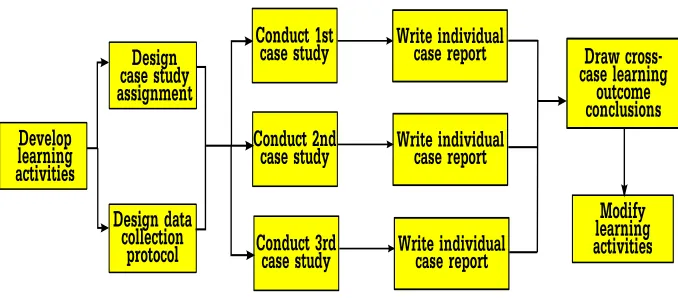
Yin describes a method whereby theory is modified from conclusions drawn from a series of case studies (figure 2). The idea is that a theory is investigated through carrying out several distinct case studies. In this way, conclusions regarding the veracity of the theory are made stronger by the fact that a single experiment is not relied on; by putting the theory to the test in different ways, corroborating cross-case conclusions can be made.
Fig. 1.Biggs constructive alignment: source HEA academy [5]
[image:4.612.138.481.444.594.2]Fig. 3.Yin’s case study method adapted for Biggs
3.1 Data Collection
To conduct Yin, a data collection protocol is required. Data must be collected that allows the testing of the theory. For the purpose of using Biggs, a data col-lection protocol was required that would allow cross-case conclusions to be made regarding the outcomes of learning activities; how well have the students achieved the intended learning outcomes of the module? Four possible data sources were considered:
1. The marks obtained by the students. 2. Student feedback.
3. A marking scheme.
4. The contents of the coursework.
Student marks Marks taken alone would not indicate whether a particular leaning outcome had been achieved. However, marks will provide an indication as to the depth to which learning outcomes have been achieved. In conjunction with a measure of what has been learned, marks can tell us how well something has been learned.
Marking scheme It would be possible to design a matrix marking scheme to directly measure the intended learning outcomes; a row in the matrix represent-ing a learnrepresent-ing outcome and columns to grade the extent to which it has been achieved. The problem with this approach has been discussed above; assessment criteria should reflect the assignment activities of the new topic. Explicitly bas-ing the case study assessment criteria on the intended module learnbas-ing outcomes would defeat the purpose of testing the current ‘theory’.
Coursework content The content of coursework clearly provides qualitative evidence of learning. But taking the whole of the students’ reports as data would be difficult to manage in terms of sheer quantity of written work. However, as part of a case study assignment, it is appropriate to require students to make conclusions. Requiring this as part of the individual case study report will provide a good source of data on which learning outcomes can be judged. And as a data collection protocol, this has the added benefit that students will be motivated to provide good quality data; they are being assessed on it.
[image:6.612.140.479.416.590.2]As a by-product, this protocol also provides the mechanism in Biggs whereby emergent learning outcomes can be identified. The incorporation of the method into Biggs can be seen in figure 4.
4
Applying the Method: The Three Cycle Smart
Applications Project
Smart Applications is a final year undergraduate computing module taught at Sheffield Hallam University. One of the aims of the module is to introduce stu-dents to frameworks and techniques for representing and reasoning with knowl-edge for smart applications. It was felt that FCA was an appropriate technique to study as a topic to help achieve this aim. However, the topic would have to be aligned with the existing intended learning outcomes of the module. It was decided to use this as an opportunity to develop the pedagogical method, de-scribed above, for incorporating new topics into existing modules. The process was carried out in three cycles, over the academic years 2007/8, 2008/9 and 2009/10.
FCA, as a new topic, was required to provide one or more of the intended learning outcomes (ILOs) of the Smart Applications module, which were:
ILO1 Describe the notion of representing and reasoning with knowledge for smart applications.
ILO2 Draw on one or more frameworks and techniques for representing and reasoning with knowledge for smart applications.
ILO3 Critically evaluate the key issues in knowledge representation and knowl-edge sharing for smart applications.
ILO4 Identify the practical use of software tools for developing smart applica-tions.
4.1 Cycle 1: 2007/8
The learning activities associated with FCA in the 2007/8 delivery of the Smart Applications module were primarily concerned with the mathematical underpin-nings of FCA. After an introduction to FCA, lectures and tutorials were based on the themes ofKnowledge Architectures for Smart Applications through Con-ceptual Structures andSpecifying Smart Applications using FCA. Because FCA was one topic of several, the main assessment of FCA had to be limited to a single assignment. To ensure that this would not conflict with Yin’s require-ment that case studies should to be distinct, the design of the assignrequire-ment had to allow for as much variation as possible, whilst still being consistent in terms of assessment criteria. The assessment was based around a smart application case study for managing user profiles in a business information system. Varia-tion was designed into the assignment by phrasing it as openly as possible; the students were asked to investigate possible solutions and make their own rec-ommendations. The deliverable was a report that considered “How might the implementation of a ‘user profile concept lattice’ be accomplished, that supports the capture and reconfiguration of user profiles? The FCA approach should also consider how appropriate data might be assimilated, managed and presented to the user.”
1. “FCA lends itself well to mapping user profile details. This is best achieved using a series of different lattices covering the different aspects of user pro-files. Trying to capture all of the relevant user information in one lattice would probably be a little ambitious and also result in a complex and im-practical lattice.”
2. “Through implementation of web mining techniques of Association rules or Conceptual Clustering Mining you can capture User Profiles.”
3. “By utilising BI techniques and FCA modeling, user profiles would be smart as they would show relevant information to users across the company.” 4. “I have found that using FCA for capturing User Profiles makes seeing the
relationship between objects and attribute a lot easier, which we can then use to see relationships for that particular profile which helps gathering data for use in trends.”
5. “Through user profiling with FCA I found that content and information only relevant to that particular individual within the company can be displayed, saving time and improving productivity.”
6. “Although FCA seems to be a good way to analyse and create user profiles it can become slightly difficult if you have a model that constantly changes as it can be difficult to adapt a new role into the model.”
7. “Once a Smart Google system can comprehend the context of a sentence, through the identification of relations between words in a search phrase, it will then deliver the user with answers rather than results. This I would consider as smart.”
8. “Combining FCA and BI with the functions and facilities available in Web DynPro has the capacity to store a lot of information in a very well organised and formal structure, which can be added to or reduced very easily, with little adaptation of the data structure.”
The marks for the assignment were slightly disappointing with a mean of 54%, although the first time pass rate was a reasonable 88%.
It was decided, therefore, to modify the learning activities of the module to focus less on the mathematical theory of FCA and more on its practical application; perhaps by implementing FCA-based software, students’ learning outcomes would be better aligned with the intended ones.
4.2 Cycle 2: 2008/9
The emphasis of the learning activities associated with FCA in the 2008/9 de-livery of the Smart Applications module was on the development and imple-mentation of FCA-based smart applications. Modifications were made to the learning activities of the previous cycle to focus less on the theoretical aspects of FCA and more on the engineering of FCA-based software. The themes were Se-mantic Search: ‘Sleuthing’ with FCA,Data Structures for FCAand FCA-based Smart User Interfaces. The assessment was a modified version of the 2007/8 assignment, with an element of application prototyping replacing some of the investigation of theory. The assignment was still open enough to allow sufficient variation for Yin.
The following are quotes from the conclusions of the students’ case study reports that gave an indication of the learning outcomes achieved:
1. “Integrating FCA user profiles into an SUI such as Dynpro comes with issues. Dynpro is not very flexible in terms of changing things by the program. It requires the user profiles to already be configured to support an FCA ontology.”
2. “Concept lattices were used to structure ... an FCA-based user profile. This data was ... integrated into a Smart User Interface (SUI) by being focused on the organising, sorting and searching of data, and finding matching con-cepts.”
3. “Using the unique way that FCA stores and represents knowledge the Smart User Interface can give the user multiple ways of finding information.” 4. “We defined user sessions as only the URLs that have been requested and
visited by the user. This considerably lowered the amount of attributes and data that had to be analysed.”
5. “We have presented how Web Dynpro implements the MVC framework which allows FCA of the data used within it, integrated with BI to sup-port user profiles, customising a user’s interface, manipulating it to suit the aims of enterprise and user. Using FCA to discover patterns and correlations [was a] way of determining relationships and discovering the implicit ones that other methods struggle to uncover.”
6. “It is possible to integrate the FCA user profiles successfully; however, there are several difficulties when implementing them: firstly there’s the issue with accuracy, as the larger the company or department the more complicated it is going to be to implement. There’s also a concern with timing, as it’s a long process computing the profiles.”
The marks for the assignment were poor, with a mean of 47%; down signif-icantly on the previous year’s mean of 54%. The first-time pass rate was also poor, at 71%.
This time it was clear that most of the intended learning outcomes were being met, and also to higher degree. ILO1 was evidenced by many of the comments as was ILO2. Key issues were highlighted more this time (ILO3); some of the quotes indicate a good awareness of complexity and performance issues and some of them indicate that some of the key advantages of FCA have been better explored and understood. Some quotes, including the final one, indicate that some broader understanding of the context has taken place. Less in evidence is ILO4; very few of the students reflected on the use of software tools for developing smart applications.
Unfortunately, the low mean mark suggests that, whilst the learning out-comes may now be better aligned, the achievement in terms of results was not good. Although the quotes give an encouraging picture of the learning that has taken place, the technical aspects of the learning and assessment activities proved to be a struggle for some of the students. The programming skills, for example, of many of the students were not adequate for developing a useful prototype application. It was therefore decided to modify the learning activities to require less of these technical skills, by de-emphasising the construction of new software, and focus more on the investigation, use and development of existing FCA tools and applications.
4.3 Cycle 3: 2009/10
This time the learning activities were based on the themes of FCA Tools, FCA ‘Sleuth’ Applications and Data Mining with FCA. Practical sessions were de-signed to explore the capabilities and limitations of existing software. The as-signment was changed by replacing the prototyponmg element with one that used existing tools and techniques to carry out FCA on real sets of user profile data.
The following are quotes from the conclusions of the students’ case study reports that gave an indication of the learning outcomes achieved:
1. “FCA raises new questions regarding the actual warranty of ‘hidden’ infor-mation. How can we trust that a smart application is actually giving the right results?”
2. “To make this investigation even more interesting, we could use similar FCA techniques on the categorised attributes and incorporate the boolean at-tributes to discover if the top 4 factors are actually the factors of people from all age groups, for example.”
3. “Filtering the formal concepts generated allowed for visualisation of the large data set and allowed for affective analysis.”
5. “While formal concept analysis and the enabling technologies described are now in a usable state, the applications to use it now have to catch up with them.”
6. “Visualisation techniques are key to enabling Smart Applications. Informa-tion that would be hard to find otherwise was made clear to understand.” 7. “There seems to be a lack of ability to be able to communicate and exchange
data between FCA systems and tools with non-FCA applications. Although the data mining is ‘smart’, problems arise when changes are needed to be made to lattices.”
8. “[It would be useful if] visualisation techniques can be brought together, allowing easy access to the produced images and concepts and so giving a broad and easily digestible view of the information contained within.”
The marks for the assignment had a mean of 67%. The first-time pass rate was 93%.
The quotes indicate that the learning outcomes have been met, and to a good extent. Notions of representing and reasoning with knowledge for smart applications (ILO1) and the drawing on FCA as a framework/technique for smart applications (ILO2) are apparent in many of the comments. There is good evidence that an ability to critically evaluate key issues has been demonstrated (ILO3), particularly in quotes 1, 3, 4 and 7. And there is a strong sense that the students can identify the practical use of software tools for developing smart applications (ILO4).
5
Conclusion
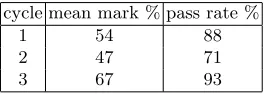
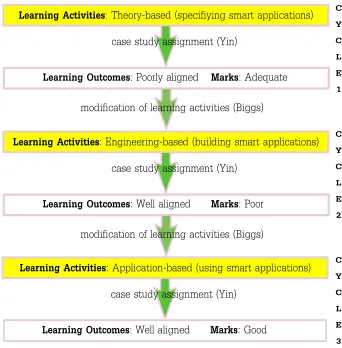
The three-year Smart Applications project shows that FCA can be aligned with the intended learning outcomes of a suitable existing module using sound peda-gogical practice. In Yin’s adapted case-study method, students drew conclusions on the work they had undertaken, then, from these, teachers drew cross-case conclusions regarding the learning outcomes achieved and how far they were aligned with the intended ones. The students’ concluding remarks gave a quali-tative measure of their learning whilst their marks gave a quantiquali-tative measure of the depth of their learning. The three cycles of the project are summarised in figure 5 and the results are summarised in table 1.
cycle mean mark % pass rate %
1 54 88
2 47 71
[image:11.612.242.374.545.592.2]3 67 93
Table 1.Summary ofSmart ApplicationsResults
student cohort into place. The small number of students involved meant that statistical anomalies were easily possible. A degree of additional judgment from observation and assessment was used, for example, in detecting the problems that the students had with programming, leading to poor performance in the case study assignment in the second cycle. Secondly, there was no clear metric for determining the nature of the modifications required to the learning activities. Again, a degree of additional judgment was required to fathom a sensible change. Notwithstanding the limited amount of student feedback one would be likely to get on a small module, an additional element of data gathering involving a module questionnaire might be useful in judging new directions for learning activities.
References
1. Biggs, J.: Teaching for Quality Learning at University, SRHE and Open University Press, Buckingham (1999)
2. Biggs, J.: Aligning Teaching and Assessment to Curriculum Objectives, (magina-tive Curriculum Project, LTSN Generic Centre (2003)
3. Dau, F., Ducrou, J., Eklund, P.: Concept Similarity and Related Categories in SearchSleuth. In: Eklund, P., Haemmerl`e, O. (eds.) ICCS 2008, LNAI 5113, pp. 255-268. Springer-Verlag, Berlin/Heidelberg (2008)
4. Grigoriev, P., A., Yevtushenko, S.A.: QuDA: Applying Formal Concept Analysis in a Data Mining Environment. In: Eklund, P. (ed.) ICFCA 2004, LNAI 2961, pp. 386-393. Springer-Verlag, Berlin/Heidelberg (2004)
5. HEA Academy, Learning and Teaching Theory Guide:http://www.engsc.ac.uk/ learning-and-teaching-theory-guide/constructive-alignment
6. Kaytoue-Uberall, M., Duplesssis, S., Napoli, A.: Using Formal Concept Analysis for the Extraction of Groups of Co-expressed Genes. In: Le Thi, H.A., Bouvry, P., Pham Dinh, T. (eds.) MCO 2008. CCIS vol. 14, pp. 439-449. Springer-Verlag, Berlin/Heidelberg (2008)
7. Kuznetsov, S.O., Obiedkov, S.A.: Comparing Performance of Algorithms for Gen-erating Concept Lattices. In: Journal of Experimental and Theoretical Artificial Intelligence, Vol. 14, pp. 189-216 (2002).
8. Priss, U., Old, L., J.: Bilingual Word Association Networks. In: Priss, U., Polov-ina, S., Hill, R. (eds.) ICCS 2007, LNAI 4604, pp. 310-320. Springer-Verlag, Berlin/Heidelberg (2007)
9. Priss, U. (ed.): FCA Home-page,http://www.upriss.org.uk/fca/fcasoftware. html
10. Wille, R.: Formal Concept Analysis as Mathematical Theory of Concepts and Concept Hierarchies. In: Ganter, B., Stumme, G., Wille, R. (eds.), Formal Con-cept Analysis: Foundations and Applications, pages 1-33. Springer-Verlag, Germany (2005).
11. Wille, R., Wille-Henning, R.: Towards a Semantology of Music. In: Priss, U., Polovina, S., Hill, R. (eds.) ICCS 2007, LNAI 4604, pp. 269-282. Springer-Verlag, Berlin/Heidelberg (2007)
12. Wollf, K., E.: A First Course in Formal Concept Analysis: How to Understand Line Diagrams. In: In: Faulbaum, F. (ed.) SoftStat’93, Advances in Statistical Software 4, 429-438 (1993)
![Fig. 1. Biggs constructive alignment: source HEA academy [5]](https://thumb-us.123doks.com/thumbv2/123dok_us/752376.580673/4.612.138.481.444.594/fig-biggs-constructive-alignment-source-hea-academy.webp)