Metal salt modified PEDOT : PSS as anode buffer layer and
its effect on power conversion efficiency of organic solar
cells
KADEM, Burak, CRANTON, Wayne <http://orcid.org/0000-0002-0142-7810> and HASSAN, Aseel <http://orcid.org/0000-0002-7891-8087>
Available from Sheffield Hallam University Research Archive (SHURA) at:
http://shura.shu.ac.uk/12475/
This document is the author deposited version. You are advised to consult the publisher's version if you wish to cite from it.
Published version
KADEM, Burak, CRANTON, Wayne and HASSAN, Aseel (2015). Metal salt modified PEDOT : PSS as anode buffer layer and its effect on power conversion efficiency of organic solar cells. Organic Electronics, 24, 73-79.
Copyright and re-use policy
See http://shura.shu.ac.uk/information.html
Sheffield Hallam University Research Archive
Metal salt modified PEDOT:PSS as anode buffer layer and its effect on power
conversion efficiency of organic solar cells
Burak Kadem, Wayne Cranton and Aseel Hassan*
Materials and Engineering Research Institute, Sheffield Hallam University, City Campus, Sheffield S1 1WB, UK
Abstract:
The effects of metal chlorides such as LiCl, NaCl, CdCl2 and CuCl2 on optical transmittance, electrical conductivity as well as morphology of PEDOT:PSS films have been investigated.
Transmittance spectra of spun PEDOT:PSS layers were improved by more than 6% to a
maximum of 94% in LiCl doped PEDOT:PSS film. The surface of the PEDOT:PSS films has
exhibited higher roughness associated with an increase in the electrical conductivity after doping
with metal salts. The improvement in the physical properties of PEDOT:PSS as the hole
transport layer proved to be key factors towards enhancing the P3HT:PCBM bulk heterojunction
(BHJ) solar cells. These improvements include significantly improved power conversion
effeciency with values as high as 6.82% associated with high fill factor (61%) and larger short
circuit current density (~18 mA.cm-2).
1. Introduction:
Organic solar cells (OSCs) have received significant attention during the last few decades due to
their low cost processing which is compatible with flexible substrates, high throughput and thus
requires less capital investment [1]. OSCs are mainly based on bulk heterojunctions (BHJ) of
conjugated polymers such as poly (3-hexylthiophene) (P3HT) and fullerenes such as
(6,6)-phenyl-C61 butyric acid methyl ester (PCBM). Power conversion efficiencies (PCE) in the
region of 5% have been achieved [2] and PCE of 10% or larger [3] is projected for the
foreseeable future, which makes OSCs a viable replacement of the well-established silicon SCs.
OSCs are diverse and versatile, and can offer wide range of properties including tailored band
gap and thus varied range of light harvesting efficiency covering a broad range of the solar
spectrum. It could be argued that OSCs based on BHJ comprising P3HT and PCBM are
considered as the most investigated devices [4]. The nature of contacts on both sides of the active
layer is considered as an essential feature to determine the device performance, and therefore
their PCE. Poly (3,4-ethylenedioxythiophene) doped with poly(styrene sulfonate), abbreviated as
PEDOT:PSS has been widely known as one of the most promising conductive polymers
employed as a hole transporting layer, due to its simple processing, high transparency and high
stability. It is considered as a favorable material to replace inorganic materials to deposit on
flexible substrates for plastic electronics applications such as memories, sensors, OLEDs and
flexible PV devices [5]. PEDOT:PSS dispersed in water can easily form a transparent film with
high conductivity by spin coating, thus producing a low sheet resistance film[6]. The optimised
combination of conductivity and surface morphology is essential for numerous applications of
PEDOT:PSS thin films; these could be influenced by a variety of factors during the drying
process including the fraction of solid content, particle size, proportion of PSS and the solution
viscosity which could lead to different morphological and electrical properties [7]. The
photovoltaic (PV) device performance is mainly defined by the PCE which depends on several
parameters such as light harvesting properties of the active layer, generation of excitons, exciton
diffusion and separation, transportation and collection by the cell electrodes [8]. However, the
modification of both contacts has been demonstrated to play significant role in the enhancement
of charge collection (electrons and holes), which could largely improve the device PCE [9]. To
date, several treatments were carried out to modify the properties of the PEDOT:PSS layer,
which included the use of different organic solvents. Among those solvents are ethanol,
improvement of PEDOT:PSS layer conductivity [10]. Through an alternative approach, Ouyang
has studied the effect of various salts on PEDOT:PSS conductivity and it was shown that the
conductivity enhanced by employing metal salts as dopants within the aqueous PEDOT:PSS
solution. This was ascribed to the binding of the metal ions to the PSS anions of PEDOT:PSS
layer [11]. Furthermore, PEDOT:PSS treatment with hexafluoroacetone (HFA) were shown to
reduce the sheet resistance from 7 MΩ/□ to 40 kΩ/□ [12]. For the work presented here, the effect
of metal salts, both in powder form and as aqueous solutions on the PEDOT:PSS films’
properties such as conductivity, transmittance and morphology were investigated. The modified
PEDOT:PSS layers were adopted as anode buffer layer to study their effects on P3HT:PCBM
OSCs performance and thus on device PCE. To the best of the authors' knowledge this is the first
attempt to apply salt-modified PEDOT:PSS layers to P3HT:PCBM-based OSCs.
2. Experimental methods
2.1.Preparation of PEDOT:PSS solution with metal salts
PEDOT:PSS (conductive grade-483095 Aldrich) were mixed with different metal salts (Sigma
Aldrich); these are CuCl2 (99.99%), CdCl2 (99.99%), NaCl (99.99%) and LiCl (99.99%) used as
powders and as aqueous solutions. 1 mg of the metal salts was added separately as powders to
1ml of PEDOT:PSS solution; the final solutions were sonicated for 30 min to ensure good
dispersion and complete solubility of the salts. In a separate method, aqueous solutions of each
metal salt with the concentration of 1 mg.ml-1 were prepared in deionised (DI) water. The solutions were sonicated for 30 min before mixing with PEDOT:PSS solution with a volume
ratio of 0.1:1ml. Further sonication for 30 min was carried out for efficient dispersion after
mixing the PEDOT:PSS with the aqueous salts solutions. Additional samples of LiCl and CdCl2 in DI water were used in the concentrations of 5 mg.ml-1 and 10 mg.ml-1 in order to examine the role of dopant concentration on the electrical and optical properties of PEDOT:PSS.
2.2.Organic solar cells preparations
ITO-coated glass slides (sigma Aldrich; sheet resistance 8-10 Ω /□) were cleaned using DI water,
acetone and 2-propanol for 10 min each in ultrasonic bath, respectively, and then blown dry in
chlorobenzene (CB:CF) with the ratio 1:1. The active layers were spin coated inside a
nitrogen-filled glove box followed by annealing inside the glove box at 120 oC for 10 min. Film thickness of 95 nm was obtained as determined by spectroscopic ellipsometery. A top contact of aluminum
(Al) was evaporated with a thickness of about 100 nm, at the deposition rate of 0.1-0.2 nm/sec as
was monitored by a quartz crystal thickness monitor. All the devices were subjected to further
heat treatment inside the glove box at 120oC for 10 min and left to cool down for 30 min before measurements were carried out.
2.3. Measurements
A UV-visible spectrophotometer (Varian 50-scan UV-visible) in the range of 190-1100 nm was
used to study the transmittance spectra of PEDOT:PSS layers which were spin coated onto
cleaned glass substrates. The active layer and PEDOT:PSS layer thicknesses were determined
using M2000 (J.A. Woollam Co., Inc.) spectroscopic ellipsometry operating in the wavelength
range 370-1000 nm. Morphology of PEDOT:PSS layers were examined using a Nanoscope IIIa
multimode atomic force microscope (AFM). DC electrical characteristics in the form of current
density-voltage (J-V) dependence and electrical conductivity of PEDOT:PSS layers as well as
completed OSC devices were studied using a 4200 Keithley semiconductor characterisation
system and the photo current was generated under AM 1.5 solar simulator source of 100mW.cm -2
. The fill factor (FF) and the overall light to-electrical energy conversion efficiency (PCE) of the
solar cell were calculated according to the following equations [13]:
PCE (%) = JmaxVmax
Pin (1)
FF =JmaxVmax
Jsc Voc (2)
where Jsc is the short-circuit current density (mA.cm-2), Voc is the open-circuit voltage (V), Pin is the incident light power and Jmax (mA.cm-2) and Vmax (V) are the current density and voltage at the point of maximum output power in the J-V curves, respectively. Furthermore, the electrical
conductivity was determined using interdigitated platinum electrodes (IDEs) purchased from
DropSens (Spain). The IDE can be used to measure the surface conductivity (σ) of the samples
from the following relationship[14]
where, t is the thickness of the film, W is the distance between the fingers (6.67mm), n is the
number of fingers (500), and (L) is the distance between electrodes (5μm).
2. Results
2.1.Transmittance spectra
Fig. 1 shows transmittance spectra of metal salts treated PEDOT:PSS films as well as those of
films prepared from as purchased PEDOT:PSS. Modified PEDOT:PSS films doped with metal
salts have exhibited higher transmittance as compared to pure PEDOT:PSS films. Conversely,
aqueous solution-treated PEDOT:PSS films showed a higher transmittance than those treated
with metal salt powders. In both cases, metal chloride treated PEDOT:PSS layers are found to be
useful for solar cells specifically for materials employed as a windows layer. The maximum
transmittance of pure PEDOT:PSS film was in the range 88 -91% within the wavelength range
(400–650 nm), while transmittance of powder salts treated-PEDOT:PSS films has increased up
to 93%. Aqueous solution (1mg.ml-1) of metal salts treated PEDOT:PSS films have however exhibited further increase in transmittance, reaching 94%. The PEDOT;PSS films treated with
LiCl and CdCl2 were shown to demonstrate maximum transmittance in both cases of treatment, in powder and in aqueous solutions. Moreover, an increase in the aqueouse solution concetration
of LiCl and CdCl2 has led to further improvement in trasmittance.
2.2.Surface morphology
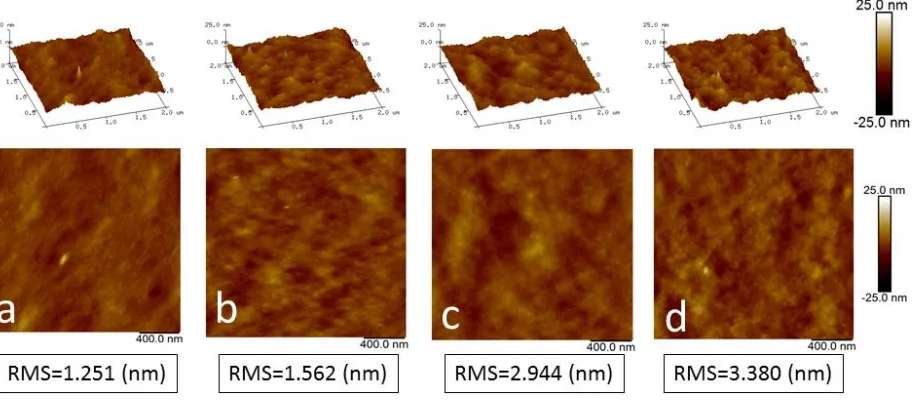
Fig.2 shows AFM images obtained for treated and untreated PEDOT:PSS films. The pure film
has exhibited smooth surface with rms=1.25nm while rougher morphologies were markedly clear
in the metal salts-treated films; LiCl (10mg.ml-1 aqueous solution) doped PEDOT:PSS has exhibited more rough surface with rms=3.38nm. Generally speaking the brighter regions
observed in the AFM images could be associated with the PEDOT whereas the darker regions
are related to the less conductive PSS regions [15]. This increase in the surface roughness may
be ascribed to the increase in grain size after metal chloride treatment. It has recently been shown
that surface roughness and grain size of inorganic CdS layer has increased as a result of CdCl2
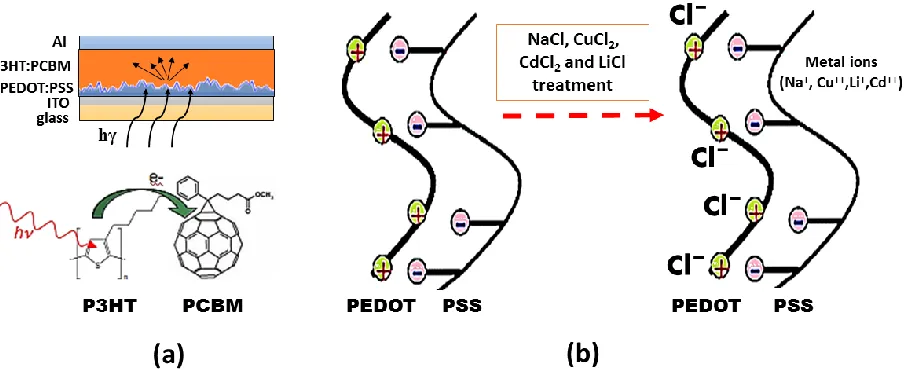
treatment [16]. At the same time, the group VII element (Cl) has also acted as a p-type dopant
when it produces complexes with un-known native defects within the inorganic layer [16]. It can
(anion) to act as a dopant impurity to improve the PEDOT conductivity and enhance its surface
roughness as shown in Fig.3 (a) and (b). It therefore appears that this treatment improves the
light harvesting by the active layer as well as decreasing the contact resistance of the interfacial
layer, hence increasing the short circuit current density (Jsc).
2.3.Electrical conductivity
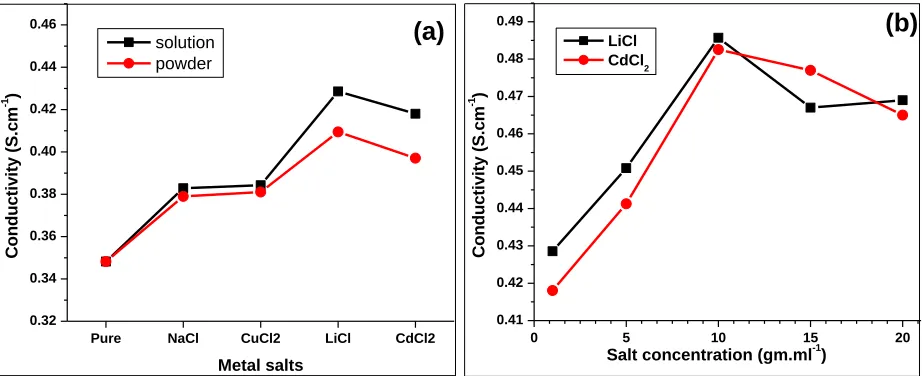
Fig.4 illustrates the variation in electrical conductivity of the PEDOT:PSS layer as a result of
treatment with different metal chlorides (Fig. 4a), as well as the effect of concentration of the
chloride aqueous solutions (Fig. 4b). A maximum conductivity of 0.41 S.cm-1 was obtained for the LiCl treated film when the metal salt was added in powder form while a conductivity of 0.43
S.cm-1 was obtained using aqueous solution. Further treatment was carried out to examine the effect of CdCl2 and LiCl concentrations on PEDOT:PSS conductivity, using concentrations of
5mg.ml-1 and 10mg.ml-1 metal salt solutions. Fig.4(b) shows the increase in films’ conductivity with increased concentration of the aqueous solution added to the PEDOT:PSS. The LiCl treated
film (10mg.ml-1)shows higher conductivity of 0.485 S.cm-1 while the CdCl2 treated (10mg.ml-1) films exhibited slightly lower conductivity of 0.48 S.cm-1. Once again, this could be ascribed to the removal of PSS chains from the PEDPT:PSS films by the cations, as illustrated in Fig.3(b).
This could be further understood as the result of dissociation of the metal salts where the higher
dissociation contributes higher ions concentration which significantly reduces the coulombic
attraction between the PEDOT and PSS chains, thus more loss of PSS chains from the
PEDOT:PSS film via the salt treatment [17]. It has been established that conduction in
PEDPOT:PSS films is due to charge transport across the PEDOT chains via hopping, and that it remains unchanged after impurities addition [11].
2.4.Series resistance determination
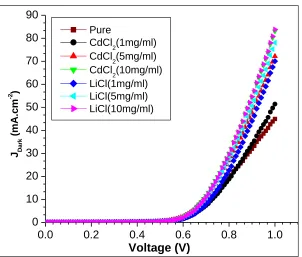
The series resistance (Rs) is an effective parameter which influences the solar cell behavior. Fig.5 shows the dark J-V curves for the pure PEDOT:PSS based device and devices with CdCl2 and
LiCl treated PEDOT:PSS based devices with different concentrations. Shen and co-authors have
argued that dark I-V characteristics is an efficient method to determine the Rs using the following
equation [18]:
I = IL− Io[eq(v−IRs) nkT⁄ − 1] −V−IRs
where IL is the light current, Io is the saturation current, n is the ideality factor, kT/q is the thermal energy, Rs is the series resistance, and Rsh is the shunt resistance. Typically, under dark
conditions the photocurrent is zero and therefore it could be presumed that Rsh is large enough to ignor the last term in Eq.4. Therfore, the dark I-V characterisitics can be described as follows:
I = Io[eq(V−IRs) nkT⁄ − 1] (5)
Re-arranging Eq. 5 the following relation is obtained:
V =nkT
q ln (
I
Io+ 1) + IRs (6)
Therefore, at higher applied voltage when I>>Io, Eq. 6 becomes:
IdV
dI = IRs+
nkT
q (7)
Using Eq. 7, Rs could be extracted from the slope at the high current region of I(dV dI)⁄ vs. I plot
as shown in Fig. 6 for the pure PEDO:PSS based device as an example. The lowest Rs was
exhibited by OSC devices with LiCl treated PEDOT:PSS with the value of Rs=52.3Ω compared
to devices employing pure PEDOT:PSS layer which revealed Rs=111.2Ω (results are
summarised in table 3). This improvement in Rs could be a key factor among others towards
achieving efficient electrode properties and therefore better device performance.
2.5.Photovoltaic measurements
Using measured J(V) characteristics under illumination, the PV properties of
PEDOT:PSS/P3HT:PCBM/Al OSCs were determined with PEDOT:PSS layers treated with
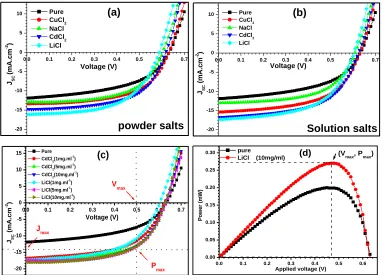
different metal chlorides. Fig.7 shows J-V curves of the investigated OSCs with different salts
treated-PEDOT:PSS. Devices with untreated PEDOT:PSS layer have exhibited lower PV
performance with Voc=0.62V, Jsc=11.9 mA.cm-1, FF=53% and PCE of 3.92%. These are in line with values frequently reported in the literature [19]. However, devices with powder metal salt
treated PEDOT:PSS layers have demonstrated significant improvement in all PV parameters as
revealed in Fig. 7(a), and the results are summarised in Table 1. The highest PCE of 5.6% and
short circuit current density Jsc=16.1 mA.cm-1 were achieved when LiCl2 powder was added to PEDOT:PSS; FF and Voc however, remained unchanged for all metal salts. When the same metal
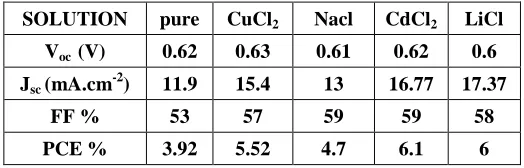
current density have reached values of about 6% and 17.4 mA.cm-1, respectively, in the case of LiCl added with the concentration of 1mg.ml-1. Once again, Voc and FF remained more or less unchanged for all metal salts studied in this work. Table 2 provides a summary of the electrical
properties of ITO/PEDOT:PSS/P3HT:PCBM/Al OSCs when metal chlorides were used in
aqueous form. The substantial increase in Jsc could be ascribed to the improved electrical conductivity of PEDOT:PSS layers as a result of metal salt treatment while enhanced PCE could
be associated with the increased films’ transmittance and surface roughness. Values of Voc remained unchanged since its value is mainly determined by the difference between the donor’s
higher occupied molecular orbital (HOMOd) and the lower unoccupied molecular orbital of the
acceptor (LUMOa) [20]. Furthermore, the metal salt treatment of PEDOT:PSS layers seems to
solve the wetting problem between the active layer, which is hydrophobic and the hydrophilic
PEDOT:PSS [21]. Such film processing method would be more favored for the fabrication of
inverted OSC structure. Electrical properties of the OSCs were further improved when the
concentration of CdCl2 and LiCl in aqueous solution increased to 5 and 10mg.ml-1 as demonstrated in Fig. 7(c). Moreover, the estimation of Jmax and Vmax values is illustrated in Fig
7(c). Fig. 7(d) shows the variation of output power as a function of applied voltage.
A summary of the electrical parameters of the ITO/PEDOT:PSS/P3HT:PCBM/Al OSCs treated
with these solutions is given in Table 3. PCE as high as 6.82% associated with FF=61%, Jsc≈18
mA.cm-2 and Voc=0.62 V have been recorded for LiCl treated devices using a higher concentration of 10mg.ml-1. Treatment of PEDOT:PSS with metal salts of concentrations higher than 10mg.ml-1 has not shown any further improvement in device performance. The above reported efficiency of 6.82% is found to be repeatable and on comparing this value with PCE
values obtained for other metal salts treatment (see Table 3 and data summarised in Fig. 7) it can
be confirmed that these results are very reliable. The optimization of electrode treatment [22-25]
as well as active layer thickness [26,27], are found to be key processing conditions to achieve
good device performance. In a recent review [11] conductivity enhancement of PEDOT:PSS thin
films for use in polymer light-emitting diodes and polymer solar cells has been discussed and
conductivity increase of up to 1000 S.cm-1 was reported depending on the type of additives. Recently modification of electron transport layer in P3HT:PCBM-based OSC has revealed 3
times improvement in the cells' PCE as compared to untreated electrodes [28]. In the present
preferably in solution form, has been shown to play crucial role in improving OSCs performance
as well as device stability.
3. Conclusion
PEDOT:PSS layers doped with different metal salts (LiCl, NaCl, CdCl2 and CuCl2) were
employed as hole transport layers in P3HT:PCBM based OSCs. The effects of metal salts added
as powders or as solutions on the electrical, optical as well as morphological properties of
PEDOT:PSS layers were investegated. PEDOT:PSS films doped with LiCl salt in solution form
with the concentration 10mg.ml-1 have exhibited the highest electrical conductivity as well as highest transmittance intensities. The metal salt doping has resulted in a more rough surface
morphology of PEDOT:PSS layers compared to prisitine PEDOT:PSS films. Furthermore, in
doped films the series resistance has exhibited much lower values of about 52.3Ω. These
improvements in PEDOT:PSS layer structural, optical and electrical properties are thought to be
the main reasons for the enhancement of P3HT:PCBM based solar cells performance, with PCE
as high as 6.82% , FF=61% and Jsc~18 mA.cm-2 in the case of PEDOT:PSS doped with LiCl (10mg.ml-1 aqueous solution) device.
Acknowledgement
Burak Kadem wishes to acknowledge the PhD scholarship awarded by the Ministry of Higher
Education and Scientific Research-Babylon University in Iraq. The support and fruitful
References
[1] Mahmoud, Alaa Y., et al. Thickness dependent enhanced efficiency of polymer solar cells with gold nanorods embedded in the photoactive layer. Sol. En. mater and sol. cells, 116 (2013) 1-8; DOI:10.1016/j.solmat.2013.03.037
[2] Kumar, Vikas, Wang, Heming and Rodenburg, Cornelia. High-efficiency inverted polymer solar cells via dual effects of introducing the high boiling point solvent and the high conductive PEDOT:PSS layer. Org. Elect., 15 (2014) 2059-2067;
DOI:10.1016/j.orgel.2014.06.001
[3] Christoph J. Brabec, Srinivas Gowrisanker, Jonathan J. M. Halls, Darin Laird, Shijun Jia, and Shawn P. Williams. Polymer–Fullerene Bulk-Heterojunction Solar Cells, Adv. Mater. 22(2010) 3839–3856; DOI: 10.1002/adma.200903697
[4] Zong-Xiang Xu, V. A. L. Roy, Kam-Hung Low and Chi-Ming Che. Bulk heterojunction photovoltaic cells based on tetra-methyl substituted copper(II) phthalocyanine : P3HT :PCBM composite, Chem. Commun., 47 (2011) 9654–9656; DOI: 10.1039/C1CC13827H
[5] I. Cruz-Cruza, M.Reyes-Reyesa, M.A.Aguilar-Frutisb, A.G.Rodrigueza,c, R.López-Sandovald. Study of the effect of DMSO concentration on the thickness of the PSS insulating barrier in PEDOT:PSS thin films, Synth. Met. 160 (2010) 1501–1506;
DOI:10.1016/j.synthmet.2010.05.010
[6] S.K.M. Jőnsson, J. Birgerson, X. Crispin, G. Greczynski, W. Osikowicz, A.W. Denier van der Gon, W.R. Salaneck, M. Fahlman. The effects of solvents on the morphology and sheet resistance in poly(3,4-ethylenedioxythiophene)–polystyrene sulfonic acid (PEDOT:PSS) films, Synth. Met. 139 (2003) 1–10; DOI:10.1016/S0379-6779(02)01259-6
[7] C S Suchand Sangeeth, Manu Jaiswal and Reghu Menon. Correlation of morphology and charge transport in poly(3,4-ethylenedioxythiophene)–polystyrenesulfonic acid (PEDOT:PSS) films, J. Phys.: Condens. Matter 21 (2009) 072101; DOI:10.1088/0953-8984/21/7/072101
[8] Hsieh-Cheng Han, Chi-Ang Tseng, Chan-Yi Du, Abhijit Ganguly, Cheong-Wei Chong, Sheng-Bo Wang, Chi-Feng Lin, Sheng-Hsiung Chang, Chao-Chin Su, Jiun-Haw Lee, Kuei-Hsien Chen and Li-Chyong Chen. Enhancing efficiency with fluorinated interlayers in small molecule organic solar cells, J. Mater. Chem., 22 (2012) 22899;
DOI: 10.1039/C2JM34091G
[9] R. Steim, F. R. Kogler and C. J. Brabec. Interface materials for organic solar cells, J. Mater. Chem., 20 (2010) 2499; DOI: 10.1039/B921624C
[10] Yijie Xia and Jianyong Ouyang. PEDOT:PSS films with significantly enhanced conductivities induced by preferential solvation with cosolvents and their application in polymer photovoltaic cells, J. Mater. Chem., 21 (2011) 4927; DOI: 10.1039/C0JM04177G
[11] Jianyong Ouyang. ‘‘Secondary doping’’ methods to significantly enhance the conductivity of PEDOT:PSS for its application as transparent electrode of optoelectronic devices, Displays 34 (2013) 423–436; DOI:10.1016/j.displa.2013.08.007
[13] Yue Gen Tian, WU Ji Huai, XIAO Yao Ming, YE Hai Feng, LIN Jian Ming and HUANG Miao Liang. Flexible dye-sensitized solar cell based on PCBM/P3HT hetrojunction. Chin. Sci. Bull., 56 (2011) 325−330; DOI: 10.1007/s11434-010-3080-0
[14] Lhd Skjolding, C Spegel, A Ribayrol, J Emneus and L Montelius. Characterisation of nano-interdigitated electrodes, Journal of Physics: Conference Series, 100 (2008) 052045;
DOI:10.1088/1742-6596/100/5/052045
[15] Chantal Badre, Ludovic Marquant, Ahmed M. Alsayed, and Lawrence A. Hough. Highly Conductive Poly(3,4-ethylenedioxythiophene):Poly (styrenesulfonate) Films Using 1-Ethyl-3-methylimidazolium Tetracyanoborate Ionic Liquid, Adv. Funct. Mater. 22 (2012) 2723–2727; DOI: 10.1002/adfm.201200225
[16] I. M. Dharmadasa. Review of the CdCl2 Treatment Used in CdS/CdTe Thin Film Solar Cell Development and New Evidence towards Improved Understanding, Coatings, 4 (2014) 282-307; DOI:10.3390/coatings4020282
[17] Yijie Xia, Jianyong Ouyang. Anion effect on salt-induced conductivity enhancement of poly (3,4-ethylene-dioxythiophene):poly (styrene sulfonate) films, Org. Elec. 11 (2010) 1129–113; DOI:10.1016/j.orgel.2010.04.007
[18] Yang Shen, Kejia Li, Nabanita Majumdar, Joe C. Campbell, Mool C. Gupta, Bulk and contact resistance in P3HT:PCBM heterojunction solar cells, Solar Energy Materials & Solar Cells 95 (2011) 2314–2317DOI:10.1016/j.solmat.2011.03.046
[19] Pontsho S. Mbule, Hendrik C. Swart, Odireleng M. Ntwaeaborw. Effects of thermal treatment and depth profiling analysis of solution processed bulk-heterojunction organic photovoltaic cells, J. Coll. and Inter Sci. 436 (2014) 9–15; DOI:10.1016/j.jcis.2014.09.005
[20] Daniel Rauh, Alexander Wagenpfahl, Carsten Deibel, and Vladimir Dyakonov. Relation of open circuit voltage to charge carrier density in organic bulk heterojunction solar cells. Appl. Phy. Let. 98 (2011) 133301; DIO.org/10.1063/1.3566979
[21] Yuze Lin, Yongfang Li and Xiaowei Zhan. Small molecule semiconductors for high-efficiency organic photovoltaics, Chem. Soc. Rev. 41 (2012) 4245-4272;
DOI: 10.1039/C2CS15313K
[22] Kuan Sun, Yijie Xia, Jianyong Ouyang. Improvement in the photovoltaic efficiency of polymer solar cells by treating the poly(3,4 thylenedioxythiophene):poly(styrenesulfonate) buffer layer with co-solvents of hydrophilic organic solvents and hydrophobic 1,2-dichlorobenzene, Sol. En. Mater. and Sol. Cel. 97 (2012) 89–96; DOI:10.1016/j.solmat.2011.09.039
[23] Jae Hyun Kim and Jyongsik Jang. Thickness and Composition Dependence of the Glass Transition Temperature in Thin Homogeneous Polymer Blend Films, Macro. 35 (2002) 311-313; DOI: 10.1021/ma010198n
[24] Benhu Fan, Xiaoguang Mei, and Jianyong Ouyang. Significant Conductivity Enhancement of Conductive Poly(3,4- thylenedioxythiophene): Poly(styrenesulfonate) Films by Adding Anionic Surfactants into Polymer Solution, Macro, 41 (2008) 5971-5973;
DOI: 10.1021/ma8012459
[26] Kyungkon Kim, Jiwen Liu, Manoj A. G. Namboothiry, and David L. Carroll. Roles of donor and acceptor nanodomains in 6% efficient thermally annealed polymer Photovoltaics, Appl. Phy. Let. 90 (2007) 16351; DOI.org/10.1063/1.2730756
[27] Riede, Moritz K. and Mueller, Toni and Maennig, Bert and Leo, Karl and Sylvester-Hvid, Kristian O. and Zimmermann, Birger and Niggemann, Michael and Gombert, Andreas. Comment on “Roles of donor and acceptor nanodomains in 6% efficient thermally annealed polymer photovoltaics” [Appl. Phys. Lett.90 (2007) 163511], Appl. Phys. Lett. 92, 076101 (2008); DOI.org/10.1063/1.2840155
Figure captions
Fig. 1 The transmittance spectra of PEDOT:PSS films: (a) on treatment with powder salts of NaCl, CuCl2, CdCl2 and LiCl; (b) on treatment with aqueous solution of NaCl, CuCl2, CdCl2 and LiCl in DI water with the concentration 1 mg.ml-1; (c) on treatment with aqueous solutions of LiCl and CdCl2 with the concentrations 5 mg.ml-1 and 10 mg.ml-1
Fig. 2 AFM images for pure (a) and LiCl aqueous solution treated PEDOT:PSS layers (b,c and d) of concentrations 1 mg.ml-1, 5 mg.ml-1 and 10 mg.ml-1 respectively
Fig. 3 (a) The cross-section of the P3HT:PCBM solar cell after modifying PEDOT:PSS layer and the scattering of the incident light within the active layer due to PEDOT:PSS surface roughness. (b) The PEDOT:PSS after chlorine salts treatment and the dissociation of the metal ions and the Cl¯ within the PEDOT:PSS
Fig. 4 (a) The conductivity of PEDOT:PSS variation with salts treatment. (b) Dependence of conductivity on LiCl and CdCl2 solution concentration
Fig. 5 Dark J-V characteristics for P3HT:PCBM solar cell based on PEDOT:PSS treatment with LiCl and CdCl2 aqueous solutions of different concentrations (1, 5, 10 mg.ml-1)
Fig.6 I(dV/dI) vs. I characteristics of P3HT:PCBM solar cell based on pure PEDOT:PSS
Table (1): OSC parameters of devices having PEDOT:PSS layer treated with powder salts (NaCl, CuCl2, CdCl2 and LiCl)
POWDER pure CuCl2 NaCl CdCl2 LiCl
Voc (V) 0.62 0.62 0.6 0.62 0.59
Jsc (mA.cm-2) 11.9 13.37 12.92 14.8 16.1
FF % 53 59 59 59 59
PCE % 3.92 5 4.6 5.4 5.6
Table (2): Photovoltaic parameters of devices with PEDOT:PSS layer treated with aqueous solutions of NaCl, CuCl2, CdCl2 and LiCl with the concentration of 1mg/ml
SOLUTION pure CuCl2 Nacl CdCl2 LiCl
Voc (V) 0.62 0.63 0.61 0.62 0.6
Jsc (mA.cm -2
) 11.9 15.4 13 16.77 17.37
FF % 53 57 59 59 58
PCE % 3.92 5.52 4.7 6.1 6
Table (3) Photovoltaic parameters of devices with PEDOT:PSS layer treated with different concentrations of aqueous solution of CdCl2 and LiC
SOLUTION Pure CdCl2
(1mg/ml)
CdCl2
(5mg/ml)
CdCl2
(10mg/ml)
LiCl (1mg/ml)
LiCl (5mg/ml)
LiCl (10mg/ml)
Voc (V) 0.62 0.62 0.62 0.62 0.6 0.62 0.62
Jsc (mA.cm-2) 11.9 16.77 17.23 17.8 17.37 17.3 17.97
FF % 53 59 62 61 58 63 61
PCE % 3.92 6.07 6.65 6.72 6 6.77 6.82
[image:15.612.177.438.134.221.2] [image:15.612.175.437.326.410.2] [image:15.612.86.532.513.619.2]Fig. 1 The transmittance spectra of PEDOT:PSS films: (a) on treatment with powder salts of NaCl, CuCl2, CdCl2 and LiCl; (b) on treatment with aqueous solution of NaCl, CuCl2, CdCl2 and
Fig. 1 The transmittance spectra of PEDOT:PSS films: (a) on treatment with powder salts of NaCl, CuCl2, CdCl2 and LiCl; (b) on treatment with aqueous solution of NaCl, CuCl2, CdCl2 and LiCl in DI water with the concentration 1 mg.ml-1; (c) on treatment with aqueous solutions of LiCl and CdCl2 with the concentrations 5 mg.ml-1 and 10 mg.ml-1
Fig. 3 (a) The cross-section of the P3HT:PCBM solar cell after modifying PEDOT:PSS layer and the scattering of the incident light within the active layer due to PEDOT:PSS surface roughness. (b) The PEDOT:PSS after chlorine salts treatment and the dissociation of the metal ions and the
[image:18.612.78.530.163.348.2]Fig. 4 (a) The conductivity of PEDOT:PSS variation with salts treatment. (b) Dependence of conductivity on LiCl and CdCl2 solution concentration
Pure NaCl CuCl2 LiCl CdCl2 0.32 0.34 0.36 0.38 0.40 0.42 0.44 0.46 (a) C o n d u c ti v it y ( S .c m -1 ) Metal salts solution powder
0 5 10 15 20
0.41 0.42 0.43 0.44 0.45 0.46 0.47 0.48 0.49 (b) C o n d u c ti v it y ( S .c m -1 )
Salt concentration (gm.ml-1)
[image:19.612.76.537.182.370.2]Fig. 5 Dark J-V characteristics for P3HT:PCBM solar cell based on PEDOT:PSS treatment with LiCl and CdCl2 aqueous solutions of different concentrations (1, 5, 10 mg.ml-1)
0.0 0.2 0.4 0.6 0.8 1.0
0 10 20 30 40 50 60 70 80 90
J D
a
rk
(
m
A
.c
m
-2 )
Voltage (V) Pure
CdCl2(1mg/ml)
CdCl
2(5mg/ml)
CdCl2(10mg/ml)
Fig.6 I(dV/dI) vs. I characteristics of P3HT:PCBM solar cell based on pure PEDOT:PSS
0.000 0.001 0.002 0.003
0.0 0.2 0.4 0.6 0.8 1.0 1.2
Pure PEDOT:PSS
I
(d
V
/d
I)
Fig. 7 J-V characteristics for P3HT:PCBM solar cell based on PEDOT:PSS treatment with several salts as powder (a), as aqueous solution (b), subjected to further treatment with different
CdCl2 and LiCl concentrations (c) and output power plotted as a function of voltage for pure PEDOT:PSS and LiCl (10mg.ml-1) aqueous solution-treated PEDOT:PSS based devices (d)
0.0 0.1 0.2 0.3 0.4 0.5 0.6 0.7
-20 -15 -10 -5 0 5 10 (a) powder salts JS C (m A .c m -2 ) Voltage (V) Pure CuCl2 NaCl CdCl2 LiCl
0.0 0.1 0.2 0.3 0.4 0.5 0.6 0.7
-20 -15 -10 -5 0 5 10 (b) Solution salts JSC ( m A .c m -2) Voltage (V) Pure CuCl2 NaCl CdCl2 LiCl
0.0 0.1 0.2 0.3 0.4 0.5 0.6 0.7
-20 -15 -10 -5 0 5 10 15 (c) Vmax Pmax Jmax JSC ( m A .c m -2) Voltage (V) Pure
CdCl2(1mg.ml
-1
)
CdCl2(5mg.ml
-1
)
CdCl2(10mg.ml
-1 ) LiCl(1mg.ml-1 ) LiCl(5mg.ml-1 ) LiCl(10mg.ml-1 )
0.0 0.1 0.2 0.3 0.4 0.5 0.6
0.00 0.05 0.10 0.15 0.20 0.25 0.30 (V
max, Pmax) (d) P o w e r (m W )
Applied voltage (V) pure