Proceedings of the 2019 Conference on Empirical Methods in Natural Language Processing 2692
Asynchronous Deep Interaction Network for Natural Language Inference
Di Liang∗, Fubao Zhang∗, Qi Zhang†, and Xuanjing Huang
School of Computer Science, Shanghai Key Laboratory of Intelligent Information Processing Fudan University, Shanghai, P.R.China 201203
{liangd17, fbzhang17, qz, xjhuang}@fudan.edu.cn
Abstract
Natural language inference aims to predict whether a premise sentence can infer another hypothesis sentence. Existing methods typi-cally have framed the reasoning problem as a semantic matching task. The both sentences are encoded and interacted symmetrically and in parallel. However, in the process of reason-ing, the role of the two sentences is obviously different, and the sentence pairs for NLI are asymmetrical corpora. In this paper, we pro-pose anasynchronous deep interaction net-work (ADIN)to complete the task. ADIN is a neural network structure stacked with mul-tiple inference sub-layers, and each sub-layer consists of two local inference modules in an asymmetrical manner. Different from previous methods, this model deconstructs the reason-ing process and implements the asynchronous and multi-step reasoning. Experiment results show that ADIN achieves competitive perfor-mance and outperforms strong baselines on three popular benchmarks: SNLI, MultiNLI, and SciTail.
1 Introduction
Natural language inference (NLI) is a pivotal and fundamental task in natural language understand-ing and artificial intelligence. The goal of NLI is to predict whether a premise sentence can in-fer another hypothesis sentence. As illustrated in Table1, logical relationships between the two sen-tences include entailment (if the premise is true, then the hypothesis must be true), contradiction
(if the premise is true, then the hypothesis must be false), andneutral(neither entailment nor contra-diction).
As a core task, conventional approaches have studied various aspects of the inference
prob-∗
Equal contribution. Alphabetical order of the last name.
†
Corresponding author.
Premise: A dog is jumping for a Frisbee in the snow.
Hypothesis: An animal is playing with a plastic toy.
Label:Entailment
Premise: He was crying like his mother had just walloped him.
Hypothesis: He was crying like his mother hit him with a spoon.
Label:Neutral
Premise: Several men in front of a white building.
Hypothesis:Several people in front of a gray building.
Label:contradiction
Table 1: Examples of natural language inference.
lem (MacCartney and Manning, 2008; Heilman and Smith, 2010). Thanks to the release of the largest publicly available corpus - the Stanford Natural Language Inference (SNLI) corpus ( Bow-man et al., 2015), neural network-based models have also been successfully used for this task (Parikh et al.,2016;Chen et al.,2016;Tay et al.,
2018;Duan et al.,2018). These methods typically treat the premise sentence and the hypothesis sen-tence equally, learn an alignment of sub-phrases in both sentences symmetrically and in parallel, and fuse local information for making a global deci-sion at the sentence level. They all frame the in-ference problem as a semantic matching task and ignore the reasoning process.
Pooling
Local Inference Prediction
Local Inference Interaction
& Prediction
Asynchronous Inference
Representation
×N
Pooling
Premise Hypothesis
ℎ ℎ ℎ ℎ ℎ
…
ℎ ℎ ℎ ℎ
Ha
ℎ
Concatenation Feed Forward & Norm
ℎ
Local Inference
Internal structure.
[image:2.595.86.512.62.233.2]ℎ ℎ ℎ -ℎ ℎ ⊙ℎ
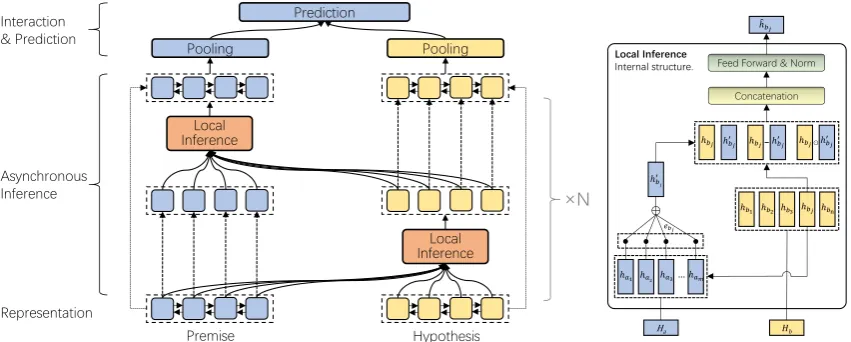
Figure 1: The overall view of our model. The left part is the main framework of this work. The dashed lines refer to the copy operation. The asynchronous inference layer is stacked withN inference sub-layers. In the first sub-layer of the asynchronous inference layer, the input is from the representation layer. Subsequently, the input of sub-layers come from the previous sub-layers. The right part is the detailed structure of the local inference module, takinghˆbj as an example.
example in Table1, the premise sentence can infer the hypothesis sentence, however, the hypothesis sentence can’t infer the premise sentence. The in-ference process intuitively needs to consider the relationship between two sentences in sequential order. According to the actual inference process, we argue that the model should first get the in-ferential information to model the hypothesis sen-tence, based on the premise sensen-tence, and then model premise sentence, based on the new repre-sentation for hypothesis sentence.
In this paper, we propose an asynchronous deep interaction network (ADIN) to achieve the reason-ing. This model is stacked with multiple inference sub-layers to implement the multi-step reasoning, and each sub-layer consists of two local inference modules in an asymmetrical manner to simulate the asynchronous and interpretable reasoning pro-cess. In a local inference module, we update the sentence representation by using the local infer-ence information, based on the attention of the other sentence. Lastly, we combine the inference information between the two sentences to make a global decision.
To demonstrate the effectiveness of our model, we evaluate it on three popular benchmarks: SNLI, MultiNLI, and SciTail. The experimen-tal results on these three data sets reveal that our method achieves competitive performance.
The main contributions of this work can be sum-marized as follows:
• We break the matching architecture that
inter-acts with the information between two sen-tences for alignment, and propose an asyn-chronous deep interaction network to achieve the asynchronous and multi-step reasoning.
• We deconstruct the reasoning process be-tween the two sentences, and the process can be analyzed step-by-step.
• The experimental results on three highly competitive benchmark datasets demonstrate that our model can achieve better perfor-mance than other strong baselines.
2 Approach
We define the natural language inference as a classification task that predicts the relation y ∈
Y for a given pair of sentences, where Y =
entailment, contradiction, neutral . In this work, we propose an asynchronous deep interac-tion network (ADIN) to complete this task. The overall architecture of the model is illustrated on the left part of Figure1.
Our sentence inference architecture, ADIN , is composed of the following three components: (1)
2.1 Local Inference Module
Given two natural sentences a and b, Ha = {hai|hai ∈ R
k, i = 1,2, ..., m} and H
b =
{hbj|hbj ∈ R
k, j = 1,2, ..., n} denote their k
-dimensional representations respectively , where
m, n denote the length of two sentences. Here, we implement a general reasoning process where the module captures the relevance between the two sentences, then incorporates the inferential infor-mation to the new representation for sentence b, based on the sentencea. First, we compute a co-attention matrix E ∈ Rm×n to capture the
rel-evance between the two sentences, each element
Ei,j ∈ R indicates the relevance between the i-th
word of sentence a and the j-th word ofb. For-mally, the co-attention matrix could be computed as:
Ei,j =PTtanh(W(haihbj)), (1)
where W ∈ Rs×k, P ∈
Rs, and denotes the
element-wise production operation. Then, we get
a-guided attentive vectors for sentenceb:
ebj =sof tmax(E:,j), (2)
h0bj =Ha·ebj, (3)
In order to enhance the interaction further, we combine the original vector anda-guided attentive vector for sentenceb. More formally:
h00bj = [hbj;h 0
bj;hbj−h 0
bj;hbj h 0
bj], (4)
˜
hbj =ReLU(Wbjh 00
bj+bbj), (5)
where [·;·;·;·] refers to the concatenation opera-tion. In Equation 4, we first calculate the differ-ence and the element-wise product for(hbj,h0bj). We get the new representation containinga-guided inferential information for sentenceb:
˜
Hb = (˜hb1,hb2˜ , ...,˜hbn), (6)
ˆ
Hb=LayerN orm( ˜Hb), (7)
WhereLayerN orm(.)is layer normalization (Ba et al.,2016). The resultHbˆ is a 2D-tensor that has the same shape asHb, and we refer to the whole
inferential module as:
InferentialModule(Ha,Hb), (8)
As described, the inferential module can capture the relevance between the two sentences, incorpo-rate the inferential information to the new repre-sentation for sentenceb, based on the sentencea.
2.2 Information Representation Layer
The information representation layer converts each word or phrase in the sentences into a vec-tor representation and constructs the representa-tion matrix for the sentences. We combine the multi-level features as the sentence representation. Each token is represented as a vector by using the pre-trained word embedding such as GloVe ( Pen-nington et al., 2014), word2Vec (Mikolov et al.,
2013), and fasttext (Joulin et al.,2016). It can also incorporate more syntactical and lexical informa-tion into the feature vector.
For ADIN, we use a concatenation of word embedding, character embedding, and syntactical features as the sentence representation. The word embedding is obtained by mapping token to high dimensional vector space by pre-trained word vec-tor (300D Glove 840B), and the word embedding is updated during training. Character-level em-bedding could alleviate out-of-vocabulary (OOV) problems and capture helpful morphological infor-mation. As in (Kim et al.,2016;Lee et al.,2016), we filter the character embedding with 1D convo-lution kernel. The character convoconvo-lutional feature maps are then max pooled over the time dimension for each token to obtain a vector.
As in (Chen et al., 2018), the syntactical fea-tures consist of one-hot part-of-speech (POS) tag-ging feature and binary exact match (EM) feature. For one sentence, the EM value is activated if the same word is found in the other sentence.
Next, ADIN adopts bidirectional Long Short-Term Memory network (Bi-LSTM) (Graves and Schmidhuber,2005) to model the internal tempo-ral interaction on both directions of the sentences. Consider a premise sentence p and a hypothesis sentenceq, we have got their multi-level features representation. Suppose the length ofpandqare
m andnrespectively. These multi-level features representation are then passed to a Bi-LSTM en-coder to obtain the context-dependent hidden state matrix, i.e,Hp ={hpi|hpi ∈R
d, i= 1,2, ..., m},
andHq ={hqj|hqj ∈ R
d, j = 1,2, ..., n}, where
dis the dimension of Bi-LSTM’s hidden state.
2.3 Asynchronous Inference Layer
frame the inference problem as a semantic match-ing task and ignore the reasonmatch-ing process, where the premise sentence and the hypothesis sentence are encoded and interacted symmetrically and in parallel.
In this paper, we utilize the local inference module to deconstruct the reasoning process and achieve the asynchronous and multi-step reason-ing for NLI. To model the multi-step reasonreason-ing habit, this model is stacked withN inference sub-layers to capture step-by-step the logic relation-ship between the two sentences. In the each in-ference sub-layer , two inferential modules per-form two asynchronous inference processes re-spectively.
Concretely, in the t-th inference sub-layer, given the representations of two sentences computed in the previous sub-layer : Vtp−1 = (vtp1−1,vtp2−1, ...,vtp−m1) and
Vtq−1 = (vt−1
q1 ,vtq2−1, ...,vtq−n1), we get the
deeper-level representations:
ˆ
Vtq =InferentialModule(Vtp−1,Vtq−1), (9)
ˆ
Vtp =InferentialModule(Vtq,Vtp−1), (10)
˜
vtqi = [ˆvtqi;vtq−i1], v˜tpj = [ˆvtpj;vtp−j1], (11)
vtqi =Bi-LSTM(˜vtqi−1,˜vtqi,˜vtqi+1), (12)
vtpj =Bi-LSTM(˜vtpj−1,˜vtpj,˜vtpj+1), (13)
where V0p = Hp, Vq0 = Hq, Vˆtp =
(ˆvtp1,ˆvtp2, ...,ˆvtpm), andVˆtq= (ˆvtq1,ˆvq2t , ...,ˆvtqn). In an inference sub-layer, we first get the inferential information to update the representation for hy-pothesis sentence, based on the premise sentence. Next, the model incorporates the inferential infor-mation to the premise sentence, based on the new representation for hypothesis sentence.
2.4 Interaction and Prediction Layer
To extract a proper representation for each sen-tence, we apply a mean pooling and a max pooling on each of them. Formally:
Vmeanp = m X
i=1 vNpi
m , V
max
p =
m max
i=1 v N
pi, (14)
Vmeanq = n X
j=1 vNqj
n , V
max
q =
n max
j=1 v N
qj, (15)
Vnewp = [Vmeanp ;Vmaxp ], Vnewq = [Vmeanq ;Vmaxq ],
(16)
Train Dev Test L(P) L(H) Vocab
SNLI 549K 9.8K 9.8K 14 8 36K MultiNLI1
392K 9.8K 9.8K 22 11 85K MultiNLI2 9.8K 9.8K 22 11 85K SciTail 23.6K 1.3K 2.1K 10 7
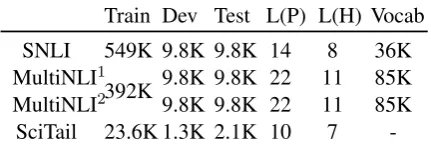
-Table 2: Statistics of datasets: SNLI, MultiNLI, Sci-Tail. L(P) and L(H) refer to the average length of two sentences. MultiNLI1 and MultiNLI2 indicate the in-domain and cross-in-domain datasets.
Then, we aggregate these representations Vnewp
andVnewq for the two sentencespandqin various ways in the interaction layer and the final feature vectorrfor the inference is obtained as follows:
r= [Vnewp ;Vnewq ;Vnewp −Vnewq ;Vnewp Vnewq ],
(17)
Finally, based on the aggregated featurer, we use a multi-layer perceptron (MLP) classifier to pre-dict the label:
v =ReLU(Wrr+br), (18)
ˆ
y=sof tmax(Wvv+bv). (19)
where Wr,br,Wv,and bv are trainable parame-ters. The entire model is trained end-to-end, opti-mizing the standard multi-class cross-entropy loss function.
3 Experiments
In this section, we present the evaluation of our model. We first perform quantitative evaluation, comparing our model with other strong baselines. We then conduct some qualitative analyses to un-derstand how ADIN achieve the asynchronous and multi-step inference between the premise sentence and the hypothesis sentence.
3.1 Dataset
We evaluate our model on three popular bench-marks: the Stanford Natural Language Inference (SNLI), the MultiGenre NLI Corpus (MultiNLI) and SciTail. Detailed statistical information of these datasets is shown in Table2.
[image:4.595.307.523.65.140.2]MultiNLI The corpus (Williams et al., 2017) is a new dataset for NLI, which contains 433k sentences pairs. Similar to SNLI, each pair is labeled with one of the following relationships: entailment, contradiction, or neutral. We com-pare on two test sets (matched and mismatched) which represent in-domain and out-domain perfor-mance. We use the same data split as provided by (Williams et al.,2017).
SciTailWe also include the newly released Sc-iTail dataset (Khot et al.,2018) which is a binary entailment classification task constructed from sci-ence questions. This is the first entailment set that is created solely from natural sentences that al-ready exist independently “in the wild” rather than sentences authored specifically for the entailment task. We use the same data split as in (Khot et al.,
2018).
3.2 Models for Comparing
To analyze the effectiveness of our model, we evaluate some traditional and state-of-the-art methods as baselines as follows on the above three data sets:
• DecompAtt(Parikh et al.,2016) is a simple model that decomposes the problem into par-allelizable attention computations.
• ESIM(Chen et al.,2016) is a previous state-of-the-art model for the natural language in-ference (NLI) task. It is a sequential model that incorporates the chain LSTM and the tree LSTM to infer local information between two sentences.
• BiMPMis proposed in (Wang et al.,2017). The model combines two sentence encoders and employs a multi-perspective matching mechanism in sentence pair modeling tasks.
• DIIN (Gong et al., 2017) is a novel class of neural network architectures that is able to achieve high-level understanding of the sentence pair by hierarchically extracting se-mantic features from the interaction space. The model uses word-by-word dimension-wise alignment tensors to encode the high-order alignment relationship between sen-tence pairs.
• DGEM (Khot et al., 2018) is a entailment model that exploits structure from the hy-pothesis only. This model shows the value of
structured representation on just the hypothe-sis for NLI.
• MwAN(Tan et al.,2018) is a multiway atten-tion network that applies multiple attenatten-tion functions to model the matching between a pair of sentences.
• CAFE (Tay et al., 2018) compares and
compresses alignment pairs using factoriza-tion layers which leverages the rich history of standard machine learning literature to achieve this task.
• AF-DMN(Duan et al.,2018) stacks multiple computational blocks in its matching layer to learn the interaction of the sentence pair bet-ter.
• KIM(Chen et al., 2018) is neural network-based NLI model that can benefit from ex-ternal knowledge. The model is capa-ble of leveraging external knowledge in co-attention, local inference collection, and in-ference composition components.
3.3 Experiment Configurations
Hyper-parameters may influence the performance of a neural network-based model. For all the three datasets, there are 3 inference sub-layers in the asynchronous inference Layer. An Adam (Kingma and Ba,2014) optimizer withβ1 as 0.9
andβ2 as 0.999 is used to optimize all trainable
parameters. The initial learning rate is set to 0.001 and is halved when the accuracy on the dev set de-creases. We also apply dropout (Srivastava et al.,
2014) on the all MLPs to avoid over-fitting, and the dropout rate is set to 0.2. For preprocessing, we just tokenize the sentences and lowercase the tokens.
For initialization, we initialize the word embed-dings with a 300D Glove 840B (Pennington et al.,
Model train test
Single Models
200D DecompAtt 90.5 86.8 (Parikh et al.,2016)
600D ESIM (Chen et al.,2016) 92.6 88.0 BiMPM (Wang et al.,2017) 90.9 87.5 448D DIIN (Gong et al.,2017) 91.2 88.0 300D MwAN (Tan et al.,2018) 94.5 88.3 300D CAFE (Tay et al.,2018) 89.8 88.5
300D AF-DMN 94.5 88.6
(Duan et al.,2018)
KIM (Chen et al.,2018) 94.1 88.6
ADIN (ours) 93.6 88.8
Ensemble Models
600D ESIM (Chen et al.,2016) 93.5 88.6 BiMPM (Wang et al.,2017) 93.2 88.8 448D DIIN (Gong et al.,2017) 92.3 88.9
300D AF-DMN 94.9 89.0
(Duan et al.,2018)
300D CAFE (Tay et al.,2018) 92.5 89.3
[image:6.595.308.525.63.394.2]ADIN (ours) 95.6 89.5
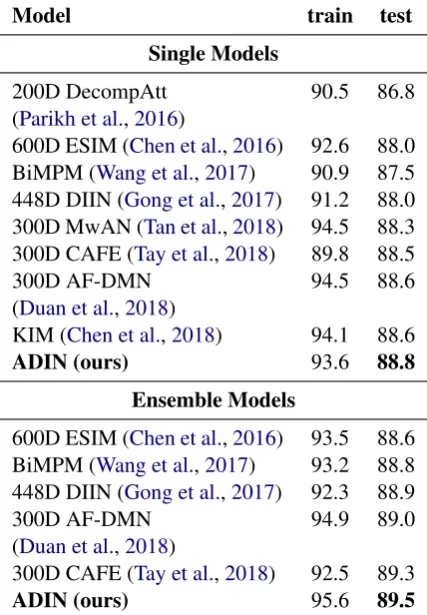
Table 3: Comparison with previous models on the SNLI dataset.
3.4 Ensemble
The ensemble strategy is an effective method to improve model accuracy. Following (Wang et al.,
2017), our ensemble model averages the prob-ability distributions from five individual single ADINs, who have exactly identical architectures but distinguished initializations on parameters.
3.5 Quantitative Results
We use the accuracy to evaluate the performance of ADIN and other models on datasets SNLI, MultiNLI, and SciTail.
Table3shows the results of different models on the training and test sets of SNLI. In Table3, the first category of methods are single models and the second category of methods are ensemble models. We show our model, ADIN, achieves state-of-the-art performance on the competitive leaderboard. In this table, KIM is neural network-based NLI model that can benefit from external knowledge, and other strong baselines encode and interact the both sentences symmetrically and in parallel.
Table 4 reports our results on the MultiNLI dataset. Similar to Table 3, the first category
Model Test Accuracy
Matched Mismatched
Single Models
ESIM 72.3 72.1
(Chen et al.,2016)
DIIN 78.8 77.8
(Gong et al.,2017)
AF-DMN 76.9 76.3
(Duan et al.,2018)
CAFE 78.7 77.9
(Tay et al.,2018)
MwAN 78.5 77.7
(Tan et al.,2018)
ADIN (ours) 78.8 77.9
Ensemble Models
DIIN 80.0 78.7
(Gong et al.,2017)
CAFE 80.2 79.0
(Tay et al.,2018)
MwAN 79.8 79.4
(Tan et al.,2018)
[image:6.595.72.286.65.373.2]ADIN (ours) 80.3 79.6
Table 4: Comparison with previous models on the MultiNLI dataset.
of methods are single models and the second category of methods are ensemble models. On MultiNLI, we compare on two test sets (matched and mismatched) which represent in-domain and domain performance. ADIN significantly out-performs ESIM, a strong baseline on the both test sets. An ensemble of ADIN models also achieve competitive result on the MultiNLI dataset.
As illustrated in Table5, our model outperforms the baselines and achieves an accuracy of 84.6%
in the test set of the SciTail dataset. As such, em-pirical results demonstrate the effectiveness of our proposed ADIN model on the challenging SciTail dataset.
[image:6.595.308.525.69.395.2]Model Accuracy
ESIM (Chen et al.,2016) 70.6 DecompAtt (Parikh et al.,2016) 72.3 DGEM (Khot et al.,2018) 77.3 CAFE (Tay et al.,2018) 83.3
[image:7.595.319.518.64.171.2]ADIN (ours) 84.6
Table 5: Comparison with previous models on the Sci-Tail dataset.
# layers Dev Test
1 88.6 88.4
2 88.9 88.6
3 89.0 88.8
Table 6: Effect of number of asynchronous inference layers on the SNLI.
3.6 Model Analysis
To better understand the performance of ADIN, we analyze the effect of each key component of the proposed model on the SNLI dateset.
Table 6 shows the performance with a differ-ent number of asynchronous inference sub-layers. As we can see, with the number of sub-layers in-creases from 1 to 3, the performance inin-creases both on the development set and the test set. As the level of reasoning deepens, the model captures more inferential information. Because of compu-tational cost, we just set the number of sub-layers as 3 on SNLI and other two datesets.
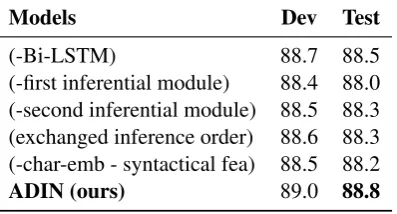
In Table7, we show the results of ablation study on our base model. After removing the Bi-LSTM in the asynchronous inference Layer, the model performance decrease by 0.3 percentage points on the test set. Furthermore, we study the effect of two inferential modules in one asynchronous inference sub-layer. Without the first inferen-tial module, that is, without the reasoning pro-cess from premise to hypothesis, the model perfor-mance sharply decreases by 0.8 percentage points. However, remove the second module and the test accuracy decreases by 0.5 percentage points. (ex-changed inference order) indicates that we get the inferential information to first model the premise sentence, and then model hypothesis sentence. The performance of the model is reduced to 88.3% after exchanging inference order between two sen-tences. The above three experiments reflect that the both modules are not equally important for the
Models Dev Test
(-Bi-LSTM) 88.7 88.5
(-first inferential module) 88.4 88.0 (-second inferential module) 88.5 88.3 (exchanged inference order) 88.6 88.3 (-char-emb - syntactical fea) 88.5 88.2
ADIN (ours) 89.0 88.8
Table 7: Effect of components on the SNLI.
Premise
(1) AdogisjumpingforaFrisbeein thesnow. (2) AdogisjumpingforaFrisbeein the snow. (3) AdogisjumpingforaFrisbeein the snow. (4) AdogisjumpingforaFrisbeein the snow.
Hypothesis
(1) Ananimalisplayingwitha plastictoy. (2) Ananimalisplayingwitha plastictoy.
(3) Ananimalisplayingwitha plastictoy.
[image:7.595.73.283.64.161.2](4) Ananimalisplayingwithaplastictoy.
Figure 2: Gradient visualization of premise and hy-pothesis. (1) Gradient scale of Hp,Hq on
represen-tation layer. (2) Gradient scale of V1p,V
1
q on the
first asynchronous inference sub-layer. (3) Gradient scale ofV2p,V2q on the second asynchronous inference sub-layer. (4) Gradient scale of V3p,V
3
q on the third
asynchronous inference sub-layer. Darker color cor-responds to a higher scale of gradient, and implies a higher contribution to the final prediction.
inference and the sentence pair for NLI is asym-metrical corpora. In the last comparative experi-ment, we explore the role of multi-level features. We remove character embedding and syntactical features and just keep word embedding as the rep-resentation. The test accuracy is reduced to 88.2%.
3.7 Case study
To visually demonstrate the validity of the model, we do a qualitative study using the first example in Table1.
Hp,Hq are the hidden states at the representa-tion layer of premise sentence and hypothesis sen-tence, andVtp,Vtq are the hidden states at thet-th asynchronous inference sub-layer. For a hidden statehpiof wordpi, we can calculate the gradient
scale
∂J
∂hpi
2
[image:7.595.100.263.207.274.2]play-ing with a plastic toy) instead of isolated words (like Frisbee and toy) become more focused af-ter an asynchronous inference layer. The results imply that ADIN could capture some higher-level patterns. As the level of reasoning deepens, the model captures more inferential information.
4 Related Work
As a long standing problem in NLP research, natural language inference (or textual entailment recognition) has been widely investigated for many years. Conventional works on NLI relies on handcrafted features such as syntactic infor-mation, n-gram overlapping and so on (Bowman et al.,2015;Heilman and Smith,2010).
Benefiting from the development of deep learn-ing and the availability of large-scale annotated datasets (Bowman et al., 2015), neural network-based models have also been successfully used for this task. And two categories of neural network-based models have been developed for this prob-lem. The first set of models is sentence encoding-based and aims to find vector representation for each sentence and classifies the relation by us-ing the concatenation of two vector representation (Bowman et al., 2016; Nangia et al., 2017;Mou et al.,2015). However, this kind of framework ig-nores the interaction between two sentences.
The other set of models uses the cross-sentence feature or inter-sentence attention from one sen-tence to another, and is hence referred to as a matching-aggregation framework. Parikh et al.
(2016) use attention to decompose the problem into subproblems that can be solved separately, thus making it trivially parallelizable. Chen et al.
(2016) propose a state-of-the-art model for the nat-ural language inference (NLI) task. It is a sequen-tial model that incorporates the chain LSTM and the tree LSTM to infer local information between two sentences. A novel class of neural network architectures is proposed in (Gong et al., 2017) that is able to achieve high-level understanding of the sentence pair by hierarchically extracting se-mantic features from interaction space. Tan et al.
(2018) propose a multiway attention network that designs four attention functions to match words in corresponding sentences, aggregates the match-ing information from each function, and combines the information from all functions to obtain the fi-nal representation. Tay et al.(2018) compare and compress alignment pairs using factorization
lay-ers which leverages the rich history of standard machine learning literature to achieve this task. AF-DMN (Duan et al.,2018) stacks multiple com-putational blocks in its matching layer to learn the interaction of the sentence pair better. KIM (Chen et al., 2018) is capable of leveraging ex-ternal knowledge in co-attention, local inference collection, and inference composition components to improve the performance. These methods all frame the inference problem as a semantic match-ing task and ignore the reasonmatch-ing process.
Different from the above methods, ADIN is a neural network structure stacked with multiple asynchronous inference layers, and each sub-layer consists of two local inference modules in an asymmetrical manner. This model deconstructs the reasoning process and implements the asyn-chronous and multi-step reasoning.
5 Conclusions
In this paper, we propose an asynchronous deep interaction network (ADIN) for natural language inference. To simulate human reasoning process, ADIN is stacked with multiple asynchronous in-ference sub-layers, and each sub-layer consists of two inferential modules in an asymmetrical man-ner. The model deconstructs the reasoning process and implements the asynchronous and multi-step reasoning. We evaluate our model on three pop-ular benchmarks: SNLI, MultiNLI, and SciTail. The experiment results show that ADIN achieves competitive performance and outperforms strong baselines.
Acknowledgments
The authors wish to thank the anonymous review-ers for their helpful comments. This work was partially funded by China National Key RD Pro-gram (No. 2018YFB1005104, 2018YFC0831105, 2017YFB1002104), National Natural Science Foundation of China (No. 61976056, 61532011, 61751201), Shanghai Municipal Science and Technology Major Project (No.2018SHZDZX01), STCSM (No.16JC1420401,17JC1420200).
References
Samuel R Bowman, Gabor Angeli, Christopher Potts, and Christopher D Manning. 2015. A large anno-tated corpus for learning natural language inference.
arXiv preprint arXiv:1508.05326.
Samuel R Bowman, Jon Gauthier, Abhinav Ras-togi, Raghav Gupta, Christopher D Manning, and Christopher Potts. 2016. A fast unified model for parsing and sentence understanding. arXiv preprint arXiv:1603.06021.
Qian Chen, Xiaodan Zhu, Zhen-Hua Ling, Diana Inkpen, and Si Wei. 2018. Neural natural language inference models enhanced with external knowl-edge. InProceedings of the 56th Annual Meeting of the Association for Computational Linguistics (Vol-ume 1: Long Papers), volume 1, pages 2406–2417.
Qian Chen, Xiaodan Zhu, Zhenhua Ling, Si Wei, Hui Jiang, and Diana Inkpen. 2016. Enhanced lstm for natural language inference. arXiv preprint arXiv:1609.06038.
Chaoqun Duan, Lei Cui, Xinchi Chen, Furu Wei, Con-ghui Zhu, and Tiejun Zhao. 2018. Attention-fused deep matching network for natural language infer-ence. InIJCAI, pages 4033–4040.
Yichen Gong, Heng Luo, and Jian Zhang. 2017. Natu-ral language inference over interaction space. arXiv preprint arXiv:1709.04348.
Alex Graves and J¨urgen Schmidhuber. 2005. Frame-wise phoneme classification with bidirectional lstm and other neural network architectures. Neural Net-works, 18(5-6):602–610.
Michael Heilman and Noah A Smith. 2010. Tree edit models for recognizing textual entailments, para-phrases, and answers to questions. ACL.
Armand Joulin, Edouard Grave, Piotr Bojanowski, and Tomas Mikolov. 2016. Bag of tricks for efficient text classification. arXiv preprint arXiv:1607.01759.
Tushar Khot, Ashish Sabharwal, and Peter Clark. 2018. Scitail: A textual entailment dataset from science question answering. InAAAI.
Yoon Kim, Yacine Jernite, David Sontag, and Alexan-der M Rush. 2016. Character-aware neural language models. InAAAI, pages 2741–2749.
Diederik P Kingma and Jimmy Ba. 2014. Adam: A method for stochastic optimization. arXiv preprint arXiv:1412.6980.
Jason Lee, Kyunghyun Cho, and Thomas Hofmann. 2016. Fully character-level neural machine trans-lation without explicit segmentation. arXiv preprint arXiv:1610.03017.
Bill MacCartney and Christopher D Manning. 2008. Modeling semantic containment and exclusion in natural language inference. In Proceedings of the 22nd International Conference on Computational Linguistics-Volume 1, pages 521–528. Association for Computational Linguistics.
Tomas Mikolov, Ilya Sutskever, Kai Chen, Greg S Cor-rado, and Jeff Dean. 2013. Distributed representa-tions of words and phrases and their compositional-ity. InAdvances in neural information processing systems, pages 3111–3119.
Lili Mou, Rui Men, Ge Li, Yan Xu, Lu Zhang, Rui Yan, and Zhi Jin. 2015. Natural language inference by tree-based convolution and heuristic matching.
arXiv preprint arXiv:1512.08422.
Nikita Nangia, Adina Williams, Angeliki Lazaridou, and Samuel R Bowman. 2017. The repeval 2017 shared task: Multi-genre natural language infer-ence with sentinfer-ence representations. arXiv preprint arXiv:1707.08172.
Ankur P Parikh, Oscar T¨ackstr¨om, Dipanjan Das, and Jakob Uszkoreit. 2016. A decomposable attention model for natural language inference. arXiv preprint arXiv:1606.01933.
Jeffrey Pennington, Richard Socher, and Christopher Manning. 2014. Glove: Global vectors for word representation. In Proceedings of EMNLP, pages 1532–1543.
Tim Rockt¨aschel, Edward Grefenstette, Karl Moritz Hermann, Tom´aˇs Koˇcisk`y, and Phil Blunsom. 2015. Reasoning about entailment with neural attention.
arXiv preprint arXiv:1509.06664.
Nitish Srivastava, Geoffrey Hinton, Alex Krizhevsky, Ilya Sutskever, and Ruslan Salakhutdinov. 2014. Dropout: a simple way to prevent neural networks from overfitting. The Journal of Machine Learning Research, 15(1):1929–1958.
Chuanqi Tan, Furu Wei, Wenhui Wang, Weifeng Lv, and Ming Zhou. 2018. Multiway attention networks for modeling sentence pairs. InIJCAI, pages 4411– 4417.
Yi Tay, Anh Tuan Luu, and Siu Cheung Hui. 2018. Compare, compress and propagate: Enhancing neu-ral architectures with alignment factorization for natural language inference. In Proceedings of EMNLP, pages 1565–1575.
Zhiguo Wang, Wael Hamza, and Radu Florian. 2017. Bilateral multi-perspective matching for natural lan-guage sentences. arXiv preprint arXiv:1702.03814.
Adina Williams, Nikita Nangia, and Samuel R Bow-man. 2017. A broad-coverage challenge corpus for sentence understanding through inference. arXiv preprint arXiv:1704.05426.
Kexin Yi, Jiajun Wu, Chuang Gan, Antonio Tor-ralba, Pushmeet Kohli, and Josh Tenenbaum. 2018. Neural-symbolic vqa: Disentangling reasoning from vision and language understanding. In Advances in Neural Information Processing Systems, pages 1039–1050.