Kent Academic Repository
Full text document (pdf)
Copyright & reuse
Content in the Kent Academic Repository is made available for research purposes. Unless otherwise stated all content is protected by copyright and in the absence of an open licence (eg Creative Commons), permissions for further reuse of content should be sought from the publisher, author or other copyright holder.
Versions of research
The version in the Kent Academic Repository may differ from the final published version.
Users are advised to check http://kar.kent.ac.uk for the status of the paper. Users should always cite the published version of record.
Enquiries
For any further enquiries regarding the licence status of this document, please contact:
If you believe this document infringes copyright then please contact the KAR admin team with the take-down information provided at http://kar.kent.ac.uk/contact.html
Citation for published version
Song, Yan and Cui, Ruilian and Hong, Xinhai and McLoughlin, Ian Vince and Shi, Jiong and
Dai, Lirong (2016) Improved language identification using deep bottleneck network. In: Acoustics,
Speech and Signal Processing (ICASSP), 2015 IEEE International Conference, 19-24 April 2015,
Brisbane, Australia.
DOI
https://doi.org/10.1109/ICASSP.2015.7178762
Link to record in KAR
http://kar.kent.ac.uk/55021/
Document Version
IMPROVED LANGUAGE IDENTIFICATION USING DEEP BOTTLENECK NETWORK
Yan Song
1, Ruilian-Cui
1, Xinhai-Hong
1, Jiong Shi
2, Ian Mcloughlin
1, Lirong-Dai
1 1National Engineering Laboratory of Speech and Language Information Processing, USTC
2
Anhui Post and Telecommunication College
ABSTRACT
Effective representation plays an important role in automatic spoken language identification (LID). Recently, several rep-resentations that employ a pre-trained deep neural network (DNN) as the front-end feature extractor, have achieved state-of-the-art performance. However performance is still far from satisfactory, especially for dialect and short-duration utterance identification tasks, due to the deficiency of exist-ing representations. To address this issue, this paper pro-poses improved representations to exploit the information extracted from different layers of the DNN structure. This is conceptually motivated by regarding the DNN as a bridge between low-level acoustic input and high-level phonetic output features. Specifically, we employ deep bottleneck net-work (DBN), a DNN with an internal bottleneck layer acting as a feature extractor We extract representations from two layers of this single network, i.e. TopLayer and DBN-MidLayer. Evaluations on the NIST LRE2009 dataset, as well as the more specific dialect recognition task, show that each representation can achieve an incremental performance gain. Furthermore, a simple fusion of the representations is shown to exceed current state-of-the-art performance.
Index Terms— Language Identification, Deep Neural Network, Bottleneck Feature, Representation Learning
1. INTRODUCTION
Spoken language identification (LID) is the process of de-termining the language identity of a given utterance. As a branch of audio classification, LID approaches mainly con-sist of two phases: (1) Front-end feature extraction, which converts a given utterance into a discrete token sequence or a set of continuous-valued feature vectors; (2) Back-end mod-eling, which constructs the representations for LID.
In phonotactic approaches, such as Phone Recognizer followed by Language Modeling (PRLM) and Phone Rec-ognizer followed by Support Vector Machines (PR-SVMs), the utterances are first tokenized into a sequence of phones using a pre-trained phone recognizer (PR). The phonotactic representations are then constructed using an n-gram model
Thanks to National Nature Science Foundation of China (grant, 61172158) and Chinese Universities Scientific Fund (grant Wk2100060008)
to capture the statistics of phonemic constraints and patterns for each language. A similar concept can be found with acoustic approaches, including Gaussian Mixture Model-Universal Background Model (GMM-UBM) and Gaussian Mixture Model-Support Vector Machine (GMM-SVM) meth-ods, where the short-term spectral features such as MEL-Frequency Cepstral Coefficients (MFCC) and Shifted Delta Cepstrum (SDC) are extracted and modeled using GMM.
It can be seen that effective representation (i.e. feature choice) plays an important role in LID. In recent years, be-sides the acoustic and phonotactic ones, intensive efforts have studied the effectiveness of representations from other do-mains, including prosodic and articulatory parameters [1] [2], universal attributes [3] [4], lexical knowledge and so on. Fur-thermore, with the help of modern machine learning tech-niques, such as discriminative training [5–7], Factor Anal-ysis (FA) [8], [9] [10] and Total Variability (TV) modeling [11, 12], the effectiveness of representations has been greatly improved, especially for long-duration utterances.
However, performance is still far from satisfactory for highly confusable dialects and short duration utterances. This may be because language information is latent and largely dependent on the statistical distribution of extracted features. For short-duration utterances and for dialects, existing repre-sentations are clearly insufficient. They are also susceptible to variations introduced by different speech content, speakers, channels and background-noise. In our previous work [13], we showed that deep bottleneck features (DBF), the output from a constricted internal layer of a structured Deep Bot-tleneck Network (DBN), can effectively mine the contextual information embedded in speech frames. By representing each utterance as an i-vector, these LID systems were shown to achieve excellent performance in the NIST LRE2009 eval-uation.
In the current paper, we extend our previous approach by taking further advantage of the DBN structure. Our motiva-tion is that, if the pre-trained DBN can be considered as a bridge from low-level spectral or acoustic features to high-level phonetic features, then the output from different DBN layers may represent a graded mixture of acoustic and pho-netic information. Exploiting this may be advantageous for LID.
front-Fig. 1. The LID system using representation based on structured DBN
end feature extractor (shown in Fig.1), we evaluate the ef-fectiveness of representations from the internal bottleneck layer (i.e. DBN-MidLayer) and the topmost layer(i.e.DBN-TopLayer), for dialect and NIST LRE2009 tasks. The contri-butions of this paper can be stated as follows:
• We propose a novel phonetic utterance by averag-ing the outputs from the topmost layer of the DBN. Like [14, 15], senone posteriors1are used as the
frame-level features. However, we propose a new Hellinger kernel-based similarity measure between utterances, which we will show can achieve better performance using the same phonetic representation.
• We propose to fuse this representation with our previ-ous DBF-TV representation [13], and will demonstrate that excellent performance can be achieved, especially for dialects and short-duration test conditions.
In summary, the resulting system significantly outperforms the current best-performing method (i.e. that introduced by the authors in [13]) for both dialect recognition and short-duration test conditions on NIST LRE2009.
In the following sections, we first briefly describe the pro-cess of language identification using the representation based on DNN in Section 2. We then detail the representations ex-tracted from DNN in Section 3, which is followed by experi-mental results and analysis in Section 4. Section 5 will con-clude and discuss future research.
2. SYSTEM DESCRIPTION
As shown in Fig.1, the proposed LID system mainly consists of three parts: 1) DBN structure, 2) Representation based on DBN and 3) Similarity measure.
DBN structure. The DBN structure is the same as the one in our previous work [13]. Different configurations of DBN have been evaluated on the NIST LRE2009 dataset, including dimensions of input and internal BN layer. With the optimal
1Senones are tied-states within context-dependent phones, which are
gen-erally used as the basic units for building word pronunciations in state-of-the-art automatic speech recognition systems
configuration, the resulting LID systems can outperform the original one in [13].
Given the Mandarin Corpus with phone-level labels, DBN training starts with an unsupervised pre-training process, in which a generative deep belief network consisting of stacked Restricted Boltzmann Machines (RBM) is obtained using the method described in [16]. After that, a supervised fine-tuning process is applied to optimize the DBN parameters by min-imizing the cross-entropy objective function with a standard error back-propagation (BP) algorithm.
Representation based on DBN. Given an utterance, two types of representation can be extracted, i.e. the DBN-TopLayer based on the output of the topmost layer of the DBN, and the DBN-MidLayer based on the output of the in-ternal BN layer; The DBN-TopLayer is constructed by aver-aging the frame-level posteriors. Intuitively, DBN-MidLayer can be processed in a similar way to the DBN-TopLayer. However, we found in practice that the average of widely different BN features doesn’t tell us much about the content of the underlying utterance, leading to inferior LID perfor-mance. Thus, the TV modeling technique is used instead in this work to construct the DBN-MidLayer representation.
Similarity measure. With the TopLayer and DBN-MidLayer representations, the distance measure should be de-fined for them respectively. Intuitively, a Euclidean distance can be used due to its simplicity and efficiency. However, the DBN-TopLayer is actually a histogram vector that counts DBN outputs. It is known that using Euclidean distance to compare histograms often yields inferior performance com-pared to usingχ2 or Hellinger kernel. For DBN-MidLayer
representation, conventional cosine distance measure is used as [12].
We will detail the representation and the corresponding similarity measure in Section 3.
3. REPRESENTATION BASED ON DBN
As mentioned, the DBN structure is pre-trained on a Man-darin Corpus with standard pre-training and fine-tuning pro-cesses, which can be regarded conceptually as forming a
bridge between low-level acoustic input and high-level pho-netic information. In this work, we evaluate the effectiveness of two specific layers of the DBN, i.e. the topmost output layer and the internal BN layer. We first introduce an optimal DBN structure used to extract the frame-level features. Then, the representations based on the outputs of the topmost layer and internal BN layer of the DBN structure, namely DBN-TopLayer and DBN-MidLayer are described respectively, followed by discussion of the similarity metric.
3.1. Optimal configuration of DNN structure
The empirically derived optimal DBN structure has 1 input layer, 5 hidden layers and 1 output layer, configured asn×
43−2048−2048−43−2048−2048−6004. Each frame fea-ture comprises 39-dimensional MFCC+△MFCC+△△MFCC, and 4-dimensional pitch features corresponding to the static pitch, 1st and 2nd derivatives and voiced speech confidence respectively. The DBN input feature is a concatenation of the
nframes centered around the current one. By heuristically settingn= 21, a 473-dimensional feature vector is obtained. The DBN contains an internal bottleneck layer of43hidden nodes, which is much smaller than other layers. This bot-tleneck layer output forms a compact representation of the input feature, which is considered to be more discrimina-tive and informadiscrimina-tive than conventional spectral features, i.e. SDC. Similarly to [14, 15], the topmost layer contains nodes corresponding to senones. Conventionally, the senones are automatically defined by a decision tree. For the Mandarin corpus, 6004 senones are used.
3.2. Similarity measure for DBN-TopLayer
LetQ = qk, k = 1, . . . , K be the set of senones. Given a
T frame speech utterance,U =ut, t= 1, . . . , T, the senone
posteriorsp(qk|ut)can be predicted by feeding forward the
input feature vectorutthrough the DBN structure. As shown
in Fig.1, the DBN-TopLayer representation,[C1, . . . ,CK]T
, is the average of the senone posteriors predicted at a frame-level. Each entry inCcan be calculated as
Ck = 1 T T X t=1 p(qk|ut) (1)
which is fixed-length feature vector that counts the frequency of senones in the utterance.
Given two utterances Ci,Cj, the similarity measure k(Ci,Cj)defined using a Hellinger kernel is
k(Ci,Cj) = q CT iCj= p CiTpCj (2)
We can see that calculation of the Hellinger kernel is equiva-lent to a dot-product of the square-root of the DBN-TopLayer features.
3.3. Similarity measure for DBN-MidLayer
We use the TV modeling technique to extract an i-vector as the DBN-MidLayer representation. Given utterance U, the GMM supervectorMis created by stacking the mean vectors
of a GMM adapted to that utterance, modeled as follows
M=m+Tw (3)
wheremis the UBM super-vector,Tis a low rank
rectangu-lar matrix. wis the required low-dimensional i-vector with
normal distributionN(0,I). The training process of loading
matrixTis similar to the eigen-voice method [17].
After i-vector extraction, two intersession compensation techniques are applied to remove the nuisance. The first is linear discriminant analysis (LDA) which is a popular dimen-sion reduction method in the machine learning community. Generally, LDA is based on the discriminative criterion that attempts to define new axes minimizing the within-class vari-ance, while maximizing the between-class variance. The sec-ond intersession compensation technique we used is within-class covariance normalization (WCCN), which normalizes the cosine kernel between utterances with an inverse of the within-class covariance [11].
IfB,Adenote LDA and WCCN projection matrices
re-spectively, the resulting DBN-MidLayer representation be-comes
ˆ
w=BTATw (4)
and the cosine distance measure between two utteranceswˆi
andwˆjcan then be defined as
k( ˆwi,wˆj) = wˆ
T i wˆj
kwˆikkwj k (5) 4. EXPERIMENTS
To evaluate the effectiveness of the proposed system, we conducted extensive experiments. Firstly on 4 Arabic di-alects (Iraqi, Levantine, MSA and Maghrebi) taken from NIST LRE2011, and secondly on the NIST LRE2009 dataset with 23 target languages (Amharic, Bosnian, Cantonese, Creole, Croatian, Dari, English-American, English-Indian, Farsi, French, Georgian, Hausa, Hindi, Korean, Mandarin, Pashto, Portuguese, Russian, Spanish, Turkish, Ukrainian, Urdu and Vietnamese). The training utterances for each lan-guage mainly come from two different channels; the dataset of Conversational Telephone Speech (CTS) and the narrow band Voice of America (VOA) radio broadcast dataset.
We have implemented six LID systems based on different representations for evaluation, including phonotactic, acous-tic and our proposed DBN-based ones, detailed as follows:
S1 the PR-SVM system using Russian PR provided by BUT as a front-end feature extractor, with a bag-of-ngram utterance representation, and an SVM classifier trained using the kernel proposed in [18].
S2 a similar PR-SVM system using a Mandarin PR, trained using a front-end DBN feature extractor.
S3 the phonetic system implemented as described in [14,15].
P4 our first proposed system, using the average of senone probabilities taken from the topmost layer of a DBN system, followed by SVM with Hellinger kernel 3.
P5 a better tuned version of the DBN system using TV mod-eling presented in [13]. In the current implementation, the i-vector dimension is 600. The number of Gaussian components is 512 for the dialect recognition task, and 2048 for the NIST LRE2009 evaluations.
P6 a system which fuses the classification scores obtained from systems P4 and P5.
As illustrated in [19] [20], we use average decision cost function (Cavg), and equal error rate (EER) as the
perfor-mance measurements. The use of these standard evaluation criteria, dataset and evaluation task allow for direct compari-son between systems.
4.1. Arabic Dialect Recognition Evaluation
To evaluate the performance of the given systems for dialect recognition, we choose the Arabic task from NIST LRE2011. Results are presented in Table 1, where we can see that the phonetic representation using PR based on a DBN structure outperforms the conventional PR with NN/HMM by about
2%−4% (S2 vs. S1). The phonetic system using senone posteriors [14] is better than conventional PR-SVM using a bag-of-trigram representation (the previous best configuration for PR-SVM) (S3 vs. S2). Compared to the senone posteri-ors [14], an additional absolute1%performance improvement is achieved by using the proposed DBN-toplayer representa-tion (P4 vs. S3). It can be seen that, for dialect recognirepresenta-tion, the DBN-midLayer representation is actually more effective than the phonetic system (P5 vs. P4). This is feasible since the distinction between dialects may be smoothed or degraded by the action of the PR. However, a PR with powerful model-ing capability may compensate for this disadvantage. Usmodel-ing frame-level features instead of phones (S3, P4 vs. S1, S2) pro-vides another feasible solution. Furthermore, we can see that the fusion of DBN-TopLayer and DBN-MidLayer achieves the currently best achievable performance. This validates the hypothesis that output from different layers of a single DBN can improve LID performance, by incorporating information from both acoustic and phonotactic representations.
4.2. NIST LRE2009 evaluations
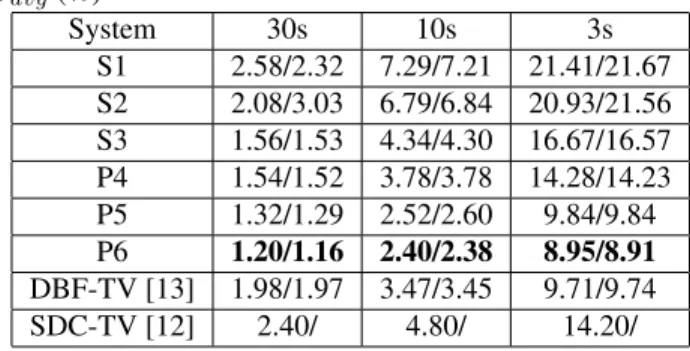
To evaluate the performance on a standard evaluation set, we conducted experiments on the LRE2009 dataset. Results are presented in Table 2, where the similar conclusion as dialects
Table 1. Evaluations on Arabic recognition in terms of EER andCavg(%) System 30s 10s 3s S1 7.93/7.69 17.27/16.95 30.13/29.57 S2 5.16/4.96 13.40/13.10 28.71/28.33 S3 4.13/4.06 12.48/12.24 26.19/25.98 P4 3.92/3.84 11.49/11.31 25.02/24.36 P5 2.70/2.56 7.63/7.17 19.47/19.03 P6 2.34/2.26 7.13/6.94 18.48/18.40
Table 2. Evaluations on NIST LRE2009 in terms of EER and
Cavg(%) System 30s 10s 3s S1 2.58/2.32 7.29/7.21 21.41/21.67 S2 2.08/3.03 6.79/6.84 20.93/21.56 S3 1.56/1.53 4.34/4.30 16.67/16.57 P4 1.54/1.52 3.78/3.78 14.28/14.23 P5 1.32/1.29 2.52/2.60 9.84/9.84 P6 1.20/1.16 2.40/2.38 8.95/8.91 DBF-TV [13] 1.98/1.97 3.47/3.45 9.71/9.74 SDC-TV [12] 2.40/ 4.80/ 14.20/
can be observed: Namely that the proposed phonetic system using DBN-TopLayer representation (P4) significantly out-performs conventional PR-SVMs (S1, S2) and the system us-ing senone posteriors (S3). The tuned DBN-MidLayer (P5) using the configuration as illustrated in Section 3 achieved much better performance than either the previously reported one [13] or the best reported results from NIST LRE 2009 [12] (both results are listed at the end of the table). Again, P6, the fusion of both acoustic and phonetic systems, performs best overall, by a significant margin.
5. CONCLUSION AND FUTURE WORK
This paper has built on the previous work of the authors which demonstrated state-of-the-art performance on the NIST LRE2009 LID task using features extracted from a deep bot-tleneck network (DBN). Motivated by the observation that the deep neural network acts as a bridge spanning between a purely acoustic feature input and a purely phonotactic classi-fication, this paper proposed using a fusion of representations extracted from a single well-trained DBN. It is well known that both acoustic and phonotactic features can be applied to the LID task, and that each have their own strengths. There-fore this paper proposed and explored fusing these strengths. Results exhibit excellent performance for both dialect recog-nition and LID, on NIST LRE tasks. In addition, this paper proposed using a novel averaging method, with Hellinger kernel based similarity measure, for the top level DBN poste-riors, which was shown to perform well.
6. REFERENCES
[1] Driss Matrouf, Martine Adda-Decker, Lori Lamel, and Jean-Luc Gauvain, “Language identification incorpo-rating lexical information.,” inProceedings of the Inter-national Conference on Spoken Language Processing, 1998, vol. 98, pp. 181–184.
[2] Stephen J Eady, “Differences in the F0 patterns of speech: Tone language versus stress language,” Lan-guage and Speech, vol. 25, no. 1, pp. 29–42, 1982. [3] Sabato Marco Siniscalchi, Jeremy Reed, Torbjørn
Svendsen, and Chin-Hui Lee, “Exploring universal at-tribute characterization of spoken languages for spoken language recognition.,” in Proceedings of the Annual Conference of the Intermational Speech Communication Association, 2009, pp. 168–171.
[4] Hamid Behravan, Ville Hautamaki, Sabato Marco Sinis-calchi, Elie Khoury, Tommi Kurki, Tomi Kinnunen, and Chin-Hui Lee, “Dialect levelling in finnish: A univer-sal speech attribute approach,” inProceedings of Inter-speech 2014, 2014.
[5] Dan Qu and Bingxi Wang, “Discriminative training of GMM for language identification,” inProceedings of ISCA & IEEE Workshop on Spontaneous Speech Pro-cessing and Recognition, 2003.
[6] Lukas Burget, Pavel Matejka, and Jan Cernocky, “Dis-criminative training techniques for acoustic language identification,” in Proc IEEE Int Conf Acoust Speech Signal Process, 2006, vol. 1, pp. 209–212.
[7] Fabio Castaldo, Daniele Colibro, Emanuele Dalmasso, Pietro Laface, and Claudio Vair, “Acoustic language identification using fast discriminative training.,” in
Proceedings of the Annual Conference of the Interma-tional Speech Communication Association, 2007, vol. 7, pp. 346–349.
[8] Claudio Vair, Daniele Colibro, Fabio Castaldo, Emanuele Dalmasso, and Pietro Laface, “Channel fac-tors compensation in model and feature domain for speaker recognition,” inProceedings of Odyssey 2006: Speaker and Language Recognition Workshop, 2006, pp. 1–6.
[9] Fabio Castaldo, Daniele Colibro, Emanuele Dalmasso, Pietro Laface, and Claudio Vair, “Compensation of nuisance factors for speaker and language recognition,”
IEEE Trans Audio Speech Lang Processing, vol. 15, no. 7, pp. 1969–1978, 2007.
[10] Valiantsina Hubeika, Lukas Burget, Pavel Matejka, and Petr Schwarz, “Discriminative training and channel
compensation for acoustic language recognition.,” in
Proceedings of the Annual Conference of the Interma-tional Speech Communication Association, 2008, pp. 301–304.
[11] Najim Dehak, Patrick J Kenny, R´eda Dehak, Pierre Du-mouchel, and Pierre Ouellet, “Front-end factor analy-sis for speaker verification,” IEEE Trans Audio Speech Lang Processing, vol. 19, no. 4, pp. 788–798, 2011. [12] Najim Dehak, Pedro A Torres-Carrasquillo, Douglas A
Reynolds, and Reda Dehak, “Language recognition via i-vectors and dimensionality reduction.,” inProceedings of the Annual Conference of the Intermational Speech Communication Association, 2011, pp. 857–860. [13] Yan Song, Bing Jiang, YeBo Bao, Si Wei, and Li-Rong
Dai, “I-vector representation based on bottleneck fea-tures for language identification,”Electron Lett, vol. 49, no. 24, pp. 1569–1570, 2013.
[14] Luciana Ferrer, Yun Lei, Mitchell Mclaren, and Nico-las Scheffer, “Spoken language recognition based on senone posteriors.,” inProceedings of the Interspeech 2014, 2014.
[15] Yun Lei, Luciana Ferrer, Mitchell Mclaren, and Nicolas Scheffer, “Application of convolutional neural networks to language identification in noisy conditions,” in Pro-ceedings of Odyssey 2014, 2014.
[16] Geoffrey E Hinton and Ruslan R Salakhutdinov, “Re-ducing the dimensionality of data with neural networks,”
Science, vol. 313, no. 5786, pp. 504–507, 2006. [17] Patrick Kenny, Gilles Boulianne, and Pierre Dumouchel,
“Eigenvoice modeling with sparse training data,” IEEE Trans Speech Audio Process, vol. 13, no. 3, pp. 345– 354, 2005.
[18] P.A.Torres-Carrasquillo and et.al. E. Singer, “Discrim-inative training techniques for acoustic language iden-tification,” inProceedings of ICASSP 2006, 2006, pp. 209–212.
[19] Alvin Martin and Craig Greenberg, “The 2009 NIST language recognition evaluation,” in Proceedings of Odyssey 2009: The Speaker and Language Recognition Workshop, 2010, pp. 165–171.
[20] Alvin Martin, Craig Greenberg, M. Howard Hohn, George R.Doddingtong, and John J. Godfrey, “Nist language recognition evaluation-past and future,” in
Odyssey 2014: The Speaker and Language Recognition Workshop, 2014.