Controlling Length in Abstractive Summarization Using a Convolutional
Neural Network
Yizhu Liu1 Zhiyi Luo2 Kenny Q. Zhu3 Shanghai Jiao Tong University, Shanghai, China {1liuyizhu,2jessherlock}@sjtu.edu.cn,3[email protected]
Abstract
Convolutional neural networks (CNNs) have met great success in abstractive summariza-tion, but they cannot effectively generate sum-maries of desired lengths. Because generated summaries are used in difference scenarios which may have space or length constraints, the ability to control the summary length in ab-stractive summarization is an important prob-lem. In this paper, we propose an approach to constrain the summary length by extending a convolutional sequence to sequence model. The results show that this approach gener-ates high-quality summaries with user defined length, and outperforms the baselines consis-tently in terms of ROUGE score, length varia-tions and semantic similarity.
1 Introduction
Great progress (Rush et al., 2015; Chopra et al., 2016; Nallapati et al., 2016; See et al., 2017; Paulus et al., 2017) has been made recently on abstractive summarization. Many use sequence-to-sequence model based on RNN and attention mechanism (Rush et al., 2015), which was orig-inally used for machine translation (Sutskever et al., 2014; Bahdanau et al., 2014). Recently, Gehring et al.(2017) proposed a convolutional se-quence to sese-quence model equipped with Gated Linear Units (Dauphin et al.,2017), residual con-nections (He et al., 2016) and attention mecha-nism. Such a convolutional model achieves state-of-the-art accuracies in abstractive summarization on single sentence summarization, and it is much faster than the previous recurrent models as it can be easily parallelized. Furthermore, unlike recur-rent models, the convoluational model has more stable gradients because of its backpropagation path.
Constraining summary length, while largely ne-glected in the past, is actually an important aspect
of abstractive summarization. For example, given the same input document, if the summary is to be displayed on mobile devices, or within a fixed area of advertisement slot on a website, we may want to produce a much shorter summary. Unfor-tunately, most existing abstractive summarization models are not trained to react to summary length constraints. When the constraint is given at test time, the current practice isi)to truncate the gener-ated summary afterN tokens are generated when you want the summaries of length no more than
N, and ii) ignore EOS (end of summary) token until the first M tokens are generated when you want the summaries of length at leastM. Such a crude way of controlling summary length makes the output summary incomplete or incoherent.
Previous research on controlling length of ab-stractive summary has been scarce. Fan et al. (2017), who applies convolutional sequence to se-quence model on multi-sentence summarization, converts length range as some special markers which are predefined and fixed. These markers are included in the training vocabulary. At train-ing time, the model prepends the input of the sum-marizer with marker indicating the length of input sequence. At test time, it controls the length of the generated summary also by prepending length marker indicating the desired length. Unfortu-nately, this approach can not generate summaries of arbitrary lengths. It only generates summaries in predefined ranges of length, thus only meets the length constraints approximately. This is shown in Table1. The above truncation practice can be used in conjunction with any of the length control meth-ods but the excessive parts (red) will be truncated leaving incomplete sentences.
de-Table 1: Example summaries generated by different models with a desired length of 10 (red parts exceed the 10 token limit).
Reference summary (53 tokens)
david de gea and victor valdes enjoyed an afternoon off at a theme park . spanish duo donned shades as they made the most of the rare sunshine . it has certainly been a rollercoaster season for manchester united . united are third in the premier league after an impressive recent run .
Basic CNN summary (35 tokens)
david de gea and victor valdes made the most of
the rare english sun with a trip to a theme park . david de gea and victor valdes enjoyed some fun in the sun .
(Fan et al.,2017) summary (30 tokens)
david de gea and victor valdes enjoyed a trip to a
theme park . the pair enjoyed a relaxing time just days after united ’s win against manchester city . Our Length Control summary (LC) (10 tokens)
david de gea and victor valdes enjoy some fun .
sired number of tokens (also shown in Table1). To do this, a length constraint is added to each con-volutional block of the initial layer of the model. This information is propagated layer by layer dur-ing traindur-ing. Our contributions are as follows:
1. We propose a simple but effective method to generate summaries with arbitrary desired length (Section2.2).
2. Our approach outperforms the state-of-art baseline methods substantially by all evalua-tion metrics, i.e., ROUGE scores, length vari-ation and semantic similarity (Section3).
3. The generated summaries from our model are natural and complete, especially when the de-sired length is short (Section3).
Next, we present the basic convolutional se-quence to sese-quence model and our extension, fol-lowed by the evaluation of our approach and a dis-cussion of related work.
2 Methodology
In this section, we will describe the model archi-tecture used for our experiments and propose our length control method which is implemented by extending the basic model.
For summarization problems based on seq2seq
model, given a sequence of tokens x =
(x1, x2, ..., xm)in the source document and a
se-quence of tokensy= (y1, y2, ..., yn)in the target
summary (i.e. m > n), the goal is to estimate the
conditional probabilityp(y|x):
p(y|x) = T
Y
t
p(yt|y1, y2, ..., yt−1,x) (1)
We aim at getting the above conditional prob-abaility which can generate summaries with arbi-trary desired length.
2.1 Basic CNN seq2seq Model
Our basic model consists of a multi-layer con-volutional sequence to sequence model (CNN seq2seq)1 (Gehring et al., 2017; LeCun et al., 1989) and an attention mechanism. Figure 1 il-lustrates the model.
!" !# !$
%"& %#& %" %#
⨁
[image:2.595.319.516.267.395.2]⨁
Figure 1: CNN seq2seq model
In the CNN seq2seq model, we obtain the input sequenceX= (X1, ..., Xm)and output sequence
Y = (Y1, ..., Yn) after combining word vectors
with their absolute positions in the document. We usez= (z1l, z2l, ..., zml )andh= (hl1, hl2, ..., hln)to denote the convolutional output of the encoder and decoder inl-th layer. Each element of the output sequence generated by the decoder network is fed back into the next layer of decoder network. Next, we add GLU (Dauphin et al., 2017) and residual connections (He et al.,2016) in each layer:
hli=GLU(Wl[hls−1, ..., hlt−1]+bl)+hli−1 (2)
where[hls−1, ..., htl−1]corresponds to thehliin the convolutional layers. The choice of s and t is based on kernel width and the padding method used to match the output of convolutional layers to the input length. We compute the probability distribution of generating the next elements yi+1 based on the current state and transform the top decoder outputhLi via softmax:
p(yi+1|y1, ..., yi,x) =sof tmax(WohLi +bo) (3)
1https://github.com/facebookresearch/
In addition, a multi-step attention mechanism that connects the encoder and decoder is used in each decoder layer. We define the decoder statedli
for attention as following:
dli=Wdlhil+bld+Yi (4)
The attention cli is a weighted sum of the en-coder outputs. The weights alij are based on the decoder states.
alij= exp(d l i·zju)
Pm
t=1exp(dli·ztu)
(5)
cli= m
X
j=1
alij(zju+Xj) (6)
At last, we add cli to the current decoder ele-mentshli, which forms the final output or the input of the next layer in the decoder.
2.2 Modified Model with Length Control (LC)
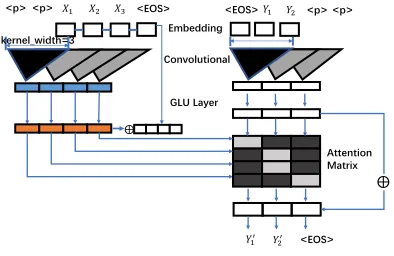
We propose an approach which can control the summary length in CNN seq2seq model. The model can generate different summaries by setting desired length. It has the ability to generate the EOS tag at the appropriate time point in a natural manner.
To produce a summary of a given desired length, we modify the basic model by feeding the desired length as a parameter into the decoder of the CNN seq2seq model. At training time, we use the true length of the gold summary as the de-sired length. At test time, we can give any dede-sired lengthlento the model and obtain a summary with length approximate tolen. The modified decoder is shown in Figure2.
𝑌1′ 𝑌2′ <EOS>
𝑌1 𝑌2 <p> <p>
Embedding Convolutional
<EOS>
GLU Layer
⨁
Attention Matrix
ke
rn
el_
wi
d
th
=3
Length
⨂
⨂
⨂
⨂
⨂
Figure 2: Modified Decoder
The CNN seq2seq model creates hierarchical structure over the input sequence. It is capable of capturing the correlation between elements over
short distances at lower layers and between ele-ments over long distances at higher layers. The useful information among the elements is aggre-gated after GLU. Therefore, we set the desired length as an input to the initial state of the decoder:
h1i=v(W1[h0s, ..., h0t]+b1)+h0i ∗len (7)
where W is a trainable parameter, lenis the de-sired length,v is GLU funciton andh0i is thei-th element in the initial layer.
In the above function, we add length informa-tion at first layer in CNN model. GLU is like a gate. It can filter some information from a particu-lar unit in each layer. The information attenuation occurs in GLU layer by layer. Different desired lengths have different degrees of information at-tenuation. Therefore the model is able to learn the probability of generating EOS with its own length information attenuation. This operation enables the model to produce a natural and complete sum-mary for a given length constraint naturally.
3 Evaluation
In this section, our benchmark is the CNN/Daily Mail DMQA dataset (Hermann et al., 2015; Nal-lapati et al., 2016;See et al.,2017) 2, consisting
of pairs of a single source document and a multi-sentence summary. The dataset includes 286,817 training pairs, 13,368 validation pairs and 11,487 test pairs. We follow the same pre-processing step used by See et al. (2017), and fill in the blanks with answer named entities. We show an example of such pairs in Table4(a).
We compare our length constrained summariza-tion model with the basic CNN seq2seq model and the state-of-the-art length controllable summariza-tion model (Fan et al.,2017)3. Following Fan et
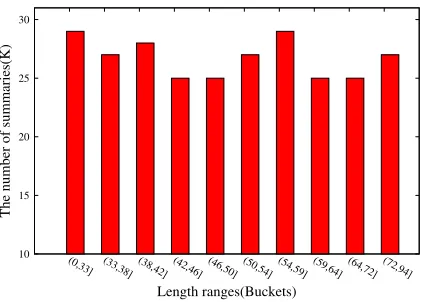
al., we distribute the dataset into a set of disjoint buckets that correspond to summaries of different lengths. Each bucket contains roughly equal num-ber of documents. The distribution is shown in Figure3.
All competing methods have three flavors:free,
truncated and exact. In the free version(Free),
given the desired length N, each method ates summaries naturally until an EOS is gener-ated. In the truncated version(Trunc), each method
2
https://cs.nyu.edu/kcho/DMQA/
3All datasets, source code and generated summaries
can be downloaded from http://202.120.38.146/
10 15 20 25 30
(0,33] (33,38] (38,42] (42,46] (46,50] (50,54] (54,59] (59,64] (64,72] (72,94]
The number of summaries(K)
[image:4.595.73.285.64.215.2]Length ranges(Buckets)
Figure 3: The buckets distribution of the dataset
artificially inserts an EOS if EOS has not been generated in the first N tokens. In the exact ver-sion(Exact), each method generates N non-EOS tokens by assigning a score of -∞to the EOS and inserts an EOS after the N-th token. The pur-pose of Free version is to evaluate the method’s ability to generate summaries with desired length; the purpose of the other two versions is to en-able fair comparison of the summaries in terms of their content given that the summaries are of equal length.
3.1 Experimental Setup
In the following experiments, all the competing models have 8 convolutional layers in both en-coder and deen-coder parts with kernel width as 3. For each convolutional layer, we set the hidden vector size as 512 and the embedding size as 256. To alleviate the overfitting problem, we add the dropout (p = 0.2) layer for all convolutional lay-ers and fully connected laylay-ers.
To optimize the proposed model, we use Nes-terov’s accelerated gradient method (Sutskever et al., 2013) with gradient clipping 0.1 (Pascanu et al., 2013), momentum 0.99, and learning rate 0.2. We terminate the training process when the learning rate drops below10e-5. We set beam size as 5 for the beam search algorithm in the testing step. Next, we introduce the evaluation metrics in the following experiments:
1. ROUGE scores (F1 score) of the
pro-duced summaries, including ROUGE-1(R-1), ROUGE-2(R-2) and ROUGE-L(R-L) (Lin, 2004). ROUGE-2 is the most popular metric for summarization.
2. Variance(Var) of the summary lengths
against the desired lengthlen:
var= 0.001∗ 1
n
n
X
i=0
|li−len|2, (8)
wherenis the number of pairs in the dataset, andliis the length of the generated summary
i. We introduce the variance to evaluate the ability of exact control of the output length.
3. Similarity(Sim) between generated
sum-maries and their corresponding reference summaries:
sim= 1
n
n
X
i=0
yi·y0i
||yi||||yi0||
(9)
wherenis the number of pairs.yiis the
vec-tor representation of the reference summaryi
andy0i is vector of the corresponding gener-ated summaryi. Bothyi andyi0 are the sum
of GloVe4word vectors of the words in these summaries.
We introduce the similarity metric here to com-plement the ROUGE scores because Yao et al. (2017a) showed that the standard ROUGE scores cannot capture semantic similarity beyond n-grams. Given the same source document, abstrac-tive summarization may create summaries that don’t share many words but mean the same. To show the effectiveness of this Sim metric, we de-sign a dataset from the summarization tasks of TAC 2010∼20115. The TAC dataset consists of 90
topics in total, each with 2 subset. Each subset has 4 reference summaries by different humans. We assume reference summaries about the same topic to be semantically similar to each other, while summaries across topics are unrelated. Thus we created 2,160 pairs of similar summaries as pos-tive data and 2,160 pairs of unrelated summaries as negative data. We then compute the Pearson corre-lation between the ROUGE score and the ground truth as well as between Sim and the ground truth and show the results in Table 2. Sim metric cer-tainly resembles semantic similarity better than ROUGE by this experiment.
In this paper, we don’t use manual evaluation as the major metric. The reason is that Lin (2004) showed that the manual evaluation is unstable and
4
https://nlp.stanford.edu/projects/glove/.
Table 2: Pearson correlation with the true semantic re-latedness
TAC 2010 TAC 2011
R-2 0.6107 0.6034
Sim 0.6653 0.7165
the inter-human agreement is low due to the vari-ety in abstractive summaries. The ROUGE scores and Similarity scores can respectively measure the syntactic similarity and semantic similarity. They are complementary to each other and give bet-ter quantitative assessment of the summarization quality.
3.2 Experiment 1: Gold Summary Lengths
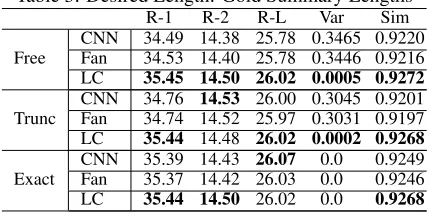
[image:5.595.74.289.442.549.2]In the first experiment, for each test document-summary pair, we set the desired length as the length of the gold summary and ask the competing methods to generate a summary with the desired length. As shown in Table3, the proposed model (LC) outperforms the other models on all of the evaluation metrics. The ROUGE score shows the accuracy of these models. Lower variance reflects better length control of the model. Higher similar-ity reflects better qualsimilar-ity of generated summaries from the semantic point of view.
Table 3: Desired Length: Gold Summary Lengths
R-1 R-2 R-L Var Sim
Free
CNN 34.49 14.38 25.78 0.3465 0.9220
Fan 34.53 14.40 25.78 0.3446 0.9216
LC 35.45 14.50 26.02 0.0005 0.9272
Trunc
CNN 34.76 14.53 26.00 0.3045 0.9201
Fan 34.74 14.52 25.97 0.3031 0.9197
LC 35.44 14.48 26.02 0.0002 0.9268
Exact
CNN 35.39 14.43 26.07 0.0 0.9249
Fan 35.37 14.42 26.03 0.0 0.9246
LC 35.44 14.50 26.02 0.0 0.9268
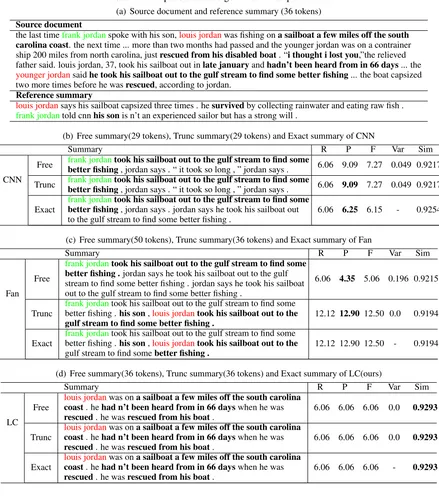
The LC model achieves the highest ROUGE and similarity scores as well as the lowest vari-ance in both Free and Exact version, which shows the effectiveness of LC for generating high quality summaries under length constraint. In the Trunc version, the LC model outperforms the other com-parable models on all evaluation metrics except for the ROUGE score. Note that, the ROUGE scores of LC model are very stable, indicating its effec-tive length control. As for the other two mod-els, they have better ROUGE score on Trunc ver-sion. However, as the example shown in Table 46, higher ROUGE scores do not necessarily mean
6The entities in different color indicate two important
roles in the text. The words in bold type mean correct content.
high quality abstractive summaries.
The ROUGE score consists of Recall(R), Preci-sion(P) and F1-measure(F). The summary tends to achieve a better ROUGE score when the length of generated summary is slightly shorter than the de-sired length. In Table 4(b), the CNN model has the same R score as LC model and a higher P score than LC model because of its slightly shorter length. We can see that the CNN model achieve a higher F score even its generated summary is not good. Moreover, for the basic model, the gener-ated summary always repeats the sentences when the length of generated summary is longer than the desired length. In Table 4(c), the P score of its Trunc version would be improved by a large mar-gin. Thus, the ROUGE score for the Trunc version biases toward the models with weak length con-trol. The generated summaries of the LC model in Table4(d), which capture the semantic of the ref-erence summary and satisfy the constraint length very well, are better than the other two models even with a slightly lower ROUGE score. The topic of this example is that Louis Jordan, who is the son of Frank Jordan, got lost during sailing and was finally rescued from his boat. Our model gen-erates the summary with correct information, but other two models get the Louis Jordan and Frank Jordan mixed up. This is correctly measured by the similarity scores.
3.3 Experiment 2: Arbitrary Lengths
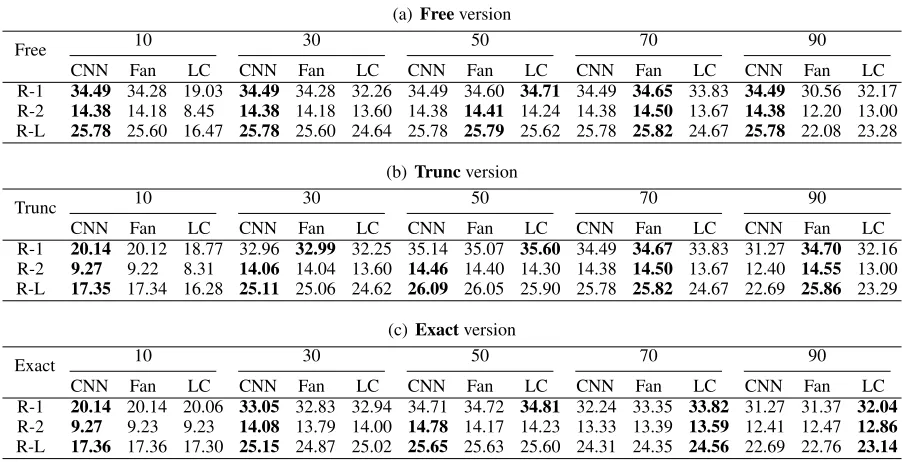
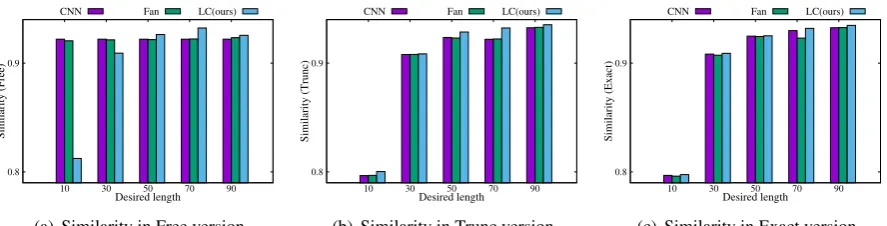
In the second experiment, we ask the methods to generate summaries with arbitrary lengths. We re-port the results of all three methods with five arbi-trary lengths: 10, 30, 50, 70 and 90. We show the performance of each model with different length constraints in Table5, Table6, Figure4and Figure 5. The basic CNN model has the same ROUGE scores in the Free version since it cannot control the length of generated summaries on its own. For Fan et al.(2017), the desired length is mapped to the model’s predefined fixed length range(s) that
contains the desired length before it produces its
summaries. For example, the desired length10is mapped to the first bucket(0,33].
Table 4: Example summaries generated in Experiment 1.
(a) Source document and reference summary (36 tokens)
Source document
the last timefrank jordanspoke with his son,louis jordanwas fishing ona sailboat a few miles off the south
carolina coast. the next time ... more than two months had passed and the younger jordan was on a contrainer
ship 200 miles from north carolina, justrescued from his disabled boat. “i thought i lost you,”the relieved
father said. louis jordan, 37, took his sailboat out inlate januaryandhadn’t been heard from in 66 days... the
younger jordansaidhe took his sailboat out to the gulf stream to find some better fishing... the boat capsized
two more times before he wasrescued, according to jordan.
Reference summary
louis jordansays his sailboat capsized three times . hesurvivedby collecting rainwater and eating raw fish .
frank jordantold cnnhis sonis n’t an experienced sailor but has a strong will .
(b) Free summary(29 tokens), Trunc summary(29 tokens) and Exact summary of CNN
Summary R P F Var Sim
CNN
Free frank jordantook his sailboat out to the gulf stream to find some
better fishing, jordan says . “ it took so long , ” jordan says . 6.06 9.09 7.27 0.049 0.9217
Trunc frank jordantook his sailboat out to the gulf stream to find some
better fishing, jordan says . “ it took so long , ” jordan says . 6.06 9.09 7.27 0.049 0.9217
Exact
frank jordantook his sailboat out to the gulf stream to find some
better fishing, jordan says . jordan says he took his sailboat out to the gulf stream to find some better fishing .
6.06 6.25 6.15 - 0.9254
(c) Free summary(50 tokens), Trunc summary(36 tokens) and Exact summary of Fan
Summary R P F Var Sim
Fan Free
frank jordantook his sailboat out to the gulf stream to find some
better fishing .jordan says he took his sailboat out to the gulf stream to find some better fishing . jordan says he took his sailboat out to the gulf stream to find some better fishing .
6.06 4.35 5.06 0.196 0.9215
Trunc
frank jordantook his sailboat out to the gulf stream to find some
better fishing .his son,louis jordantook his sailboat out to the
gulf stream to find some better fishing .
12.12 12.90 12.50 0.0 0.9194
Exact
frank jordantook his sailboat out to the gulf stream to find some
better fishing .his son,louis jordantook his sailboat out to the
gulf stream to find somebetter fishing .
12.12 12.90 12.50 - 0.9194
(d) Free summary(36 tokens), Trunc summary(36 tokens) and Exact summary of LC(ours)
Summary R P F Var Sim
LC Free
louis jordanwas ona sailboat a few miles off the south carolina coast. hehad n’t been heard from in 66 dayswhen he was
rescued. he wasrescued from his boat.
6.06 6.06 6.06 0.0 0.9293
Trunc
louis jordanwas ona sailboat a few miles off the south carolina coast. hehad n’t been heard from in 66 dayswhen he was
rescued. he wasrescued from his boat.
6.06 6.06 6.06 0.0 0.9293
Exact
louis jordanwas ona sailboat a few miles off the south carolina coast. hehad n’t been heard from in 66 dayswhen he was
rescued. he wasrescued from his boat.
6.06 6.06 6.06 - 0.9293
score may not be good even though the gener-ated summary matches the reference quite well semantically. The generated summaries from LC model are naturalandcomplete. The summaries with short desired length on Trunc and Exact ver-sion would be more vulnerable to the incomplete problem. We randomly sample 100 summaries generated by each model under Trunc and Ex-act with desired length of 10 and 30, and manu-ally inspect their readibility. This is a simplified human-evaluation of summarization, which just determines whether the sentences in summaries
under length control are complete or not. If com-plete, the score is 1; if not, it is 0. It is easier to accomplish and more reliable than other sophis-ticated human-evaluation. Table8shows that the LC model has a clear advantage over the other two models in terms of summary fluency.
similar-Table 5: Desired Length: 10, 30, 50, 70, 90
(a)Freeversion
Free 10 30 50 70 90
CNN Fan LC CNN Fan LC CNN Fan LC CNN Fan LC CNN Fan LC
R-1 34.49 34.28 19.03 34.49 34.28 32.26 34.49 34.60 34.71 34.49 34.65 33.83 34.49 30.56 32.17 R-2 14.38 14.18 8.45 14.38 14.18 13.60 14.38 14.41 14.24 14.38 14.50 13.67 14.38 12.20 13.00 R-L 25.78 25.60 16.47 25.78 25.60 24.64 25.78 25.79 25.62 25.78 25.82 24.67 25.78 22.08 23.28
(b)Truncversion
Trunc 10 30 50 70 90
CNN Fan LC CNN Fan LC CNN Fan LC CNN Fan LC CNN Fan LC
R-1 20.14 20.12 18.77 32.96 32.99 32.25 35.14 35.07 35.60 34.49 34.67 33.83 31.27 34.70 32.16 R-2 9.27 9.22 8.31 14.06 14.04 13.60 14.46 14.40 14.30 14.38 14.50 13.67 12.40 14.55 13.00 R-L 17.35 17.34 16.28 25.11 25.06 24.62 26.09 26.05 25.90 25.78 25.82 24.67 22.69 25.86 23.29
(c)Exactversion
Exact 10 30 50 70 90
CNN Fan LC CNN Fan LC CNN Fan LC CNN Fan LC CNN Fan LC
R-1 20.14 20.14 20.06 33.05 32.83 32.94 34.71 34.72 34.81 32.24 33.35 33.82 31.27 31.37 32.04
R-2 9.27 9.23 9.23 14.08 13.79 14.00 14.78 14.17 14.23 13.33 13.39 13.59 12.41 12.47 12.86
R-L 17.36 17.36 17.30 25.15 24.87 25.02 25.65 25.63 25.60 24.31 24.35 24.56 22.69 22.76 23.14
Table 6: Similarity of different length
(a) Freeversion
CNN Fan LC
10 0.9220 0.9205 0.8124 30 0.9220 0.9214 0.9092
50 0.9220 0.9216 0.9263
70 0.9220 0.9222 0.9323
90 0.9220 0.9234 0.9256
(b)Truncversion
CNN Fan LC
10 0.7966 0.7968 0.8003
30 0.9079 0.9080 0.9085
50 0.9236 0.9231 0.9286
70 0.9219 0.9222 0.9323
90 0.9325 0.9329 0.9353
(c) Exactversion
CNN Fan LC
10 0.7968 0.7961 0.7975
30 0.9083 0.9073 0.9090
50 0.9248 0.9245 0.9251
70 0.9299 0.9230 0.9320
[image:7.595.73.524.84.315.2]90 0.9325 0.9327 0.9347
Table 7: Generated summaries of LC (Free) model
10 theyounger jordanwasrescued from his
disabled boat.
30
louis jordanwasrescued from his disabled . heboat had n’t been heard from in 66 days in late january. he was rescued from his disabled boat .
50
“i thought i lost you, ” jordan says . the
younger jordanwas ona sailboat a few miles off the south carolina coast. “ i thought i lost
you , ” jordan tellshis son. jordan says he was
grateful to the people .
ity score is more reasonable for evaluation than ROUGE score. As shown in Table 6and Figure 4, the LC model achieves the highest similarity score except for the length of10and30in the Free version. The reason is that there is only 5% of testing data with the length of reference summary shorter than 30. Due to the effective length con-trol of LC model, the lengths of generated sum-maries from LC model are usually much shorter than those from the other models and the length of corresponding reference summaries when we
Table 8: The proportion of summaries that are natural and complete with desired length 10 and 30
Trunc Exact
10 30 10 30
CNN 0.41 0.37 0.48 0.47
Fan 0.50 0.42 0.53 0.57
LC 0.62 0.59 0.88 0.86
[image:7.595.80.286.469.585.2]0.8 0.9
10 30 50 70 90
Similarity (Free)
Desired length
CNN Fan LC(ours)
(a) Similarity in Free version
0.8 0.9
10 30 50 70 90
Similarity (Trunc)
Desired length
CNN Fan LC(ours)
(b) Similarity in Trunc version
0.8 0.9
10 30 50 70 90
Similarity (Exact)
Desired length
CNN Fan LC(ours)
[image:8.595.77.521.66.179.2](c) Similarity in Exact version
Figure 4: Similarity of different length
0 0.5 1 1.5 2
10 20 30 40 50 60 70 80 90
Variance
Length
CNN Fan LC(ours)
(a) Variance in Free version
0 0.5 1 1.5 2
10 20 30 40 50 60 70 80 90
Variance
Length
CNN Fan LC(ours)
[image:8.595.152.444.227.342.2](b) Variance in Trunc version
Figure 5: Variance of different length
3.4 Significance Test on Similarity Result
We use significance test to prove that similarity metric is reliable even though the numerical dif-ference of similarity scores in experiment is little. Because the similarity scores of generated sum-maries do not follow normal distribution, we take Kruskal-Wallis test (Loukina et al.,2014;Albert, 2017) as our significance test to measure that the difference of similarity results of three methods is significant or not. As shown in Table9, all p-values are less than 0.05. The smaller p-value, the higher significant. Thus, the difference of the sim-ilarity results is significant.
Table 9: p-value of significance test
Free Trunc Exact
Exp.1 3.4e-32 2.12e-45 0.01
Exp.2 0.0 4.6e-39 1.0e-4
4 Related Work
In this section, we discuss some previous work on length control in abstractive summarization and explain why we choose CNN as our basic summa-rization model.
4.1 Length Control for Abstractive Summarization
When summarizing a document, it is desirable to be able to control the length of summary so as to cater to different users and scenarios. Most abstractive summarization systems are based on encoder-decoder models and generate summaries whose length depends on the training summaries. Due to the variability of the sequence genera-tion models, such as the different structures and functions, it is hard to design a length constraint method on all summarization models.
spe-cial markers into the vocabulary which denote dif-ferent length ranges. It prepends the input of the summarizer with the marker during training and testing. These special markers are predefined and fixed. In this paper, we aim at generating complete summaries with arbitrary desired length naturally for CNN seq2seq model. We use multi-layers CNN seq2seq model on both encoder and decoder. We set the length constraint at the first layer of de-coder to implement the length control of the sum-marization. Compared with other methods, our approach can effectively control the length of gen-erated summary in a natural manner. Meanwhile, it can generate summaries with length approxi-mate to the desired length without semantic losing in less time.
4.2 Encoder-Decoder for Abstractive Summarization
Automatic document summarization generates short summaries for original documents. A sum-mary should cover the key topics of the origi-nal document(s). A good summary should be coherent, non-redundant and readable(Yao et al., 2017b). The research in abstractive summariza-tion with encoder-decoder model (Sutskever et al., 2014;Rush et al.,2015;Chopra et al.,2016; Nal-lapati et al.,2016;See et al., 2017;Paulus et al., 2017;Fan et al.,2017) has made some progress.
Most of them use RNN with different atten-tion mechanisms (Nallapati et al.,2016;See et al., 2017; Paulus et al., 2017). Rush et al. (2015) used RNN with soft-attention, whilePaulus et al. (2017) used the RNN with intra-attention. Re-cently, research on CNN based summarization has gained momentum. Gehring et al. (2017) pro-posed the CNN seq2seq model with multi-step at-tention, which was extended in (Fan et al.,2017). Bai et al.(2018) showed that CNN is more pow-erful than RNN for sequence modeling. What’s more, CNN enables much faster training and more stable gradients than RNN. Therefore we select CNN seq2seq model as our basic model and do not compare our model with RNN seq2seq model.
5 Conclusion
We presented a simple approach to modify exist-ing CNN seq2seq model with a summary length input and were able to train a model that pro-duces summaries of desired length that are flu-ent and coherflu-ent. This is a better solution than
the current practice of summary truncation. Com-pared with the existing summarization methods, we show that our model has the ability to control the output length on its own using its internal state without losing semantic information or sacrificing the ROUGE score.
Acknowledgment
Kenny Q. Zhu is the contact author and was sup-ported by NSFC grants 91646205 and 61373031. Thanks to the anonymous reviewers for their valu-able feedback.
References
Corbin Albert. 2017. Exploring teacher forcing tech-niques for sequence-to-sequence abstractive head-line summarization.
Dzmitry Bahdanau, Kyunghyun Cho, and Yoshua Bengio. 2014. Neural machine translation by jointly learning to align and translate. CoRR, abs/1409.0473.
Shaojie Bai, J Zico Kolter, and Vladlen Koltun. 2018. An empirical evaluation of generic convolu-tional and recurrent networks for sequence model-ing.arXiv preprint arXiv:1803.01271.
Sumit Chopra, Michael Auli, and Alexander M. Rush. 2016. Abstractive sentence summarization with at-tentive recurrent neural networks. InNAACL HLT 2016, The 2016 Conference of the North American Chapter of the Association for Computational Lin-guistics: Human Language Technologies, San Diego California, USA, June 12-17, 2016, pages 93–98.
Yann N. Dauphin, Angela Fan, Michael Auli, and David Grangier. 2017. Language modeling with gated convolutional networks. InProceedings of the 34th International Conference on Machine Learn-ing, ICML 2017, Sydney, NSW, Australia, 6-11 Au-gust 2017, pages 933–941.
Angela Fan, David Grangier, and Michael Auli. 2017. Controllable abstractive summarization. arXiv preprint arXiv:1711.05217.
Jonas Gehring, Michael Auli, David Grangier, De-nis Yarats, and Yann N. Dauphin. 2017. Convo-lutional sequence to sequence learning. In Pro-ceedings of the 34th International Conference on Machine Learning, ICML 2017, Sydney, NSW, Aus-tralia, 6-11 August 2017, pages 1243–1252.
Karl Moritz Hermann, Tom´as Kocisk´y, Edward Grefenstette, Lasse Espeholt, Will Kay, Mustafa Su-leyman, and Phil Blunsom. 2015. Teaching ma-chines to read and comprehend. In Advances in Neural Information Processing Systems 28: Annual Conference on Neural Information Processing Sys-tems 2015, December 7-12, 2015, Montreal, Que-bec, Canada, pages 1693–1701.
Yuta Kikuchi, Graham Neubig, Ryohei Sasano, Hiroya Takamura, and Manabu Okumura. 2016. Control-ling output length in neural encoder-decoders. In
Proceedings of the 2016 Conference on Empirical Methods in Natural Language Processing, EMNLP 2016, Austin, Texas, USA, November 1-4, 2016, pages 1328–1338.
Yann LeCun, Bernhard E. Boser, John S. Denker, Don-nie Henderson, Richard E. Howard, Wayne E. Hub-bard, and Lawrence D. Jackel. 1989. Handwritten digit recognition with a back-propagation network. InAdvances in Neural Information Processing Sys-tems 2, [NIPS Conference, Denver, Colorado, USA, November 27-30, 1989], pages 396–404.
Chin-Yew Lin. 2004. Rouge: a package for auto-matic evaluation of summaries. Text Summarization Branches Out.
Anastassia Loukina, Klaus Zechner, and Lei Chen. 2014. Automatic evaluation of spoken summaries: the case of language assessment. In Proceedings of the ninth workshop on innovative use of NLP for building educational applications.
Ramesh Nallapati, Bowen Zhou, C´ıcero Nogueira dos Santos, C¸ aglar G¨ulc¸ehre, and Bing Xiang. 2016. Abstractive text summarization using sequence-to-sequence rnns and beyond. In Proceedings of the 20th SIGNLL Conference on Computational Natural Language Learning, CoNLL 2016, Berlin, Germany, August 11-12, 2016, pages 280–290.
Razvan Pascanu, Tomas Mikolov, and Yoshua Bengio. 2013. On the difficulty of training recurrent neural networks. InProceedings of the 30th International Conference on Machine Learning, ICML 2013, At-lanta, GA, USA, 16-21 June 2013, pages 1310–1318.
Romain Paulus, Caiming Xiong, and Richard Socher. 2017. A deep reinforced model for abstractive sum-marization.CoRR, abs/1705.04304.
Alexander M. Rush, Sumit Chopra, and Jason Weston. 2015. A neural attention model for abstractive sen-tence summarization. In Proceedings of the 2015 Conference on Empirical Methods in Natural Lan-guage Processing, EMNLP 2015, Lisbon, Portugal, September 17-21, 2015, pages 379–389.
Abigail See, Peter J. Liu, and Christopher D. Manning. 2017. Get to the point: Summarization with pointer-generator networks. InProceedings of the 55th An-nual Meeting of the Association for Computational Linguistics, ACL 2017, Vancouver, Canada, July 30
- August 4, Volume 1: Long Papers, pages 1073– 1083.
Ilya Sutskever, James Martens, George E. Dahl, and Geoffrey E. Hinton. 2013. On the importance of initialization and momentum in deep learning. In
Proceedings of the 30th International Conference on Machine Learning, ICML 2013, Atlanta, GA, USA, 16-21 June 2013, pages 1139–1147.
Ilya Sutskever, Oriol Vinyals, and Quoc V. Le. 2014. Sequence to sequence learning with neural net-works. InAdvances in Neural Information Process-ing Systems 27: Annual Conference on Neural In-formation Processing Systems 2014, December 8-13 2014, Montreal, Quebec, Canada, pages 3104– 3112.
Jin-Ge Yao, Xiaojun Wan, and Jianguo Xiao. 2017a. Recent advances in document summariza-tion. Knowl. Inf. Syst.
Jin-ge Yao, Xiaojun Wan, and Jianguo Xiao. 2017b. Recent advances in document summarization.