882
Unsupervised Deep Structured Semantic Models
for Commonsense Reasoning
Shuohang Wang1∗, Sheng Zhang2, Yelong Shen4, Xiaodong Liu3,
Jingjing Liu3, Jianfeng Gao3, Jing Jiang1
1Singapore Management University,2Johns Hopkins University,3Microsoft,4Tencent AI Lab
{shwang.2014,jingjiang}@smu.edu.sg, [email protected] {xiaodl,jingjl,jfgao}@microsoft.com, [email protected]
Abstract
Commonsense reasoning is fundamental to natural language understanding. While tra-ditional methods rely heavily on human-crafted features and knowledge bases, we ex-plore learning commonsense knowledge from a large amount of raw text via unsupervised learning. We propose two neural network models based on the Deep Structured Seman-tic Models (DSSM) framework to tackle two classic commonsense reasoning tasks, Wino-grad Schema challenges (WSC) and Pronoun Disambiguation (PDP). Evaluation shows that the proposed models effectively capture con-textual information in the sentence and co-reference information between pronouns and nouns, and achieve significant improvement over previous state-of-the-art approaches.
1 Introduction
Commonsense reasoning is concerned with sim-ulating the human ability to make presumptions about the type and essence of ordinary situa-tions they encounter every day (Davis and
Mar-cus,2015). It is one of the key challenges in
nat-ural language understanding, and has drawn in-creasing attention in recent years (Levesque et al.,
2011;Roemmele et al.,2011;Zhang et al.,2017;
Rashkin et al.,2018a,b;Zellers et al.,2018;Trinh
and Le, 2018). However, due to the lack of
la-beled training data or comprehensive hand-crafted knowledge bases, commonsense reasoning tasks such as Winograd Schema Challenge (Levesque
et al.,2011) are still far from being solved.
In this work, we propose two effective unsu-pervised models for commonsense reasoning, and evaluate them on two classic commonsense rea-soning tasks: Winograd Schema Challenge (WSC) and Pronoun Disambiguation Problems (PDP). Compared to other commonsense reasoning tasks,
∗
Work done when the author was at Microsoft
1. The city councilmen refused the demonstrators
a permit becausetheyfeared violence.
Who feared violence?
A.The city councilmen B. The
demonstra-tors
2. The city councilmen refused the demonstrators
a permit becausetheyadvocated violence.
Who advocated violence?
A. The city councilmen B.The
demonstra-tors
Table 1: Examples from Winograd Schema Challenge (WSC). The task is to identify the reference of the pro-noun in bold.
WSC and PDP better approximate real human rea-soning, and can be more easily solved by native
English-speaking adults (Levesque et al.,2011). In
addition, they are also technically challenging. For example, the best reported result on WSC is only 20 percentage points better than random guess in
accuracy (Radford et al.,2019).
Table1shows two examples from WSC. In
or-der to resolve the co-reference in these two exam-ples, one cannot predict what “they” refers to un-less she is equipped with the commonsense knowl-edge that “demonstrators usually cause violence and city councilmen usually fear violence”.
As no labeled training data is available for these tasks, previous approaches are based on either hand-crafted knowledge bases or large-scale
lan-guage models. For example,Liu et al.(2017) used
existing knowledge bases such as ConceptNet (Liu
and Singh,2004) and WordNet (Miller,1995) for
external supervision to train word embeddings and
solve the WSC challenge. Recently,Trinh and Le
em-ployed the trained model to compare the proba-bilities of the sequences, where the pronouns are replaced by each of the candidate references, and to pick the candidate that leads to the highest prob-ability as the answer.
Because none of the existing hand-crafted knowledge bases is comprehensive enough to
cover all the world knowledge1, we focus on
build-ing unsupervised models that can learn common-sense knowledge directly from unlimited raw text. Different from the neural language models, our models are optimized for co-reference resolution and achieve much better results on both the PDP and WSC tasks.
In this work we formulate the two common-sense reasoning tasks in WSC and PDP as a pair-wise ranking problem. As the first example in
Table 1, we want to develop a pair-wise
scor-ing model Scoreθ(xi, y) that scores the correct
antecedent-pronoun pair (“councilmen“, “they”) higher than the incorrect one (“demonstrators“, “they”). These scores depend to a large degree upon the contextual information of the pronoun (e.g., they) and the candidate antecedent (e.g., councilmen). In other words, it requires to capture the semantic meaning of the pronoun and the can-didate antecedent based on the sentences where they occur, respectively.
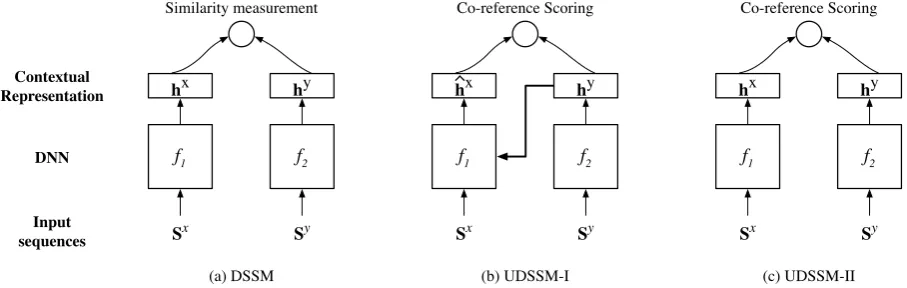
To tackle this issue, we propose two models based on the framework of Deep Structured
Sim-ilarity Model (DSSM) (Huang et al., 2013), as
shown in Figure1(a). Formally, letSxbe the
sen-tence containing the candidate antecedent xi and
Sy the sentence containing the pronoun y which
we’re interested in. DSSM measures the semantic
similarity of a pair of inputs (xi, y) by 1)
map-ping xi and y, together with their context
infor-mation, into two vectors in a semantic space
us-ing deep neural networksf1andf2, parameterized
byθ; and 2) computing cosine similarity2between
them. In our case, we need to learn a task-specific semantic space where the distance between two vectors measures how likely they co-refer. Com-monsense knowledge such as “demonstrators usu-ally cause violence” can be implicitly captured in the semantic space through DSSM, which is
1We don’t believe it is possible to construct such a
knowl-edge base given that the world is changing constantly. 2
DSSMs can be applied to a wide range of tasks
depend-ing on the definition of(x, y). For example,(x, y)is a
query-document pair for Web search ranking, a query-document pair in recommendation, a question-answer pair in QA, and so on.
See Chapter 2 of (Gao et al.,2018) for a survey.
trained on a large amount of raw text.
DSSM requires labeled pairs for training.Since there is no labeled data for our tasks, we pro-pose two unsupervised DSSMs, or UDSSMs. As
shown in Figure 1(b) and 1(c), (Sx,Sy) are
en-coded into contextual representations by deep
neu-ral networksf1andf2; then we compute pair-wise
their co-reference scores.
In what follows, we will describe two assump-tions we propose to harvest training data from raw
text. Assumption I: A pronoun refers to one
of its preceding nouns in the same sentence. The sentences generated by this assumption will be used for training UDSSM-I. Some examples will be shown in the “data generation” section. Assumption II: In a sentence, pronouns of the same gender and plurality are more likely to re-fer to the same antecedent than other pronouns. Similarly, the sentences following the assumption will be used for training UDSSM-II.
Note that the two models, UDSSM-I and UDSSM-II are trained on different types of pair-wise training data, thus the model structures are
different, as illustrated in Figure 1(b) and 1(c),
respectively. Experiments demonstrated that our methods outperform stat-of-the-art performance on the tasks of WSC and PDP.
2 Related Work
As a key component of natural language under-standing, commonsense reasoning has been in-cluded in an increasing number of tasks for
eval-uation: COPA (Roemmele et al., 2011) assesses
commonsense causal reasoning by selecting an al-ternative, which has a more plausible causal re-lation with the given premise. Story Cloze Test
(ROCStories,Mostafazadeh et al. 2016) evaluates
story understanding, story generation, and script learning by choosing the most sensible ending to
a short story. JOCI (Zhang et al., 2017)
general-izes the natural language inference (NLI)
frame-work (Cooper et al., 1996; Dagan et al., 2006;
Bowman et al., 2015;Williams et al., 2018) and
evaluates commonsense inference by predicting the ordinal likelihood of a hypothesis given a
con-text. Event2Mind (Rashkin et al., 2018b)
mod-els stereotypical intents and reactions of people, described in short free-form text. SWAG (Zellers
et al., 2018) frames commonsense inference as
multiple-choice questions for follow-up events
hx hy
f1 f2
Sx Sy
Similarity measurement
hx hy
f1 f2
Co-reference Scoring
hx hy
f1 f2
Co-reference Scoring
Contextual Representation
DNN
Input sequences
(a) DSSM (b) UDSSM-I (c) UDSSM-II
[image:3.595.74.528.64.208.2]Sx Sy Sx Sy
Figure 1: An overview of (a) the general framework of Deep Structured Semantic Model (DSSM) and our two unsupervised models based on DSSM: (b) UDSSM-I and (c) UDSSM-II. Compared with DSSM, both UDSSM-I and UDSSM-II compute co-reference scores instead of similarity.
evaluates a machine’s ability of commonsense rea-soning in reading comprehension.
Among all these commonsense reasoning tasks, the Winograd Schema Challenge (WSC) and Pro-noun Disambiguation Problems (PDP) (Levesque
et al., 2011) are known as the most challenging
tasks for commonsense reasoning. Although both tasks are based on pronoun disambiguation, a
sub-task of coreference resolution (Soon et al.,2001;
Ng and Cardie,2002;Peng et al.,2016), PDP and
WSC differ from normal pronoun disambiguation due to their unique properties, which are based on commonsense, selecting the most likely an-tecedent from both candidates in the directly pre-ceding context.
Previous efforts on solving the Winograd Schema Challenge and Pronoun Disambiguation Problems mostly rely on human-labeled data, so-phisticated rules, hand-crafted features, or
exter-nal knowledge bases (Peng et al., 2015; Bailey
et al., 2015; Sch¨uller, 2014). Rahman and Ng
(2012) hired workers to annotate supervised train-ing data and designed 70K hand-crafted features.
Sharma et al.(2015);Sch¨uller(2014);Bailey et al.
(2015);Liu et al.(2017) utilized expensive
knowl-edge bases in their reasoning processes. Recently,
Trinh and Le 2018applied neural language models
trained with a massive amount of unlabeled data to the Winograd Schema Challenge and improved the performance by a large margin. In contrast, our unsupervised method based on DSSM sig-nificantly outperforms the previous state-of-the-art method, with the advantage of capturing more contextual information in the data.
3 Approach
As shown in Figure1, we propose two
unsuper-vised deep structured semantic models
(UDSSM-I andUDSSM-II), which consist of two
compo-nents: DNN encoding and co-reference scoring. For the model UDSSM-I, the co-referred word pairs are automatically learned through an atten-tion mechanism, where the attenatten-tion weights are the co-reference scores for word pairs. For the second model UDSSM-II, we will directly opti-mize the co-reference score during training. After all, we will get the co-reference scoring function, Scoreθ(xi, y), to compare the candidate answers in the tasks of PDP/WSC. Next, we will show the details of our models trained in an unsupervised way.
In the following sections, we will use
upper-case symbols in bold, e.g., Sx, to represent
ma-trices. Lowercase symbols in bold, e.g.,hx,
repre-sent vectors. A regular uppercase symbol, e.g.,Sx,
represents a lexical sequence. A regular lowercase
symbol, e.g.,xi ory, represents a token.
3.1 UDSSM-I Model
This model is developed based on Assumption I.
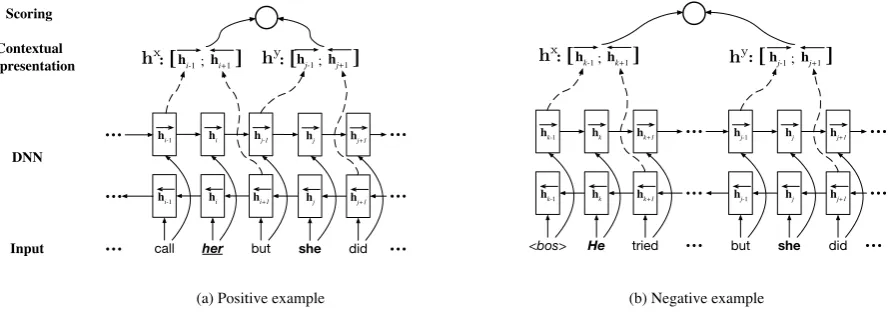
Its architecture is shown in Figure 2. The
sen-tences generated based on this assumption
con-tain a pronouny and a set of its preceding nouns
{xi, xj...}, which includes the referred word by
pronoun. For example, the sentence in Figure 2.
As there is no clear label for the co-referred word pairs under this assumption, our model will rank
the set of nouns {xi, xj...} which contains the
noun that the pronoun yrefers to higher than the
(a) Positive example (b) Negative example pilots radio controllers
hk2 x
hi x
hj x
hk x
overflew theirMinneapolis
h2
y
DNN
Input Contextual Representation
Scoring
make it negative
↵j
<latexit sha1_base64="fFTRfbxrRiYYvC4t/y6zSBs3auk=">AAAB7nicbVBNS8NAEJ34WetX1aOXxSJ4KokI6q3oxWMFYwttKJPtpl272cTdjVBC/4QXDype/T3e/Ddu2xy09cHA470ZZuaFqeDauO63s7S8srq2Xtoob25t7+xW9vbvdZIpynyaiES1QtRMcMl8w41grVQxjEPBmuHweuI3n5jSPJF3ZpSyIMa+5BGnaKzU6qBIB9h96Faqbs2dgiwSryBVKNDoVr46vYRmMZOGCtS67bmpCXJUhlPBxuVOplmKdIh91rZUYsx0kE/vHZNjq/RIlChb0pCp+nsix1jrURzazhjNQM97E/E/r52Z6CLIuUwzwySdLYoyQUxCJs+THleMGjGyBKni9lZCB6iQGhtR2Ybgzb+8SPzT2mXNvT2r1q+KNEpwCEdwAh6cQx1uoAE+UBDwDK/w5jw6L8678zFrXXKKmQP4A+fzB3aPj8g=</latexit>
<latexit sha1_base64="fFTRfbxrRiYYvC4t/y6zSBs3auk=">AAAB7nicbVBNS8NAEJ34WetX1aOXxSJ4KokI6q3oxWMFYwttKJPtpl272cTdjVBC/4QXDype/T3e/Ddu2xy09cHA470ZZuaFqeDauO63s7S8srq2Xtoob25t7+xW9vbvdZIpynyaiES1QtRMcMl8w41grVQxjEPBmuHweuI3n5jSPJF3ZpSyIMa+5BGnaKzU6qBIB9h96Faqbs2dgiwSryBVKNDoVr46vYRmMZOGCtS67bmpCXJUhlPBxuVOplmKdIh91rZUYsx0kE/vHZNjq/RIlChb0pCp+nsix1jrURzazhjNQM97E/E/r52Z6CLIuUwzwySdLYoyQUxCJs+THleMGjGyBKni9lZCB6iQGhtR2Ybgzb+8SPzT2mXNvT2r1q+KNEpwCEdwAh6cQx1uoAE+UBDwDK/w5jw6L8678zFrXXKKmQP4A+fzB3aPj8g=</latexit>
<latexit sha1_base64="fFTRfbxrRiYYvC4t/y6zSBs3auk=">AAAB7nicbVBNS8NAEJ34WetX1aOXxSJ4KokI6q3oxWMFYwttKJPtpl272cTdjVBC/4QXDype/T3e/Ddu2xy09cHA470ZZuaFqeDauO63s7S8srq2Xtoob25t7+xW9vbvdZIpynyaiES1QtRMcMl8w41grVQxjEPBmuHweuI3n5jSPJF3ZpSyIMa+5BGnaKzU6qBIB9h96Faqbs2dgiwSryBVKNDoVr46vYRmMZOGCtS67bmpCXJUhlPBxuVOplmKdIh91rZUYsx0kE/vHZNjq/RIlChb0pCp+nsix1jrURzazhjNQM97E/E/r52Z6CLIuUwzwySdLYoyQUxCJs+THleMGjGyBKni9lZCB6iQGhtR2Ybgzb+8SPzT2mXNvT2r1q+KNEpwCEdwAh6cQx1uoAE+UBDwDK/w5jw6L8678zFrXXKKmQP4A+fzB3aPj8g=</latexit> ↵
j
<latexit sha1_base64="fFTRfbxrRiYYvC4t/y6zSBs3auk=">AAAB7nicbVBNS8NAEJ34WetX1aOXxSJ4KokI6q3oxWMFYwttKJPtpl272cTdjVBC/4QXDype/T3e/Ddu2xy09cHA470ZZuaFqeDauO63s7S8srq2Xtoob25t7+xW9vbvdZIpynyaiES1QtRMcMl8w41grVQxjEPBmuHweuI3n5jSPJF3ZpSyIMa+5BGnaKzU6qBIB9h96Faqbs2dgiwSryBVKNDoVr46vYRmMZOGCtS67bmpCXJUhlPBxuVOplmKdIh91rZUYsx0kE/vHZNjq/RIlChb0pCp+nsix1jrURzazhjNQM97E/E/r52Z6CLIuUwzwySdLYoyQUxCJs+THleMGjGyBKni9lZCB6iQGhtR2Ybgzb+8SPzT2mXNvT2r1q+KNEpwCEdwAh6cQx1uoAE+UBDwDK/w5jw6L8678zFrXXKKmQP4A+fzB3aPj8g=</latexit>
<latexit sha1_base64="fFTRfbxrRiYYvC4t/y6zSBs3auk=">AAAB7nicbVBNS8NAEJ34WetX1aOXxSJ4KokI6q3oxWMFYwttKJPtpl272cTdjVBC/4QXDype/T3e/Ddu2xy09cHA470ZZuaFqeDauO63s7S8srq2Xtoob25t7+xW9vbvdZIpynyaiES1QtRMcMl8w41grVQxjEPBmuHweuI3n5jSPJF3ZpSyIMa+5BGnaKzU6qBIB9h96Faqbs2dgiwSryBVKNDoVr46vYRmMZOGCtS67bmpCXJUhlPBxuVOplmKdIh91rZUYsx0kE/vHZNjq/RIlChb0pCp+nsix1jrURzazhjNQM97E/E/r52Z6CLIuUwzwySdLYoyQUxCJs+THleMGjGyBKni9lZCB6iQGhtR2Ybgzb+8SPzT2mXNvT2r1q+KNEpwCEdwAh6cQx1uoAE+UBDwDK/w5jw6L8678zFrXXKKmQP4A+fzB3aPj8g=</latexit>
<latexit sha1_base64="fFTRfbxrRiYYvC4t/y6zSBs3auk=">AAAB7nicbVBNS8NAEJ34WetX1aOXxSJ4KokI6q3oxWMFYwttKJPtpl272cTdjVBC/4QXDype/T3e/Ddu2xy09cHA470ZZuaFqeDauO63s7S8srq2Xtoob25t7+xW9vbvdZIpynyaiES1QtRMcMl8w41grVQxjEPBmuHweuI3n5jSPJF3ZpSyIMa+5BGnaKzU6qBIB9h96Faqbs2dgiwSryBVKNDoVr46vYRmMZOGCtS67bmpCXJUhlPBxuVOplmKdIh91rZUYsx0kE/vHZNjq/RIlChb0pCp+nsix1jrURzazhjNQM97E/E/r52Z6CLIuUwzwySdLYoyQUxCJs+THleMGjGyBKni9lZCB6iQGhtR2Ybgzb+8SPzT2mXNvT2r1q+KNEpwCEdwAh6cQx1uoAE+UBDwDK/w5jw6L8678zFrXXKKmQP4A+fzB3aPj8g=</latexit>
pilots radio controllers hk2
x
hi x
hj x
hk x
h2
y
↵j
<latexit sha1_base64="fFTRfbxrRiYYvC4t/y6zSBs3auk=">AAAB7nicbVBNS8NAEJ34WetX1aOXxSJ4KokI6q3oxWMFYwttKJPtpl272cTdjVBC/4QXDype/T3e/Ddu2xy09cHA470ZZuaFqeDauO63s7S8srq2Xtoob25t7+xW9vbvdZIpynyaiES1QtRMcMl8w41grVQxjEPBmuHweuI3n5jSPJF3ZpSyIMa+5BGnaKzU6qBIB9h96Faqbs2dgiwSryBVKNDoVr46vYRmMZOGCtS67bmpCXJUhlPBxuVOplmKdIh91rZUYsx0kE/vHZNjq/RIlChb0pCp+nsix1jrURzazhjNQM97E/E/r52Z6CLIuUwzwySdLYoyQUxCJs+THleMGjGyBKni9lZCB6iQGhtR2Ybgzb+8SPzT2mXNvT2r1q+KNEpwCEdwAh6cQx1uoAE+UBDwDK/w5jw6L8678zFrXXKKmQP4A+fzB3aPj8g=</latexit>
<latexit sha1_base64="fFTRfbxrRiYYvC4t/y6zSBs3auk=">AAAB7nicbVBNS8NAEJ34WetX1aOXxSJ4KokI6q3oxWMFYwttKJPtpl272cTdjVBC/4QXDype/T3e/Ddu2xy09cHA470ZZuaFqeDauO63s7S8srq2Xtoob25t7+xW9vbvdZIpynyaiES1QtRMcMl8w41grVQxjEPBmuHweuI3n5jSPJF3ZpSyIMa+5BGnaKzU6qBIB9h96Faqbs2dgiwSryBVKNDoVr46vYRmMZOGCtS67bmpCXJUhlPBxuVOplmKdIh91rZUYsx0kE/vHZNjq/RIlChb0pCp+nsix1jrURzazhjNQM97E/E/r52Z6CLIuUwzwySdLYoyQUxCJs+THleMGjGyBKni9lZCB6iQGhtR2Ybgzb+8SPzT2mXNvT2r1q+KNEpwCEdwAh6cQx1uoAE+UBDwDK/w5jw6L8678zFrXXKKmQP4A+fzB3aPj8g=</latexit>
<latexit sha1_base64="fFTRfbxrRiYYvC4t/y6zSBs3auk=">AAAB7nicbVBNS8NAEJ34WetX1aOXxSJ4KokI6q3oxWMFYwttKJPtpl272cTdjVBC/4QXDype/T3e/Ddu2xy09cHA470ZZuaFqeDauO63s7S8srq2Xtoob25t7+xW9vbvdZIpynyaiES1QtRMcMl8w41grVQxjEPBmuHweuI3n5jSPJF3ZpSyIMa+5BGnaKzU6qBIB9h96Faqbs2dgiwSryBVKNDoVr46vYRmMZOGCtS67bmpCXJUhlPBxuVOplmKdIh91rZUYsx0kE/vHZNjq/RIlChb0pCp+nsix1jrURzazhjNQM97E/E/r52Z6CLIuUwzwySdLYoyQUxCJs+THleMGjGyBKni9lZCB6iQGhtR2Ybgzb+8SPzT2mXNvT2r1q+KNEpwCEdwAh6cQx1uoAE+UBDwDK/w5jw6L8678zFrXXKKmQP4A+fzB3aPj8g=</latexit> ↵
j
<latexit sha1_base64="fFTRfbxrRiYYvC4t/y6zSBs3auk=">AAAB7nicbVBNS8NAEJ34WetX1aOXxSJ4KokI6q3oxWMFYwttKJPtpl272cTdjVBC/4QXDype/T3e/Ddu2xy09cHA470ZZuaFqeDauO63s7S8srq2Xtoob25t7+xW9vbvdZIpynyaiES1QtRMcMl8w41grVQxjEPBmuHweuI3n5jSPJF3ZpSyIMa+5BGnaKzU6qBIB9h96Faqbs2dgiwSryBVKNDoVr46vYRmMZOGCtS67bmpCXJUhlPBxuVOplmKdIh91rZUYsx0kE/vHZNjq/RIlChb0pCp+nsix1jrURzazhjNQM97E/E/r52Z6CLIuUwzwySdLYoyQUxCJs+THleMGjGyBKni9lZCB6iQGhtR2Ybgzb+8SPzT2mXNvT2r1q+KNEpwCEdwAh6cQx1uoAE+UBDwDK/w5jw6L8678zFrXXKKmQP4A+fzB3aPj8g=</latexit>
<latexit sha1_base64="fFTRfbxrRiYYvC4t/y6zSBs3auk=">AAAB7nicbVBNS8NAEJ34WetX1aOXxSJ4KokI6q3oxWMFYwttKJPtpl272cTdjVBC/4QXDype/T3e/Ddu2xy09cHA470ZZuaFqeDauO63s7S8srq2Xtoob25t7+xW9vbvdZIpynyaiES1QtRMcMl8w41grVQxjEPBmuHweuI3n5jSPJF3ZpSyIMa+5BGnaKzU6qBIB9h96Faqbs2dgiwSryBVKNDoVr46vYRmMZOGCtS67bmpCXJUhlPBxuVOplmKdIh91rZUYsx0kE/vHZNjq/RIlChb0pCp+nsix1jrURzazhjNQM97E/E/r52Z6CLIuUwzwySdLYoyQUxCJs+THleMGjGyBKni9lZCB6iQGhtR2Ybgzb+8SPzT2mXNvT2r1q+KNEpwCEdwAh6cQx1uoAE+UBDwDK/w5jw6L8678zFrXXKKmQP4A+fzB3aPj8g=</latexit>
<latexit sha1_base64="fFTRfbxrRiYYvC4t/y6zSBs3auk=">AAAB7nicbVBNS8NAEJ34WetX1aOXxSJ4KokI6q3oxWMFYwttKJPtpl272cTdjVBC/4QXDype/T3e/Ddu2xy09cHA470ZZuaFqeDauO63s7S8srq2Xtoob25t7+xW9vbvdZIpynyaiES1QtRMcMl8w41grVQxjEPBmuHweuI3n5jSPJF3ZpSyIMa+5BGnaKzU6qBIB9h96Faqbs2dgiwSryBVKNDoVr46vYRmMZOGCtS67bmpCXJUhlPBxuVOplmKdIh91rZUYsx0kE/vHZNjq/RIlChb0pCp+nsix1jrURzazhjNQM97E/E/r52Z6CLIuUwzwySdLYoyQUxCJs+THleMGjGyBKni9lZCB6iQGhtR2Ybgzb+8SPzT2mXNvT2r1q+KNEpwCEdwAh6cQx1uoAE+UBDwDK/w5jw6L8678zFrXXKKmQP4A+fzB3aPj8g=</latexit>
ˆ hx
<latexit sha1_base64="e6qXSQNvtYYIQU2L7jV9cxk6EgE=">AAACAXicbVBNS8NAEN34WetX1JN4CRbBU0lEUG9FLx4rGFtoYtlsN83SzSbsTqQlBC/+FS8eVLz6L7z5b9y0PWjrg4HHezPMzAtSzhTY9rexsLi0vLJaWauub2xubZs7u3cqySShLkl4ItsBVpQzQV1gwGk7lRTHAaetYHBV+q0HKhVLxC2MUurHuC9YyAgGLXXNfS/CkHsxhigI86go7j2gQ8iHRdes2XV7DGueOFNSQ1M0u+aX10tIFlMBhGOlOo6dgp9jCYxwWlS9TNEUkwHu046mAsdU+fn4hcI60krPChOpS4A1Vn9P5DhWahQHurO8Vc16pfif18kgPPdzJtIMqCCTRWHGLUisMg+rxyQlwEeaYCKZvtUiEZaYgE6tqkNwZl+eJ+5J/aJu35zWGpfTNCroAB2iY+SgM9RA16iJXETQI3pGr+jNeDJejHfjY9K6YExn9tAfGJ8/MeiYJg==</latexit>
<latexit sha1_base64="e6qXSQNvtYYIQU2L7jV9cxk6EgE=">AAACAXicbVBNS8NAEN34WetX1JN4CRbBU0lEUG9FLx4rGFtoYtlsN83SzSbsTqQlBC/+FS8eVLz6L7z5b9y0PWjrg4HHezPMzAtSzhTY9rexsLi0vLJaWauub2xubZs7u3cqySShLkl4ItsBVpQzQV1gwGk7lRTHAaetYHBV+q0HKhVLxC2MUurHuC9YyAgGLXXNfS/CkHsxhigI86go7j2gQ8iHRdes2XV7DGueOFNSQ1M0u+aX10tIFlMBhGOlOo6dgp9jCYxwWlS9TNEUkwHu046mAsdU+fn4hcI60krPChOpS4A1Vn9P5DhWahQHurO8Vc16pfif18kgPPdzJtIMqCCTRWHGLUisMg+rxyQlwEeaYCKZvtUiEZaYgE6tqkNwZl+eJ+5J/aJu35zWGpfTNCroAB2iY+SgM9RA16iJXETQI3pGr+jNeDJejHfjY9K6YExn9tAfGJ8/MeiYJg==</latexit>
<latexit sha1_base64="e6qXSQNvtYYIQU2L7jV9cxk6EgE=">AAACAXicbVBNS8NAEN34WetX1JN4CRbBU0lEUG9FLx4rGFtoYtlsN83SzSbsTqQlBC/+FS8eVLz6L7z5b9y0PWjrg4HHezPMzAtSzhTY9rexsLi0vLJaWauub2xubZs7u3cqySShLkl4ItsBVpQzQV1gwGk7lRTHAaetYHBV+q0HKhVLxC2MUurHuC9YyAgGLXXNfS/CkHsxhigI86go7j2gQ8iHRdes2XV7DGueOFNSQ1M0u+aX10tIFlMBhGOlOo6dgp9jCYxwWlS9TNEUkwHu046mAsdU+fn4hcI60krPChOpS4A1Vn9P5DhWahQHurO8Vc16pfif18kgPPdzJtIMqCCTRWHGLUisMg+rxyQlwEeaYCKZvtUiEZaYgE6tqkNwZl+eJ+5J/aJu35zWGpfTNCroAB2iY+SgM9RA16iJXETQI3pGr+jNeDJejHfjY9K6YExn9tAfGJ8/MeiYJg==</latexit> ˆh
x
<latexit sha1_base64="e6qXSQNvtYYIQU2L7jV9cxk6EgE=">AAACAXicbVBNS8NAEN34WetX1JN4CRbBU0lEUG9FLx4rGFtoYtlsN83SzSbsTqQlBC/+FS8eVLz6L7z5b9y0PWjrg4HHezPMzAtSzhTY9rexsLi0vLJaWauub2xubZs7u3cqySShLkl4ItsBVpQzQV1gwGk7lRTHAaetYHBV+q0HKhVLxC2MUurHuC9YyAgGLXXNfS/CkHsxhigI86go7j2gQ8iHRdes2XV7DGueOFNSQ1M0u+aX10tIFlMBhGOlOo6dgp9jCYxwWlS9TNEUkwHu046mAsdU+fn4hcI60krPChOpS4A1Vn9P5DhWahQHurO8Vc16pfif18kgPPdzJtIMqCCTRWHGLUisMg+rxyQlwEeaYCKZvtUiEZaYgE6tqkNwZl+eJ+5J/aJu35zWGpfTNCroAB2iY+SgM9RA16iJXETQI3pGr+jNeDJejHfjY9K6YExn9tAfGJ8/MeiYJg==</latexit>
<latexit sha1_base64="e6qXSQNvtYYIQU2L7jV9cxk6EgE=">AAACAXicbVBNS8NAEN34WetX1JN4CRbBU0lEUG9FLx4rGFtoYtlsN83SzSbsTqQlBC/+FS8eVLz6L7z5b9y0PWjrg4HHezPMzAtSzhTY9rexsLi0vLJaWauub2xubZs7u3cqySShLkl4ItsBVpQzQV1gwGk7lRTHAaetYHBV+q0HKhVLxC2MUurHuC9YyAgGLXXNfS/CkHsxhigI86go7j2gQ8iHRdes2XV7DGueOFNSQ1M0u+aX10tIFlMBhGOlOo6dgp9jCYxwWlS9TNEUkwHu046mAsdU+fn4hcI60krPChOpS4A1Vn9P5DhWahQHurO8Vc16pfif18kgPPdzJtIMqCCTRWHGLUisMg+rxyQlwEeaYCKZvtUiEZaYgE6tqkNwZl+eJ+5J/aJu35zWGpfTNCroAB2iY+SgM9RA16iJXETQI3pGr+jNeDJejHfjY9K6YExn9tAfGJ8/MeiYJg==</latexit>
<latexit sha1_base64="e6qXSQNvtYYIQU2L7jV9cxk6EgE=">AAACAXicbVBNS8NAEN34WetX1JN4CRbBU0lEUG9FLx4rGFtoYtlsN83SzSbsTqQlBC/+FS8eVLz6L7z5b9y0PWjrg4HHezPMzAtSzhTY9rexsLi0vLJaWauub2xubZs7u3cqySShLkl4ItsBVpQzQV1gwGk7lRTHAaetYHBV+q0HKhVLxC2MUurHuC9YyAgGLXXNfS/CkHsxhigI86go7j2gQ8iHRdes2XV7DGueOFNSQ1M0u+aX10tIFlMBhGOlOo6dgp9jCYxwWlS9TNEUkwHu046mAsdU+fn4hcI60krPChOpS4A1Vn9P5DhWahQHurO8Vc16pfif18kgPPdzJtIMqCCTRWHGLUisMg+rxyQlwEeaYCKZvtUiEZaYgE6tqkNwZl+eJ+5J/aJu35zWGpfTNCroAB2iY+SgM9RA16iJXETQI3pGr+jNeDJejHfjY9K6YExn9tAfGJ8/MeiYJg==</latexit>
hy
<latexit sha1_base64="G5n/1Fghu52Ax5DmEDM5lT1gJPI=">AAAB+3icbVBNS8NAFNz4WetXtEcvwSJ4KokI6q3oxWMFYwtNLJvtpl262YTdFzGE+Fe8eFDx6h/x5r9x0+agrQMLw8x7vNkJEs4U2Pa3sbS8srq2Xtuob25t7+yae/t3Kk4loS6JeSx7AVaUM0FdYMBpL5EURwGn3WByVfrdByoVi8UtZAn1IzwSLGQEg5YGZsOLMIyDMB8X9x7QR8izYmA27ZY9hbVInIo0UYXOwPzyhjFJIyqAcKxU37ET8HMsgRFOi7qXKppgMsEj2tdU4IgqP5+GL6wjrQytMJb6CbCm6u+NHEdKZVGgJ8uoat4rxf+8fgrhuZ8zkaRABZkdClNuQWyVTVhDJikBnmmCiWQ6q0XGWGICuq+6LsGZ//IicU9aFy375rTZvqzaqKEDdIiOkYPOUBtdow5yEUEZekav6M14Ml6Md+NjNrpkVDsN9AfG5w8865Va</latexit>
<latexit sha1_base64="G5n/1Fghu52Ax5DmEDM5lT1gJPI=">AAAB+3icbVBNS8NAFNz4WetXtEcvwSJ4KokI6q3oxWMFYwtNLJvtpl262YTdFzGE+Fe8eFDx6h/x5r9x0+agrQMLw8x7vNkJEs4U2Pa3sbS8srq2Xtuob25t7+yae/t3Kk4loS6JeSx7AVaUM0FdYMBpL5EURwGn3WByVfrdByoVi8UtZAn1IzwSLGQEg5YGZsOLMIyDMB8X9x7QR8izYmA27ZY9hbVInIo0UYXOwPzyhjFJIyqAcKxU37ET8HMsgRFOi7qXKppgMsEj2tdU4IgqP5+GL6wjrQytMJb6CbCm6u+NHEdKZVGgJ8uoat4rxf+8fgrhuZ8zkaRABZkdClNuQWyVTVhDJikBnmmCiWQ6q0XGWGICuq+6LsGZ//IicU9aFy375rTZvqzaqKEDdIiOkYPOUBtdow5yEUEZekav6M14Ml6Md+NjNrpkVDsN9AfG5w8865Va</latexit>
<latexit sha1_base64="G5n/1Fghu52Ax5DmEDM5lT1gJPI=">AAAB+3icbVBNS8NAFNz4WetXtEcvwSJ4KokI6q3oxWMFYwtNLJvtpl262YTdFzGE+Fe8eFDx6h/x5r9x0+agrQMLw8x7vNkJEs4U2Pa3sbS8srq2Xtuob25t7+yae/t3Kk4loS6JeSx7AVaUM0FdYMBpL5EURwGn3WByVfrdByoVi8UtZAn1IzwSLGQEg5YGZsOLMIyDMB8X9x7QR8izYmA27ZY9hbVInIo0UYXOwPzyhjFJIyqAcKxU37ET8HMsgRFOi7qXKppgMsEj2tdU4IgqP5+GL6wjrQytMJb6CbCm6u+NHEdKZVGgJ8uoat4rxf+8fgrhuZ8zkaRABZkdClNuQWyVTVhDJikBnmmCiWQ6q0XGWGICuq+6LsGZ//IicU9aFy375rTZvqzaqKEDdIiOkYPOUBtdow5yEUEZekav6M14Ml6Md+NjNrpkVDsN9AfG5w8865Va</latexit> h y
<latexit sha1_base64="G5n/1Fghu52Ax5DmEDM5lT1gJPI=">AAAB+3icbVBNS8NAFNz4WetXtEcvwSJ4KokI6q3oxWMFYwtNLJvtpl262YTdFzGE+Fe8eFDx6h/x5r9x0+agrQMLw8x7vNkJEs4U2Pa3sbS8srq2Xtuob25t7+yae/t3Kk4loS6JeSx7AVaUM0FdYMBpL5EURwGn3WByVfrdByoVi8UtZAn1IzwSLGQEg5YGZsOLMIyDMB8X9x7QR8izYmA27ZY9hbVInIo0UYXOwPzyhjFJIyqAcKxU37ET8HMsgRFOi7qXKppgMsEj2tdU4IgqP5+GL6wjrQytMJb6CbCm6u+NHEdKZVGgJ8uoat4rxf+8fgrhuZ8zkaRABZkdClNuQWyVTVhDJikBnmmCiWQ6q0XGWGICuq+6LsGZ//IicU9aFy375rTZvqzaqKEDdIiOkYPOUBtdow5yEUEZekav6M14Ml6Md+NjNrpkVDsN9AfG5w8865Va</latexit>
<latexit sha1_base64="G5n/1Fghu52Ax5DmEDM5lT1gJPI=">AAAB+3icbVBNS8NAFNz4WetXtEcvwSJ4KokI6q3oxWMFYwtNLJvtpl262YTdFzGE+Fe8eFDx6h/x5r9x0+agrQMLw8x7vNkJEs4U2Pa3sbS8srq2Xtuob25t7+yae/t3Kk4loS6JeSx7AVaUM0FdYMBpL5EURwGn3WByVfrdByoVi8UtZAn1IzwSLGQEg5YGZsOLMIyDMB8X9x7QR8izYmA27ZY9hbVInIo0UYXOwPzyhjFJIyqAcKxU37ET8HMsgRFOi7qXKppgMsEj2tdU4IgqP5+GL6wjrQytMJb6CbCm6u+NHEdKZVGgJ8uoat4rxf+8fgrhuZ8zkaRABZkdClNuQWyVTVhDJikBnmmCiWQ6q0XGWGICuq+6LsGZ//IicU9aFy375rTZvqzaqKEDdIiOkYPOUBtdow5yEUEZekav6M14Ml6Md+NjNrpkVDsN9AfG5w8865Va</latexit>
<latexit sha1_base64="G5n/1Fghu52Ax5DmEDM5lT1gJPI=">AAAB+3icbVBNS8NAFNz4WetXtEcvwSJ4KokI6q3oxWMFYwtNLJvtpl262YTdFzGE+Fe8eFDx6h/x5r9x0+agrQMLw8x7vNkJEs4U2Pa3sbS8srq2Xtuob25t7+yae/t3Kk4loS6JeSx7AVaUM0FdYMBpL5EURwGn3WByVfrdByoVi8UtZAn1IzwSLGQEg5YGZsOLMIyDMB8X9x7QR8izYmA27ZY9hbVInIo0UYXOwPzyhjFJIyqAcKxU37ET8HMsgRFOi7qXKppgMsEj2tdU4IgqP5+GL6wjrQytMJb6CbCm6u+NHEdKZVGgJ8uoat4rxf+8fgrhuZ8zkaRABZkdClNuQWyVTVhDJikBnmmCiWQ6q0XGWGICuq+6LsGZ//IicU9aFy375rTZvqzaqKEDdIiOkYPOUBtdow5yEUEZekav6M14Ml6Md+NjNrpkVDsN9AfG5w8865Va</latexit>
↵k
<latexit sha1_base64="zOMfb+tFRXh0xgOR06mYTY3XPgw=">AAAB73icbVBNS8NAEJ3Ur1q/qh69LBbBU0lE0GPRi8cKpi20oUy2m3bpZhN3N0IJ/RNePCji1b/jzX/jts1BWx8MPN6bYWZemAqujet+O6W19Y3NrfJ2ZWd3b/+genjU0kmmKPNpIhLVCVEzwSXzDTeCdVLFMA4Fa4fj25nffmJK80Q+mEnKghiHkkecorFSp4ciHWF/3K/W3Lo7B1klXkFqUKDZr371BgnNYiYNFah113NTE+SoDKeCTSu9TLMU6RiHrGupxJjpIJ/fOyVnVhmQKFG2pCFz9fdEjrHWkzi0nTGakV72ZuJ/Xjcz0XWQc5lmhkm6WBRlgpiEzJ4nA64YNWJiCVLF7a2EjlAhNTaiig3BW355lbQu6p5b9+4va42bIo4ynMApnIMHV9CAO2iCDxQEPMMrvDmPzovz7nwsWktOMXMMf+B8/gAMyI/2</latexit>
<latexit sha1_base64="zOMfb+tFRXh0xgOR06mYTY3XPgw=">AAAB73icbVBNS8NAEJ3Ur1q/qh69LBbBU0lE0GPRi8cKpi20oUy2m3bpZhN3N0IJ/RNePCji1b/jzX/jts1BWx8MPN6bYWZemAqujet+O6W19Y3NrfJ2ZWd3b/+genjU0kmmKPNpIhLVCVEzwSXzDTeCdVLFMA4Fa4fj25nffmJK80Q+mEnKghiHkkecorFSp4ciHWF/3K/W3Lo7B1klXkFqUKDZr371BgnNYiYNFah113NTE+SoDKeCTSu9TLMU6RiHrGupxJjpIJ/fOyVnVhmQKFG2pCFz9fdEjrHWkzi0nTGakV72ZuJ/Xjcz0XWQc5lmhkm6WBRlgpiEzJ4nA64YNWJiCVLF7a2EjlAhNTaiig3BW355lbQu6p5b9+4va42bIo4ynMApnIMHV9CAO2iCDxQEPMMrvDmPzovz7nwsWktOMXMMf+B8/gAMyI/2</latexit>
[image:4.595.73.524.59.196.2]<latexit sha1_base64="zOMfb+tFRXh0xgOR06mYTY3XPgw=">AAAB73icbVBNS8NAEJ3Ur1q/qh69LBbBU0lE0GPRi8cKpi20oUy2m3bpZhN3N0IJ/RNePCji1b/jzX/jts1BWx8MPN6bYWZemAqujet+O6W19Y3NrfJ2ZWd3b/+genjU0kmmKPNpIhLVCVEzwSXzDTeCdVLFMA4Fa4fj25nffmJK80Q+mEnKghiHkkecorFSp4ciHWF/3K/W3Lo7B1klXkFqUKDZr371BgnNYiYNFah113NTE+SoDKeCTSu9TLMU6RiHrGupxJjpIJ/fOyVnVhmQKFG2pCFz9fdEjrHWkzi0nTGakV72ZuJ/Xjcz0XWQc5lmhkm6WBRlgpiEzJ4nA64YNWJiCVLF7a2EjlAhNTaiig3BW355lbQu6p5b9+4va42bIo4ynMApnIMHV9CAO2iCDxQEPMMrvDmPzovz7nwsWktOMXMMf+B8/gAMyI/2</latexit><latexit sha1_base64="zOMfb+tFRXh0xgOR06mYTY3XPgw=">AAAB73icbVBNS8NAEJ3Ur1q/qh69LBbBU0lE0GPRi8cKpi20oUy2m3bpZhN3N0IJ/RNePCji1b/jzX/jts1BWx8MPN6bYWZemAqujet+O6W19Y3NrfJ2ZWd3b/+genjU0kmmKPNpIhLVCVEzwSXzDTeCdVLFMA4Fa4fj25nffmJK80Q+mEnKghiHkkecorFSp4ciHWF/3K/W3Lo7B1klXkFqUKDZr371BgnNYiYNFah113NTE+SoDKeCTSu9TLMU6RiHrGupxJjpIJ/fOyVnVhmQKFG2pCFz9fdEjrHWkzi0nTGakV72ZuJ/Xjcz0XWQc5lmhkm6WBRlgpiEzJ4nA64YNWJiCVLF7a2EjlAhNTaiig3BW355lbQu6p5b9+4va42bIo4ynMApnIMHV9CAO2iCDxQEPMMrvDmPzovz7nwsWktOMXMMf+B8/gAMyI/2</latexit> ↵<latexit sha1_base64="zOMfb+tFRXh0xgOR06mYTY3XPgw=">AAAB73icbVBNS8NAEJ3Ur1q/qh69LBbBU0lE0GPRi8cKpi20oUy2m3bpZhN3N0IJ/RNePCji1b/jzX/jts1BWx8MPN6bYWZemAqujet+O6W19Y3NrfJ2ZWd3b/+genjU0kmmKPNpIhLVCVEzwSXzDTeCdVLFMA4Fa4fj25nffmJK80Q+mEnKghiHkkecorFSp4ciHWF/3K/W3Lo7B1klXkFqUKDZr371BgnNYiYNFah113NTE+SoDKeCTSu9TLMU6RiHrGupxJjpIJ/fOyVnVhmQKFG2pCFz9fdEjrHWkzi0nTGakV72ZuJ/Xjcz0XWQc5lmhkm6WBRlgpiEzJ4nA64YNWJiCVLF7a2EjlAhNTaiig3BW355lbQu6p5b9+4va42bIo4ynMApnIMHV9CAO2iCDxQEPMMrvDmPzovz7nwsWktOMXMMf+B8/gAMyI/2</latexit><latexit sha1_base64="zOMfb+tFRXh0xgOR06mYTY3XPgw=">AAAB73icbVBNS8NAEJ3Ur1q/qh69LBbBU0lE0GPRi8cKpi20oUy2m3bpZhN3N0IJ/RNePCji1b/jzX/jts1BWx8MPN6bYWZemAqujet+O6W19Y3NrfJ2ZWd3b/+genjU0kmmKPNpIhLVCVEzwSXzDTeCdVLFMA4Fa4fj25nffmJK80Q+mEnKghiHkkecorFSp4ciHWF/3K/W3Lo7B1klXkFqUKDZr371BgnNYiYNFah113NTE+SoDKeCTSu9TLMU6RiHrGupxJjpIJ/fOyVnVhmQKFG2pCFz9fdEjrHWkzi0nTGakV72ZuJ/Xjcz0XWQc5lmhkm6WBRlgpiEzJ4nA64YNWJiCVLF7a2EjlAhNTaiig3BW355lbQu6p5b9+4va42bIo4ynMApnIMHV9CAO2iCDxQEPMMrvDmPzovz7nwsWktOMXMMf+B8/gAMyI/2</latexit><latexit sha1_base64="zOMfb+tFRXh0xgOR06mYTY3XPgw=">AAAB73icbVBNS8NAEJ3Ur1q/qh69LBbBU0lE0GPRi8cKpi20oUy2m3bpZhN3N0IJ/RNePCji1b/jzX/jts1BWx8MPN6bYWZemAqujet+O6W19Y3NrfJ2ZWd3b/+genjU0kmmKPNpIhLVCVEzwSXzDTeCdVLFMA4Fa4fj25nffmJK80Q+mEnKghiHkkecorFSp4ciHWF/3K/W3Lo7B1klXkFqUKDZr371BgnNYiYNFah113NTE+SoDKeCTSu9TLMU6RiHrGupxJjpIJ/fOyVnVhmQKFG2pCFz9fdEjrHWkzi0nTGakV72ZuJ/Xjcz0XWQc5lmhkm6WBRlgpiEzJ4nA64YNWJiCVLF7a2EjlAhNTaiig3BW355lbQu6p5b9+4va42bIo4ynMApnIMHV9CAO2iCDxQEPMMrvDmPzovz7nwsWktOMXMMf+B8/gAMyI/2</latexit><latexit sha1_base64="zOMfb+tFRXh0xgOR06mYTY3XPgw=">AAAB73icbVBNS8NAEJ3Ur1q/qh69LBbBU0lE0GPRi8cKpi20oUy2m3bpZhN3N0IJ/RNePCji1b/jzX/jts1BWx8MPN6bYWZemAqujet+O6W19Y3NrfJ2ZWd3b/+genjU0kmmKPNpIhLVCVEzwSXzDTeCdVLFMA4Fa4fj25nffmJK80Q+mEnKghiHkkecorFSp4ciHWF/3K/W3Lo7B1klXkFqUKDZr371BgnNYiYNFah113NTE+SoDKeCTSu9TLMU6RiHrGupxJjpIJ/fOyVnVhmQKFG2pCFz9fdEjrHWkzi0nTGakV72ZuJ/Xjcz0XWQc5lmhkm6WBRlgpiEzJ4nA64YNWJiCVLF7a2EjlAhNTaiig3BW355lbQu6p5b9+4va42bIo4ynMApnIMHV9CAO2iCDxQEPMMrvDmPzovz7nwsWktOMXMMf+B8/gAMyI/2</latexit> k
Figure 2: The procedure of using UDSSM-I to compute the co-reference scores of a positive example and a negative
example respectively. The positive example is generated from the sentence ‘TwoNorthwest Airlines pilotsfailed
to makeradio contactwithground controllersfor more than an hour and overflewtheirMinneapolis destination by 150 miles before discovering the mistake and turning around.”. The negative one replaces the second sequence with one sequence from different sentence.
(a) Positive example (b) Negative example
hk-1 hk hk+1 hj-1 hj hj+1
hk-1 hk hk+1 hj-1 hj hj+1
<bos> He tried but she did
hk-1;hk+1] hj-1;hj+1]
DNN
Input Contextual Representation
Scoring
hi-1 hi hj-1 hj hj+1
hi-1 hi hi+1 hj hj+1
call her but she did
hi-1
: [ ;hi+1] : [hj-1;hj+1] h: [ : [
x
<latexit sha1_base64="YntzHWVY8zrIDQ/SieJ4Xw31Xik=">AAAB+3icbVBNS8NAFNzUr1q/oj16CRbBU0lEUG9FLx4rGFtoY9lsN+3SzSbsvkhDiH/FiwcVr/4Rb/4bN20O2jqwMMy8x5sdP+ZMgW1/G5WV1bX1jepmbWt7Z3fP3D+4V1EiCXVJxCPZ9bGinAnqAgNOu7GkOPQ57fiT68LvPFKpWCTuII2pF+KRYAEjGLQ0MOv9EMPYD7Jx/tAHOoVsmg/Mht20Z7CWiVOSBirRHphf/WFEkpAKIBwr1XPsGLwMS2CE07zWTxSNMZngEe1pKnBIlZfNwufWsVaGVhBJ/QRYM/X3RoZDpdLQ15NFVLXoFeJ/Xi+B4MLLmIgToILMDwUJtyCyiiasIZOUAE81wUQyndUiYywxAd1XTZfgLH55mbinzcumfXvWaF2VbVTRITpCJ8hB56iFblAbuYigFD2jV/RmPBkvxrvxMR+tGOVOHf2B8fkDO2eVWQ==</latexit>
<latexit sha1_base64="YntzHWVY8zrIDQ/SieJ4Xw31Xik=">AAAB+3icbVBNS8NAFNzUr1q/oj16CRbBU0lEUG9FLx4rGFtoY9lsN+3SzSbsvkhDiH/FiwcVr/4Rb/4bN20O2jqwMMy8x5sdP+ZMgW1/G5WV1bX1jepmbWt7Z3fP3D+4V1EiCXVJxCPZ9bGinAnqAgNOu7GkOPQ57fiT68LvPFKpWCTuII2pF+KRYAEjGLQ0MOv9EMPYD7Jx/tAHOoVsmg/Mht20Z7CWiVOSBirRHphf/WFEkpAKIBwr1XPsGLwMS2CE07zWTxSNMZngEe1pKnBIlZfNwufWsVaGVhBJ/QRYM/X3RoZDpdLQ15NFVLXoFeJ/Xi+B4MLLmIgToILMDwUJtyCyiiasIZOUAE81wUQyndUiYywxAd1XTZfgLH55mbinzcumfXvWaF2VbVTRITpCJ8hB56iFblAbuYigFD2jV/RmPBkvxrvxMR+tGOVOHf2B8fkDO2eVWQ==</latexit>
<latexit sha1_base64="YntzHWVY8zrIDQ/SieJ4Xw31Xik=">AAAB+3icbVBNS8NAFNzUr1q/oj16CRbBU0lEUG9FLx4rGFtoY9lsN+3SzSbsvkhDiH/FiwcVr/4Rb/4bN20O2jqwMMy8x5sdP+ZMgW1/G5WV1bX1jepmbWt7Z3fP3D+4V1EiCXVJxCPZ9bGinAnqAgNOu7GkOPQ57fiT68LvPFKpWCTuII2pF+KRYAEjGLQ0MOv9EMPYD7Jx/tAHOoVsmg/Mht20Z7CWiVOSBirRHphf/WFEkpAKIBwr1XPsGLwMS2CE07zWTxSNMZngEe1pKnBIlZfNwufWsVaGVhBJ/QRYM/X3RoZDpdLQ15NFVLXoFeJ/Xi+B4MLLmIgToILMDwUJtyCyiiasIZOUAE81wUQyndUiYywxAd1XTZfgLH55mbinzcumfXvWaF2VbVTRITpCJ8hB56iFblAbuYigFD2jV/RmPBkvxrvxMR+tGOVOHf2B8fkDO2eVWQ==</latexit>
<latexit sha1_base64="C39OhB+IczRcjLNINXH29e9lt8M=">AAAB2HicbZDNSgMxFIXv1L86Vq1rN8EiuCpTN+pOcOOygmML7VAymTttaCYzJHeEMvQFXLhRfDB3vo3pz0KtBwIf5yTk3hMXSloKgi+vtrW9s7tX3/cPGv7h0XGz8WTz0ggMRa5y04+5RSU1hiRJYb8wyLNYYS+e3i3y3jMaK3P9SLMCo4yPtUyl4OSs7qjZCtrBUmwTOmtowVqj5ucwyUWZoSahuLWDTlBQVHFDUiic+8PSYsHFlI9x4FDzDG1ULcecs3PnJCzNjTua2NL9+aLimbWzLHY3M04T+zdbmP9lg5LS66iSuigJtVh9lJaKUc4WO7NEGhSkZg64MNLNysSEGy7INeO7Djp/N96E8LJ90w4eAqjDKZzBBXTgCm7hHroQgoAEXuDNm3iv3vuqqpq37uwEfsn7+Aap5IoM</latexit><latexit sha1_base64="gzCdqps4E2GCn6bK5ZZ1JDrmXec=">AAAB8HicbVBNS8NAFHypX7VWjXr0EiyCp5J4UW+CF48VjC00sWy2m3bp5oPdF2kI8a948aDir/Hmv3HT9qCtAwvDzHu82QlSwRXa9rdRW1vf2Nyqbzd2mrt7++ZB80ElmaTMpYlIZC8gigkeMxc5CtZLJSNRIFg3mNxUfveJScWT+B7zlPkRGcU85JSglgbmkRcRHAdhMS4fPWRTLKblwGzZbXsGa5U4C9KCBToD88sbJjSLWIxUEKX6jp2iXxCJnApWNrxMsZTQCRmxvqYxiZjyi1n40jrVytAKE6lfjNZM/b1RkEipPAr0ZBVVLXuV+J/XzzC89AsepxmymM4PhZmwMLGqJqwhl4yiyDUhVHKd1aJjIglF3VdDl+Asf3mVuOftq7Z9Z0MdjuEEzsCBC7iGW+iACxRyeIE3eDeejVfjY95WzVjUdgh/YHz+AM5Tk/M=</latexit>
<latexit sha1_base64="gzCdqps4E2GCn6bK5ZZ1JDrmXec=">AAAB8HicbVBNS8NAFHypX7VWjXr0EiyCp5J4UW+CF48VjC00sWy2m3bp5oPdF2kI8a948aDir/Hmv3HT9qCtAwvDzHu82QlSwRXa9rdRW1vf2Nyqbzd2mrt7++ZB80ElmaTMpYlIZC8gigkeMxc5CtZLJSNRIFg3mNxUfveJScWT+B7zlPkRGcU85JSglgbmkRcRHAdhMS4fPWRTLKblwGzZbXsGa5U4C9KCBToD88sbJjSLWIxUEKX6jp2iXxCJnApWNrxMsZTQCRmxvqYxiZjyi1n40jrVytAKE6lfjNZM/b1RkEipPAr0ZBVVLXuV+J/XzzC89AsepxmymM4PhZmwMLGqJqwhl4yiyDUhVHKd1aJjIglF3VdDl+Asf3mVuOftq7Z9Z0MdjuEEzsCBC7iGW+iACxRyeIE3eDeejVfjY95WzVjUdgh/YHz+AM5Tk/M=</latexit>
<latexit sha1_base64="m62G6GSypt9BNZT8mzd7Taq34F0=">AAAB+3icbVC7TsMwFHV4lvIKdGSxqJCYqoQF2CpYGItEaKUmVI7rtFadh+wb1CgKv8LCAIiVH2Hjb3DaDNByJEtH59yre3z8RHAFlvVtrKyurW9s1rbq2zu7e/vmweG9ilNJmUNjEcueTxQTPGIOcBCsl0hGQl+wrj+5Lv3uI5OKx9EdZAnzQjKKeMApAS0NzIYbEhj7QT4uHlxgU8inxcBsWi1rBrxM7Io0UYXOwPxyhzFNQxYBFUSpvm0l4OVEAqeCFXU3VSwhdEJGrK9pREKmvHwWvsAnWhniIJb6RYBn6u+NnIRKZaGvJ8uoatErxf+8fgrBhZfzKEmBRXR+KEgFhhiXTeAhl4yCyDQhVHKdFdMxkYSC7quuS7AXv7xMnLPWZcu6tZrtq6qNGjpCx+gU2egctdEN6iAHUZShZ/SK3own48V4Nz7moytGtdNAf2B8/gA6J5VV</latexit>
<latexit sha1_base64="YntzHWVY8zrIDQ/SieJ4Xw31Xik=">AAAB+3icbVBNS8NAFNzUr1q/oj16CRbBU0lEUG9FLx4rGFtoY9lsN+3SzSbsvkhDiH/FiwcVr/4Rb/4bN20O2jqwMMy8x5sdP+ZMgW1/G5WV1bX1jepmbWt7Z3fP3D+4V1EiCXVJxCPZ9bGinAnqAgNOu7GkOPQ57fiT68LvPFKpWCTuII2pF+KRYAEjGLQ0MOv9EMPYD7Jx/tAHOoVsmg/Mht20Z7CWiVOSBirRHphf/WFEkpAKIBwr1XPsGLwMS2CE07zWTxSNMZngEe1pKnBIlZfNwufWsVaGVhBJ/QRYM/X3RoZDpdLQ15NFVLXoFeJ/Xi+B4MLLmIgToILMDwUJtyCyiiasIZOUAE81wUQyndUiYywxAd1XTZfgLH55mbinzcumfXvWaF2VbVTRITpCJ8hB56iFblAbuYigFD2jV/RmPBkvxrvxMR+tGOVOHf2B8fkDO2eVWQ==</latexit>
<latexit sha1_base64="YntzHWVY8zrIDQ/SieJ4Xw31Xik=">AAAB+3icbVBNS8NAFNzUr1q/oj16CRbBU0lEUG9FLx4rGFtoY9lsN+3SzSbsvkhDiH/FiwcVr/4Rb/4bN20O2jqwMMy8x5sdP+ZMgW1/G5WV1bX1jepmbWt7Z3fP3D+4V1EiCXVJxCPZ9bGinAnqAgNOu7GkOPQ57fiT68LvPFKpWCTuII2pF+KRYAEjGLQ0MOv9EMPYD7Jx/tAHOoVsmg/Mht20Z7CWiVOSBirRHphf/WFEkpAKIBwr1XPsGLwMS2CE07zWTxSNMZngEe1pKnBIlZfNwufWsVaGVhBJ/QRYM/X3RoZDpdLQ15NFVLXoFeJ/Xi+B4MLLmIgToILMDwUJtyCyiiasIZOUAE81wUQyndUiYywxAd1XTZfgLH55mbinzcumfXvWaF2VbVTRITpCJ8hB56iFblAbuYigFD2jV/RmPBkvxrvxMR+tGOVOHf2B8fkDO2eVWQ==</latexit>
<latexit sha1_base64="YntzHWVY8zrIDQ/SieJ4Xw31Xik=">AAAB+3icbVBNS8NAFNzUr1q/oj16CRbBU0lEUG9FLx4rGFtoY9lsN+3SzSbsvkhDiH/FiwcVr/4Rb/4bN20O2jqwMMy8x5sdP+ZMgW1/G5WV1bX1jepmbWt7Z3fP3D+4V1EiCXVJxCPZ9bGinAnqAgNOu7GkOPQ57fiT68LvPFKpWCTuII2pF+KRYAEjGLQ0MOv9EMPYD7Jx/tAHOoVsmg/Mht20Z7CWiVOSBirRHphf/WFEkpAKIBwr1XPsGLwMS2CE07zWTxSNMZngEe1pKnBIlZfNwufWsVaGVhBJ/QRYM/X3RoZDpdLQ15NFVLXoFeJ/Xi+B4MLLmIgToILMDwUJtyCyiiasIZOUAE81wUQyndUiYywxAd1XTZfgLH55mbinzcumfXvWaF2VbVTRITpCJ8hB56iFblAbuYigFD2jV/RmPBkvxrvxMR+tGOVOHf2B8fkDO2eVWQ==</latexit>
<latexit sha1_base64="YntzHWVY8zrIDQ/SieJ4Xw31Xik=">AAAB+3icbVBNS8NAFNzUr1q/oj16CRbBU0lEUG9FLx4rGFtoY9lsN+3SzSbsvkhDiH/FiwcVr/4Rb/4bN20O2jqwMMy8x5sdP+ZMgW1/G5WV1bX1jepmbWt7Z3fP3D+4V1EiCXVJxCPZ9bGinAnqAgNOu7GkOPQ57fiT68LvPFKpWCTuII2pF+KRYAEjGLQ0MOv9EMPYD7Jx/tAHOoVsmg/Mht20Z7CWiVOSBirRHphf/WFEkpAKIBwr1XPsGLwMS2CE07zWTxSNMZngEe1pKnBIlZfNwufWsVaGVhBJ/QRYM/X3RoZDpdLQ15NFVLXoFeJ/Xi+B4MLLmIgToILMDwUJtyCyiiasIZOUAE81wUQyndUiYywxAd1XTZfgLH55mbinzcumfXvWaF2VbVTRITpCJ8hB56iFblAbuYigFD2jV/RmPBkvxrvxMR+tGOVOHf2B8fkDO2eVWQ==</latexit>
<latexit sha1_base64="YntzHWVY8zrIDQ/SieJ4Xw31Xik=">AAAB+3icbVBNS8NAFNzUr1q/oj16CRbBU0lEUG9FLx4rGFtoY9lsN+3SzSbsvkhDiH/FiwcVr/4Rb/4bN20O2jqwMMy8x5sdP+ZMgW1/G5WV1bX1jepmbWt7Z3fP3D+4V1EiCXVJxCPZ9bGinAnqAgNOu7GkOPQ57fiT68LvPFKpWCTuII2pF+KRYAEjGLQ0MOv9EMPYD7Jx/tAHOoVsmg/Mht20Z7CWiVOSBirRHphf/WFEkpAKIBwr1XPsGLwMS2CE07zWTxSNMZngEe1pKnBIlZfNwufWsVaGVhBJ/QRYM/X3RoZDpdLQ15NFVLXoFeJ/Xi+B4MLLmIgToILMDwUJtyCyiiasIZOUAE81wUQyndUiYywxAd1XTZfgLH55mbinzcumfXvWaF2VbVTRITpCJ8hB56iFblAbuYigFD2jV/RmPBkvxrvxMR+tGOVOHf2B8fkDO2eVWQ==</latexit>
hx
<latexit sha1_base64="YntzHWVY8zrIDQ/SieJ4Xw31Xik=">AAAB+3icbVBNS8NAFNzUr1q/oj16CRbBU0lEUG9FLx4rGFtoY9lsN+3SzSbsvkhDiH/FiwcVr/4Rb/4bN20O2jqwMMy8x5sdP+ZMgW1/G5WV1bX1jepmbWt7Z3fP3D+4V1EiCXVJxCPZ9bGinAnqAgNOu7GkOPQ57fiT68LvPFKpWCTuII2pF+KRYAEjGLQ0MOv9EMPYD7Jx/tAHOoVsmg/Mht20Z7CWiVOSBirRHphf/WFEkpAKIBwr1XPsGLwMS2CE07zWTxSNMZngEe1pKnBIlZfNwufWsVaGVhBJ/QRYM/X3RoZDpdLQ15NFVLXoFeJ/Xi+B4MLLmIgToILMDwUJtyCyiiasIZOUAE81wUQyndUiYywxAd1XTZfgLH55mbinzcumfXvWaF2VbVTRITpCJ8hB56iFblAbuYigFD2jV/RmPBkvxrvxMR+tGOVOHf2B8fkDO2eVWQ==</latexit>
<latexit sha1_base64="YntzHWVY8zrIDQ/SieJ4Xw31Xik=">AAAB+3icbVBNS8NAFNzUr1q/oj16CRbBU0lEUG9FLx4rGFtoY9lsN+3SzSbsvkhDiH/FiwcVr/4Rb/4bN20O2jqwMMy8x5sdP+ZMgW1/G5WV1bX1jepmbWt7Z3fP3D+4V1EiCXVJxCPZ9bGinAnqAgNOu7GkOPQ57fiT68LvPFKpWCTuII2pF+KRYAEjGLQ0MOv9EMPYD7Jx/tAHOoVsmg/Mht20Z7CWiVOSBirRHphf/WFEkpAKIBwr1XPsGLwMS2CE07zWTxSNMZngEe1pKnBIlZfNwufWsVaGVhBJ/QRYM/X3RoZDpdLQ15NFVLXoFeJ/Xi+B4MLLmIgToILMDwUJtyCyiiasIZOUAE81wUQyndUiYywxAd1XTZfgLH55mbinzcumfXvWaF2VbVTRITpCJ8hB56iFblAbuYigFD2jV/RmPBkvxrvxMR+tGOVOHf2B8fkDO2eVWQ==</latexit>
<latexit sha1_base64="YntzHWVY8zrIDQ/SieJ4Xw31Xik=">AAAB+3icbVBNS8NAFNzUr1q/oj16CRbBU0lEUG9FLx4rGFtoY9lsN+3SzSbsvkhDiH/FiwcVr/4Rb/4bN20O2jqwMMy8x5sdP+ZMgW1/G5WV1bX1jepmbWt7Z3fP3D+4V1EiCXVJxCPZ9bGinAnqAgNOu7GkOPQ57fiT68LvPFKpWCTuII2pF+KRYAEjGLQ0MOv9EMPYD7Jx/tAHOoVsmg/Mht20Z7CWiVOSBirRHphf/WFEkpAKIBwr1XPsGLwMS2CE07zWTxSNMZngEe1pKnBIlZfNwufWsVaGVhBJ/QRYM/X3RoZDpdLQ15NFVLXoFeJ/Xi+B4MLLmIgToILMDwUJtyCyiiasIZOUAE81wUQyndUiYywxAd1XTZfgLH55mbinzcumfXvWaF2VbVTRITpCJ8hB56iFblAbuYigFD2jV/RmPBkvxrvxMR+tGOVOHf2B8fkDO2eVWQ==</latexit>
<latexit sha1_base64="C39OhB+IczRcjLNINXH29e9lt8M=">AAAB2HicbZDNSgMxFIXv1L86Vq1rN8EiuCpTN+pOcOOygmML7VAymTttaCYzJHeEMvQFXLhRfDB3vo3pz0KtBwIf5yTk3hMXSloKgi+vtrW9s7tX3/cPGv7h0XGz8WTz0ggMRa5y04+5RSU1hiRJYb8wyLNYYS+e3i3y3jMaK3P9SLMCo4yPtUyl4OSs7qjZCtrBUmwTOmtowVqj5ucwyUWZoSahuLWDTlBQVHFDUiic+8PSYsHFlI9x4FDzDG1ULcecs3PnJCzNjTua2NL9+aLimbWzLHY3M04T+zdbmP9lg5LS66iSuigJtVh9lJaKUc4WO7NEGhSkZg64MNLNysSEGy7INeO7Djp/N96E8LJ90w4eAqjDKZzBBXTgCm7hHroQgoAEXuDNm3iv3vuqqpq37uwEfsn7+Aap5IoM</latexit><latexit sha1_base64="gzCdqps4E2GCn6bK5ZZ1JDrmXec=">AAAB8HicbVBNS8NAFHypX7VWjXr0EiyCp5J4UW+CF48VjC00sWy2m3bp5oPdF2kI8a948aDir/Hmv3HT9qCtAwvDzHu82QlSwRXa9rdRW1vf2Nyqbzd2mrt7++ZB80ElmaTMpYlIZC8gigkeMxc5CtZLJSNRIFg3mNxUfveJScWT+B7zlPkRGcU85JSglgbmkRcRHAdhMS4fPWRTLKblwGzZbXsGa5U4C9KCBToD88sbJjSLWIxUEKX6jp2iXxCJnApWNrxMsZTQCRmxvqYxiZjyi1n40jrVytAKE6lfjNZM/b1RkEipPAr0ZBVVLXuV+J/XzzC89AsepxmymM4PhZmwMLGqJqwhl4yiyDUhVHKd1aJjIglF3VdDl+Asf3mVuOftq7Z9Z0MdjuEEzsCBC7iGW+iACxRyeIE3eDeejVfjY95WzVjUdgh/YHz+AM5Tk/M=</latexit>
<latexit sha1_base64="gzCdqps4E2GCn6bK5ZZ1JDrmXec=">AAAB8HicbVBNS8NAFHypX7VWjXr0EiyCp5J4UW+CF48VjC00sWy2m3bp5oPdF2kI8a948aDir/Hmv3HT9qCtAwvDzHu82QlSwRXa9rdRW1vf2Nyqbzd2mrt7++ZB80ElmaTMpYlIZC8gigkeMxc5CtZLJSNRIFg3mNxUfveJScWT+B7zlPkRGcU85JSglgbmkRcRHAdhMS4fPWRTLKblwGzZbXsGa5U4C9KCBToD88sbJjSLWIxUEKX6jp2iXxCJnApWNrxMsZTQCRmxvqYxiZjyi1n40jrVytAKE6lfjNZM/b1RkEipPAr0ZBVVLXuV+J/XzzC89AsepxmymM4PhZmwMLGqJqwhl4yiyDUhVHKd1aJjIglF3VdDl+Asf3mVuOftq7Z9Z0MdjuEEzsCBC7iGW+iACxRyeIE3eDeejVfjY95WzVjUdgh/YHz+AM5Tk/M=</latexit>
<latexit sha1_base64="m62G6GSypt9BNZT8mzd7Taq34F0=">AAAB+3icbVC7TsMwFHV4lvIKdGSxqJCYqoQF2CpYGItEaKUmVI7rtFadh+wb1CgKv8LCAIiVH2Hjb3DaDNByJEtH59yre3z8RHAFlvVtrKyurW9s1rbq2zu7e/vmweG9ilNJmUNjEcueTxQTPGIOcBCsl0hGQl+wrj+5Lv3uI5OKx9EdZAnzQjKKeMApAS0NzIYbEhj7QT4uHlxgU8inxcBsWi1rBrxM7Io0UYXOwPxyhzFNQxYBFUSpvm0l4OVEAqeCFXU3VSwhdEJGrK9pREKmvHwWvsAnWhniIJb6RYBn6u+NnIRKZaGvJ8uoatErxf+8fgrBhZfzKEmBRXR+KEgFhhiXTeAhl4yCyDQhVHKdFdMxkYSC7quuS7AXv7xMnLPWZcu6tZrtq6qNGjpCx+gU2egctdEN6iAHUZShZ/SK3own48V4Nz7moytGtdNAf2B8/gA6J5VV</latexit>
<latexit sha1_base64="YntzHWVY8zrIDQ/SieJ4Xw31Xik=">AAAB+3icbVBNS8NAFNzUr1q/oj16CRbBU0lEUG9FLx4rGFtoY9lsN+3SzSbsvkhDiH/FiwcVr/4Rb/4bN20O2jqwMMy8x5sdP+ZMgW1/G5WV1bX1jepmbWt7Z3fP3D+4V1EiCXVJxCPZ9bGinAnqAgNOu7GkOPQ57fiT68LvPFKpWCTuII2pF+KRYAEjGLQ0MOv9EMPYD7Jx/tAHOoVsmg/Mht20Z7CWiVOSBirRHphf/WFEkpAKIBwr1XPsGLwMS2CE07zWTxSNMZngEe1pKnBIlZfNwufWsVaGVhBJ/QRYM/X3RoZDpdLQ15NFVLXoFeJ/Xi+B4MLLmIgToILMDwUJtyCyiiasIZOUAE81wUQyndUiYywxAd1XTZfgLH55mbinzcumfXvWaF2VbVTRITpCJ8hB56iFblAbuYigFD2jV/RmPBkvxrvxMR+tGOVOHf2B8fkDO2eVWQ==</latexit>
<latexit sha1_base64="YntzHWVY8zrIDQ/SieJ4Xw31Xik=">AAAB+3icbVBNS8NAFNzUr1q/oj16CRbBU0lEUG9FLx4rGFtoY9lsN+3SzSbsvkhDiH/FiwcVr/4Rb/4bN20O2jqwMMy8x5sdP+ZMgW1/G5WV1bX1jepmbWt7Z3fP3D+4V1EiCXVJxCPZ9bGinAnqAgNOu7GkOPQ57fiT68LvPFKpWCTuII2pF+KRYAEjGLQ0MOv9EMPYD7Jx/tAHOoVsmg/Mht20Z7CWiVOSBirRHphf/WFEkpAKIBwr1XPsGLwMS2CE07zWTxSNMZngEe1pKnBIlZfNwufWsVaGVhBJ/QRYM/X3RoZDpdLQ15NFVLXoFeJ/Xi+B4MLLmIgToILMDwUJtyCyiiasIZOUAE81wUQyndUiYywxAd1XTZfgLH55mbinzcumfXvWaF2VbVTRITpCJ8hB56iFblAbuYigFD2jV/RmPBkvxrvxMR+tGOVOHf2B8fkDO2eVWQ==</latexit>
<latexit sha1_base64="YntzHWVY8zrIDQ/SieJ4Xw31Xik=">AAAB+3icbVBNS8NAFNzUr1q/oj16CRbBU0lEUG9FLx4rGFtoY9lsN+3SzSbsvkhDiH/FiwcVr/4Rb/4bN20O2jqwMMy8x5sdP+ZMgW1/G5WV1bX1jepmbWt7Z3fP3D+4V1EiCXVJxCPZ9bGinAnqAgNOu7GkOPQ57fiT68LvPFKpWCTuII2pF+KRYAEjGLQ0MOv9EMPYD7Jx/tAHOoVsmg/Mht20Z7CWiVOSBirRHphf/WFEkpAKIBwr1XPsGLwMS2CE07zWTxSNMZngEe1pKnBIlZfNwufWsVaGVhBJ/QRYM/X3RoZDpdLQ15NFVLXoFeJ/Xi+B4MLLmIgToILMDwUJtyCyiiasIZOUAE81wUQyndUiYywxAd1XTZfgLH55mbinzcumfXvWaF2VbVTRITpCJ8hB56iFblAbuYigFD2jV/RmPBkvxrvxMR+tGOVOHf2B8fkDO2eVWQ==</latexit>
<latexit sha1_base64="YntzHWVY8zrIDQ/SieJ4Xw31Xik=">AAAB+3icbVBNS8NAFNzUr1q/oj16CRbBU0lEUG9FLx4rGFtoY9lsN+3SzSbsvkhDiH/FiwcVr/4Rb/4bN20O2jqwMMy8x5sdP+ZMgW1/G5WV1bX1jepmbWt7Z3fP3D+4V1EiCXVJxCPZ9bGinAnqAgNOu7GkOPQ57fiT68LvPFKpWCTuII2pF+KRYAEjGLQ0MOv9EMPYD7Jx/tAHOoVsmg/Mht20Z7CWiVOSBirRHphf/WFEkpAKIBwr1XPsGLwMS2CE07zWTxSNMZngEe1pKnBIlZfNwufWsVaGVhBJ/QRYM/X3RoZDpdLQ15NFVLXoFeJ/Xi+B4MLLmIgToILMDwUJtyCyiiasIZOUAE81wUQyndUiYywxAd1XTZfgLH55mbinzcumfXvWaF2VbVTRITpCJ8hB56iFblAbuYigFD2jV/RmPBkvxrvxMR+tGOVOHf2B8fkDO2eVWQ==</latexit>
<latexit sha1_base64="YntzHWVY8zrIDQ/SieJ4Xw31Xik=">AAAB+3icbVBNS8NAFNzUr1q/oj16CRbBU0lEUG9FLx4rGFtoY9lsN+3SzSbsvkhDiH/FiwcVr/4Rb/4bN20O2jqwMMy8x5sdP+ZMgW1/G5WV1bX1jepmbWt7Z3fP3D+4V1EiCXVJxCPZ9bGinAnqAgNOu7GkOPQ57fiT68LvPFKpWCTuII2pF+KRYAEjGLQ0MOv9EMPYD7Jx/tAHOoVsmg/Mht20Z7CWiVOSBirRHphf/WFEkpAKIBwr1XPsGLwMS2CE07zWTxSNMZngEe1pKnBIlZfNwufWsVaGVhBJ/QRYM/X3RoZDpdLQ15NFVLXoFeJ/Xi+B4MLLmIgToILMDwUJtyCyiiasIZOUAE81wUQyndUiYywxAd1XTZfgLH55mbinzcumfXvWaF2VbVTRITpCJ8hB56iFblAbuYigFD2jV/RmPBkvxrvxMR+tGOVOHf2B8fkDO2eVWQ==</latexit> h y
<latexit sha1_base64="G5n/1Fghu52Ax5DmEDM5lT1gJPI=">AAAB+3icbVBNS8NAFNz4WetXtEcvwSJ4KokI6q3oxWMFYwtNLJvtpl262YTdFzGE+Fe8eFDx6h/x5r9x0+agrQMLw8x7vNkJEs4U2Pa3sbS8srq2Xtuob25t7+yae/t3Kk4loS6JeSx7AVaUM0FdYMBpL5EURwGn3WByVfrdByoVi8UtZAn1IzwSLGQEg5YGZsOLMIyDMB8X9x7QR8izYmA27ZY9hbVInIo0UYXOwPzyhjFJIyqAcKxU37ET8HMsgRFOi7qXKppgMsEj2tdU4IgqP5+GL6wjrQytMJb6CbCm6u+NHEdKZVGgJ8uoat4rxf+8fgrhuZ8zkaRABZkdClNuQWyVTVhDJikBnmmCiWQ6q0XGWGICuq+6LsGZ//IicU9aFy375rTZvqzaqKEDdIiOkYPOUBtdow5yEUEZekav6M14Ml6Md+NjNrpkVDsN9AfG5w8865Va</latexit>
<latexit sha1_base64="G5n/1Fghu52Ax5DmEDM5lT1gJPI=">AAAB+3icbVBNS8NAFNz4WetXtEcvwSJ4KokI6q3oxWMFYwtNLJvtpl262YTdFzGE+Fe8eFDx6h/x5r9x0+agrQMLw8x7vNkJEs4U2Pa3sbS8srq2Xtuob25t7+yae/t3Kk4loS6JeSx7AVaUM0FdYMBpL5EURwGn3WByVfrdByoVi8UtZAn1IzwSLGQEg5YGZsOLMIyDMB8X9x7QR8izYmA27ZY9hbVInIo0UYXOwPzyhjFJIyqAcKxU37ET8HMsgRFOi7qXKppgMsEj2tdU4IgqP5+GL6wjrQytMJb6CbCm6u+NHEdKZVGgJ8uoat4rxf+8fgrhuZ8zkaRABZkdClNuQWyVTVhDJikBnmmCiWQ6q0XGWGICuq+6LsGZ//IicU9aFy375rTZvqzaqKEDdIiOkYPOUBtdow5yEUEZekav6M14Ml6Md+NjNrpkVDsN9AfG5w8865Va</latexit>
<latexit sha1_base64="G5n/1Fghu52Ax5DmEDM5lT1gJPI=">AAAB+3icbVBNS8NAFNz4WetXtEcvwSJ4KokI6q3oxWMFYwtNLJvtpl262YTdFzGE+Fe8eFDx6h/x5r9x0+agrQMLw8x7vNkJEs4U2Pa3sbS8srq2Xtuob25t7+yae/t3Kk4loS6JeSx7AVaUM0FdYMBpL5EURwGn3WByVfrdByoVi8UtZAn1IzwSLGQEg5YGZsOLMIyDMB8X9x7QR8izYmA27ZY9hbVInIo0UYXOwPzyhjFJIyqAcKxU37ET8HMsgRFOi7qXKppgMsEj2tdU4IgqP5+GL6wjrQytMJb6CbCm6u+NHEdKZVGgJ8uoat4rxf+8fgrhuZ8zkaRABZkdClNuQWyVTVhDJikBnmmCiWQ6q0XGWGICuq+6LsGZ//IicU9aFy375rTZvqzaqKEDdIiOkYPOUBtdow5yEUEZekav6M14Ml6Md+NjNrpkVDsN9AfG5w8865Va</latexit>
h<latexit sha1_base64="G5n/1Fghu52Ax5DmEDM5lT1gJPI=">AAAB+3icbVBNS8NAFNz4WetXtEcvwSJ4KokI6q3oxWMFYwtNLJvtpl262YTdFzGE+Fe8eFDx6h/x5r9x0+agrQMLw8x7vNkJEs4U2Pa3sbS8srq2Xtuob25t7+yae/t3Kk4loS6JeSx7AVaUM0FdYMBpL5EURwGn3WByVfrdByoVi8UtZAn1IzwSLGQEg5YGZsOLMIyDMB8X9x7QR8izYmA27ZY9hbVInIo0UYXOwPzyhjFJIyqAcKxU37ET8HMsgRFOi7qXKppgMsEj2tdU4IgqP5+GL6wjrQytMJb6CbCm6u+NHEdKZVGgJ8uoat4rxf+8fgrhuZ8zkaRABZkdClNuQWyVTVhDJikBnmmCiWQ6q0XGWGICuq+6LsGZ//IicU9aFy375rTZvqzaqKEDdIiOkYPOUBtdow5yEUEZekav6M14Ml6Md+NjNrpkVDsN9AfG5w8865Va</latexit><latexit sha1_base64="G5n/1Fghu52Ax5DmEDM5lT1gJPI=">AAAB+3icbVBNS8NAFNz4WetXtEcvwSJ4KokI6q3oxWMFYwtNLJvtpl262YTdFzGE+Fe8eFDx6h/x5r9x0+agrQMLw8x7vNkJEs4U2Pa3sbS8srq2Xtuob25t7+yae/t3Kk4loS6JeSx7AVaUM0FdYMBpL5EURwGn3WByVfrdByoVi8UtZAn1IzwSLGQEg5YGZsOLMIyDMB8X9x7QR8izYmA27ZY9hbVInIo0UYXOwPzyhjFJIyqAcKxU37ET8HMsgRFOi7qXKppgMsEj2tdU4IgqP5+GL6wjrQytMJb6CbCm6u+NHEdKZVGgJ8uoat4rxf+8fgrhuZ8zkaRABZkdClNuQWyVTVhDJikBnmmCiWQ6q0XGWGICuq+6LsGZ//IicU9aFy375rTZvqzaqKEDdIiOkYPOUBtdow5yEUEZekav6M14Ml6Md+NjNrpkVDsN9AfG5w8865Va</latexit><latexit sha1_base64="G5n/1Fghu52Ax5DmEDM5lT1gJPI=">AAAB+3icbVBNS8NAFNz4WetXtEcvwSJ4KokI6q3oxWMFYwtNLJvtpl262YTdFzGE+Fe8eFDx6h/x5r9x0+agrQMLw8x7vNkJEs4U2Pa3sbS8srq2Xtuob25t7+yae/t3Kk4loS6JeSx7AVaUM0FdYMBpL5EURwGn3WByVfrdByoVi8UtZAn1IzwSLGQEg5YGZsOLMIyDMB8X9x7QR8izYmA27ZY9hbVInIo0UYXOwPzyhjFJIyqAcKxU37ET8HMsgRFOi7qXKppgMsEj2tdU4IgqP5+GL6wjrQytMJb6CbCm6u+NHEdKZVGgJ8uoat4rxf+8fgrhuZ8zkaRABZkdClNuQWyVTVhDJikBnmmCiWQ6q0XGWGICuq+6LsGZ//IicU9aFy375rTZvqzaqKEDdIiOkYPOUBtdow5yEUEZekav6M14Ml6Md+NjNrpkVDsN9AfG5w8865Va</latexit> y
Figure 3: The procedure of using UDSSM-II to compute the co-reference scores of a positive example and a
negative example respectively. Both examples are generated from the sentence “He tried twice to call her but she
did not answer the phone”.
training, but is learned indirectly through the atten-tion mechanism. We will describe in turn how the training data is generated from raw text, the model architecture, and the co-reference scoring function for the final prediction on the tasks of PDP/WSC.
3.1.1 Data Generation
The main challenge of PDP/WSC tasks is that it has no labeled training data. Here we introduce a simple method to collect unsupervised train-ing data by leveragtrain-ing some ltrain-inguistic patterns. Following Assumption 1, the first hypothesis we make is that “the pronoun refers to one of the pre-ceding nouns”, which is a common phenomenon in well-written stories or news. In this way, we
generate (Sx,Sy) pairs from raw text as follows:
• Parse the sentences in the raw text to obtain
en-tity names, nouns and pronouns.
• Pick sentences that contain at least one pronoun
and multiple nouns preceding it.
• Split each sentence into two sub-sentences to
form a positive pair (Sx, Sy), where Sx is the
first sub-sentence with identified nouns and
en-tity names whileSyis the second sub-sentence
with a pronoun.
• One or more negative pairs are generated from
(Sx, Sy) by replacing Sy with Syneg randomly
sampled from other positive pairs.
We split the sentence with pronouns and nouns into two sub-sequences separated by the previous word of the pronoun. Therefore, the example
sen-tence in the Figure 2 can be split into two
sub-sentences as shown below:
• Sx: “ Two Northwest Airlines pilotsfailed to
[image:4.595.82.527.283.440.2]for more than an hour and”
• Sy: “overflewtheirMinneapolis destination by
150 miles before discovering the mistake and turning around”.
As the sentences are collected from raw text, the co-reference words are not given. Our proposed UDSSM-I model will learn the co-reference scor-ing function through attention mechanism based on the generated sequence pairs. Next, we will in-troduce the details of this model.
3.1.2 Model Architecture
This method takes the pair of sequences, (Sx,Sy),
as inputs, and computes similarity between the sequences collected from the same sentence. As we hypothesize that one of the nouns in the first sequence and the pronoun in the second are co-referred, we only use the contextual representa-tions of nouns and pronoun to represent the se-quences. To obtain the contextual representation, we first use a bi-directional LSTM to process these
sequences3:
Hx =Bi-LSTM(Sx),Hy =Bi-LSTM(Sy), (1)
whereSx ∈
Rd×X,Sy ∈Rd×Y are the word
em-beddings of the two sequences.dis the dimension
of the word embeddings.X, Y are the lengths of
the two sequences.Hx ∈
Rl×X andHy ∈ Rl×Y
are the hidden states of bi-directional LSTM. Our model is task-specifically constructed, so we di-rectly use the hidden state of the first pronoun in the second sequence as its representation:
f2(Sy) = hy = hy2, (2)
wherehy2∈Rlis the second4vector fromHyand
it represents the contextual information of the pro-noun. Next, we will get the representation of the first sequence. As there are multiple nouns in the first sequence and the pronoun usually refers to only one of them, we use the weighted sum of all the LSTM hidden states of the nouns to represent
the sequence,hˆx∈Rl, as follows:
Hn = [hxi;hxj;...]
α = SoftMax (WgHn+bg⊗eN)Thy
,
f1(Sx) = ˆhx = Hnα, (3)
3We use two different LSTMs to process the sequences
Sx andSY here. This is to make the negative sampling in
Eqn. (4) more efficient, so that we can directly use the other representations in the same batch as negative ones.
4We assign the word just before the pronoun to the
sec-ond sequence, so the pronoun always appears in the secsec-ond position of the sequence.
wherei, j... are the positions of the nouns in the
sequence Sx and [; ] is the concatenation of two
vectors. Hn ∈
Rl×N are all the hidden states of
the nouns5inHxin the sequence.Nis the number
of nouns in the sequence.α ∈ RN is the weights
assigned for the different nouns and hˆx ∈
Rl is
the weighted sum of all the hidden states of the
nouns.Wg ∈
Rl×l andbg ∈ Rl are the
parame-ters to learn;eN ∈RNis a vector of all 1s and it
is used to repeat the bias vectorN times into the
matrix. Then we will maximize the similarity of
the contextual representations of (hˆx,hy).
Mean-while, we also need some negative samples hyneg
k
forhˆx. Then our loss function for this method is
constructed:
L=−log
exphˆxhy
exphˆxhy+PK
k exp
ˆ
hxhyneg
k
,
(4)
where hyneg
k ∈ Rl is the randomly sampled
hid-den state of pronoun from the sequences not in the
same sentence withSy.
3.1.3 Co-reference Scoring Function
Overall, the model tries to make the co-reference states similar to each other. The co-reference scor-ing function is defined:
Scoreθ(xi, y) =g(hxi,hy) = (Wghxi +bg)Thy,
(5)
where the candidate located at thei-th position is
represented by its LSTM hidden statehx
i and the
pronoun in the snippet is represented byhy. And
the output value of this function for each candidate will be used for the final prediction. Next, we will introduce the other unsupervised method.
3.2 UDSSM-II Model
This model is developed based on Assumption II.
Its architecture is shown in Figure3. As the model
is similar to the previous one, we will introduce the details in a similar way.
3.2.1 Data Generation
The second assumption is that “the pronoun pairs in a single sentence are co-reference words if they are of the same gender and plurality; otherwise they are not.” Based on this assumption, we can directly construct the co-reference training pairs as follows:
5We use the toolkit of spaCy in Python for POS and NER,
• Parse the raw sentences to identify pronouns.
• Pick sentences that contain at least two
pro-nouns.
• The sub-sequence pair with pronouns of the
same gender and plurality is labeled as a posi-tive pair; otherwise it is labeled as negaposi-tive.
• Replace the corresponding pronoun pairs with a
special token “@Ponoun”.
Take the following sentence as an example: “He
tried twice to callherbutshedid not answer the
phone.” There are three pronouns detected in the
sentence, and we assume that the words herand
sheare co-reference words, while pairs(she,He)
and (her,He) are not. Thus we can obtain three
training examples from the given sentence. How-ever, in the PDP and WSC tasks, models are asked to compute the co-reference scores between noun and candidate nouns, instead of two pro-nouns. Therefore, we replace the first pronoun in the sentence with a place holder; i.e., a negative training pair is generated by splitting the raw sen-tence into the following two sub-sequences:
• Sx: “@Ponountried twice to call her”
• Sy: “butshedid not answer the phone.”
• label: Negative
and the positive training pair can be generated by the same way:
• Sx: “ He tried twice to call@Ponoun”
• Sy: “butshedid not answer the phone.”
• label: Positive
Thus, we could directly train the encoder and co-reference scoring components through the gener-ated training pairs.
3.2.2 Model Architecture
The previous method, UDSSM-I, follows the task setting of PDP/WSC, and builds the model based on the similarity of the representations between nouns and the pronoun. As there is no signal in-dicating the exact alignment between co-reference words, the model tries to learn it based on the co-occurrence information from large scale unla-belled corpus. For the method of UDSSM-II, each
representation pair (hx,hy) has a clear signal,r,
indicating whether they are co-referred or not. For simplicity, we do not have to split the sentence into
two parts. We first use LSTM to process the sen-tence as follows:
− →
H=−LSTM([S−−−→ x;Sy]),←H−=←LSTM([S−−−− x;Sy]), (6)
where we can concatenate the word embeddings,
[Sx;Sy], of two sequences collected under
As-sumption II.−LSTM and−−−→ ←LSTM are built in differ-−−−−
ent directions, and−→H,←H−are the hidden states of
the corresponding LSTM. Suppose that the
pro-noun pair in the sentence are located at the i-th
and j-th positions as shown in the bottom part
of Figure 3(a). We use the hidden states around
the pronouns as their contextual representations as follows:
f1(Sx) =hx=
"−−→
hi−1
←−−
hi+1
#
, f2(Sy) =hy=
"−−→
hj−1
←−−
hj+1
#
,
(7)
where
· ·
is the concatenation of all the vectors
inside it. Then we further concatenate these repre-sentation pair:
hc=
hx
hy
, (8)
where hc ∈
R4l, and it will be the input of loss
function with cross entropy as follows:
L = −rlog
exp(wphc)
exp(wphc) + exp(wnhc)
− (1−r) log
exp(wnhc)
exp(wphc) + exp(wnhc)
,
wherer ∈ {0,1}indicates whether the pronouns
at the m-th and n-th positions should be
consid-ered co-reference or not.wp ∈
R4landwn∈R4l
are the parameters to learn.
3.2.3 Co-reference Scoring Function
Similar to the Eqn.(5), for each candidate, we use
co-reference scoring function Scoreθ(xi, y)for the
answer selection:
Scoreθ(xi, y) =g(hxi,hy) =wp
−−→
hi−1
←−−
hi+1
−−→
hj−1
←−−
hj+1
, (9)
whereiis the position of the candidate in the
PDP WSC
Co-reference Resolution Tool 41.7% 50.5
Patric Dhondt (WS Challenge 2016) 45.0%
-Nicos Issak (WS Challenge 2016) 48.3%
-Quan Liu (WS Challenge 2016 - winner) 58.3%
-Unsupervised Semantic Similarity Method (USSM) 48.3%
-Neural Knowledge Activated Method (NKAM) 51.7%
-USSM + Cause-Effect Knowledge Base 55.0% 52.0%
USSM + Cause-Effect + WordNet + ConceptNet Knowledge Bases 56.7% 52.8%
USSM + NKAM 53.3%
USSM + NKAM + 3 Knowledge Bases 66.7% 52.8%
ELMo 56.7% 51.5%
Google Language Model (Trinh and Le,2018) 60.0% 56.4%
UDSSM-I 75.0% 54.5%
UDSSM-II 75.0% 59.2%
Google Language Model (ensemble) 70.0% 61.5%
UDSSM-I (ensemble) 76.7% 57.1%
[image:7.595.103.496.69.327.2]UDSSM-II (ensemble) 78.3% 62.4%
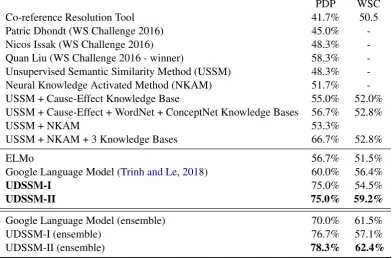
Table 2: The experiment results on PDP and WSC datasets. We compare our models to Goolge LM trained on the
same corpus6.
4 Experiments
In this section, we will introduce the datasets to train and evaluate our models for commonsense reasoning, the hyper-parameters of our model, and the analysis of our results.
4.1 Datasets
Training Corpus We make use of the raw text
from Gutenberg7, a corpus offerring over 57,000
free eBooks, and 1 Billion Word 8, a corpus of
news, to train our model. We first ignore the sen-tences that contain less than 10 tokens or longer than 50 tokens. Then, for the model UDSSM-I, we collect all the sentences with the pronoun before which there’re at least two nouns. For UDSSM-II, we collect all the sentences with at least 2 pronouns. In total, we collect around 4 million training pairs from each corpus for our proposed method respectively, and we split 5% as validation set.
Evaluation Dataset We evaluate our model on
the commonsense reasoning datasets, Pronoun
6
The best models reported in the works ofRadford et al.
(2019) andTrinh and Le(2018) are trained on a much larger
corpus from Common Crawl. 7
http://www.gutenberg.org
8https://github.com/ciprian-chelba/
1-billion-word-language-modeling-benchmark
Disambiguation Problems (PDP)9 and Winograd
Schema challenges (WSC) 10, which include 60
and 285 questions respectively. Both of the tasks are constructed for testing commonsense reason-ing and all the questions from these challenges are obvious for human beings to solve with common-sense knowledge, but hard for machines to solve with statistical techniques.
4.2 Experimental Setting
We use the same setting for both our models. The hidden state dimension of a single-directional LSTM is set to be 300. We use 300 dimensional
GloVe embeddings 11 for initialization. We use
Adamax to optimise the model, set learning rate to be 0.002, dropout rate on all layers are tuned from [0, 0.1, 0.2] and the batch size from [30, 50, 100, 200]. For the model UDSSM-I, in one batch, we treat all sequence pairs not from the same sentence as negative cases. And it takes around 30 hours on a single K40 GPU to train our models, which are much faster than training a large LM (Jozefowicz
et al.,2016) taking weeks on multiple GPUs.
9
https://cs.nyu.edu/faculty/davise/ papers/WinogradSchemas/PDPChallenge2016. xml
10
https://cs.nyu.edu/faculty/davise/ papers/WinogradSchemas/WSCollection.xml
4.3 Experimental Results
The experiment results are shown in Table2. Most
of the performance in the top of the Table 2 are
the models trained with external knowledge bases,
such as Cause-Effect (Liu et al., 2016),
Word-Net (Miller, 1995), ConceptNet (Liu and Singh,
2004) knowledge bases. Unsupervised Semantic
Similarity Method (USSM) (Liu et al., 2017) is
based on the skip-gram model (Mikolov et al., 2013) to train word embeddings and the embed-dings of all the words connected by knowledge bases are optimized to be closer. Neural
Knowl-edge Activated Method (NKAM) (Liu et al.,2017)
trained a binary classification model based on whether the word pairs appear in the knowledge base. One limitation of these methods is that they rely heavily on the external knowledge bases. An-other limitation is that they just linearly aggre-gate the embeddings of the words in the context, and that’s hard to integrate the word order infor-mation. Instead, our model with LSTM can better represent the contextual information. Besides, our model don’t need any external knowledge bases, and achieve a significant improvement on both of the datasets.
We further compare our models with the
un-supervised baselines, ELMo (Peters et al., 2018)
which selects the candidate based on the co-sine similarity of the hidden states of noun and pronoun. Another unsupervised baseline, Google Language Model for commonsense
rea-soning (Trinh and Le,2018), which compares the
perplexities of the new sentences by replacing the pronoun with candidates. To make a fair
com-parison to Trinh and Le (2018)’s work, we also
train our single model on the corpus of Guten-berg only. We can see that both of our methods get significant improvement on the PDP dataset, and our UDSSM-II can achieve much better perfor-mance on the WSC dataset. We also report our en-semble model (nine models with different hyper-parameters) trained with both corpus of Gutenberg and 1 Billion Word, and it also achieve better per-formance than Google Language Model trained with the same corpus.
Finally, we also compare to the pre-trained Coreference Resolution Tool (Clark and Manning,
2016a,b)12, and we can see that it doesn’t adapt
to our commonsense reasoning tasks and can’t tell
12https://github.com/huggingface/
neuralcoref
the difference between each pair of sentences from WSC. In this way, our model can get much better performance.
4.4 Analysis
WSC 1: Paul tried to call George on the
phone, buthewasn’t successful.
Ours 1: He tried to call 911 using her cell
phone but that hecould n’t get the
phone to work.
WSC 2: Paul tried to call George on the
phone, buthewas n’t available .
Ours 2: He tried twice to callherbutshedid
not answer the phone .
Table 3: Comparison of the data from WSC and our training data. Our sentences are retrieved from the UDSSM-II training dataset based on the BM25 value for analysis. The pseudo labels in our training data can help identify the co-references in WSC.
In this subsection, we will conduct further anal-ysis on the reason that our models work, the bene-fit of our models comparing to a baseline, and the limitation of our proposed models.
We have a further analysis on the pair-wise sen-tences, which we collected for training, to check how our model can work. We find that some rea-soning problems can somehow be converted to the
paraphrase problem. For example, in Table3, we
make use of Lucene Index13with BM25 to retrieve
the similar sentences to the WSC sentences from our training dataset, and make a comparison. We can see that these pairs are somehow paraphrased each other respectively. For the first pair, the con-textual representations of “Paul” and “he” in WSC could be similar to the contextual representations of ”he” in our training sentence. As these represen-tations are used to compute the co-reference score, the final scores would be similar. The pseudo la-bel “positive” for our first sentence will make the positive probability of the golden co-references “Paul” and “he” in WSC higher. And for the
sec-ond pair in Table3, the pseudo label of positive in
our second sentence will make the positive prob-ability of the golden co-references “George” and “he” in WSC 2 higher. In this way, these kinds of co-reference patterns from training data can be directly mapped to solve the Winograd Schema Challenges.
Here’s another example from PDP demonstrat-ing the benefit of our method: “Always before,
Larry had helped Dad with his work. Buthecould
not help him now, for Dad said that ”.Trinh and Le
(2018) failed on this one, probably because lan-guage models are not good at solving long dis-tance dependence, and tends to predict that “he ” refers to “his” in the near context rather the cor-rect answer “Larry”. And our model can give the correct prediction.
We further analysis the predictions of our model. We find that some specific commonsense knowledge are still hard to learn, such as the fol-lowing pairs:
• The trophy doesn’t fit into the brown suitcase
becauseitis too small.
• The trophydoesn’t fit into the brown suitcase
becauseitis too large.
To solve this problem, the model should learn the knowledge to compare the size of the objects. However, all of our models trained with differ-ent hyper-parameters select the same candidate as the co-referred word for “it” in both sentences. To solve the problem, broader data need to collect for learning more commonsense knowledge.
5 Conclusion
In conclusion, to overcome the lack of human la-beled data, we proposed two unsupervised deep structured semantic models (UDSSM) for com-monsense reasoning. We evaluated our models on the commonsense reasoning tasks of Pronoun Disambiguation Problems (PDP) and Winograd
Schema Challenge (Levesque et al.,2011), where
the questions are quite easy for human to answer, but quite challenging for the machine. Without using any hand-craft knowledge base, our model achieved stat-of-the-art performance on the two tasks.
In the future work, we will use Transformer, which is proved to be more powerful than LSTM, as the encoder of our unsupervised deep structured semantic models, and we will collect a larger cor-pus from Common Crawl to train our model.
References
Daniel Bailey, Amelia Harrison, Yuliya Lierler, Vladimir Lifschitz, and Julian Michael. 2015. The winograd schema challenge and reasoning about
correlation. In Knowledge Representation;
Coref-erence Resolution; Reasoning.
Samuel R. Bowman, Gabor Angeli, Christopher Potts,
and Christopher D. Manning. 2015. A large
an-notated corpus for learning natural language
infer-ence. InProceedings of the Conference on
Empiri-cal Methods in Natural Language Processing.
Kevin Clark and Christopher D Manning. 2016a. Deep reinforcement learning for mention-ranking
corefer-ence models. Proceedings of the Conference on
Em-pirical Methods in Natural Language Processing.
Kevin Clark and Christopher D Manning. 2016b. Im-proving coreference resolution by learning
entity-level distributed representations. Proceedings of the
Association for Computational Linguistics.
Robin Cooper, Dick Crouch, Jan Van Eijck, Chris Fox, Johan Van Genabith, Jan Jaspars, Hans Kamp, David Milward, Manfred Pinkal, Massimo Poesio,
and Steve Pulman. 1996. Using the framework.
Technical report, Technical Report LRE 62-051 D-16, The FraCaS Consortium.
Ido Dagan, Oren Glickman, and Bernardo Magnini.
2006. The pascal recognising textual entailment
challenge. InMachine Learning Challenges.
Evalu-ating Predictive Uncertainty, Visual Object Classifi-cation, and Recognising Tectual Entailment.
Ernest Davis and Gary Marcus. 2015. Commonsense reasoning and commonsense knowledge in artificial
intelligence. Communications of the ACM.
Jianfeng Gao, Michel Galley, and Lihong Li. 2018.
Neural approaches to conversational ai. arXiv
preprint arXiv:1809.08267.
Po-Sen Huang, Xiaodong He, Jianfeng Gao, Li Deng, Alex Acero, and Larry Heck. 2013. Learning deep structured semantic models for web search using
clickthrough data. InProceedings of the 22nd ACM
international conference on Conference on informa-tion & knowledge management.
Rafal Jozefowicz, Oriol Vinyals, Mike Schuster, Noam
Shazeer, and Yonghui Wu. 2016. Exploring the
limits of language modeling. arXiv preprint
arXiv:1602.02410.
Hector J Levesque, Ernest Davis, and Leora Morgen-stern. 2011. The winograd schema challenge. In
AAAI spring symposium: Logical formalizations of commonsense reasoning.
Hugo Liu and Push Singh. 2004. Conceptneta
practi-cal commonsense reasoning tool-kit. BT technology
journal, 22(4):211–226.
Quan Liu, Hui Jiang, Andrew Evdokimov, Zhen-Hua Ling, Xiaodan Zhu, Si Wei, and Yu Hu. 2016. Prob-abilistic reasoning via deep learning: Neural