1315
Star-Transformer
Qipeng Guo†
Xipeng Qiu†∗
Pengfei Liu†
Yunfan Shao†
Xiangyang Xue†
†Shanghai Key Laboratory of Intelligent Information Processing, Fudan University
†School of Computer Science, Fudan University
‡New York University
Zheng Zhang‡
Abstract
AlthoughTransformerhas achieved great suc-cesses on many NLP tasks, its heavy struc-ture with fully-connected attention connec-tions leads to dependencies on large train-ing data. In this paper, we present Star-Transformer, a lightweight alternative by care-ful sparsification. To reduce model complex-ity, we replace the fully-connected structure with a star-shaped topology, in which every two non-adjacent nodes are connected through a shared relay node. Thus, complexity is re-duced from quadratic to linear, while preserv-ing the capacity to capture both local compo-sition and long-range dependency. The ex-periments on four tasks (22 datasets) show that Star-Transformer achieved significant im-provements against the standard Transformer for the modestly sized datasets.
1 Introduction
Recently, the fully-connected attention-based models, like Transformer (Vaswani et al., 2017), become popular in natural language processing (NLP) applications, notably machine translation (Vaswani et al., 2017) and language modeling (Radford et al., 2018). Some recent work also suggest that Transformer can be an alternative to recurrent neural networks (RNNs) and convo-lutional neural networks (CNNs) in many NLP tasks, such as GPT (Radford et al.,2018), BERT (Devlin et al.,2018), Transformer-XL (Dai et al.,
2019) and Universal Transformer (Dehghani et al.,
2018).
More specifically, there are two limitations of the Transformer. First, the computation and
mem-∗
Corresponding Author.
‡
work done at NYU Shanghai, now with AWS Shanghai AI Lab.
h1
h2
h3
h4
h5
h6
h7
h8
s h1
h2
h3
h4
h5
h6
h7
[image:1.595.311.521.263.356.2]h8
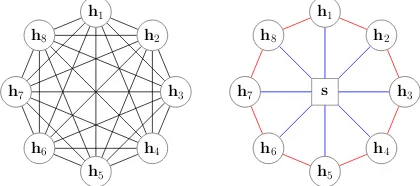
Figure 1: Left: Connections of one layer in Trans-former, circle nodes indicate the hidden states of in-put tokens. Right: Connections of one layer in Star-Transformer, the square node is the virtual relay node. Red edges and blue edges are ring and radical connec-tions, respectively.
ory overhead of the Transformer are quadratic to the sequence length. This is especially problem-atic with long sentences. Transformer-XL (Dai et al.,2019) provides a solution which achieves the acceleration and performance improvement, but it is specifically designed for the language modeling task. Second, studies indicate that Transformer would fail on many tasks if the training data is limited, unless it is pre-trained on a large corpus. (Radford et al.,2018;Devlin et al.,2018).
A key observation is that Transformer does not exploit prior knowledge well. For example, the local compositionality is already a robust induc-tive bias for modeling the text sequence. How-ever, the Transformer learns this bias from scratch, along with non-local compositionality, thereby in-creasing the learning cost. The key insight is then whether leveraging strong prior knowledge can help to “lighten up” the architecture.
architecture by moving the fully-connected topol-ogy into a star-shaped structure. Fig-1 gives an overview. Star-Transformer has two kinds of con-nections. The radical connections preserve the non-local communication and remove the redun-dancy in fully-connected network. The ring con-nections embody the local-compositionality prior, which has the same role as in CNNs/RNNs. The direct outcome of our design is the improvement of both efficiency and learning cost: the compu-tation cost is reduced from quadratic to linear as a function of input sequence length. An inherent ad-vantage is that the ring connections can effectively reduce the burden of the unbias learning of local and non-local compositionality and improve the generalization ability of the model. What remains to be tested is whether one shared relay node is capable of capturing the long-range dependencies. We evaluate the Star-Transformer on three NLP tasks including Text Classification, Natural Lan-guage Inference, and Sequence Labelling. Experi-mental results show that Star-Transformer outper-forms the standard Transformer consistently and has less computation complexity. An additional analysis on a simulation task indicates that Star-Transformer preserve the ability to handle with long-range dependencies which is a crucial feature of the standard Transformer.
In this paper, we claim three contributions as the following and our code is available on Github1:
• Compared to the standard Transformer, Star-Transformer has a lightweight structure but with an approximate ability to model the long-range dependencies. It reduces the number of connections fromn2to2n, where nis the sequence length.
• The Star-Transformer divides the labor of se-mantic compositions between the radical and the ring connections. The radical connections focus on the non-local compositions and the ring connections focus on the local composi-tion. Therefore, Star-Transformer works for modestly sized datasets and does not rely on heavy pre-training.
• We design a simulation task “Masked Sum-mation” to probe the ability dealing with long-range dependencies. In this task,
1https://github.com/dmlc/dgl and https: //github.com/fastnlp/fastNLP
we verify that both Transformer and Star-Transformer are good at handling long-range dependencies compared to the LSTM and BiLSTM.
2 Related Work
Recently, neural networks have proved very suc-cessful in learning text representation and have achieved state-of-the-art results in many different tasks.
Modelling Local Compositionality A popular approach is to represent each word as a low-dimensional vector and then learn the local seman-tic composition functions over the given sentence structures. For example,Kim(2014); Kalchbren-ner et al.(2014) used CNNs to capture the seman-tic representation of sentences, whereasCho et al.
(2014) used RNNs.
These methods are biased for learning local compositional functions and are hard to capture the long-term dependencies in a text sequence. In order to augment the ability to model the non-local compositionality, a class of improved meth-ods utilizes various self-attention mechanisms to aggregate the weighted information of each word, which can be used to get sentence-level represen-tations for classification tasks (Yang et al.,2016;
Lin et al.,2017;Shen et al.,2018a). Another class of improved methods augments neural networks with a re-reading ability or global state while pro-cessing each word (Cheng et al., 2016; Zhang et al.,2018).
However, those Transformer-based methods usually require a large training corpus. When ap-plying them on modestly sized datasets, we need the help of semi-supervised learning and unsu-pervised pretraining techniques (Radford et al.,
2018).
Graph Neural Networks Star-Transformer is also inspired by the recent graph networks (Gilmer et al., 2017; Kipf and Welling, 2016; Battaglia et al., 2018; Liu et al., 2018b), in which the in-formation fusion progresses via message-passing across the whole graph.
The graph structure of the Star-Transformer is star-shaped by introducing a virtual relay node. The radical and ring connections give a better bal-ance between the local and non-local composition-ality. Compared to the previous augmented mod-els (Yang et al.,2016;Lin et al.,2017;Shen et al.,
2018a;Cheng et al.,2016;Zhang et al.,2018), the implementation of Star-Transform is purely based on the attention mechanism similar to the standard Transformer, which is simpler and well suited for parallel computation.
Due to its better parallel capacity and lower complexity, the Star-Transformer is faster than RNNs or Transformer, especially on modeling long sequences.
3 Model
3.1 Architecture
The Star-Transformer consists of one relay node and n satellite nodes. The state of i-th satellite node represents the features of thei-th token in a text sequence. The relay node acts as a virtual hub to gather and scatter information from and to all the satellite nodes.
Star-Transformer has a star-shaped structure, with two kinds of connections in the: the radical connections and the ring connections.
Radical Connections For a network ofn satel-lite nodes, there arenradical connections. Each connection links a satellite node to the shared re-lay node. With the radical connections, every two non-adjacent satellite nodes are two-hop neigh-bors and can receive non-local information with a two-step update.
Ring Connections Since text input is a se-quence, we bake such prior as an inductive bias. Therefore, we connect the adjacent satellite nodes
to capture the relationship of local compositions. The first and last nodes are also connected. Thus, all these local connections constitute a ring-shaped structure. Note that the ring connections allow each satellite node to gather information from its neighbors and plays the same role to CNNs or bidirectional RNNs.
With the radical and ring connections, Star-Transformer can capture both the non-local and lo-cal compositions simultaneously. Different from the standard Transformer, we make a division of labor, where the radical connections capture non-local compositions, whereas the ring connections attend to local compositions.
3.2 Implementation
The implementation of the Star-Transformer is very similar to the standard Transformer, in which the information exchange is based on the attention mechanism (Vaswani et al.,2017).
Multi-head Attention Just as in the standard Transformer, we use the scaled dot-product atten-tion (Vaswani et al., 2017). Given a sequence of vectors H ∈ Rn×d, we can use a query vector q ∈ R1×d to soft select the relevant information
with attention.
Att(q,K,V) = softmax(qK
T
√
d )V, (1)
whereK =HWK,V =HWV, andWK,WV
are learnable parameters.
To gather more useful information fromH, sim-ilar to channels in CNNs, we can use multi-head attention withkheads.
MultiAtt(q,H) = (a1⊕ · · · ⊕ak)WO, (2)
ai= Att(qWQi ,HWiK,HWiV), i∈[1, k] (3)
where⊕denotes the concatenation operation, and
WiQ,WKi ,WiV,WOare learnable parameters.
Update Let st ∈
R1×d and Ht ∈ Rn×d de-note the states for the relay node and all the n satellite nodes at step t. When using the Star-Transformer to encode a text sequence of length n, we start from its embeddingE = [e1;· · ·;en],
whereei ∈ R1×dis the embedding of the i-th to-ken.
We initialize the state with H0 = E ands0 =
The update of the Star-Transformer at steptcan be divided into two alternative phases: (1) the up-date of the satellite nodes and (2) the upup-date of the relay node.
At the first phase, the state of each satellite node
hi are updated from its adjacent nodes,
includ-ing the neighbor nodeshi−1,hi+1in the sequence,
the relay nodest, its previous state, and its corre-sponding token embedding.
Cti = [hit−−11;hti−1;hti+1−1;ei;st−1], (4)
hti = MultiAtt(hti−1,Cti), (5)
whereCti denotes the context information for the i-th satellite node. Thus, the update of each satel-lite node is similar to the recurrent network, except that the update fashion is based on attention mech-anism. After the information exchange, a layer normalization operation (Ba et al.,2016) is used.
hti = LayerNorm(ReLU(hti)), i∈[1, n]. (6)
At the second phase, the relay nodest summa-rizes the information of all the satellite nodes and its previous state.
st= MultiAtt(st−1,[st−1;Ht]), (7)
st= LayerNorm(ReLU(st)). (8)
By alternatively updating update the satellite and relay nodes, the Star-Transformer finally cap-tures all the local and non-local compositions for an input text sequence.
Position Embeddings To incorporate the se-quence information, we also add the learnable po-sition embeddings, which are added with the token embeddings at the first layer.
The overall update algorithm of the Star-Transformer is shown in the Alg-1.
3.3 Output
AfterT rounds of update, the final states of HT
andsT can be used for various tasks such as se-quence labeling and classification. For different tasks, we feed them to different task-specific mod-ules. For classification, we generate the fix-length sentence-level vector representation by applying a max-pooling across the final layer and mixing it with sT, this vector is fed into a Multiple Layer Perceptron (MLP) classifier. For the sequence la-beling task, theHT provides features correspond-ing to all the input tokens.
Algorithm 1The Update of Star-Transformer Input: Number of layers T, embedding of input tokense1,· · ·, en
1: //Initialization
2: h01,· · ·,hn0 ←e1,· · ·,en
3: s0 ←average(e1,· · · ,en)
4: fortfrom1toT do
5: //update the satellite nodes
6: forifrom1tondo
7: Cti = [hti−−11;hit−1;hit+1−1;ei;st−1] 8: hti = MultiAtt(hti−1,Cti)
9: hti = LayerNorm(ReLU(hti))
10: //update the relay node
11: st= MultiAtt(st−1,[st−1;Ht])
12: st= LayerNorm(ReLU(st))
4 Comparison to the standard Transformer
Since our goal is making the Transformer lightweight and easy to train with modestly sized dataset, we have removed many connections com-pared with the standard Transformer (see Fig-1). If the sequence length is n and the dimension of hidden states is d, the computation complex-ity of one layer in the standard Transformer is O(n2d). The Star-Transformer has two phases, the update of ring connections costsO(5nd) (the constant5 comes from the size of context infor-mationC), and the update of radical connections costsO(nd), so the total cost of one layer in the Star-Transformer isO(6nd).
In theory, Star-Transformer can cover all the possible relationships in the standard Transformer. For example, any relationship hi → hj in the
standard Transformer can be simulated byhi →
s→hj. The experiment on the simulation task in
Sec-5.1 provides some evidence to show the vir-tual nodescould handle long-range dependencies. Following this aspect, we can give a rough anal-ysis of the path length of dependencies in these models. As discussed in the Transformer paper (Vaswani et al.,2017), the maximum dependency path length of RNN and Transformer are O(n), O(1), respectively. Star-Transformer can pass the message from one node to another node via the relay node so that the maximum dependency path length is alsoO(1), with a constant two comparing to Transformer.
connec-Dataset Train Dev. Test |V| H DIM #head head DIM
Masked Summation 10k 10k 10k - 100 10 10
SST (Socher et al.,2013) 8k 1k 2k 20k 300 6 50
MTL-16† (Liu et al.,
2017)
Apparel Baby Books Camera DVD Electronics Health IMDB Kitchen Magazines MR Music Software Sports Toys Video
1400 200 400 8k∼28k 300 6 50
SNLI (Bowman et al.,2015) 550k 10k 10k 34k 600 6 100
PTB POS (Marcus et al.,1993) 38k 5k 5k 44k 300 6 50
CoNLL03 (Sang and Meulder,2003) 15k 3k 3k 25k 300 6 50
[image:5.595.83.515.63.228.2]OntoNotes NER (Pradhan et al.,2012) 94k 14k 8k 63k 300 6 50
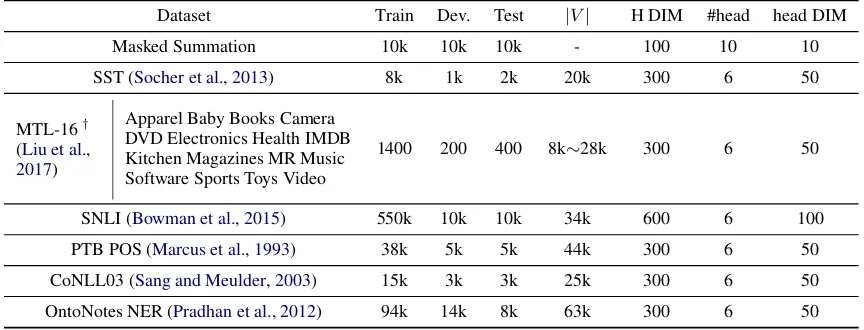
Table 1: An overall of datasets and its hyper-parameters, “H DIM, #head, head DIM” indicates the dimension of hidden states, the number of heads in the Multi-head attention, the dimension of each head, respectively. MTL-16† consists of 16 datasets, each of them has 1400/200/400 samples in train/dev/test.
tions are replaced with a “gather and dispatch” mechanism. As a result, we accelerate the Trans-former 10 times on the simulation task and 4.5 times on real tasks. The model also preserves the ability to handle long input sequences. Besides the acceleration, the Star-Transformer achieves significant improvement on some modestly sized datasets.
5 Experiments
We evaluate Star-Transformer on one simulation task to probe its behavior when challenged with long-range dependency problem, and three real tasks (Text Classification, Natural Language Infer-ence, and Sequence Labelling). All experiments are ran on a NVIDIA Titan X card. Datasets used in this paper are listed in the Tab-1. We use the Adam (Kingma and Ba, 2014) as our optimizer. On the real task, we set the embedding size to 300 and initialized with GloVe (Pennington et al.,
2014). And the symbol “Ours + Char” means an additional character-level pre-trained embedding JMT (Hashimoto et al., 2017) is used. There-fore, the total size of embedding should be 400 which as a result of the concatenation of GloVe and JMT. We also fix the embedding layer of the Star-Transformer in all experiments.
Since semi- or unsupervised model is also a fea-sible solution to improve the model in a parallel direction, such as the ELMo (Peters et al.,2018) and BERT (Devlin et al.,2018), we exclude these models in the comparison and focus on the rele-vant architectures.
5.1 Masked Summation
In this section, we introduce a simulation task on the synthetic data to probe the efficiency and non-local/long-range dependencies of LSTM, Trans-former, and the Star-Transformer. As mentioned in (Vaswani et al., 2017), the maximum path length of long-range dependencies of LSTM and Transformer are O(n) andO(1), where nis the sequence length. The maximum dependency path length of Star-Transformer isO(1)with a constant two via the relay node. To validate the ability to deal with long-range dependencies, we design a simulation task named “Masked Summation”. The input of this task is a matrixX∈Rn×d, it has ncolumns and each column hasdelements. The first dimension indicates the mask value Xi0 ∈ {0,1},0means the column is ignored in summa-tion. The restd−1elements are real numbers in drawn uniformly from the range [0,1). The tar-get is ad−1dimensional vector which equals the summation of all the columns with the mask value
1. There is an implicit variable k to control the number of1in the input. Note that a simple base-line is always guessing the valuek/2.
The evaluation metric is the Mean Square Error (MSE), and the generated dataset has (10k/10k/10k) samples in (train/dev/test) sets. The Fig-2show a case of the masked summation task.
[image:5.595.83.520.63.229.2]per-Input
1
0.3
0.4
0
0.5
0.7
0
0.1
0.2
1
0.5
0.9
0
0.4
0.2
0
0.6
0.8
0
0.1
0.3
1
0.1
0.6
0.9
[image:6.595.76.249.194.315.2]1.9 Target
Figure 2: An example of the masked summation task, the input is a sequence ofn vectors, each vector has d
dimension, and there are totalkvectors which have the mask value equals1. The target is the summation of such masked vectors. In this figure,n= 8, k= 3, d= 3.
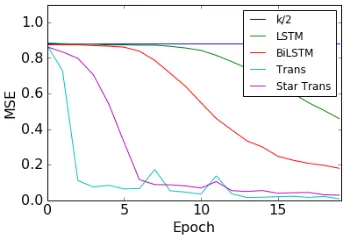
(a) MSE loss on the masked summation when n = 200, k = 10, d = 10. Thek/2line means the MSE loss when the model always guess the ex-ception valuek/2.
(b) Test Time,k= 10, d= 10
formance curves of models on various lengths. Although the task is easy, the performance of LSTM and BiLSTM dropped quickly when the se-quence length increased. However, both Trans-former and Star-TransTrans-former performed consis-tently on various lengths. The result indicates the Star-Transformer preserves the ability to deal with the non-local/long-range dependencies.
Besides the performance comparison, we also study the speed with this simulation task since we could ignore the affection of padding, masking, and data processing. We also report the inference time in the Fig-3b, which shows that Transformer is faster than LSTM and BiLSTM a lot, and Star-Transformer is faster than Star-Transformer, especially on the long sequence.
Model Acc
BiLSTM (Li et al.,2015) 49.8 Tree-LSTM (Tai et al.,2015) 51.0 CNN-Tensor (Lei et al.,2015) 51.2 Emb + self-att (Shen et al.,2018a) 48.9 BiLSTM + self-att (Yoon et al.,2018) 50.4 CNN + self-att (Yoon et al.,2018) 50.6 Dynamic self-att (Yoon et al.,2018) 50.6 DiSAN (Shen et al.,2018a) 51.7
Transformer 50.4
[image:6.595.77.245.373.491.2]Ours 52.9
Table 2: Test Accuracy on SST dataset.
5.2 Text Classification
Text classification is a basic NLP task, and we se-lect two datasets to observe the performance of our model in different conditions, Stanford Senti-ment Treebank(SST) dataset (Socher et al.,2013) and MTL-16 (Liu et al.,2017) consists of 16 small datasets on various domains. We truncate the se-quence which its length higher than 256 to ensure the standard Transformer can run on a single GPU card.
For classification tasks, we use the state of the relay nodesT plus the feature of max pooling on satellite nodes max(HT) as the final representa-tion and feed it into the softmax classifier. The description of hyper-parameters is listed in Tab-1
and Appendix.
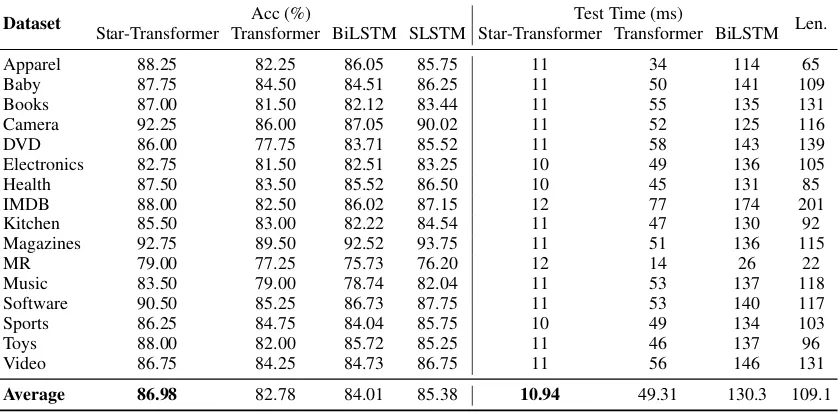
Results on SST and MTL-16 datasets are listed in Tab-2,3, respectively. On the SST, the Star-Transformer achieves 2.5 points improvement against the standard Transformer and beat the most models.
Star-Dataset Acc (%) Test Time (ms) Len. Star-Transformer Transformer BiLSTM SLSTM Star-Transformer Transformer BiLSTM
Apparel 88.25 82.25 86.05 85.75 11 34 114 65
Baby 87.75 84.50 84.51 86.25 11 50 141 109
Books 87.00 81.50 82.12 83.44 11 55 135 131
Camera 92.25 86.00 87.05 90.02 11 52 125 116
DVD 86.00 77.75 83.71 85.52 11 58 143 139
Electronics 82.75 81.50 82.51 83.25 10 49 136 105
Health 87.50 83.50 85.52 86.50 10 45 131 85
IMDB 88.00 82.50 86.02 87.15 12 77 174 201
Kitchen 85.50 83.00 82.22 84.54 11 47 130 92
Magazines 92.75 89.50 92.52 93.75 11 51 136 115
MR 79.00 77.25 75.73 76.20 12 14 26 22
Music 83.50 79.00 78.74 82.04 11 53 137 118
Software 90.50 85.25 86.73 87.75 11 53 140 117
Sports 86.25 84.75 84.04 85.75 10 49 134 103
Toys 88.00 82.00 85.72 85.25 11 46 137 96
Video 86.75 84.25 84.73 86.75 11 56 146 131
[image:7.595.90.510.64.271.2]Average 86.98 82.78 84.01 85.38 10.94 49.31 130.3 109.1
Table 3: Test Accuracy over MTL-16 datasets. “Test Time” means millisecond per batch on the test set (batch size is 128). “Len.” means the average sequence length on the test set.
Transformer could work well on the small dataset which only has 1400 training samples. Results of the time-consuming show the Star-Transformer could be 4.5 times fast than the standard Trans-former on average.
5.3 Natural Language Inference
Natural Language Inference (NLI) asks the model to identify the semantic relationship between a premise sentence and a corresponding hypothesis sentence. In this paper, we use the Stanford Nat-ural Language Inference (SNLI) (Bowman et al.,
2015) for evaluation. Since we want to study how the model encodes the sentence as a vector rep-resentation, we set Star-Transformer as a sentence vector-based model and compared it with sentence vector-based models.
In this experiment, we follow the previous work (Bowman et al.,2016) to use concat(r1,r2,kr1− r2k,r1 − r2) as the classification feature. The r1,r2 are representations of premise and
hypoth-esis sentence, it is calculated bysT + max(HT)
which is same with the classification task. See Ap-pendix for the detail of hyper-parameters.
As shown in Tab-4, the Star-Transformer out-performs most typical baselines (DiSAN, SPINN) and achieves comparable results compared with the state-of-the-art model. Notably, our model beats standard Transformer by a large margin, which is easy to overfit although we have made a careful hyper-parameters’ searching for Trans-former.
Model Acc
BiLSTM (Liu et al.,2016) 83.3 BiLSTM + self-att (Liu et al.,2016) 84.2 300D SPINN-PI (Bowman et al.,2016) 83.2 Tree-based CNN (Mou et al.,2016) 82.1 4096D BiLSTM-max (Conneau et al.,2017) 84.5 300D DiSAN (Shen et al.,2018a) 85.6 Residual encoders (Nie and Bansal,2017) 86.0 Gumbel TreeLSTM (Choi et al.,2018) 86.0 Reinforced self-att (Shen et al.,2018b) 86.3 2400D Multiple DSA (Yoon et al.,2018) 87.4
Transformer 82.2
Star-Transformer 86.0
Table 4: Test Accuracy on SNLI dataset.
The SNLI dataset is not a small dataset in NLP area, so improving the generalization ability of the Transformer is a significant topic.
The best result in Tab-4 (Yoon et al., 2018) using a large network and fine-tuned hyper-parameters, they get the best result on SNLI but an undistinguished result on SST, see Tab-2.
5.4 Sequence Labelling
To verify the ability of our model in sequence la-beling, we choose two classic sequence labeling tasks: Part-of-Speech (POS) tagging and Named Entity Recognition (NER) task.
[image:7.595.311.523.323.468.2]fi-Model Adv Tech
POS NER
PTB CoNLL2003 CoNLL2012
char CRF Acc F1 F1
(Ling et al.,2015) X X 97.78 -
-(Collobert et al.,2011) X X 97.29 89.59
-(Huang et al.,2015) X X 97.55 90.10
-(Chiu and Nichols,2016a) X X - 90.69 86.35
(Ma and Hovy,2016) X X 97.55 91.06
-(Nguyen et al.,2016) X X - 91.2
-(Chiu and Nichols,2016b) X X - 91.62 86.28
(Zhang et al.,2018) X X 97.55 91.57
-(Akhundov et al.,2018) X X 97.43 91.11 87.84
Transformer 96.31 86.48 83.57
Transformer + Char X 97.04 88.26 85.14
Star-Transformer 97.14 90.93 86.30
Star-Transformer + Char X 97.64 91.89 87.64
Star-Transformer + Char + CRF X X 97.68 91.98 87.88
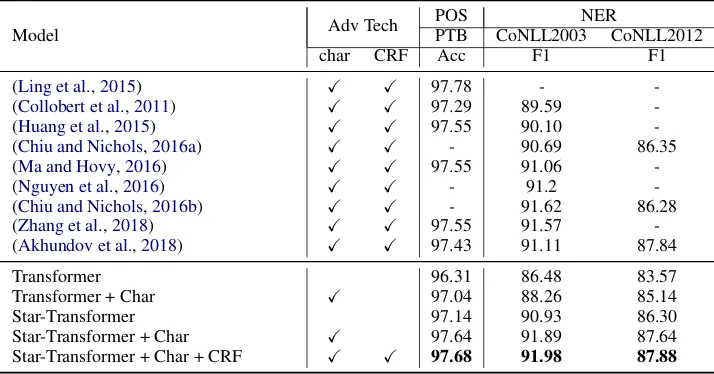
Table 5: Results on sequence labeling tasks. We list the “Advanced Techniques” except widely-used pre-trained embeddings (GloVe, Word2Vec, JMT) in columns. The “Char” indicates character-level features, it also includes the Capitalization Features, Suffix Feature, Lexicon Features, etc. The “CRF” means an additional Conditional Random Field (CRF) layer.
Model SNLI CoNLL03 MS
Acc Acc MSE
[image:8.595.120.477.63.250.2]Star-Transformer 86.0 90.93 0.0284 variant (a) -radical 84.0 89.35 0.1536 variant (b) -ring 77.6 79.36 0.0359
Table 6: Test Accuracy on SNLI dataset, CoNLL2003 NER task and the Masked Summationn = 200, k = 10, d= 10.
nal state of satellite nodesHT to classify the label in each position. Since we believe that the com-plex neural network could be an alternative of the CRF, we also report the result without CRF layer.
As shown in Tab-5, Star-Transformer achieves the state-of-the-art performance on sequence la-beling tasks. The “Star-Transformer + Char” has already beat most of the competitors. Star-Transformer could achieve such results without CRF, suggesting that the model has enough ca-pability to capture the partial ability of the CRF. The Star-Transformer also outperforms the stan-dard Transformer on sequence labeling tasks with a significant gap.
5.5 Ablation Study
In this section, we perform an ablation study to test the effectiveness of the radical and ring con-nections.
We test two variants of our models, the first variants (a) remove the radical connections and only keep the ring connections. Without the radi-cal connections, the maximum path length of this
variant becomesO(n). The second variant (b) re-moves the ring connections and remains the rad-ical connections. Results in Tab-6 give some in-sights, the variant (a) loses the ability to han-dle long-range dependencies, so it performs worse on both the simulation and real tasks. However, the performance drops on SNLI and CoNLL03 is moderate since the remained ring connections still capture the local features. The variant (b) still works on the simulation task since the max-imum path length stays unchanged. Without the ring connections, it loses its performance heavily on real tasks. Therefore, both the radical and ring connections are necessary to our model.
6 Conclusion and Future Works
In this paper, we present Star-Transformer which reduce the computation complexity of the standard Transformer by carefully sparsifying the topology. We compare the standard Transformer with other models on one toy dataset and 21 real datasets and find Star-Transformer outperforms the stan-dard Transformer and achieves comparable results with state-of-the-art models.
Acknowledgments
We would like to thank the anonymous re-viewers for their valuable comments. The re-search work is supported by Shanghai Munic-ipal Science and Technology Commission (No. 17JC1404100 and 16JC1420401), National Key Research and Development Program of China (No. 2017YFB1002104), and National Natural Science Foundation of China (No. 61672162 and 61751201).
References
Adnan Akhundov, Dietrich Trautmann, and Georg Groh. 2018. Sequence labeling: A practical ap-proach. CoRR, abs/1808.03926.
Lei Jimmy Ba, Ryan Kiros, and Geoffrey E. Hinton. 2016. Layer normalization. CoRR, abs/1607.06450.
Peter W Battaglia, Jessica B Hamrick, Victor Bapst, Alvaro Sanchez-Gonzalez, Vinicius Zambaldi, Ma-teusz Malinowski, Andrea Tacchetti, David Raposo, Adam Santoro, Ryan Faulkner, et al. 2018. Rela-tional inductive biases, deep learning, and graph net-works. arXiv preprint arXiv:1806.01261.
Samuel R. Bowman, Gabor Angeli, Christopher Potts, and Christopher D. Manning. 2015. A large an-notated corpus for learning natural language infer-ence. InEMNLP, pages 632–642. The Association for Computational Linguistics.
Samuel R. Bowman, Jon Gauthier, Abhinav Ras-togi, Raghav Gupta, Christopher D. Manning, and Christopher Potts. 2016. A fast unified model for parsing and sentence understanding. In ACL (1). The Association for Computer Linguistics.
Jianpeng Cheng, Li Dong, and Mirella Lapata. 2016. Long short-term memory-networks for machine reading. InProceedings of the 2016 Conference on EMNLP, pages 551–561.
Jason Chiu and Eric Nichols. 2016a. Sequential label-ing with bidirectional lstm-cnns. InProc. Interna-tional Conf. of Japanese Association for NLP, pages 937–940.
Jason P. C. Chiu and Eric Nichols. 2016b. Named en-tity recognition with bidirectional lstm-cnns. TACL, 4:357–370.
Kyunghyun Cho, Bart van Merrienboer, Caglar Gul-cehre, Fethi Bougares, Holger Schwenk, and Yoshua Bengio. 2014. Learning phrase representations using rnn encoder-decoder for statistical machine translation. InProceedings of EMNLP.
Jihun Choi, Kang Min Yoo, and Sang-goo Lee. 2018. Learning to compose task-specific tree structures. In AAAI, pages 5094–5101. AAAI Press.
Ronan Collobert, Jason Weston, L´eon Bottou, Michael Karlen, Koray Kavukcuoglu, and Pavel P. Kuksa. 2011. Natural language processing (almost) from scratch. Journal of Machine Learning Research, 12:2493–2537.
Alexis Conneau, Douwe Kiela, Holger Schwenk, Lo¨ıc Barrault, and Antoine Bordes. 2017. Supervised learning of universal sentence representations from natural language inference data. InEMNLP, pages 670–680. Association for Computational Linguis-tics.
Zihang Dai, Zhilin Yang, Yiming Yang, Jaime G. Carbonell, Quoc V. Le, and Ruslan Salakhutdi-nov. 2019. Transformer-xl: Attentive language models beyond a fixed-length context. CoRR, abs/1901.02860.
Mostafa Dehghani, Stephan Gouws, Oriol Vinyals, Jakob Uszkoreit, and Lukasz Kaiser. 2018. Univer-sal transformers.CoRR, abs/1807.03819.
Jacob Devlin, Ming-Wei Chang, Kenton Lee, and Kristina Toutanova. 2018. BERT: pre-training of deep bidirectional transformers for language under-standing. CoRR, abs/1810.04805.
Justin Gilmer, Samuel S Schoenholz, Patrick F Riley, Oriol Vinyals, and George E Dahl. 2017. Neural message passing for quantum chemistry. InICML, pages 1263–1272.
Kazuma Hashimoto, Caiming Xiong, Yoshimasa Tsu-ruoka, and Richard Socher. 2017. A joint many-task model: Growing a neural network for multiple NLP tasks. In EMNLP, pages 1923–1933. Association for Computational Linguistics.
Zhiheng Huang, Wei Xu, and Kai Yu. 2015. Bidi-rectional LSTM-CRF models for sequence tagging. CoRR, abs/1508.01991.
Nal Kalchbrenner, Edward Grefenstette, and Phil Blun-som. 2014. A convolutional neural network for modelling sentences. InProceedings of ACL.
Yoon Kim. 2014. Convolutional neural networks for sentence classification. InProceedings of the 2014 Conference on EMNLP, pages 1746–1751.
Diederik P. Kingma and Jimmy Ba. 2014. Adam: A method for stochastic optimization. CoRR, abs/1412.6980.
Thomas N Kipf and Max Welling. 2016. Semi-supervised classification with graph convolutional networks. arXiv preprint arXiv:1609.02907.
Jiwei Li, Thang Luong, Dan Jurafsky, and Eduard H. Hovy. 2015. When are tree structures necessary for deep learning of representations? InEMNLP, pages 2304–2314. The Association for Computational Lin-guistics.
Zhouhan Lin, Mo Feng, Yu, Bing Xiang, Bowen Zhou, and Yoshua Bengio. 2017. A structured self-attentive sentence embedding. arXiv preprint arXiv:1703.03130.
Wang Ling, Chris Dyer, Alan W. Black, Isabel Tran-coso, Ramon Fermandez, Silvio Amir, Lu´ıs Marujo, and Tiago Lu´ıs. 2015. Finding function in form: Compositional character models for open vocabu-lary word representation. InEMNLP, pages 1520– 1530. The Association for Computational Linguis-tics.
Pengfei Liu, Shuaichen Chang, Xuanjing Huang, Jian Tang, and Jackie Chi Kit Cheung. 2018a. Contextu-alized non-local neural networks for sequence learn-ing. arXiv preprint arXiv:1811.08600.
Pengfei Liu, Jie Fu, Yue Dong, Xipeng Qiu, and Jackie Chi Kit Cheung. 2018b. Multi-task learning over graph structures.arXiv preprint arXiv:1811.10211.
Pengfei Liu, Xipeng Qiu, and Xuanjing Huang. 2017. Adversarial multi-task learning for text classifica-tion. InACL (1), pages 1–10. Association for Com-putational Linguistics.
Yang Liu, Chengjie Sun, Lei Lin, and Xiaolong Wang. 2016. Learning natural language inference us-ing bidirectional LSTM model and inner-attention. CoRR, abs/1605.09090.
Xuezhe Ma and Eduard H. Hovy. 2016. End-to-end se-quence labeling via bi-directional lstm-cnns-crf. In ACL (1). The Association for Computer Linguistics.
Mitchell P. Marcus, Beatrice Santorini, and Mary Ann Marcinkiewicz. 1993. Building a large annotated corpus of english: The penn treebank. Computa-tional Linguistics, 19(2):313–330.
Lili Mou, Rui Men, Ge Li, Yan Xu, Lu Zhang, Rui Yan, and Zhi Jin. 2016. Natural language inference by tree-based convolution and heuristic matching. In ACL (2). The Association for Computer Linguistics.
Dat Ba Nguyen, Martin Theobald, and Gerhard Weikum. 2016. J-NERD: joint named entity recog-nition and disambiguation with rich linguistic fea-tures. TACL, 4:215–229.
Yixin Nie and Mohit Bansal. 2017. Shortcut-stacked sentence encoders for multi-domain inference. In RepEval@EMNLP, pages 41–45. Association for Computational Linguistics.
Jeffrey Pennington, Richard Socher, and Christo-pher D. Manning. 2014. Glove: Global vectors for word representation. InEMNLP, pages 1532–1543. ACL.
Matthew E. Peters, Mark Neumann, Mohit Iyyer, Matt Gardner, Christopher Clark, Kenton Lee, and Luke Zettlemoyer. 2018. Deep contextualized word repre-sentations. InNAACL-HLT, pages 2227–2237. As-sociation for Computational Linguistics.
Sameer Pradhan, Alessandro Moschitti, Nianwen Xue, Olga Uryupina, and Yuchen Zhang. 2012. Conll-2012 shared task: Modeling multilingual unre-stricted coreference in ontonotes. In EMNLP-CoNLL Shared Task, pages 1–40. ACL.
Alec Radford, Karthik Narasimhan, Tim Salimans, and Ilya Sutskever. 2018. Improving language under-standing by generative pre-training.
Erik F. Tjong Kim Sang and Fien De Meulder. 2003. Introduction to the conll-2003 shared task: Language-independent named entity recognition. In CoNLL, pages 142–147. ACL.
Tao Shen, Tianyi Zhou, Guodong Long, Jing Jiang, Shirui Pan, and Chengqi Zhang. 2018a. Disan: Di-rectional self-attention network for rnn/cnn-free lan-guage understanding. In AAAI, pages 5446–5455. AAAI Press.
Tao Shen, Tianyi Zhou, Guodong Long, Jing Jiang, Sen Wang, and Chengqi Zhang. 2018b. Reinforced self-attention network: a hybrid of hard and soft self-attention for sequence modeling. InIJCAI, pages 4345–4352. ijcai.org.
Richard Socher, Alex Perelygin, Jean Wu, Jason Chuang, Christopher D. Manning, Andrew Y. Ng, and Christopher Potts. 2013. Recursive deep mod-els for semantic compositionality over a sentiment treebank. InEMNLP, pages 1631–1642. ACL.
Kai Sheng Tai, Richard Socher, and Christopher D. Manning. 2015. Improved semantic representations from tree-structured long short-term memory net-works. In ACL (1), pages 1556–1566. The Asso-ciation for Computer Linguistics.
Ashish Vaswani, Noam Shazeer, Niki Parmar, Jakob Uszkoreit, Llion Jones, Aidan N. Gomez, Lukasz Kaiser, and Illia Polosukhin. 2017. Attention is all you need. InNIPS, pages 6000–6010.
Zichao Yang, Diyi Yang, Chris Dyer, Xiaodong He, Alex Smola, and Eduard Hovy. 2016. Hierarchi-cal attention networks for document classification. In Proceedings of the 2016 Conference of NAACL, pages 1480–1489.
Deunsol Yoon, Dongbok Lee, and SangKeun Lee. 2018. Dynamic self-attention : Computing atten-tion over words dynamically for sentence embed-ding. CoRR, abs/1808.07383.