TweeTime: A Minimally Supervised Method for Recognizing and
Normalizing Time Expressions in Twitter
Jeniya Tabassum, Alan Ritter and Wei Xu
Computer Science and Engineering Ohio State University
{bintejafar.1,ritter.1492,xu.1265}@osu.edu
Abstract
We describe TweeTIME, a temporal tagger for recognizing and normalizing time expres-sions in Twitter. Most previous work in so-cial media analysis has to rely on tempo-ral resolvers that are designed for well-edited text, and therefore suffer from reduced perfor-mance due to domain mismatch. We present a minimally supervised method that learns from large quantities of unlabeled data and requires no hand-engineered rules or hand-annotated training corpora. TweeTIME achieves 0.68 F1 score on the end-to-end task of resolving date expressions, outperforming a broad range of state-of-the-art systems.1
1 Introduction
Temporal expressions are words or phrases that re-fer to dates, times or durations. Resolving time pressions is an important task in information ex-traction (IE) that enables downstream applications such as calendars or timelines of events (Derczyn-ski and Gaizauskas, 2013; Do et al., 2012; Rit-ter et al., 2012; Ling and Weld, 2010), knowledge base population (Ji et al., 2011), information re-trieval (Alonso et al., 2007), automatically schedul-ing meetschedul-ings from email and more. Previous work in this area has applied rule-based systems (Mani and Wilson, 2000; Bethard, 2013b; Chambers, 2013) or supervised machine learning on small collections of hand-annotated news documents (Angeli et al., 2012; Lee et al., 2014).
1Our code and data are publicly available at https://
[image:1.612.332.517.233.293.2]github.com/jeniyat/TweeTime.
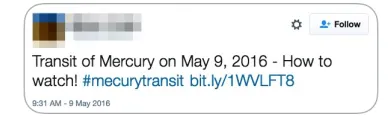
Figure 1:A tweet published onFriday 5/6/2016that contains the temporal expressionMonday referring to the date of the event (5/9/2016), which a generic temporal tagger failed to re-solve correctly.
Figure 2:A tweet that contains a simple explicit time mention and an event (Mercury, 5/9/2016) that can be identified by an open-domain information extraction system.
Social media especially contains time-sensitive information and requires accurate temporal anal-ysis, for example, for detecting real-time cyber-security events (Ritter et al., 2015; Chang et al., 2016), disease outbreaks (Kanhabua et al., 2012) and extracting personal information (Schwartz et al., 2015). However, most work on social media simply uses generic temporal resolvers and therefore suffers from suboptimal performance. Recent work on tem-poral resolution focuses primarily on news articles and clinical texts (UzZaman et al., 2013; Bethard and Savova, 2016).
Resolving time expressions in social media is a non-trivial problem. Besides many spelling varia-tions, time expressions are more likely to refer to future dates than in newswire. For the example in
[image:1.612.326.522.365.423.2]Figure 1, we need to recognize thatMondayrefers to the upcoming Monday and not the previous one to resolve to its correct normalized date (5/9/2016). We also need to identify that the wordSunis not re-ferring to a Sunday in this context.
In this paper, we present a new minimally super-vised approach to temporal resolution that requires no domain annotation or hand-crafted rules, in-stead learning from large quantities of unlabeled text in conjunction with a database of known events. Our approach is capable of learning robust time expres-sion models adapted to the informal style of text found on social media.
For popular events, some related tweets (e.g. Fig-ure 2) may contain explicit or other simple time mentions that can be captured by a generic temporal tagger. An open-domain information extraction sys-tem (Ritter et al., 2012) can then identify events (e.g. [Mercury, 5/9/2016]) by aggregating those tweets. To automatically generate temporally annotated data for training, we make the following noveldistant su-pervision assumption:2
Tweets posted near the time of a known event that mention central entities are likely to contain time expressions that re-fer to the date of the event.
Based on this assumption, tweets that contain the same named entity (e.g. Figure 1) are heuristically labeled as training data. Each tweet is associated with multiple overlapping labels that indicate the day of the week, day of the month, whether the event is in the past or future and other time properties of the event date in relation to the tweet’s creation date. In order to learn a tagger that can recognize temporal expressions at the word-level, we present a multiple-instance learning approach to model sentence and word-level tags jointly and handle overlapping la-bels. Using heuristically labeled data and the tem-poral tags predicted by the multiple-instance learn-ing model as input, we then train a log-linear model that normalizes time expressions to calendar dates.
Building on top of the multiple-instance learn-ing model, we further improve performance uslearn-ing 2We focus on resolving dates, arguably the most important and frequent category of time expressions in social media data, and leave other phenomenon such as times and durations to tra-ditional methods or future work.
a missing data model that addresses the problem of errors introduced during the heuristic labeling pro-cess. Our best model achieves a 0.68 F1 score when resolving date mentions in Twitter. This is a 17% increase over SUTime (Chang and Manning, 2012), outperforming other state-of-the-art time expression resolvers HeidelTime (Str¨otgen and Gertz, 2013), TempEX (Mani and Wilson, 2000) and UWTime (Lee et al., 2014) as well. Our approach also pro-duces a confidence score that allows us to trade re-call for precision. To the best of our knowledge, TweeTIME is the first time resolver designed specif-ically for social media data.3 This is also the first time that distant supervision is successfully applied for end-to-end temporal recognition and normaliza-tion. Previous distant supervision approaches (An-geli et al., 2012; An(An-geli and Uszkoreit, 2013) only address the normalization problem, assuming gold time mentions are available at test time.
2 System Overview
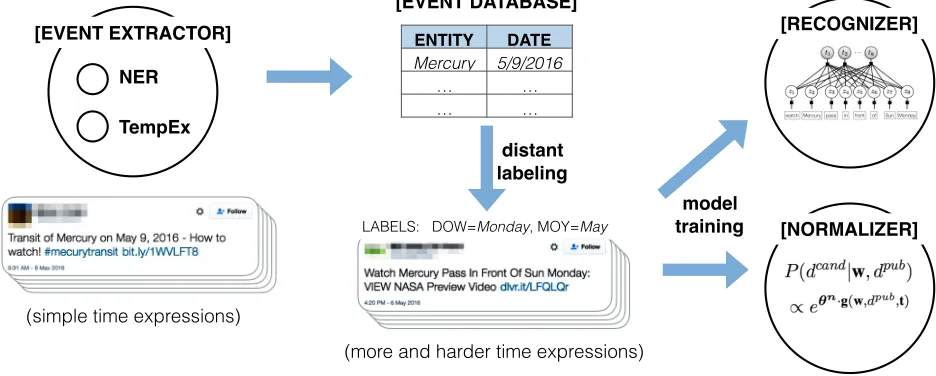
Our TweeTIME system consists of two major com-ponents as shown in Figure 3:
1. ATemporal Recognizerwhich identifies time expressions (e.g. Monday) in English text and outputs 5 different temporal types (described in Table 1) indicating timeline direction, month of year, date of month, day of week or no temporal information (NA). It is realized as a multiple-instance learning model, and in an enhanced version, as a missing data model.
2. A Temporal Normalizer that takes a tweet with its creation time and temporal expressions tagged by the above step as input, and out-puts their normalized forms (e.g. Monday →
5/9/2016). It is a log-linear model that uses both lexical features and temporal tags.
[RECOGNIZER]
[NORMALIZER] [EVENT EXTRACTOR]
NER
TempEx
ENTITY DATE
Mercury 5/9/2016
… …
… …
distant labeling
model training [EVENT DATABASE]
(simple time expressions)
[image:3.612.72.540.61.249.2](more and harder time expressions) LABELS: DOW=Monday, MOY=May
Figure 3:TweeTIME system diagram of model training.
Temporal Types Possible Values (tags) Timeline (TL) past, present, f uture
Day of Week (DOW) M on, T ue, . . . , Sun
Day of Month (DOM) 1,2,3, . . . ,31 Month of Year (MOY) Jan, F eb, . . . , Dec
None (NA) N A
Table 1: Our Temporal Recognizer can extract five different temporal types and assign one of their values to each word of a tweet.
proposed by Ritter et al. (2012). Each event con-sists of one or more named entities, in addition to the date on which the event takes place, for exam-ple [Mercury,5/9/2016]. Tweets are first processed by a Twitter named entity recognizer (Ritter et al., 2011), and a generic date resolver (Mani and Wil-son, 2000). Events are then extracted based on the strength of association between each named entity and calendar date, as measured by aG2test on their
co-occurrence counts. More details of theEvent Ex-tractorcan be found in Section 5.1.
The following two sections describe the details of ourTemporal RecognizerandTemporal Normal-izerseparately.
3 Distant Supervision for Recognizing Time Expressions
The goal of the recognizer is to predict the tempo-ral tag of each word, given a sentence (or a tweet) w = w1, . . . , wn. We propose a multiple-instance
learning model and a missing data model that are capable of learning word-level taggers given only sentence-level labels.
Our recognizer module in is built using a database of known events asdistant supervision. We assume tweets published around the time of a known event that mention a central entity are also likely to contain time expressions referring to the event’s date. For each event, such as [Mercury,5/9/2016], we gather all tweets that contain the central entityMercuryand are posted within 7 days of 5/9/2016. We then la-bel each tweet based on the event date in addition to the tweet’s creation date. The sentence-level tempo-ral tags for the tweet in Figure 1 are: TL=f uture,
DOW=M on, DOM=9, MOY=M ay.
3.1 Multiple-Instance Learning Temporal Tagging Model (MultiT)
Unlike supervised learning, where labeled instances are provided to the learner, in multiple instance learning scenarios (Dietterich et al., 1997), the learner is only provided with bags of instances la-beled as either positive (where at least one instance is positive) or all negative. This is a close match to our problem setting, in which sentences are labeled with tags that should be assigned to one or more words.
prob-z
1z
2…
Watch Mercury Pass In Front Of Sun Monday
[image:4.612.77.300.57.188.2]z
3z
4z
5z
6z
7z
8t
1t
2t
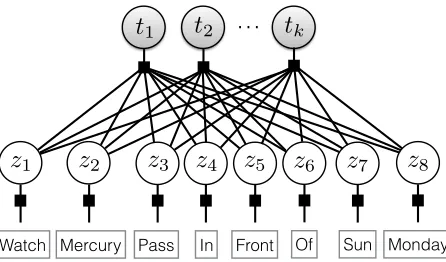
kFigure 4:Multiple-Instance Learning Temporal Tagging Model – our approach to learn a word-level tagging model given only sentence-level labels. In this example a sentence-level vari-ableta = 1indicates the temporal tag DOW=M onmust be
present andtb= 1indicates that the target date is in the future
(TL=f uture). The multiple instance learning assumption
im-plies that at least one word must be tagged with each of these present temporal tags. For example, ideally after training, the model will learn to assignz8to tagaandz1to tagb.
lem, we never directly observe the words’ tags (z= z1, . . . , zn) during learning. Instead, they are la-tent and we only observe the date of an event men-tioned in the text, from which we derive sentence-level binary variablest = t1, . . . , tk corresponding to temporal tags for the sentence. Following previ-ous work on multiple-instance learning (Hoffmann et al., 2011a; Xu et al., 2014), we model the connec-tion between sentence-level labels and word-level tags using a set of deterministic-OR factorsφsent.
The overall conditional probability of our model is defined as:
P(t,z|w;θr)
= 1 Z
k
Y
i=1
φsent(ti,z)× n
Y
j=1
φword(zj, wj)
= 1 Z
k
Y
i=1
φsent(ti,z)× n
Y
j=1
eθr·f(zj,wj)
(1)
wheref(zj, wj)is a feature vector and
φsent(ti,z) =
1 ifti =true∧ ∃j:zj =i 1 ifti =f alse∧ ∀j:zj 6=i 0 otherwise
(2) We include a standard set of tagging features that
includes word shape and identity in addition to pre-fixes and sufpre-fixes. To learn parameters θr of the Temporal Tagger, we maximize the likelihood of the sentence-level heuristic labels conditioned on ob-served words over all tweets in the training corpus. Given a training instancewwith labelt, the gradient of the conditional log-likelihood with respect to the parameters is:
∇P(t|w) =X
z
P(z|w,t;θr)·f(z,w)
−X
t,z
P(t,z|w;θr)·f(z,w) (3)
This gradient is the difference of two conditional ex-pectations over the feature vectorf: a “clamped” ex-pectation that is conditioned on the observed words and tags (w,t) and a “free” expectation that is only conditioned on the words in the text,w, and ignores the sentence-level labels. To make the inference tractable, we use a Viterbi approximation that re-places the expectations with maximization. Because each sentence corresponds to more than one tempo-ral tag, the maximization of the “clamped” maxi-mization is somewhat challenging to compute. We use the approximate inference algorithm of Hoff-mann et al. (2011a), that views inference as a weighted set cover problem, with worst case running time(|T| · |W|), where|T|is the number of all pos-sible temporal tag values and|W|is the number of
words in a sentence.
3.2 Missing Data Temporal Tagging Model (MiDaT)
While the multiple-instance learning assumption works well much of the time, it can easily be vio-lated – there are many tweets that mention entities involved in an event but that never explicitly men-tion its date.
The missing data modeling approach to weakly supervised learning proposed by Ritter et. al. (2013) addresses this problem by relaxing the hard con-straints of deterministic-OR factors, such as those described above, as soft constraints. Our missing-data model for weakly supervised tagging splits the sentence-level variables,tinto two parts : mwhich
whether a temporal tag can be derived from the event date. A set of pairwise potentialsψ(mj, t0j)are in-troduced that encourage (but don’t strictly require) agreement betweenmj andt0j, that is:
ψ(mj, t0j) =
(
αp, if t0j 6=mj αr, if t0j =mj
(4)
Here, αp (Penalty), andαr (Reward) are param-eters for the MiDaT model. αp is the penalty for extracting a temporal tag that is not related to the event-date andαr is the reward for extracting a tag that matches the date.
During learning, if the local classifier is very con-fident, it is possible for a word to be labeled with a tag that is not derived from the event-date, and also for a sentence-level tag to be ignored, although ei-ther case will be penalized by the agreement poten-tials, ψ(mj, t0j), in the global objective. We use a local-search approach to inference that was empiri-cally demonstrated to nearly always yield exact so-lutions by Ritter et. al. (2013).
4 A Log-Linear Model for Normalizing Time Expressions
The Temporal Normalizer is built using a log-linear model which takes the tagstproduced by the Tem-poral Recognizer as input and outputs one or more dates mentioned in a tweet. We formulate date nor-malization as a binary classification problem: given a tweet w published on date dpub, we consider 22
candidate target dates (w,dcandl ) such thatdcandl = dpub+l, where l = −10, . . . ,−1,0,+1, . . . ,+10, limiting the possible date references that are consid-ered within 10 days before or after the tweet creation date, in addition todcand
l =null(the tweet does not mention a date).4 While our basic approach has the limitation, that it is only able to predict dates within
±10days of the target date, we found that in prac-tice the majority of date references on social media fall within this window. Our approach is also able to score dates outside this range that are generated by traditional approaches to resolving time expressions, as described in Section 5.3.3.
4Although the temporal recognizer is trained with tweets from±7days around the event date, we found that extending
the candidate date range to±10days for the temporal normal-izer increased the performance of TweeTIME in the dev set.
The normalizer is similarly trained using the event database as distant supervision. The probability that a tweet mentions a candidate date is estimated using a log-linear model:
P(dcand|w, dpub)∝eθn·g(w,dpub,t) (5)
whereθnandgare the parameter and feature vector respectively in the Temporal Normalizer. For every tweet and candidate date pair (w,dcandl ), we extract
the following set of features:
Temporal Tag Features that indicate whether the candidate date agrees with the temporal tags extracted by the Temporal Recognizer. Three cases can happen here: The recognizer can extract a tag that can not be derived from the candidate date; The recognizer can miss a tag derived from the candidate date; The recognizer can extract a tag that is derived from the candidate date.
Lexical Features that include two types of binary features from the tweet: 1) Word Tag features consist of conjunctions of words in the tweet and tags associated with the candidate date. We remove URLs, stop words and punctuation; 2)Word POS features that are the same as above, but include conjunctions of POS tags, words and temporal tags derived from the candidate date.
Time Difference Features are numerical features that indicate the distance between the creation date and the candidate date. They include difference of day ranges form -10 to 10 and the difference of week ranges from -2 to 2.
5 Experiments
In the following sub-sections we present experi-mental results on learning to resolve time expres-sions in Twitter using minimal supervision. We start by describing our dataset, and proceed to present our results, including a large-scale evaluation on heuristically-labeled data and an evaluation compar-ing against human judgements.
5.1 Data Collection
From this automatically-annotated corpus we ex-tract the top 10,000 events and their correspond-ing dates uscorrespond-ing the G2 test, which measures the
strength of association between an entity and date using the log-likelihood ratio between a model in which the entity is conditioned on the date and a model of independence (Ritter et al., 2012). Events extracted using this approach then simply consist of the highest-scoring entity-date pairs, for example [Mercury, 5/9/2016].
After automatically extracting the database of events, we next gather all tweets that mention an entity from the list that are also written within±7 days of the event. These tweets and the dates of the known events serve as labeled examples that are likely to mention a known date.
We also include a set of pseudo-negative exam-ples, that are unlikely to refer to any event, by gath-ering a random sample of tweets that do not men-tion any of the top10,000events and where TempEx does not extract any date.
5.2 Large-Scale Heuristic Evaluation
We first evaluate our tagging model, by testing how well it can predict the heuristically generated labels. As noted in previous work on distant supervision (Mintz et al., 2009a), this type of evaluation usu-ally under-estimates precision, however it provides us with a useful intrinsic measure of performance.
In order to provide even coverage of months in the training and test set, we divide the twitter corpus into 3 subsets based on the mod-5 week of each tweet’s creation date. To train system we use tweets that are created in1st, 2nd or3rd weeks. To tune
pa-rameters of the MiDaT model we used tweets from 5th weeks, and to evaluate the performance of the
trained model we used tweets from4thweeks.
Precision Recall F-value
MultiT 0.61 0.21 0.32
[image:6.612.91.280.568.612.2]MiDaT 0.67 0.31 0.42
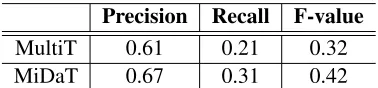
Table 2:Performance comparison of MultiT and MiDaT at pre-dicting heuristically generated tags on the dev set.
The performance of the MiDaT model varies with the penalty and reward parameters. To find a (near) optimal setting of the values we performed a grid search on the dev set and found that a penalty of
−25and reward of 500 works best. A comparison of MultiT and MiDaT’s performance at predicting heuristically generated labels is shown in Table 2.
The word level tags predicted by the temporal rec-ognizer are used as the input to the temporal normal-izer, which predicts the referenced date from each tweet. The overall system’s performance at predict-ing event dates on the automatically generated test set, compared against SUTime, is shown in Table 3.
System Prec. Recall F-value
dev set TweeTIME 0.93 0.69 0.79
SUTime 0.89 0.64 0.75
test set TweeTIME 0.97 0.94 0.96
SUTime 0.85 0.75 0.80
Table 3:Performance comparison of TweeTIME and SUTime at predicting heuristically labeled normalized dates.
5.3 Evaluation Against Human Judgements In addition to automatically evaluating our tagger on a large corpus of heuristically-labeled tweets, we also evaluate the performance of our tagging and date-resolution models on a random sample of tweets taken from a much later time period, that were manually annotated by the authors.
5.3.1 Word-Level Tags
To evaluate the performance of the MiDaT-tagger we randomly selected 50 tweets and labeled each word with its corresponding tag. Against this hand annotated test set, MiDaT achieves Precision=0.54, Recall=0.45 and F-value=0.49. A few examples of word-level tags predicted by MiDaT are shown in Table 4. We found that because the tags are learned as latent variables inferred by our model, they some-times don’t line up exactly with our intuitions but still provide useful predictions, for example in Table 4,Christmasis labeled with the tag MOY=dec.
5.3.2 End-to-end Date Resolution
Tweets and their corresponding word tags (wordtag) ImN AhellaN Aexcitedf utureforN Atomorrowf uture
KickN AoffN AtheN ANewf utureYearf utureRightN A@N A#ClubLacuraN A#FRIDAYf ri!N A HOSTEDN ABYN A[[N ADCN AYoungN AFlyN A]]N A
@OxfordTownHallN AThksN AforN AaN AtopN AnightN AatN AourN AChristmasdecpartyN AonN AFri!f ri ComplimentsN AtoN Achef!N A(RoseN AmelonN AcantaloupeN A :)N A
ImN AproudN AtoN AsayN AthatN AIN AbreathedpasttheN AsameN AairN AasN AHarryN AonN AMarchmar 21,212015.N A#KCAN A#Vote1DUKN A
C’monpresent let’spresentjackN ATonightpresentwillN AbepresentaN AnightN AtoN Aremember.N A
Table 4:Example MiDaT tagging output on the test set.
Precision Recall F-value
TweeTIME 0.61 0.81 0.70
- Day Diff. 0.46 0.72 0.56
- Lexical&POS 0.48 0.80 0.60
- Week Diff. 0.49 0.85 0.62
- Lexical 0.50 0.88 0.64
[image:7.612.335.503.228.350.2]- Temporal Tag 0.57 0.83 0.68
Table 5:Feature ablation of the Temporal Resolver by remov-ing each individual feature group from the full set.
System Prec. Recall F-value
dev set
TweeTIME 0.61 0.81 0.70
TweeTIME+SU 0.67 0.83 0.74
SUTime 0.51 0.86 0.64
TempEx 0.58 0.64 0.61
HeidelTime 0.57 0.63 0.60
UWTime 0.49 0.57 0.53
test set
TweeTIME 0.58 0.70 0.63
TweeTIME+SU 0.62 0.76 0.68
SUTime 0.54 0.64 0.58
TempEx 0.56 0.58 0.57
HeidelTime 0.43 0.52 0.47
UWTime 0.39 0.50 0.44
Table 6:Performance comparison of TweeTIME against state-of-the-art temporal taggers. TweeTIME+SU uses our proposed approach to system combination, re-scoring output from SU-Time using extracted features and learned parameters from TweeTIME.
We experimented with different feature sets on the development data. Feature ablation experiments are presented in Table 5.
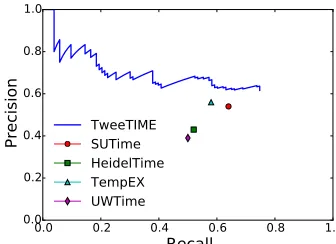
The final performance of our system, compared against a range of state-of-the-art time resolvers is presented in Table 6. We see that TweeTIME
out-0.0 0.2 0.4 0.6 0.8 1.0
Recall
0.0 0.2 0.4 0.6 0.8 1.0
Precision
TweeTIMESUTime HeidelTime TempEX UWTimeFigure 5: Precision and recall at resolving time expressions compared against human judgements. TweeTIME achieves higher precision at comparable recall than other state-of-the-art systems.
performs SUTime, Tempex, HeidelTime (using its COLLOQUIAL mode, which is designed for SMS text) and UWTime. Brief descriptions of each sys-tem can be found in Section 6.
5.3.3 System Combination with SUTime As our basic TweeTIME system is designed to predict dates within±10 days of the creation date, it fails when a tweet refers to a date outside this range. To overcome this limitation we append the date predicted by SUTime in the list of candidate days. We then re-rank SUTime’s predictions using our log-linear model, and include its output as a pre-dicted date if the confidence of our normalizer is suf-ficiently high.
5.3.4 Error Analysis
Spelling Variations: 45%
Hashtag: 20%
Tokenization: 15% Missing Rules: 5% Ambiguity: 15%
SUTime
Spelling Variations: 30%
Hashtag: 45%
Tokenization: 5% Missing Rules: 15%
Ambiguity: 5%
HeidelTime
Out of Range: 10% Ambiguity: 20%
Over−Prediction: 70%
[image:8.612.78.506.56.157.2]TweeTime
Figure 6:Error analyses for different temporal resolvers
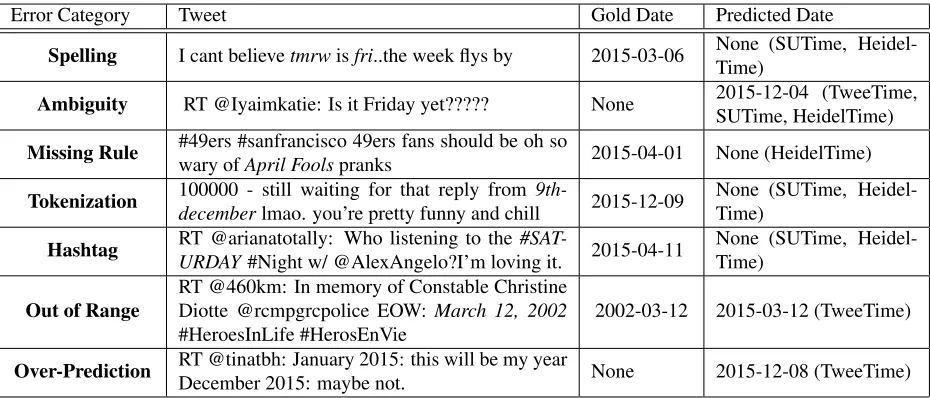
Spelling Variation: Twitter users are very creative in their use of spelling and abbreviations. For ex-ample, a large number of variations of the word to-morrowcan be found in tweets, including2morrow, 2mrw, tmrw, 2mrowand so on. Previous temporal resolvers often fail in these cases, while TweeTIME significantly reduces such errors.
Ambiguity:In many cases, temporal words like Fri-dayin the tweet Is it Friday yet? may not refer to any specific event or date, but are often predicted in-correctly. Also included in this category are cases where the future and past are confused. For exam-ple, predicting the past Friday, when it is actually the coming Friday.
Missing Rule: Cases where specific temporal key-words, such as April Fools, are not covered by the rule-based systems.
Tokenization: Traditional systems tend to be very sensitive to incorrect tokenization and have trouble to handle expressions such as 9th-december, May 9,2015orJan1. For the following Tweet:
JUST IN Delhi high court asks state gov-ernment to submit data on changes in pol-lution level since #OddEven rule came into effect onJan1
TweeTIME is able to correctly extract 01/01/2016, whereas HeidelTime, SUTime, TempEX and UW-Time all failed to extract any dates.
Hashtag:Hashtags can carry temporal information, for example, #September11. Only our system that is adapted to social media can resolve these cases. Out of Range: TweeTIME only predicts dates within 10 days before or after the tweet. Time ex-pressions referring to dates outside this range will not be predicted correctly. System combination with SUTime (Section 5.3.3) only partially addressed this problem.
Over-Prediction:Unlike rule-based systems, Twee-TIME has a tendency to over-predict when there is no explicit time expression in the tweets, possibly because of the presence of present tense verbs. Such mistakes could also happen in some past tense verbs. Because TweeTIME resolves time expressions us-ing a very different approach compared to traditional methods, its distribution of errors is quite distinct, as illustrated in Figure 6.
6 Related Work
Temporal Resolvers primarily utilize either based or probabilistic approaches. Notable rule-based systems such as TempEx (Mani and Wil-son, 2000), SUTime (Chang and Manning, 2012) and HeidelTime (Str¨otgen and Gertz, 2013) pro-vide particularly competitive performance compared to the state-of-the-art machine learning methods. Probabilistic approaches use supervised classifiers trained on in-domain annotated data (Kolomiyets and Moens, 2010; Bethard, 2013a; Filannino et al., 2013) or hybrid with hand-engineered rules (UzZa-man and Allen, 2010; Lee et al., 2014). UWTime (Lee et al., 2014) is one of the most recent and com-petitive systems and uses Combinatory Categorial Grammar (CCG).
Error Category Tweet Gold Date Predicted Date
Spelling I cant believetmrwisfri..the week flys by 2015-03-06 None (SUTime, Heidel-Time)
Ambiguity RT @Iyaimkatie: Is it Friday yet????? None 2015-12-04 (TweeTime,SUTime, HeidelTime)
Missing Rule #49ers #sanfrancisco 49ers fans should be oh sowary ofApril Foolspranks 2015-04-01 None (HeidelTime)
Tokenization 100000 - still waiting for that reply fromdecemberlmao. you’re pretty funny and chill9th- 2015-12-09 None (SUTime, Heidel-Time)
Hashtag RT @arianatotally: Who listening to theURDAY#Night w/ @AlexAngelo?I’m loving it.#SAT- 2015-04-11 None (SUTime, Heidel-Time)
Out of Range RT @460km: In memory of Constable ChristineDiotte @rcmpgrcpolice EOW: March 12, 2002
#HeroesInLife #HerosEnVie 2002-03-12 2015-03-12 (TweeTime)
[image:9.612.74.539.56.255.2]Over-Prediction RT @tinatbh: January 2015: this will be my yearDecember 2015: maybe not. None 2015-12-08 (TweeTime)
Table 7:Representative Examples of System (SUTime, HeidelTime, TweeTIME) Errors
annotated data. One existing work used distant su-pervision (Angeli et al., 2012; Angeli and Uszko-reit, 2013), but for normalization only, assuming gold time mentions as input. They used an EM-style bootstrapping approach and a CKY parser.
Distant Supervision has recently become popu-lar in natural language processing. Much of the work has focused on the task of relation extraction (Craven and Kumlien, 1999; Bunescu and Mooney, 2007; Mintz et al., 2009b; Riedel et al., 2010; Hoff-mann et al., 2011b; Nguyen and Moschitti, 2011; Surdeanu et al., 2012; Xu et al., 2013; Ritter et al., 2013; Angeli et al., 2014). Recent work also shows exciting results on extracting named entities (Ritter et al., 2011; Plank et al., 2014), emotions (Purver and Battersby, 2012), sentiment (Marchetti-Bowick and Chambers, 2012), as well as finding evidence in medical publications (Wallace et al., 2016). Our work is closely related to the joint word-sentence model that exploits multiple-instance learning for paraphrase identification (Xu et al., 2014) in Twit-ter.
7 Conclusions
In this paper, we showed how to learn time re-solvers from large amounts of unlabeled text, us-ing a database of known events as distant supervi-sion. We presented a method for learning a word-level temporal tagging models from tweets that are heuristically labeled with only sentence-level labels. This approach was further extended to account for
the case of missing tags, or temporal properties that are not explicitly mentioned in the text of a tweet. These temporal tags were then combined with a va-riety of other features in a novel date-resolver that predicts normalized dates referenced in a Tweet. By learning from large quantities of in-domain data, we were able to achieve 0.68 F1 score on the end-to-end time normalization task for social media data, sig-nificantly outperforming SUTime, TempEx, Heidel-Time and UWHeidel-Time on this challenging dataset for time normalization.
Acknowledgments
References
Omar Alonso, Michael Gertz, and Ricardo Baeza-Yates. 2007. On the value of temporal information in infor-mation retrieval. In ACM SIGIR Forum, volume 41, pages 35–41. ACM.
Gabor Angeli and Jakob Uszkoreit. 2013. Language-independent discriminative parsing of temporal ex-pressions. In Proceedings of the 51st Annual Meet-ing of the Association for Computational LMeet-inguistics (ACL).
Gabor Angeli, Christopher D Manning, and Daniel Ju-rafsky. 2012. Parsing time: Learning to interpret time expressions. InProceedings of the 2012 Conference of the North American Chapter of the Association for Computational Linguistics: Human Language Tech-nologies (NAACL).
Gabor Angeli, Julie Tibshirani, Jean Wu, and Christo-pher D Manning. 2014. Combining distant and partial supervision for relation extraction. InProceedings of the 2014 Conference on Empirical Methods in Natural Language Processing (EMNLP).
Steven Bethard and Guergana Savova. 2016. SemEval-2016 Task 12: Clinical TempEval. InProceedings of the 10th International Workshop on Semantic Evalua-tion (SemEval).
Steven Bethard. 2013a. ClearTK-TimeML: A minimal-ist approach to TempEval 2013. InProceedings of the Seventh International Workshop on Semantic Evalua-tion (SemEval).
Steven Bethard. 2013b. A synchronous context free grammar for time normalization. In Proceedings of the 2013 Conference on Empirical Methods in Natural Language Processing (EMNLP).
Razvan C. Bunescu and Raymond J. Mooney. 2007. Learning to extract relations from the Web using min-imal supervision. InProceedings of the 45th Annual Meeting of the Association for Computational Linguis-tics (ACL).
Nathanael Chambers. 2013. NavyTime: Event and time ordering from raw text. In Proceedings of the 7th International Workshop on Semantic Evaluation (Se-mEval).
Angel X Chang and Christopher D Manning. 2012. SU-Time: A library for recognizing and normalizing time expressions. InProceedings of the 8th International Conference on Language Resources and Evaluation (LREC).
Ching-Yun Chang, Zhiyang Teng, and Yue Zhang. 2016. Expectation-regulated neural model for event mention extraction. Proccedings of the 2016 Conference of the North American Chapter of the Association for Com-putational Linguistics: Technologies (NAACL).
Mark Craven and Johan Kumlien. 1999. Constructing biological knowledge bases by extracting information from text sources. InProceedings of the Seventh Inter-national Conference on Intelligent Systems for Molec-ular Biology (ISMB).
Leon Derczynski and Robert J Gaizauskas. 2013. Tem-poral signals help label temTem-poral relations. In Pro-ceedings of the 51st Annual Meeting of the Association for Computational Linguistics (ACL).
Thomas G Dietterich, Richard H Lathrop, and Tom´as Lozano-P´erez. 1997. Solving the multiple instance problem with axis-parallel rectangles. Artificial intel-ligence, 89(1).
Quang Xuan Do, Wei Lu, and Dan Roth. 2012. Joint inference for event timeline construction. In Proceed-ings of the 2012 Joint Conference on Empirical Meth-ods in Natural Language Processing and Computa-tional Natural Language Learning (EMNLP).
Michele Filannino, Gavin Brown, and Goran Nenadic. 2013. ManTIME: Temporal expression identification and normalization in the TempEval-3 challenge. In
Proceedings of the Seventh International Workshop on Semantic Evaluation (SemEval).
Raphael Hoffmann, Congle Zhang, Xiao Ling, Luke Zettlemoyer, and Daniel S. Weld. 2011a. Knowledge-based weak supervision for information extraction of overlapping relations. In The 49th Annual Meeting of the Association for Computational Linguistics: Hu-man Language Technologies (ACL).
Raphael Hoffmann, Congle Zhang, Xiao Ling, Luke S. Zettlemoyer, and Daniel S. Weld. 2011b. Knowledge-based weak supervision for information extraction of overlapping relations. InProceedings of the 49th An-nual Meeting of the Association for Computational Linguistics (ACL).
Heng Ji, Ralph Grishman, Hoa Trang Dang, Kira Grif-fitt, and Joe Ellis. 2011. Overview of the tac 2011 knowledge base population track. InProceedings of the Fourth Text Analysis Conference (TAC).
Nattiya Kanhabua, Sara Romano, Avar´e Stewart, and Wolfgang Nejdl. 2012. Supporting temporal analyt-ics for health-related events in microblogs. In Pro-ceedings of the 21st ACM International Conference on Information and Knowledge Management (CIKM). Oleksandr Kolomiyets and Marie-Francine Moens. 2010.
KUL: Recognition and normalization of temporal ex-pressions. In Proceedings of the 5th International Workshop on Semantic Evaluation (SemEval). Kenton Lee, Yoav Artzi, Jesse Dodge, and Luke
Xiao Ling and Daniel S Weld. 2010. Temporal infor-mation extraction. InProceedings of the 24th AAAI Conference on Artificial Intelligence (AAAI).
Inderjeet Mani and George Wilson. 2000. Robust tempo-ral processing of news. InProceedings of the 38th An-nual Meeting on Association for Computational Lin-guistics (ACL).
Micol Marchetti-Bowick and Nathanael Chambers. 2012. Learning for microblogs with distant supervi-sion: Political forecasting with Twitter. In Proceed-ings of the 13th Conference of the European Chap-ter of the Association for Computational Linguistics (EACL).
Mike Mintz, Steven Bills, Rion Snow, and Dan Juraf-sky. 2009a. Distant supervision for relation extraction without labeled data. InProceedings of the Joint Con-ference of the Association of Computational Linguis-tics and the International Joint Conference on Natural Language Processing (ACL-IJCNLP).
Mike Mintz, Steven Bills, Rion Snow, and Daniel Juraf-sky. 2009b. Distant supervision for relation extrac-tion without labeled data. InProceedigns of the 47th Annual Meeting of the Association for Computational Linguistics and the 4th International Joint Conference on Natural Language Processing (ACL).
Truc-Vien T. Nguyen and Alessandro Moschitti. 2011. End-to-end relation extraction using distant supervi-sion from external semantic repositories. In Proceed-ings of the 49th Annual Meeting of the Association for Computational Linguistics (ACL).
Barbara Plank, Dirk Hovy, Ryan McDonald, and Anders Søgaard. 2014. Adapting taggers to twitter with not-so-distant supervision. pages 1783–1792.
Matthew Purver and Stuart Battersby. 2012. Experi-menting with distant supervision for emotion classi-fication. In Proceedings of the 13th Conference of the European Chapter of the Association for Compu-tational Linguistics (EACL).
Sebastian Riedel, Limin Yao, and Andrew McCallum. 2010. Modeling relations and their mentions without labeled text. InProceedigns of the European Confer-ence on Machine Learning and Principles and Prac-tice of Knowledge Discovery in Databases (ECML-PKDD).
Alan Ritter, Mausam, Sam Clark, and Oren Etzioni. 2011. Named entity recognition in Tweets: An ex-perimental study. In Proceedings of the Conference on Empirical Methods in Natural Language Process-ing (EMNLP).
Alan Ritter, Mausam, Oren Etzioni, and Sam Clark. 2012. Open domain event extraction from twitter. In
Proceedings of the 18th ACM SIGKDD international conference on Knowledge discovery and data mining (KDD).
Alan Ritter, Luke Zettlemoyer, Mausam, and Oren Et-zioni. 2013. Modeling missing data in distant su-pervision for information extraction. Transactions of the Association for Computational Linguistics (TACL), 1:367–378.
Alan Ritter, Evan Wright, William Casey, and Tom Mitchell. 2015. Weakly supervised extraction of com-puter security events from Twitter. InProceedings of the 24th International Conference on World Wide Web (WWW).
H Andrew Schwartz, Greg Park, Maarten Sap, Evan Weingarten, Johannes Eichstaedt, Margaret Kern, Jonah Berger, Martin Seligman, and Lyle Ungar. 2015. Extracting human temporal orientation in Face-book language. In Proceedings of the 2015 Confer-ence of the North American Chapter of the Associa-tion for ComputaAssocia-tional Linguistics: Human Language Technologies (NAACL).
Jannik Str¨otgen and Michael Gertz. 2012. Temporal tagging on different domains: Challenges, strategies, and gold standards. InProceedings of the 8th Interna-tional Conference on Language Resources and Evalu-ation (LREC).
Jannik Str¨otgen and Michael Gertz. 2013. Multilingual and cross-domain temporal tagging. Language Re-sources and Evaluation, 47(2):269–298.
Jannik Str¨otgen and Michael Gertz. 2015. A baseline temporal tagger for all languages. InProceedings of the 2015 Conference on Empirical Methods in Natural Language Processing (EMNLP).
Mihai Surdeanu, Julie Tibshirani, Ramesh Nallapati, and Christopher D. Manning. 2012. Multi-instance multi-label learning for relation extraction. InProceedings of the 50th Annual Meeting of the Association for Computational Linguistics (ACL).
Naushad UzZaman and James F Allen. 2010. TRIPS and TRIOS system for Tempeval-2: Extracting tem-poral information from text. InProceedings of the 5th International Workshop on Semantic Evaluation (Se-mEval).
Naushad UzZaman, Hector Llorens, James Allen, Leon Derczynski, Marc Verhagen, and James Pustejovsky. 2013. SemEval-2013 Task 1: TEMPEVAL-3: Evalu-ating time expressions, events, and temporal relations. In Proceedings of the 7th International Workshop on Semantic Evaluation (SemEval).
Byron C Wallace, Jo¨el Kuiper, Aakash Sharma, Mingxi Brian Zhu, and Iain J Marshall. 2016. Extract-ing PICO sentences from clinical trial reports usExtract-ing supervised distant supervision. Journal of Machine Learning Research (JMLR).
supervision of relation extraction. InProceedings of the 51th Annual Meeting of the Association for Com-putational Linguistics (ACL).