Learning to Represent Review
with Tensor Decomposition for Spam Detection
Xuepeng Wang1,2, Kang Liu1, Shizhu He1 and Jun Zhao1,2 1 National Laboratory of Pattern Recognition, Institute of Automation,
Chinese Academy of Sciences, Beijing, 100190, China
2 University of Chinese Academy of Sciences, Beijing, 100049, China
{xpwang, kliu, shizhu.he, jzhao}@nlpr.ia.ac.cn
Abstract
Review spam detection is a key task in opin-ion mining. To accomplish this type of de-tection, previous work has focused mainly on effectively representing fake and non-fake re-views with discriminative features, which are discovered or elaborately designed by expert-s or developerexpert-s. Thiexpert-s paper propoexpert-seexpert-s a nov-el review spam detection method that learn-s the reprelearn-sentation of reviewlearn-s automatically instead of heavily relying on experts’ knowl-edge in a data-driven manner. More specifi-cally, according to 11 relations (generated au-tomatically from two basic patterns) between reviewers and products, we employ tensor de-composition to learn the embeddings of the re-viewers and products in a vector space. We collect relations between any two entities (re-viewers and products), which results in much useful and global information. We concate-nate the review text, the embeddings of the re-viewer and the reviewed product as the resentation of a review. Based on such rep-resentations, the classifier could identify the opinion spam more precisely. Experimental results on an open Yelp dataset show that our method could effectively enhance the spam detection accuracy compared with the state-of-the-art methods.
1 Introduction
With the development of E-commerce, more and more customers share their experiences about prod-ucts and services by posting reviews on the we-b. These reviews could heavily guide the purchas-ing behaviors of customers. The products which
receive more positive reviews tend to attract more consumers and result in more profits. Studies on Yelp.com have shown that an extra half-star rating could cause a restaurant to sell out 19% more prod-ucts (Anderson and Magruder, 2012), and a one-star increase leads to a 5-9% profit increase (Luca, 2011). Therefore, more and more sellers and manu-facturers have begun to place emphasis on analyzing reviews. However, the question remains: is every online review trustful? It has been reported that up to 25% of the reviews on Yelp.com could be fraudu-lent1. Due to the great profit or reputation, impostors
or spammers energetically post fake reviews on the web to promote or defame targeted products (Jindal and Liu, 2008). Such fake reviews could mislead consumers and damage the online review websites’ reputations. Therefore, it is necessary and urgent to detect fake reviews (review spam).
To accomplish this goal, much work has been conducted. They commonly regard this task as a classification task and most efforts are devoted to exploring useful features for representing target re-views. Li et al. (2013) and Kim et al. (2015) rep-resent reviews with linguistic features; Lim et al. (2010) and Mukherjee et al. (2013c) represent re-views with reviewers’ behavioral features2; Wang
et al. (2011) and Akoglu et al. (2013) explore graph structure features3; Mukherjee et al. (2013b),
1http://www.bbc.com/news/technology-24299742
2Reviewers’ spammer-like behaviors, e.g., if a reviewer con-tinuously posts reviews within a short period of time, (s)he might be a spammer, and her (his) posted reviews could be s-pam.
3A kind of behavioral features which contain much interac-tions between reviewers and products
Rayana and Akoglu (2015) use the combination of aforementioned features. According to the exist-ing studies, reviewers’ behavioral features have been proven to be more effective than reviews’ linguistic features for detecting review spam (Mukherjee et al., 2013c). It is because that foxy spammers could eas-ily disguise their writing styles and forge reviews, discovering discriminative linguistic features is very difficult. Recently, most of the researchers (Rayana and Akoglu, 2015) have focused on the reviewer-s’ behavioral features, the intuition behind which is to capture the reviewers’ actions and supposes that those reviews written with spammer-like behaviors would be spam.
Although, the existing work has made signifi-cant progress in combating review spamming, they also have several limitations as follows. (1) The representations of reviews rely heavily on experts’ prior knowledge or developers’ ingenuity. To dis-cover more discriminative features for representing reviews, previous work (Mukherjee et al., 2013b; Rayana and Akoglu, 2015) have spent lots of man-power and time on the statistics of the review datasets. Besides, experts’ prior knowledge or de-velopers’ ingenuity is not always reliable with the variations of domains and languages. For exam-ple, based on the datasets from Dianping site4, Li
et al. (2015) find that the real users tend to review the restaurants nearby, but the spammers are not re-stricted to the geographical location, they may come from anywhere. However, it is not true in the Yelp datasets (Mukherjee et al., 2013b). We found that 72% of the Yelp’s review spam is posted from the areas near the restaurants, but only 64% of the au-thentic reviews are near the restaurants. Therefore, how to learn the representations of reviews direct-ly from data instead of heavidirect-ly redirect-lying on the ex-perts’ prior knowledge or developers’ ingenuity be-comes crucial and urgent. (2) Furthermore, limited by the experts’ knowledge, previous work only uses partial information of the review system. For exam-ple, traditional behavioral features (Lim et al., 2010; Mukherjee et al., 2013c) only utilize the information of individual reviewer. Although the work (Wang et al., 2011; Rayana and Akoglu, 2015) have tried to employ graph structure to consider the
interac-4http://www.dianping.com
tions among the reviewers and products, it is a kind of local interaction defined within the same produc-t review page. However, produc-the inproduc-teracproduc-tion among produc-the reviewers and products from different review pages also provides much useful and global information, which is ignored by the previous work.
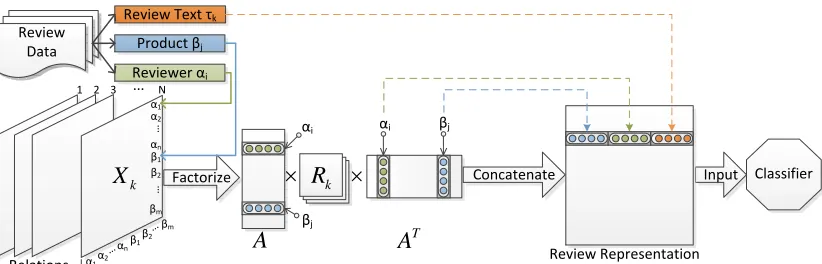
To tackle the problems described above, we pro-pose a novel review spam detection method which can learn the representations of reviews instead of heavily relying on the experts’ knowledge, develop-ers’ ingenuity, or spammer-like assumption, and can reserve the original information with a global man-ner. Inspired by the work about distributional repre-sentation or embedding for text and knowledge base, we propose a tensor factorization-based model to learn the representation of each review automatical-ly. The finally learnt representation of each review is determined by the original data, rather than the fea-tures or clues found by experts. More specifically, we defined two basic patterns without any expert-s’ knowledge, developerexpert-s’ ingenuity, or spammer-like assumptions. Based on the two basic patterns, we extended 11 interactive relations between entities (reviewers and products) in terms of time, locations, social contact, etc. Then, we build a 3-mode tensor on these 11 interactive relations between reviewers and products. In order to reserve the original infor-mation with a global manner, we collect the relation-s of any two entitierelation-s regardlerelation-srelation-s of whether they are from the same review page. In this way, we could reserve the original information of the data as much as possible, which dispenses with human selection. Next, we utilize tensor factorization to perform ten-sor decomposition, and the representations of re-viewers and products are embedded in a latent vector space by collective learning. Afterward, we could obtain vector representations (embeddings) for both the reviewers and products. Then, we concatenate the review text (e.g., bigram), the embedding of a reviewer and the reviewed product as the represen-tation of a review. In this way, the represenrepresen-tations of reviews driven by data could be learnt in the en-tire review system in a global manner. Finally, such representations are fed into a classifier to detect the review spam.
In summary, this paper makes the following con-tributions:
1 2 3 … N
α1 α2
…
αn β1 β2
…
βm
α1α2… αnβ1β2
…βm
k
X Factorize
A T
A αi
βj
αi
Concatenate
Review Representation
Input Classifier
βj
k
R
Review
Data Product βj
Reviewer αi
Review Text τk
[image:3.612.100.511.56.188.2]Relations
Figure 1:Illustrated of our method. Theαidenotes thei-th reviewer, and theβjdenotes thej-th product.
new perspective. Specifically, it learns the rep-resentation of reviews directly from the da-ta. The key advantage is that it can represent the reviews instead of heavily relying on hu-man ingenuity cost, experts’ knowledge or any spammer-like assumption.
• It collects the relations between any two en-tities regardless of whether they are from the same review page, which results in much global information. With the help of tensor factoriza-tion, it could collectively embed the informa-tion of different relainforma-tions into the final repre-sentations of reviews, and further optimize the representations. Therefore it could faithfully reflect the original characteristics of the entire review system with a global manner.
• An extra advantage is that the learnt represen-tations of reviews are embeddings in a latent s-pace. They are hardly comprehended by human beings included spammers. It’s a robust detec-tion method in contrast to the previous meth-ods in which the reviews are represented by the explicit detecting clues and features. Once have realized the explicit features that were captured, experienced spammers could change their spamming strategies.
• The method of this paper renders 89.2%
F1-score in detecting restaurant review spam which is higher than the F1-score of 86.1% rendered by the method in (Mukherjee et al., 2013b) (in hotel domain, it’s 87.0% vs 84.8%). These experimental results give good confi-dence to the proposed approach, and the learnt representations of reviews are more robust and effective than in previous methods.
2 The Proposed Method
In this section, we propose our method (shown in Figure 1) in detail. Compared with the previous work, we address the review spam detection issue by learning the representation of the reviews automati-cally in a latent space without experts’ knowledge. First, we extend 11 interactive relations between en-tities (reviewers and products) from the two basic patterns in terms of time, locations, social contact, etc. Then, our method generates 11 relation matrices of the reviewers (αi) and products (βj). After that,
we construct a 3-mode tensor X, where each slice
Xk in Xdenotes the link relationship between the
reviewers and products in the relationk. Second, we
factorize the tensor Xby employing the algorithm RESCAL (Nickel et al., 2011). In the factorization results,Arepresents the embeddings of the
review-ers (αi) and products (βj) in the latent space with
the collective learning. Third, we concatenate the review text (bigram), the embedding of its reviewer and the reviewed product together, as the representa-tion of the review. Last, the concatenated embedding of the review is fed into a classifier (e.g., SVM) to detect whether it is a fake or non-fake review.
2.1 Relation Matrices Generation
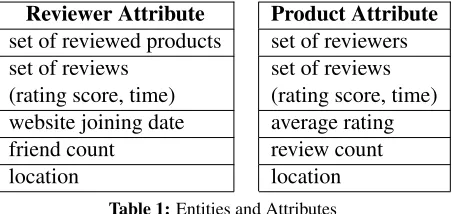
In the review system, there are two kinds of entities: reviewers and products5. Each entity has several
at-tributes, e.g., the attribute ‘location’ of a restaurant is Chicago (the restaurant is regarded as a product). More details are shown in Table 1.
To learn the representations of reviews directly from the data instead of experts’ knowledge, we de-fined two basic patterns:
Reviewer Attribute Product Attribute
set of reviewed products set of reviewers set of reviews
(rating score, time)
set of reviews (rating score, time) website joining date average rating friend count review count
[image:4.612.74.303.57.164.2]location location
Table 1:Entities and Attributes
Pattern 1:Record the relationships between two entities.
Pattern 2:Record the relationships between at-tributes of two entities.
These patterns do not contain any spammer-like prior assumption, just record the natural relation in the original review system. Based on the t-wo basic patterns, we extended 11 interactive rela-tions between entities and their attributes (showed in Table 1). They will be described in detail as follows. Meanwhile, we define that avg(ak,i) =
1
n
Pn k=1ak,i.
1. Have reviewed: This relation records whether a reviewer has reviewed a product. If reviewer
αi reviewed product βj, the valueX[i, j,1]in
this relation matrixX[:,:,1]is 1, otherwise it’s
0.
2. Rating score: What score (1 to 5 star) a reviewer-rated product receives. The value
X[i, j,2]∈ {1,2, ...,5}.
3. Commonly reviewed products: The number of products that a reviewer commonly reviewed with other reviewers. The value X[i, j,3] =
|Pij|, Pij = Pi ∩Pj;Pi is the product set
re-viewed by reviewerαi.
4. Commonly reviewed time difference: The time differences that a reviewer who commonly reviews with other reviewers on the same prod-ucts. The valueX[i, j,4] =ti−tj, whereti=
avg(tk,i); tk,i is the time that the reviewer αi
reviewed the productβkin thePij set.
5. Commonly reviewed rating difference: The rating differences that a reviewer who com-monly reviews with other reviewers on the same products. The value X[i, j,5] = ri −
rj, whereri = avg(rk,i); rk,i is the score of
the reviewerαirated the productβkinPij set.
6. Date difference of websites joined: The date differences of joining review websites between a reviewer and others. The valueX[i, j,6] =
di−dj, wherediis the date on which reviewer
αijoining websites.
7. Average rating difference:The differences in the average rating of a reviewer over all his re-views compared with other reviewers. The val-ueX[i, j,7] =γir−γjr, whereγir=avg(γrk,i);
γk,ir is the score with which the reviewerαi
rat-ed the productβkinPi.
The differences in the average rating of a product over all its reviews compared with oth-er products. X[i, j,7] =γip−γjp, whereγip =
avg(γk,ip );γpk,iis the score of review kinRβi,
which is the review set for productβi.
8. Friend count difference: The differences in the friend count of a reviewer compared to oth-ers. At the review website, a reviewer can make friends with others. The value X[i, j,8] =
fi−fj; wherefiis the friend count of reviewer
αi.
9. Have the same location or not: Whether t-wo reviewers/products are from the same city or whether a reviewer has the same location with a product. If two entities have the same location, the value X[i, j,9] = 1, otherwise
X[i, j,9] = 0.
10. Common reviewers:The number of the same reviewers that a product has with other product-s. The valueX[i, j,10] =|Θij|, whereΘij =
Θi ∩Θj; Θi is the set of reviewers who
re-viewed productβi.
11. Review count difference: The differences in the reviews count of any two reviewers. The valueX[i, j,11] = |Rαi| −Rαj, whereRαi is
the reviews set of reviewerαi. Or the
differ-ences in the reviews count of any two products, whereX[i, j,11] =Rβi−Rβj, whereRβi is
the reviews set of productβi.
sigmoid function. Thus, the value ‘0’ will be nor-malized to ‘0.5’. Moreover, we set the values that make no sense to ‘0’, such as the value between t-wo products in Relation 1: Have reviewed. Then, we unite the 11 matrices to form the adjacent ten-sor. Each of the matrices is a slice of the tenten-sor. The reviewers and products are regarded as the same en-tities in the tensor. We build two separate tensors for the hotel domain and restaurant domain respective-ly. Next, we perform tensor factorization to learn the representations (embeddings) of reviewers and prod-ucts. Note that the word “relation” is normally used for binary (0/1) relations, but some values of afore-mentioned relations could be between 0 and 1. How-ever, our experiments show that this type of rela-tion is actually practicable. Besides, there is not any spammer-like assumption in the relations. Namely, the values of relations don’t indicate how suspicious the reviewers are. The values faithfully reflect the original characteristics of the entire review system. This can help to reduce the need of carefully design-ing expert features and the understanddesign-ing of domain-s adomain-s much adomain-s podomain-sdomain-sible.
2.2 Learning to Represent Reviews
In general case, a review contains the text, the re-viewer and the reviewed product. We firstly learn to represent reviewers and products. As mentioned above, based on the relations, we could construct an adjacency tensorX. Then, we convert the global re-lation information related reviewers and products in-to embeddings through tensor facin-torization, where an efficient factorization algorithm called RESCAL (Nickel et al., 2011) is employed. First, we intro-duce it briefly.
To identify latent components in a tensor for collective learning, Nickel et al. (2011) proposed RESCAL, which is a tensor factorization algorithm. Given a tensor Xn0×n0×m0, RESCAL aims to have
a rank-rapproximation, where each sliceXkis
fac-torized as
Xk≈ARkAT, for allk= 1...m0, (1)
Ais ann0×rmatrix, where thei-th row denotes the i-th entity. Rk is an asymmetricr ×r matrix that
describes the interactions of the latent components according to the k-th relation. Note that while Rk
differs in each slice,Aremains the same.
AandRkare derived by minimizing the loss
func-tion below.
min A,Rk
f(A, Rk) +λ·g(A, Rk), (2)
where f(A, Rk) = 12(Pk k Xk −ARkAT k2F ) is the mean-squared reconstruction error, and
g(A, Rk) = 12(k A k2 F +
P
k k Rk k2F) is the
regularization term.
In our method, sliceXkis thek-th relation above.
Thei-th entity is thei-th reviewer or product.
As mentioned in Section 2.1, in order to obtain more useful and global information automatically, we collect the relations of any two entities no mat-ter whether they are from the same review page. Then we could embed the informations over multi-relations into the finally learnt representation by the tensor factorization. As Nickel et al. (2011) proved, all the relations have a determining influence on the learnt latent-component representation of the i-th
entity. It removes the noise of the original data by learning through the global loss function. Conse-quently, we get the representation of reviewers and products with a further optimization by the collec-tive learning.
2.3 Detecting Review Spam in Latent Space
After learning the representations of reviewers and products, we begin to represent the reviews that were written by reviewers for the products. Our final pur-pose is to detect the review spam. We concatenate the review text (bigram), the embedding of a review-er and the reviewed product as the representation of a review. The representations of the review text by bigram have been proved to be effective in sever-al previous work (Mukherjee et sever-al., 2013b; Rayana and Akoglu, 2015; Kim et al., 2015). It’s also a kind of data-driven representation. Then, we take the em-beddings of the reviews as the input to the classifiers. Here, we use the linear kernel SVM model to com-pare with the experimental results in (Mukherjee et al., 2013b) and (Rayana and Akoglu, 2015).
3 Experiments
3.1 Datasets and Evaluation Metrics
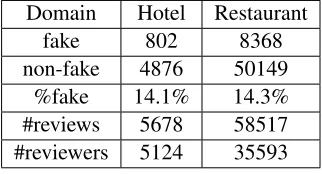
previous studies (Mukherjee et al., 2013b; Mukher-jee et al., 2013c; Rayana and Akoglu, 2015). Al-though there are other datasets for evaluation, such as (Jindal and Liu, 2008), (Lim et al., 2010; Xie et al., 2012) and (Ott et al., 2011), they are generated by human labeling or crowd sourcing and have been proved not to be reliable since human labeling fake reviews is quite poor (Ott et al., 2011). There was lack of real-life and nearly ground truth data, until Mukherjee et al. (2013c) proposed the Yelp review dataset. The statistics of the Yelp dataset are listed in Table 2. The reviewed product here refers to a hotel or restaurant.
Evaluation Metrics: We select precision (P), recall (R), F1-Score (F1) and accuracy (A) as metrics.
Domain Hotel Restaurant
fake 802 8368
[image:6.612.105.266.269.356.2]non-fake 4876 50149 %fake 14.1% 14.3% #reviews 5678 58517 #reviewers 5124 35593
Table 2: Yelp Labeled Dataset Statistics.
3.2 Our Method vs. The State-of-the-art Methods
To illustrate the effectiveness of the proposed ap-proach, we select several state-of-the-arts for com-parison. The first one is SPEAGLE+ (Rayana and Akoglu, 2015), which is a kind of graph-based method. The representations of reviews in (Rayana and Akoglu, 2015) are combined with linguistic fea-tures, behavioral features and review graph structure features. It’s a semi-supervised method. For a fair comparison with our 5-fold CV classification, we set the ratio of labeled data in SPEAGLE+ to 80%. The second one is Mukherjee et al. (2013b). KC and Mukherjee (2016) also conduct experiments on the restaurant subset in Table 2. But they mainly focus on analyzing the effects of temporal dynamics. It’s not our focus. So we didn’t take it into comparison. In our experiments, we employ behavioral features (Mukherjee BF) and both of behavioral and linguis-tic features (Mukherjee BF+Bigram) proposed in Mukherjee et al. (2013b), respectively. The parame-ters used in these compared methods are same as the original papers. For our approach, we set the param-eterr to 150, λto 10, and the iteration number to
100.
The compared results are shown in Table 3. We u-tilize our learnt embeddings of reviewers (Ours RE), both of reviewers’ embeddings and products’ em-beddings (Ours RE+PE), respectively. Moreover, to perform fair comparison, like Mukherjee et al. (2013b), we add representations of the review text in classifier (Ours RE+PE+Bigram). From the result-s, we can observe that our method could outperform all state-of-the-arts in both the hotel and restaurant domains. It proves that our method is effective. Fur-thermore, the improvements in both the hotel and restaurant domains prove that our model possesses preferable domain-adaptability. It could represent the reviews more accurately and globally by learn-ing from the original data, rather than the experts’ knowledge or assumption.
3.3 The Effectiveness of Learning to Represent Review
non-Method C.D. P R F1 A SPEAGLE+(80%) 50:50 75.7 83.0 79.1 81.0
N.D. 26.5 56.0 36.0 80.4 Mukherjee BF 50:50N.D. 82.441.4 85.284.6 83.755.6 83.882.4
Mukherjee BF+Bigram 50:50N.D. 82.846.5 86.982.5 84.859.4 85.184.9
Ours RE 50:50N.D. 83.347.1 88.183.5 85.6 85.560.2 85.0
Ours RE+PE 50:50N.D. 83.647.5 89.084.1 86.2 85.760.7 85.3
Ours RE+PE+Bigram 50:50N.D. 84.248.2 89.985.0 87.0 86.561.5 85.9
(a)Hotel
P R F1 A
80.5 83.2 81.8 82.5 1 50.1 70.5 58.6 82.0 2 82.8 88.5 85.6 83.3 3 48.2 87.9 62.3 78.6 4 84.5 87.8 86.1 86.5 5 48.9 87.3 62.7 82.3 6
85.4 90.2 87.7 87.4 7
56.9 90.1 69.8 85.8 8
86.0 90.7 88.3 88.0 9
57.4 89.9 70.1 86.1 10
86.8 91.8 89.2 89.9 11
58.2 90.3 70.8 87.8 12
[image:7.612.95.509.55.226.2](b)Restaurant
Table 3: Classification results across the behavioral features (BF), the reviewer embeddings (RE) , product embeddings (PE) and bigram of the review texts. Training uses balanced data (50:50). Testing uses two class distributions (C.D.): 50:50 (balanced) and Natural Distribution (N.D.). Improvements of our method are statistically significant with p<0.005 based on pairedt-test.
84% 86% 88%
BF Rels RE
80% 82%
P R F1 A
(a)Hotel
86% 88% 90%
BF Rels RE
82% 84%
P R F1 A (b)Restaurant
Figure 2: SVM 5-fold CV classification results across behav-ioral features (BF), 11 relations (Rels) and reviewer embed-dings (RE) in our method. Both training and testing use bal-anced data (50:50). Improvements are statistically significant with p<0.005 based on pairedt-test.
spammers to pretend to be a normal reviewer. Be-sides, as there isn’t any spammer-like assumption in our extended relations (Section 2.1), crafty spam-mers have little influence on them.
We also compared existing behavioral features (BF) (Mukherjee et al., 2013b) with detecting view spam by only employing the 11 generated re-lations (Rels). We take the relation matrix row of each reviewer as the representations of the reviews. According to the results shown in Figure 2, the 11 generated relations (Rels) results in an obvious im-provement than the existing behavioral features (BF) (Mukherjee et al., 2013b) (Table 3 (a,b) row 3) in both the hotel and restaurant domains. It proves that the generated relations could obtain more useful and global informations, as they collect the relations of any entities (reviewers and products) regardless of whether they are from the same review page. Fur-thermore, Figure 2 also showed that the embeddings
Dropped
[image:7.612.344.507.266.428.2]Relation F1HotelA RestaurantF1 A 1 -2.1 -2.0 -2.0 -3.1 2 -2.3 -2.1 -1.9 -2.9 3 -3.9 -4.0 -4.0 -6.3 4 -3.7 -3.5 -3.6 -5.5 5 -3.5 -3.6 -2.8 -4.5 6 -2.5 -2.5 -3.4 -5.2 7 -3.2 -3.2 -3.3 -5.0 8 -2.8 -2.6 -3.0 -4.6 9 -4.0 -3.7 -3.7 -5.4 10 -2.2 -2.4 -1.8 -2.8 11 -2.6 -2.4 -2.7 -4.4
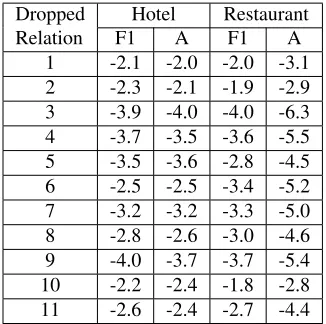
Table 4: SVM 5-fold CV classification results by dropping re-lations from our method utilizing RE+PE+Bigram. Both train-ing and testtrain-ing use balanced data (50:50). Differences in clas-sification metrics for each dropped relation are statistically sig-nificant with p<0.01 based on pairedt-test.
of reviewers (RE) learnt by the tensor decomposi-tion perform better than the Rels. As we mendecomposi-tioned in Section 2.2, the tensor decomposition embeds the informations over all the relations collectively, and removes the noise of the original data by learning through the global loss function. Consequently, we get the representations with a further optimization.
3.4 The Effectiveness of Product Embeddings
[image:7.612.75.300.268.378.2]perform better than just using the reviewer embed-dings. Statistics of the datasets suggest that there are about 1% of spammers who not only write fake reviews, but also write non-fake reviews. Liu (2015) also proved that some reviewers have contributed many genuine reviews and have built up their reputa-tion; then they started to spam for some businesses, or even sell their accounts to spammers. Compared with previous work, our method by adding produc-t embeddings could disproduc-tinguish produc-the reviews of produc-the same reviewer for different products.
3.5 The Effects of Different Relations
We also drop relations of our method with a grace-ful degradation. Table 4 shows the performances of our method utilizing BF+PE+Bigram for hotel and restaurant domains. We found that dropping Rela-tions 1, 2 and 10 results in a relatively gentle re-duction (about 2.2%) in F1-score. According to our survey, the sparseness of the slices generated by Re-lation 1, 2 and 10 is about 99.9%. For this reason, the result is a relatively gentle reduction. Dropping other relations also result in a 2.5-4.0% performance reduction. It proves that each relation has an influ-ence on the learning to represent reviews.
4 Related Work
Jindal and Liu (2008) first propose the problem of review spam detection. They identify three cate-gories of spam: fake reviews (also called untruth-ful opinions), reviews on the brand only, and non-reviews.Stepping studies focus on studying fake re-views because of its difficulty to be detected. Most efforts are devoted to represent fake and non-fake reviews with effective features.
Linguistic Features Ott et al. (2011) apply psy-chological and linguistic clues to identify review spam. They produce the first dataset of gold-standard deceptive review spam, employing crowd-sourcing through the Amazon Mechanical Turk. Harris (2012) explores several human- and machine-based assessment methods with writing style fea-tures. Feng et al. (2012a) investigate syntactic sty-lometry for review spam detection. Li et al. (2013) propose a generative LDA-based topic modeling ap-proach for fake review detection. They (Li et al., 2014b) further investigate the general difference of
language usage between deceptive and truthful re-views. Li et al. (2014a) propose a positive-unlabeled learning method base on unigrams and bigrams. Kim et al. (2015) carry out a frame-based deep se-mantic analysis on deceptive opinions.
Behavioral Features Lim et al. (2010) investigate reviewers’ rating behavioral features. Jindal et al. (2010) identify unusual review patterns which can represent suspicious behaviors of reviews. Li et al. (2011) provide a two-view semi-supervised method, co-training method base on behavioral fea-tures. Feng et al. (2012b) study the distributions of behavioral features. Xie et al. (2012) explore the s-ingleton reviews with abnormal temporal patterns. Mukherjee et al. (2012) study the group spammers’ behavioral features. Mukherjee et al. (2013a) pro-pose a principal method which models the spamici-ty of reviewers. Fei et al. (2013) model the review-ers’ co-occurrence in review bursts. Mukherjee et al. (2013c) prove that reviewers’ behavioral features are more effective than reviews’ linguistic features for detecting review spam. Li et al. (2015) explore the temporal and spatial patterns at Dianping.com. KC and Mukherjee (2016) analyze the temporal dy-namics of opinion spamming.
Graph StructureWang et al. (2011) investigate the review graph features of online store review. Akoglu et al. (2013) exploit the network effect among re-viewers and products.
Combined Features There are also some work which explores methods via the combined features referred above. Mukherjee et al. (2013b) prose a method base on the linguistic features and behav-ioral features. Rayana and Akoglu (2015) propose a model that utilizes clues from review text, reviewer-s’ behaviors and the review graph structure.
5 Conclusion and Future Work
reviewed product as the representation of a review. Then, a classifier is applied to detect the review s-pam. Experimental results prove the effectiveness of the proposed method, which learns more robust re-view representations. In future work, we plan to ex-plore a more effective way to learn the embeddings of review text.
Acknowledgments
This work was supported by the Natural Sci-ence Foundation of China (No. 61533018), the National Basic Research Program of China (No. 2014CB340503) and the National Natural Science Foundation of China (No. 61502493). We would like to thank Prof. Bing Liu for sharing the Yelp re-view dataset with us, and the anonymous rere-viewers for their detailed comments and suggestions.
References
Leman Akoglu, Rishi Chandy, and Christos Faloutsos. 2013. Opinion fraud detection in online reviews by network effects.ICWSM, 13:2–11.
Michael Anderson and Jeremy Magruder. 2012. Learn-ing from the crowd: Regression discontinuity esti-mates of the effects of an online review database*. The Economic Journal, 122(563):957–989.
Geli Fei, Arjun Mukherjee, Bing Liu, Meichun Hsu, Malu Castellanos, and Riddhiman Ghosh. 2013. Ex-ploiting burstiness in reviews for review spammer de-tection. InICWSM. Citeseer.
Song Feng, Ritwik Banerjee, and Yejin Choi. 2012a. Syntactic stylometry for deception detection. In Pro-ceedings of the 50th ACL: Short Papers-Volume 2, pages 171–175. ACL.
Song Feng, Longfei Xing, Anupam Gogar, and Yejin Choi. 2012b. Distributional footprints of deceptive product reviews. InICWSM.
C Harris. 2012. Detecting deceptive opinion spam using human computation. InWorkshops at AAAI on Artifi-cial Intelligence.
Nitin Jindal and Bing Liu. 2008. Opinion spam and anal-ysis. InProceedings of the First WSDM, pages 219– 230. ACM.
Nitin Jindal, Bing Liu, and Ee-Peng Lim. 2010. Find-ing unusual review patterns usFind-ing unexpected rules. In Proceedings of the 19th CIKM, pages 1549–1552. ACM.
Santosh KC and Arjun Mukherjee. 2016. On the tem-poral dynamics of opinion spamming: Case studies on
yelp. InProceedings of the 25th International Confer-ence on World Wide Web, pages 369–379. International World Wide Web Conferences Steering Committee. Seongsoon Kim, Hyeokyoon Chang, Seongwoon Lee,
Minhwan Yu, and Jaewoo Kang. 2015. Deep semantic frame-based deceptive opinion spam analysis. In Pro-ceedings of the 24th CIKM, pages 1131–1140. ACM. Fangtao Li, Minlie Huang, Yi Yang, and Xiaoyan Zhu.
2011. Learning to identify review spam. In IJCAI Proceedings, volume 22, page 2488.
Jiwei Li, Claire Cardie, and Sujian Li. 2013. Topicspam: a topic-model based approach for spam detection. In
ACL (2), pages 217–221.
Huayi Li, Bing Liu, Arjun Mukherjee, and Jidong Shao. 2014a. Spotting fake reviews using positive-unlabeled learning.Computaci´on y Sistemas, 18(3):467–475. Jiwei Li, Myle Ott, Claire Cardie, and Eduard Hovy.
2014b. Towards a general rule for identifying decep-tive opinion spam. ACL.
Huayi Li, Zhiyuan Chen, Arjun Mukherjee, Bing Liu, and Jidong Shao. 2015. Analyzing and detecting opinion spam on a large-scale dataset via temporal and spatial patterns. InNinth International AAAI Confer-ence on Web and Social Media.
Ee-Peng Lim, Viet-An Nguyen, Nitin Jindal, Bing Liu, and Hady Wirawan Lauw. 2010. Detecting product review spammers using rating behaviors. In Proceed-ings of the 19th CIKM, pages 939–948. ACM. Bing Liu. 2015. Sentiment Analysis: Mining
Opinion-s, SentimentOpinion-s, and Emotions. Cambridge University Press.
Michael Luca. 2011. Reviews, reputation, and revenue: The case of yelp. com. Com (September 16, 2011). Harvard Business School NOM Unit Working Paper, (12-016).
Arjun Mukherjee, Bing Liu, and Natalie Glance. 2012. Spotting fake reviewer groups in consumer reviews. In
Proceedings of the 21st WWW, pages 191–200. ACM. Arjun Mukherjee, Abhinav Kumar, Bing Liu, Junhui Wang, Meichun Hsu, Malu Castellanos, and Riddhi-man Ghosh. 2013a. Spotting opinion spammers using behavioral footprints. InProceedings of the 19th ACM SIGKDD, pages 632–640. ACM.
Arjun Mukherjee, Vivek Venkataraman, Bing Liu, and Natalie Glance. 2013b. Fake review detection: Classi-fication and analysis of real and pseudo reviews. Tech-nical report, TechTech-nical Report UIC-CS-2013-03, Uni-versity of Illinois at Chicago.
Arjun Mukherjee, Vivek Venkataraman, Bing Liu, and Natalie S Glance. 2013c. What yelp fake review filter might be doing? InICWSM.
learning on multi-relational data. In Proceedings of the 28th ICML, pages 809–816.
Myle Ott, Yejin Choi, Claire Cardie, and Jeffrey T Han-cock. 2011. Finding deceptive opinion spam by any stretch of the imagination. InProceedings of the 49th ACL: Human Language Technologies-Volume 1, pages 309–319. ACL.
Shebuti Rayana and Leman Akoglu. 2015. Collective opinion spam detection: Bridging review networks and metadata. In Proceedings of the 21th ACM SIGKD-D International Conference on Knowledge SIGKD-Discovery and Data Mining, pages 985–994. ACM.
Guan Wang, Sihong Xie, Bing Liu, and Philip S Yu. 2011. Review graph based online store review spam-mer detection. In Proceedings of the 11th ICDM, pages 1242–1247. IEEE.