4-Methyl-3-nitrobenzaldehyde
Ze-Rong Guo,* Hua-Bo Li and Fang Li
State Key Laboratory of Explosion Science and Technology, Beijing Institute of Technology, Beijing 100081, People’s Republic of China
Correspondence e-mail: [email protected]
Received 11 August 2010; accepted 20 August 2010
Key indicators: single-crystal X-ray study;T= 293 K; mean(C–C) = 0.002 A˚; Rfactor = 0.039;wRfactor = 0.114; data-to-parameter ratio = 12.3.
In the crystal structure of the title compound, C8H7NO3, molecules are linked through weak intermolecular C—H O hydrogen bonding.
Related literature
For the preparation, see: Johnson et al. (1991). For general background to supramolecular electron-transfer materials, see: Yagiet al.(2003); Ezoeet al.(2006); Normand-Bayleet al. (2005); Wardet al.(2005). For a related structure, see: Zhanget al.(2009).
Experimental
Crystal data
C8H7NO3 Mr= 165.15 Monoclinic,P21=c a= 3.9052 (6) A˚ b= 17.841 (3) A˚ c= 11.0663 (15) A˚ = 97.647 (2)
V= 764.14 (19) A˚3 Z= 4
MoKradiation = 0.11 mm1 T= 293 K
0.320.200.12 mm
Data collection
Bruker APEX CCD area-detector diffractometer
Absorption correction: multi-scan (SADABS; Bruker, 2003) Tmin= 0.745,Tmax= 1.000
4088 measured reflections 1353 independent reflections 1012 reflections withI> 2(I) Rint= 0.018
Refinement
R[F2> 2(F2)] = 0.039 wR(F2) = 0.114 S= 1.05 1353 reflections
110 parameters
H-atom parameters constrained
max= 0.13 e A˚
3
min=0.16 e A˚
3
Table 1
Hydrogen-bond geometry (A˚ ,).
D—H A D—H H A D A D—H A
C4—H4 O3i
0.93 2.47 3.319 (2) 152
Symmetry code: (i)xþ1;yþ1;zþ1.
Data collection:SMART(Bruker, 2002); cell refinement: SAINT-Plus(Bruker, 2003); data reduction:SAINT-Plus; program(s) used to solve structure: SHELXTL (Sheldrick, 2008); program(s) used to refine structure: SHELXTL; molecular graphics: ORTEP-3
(Farrugia, 1997); software used to prepare material for publication:
WinGX(Farrugia, 1999).
This work was supported by the State Key Laboratory of Explosion Science and Technology Foundation (YBKT09–10, SKLEST–ZZ–09–10), Beijing Institute of Technology.
Supplementary data and figures for this paper are available from the IUCr electronic archives (Reference: LX2167).
References
Bruker (2002).SMART. Bruker AXS Inc., Madison, Wisconsin, USA. Bruker (2003). SADABS and SAINT-Plus. Bruker AXS Inc., Madison,
Wisconsin, USA.
Ezoe, M., Yagi, S., Nakazumi, H., Itou, M., Araki, Y. & Ito, O. (2006). Tetrahedron,62, 2501–2510.
Farrugia, L. J. (1997).J. Appl. Cryst.30, 565. Farrugia, L. J. (1999).J. Appl. Cryst.32, 837–838.
Johnson, M. P., Fresca, S. P., Oberlender, R. & Nichols, D. E. (1991).J. Med. Chem.34, 1662–1668.
Normand-Bayle, M., Benard, C., Zouhiri, F., Mouscadet, J.-F., Leh, H., Thomas, C.-M., Mbemba, G., Desmae¨le, D. & Angelo, J. (2005).Bioorg. Med. Chem. Lett.15, 4019–4022.
Sheldrick, G. M. (2008).Acta Cryst.A64, 112–122.
Ward, S. E., Harrington, F. P., Gordon, L. J., Hopley, S. C., Scott, C. M. & Watson, J. M. (2005).J. Med. Chem.48, 3478–3480.
Yagi, S., Ezoe, M., Yonekura, I., Takagishi, T. & Nakazumi, H. (2003).J. Am. Chem. Soc.125, 4068–4069.
Zhang, J., Chen, Y. & Wang, X. (2009).Acta Cryst.E65, o1925. Structure Reports
Online
supporting information
Acta Cryst. (2010). E66, o2420 [https://doi.org/10.1107/S1600536810033635]
4-Methyl-3-nitrobenzaldehyde
Ze-Rong Guo, Hua-Bo Li and Fang Li
S1. Comment
The title compound is an important intermediate for preparing supramolecular electron transfer materials (Yagi et al.,
2003; Ezoe et al., 2006) and it has been utilized to synthesize medicinal compounds with biological activities. Herein we
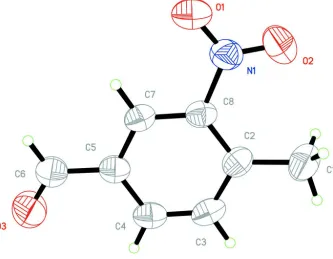
report the crystal structure of the title compound (Fig. 1).
The title compound crystallizes in the monoclinic space group P21/c, the unit cell is consists of four molecules. In the
title compound, the bond distances and bond angles are similar to those of the reported compound (Zhang et al., 2009).
The crystal packing (Fig. 2) is stabilized by a weak intermolecular C—H···O hydrogen bond between the benzene H atom
and the oxygen of the aldehyde group(Table 1).
S2. Experimental
The title compound was obtained according to the literature method (Johnson et al., 1991). Single crystals suitable for X–
ray diffraction were prepared by slow evaporation of a solution of the title compound in diethyl ether at room
temperature.
S3. Refinement
The H atoms were placed in calculated positions, with C—H = 0.93–0.96 Å and refined as riding modrl, with Uiso(H) =
Figure 1
The molecular structure of the title compound with the atom numbering scheme. Displacement ellipsoids are drawn at the
Figure 2
C—H···O interaction (dotted lines) in the crystal structure of the title compound.
4-Methyl-3-nitrobenzaldehyde
Crystal data
C8H7NO3
Mr = 165.15
Monoclinic, P21/c
Hall symbol: -P 2ybc
a = 3.9052 (6) Å
b = 17.841 (3) Å
c = 11.0663 (15) Å
β = 97.647 (2)°
V = 764.14 (19) Å3
Z = 4
F(000) = 344
Dx = 1.435 Mg m−3
Mo Kα radiation, λ = 0.71073 Å Cell parameters from 1083 reflections
θ = 2.2–23.9°
µ = 0.11 mm−1
T = 293 K Block, colorless 0.32 × 0.20 × 0.12 mm
Data collection
Bruker APEX CCD area-detector diffractometer
Radiation source: fine-focus sealed tube Graphite monochromator
φ and ω scans
Absorption correction: multi-scan (SADABS; Bruker, 2003)
Tmin = 0.745, Tmax = 1.000
4088 measured reflections 1353 independent reflections 1012 reflections with I > 2σ(I)
Rint = 0.018
θmax = 25.0°, θmin = 2.2°
h = −4→4
k = −21→18
Refinement on F2
Least-squares matrix: full
R[F2 > 2σ(F2)] = 0.039
wR(F2) = 0.114
S = 1.05 1353 reflections 110 parameters 0 restraints
Primary atom site location: structure-invariant direct methods
Secondary atom site location: difference Fourier map
Hydrogen site location: inferred from neighbouring sites
H-atom parameters constrained
w = 1/[σ2(F
o2) + (0.0555P)2 + 0.1376P]
where P = (Fo2 + 2Fc2)/3
(Δ/σ)max < 0.001
Δρmax = 0.13 e Å−3
Δρmin = −0.16 e Å−3
Special details
Geometry. All e.s.d.'s (except the e.s.d. in the dihedral angle between two l.s. planes) are estimated using the full covariance matrix. The cell e.s.d.'s are taken into account individually in the estimation of e.s.d.'s in distances, angles and torsion angles; correlations between e.s.d.'s in cell parameters are only used when they are defined by crystal symmetry. An approximate (isotropic) treatment of cell e.s.d.'s is used for estimating e.s.d.'s involving l.s. planes.
Refinement. Refinement of F2 against ALL reflections. The weighted R-factor wR and goodness of fit S are based on F2,
conventional R-factors R are based on F, with F set to zero for negative F2. The threshold expression of F2 > σ(F2) is used
only for calculating R-factors(gt) etc. and is not relevant to the choice of reflections for refinement. R-factors based on F2
are statistically about twice as large as those based on F, and R- factors based on ALL data will be even larger.
Fractional atomic coordinates and isotropic or equivalent isotropic displacement parameters (Å2)
x y z Uiso*/Ueq
O1 1.3758 (4) 0.60008 (9) 1.06104 (12) 0.0824 (5) O2 1.0886 (5) 0.70092 (9) 1.05565 (14) 0.0976 (6) O3 0.8183 (5) 0.42460 (9) 0.60139 (14) 0.0937 (6) N1 1.1695 (4) 0.64374 (9) 1.00814 (13) 0.0537 (4) C1 0.7588 (6) 0.75833 (11) 0.8424 (2) 0.0680 (6)
H1A 0.6294 0.7831 0.7740 0.102*
H1B 0.9756 0.7835 0.8638 0.102*
H1C 0.6300 0.7594 0.9105 0.102*
C2 0.8234 (4) 0.67836 (9) 0.80931 (16) 0.0479 (4) C3 0.6869 (5) 0.65315 (10) 0.69353 (16) 0.0549 (5)
H3 0.5619 0.6866 0.6403 0.066*
C4 0.7290 (5) 0.58141 (10) 0.65495 (15) 0.0546 (5)
H4 0.6312 0.5669 0.5772 0.065*
C5 0.9177 (4) 0.52988 (10) 0.73139 (14) 0.0483 (4) C6 0.9618 (5) 0.45197 (11) 0.69313 (17) 0.0640 (5)
H6 1.1124 0.4217 0.7440 0.077*
C7 1.0625 (4) 0.55297 (9) 0.84592 (14) 0.0458 (4)
H7 1.1943 0.5197 0.8975 0.055*
C8 1.0119 (4) 0.62533 (9) 0.88392 (14) 0.0440 (4)
Atomic displacement parameters (Å2)
U11 U22 U33 U12 U13 U23
O3 0.1213 (14) 0.0757 (11) 0.0727 (10) 0.0141 (9) −0.0293 (9) −0.0225 (8) N1 0.0589 (9) 0.0527 (9) 0.0476 (8) −0.0074 (7) 0.0000 (7) −0.0003 (7) C1 0.0713 (13) 0.0501 (11) 0.0811 (14) 0.0055 (9) 0.0046 (11) 0.0069 (10) C2 0.0438 (9) 0.0461 (10) 0.0540 (10) −0.0021 (7) 0.0074 (8) 0.0087 (7) C3 0.0530 (10) 0.0593 (12) 0.0504 (10) 0.0036 (8) −0.0001 (8) 0.0172 (8) C4 0.0554 (11) 0.0646 (12) 0.0412 (9) −0.0009 (9) −0.0028 (8) 0.0046 (8) C5 0.0472 (10) 0.0536 (10) 0.0429 (9) −0.0010 (7) 0.0011 (7) 0.0010 (7) C6 0.0730 (13) 0.0625 (13) 0.0527 (11) 0.0082 (10) −0.0063 (9) −0.0047 (9) C7 0.0439 (9) 0.0480 (10) 0.0438 (9) 0.0007 (7) 0.0000 (7) 0.0072 (7) C8 0.0427 (9) 0.0488 (10) 0.0396 (9) −0.0064 (7) 0.0028 (7) 0.0046 (7)
Geometric parameters (Å, º)
O1—N1 1.2135 (19) C3—C4 1.366 (3)
O2—N1 1.209 (2) C3—H3 0.9300
O3—C6 1.197 (2) C4—C5 1.392 (2)
N1—C8 1.467 (2) C4—H4 0.9300
C1—C2 1.503 (2) C5—C7 1.380 (2)
C1—H1A 0.9600 C5—C6 1.470 (3)
C1—H1B 0.9600 C6—H6 0.9300
C1—H1C 0.9600 C7—C8 1.380 (2)
C2—C3 1.395 (2) C7—H7 0.9300
C2—C8 1.399 (2)
O2—N1—O1 121.80 (16) C3—C4—C5 120.32 (16)
O2—N1—C8 119.68 (16) C3—C4—H4 119.8
O1—N1—C8 118.51 (15) C5—C4—H4 119.8
C2—C1—H1A 109.5 C7—C5—C4 118.69 (17)
C2—C1—H1B 109.5 C7—C5—C6 119.82 (16)
H1A—C1—H1B 109.5 C4—C5—C6 121.49 (16)
C2—C1—H1C 109.5 O3—C6—C5 124.79 (18)
H1A—C1—H1C 109.5 O3—C6—H6 117.6
H1B—C1—H1C 109.5 C5—C6—H6 117.6
C3—C2—C8 115.51 (16) C5—C7—C8 120.08 (15)
C3—C2—C1 118.29 (16) C5—C7—H7 120.0
C8—C2—C1 126.21 (16) C8—C7—H7 120.0
C4—C3—C2 122.81 (16) C7—C8—C2 122.57 (15)
C4—C3—H3 118.6 C7—C8—N1 115.84 (14)
C2—C3—H3 118.6 C2—C8—N1 121.59 (15)
C8—C2—C3—C4 0.8 (3) C5—C7—C8—N1 178.59 (14)
C1—C2—C3—C4 −179.54 (18) C3—C2—C8—C7 0.4 (2)
C2—C3—C4—C5 −0.7 (3) C1—C2—C8—C7 −179.27 (16)
C3—C4—C5—C7 −0.5 (3) C3—C2—C8—N1 −179.79 (14)
C3—C4—C5—C6 178.88 (17) C1—C2—C8—N1 0.5 (3)
C7—C5—C6—O3 172.0 (2) O2—N1—C8—C7 −167.19 (17)
C4—C5—C6—O3 −7.4 (3) O1—N1—C8—C7 11.8 (2)
C5—C7—C8—C2 −1.6 (3)
Hydrogen-bond geometry (Å, º)
D—H···A D—H H···A D···A D—H···A
C4—H4···O3i 0.93 2.47 3.319 (2) 152