LIMSI-M
ULTIS
EMat the IJCAI SemDeep-5 WiC Challenge:
Context Representations for Word Usage Similarity Estimation
Aina Gar´ı Soler1, Marianna Apidianaki1,2and Alexandre Allauzen1
1LIMSI, CNRS, Univ. Paris Sud, Universit´e Paris-Saclay, F-91405 Orsay, France 2LLF, CNRS, Univ. Paris-Diderot
{aina.gari,marianna,allauzen}@limsi.fr
Abstract
We present the LIMSI-MULTISEM system submitted to the IJCAI-19 SemDeep-5 WiC challenge. The system measures word usage similarity in sentence pairs. We experiment with cosine similarities of word and sentence embeddings of different types, and with fea-tures based on in-context substitute annota-tions automatically assigned to WiC sentence pairs. The model with the highest performance on the WiC development set uses a combina-tion of cosine similarities from different em-bedding types. It obtains an accuracy of 66.7 on the shared task test set and is ranked third among the participating systems.
1 Introduction
The SemDeep-5 WiC shared task proposes to identify the intended meaning of words in con-text. It is framed as a binary classification task that addresses whether two instances of a target word have the same meaning (Pilehvar and Camacho-Collados,2019). The WiC dataset contains 7,466 sentence pairs and is proposed as a new evaluation benchmark for context-sensitive word representa-tions.
We apply to this task the method from
Gar´ı Soler et al.(2019) which addresses the usage similarity of contextualized instances of words. The method integrates cosine similarities from dif-ferent types of context-sensitive embeddings and in-context automatic substitutes. Our best system combines cosine similarities from three embed-ding types. It obtains an accuracy of 66.7 on the WiC test set, and is ranked third among all systems that participated in the task.
2 The WiC Dataset
The WiC dataset contains 7,466 sentence pairs of target words automatically labelled as having the
same (T) or different (F) meaning. It was automat-ically compiled by extracting usage examples and sense information from lexical resources (Word-Net (Fellbaum, 1998) VerbNet (Schuler, 2006) and Wiktionary1). To exclude instance pairs de-scribing fine-grained sense distinctions, the re-source was automatically pruned based on synset proximity in the WordNet network. Human ac-curacy upper bound on the dataset was defined as 80%, which corresponds to the average human ac-curacy on a sample of sentence pairs (Pilehvar and Camacho-Collados,2019). Inter-annotator agree-ment was at the same level. The WiC dataset pro-vides a benchmark for evaluating context-sensitive word representations, and their capacity to capture the dynamic aspects of word meaning and usage.
3 Contextualized Representations
Our proposed model computes a contextualized representation for each target word instance in a WiC sentence pair using different types of embed-dings. The cosine similarity of the obtained vector representations is used as a feature for our classi-fier. We use the following types of embeddings:
SIF(Smooth Inverse Frequency): Simple method for deriving sentence representations from uncon-textualized embeddings (Arora et al., 2017). Di-mensionality reduction is applied to a weighted average of the vectors of words in a sentence. Weighting is based on word frequency in Com-mon Crawl. We use SIF in combination with
300-dGloVe vectors trained on Common Crawl ( Pen-nington et al.,2014).2
Context2vec: Neural model that learns embed-dings for words and their contexts simultaneously (Melamud et al.,2016). It is based on word2vec’s
1http://www.wiktionary.org/
2https://nlp.stanford.edu/projects/
CBOW (Mikolov et al.,2013), but replaces the av-eraging of context word embeddings with a biL-STM that learns a representation of a sentence ex-cluding the target word. We use a 600-d model pre-trained on the UkWac corpus (Baroni et al.,
2009).3
ELMo (Embeddings from Language Models): Contextualized word representations obtained from the internal states of a deep bidirectional LSTM trained with a language model objective (Peters et al., 2018). Instead of learning the best linear combination of layer representations for a task – a common way of using ELMo – we use out-of-the-box 512-d embeddings.4 We experi-ment with the top layer, and the average of the three hidden layers. We represent each WiC sen-tence in two ways: a) with the ELMo embedding corresponding to the target word, and b) with the average of ELMo embeddings of all words in the sentence. We also average the embeddings at a context window of size two, as this was shown to work better for word usage similarity with ELMo (Gar´ı Soler et al.,2019).
BERT (Bidirectional Encoder Representations from Transformers): Representations obtained from a 12-layer bidirectional Transformer encoder trained with a language model objective where words on both sides of the target word in a sen-tence are masked and need to be predicted (Devlin et al., 2018). The pre-trained BERT architecture can be fine-tuned for specific tasks, but its inter-nal contextualized word representations can also be used directly, similar to ELMo. We use 768-d
uncased BERT representations of the target word, and the average of all words in a sentence.
USE (Universal Sentence Encoder): General-purpose sentence encoder trained with multi-task learning (Cer et al., 2018). Using transfer learn-ing, USE improves performance on different NLP tasks at the sentence and phrase level (e.g. senti-ment analysis). We use the Deep Averaging Net-work (DAN) encoder,5 where input word and bi-gram embeddings are averaged and fed through a feedforward neural network, to create embeddings for WiC sentences.
3http://u.cs.biu.ac.il/˜nlp/resources/
downloads/context2vec/
4The medium-sized model at https://allennlp.
org/elmo.
5https://tfhub.dev/google/
universal-sentence-encoder/2
4 Automatic Substitution
Manual substitute annotations have been useful for in-context usage similarity estimation (Erk et al.,
2009;McCarthy et al., 2016). The idea is that a high proportion of shared substitutes between two word instances reflects their semantic similarity.6
Extending previous work where manual substi-tute annotations were used to estimate usage sim-ilarity (Erk et al.,2009), we automatically anno-tate WiC instances with substitutes, and use fea-tures based on their overlap for our classifier. We use the context2vec method for automatic lexi-cal substitution (Melamud et al., 2016). Given a sentence with a new instance of a target word
t, and a set of candidate substitutes for the word (S=s1,s2, ...,sn), context2vec ranks all candidates
taking into account the target-to-substitute similar-ity and the substitute-to-context similarsimilar-ity.
c2v score=cos(s,t) +1
2 ×
cos(s,C) +1
2 (1)
In Formula 1, s and t are the context2vec word embeddings of a candidate substitute and the tar-get, and C is the context vector of the sentence. The pool of candidate substitutes for a target word is formed from its set of paraphrases in the Para-phrase Database (PPDB) XXL package ( Ganitke-vitch et al.,2013;Pavlick et al.,2015).7
For every instance, context2vec ranks all candi-dates available for the target. Therefore, the gener-ated ranking (R) always contains the same substi-tutes, in the same or different order. To make sub-stitute overlap measures (McCarthy et al., 2016) operational in this setting, we use a filtering strat-egy fromGar´ı Soler et al.(2019). The method de-tects a cut-off point in the rankingRthat reflects a shift from good quality substitutes (high-ranked), to substitutes that are not a good fit in the context (low-ranked). It checks whether adjacent substi-tutes are paraphrases in PPDB; if not, it discards everything found after that point inR.
After filtering the ranking R for each sentence pair, we obtain three different features based on the retained substitutes.
• Common substitutes: The proportion of shared substitutes between the two instances of a target word.
6Previous work explores graded usage similarity, whereas
in WiC it is binary.
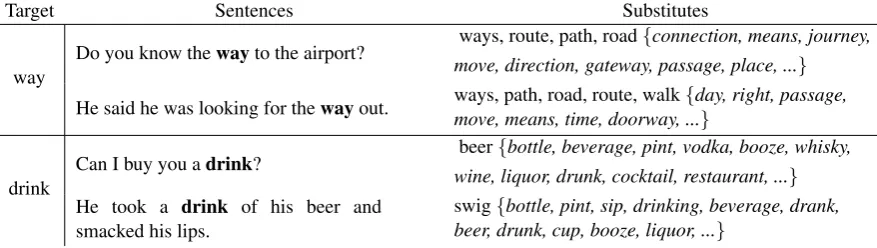
Target Sentences Substitutes
way
Do you know thewayto the airport? ways, route, path, road{connection, means, journey, move, direction, gateway, passage, place, ...}
He said he was looking for thewayout. ways, path, road, route, walk{day, right, passage, move, means, time, doorway, ...}
drink
Can I buy you adrink? beer{bottle, beverage, pint, vodka, booze, whisky, wine, liquor, drunk, cocktail, restaurant, ...}
He took a drink of his beer and smacked his lips.
[image:3.595.78.517.63.187.2]swig{bottle, pint, sip, drinking, beverage, drank, beer, drunk, cup, booze, liquor, ...}
Table 1: Sentence pairs from the WiC training set for the nounway(gold label: T) and the verbdrink(gold label: F) with automatic substitute annotations assigned by context2vec. Substitutes in italics were discarded after filtering.
• GAP score:GAP (Generalized Average Pre-cision) considers the order of ranked ele-ments and their weights (Kishida, 2005). GAP score ranges from 0 to 1 (for perfect dis-agreement/agreement). We take the average score between the rankings produced for a sentence pair in both directions (GAP(R1,R2)
andGAP(R2,R1)). Weights are the scores
as-signed to the substitutes by context2vec. We use the GAP implementation shared by Mela-mud et al.(2015).
• Substitute cosine similarity. We form pairs of substitutes fromR1 andR2, and calculate
the average of their GloVe cosine similarities. This feature accounts for the semantic simi-larity of substitutes, which can also, to some extent, reflect usage similarity.
A few WiC sentence pairs (5%) contain tar-get words that are not present in the PPDB XXL package.8 We apply automatic substitution to in-stances of target words that have paraphrases in PPDB, and back off to a classifier that uses only embedding-based features for the rest.9 Table 1
shows examples of WiC sentences with automatic substitutes, before and after filtering.
5 Training Data Augmentation
We extend the WiC training data with 4,018 sen-tence pairs automatically extracted from the Con-cepts in Context (CoInCo) corpus (Kremer et al.,
2014). CoInCo is a subset of the MASC corpus
8For full coverage, an option would be to use the whole
vocabulary as a pool, as in the original context2vec imple-mentation.
9PPDB paraphrases were available for target words in
97% of training, 89% of development and 90% of test sen-tence pairs in WiC.
(Ide et al., 2008) which contains manual substi-tute annotations for all content words in a sen-tence. We use a balanced collection of similar (T) and dissimilar (F) sentence pairs from CoInCo, with labels automatically assigned based on sub-stitute overlap (Gar´ı Soler et al.,2019).10 We ap-ply the automatic substitution method described in Section4, and extract substitute- and embedding-based features to be used by our models.
6 Model Development
We train a logistic regression classifier on the WiC training set, and experiment with different feature combinations on the development set. We use cosine similarities of different embedding repre-sentations. For ELMo and BERT, we try several layer combinations,11 the target word vector and the sentence vector (see Section3). For ELMo, we also apply a context window of size 2. The best configuration for BERT is the average of the last four layers, and for ELMo, the context window approach. We then combine the best embedding features for prediction. We also train models with the substitute-based features only, backing off to the best embedding-based model for instances of words not present in PPDB. We combine the best embedding- and substitute-based features in the Combined setting.
We apply the BERT and ELMO configurations that gave best results on the WiC development set to the setting with additional CoInCo data (WiC+CnC), and repeat the experiments. Results on the WiC development set are given in Table2. Substitute-based features do not help the model,
10https://github.com/ainagari/coinco_
usim_data/
11The average of the three layers or the top layer for ELMo.
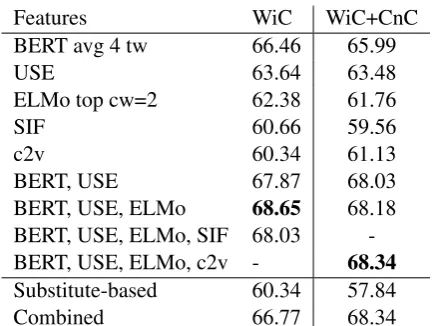
Features WiC WiC+CnC BERT avg 4 tw 66.46 65.99
USE 63.64 63.48
ELMo top cw=2 62.38 61.76
SIF 60.66 59.56
c2v 60.34 61.13
BERT, USE 67.87 68.03 BERT, USE, ELMo 68.65 68.18 BERT, USE, ELMo, SIF 68.03 -BERT, USE, ELMo, c2v - 68.34
[image:4.595.307.525.59.131.2]Substitute-based 60.34 57.84 Combined 66.77 68.34
Table 2: Accuracy of the models with embedding-based and substitute features on the WiC development set. We report results of the models trained only on WiC, and on the extended (WiC+CnC) dataset. The best configurations (marked in boldface) were applied to the WiC test set.
probably because of the noise in automatic anno-tations. The best result is obtained by the model trained only on WiC that uses cosine similarities from BERT, USE and ELMo. In the WiC+CnC setting, the Combined model gets the same per-formance as the model that uses four embedding types (BERT, USE, ELMo and c2v). We apply the simpler embedding-based model to the WiC test set.
7 Results and Analysis
Results of the two best-performing models (in boldface in Table2) on the WiC test set are given in Table3. Our best model is the one trained only on WiC, which uses BERT, USE and ELMo cosine similarities. It was ranked third at the competition with an accuracy of 66.71, which is higher than all results reported in the WiC description paper (Pilehvar and Camacho-Collados,2019).
The additional training data extracted from Co-InCo does not help the models. We believe this to be due to the different kind of sense distinc-tions present in the dataset extracted from CoInCo and in WiC. To explore this hypothesis, we take a closer look at the model predictions and carry out a qualitative analysis of the sense distinctions in the two datasets. The confusion matrices of the two best models on the development set show that wrong predictions most often concern dissimilar (F) sentence pairs. This type of error occurs more with the model trained on WiC+CnC (67% of to-tal errors compared to 59% when training only on
Approach Accuracy
WiC BERT, USE, ELMo 66.71 WiC+CnC BERT, USE, ELMo, c2v 65.64 BERTlargeThreshold (Pilehvar and
[image:4.595.73.291.60.223.2]Camacho-Collados,2019) 63.8
Table 3: Accuracy of our two best models on the WiC test set, compared to the best result from previous work.
WiC). A quick observation of WiC data reveals that dissimilar (F) pairs sometimes describe re-lated senses, in spite of the pruning that aimed at excluding these from the dataset (Pilehvar and Camacho-Collados,2019).
We extract a random sample of 60 sentence pairs from the CoInCo training data and the WiC development set to explore whether they differ in this respect. We manually annotate all pairs for graded usage similarity, using a scale of 1 (com-pletely different) to 5 (the same), as inErk et al.
(2009). Our assumption is that F pairs that de-scribe related senses will be assigned higher sim-ilarity scores. A comparison of the graded us-age similarity values of gold F instances reveals that these values differ significantly in CoInCo and WiC (p = 0.048), as determined by a Mann-Whitney test, with WiC F pairs having a higher average similarity score (3.19 ± 1.52) than Co-InCo F pairs (2.53 ± 0.19). The following F
sentence pair from WiC is an example where the target word (construction) expresses different but closely related meanings (as a process and a re-sult):Construction is underway on the new bridge
–The engineer marvelled at his construction. The CoInCo sentence pairs extracted by Gar´ı Soler et al.(2019) that we use for training describe more clear-cut sense distinctions, due to the process used for their extraction, based on the overlap of manually annotated substitutes (see Section5).
8 Conclusion and Future Work
We propose a new model for word usage simi-larity estimation. The LIMSI-MULTISEM sys-tem combines different types of context-sensitive word and sentence representations with features derived from automatic substitution for usage sim-ilarity prediction. The best configuration com-bines cosine similarities from three embedding types: BERT, USE and ELMo.
order to identify lemmas with clear-cut and fuzzy sense distinctions, as in McCarthy et al. (2016). This will help identify lemmas for which classifi-cation is trickier.
Acknowledgments
We would like to thank the anonymous review-ers for their helpful feedback. This work has been supported by the French National Research Agency under project ANR-16-CE33-0013.
References
Sanjeev Arora, Yingyu Liang, and Tengyu Ma. 2017. A Simple but Tough-to-Beat Baseline for Sentence Embeddings. InInternational Conference on Learn-ing Representations (ICLR), Toulon, France.
Marco Baroni, Silvia Bernardini, Adriano Ferraresi, and Eros Zanchetta. 2009. The WaCky wide web: a collection of very large linguistically processed web-crawled corpora. Journal of Language Re-sources and Evaluation, 43(3):209–226.
Daniel Cer, Yinfei Yang, Sheng-yi Kong, Nan Hua, Nicole Limtiaco, Rhomni St. John, Noah Constant, Mario Guajardo-Cespedes, Steve Yuan, Chris Tar, Brian Strope, and Ray Kurzweil. 2018. Universal Sentence Encoder for English. In Proceedings of the 2018 Conference on Empirical Methods in Nat-ural Language Processing: System Demonstrations, pages 169–174, Brussels, Belgium. Association for Computational Linguistics.
Jacob Devlin, Ming-Wei Chang, Kenton Lee, and Kristina Toutanova. 2018. BERT: Pre-training of Deep Bidirectional Transformers for Language Un-derstanding. arXiv preprint arXiv:1810.04805.
Katrin Erk, Diana McCarthy, and Nicholas Gaylord. 2009. Investigations on word senses and word us-ages. InProceedings of the Joint Conference of the 47th Annual Meeting of the ACL and the 4th Interna-tional Joint Conference on Natural Language Pro-cessing of the AFNLP, pages 10–18, Suntec, Singa-pore. Association for Computational Linguistics.
Christiane Fellbaum, editor. 1998. WordNet: An Elec-tronic Lexical Database. Language, Speech, and Communication. MIT Press, Cambridge, MA.
Juri Ganitkevitch, Benjamin Van Durme, and Chris Callison-Burch. 2013. PPDB: The Paraphrase Database. InProceedings of the 2013 Conference of the North American Chapter of the Association for Computational Linguistics: Human Language Tech-nologies, pages 758–764, Atlanta, Georgia. Associ-ation for ComputAssoci-ational Linguistics.
Aina Gar´ı Soler, Marianna Apidianaki, and Alexandre Allauzen. 2019. Word usage similarity estimation
with sentence representations and automatic substi-tutes. In Proceedings of the Eighth Joint Confer-ence on Lexical and Computational Semantics, Min-neapolis, MN. Association for Computational Lin-guistics.
Nancy Ide, Collin Baker, Christiane Fellbaum, Charles Fillmore, and Rebecca Passonneau. 2008. MASC: the Manually Annotated Sub-Corpus of American English. In Proceedings of the Sixth International Conference on Language Resources and Evaluation (LREC’08), Marrakech, Morocco. European Lan-guage Resources Association (ELRA).
Kazuaki Kishida. 2005. Property of average precision and its generalization: An examination of evalua-tion indicator for informaevalua-tion retrieval experiments. Technical Report NII-2005-014E, National Institute of Informatics Tokyo, Japan.
Gerhard Kremer, Katrin Erk, Sebastian Pad´o, and Ste-fan Thater. 2014. What substitutes tell us - analy-sis of an “all-words” lexical substitution corpus. In Proceedings of the 14th Conference of the European Chapter of the Association for Computational Lin-guistics, pages 540–549, Gothenburg, Sweden. As-sociation for Computational Linguistics.
Diana McCarthy, Marianna Apidianaki, and Katrin Erk. 2016. Word sense clustering and clusterability. Computational Linguistics, 42(2):245–275.
Oren Melamud, Jacob Goldberger, and Ido Dagan. 2016. context2vec: Learning Generic Context Em-bedding with Bidirectional LSTM. InProceedings of the 20th SIGNLL Conference on Computational Natural Language Learning, pages 51–61, Berlin, Germany. Association for Computational Linguis-tics.
Oren Melamud, Omer Levy, and Ido Dagan. 2015. A Simple Word Embedding Model for Lexical Substi-tution. InProceedings of the 1st Workshop on Vector Space Modeling for Natural Language Processing, pages 1–7, Denver, Colorado.
Tomas Mikolov, Kai Chen, Greg Corrado, and Jeffrey Dean. 2013. Efficient estimation of word represen-tations in vector space. InProceedings of the Inter-national Conference on Learning Representations, Scottsdale, Arizona.
Ellie Pavlick, Pushpendre Rastogi, Juri Ganitkevitch, Benjamin Van Durme, and Chris Callison-Burch. 2015. PPDB 2.0: Better paraphrase ranking, fine-grained entailment relations, word embeddings, and style classification. InProceedings of the 53rd An-nual Meeting of the Association for Computational Linguistics and the 7th International Joint Confer-ence on Natural Language Processing (Volume 2: Short Papers), pages 425–430, Beijing, China. As-sociation for Computational Linguistics.
representation. In Proceedings of the 2014 Con-ference on Empirical Methods in Natural Language Processing (EMNLP), pages 1532–1543, Doha, Qatar. Association for Computational Linguistics.
Matthew Peters, Mark Neumann, Mohit Iyyer, Matt Gardner, Christopher Clark, Kenton Lee, and Luke Zettlemoyer. 2018. Deep contextualized word rep-resentations. In Proceedings of the 2018 Confer-ence of the North American Chapter of the Associ-ation for ComputAssoci-ational Linguistics: Human Lan-guage Technologies, Volume 1 (Long Papers), pages 2227–2237, New Orleans, Louisiana. Association for Computational Linguistics.
Mohammad Taher Pilehvar and Jose Camacho-Collados. 2019. WiC: the Word-in-Context Dataset for Evaluating Context-Sensitive Meaning Repre-sentations. InProceedings of NAACL, Minneapolis, United States.
Karin Kipper Schuler. 2006. VerbNet: A
Broad-Coverage, Comprehensive Verb Lexicon. Ph.D.