Learning Structural Dependencies of Words in the Zipfian Tail
Tejaswini Deoskar School of Informatics University of Edinburgh [email protected]
Markos Mylonakis ILLC
University of Amsterdam [email protected]
Khalil Sima’an ILLC
University of Amsterdam [email protected]
Abstract
Using semi-supervised EM, we learn fine-grained but sparse lexical parameters of a generative parsing model (a PCFG) initially estimated over the Penn Treebank. Our lex-ical parameters employ supertags, which encode complex structural information at the pre-terminal level, and are particularly sparse in labeled data – our goal is to learn these for words that are unseen or rare in the labeled data. In order to guide esti-mation from unlabeled data, we incorporate both structural and lexical priors from the labeled data. We get a large error reduction in parsing ambiguous structures associated with unseen verbs, the most important case of learning lexico-structural dependencies. We also obtain a statistically significant im-provement in labeled bracketing score of the treebank PCFG, the first successful im-provement via semi-supervised EM of a generative structured model already trained over large labeled data.
1 Introduction
Computational models of natural language trained on labeled data contain many parameters that are not estimated accurately, due to the data spar-sity inherent in labeled data. This is especially true of complex structured models like parsers, which contain a large number of parameters, and where labeled training data is expensive to cre-ate.These models employ various forms of param-eter smoothing to deal with overfitting and with unknown or low-frequency words. However, it is desirable, and in many cases necessary, to aug-ment supervised models using readily available unlabeled data, such as raw news-wire or from the web. Semi-supervised methods have therefore re-ceived a lot of attention in recent years.
In this paper, we present a method for semi-supervised training of a large-scale structured
model (a Penn Treebank PCFG) using the Expec-tation Maximization algorithm (Dempster et al., 1977). We focus on learning only those parame-ters of the model that are particularly difficult or impossible to obtain from labeled data, namely parameters related to low-frequency and unseen words (the Zipfian tail). Words are important de-terminers of structural information for parsers; for instance, verb subcategorization information im-proved the Collins’ parser (Collins, 1997). How-ever, this data is very sparse in even the largest labeled dataset available today, i.e., the Penn Tree-bank (Marcus et al., 1993). To illustrate the sever-ity of the problem, consider the fact that close to 40% of verb types in the training sections of the Penn Treebank have occurred only once therein. Thus, modelling the structural properties of these verbs that may be useful for disambiguation in a parser (such as subcategorization properties) is simply not possible from labeled data, and one has to look to unlabeled data.
From the machine learning point of view, supervised learning in general, and semi-supervised EM in particular, has been successful for classification-based NLP tasks (e.g. Nigam et al. (1998), Blum and Mitchell (1998), Yarowsky (1995)). For more structured tasks such as part-of-speech tagging and grammar learning, semi-supervised learning has worked largely in the case where the labeled data is small in size (Klein and Manning, 2004; Steedman et al., 2003; Druck et al., 2009a; Ganchev et al., 2010; Reichart and Rappoport, 2007). There have been some in-stances of successful large-scale semi-supervised learning for structured models (McClosky et al., 2006; Deoskar, 2008; Koo et al., 2008; Bansal and Klein, 2011), where a grammar model trained on a large amount of labeled data such as the full Penn Treebank has shown further improvement from unlabeled data. These methods have typically de-pended on the complementarity of multiple views
of the data (a discriminative reranking model over a generative model as in (McClosky et al., 2006)), and/or complex or heuristic objective functions (as in Deoskar (2008); Koo et al. (2008)) or simply by incorporating surface counts from unlabeled data (as in a recent paper by Bansal and Klein (2011)). A contribution of this paper is that we show that using EM in a semi-supervised manner with a sim-ple objective function can improve a parser, con-trary to common belief in the field.
The PCFG model used in this paper is trained on the Penn Treebank. It contains fine-grained structural information marked on pre-terminal cat-egories, making them similar in spirit tosupertags for strongly lexicalised formalisms like LTAG (Bangalore and Joshi, 1999) and CCG (Steedman, 2000). A supertag encodes structure that is dis-tributed over the tree and localises it onto a sin-gle parameter of the model. Our learning prob-lem is cast very simply as estimating the parame-tersp(w|τ)(wherewis a word andτ a supertag) from labeled and unlabeled data. The problem is, however, more complex than a sequence labeling task because these supertags are highly ambiguous and encode argument-adjunct distinctions as well as long-distance dependencies (illustrated later in examples). Semi-supervised EM is known to of-ten give models that are worse than the supervised model (Merialdo, 1994; Charniak, 1993; Ng and Cardie, 2003). To address this, we incorporate probabilistic constraints on unsupervised estima-tion by using labeled data to derive prior knowl-edge at two levels: (a) structural constraints in the form of higher PCFG rules (b) preferences over the distributionsp(w|τ)themselves. We ob-tain large improvements in assigning correct struc-tures to unseen verbs, and also a statistically sig-nificant improvement in labeled bracketing over a smoothed supervised model.
The rest of the paper is structured as follows: a description of the Treebank PCFG model and its smoothing is in §2. §3 describes the semi-supervised method, the constraints derived from labeled data, and their theoretical interpretation.
§4 contains experiments and§5 evaluations. A dis-cussion of related literature is in§6.§7 concludes.
2 The PCFG Model
We work with a probabilistic context-free gram-mar (PCFG) model, since it is easy to analyse and most other more sophisticated parsing
mod-VP
VB.n-p add
NP
four more Boeings
PP-TMP by 1994
PP-CLR
to the two units.
1
(a) An NP PP subcategorization frame on the verb ‘add’.
VP
VB.s.e.to want
S.e.to
*NP* VP.to
TO to
VP
communicate...
1
(b) An S frame on the verb ‘want’ (*NP* is the empty subject)
NP
NP
the many new home-owners
SBAR
WHNP that
S
NP-SBJ
Mrs. Thatcher’s new policies
VP
VBD had
VP
VBD.n created
*T-NP*
1
[image:2.595.322.513.69.127.2](c) Long-distance.(*T-NP* is the trace of NP)
Figure 1: Some verbal supertags.
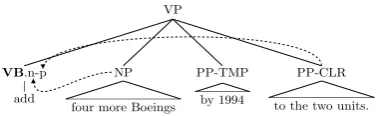
[image:2.595.315.520.82.450.2]These arguments are encoded in the supertag on the verb asn-p giving the new pre-terminal cat-egory‘VB.n-p’, made of the original PTB POS-tag VB, followed after a dot by its refinement
n-p indicating the NP and PP-CLR arguments. The temporal PP (PP-TMP) is considered an ad-junct and is not included in the supertag. Fig. 1(b) shows a more complex supertag on the verb want – this supertag encodes the complement S as s, the empty subject of the S as e and the TO further down the tree asto, together forming
s.e.to. The eserves to distinguish this struc-ture from others likeexpect them to communicate, while the to distinguishes it from finite sub-ordinate clauses like set the economy moving or help meet increasing demand. The final example in 1(c) shows an object relative clause. The verb of interest is ‘created’, which has a transitive su-pertag n indicating an NP complement. Notice that this verb is assigned the transitive supertag even though the complement NP is quite far re-moved from its original position (indicated by *T-NP*), thus capturing a long-distance dependency between the verbcreatedand the NPthe many new home-owners.
Our supertags are quite fine-grained – there are 81 sub-categories for verbs1. The additional mark-ing on the original PTB POS tag is determined au-tomatically and unambiguously by (solely) using information available in the treebank tree, such as the structure of the tree and functional tag mark-ing. As seen above, these supertags distinguish ar-guments from adjuncts and localise onto a single parameter, long distance information that may be spread across different levels of the tree.
For space reasons, we do not describe aspects of the PCFG that are not directly relevant to this work (but see Deoskar (2009)). Importantly, the PCFG does not contain lexicalisation at higher levels of the tree, except for function words such as preposi-tions and determiners (as in (Klein and Manning, 2003)). As far as content-words (non-functional words) are concerned, word or head-word infor-mation is not part of any parameter of the PCFG except pre-terminal rules. Thus the unlexicalised PCFG has a clean division between complex lexi-cal parameters (pre-terminal rules) and non-lexilexi-cal ones (the rest). We exploit this in our
semi-1This number holds for the case when lexicalized
prepo-sitions are not projected into the supertag. The complete list is available in Deoskar (2009) (Appendix D).
supervised method to constrain unsupervised es-timation (§3). Another consideration in using an unlexicalised PCFG for this work is that it would be significantly more computationally expensive to use a lexicalized one, due to the larger number of parameters.
The (smoothed) PCFG performs close to the best reported results for a simple unlexicalised Treebank PCFG (without splitting and merging of categories as in Petrov and Klein (2007)), with a labeled bracketing f-score of 87.4% (<40 words) and 86.5% (all sentences) on Section 23 of the PTB. While this is not the highest-performing grammar trained on the Penn Treebank (Petrov and Klein, 2007; Charniak and Johnson, 2005), note that it is trained on PTB trees that retain all functional categories as well as empty cate-gories originally present in the PTB. Most tree-bank parsers remove functional tags and empty categories, thereby reducing sparsity and improv-ing scores. Includimprov-ing functional categories and traces enables our PCFG to make finer distinc-tions and recover traces, but makes our training data much sparser than usual. Empty category re-covery of the PCFG is 84%, at par with the state-of-the-art (Schmid, 2006). Functional tag recov-ery is comparable to Blaheta and Charniak (2000); Blaheta (2004) (the only other reported results that use all functional tags in the PTB2). Our non-null f-scores for the categories described in Blaheta’s work are as follows (with the best scores from Blaheta and Charniak (2000) or Blaheta (2004) in brackets) – Grammatical: 94.78 (95.55), Seman-tic: 77.96 (78.63), Topicalization: 96.26 (95.28), Miscellaneous: 61.97 (58.99).
2.1 Smoothing the treebank PCFG based on
POS tagging: creating a baseline.
Most treebank parsers are required to smooth their estimates to deal with over-fitting and with un-known words. This is usually done by backing off from a more articulated level (such as words) to a less articulated one (such as POS-tags), or by interpolating between the two. In the case of fine-grained lexical categories (supertags), the problem of smoothing becomes more severe. In some other generative models containing fine-grained lexical categories, such as CCG, smoothing is done by re-placing unseen words and words below a cut-off
2Merlo and Musillo (2005)’s work uses a subset of the
frequency with POS tags. This cut-off frequency is in fact very high – for instance, Hockenmaier and Steedman (2002) find that the optimal cut-off is 30 for their generative parser. In our work, such a method is not an option: we are interested precisely in learning supertags for low frequency and unseen words from the unlabeled corpus. Sec-ondly, POS tags are not a parameter of the PCFG, only supertags are.
We adopt a smoothing method first described in Deoskar (2008), that specifically aims at introduc-ing parameters for unseen words from the unla-beled corpus into the PCFG3. In this method, ev-ery word from the unlabeled corpus is assigned with all those supertags that have been seen in the labeled corpus with the POS tag of the word. Thus, each verb is assigned all supertags that are associated with verbs in the labeled corpus. This applies both to words that are seen and unseen in the labeled data, thus taking care of the case where a word may have been seen in the labeled data, but may not have been seen with all rele-vant categories (an issue when dealing with fine-grained categories). A small probability mass is taken from the supervised distribution and redis-tributed amongst the newly introduced parameters. Equations and more details are in Deoskar (2008). The unlabeled corpus is first POS-tagged by an off-the-shelf POS tagger to give counts of words and POS-tags. The count of a (word, POS-tag) pair from the unlabeled corpus is divided amongst all supertags (for that POS-tag) based on the ratio of supertags in thelabeleddata. For unseen words, this gives an initial estimate that is informed by marginal counts, counted over all words (with the given POS tag) in the labeled data. For instance, in the case of an unseen verb, the method will result, say, in the transitive supertag being more common than a ditransitive one, since transitive supertags are overall more common than ditransi-tive ones across all verbs in the labeled data. This model thus gives us an informed baseline to eval-uate models learnt from the semi-supervised pro-cess, a baseline that is more informed than back-ing off to the part-of-speech of the word. This smoothed model also forms the initial model for the EM estimation described in the section below.
3
It is important for unsupervised estimation that the PCFG contain non-zero lexical parameters for all words in the un-labeled corpus. If not, sentences with unseen words will not get an analysis and parameters for those words will never be induced.
3 Semi-Supervised Learning of Lexical Parameters
3.1 The Learning Problem
EM is notoriously fickle for learning struc-tured models in semi-supervised settings, need-ing tricky initialisation and careful constrainneed-ing (Mann and McCallum, 2010) (e.g. Charniak (1993) for parsing, Merialdo (1994) for POS-tagging). In our case, the initial model is a highly-accurate, smoothed model obtained from labeled data (§2.1). Our task is to retrieve an estimate from the joint corpus of labelled and unlabeled data that performs better than a smoothed esti-mate from labeled data alone. In our unlexicalised PCFG, grammatical parameters (i.e., non-lexical rules) from the labeled data are fairly accurate 4. We do not re-estimate these from unlabeled data (following Deoskar (2008)). Instead, we solely re-estimate lexical parameters, which are com-plex and contain a lot of structural information lo-calised onto the pre-terminal level of the tree (re-call the examples in Fig. 1). This allows us to learn syntactic information, while keeping the learning problem adjacent to the lexical surface.
In the following sections, we describe two ways in which we use the labeled data to constrain our latent variable (preterminal supertag sequences): structural constraints in the form of non-lexical rules, and distributions over lexical parameters
p(w|τ)themselves. These constraints are included in a well-founded manner: a structural probabilis-tic prior over supertag sequences, and Dirichlet priors over conditional distributions p(w|τ) (as seen later in§3.5, by interpreting the learning pro-cess as a maximum a posteriori unsupervised es-timator). These priors direct the estimator to-wards more promising parameter spaces, creating a strong learning environment with a clear objec-tive function.
3.2 A Prior Over Supertag Sequences
Notation:
w: terminal (word) T B: labeled corpus
τ : pre-terminal U C: unlabeled corpus w: sequence of terminals
τ : sequence of pre-terminals
p(τ): distribution overτ ˆ
p(τ): relative frequency estimate ofp(τ)
4This assumption is justified to a large extent in the case of
τ := hT, ιi consists of a POS-tag T and a se-quence of featuresι.
A PCFG, apart from defining a language and distribution over terminal strings,alsodoes so for strings of pre-terminal symbols5. If we consider derivations down to the level of pre-terminals, the (syntactic part of the) PCFG provides a distribu-tion p(τ) over sequences of pre-terminals τ. If
T(τ)is the set of trees withτ as their leaves, then
p(τ) is the sum of probabilities of all such trees
p(τ) =P
T ∈T(τ)p(T).
We are concerned with estimating the condi-tional probabilitiesp(w|τ), i.e., the parameters of the conditional modelp(w|τ). We use Maximum-Likelihood Estimation (MLE) for this purpose. For the labeled part of the data T B, MLE boils down to simply getting the relative-frequency es-timate. For the unlabeled data U C however, we need to marginalise over all plausible pre-terminal sequences τ. As a consequence, p(τ) directly emerges as apriorover the latent variableτ. The likelihood of the concatenation of the two corpora can then be written as follows, with θ the set of lexical parametersp(w|τ):
L(T B, U C; θ, p(τ)) = Y
hw,τi∈T B
p(w|τ;θ)p(τ)∗
Y
w∈U C
X
τ
p(w|τ;θ)p(τ) (1)
In general, this approach allows semi-supervised MLE training of a model conditioning on a latent variable, by introducing a prior over the latent variable which can be directly estimated from the labeled part of the training data. For our model, after computing a PCFG relative-frequency estimate for the parameters ˆ
p(τ) on T B, we can shift our focus away from the syntactical analyses in T B and effectively treat this part of the data as a corpus of sentences labeled with pre-terminal sequences.
3.3 MLE with Semi-Supervised EM
We estimate the parameter setθof the conditional modelp(w|τ)by maximising the likelihood of the concatenation of the labeled and unlabeled cor-pus. During the estimation we employ the esti-matepˆ(τ)that we retrieve from the labeled corpus
5
Most PCFGs used in parsing employ pre-terminals, i.e., non-terminals which are the only ones which expand to ter-minal symbols and only terter-minal symbols. Even if a PCFG does not satisfy this requirement, it can be converted to an equivalent Chomsky Normal Form grammar which does so. Without loss of generality, we will here confine ourselves to a grammar making use of pre-terminals.
Initialiseθ0
fori= 1toNiterationsdo
E-step {Find expected complete-data log-likelihood, given current estimate}
Q(θ|θi−1) =
E[log(L(T B,hU C, U Cτi;θ,pˆ(τ)))|T B, U C, θi−1]
M-step{MaximiseQin respect toθ}
θi= arg max θ
Q(θ|θi−1)
end for
Figure 2: The EM algorithm for the semi-supervised learning ofp(w|τ)
T Bas a prior overτ, i.e., its parameters are not a subject of the estimation process and remain con-stant. On the contrary,pˆ(τ)guidesthe estimation process, showing a strong preference towards su-pertag sequences which are syntactically justified. Since τ is a latent variable for the unla-beled corpusU C, arg maxθL(T B, U C;θ,pˆ(τ)) cannot be found analytically. Instead, we use the Expectation-Maximization (EM) algorithm (Dempster et al., 1977). We start with an initial-isation pointθ0, which, since we have labeled data available, is the (smoothed) relative-frequency es-timate of these parameters onT B.
E-step In the Expectationstep, we find the
ex-pected valueQ(θ|θi−1)of the complete data log-likelihood (withU C completed with missing pre-terminal sequencesU Cτ) with respect to the miss-ing data (pre-terminal sequences), given the ob-served data (sentences inU C,hw,τipairs inT B) and the current estimate of the parameters θi−1. Since the sentences inT Balready have supertags, in practice this step relates only toU C.
M-step In the Maximizationstep, the new
esti-mateθiis retrieved by maximising the expectation
of the E-step. The M-step under the constraints
P
wp(w|τ) = 1 can be performed analytically.
This involves computing the expected counts of word-supertag pairsci−1(w, τ)over the combined corpus of labeled and unlabeled data, givenθi−1. This is equivalent to adding the observed word-supertag counts from the labeled data to the ex-pected counts from the unlabeled part, which can be efficiently computed using the Inside-Outside algorithm (Lari and Young, 1990). The update rule for the parameters of the new estimateθiare:
θi(w|τ) = cU C
i−1(w, τ) +cT Bi−1(w, τ) P
3.4 Corpora Scaling Factors and Additional Constraints
The impact of the labeled part of the data can be fine-tuned as follows: since the training data is seen as a concatenation of the labeled and unla-beled part, we can scale them before concatenat-ing them, i.e., takea‘copies’ of the unlabeled data together withb‘copies’ of the labeled data. This operation can be understood as merely altering the input training corpus and has no effect on the exist-ing analysis. In the new update formula, the scal-ing factors of the corpora trickle down as scalscal-ing factors of the (expected) counts:
θi(w|τ) =
a∗cU C
i−1(w, τ) +b∗cT Bi−1(w, τ) P
w0a∗cU Ci−1(w0, τ) +b∗cT Bi−1(w0, τ) (3)
Secondly, we might also want to constrain the estimation objective by limiting the number of parameters of the conditional model p(w|τ) to be estimated. Many lexical parameters are es-timated accurately from the treebank (for exam-ple, those related to function words and other high-frequency words), and estimation from unla-beled data might hurt them. For each distribution
p(w|τ), we choose to retain values from T B for some of the parameters which we assume are less affected by sparsity issues (i.e., we keep these pa-rameters fixed) while estimating the rest. Under the same analysis as above, we end up with a sim-ilar update formula as before. For each conditional distribution givenτ, ifπfixedis the sum of the fixed probability values and Wfreeτ the set of words for which we wish to estimatep(w|τ), the remaining (i.e., not fixed) probability mass is(1−πfixed)and is distributed to the free parameters in proportion to the related (expected) countsc(w, τ). We skip the proof due to space limitations.
θi(w|τ) =
(1−πfixed)
a∗cU C
i−1(w, τ) +b∗cT Bi−1(w, τ) X
w0∈Wτ
free
a∗cU Ci−1(w0, τ) +b∗cT Bi−1(w0, τ)
(4)
3.5 Semi-Supervised Learning as Maximum
A Posteriori Estimation
In this subsection, we discuss an interpretation of our learning method (i.e. maximum-likelihood of the concatenated labeled and unlabeled corpora) asMaximum a Posteriori(MAP) estimation solely on the unlabeled corpus employing a prior p(θ)
over the parameter setθ. This is useful in order to understand the role that the labeled data plays in guiding estimation from unlabeled data. For each of the multinomialsp(w|τ), consider a Dirichlet
conjugate prior with hyper-parameters α provid-ing a distribution over the possible multinomial parameter sets.
p(w,τ;θ) =p(w|τ;θ)p(τ)p(θ) (5)
The hyper-parameters α of the Dirichlet can be interpreted as prior counts of the events that the multinomial tracks, with each αwτ corresponding to word w emitted by pre-terminal τ. We take advantage of this feature6 to introduce relevant counts from the labeled corpus in the Dirichlet hyper-parameters, setting eachατw =cT B(w, τ)+
1.
Dempster et al. (1977) show that EM can also be used under MAP to climb towards the poste-rior mode of the parameter space θ. Due to the Dirichlet being conjugate to the multinomial dis-tribution, it is easy to show that the new quantity that we wish to maximise has the same functional form as Q(θ|θi−1). Interestingly, for the Dirich-let priors in Eq. (5), MAP estimation boils down to the same update formula as in (2), establishing an equivalent interpretation of the estimation pro-cess which clarifies how the labeled training data ‘guide’ EM estimation on the unlabeled part of the corpus at two distinct levels: (a) a structural prior
p(τ) preferring syntactically correct pre-terminal sequences, considering the interdependencies be-tween pre-terminals in a sentence and (b) priors over the parameter space itself p(θ), considering
lexical choice for each pre-terminal separately.
4 Experiments
We report experiments using a treebank PCFG trained on approximately 36,000 sentences from sections 0-22 of the Wall Street Journal (WSJ) por-tion of the PTB, with about 5000 sentences held-out for testing and development. Semi-supervised training is carried out using 4, 8, 12 and 16 mil-lion words of unlabeled WSJ data, after limiting sentence length to<25 words. Inside-outside esti-mation is implemented in Bitpar (Schmid, 2004). The corpus scaling factor for labeled data is set to 8(i.e.,a= 1andb= 8in Eq. 3; this value makes our labeled data ( 1 million words) weigh about twice as much as our smallest unlabeled corpus of 4 million words. We experimented with setting the scaling factor to4, making the labeled corpus of 1
6
Starting from an uninformed Dirichlet prior p(θ)with
ατ
w = 1for allw,τ, the posteriorp(θ|T B)after observing the labeled dataT Balso takes the form of a Dirichlet distri-bution with updated hyper-parametersατ
4M 8M 12M 16M
tsmooth 29.86 29.86 29.86 29.86 tparse 27.80 27.82 27.80 27.80
It 1 28.44 28.12 27.16 27.64 2 27.72 27.08 26.13 25.73 3 27.40 26.53 25.89 25.34 4 27.40 26.21 25.97 25.18 5 27.24 25.89 25.66 24.7
6 27.08 26.05 25.81 24.78
7 27.08 26.05 25.50 24.7
8 - - 25.42 24.62
9 - - 25.42 24.62
10 - - 25.18
-11 - - 25.42
[image:7.595.311.557.56.236.2]-% Err.reduc 9.31 12.76 15.67 17.5
Table 1: Supertag error forunseenverbs in test Viterbi parses, for different sizes of unlabeled training data
million words effectively equal in size to the unla-beled corpus of 4 million words; however, a value of 8 gives better results, and we report only these.
5 Evaluations
Learning lexico-syntactic information
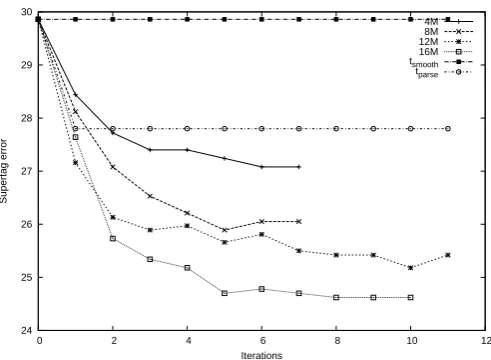
We evaluate the learning of lexico-syntactic de-pendencies by measuring the accuracy of supertag assignment in Viterbi (maximum-probability) parses of test sentences. We report this num-ber for verbs, since they are the most important lexical determiners of structure in a sentence, as well as the most ambiguous. To evaluate unseen verbs, we created a separate testset of 1200 sen-tences with about 1250 token occurrences of un-seen verbs (about 110 types), by holding out all sentences with occurrences of these verbs from the labeled data. These verbs have a wide variety of ambiguous subcategorization frames and are thus representative of typical verbs in the lexicon of a language. This evaluation is a parsing-based evaluation and gives us a focused way of measur-ing the learnmeasur-ing of syntactic structures associated with unseen words (verbs in this case). Note that each supertag is associated with a local or non-local structure, and hence counting supertag accu-racy in effect measures the accuaccu-racy of getting this subtree-structure right. Since these supertags en-code empty categories and functional tags, it is not possible to compare other standard state-of-the-art parsers on this metric, since they do not contain either in their output. Table 1 shows the error in identifying the correct supertag for these unseen verbs in Viterbi parses of test sentences, for
24 25 26 27 28 29 30
0 2 4 6 8 10 12
Supertag error
Iterations
4M 8M 12M 16M tsmooth tparse
Figure 3: Supertag error for unseen verbs in Viterbi parses, for different sizes of unlabeled training data.
beled training data of sizes 4, 8, 12 and 16 mil-lion words. The baseline model is the smoothed treebank PCFG tsmooth (§2.1), with an error of
29.86%. This model does not contain lexical in-formation specific to these verbs (being unseen). Thus, in about 70% of the cases the parser as-signs a correct supertag without verb-specific in-formation. We create a second baseline by pars-ing the unlabeled corpus with the modeltsmooth
and obtaining Viterbi parses – this parsed corpus is merged with the labeled data, keeping corpus scaling factors same as before, and a PCFGtparse
extracted from it. This model is thus a self-trained model – it improves the supertag error overtsmooth
to 27.8%, and does not change subsequently. Semi-supervised EM training improves the er-ror rate overtsmoothin the first iteration, andtparse
in the second. This improvement is already signif-icant (p <0.01, using McNemar’s test). The error rate goes on to further improve in subsequent itera-tions. The error rate also improves with increasing sizes of unlabeled data. The best obtained error is 24.62% with 16M words (p <0.0001), a substan-tial error reduction of 17.5% over the smoothed supervised model. Since these verbs have not oc-curred in the labeled data, the improvements are solely the result of learning from unlabeled data. We also evaluated seen but low-frequency verbs (frequency 1 to 5 in the training corpus). We see a benefit for these as well, with an error reduction of 8.97% (from 23.51 for the baselinetsmooth to
21.40 for 16M words of unlabeled data).
[image:7.595.78.283.60.243.2]tsmooth It 1 2 3 4 5 6 7 8 Recall 86.49 86.74 ***86.83 86.79 86.79 86.78 86.80 86.79 86.79 Precision 86.84 86.84 **86.90 **86.90 86.83 86.86 86.88 86.88 86.87 f-score 86.56 86.79 **86.87 86.83 86.82 86.82 86.82 86.84 86.83
Table 2: Labeled bracketing f-scores on Sec. 23 of PTB (4M words,f <5). *** p<0.001, ** p<0.01
unlabeled data.
Labeled bracketing
The PARSEVAL metric is not the best metric for evaluating the lexico-syntactic learning that is the focus of this paper, for two reasons. Firstly, it is a coarse metric, known to be insensitive to lexico-syntactic (i.e. subcategorization) informa-tion (Briscoe et al., 1998), in addiinforma-tion to not count-ing argument/adjunct distinctions, functional tags or empty categories. Secondly, and more impor-tantly, our method is targeted towards the learning of rare/low-frequency events, which do not have enough of a token count in Section 23 to make a big impact. However, we do see a statistically sig-nificant improvement in labeled bracketing scores on Section 23 of the PTB (Table 2) (statistical sig-nificance calculated using a randomised version of the paired-sample t-test).
The improvements are not large, however they are the first improvements to be obtained using semi-supervised EM for a large-scale Penn Tree-bank grammar. This is the result solely of learning lexical parameters of low-frequency words (f <
5). It is not surprising that the improvements are small – the total token count of words that our method impacts (i.e., words with a frequency less than 5 in the training data) constitute only 6.1% tokens in Section 23 (excluding numbers, but in-cluding proper nouns, for which it is not useful to learn structural dependencies). However, they cor-respond to about 34.2% types, relevant for a ob-taining a broad-coverage lexicon, but not relevant for a token-based evaluation like labelled bracket-ing. It should be noted that while models in later iterations are not better than the baseline, nor are they significantlyworse.
Another important point is that the f-score on Section 23 remains stable when the value of the cut-off frequencyf is increased, and when unla-beled data size is increased to 16M words (not shown in table). Thus, although we obtain large improvements in learning about unseen words (as shown in the previous evaluation), the overall quality of the models, as measured by labeled bracketing does not degrade. This is an important consideration for semi-supervised learning, since
It f <5 f <10 f <20 f <50 f <1000 tsmooth 18.13 18.13 18.13 18.13 18.13
1 17.78 17.82 17.79 17.68 17.65
2 18.14 17.63 17.63 17.65 17.65
3 18.43 17.65 17.70 17.67 17.65
4 18.14 17.74 17.75 17.67 17.70
5 17.53 17.72 17.74 17.81 17.68
6 17.65 17.81 17.84 17.79 17.75
[image:8.595.309.547.129.233.2]7 17.68 17.81 17.87 17.84 17.84
Table 3: Overall verbal supertag error, 4M words unla-beled data. (It=iteration)
adding large amounts of unlabeled data tends to have a negative impact on the supervised model.
Making more parameters free
We experimented with making more and more lex-ical parameters free, by changing the cut-off fre-quency f7. Surprisingly, this does not affect the learning process much. The best model is ob-tained withf < 5, in terms of labeled bracketing
scores, supertag accuracy for unseen verbs, as well as overall supertag accuracy for verbs (seen and unseen). Table 3 shows the overall supertag error for all verbs (seen and unseen) for different values of f. When high-frequency parameters are sub-ject to unsupervised estimation, the error rate de-grades by a small amount, but not much, even for
f <1000. Thus, the structural constraints plus the current corpus scaling factor (of eight) that scales up the size of labeled data are together sufficient to keep these estimates in the right ballpark, with the cut-off frequency not playing much of a role. This will be relevant to future work since it opens up the possibility of learning even mid-to-high frequency lexical items using this methodology.
5.1 Analysis
We present some examples of incorrect parses by the baseline modeltsmooth, and corresponding
im-proved parses by a semi-supervised EM-trained model (10 iterations, 12M words unlabeled data). These examples also serve to illustrate exactly what is captured by measuring supertag accuracy (our main evaluation). Fig. 4 shows
improve-7f is the occurrence freq. of words inT Babove which
VP
VBG.n-p
exceeding
NP
its goals
PP-CLR
for getting back into operation (a) Incorrect parse from baseline model
VP
VBG.n
exceeding
NP
NP
its goals
PP
[image:9.595.89.270.63.241.2]for getting back into operation (b) Correct parse from EM-estimated model
Figure 4: Improvement in PP attachment.
VP
VBZ.d
aims
PP-DIR
to profit
PP-MNR
by selling borrowed shares (a) Incorrect parse from baseline model
VP
VBZ.s.e.to
aims
S
*NP* VP
TO
to
VP
VB.z
profit
PP-MNR
by selling borrowed shares
(b) Correct parse from EM-estimated model
Figure 5: Detection of an S structure foraims
ments in a common PP attachment case (some cat-egories are simplified for clarity). This improve-ment is due to learning a distribution for the un-seen verbexceedingthat represents its subcatego-rization preference for ‘NP’ rather than ‘NP PP’ (VBG.nsupertag in (b) as opposed toVBG.n-p
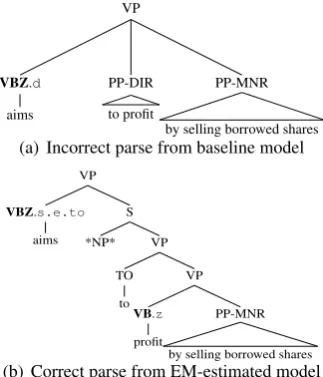
in (a)). Fig. 5 shows the improvement in assign-ing a more complex supertag. In (a), to profit is incorrectly parsed as a directional PP, and the verbaimsis assigned an incorrect supertagVBZ.d
(directional complement). The EM-trained gram-mar gives the correct parse – the correct supertag
VBZ.s.e.tois assigned toaims, with the asso-ciated structure of an S with a empty subject *NP* and an infinitival (to) VP. Additionally, profit is now correctly detected as a verb and assigned an intransitive supertag (VB.zin our notation).
6 Related Work
We compare our work to prior research along sev-eral dimensions: for instance, the use of semi-supervised EM for a complex structured model, the aspect of using labeled data to constrain or guide estimation from unlabeled data, and the use of unlabeled data to improve an already accurate, high baseline treebank parser.
Semi-supervised learning for a generative model employing the EM-algorithm was already introduced in (Miller and Uyar, 1996). It has been applied to text classification before (Nigam et al., 1998, 2006) (we derive our inspiration from this work), but has not been successful with more com-plex NLP tasks such as parsing. In contrast to text classification, where the latent variable is the doc-ument class (amongst a few tens of classes), our latent variable (pre-terminal supertag sequences) is much richer in nature and takes an unbounded number of values. While in Nigam et al. (2006) a simple multinomial prior over document classes is part of the joint model and is itself trained, we have a rich structural prior obtained from labeled data which is kept fixed. In addition, Nigam et al. (2006) make use of a uniform Dirichlet prior over the model parameters. Instead, we utilise the la-beled corpus to impose an informed Dirichlet prior over model parameters with a preference for con-figurations closer to the relative-frequency esti-mate of the labeled data.
Recently, there has been a lot of focus on semi-supervised methods that can incorporate con-straints on latent variables based on prior knowl-edge, either in the form of labeled data or by other forms of indirect supervision. Ganchev et al. (2010); Graca et al. (2007) present the Pos-terior Regularization framework, which incorpo-rates data-dependent constraints encoded as model posteriors on the observed data. The Generalized Expectation criteria (Mann and McCallum, 2010, 2007) incorporates weakly labeled data or ‘side-information’ such as marginal label distributions to inform estimation from unlabeled data. These methods have been shown to work for some struc-tured tasks but have not been applied to a large scale grammar yet, and whether they can be used to improve a high baseline model is an open ques-tion.
[image:9.595.100.262.290.479.2]focus has been on improving parsing efficiency. Some other work focuses on unsupervised learn-ing, but not for high-baseline supervised models (for instance, Dridan and Baldwin (2010); Ravi et al. (2010)).
The current work is most similar to Deoskar (2008) who used a treebank PCFG with Inside-outside to obtain ML estimates from an unlabeled corpus with an intention similar to ours: to learn lexico-syntactic dependencies. Their method gave improved results, with error reductions of up to 31.6% on the supertag detection task (we are not able to compare absolute numbers, since their tree-bank model is different from ours). Their ap-proach was based on frequency transformations of inside-outside counts at each iteration: these trans-formations ensured that unsupervised estimates did not diverge far from the original treebank esti-mates, playing the same role as our priors. Their method did not have an interpretation in terms of a well-understood objective function; it is therefore not clear whether it has general applicability, or will extend to larger unlabeled data. The current work, although it shows somewhat more modest improvements, overcomes these shortcomings.
McClosky et al. (2006) enhance the perfor-mance of a state-of-the-art parser-reranker combi-nation by self-training on large amounts of unla-beled data. Much of the improvement in their case comes from the ability of an external maximum-entropy Parse Reranker (Charniak and Johnson, 2005) to select parses from the parser’s output for the unannotated sentences. Our work differs from McClosky et al. (2006) in that, firstly, they employ a fully lexicalized parser, whereas our parser is un-lexicalised with supertags as pre-terminals. We are thus isolating lexico-syntactic dependencies, rather than word-word dependencies. All our im-provements come from enhancing the lexical com-ponent of the PCFG. They find in their analysis that lexical learning does not play a large role in the improvements they obtain. Secondly, in con-trast with their somewhat complex self-training objective, we retrain the parser under a well known and simple Maximum-likelihood objective. Koo et al. (2008) improved a dependency parser by us-ing word clusters learnt from unlabeled data (an idea similar in some ways to learning supertag-word dependencies, since supertags form finer classes of words that POS tags do, but coarser than words), showing the utility of learning such
statis-tics from unlabeled data. Most recently, Bansal and Klein (2011) improved the Berkeley parser (Petrov and Klein, 2007) by using surface counts from Google n-grams. The method proved very useful for some cases of parser disambiguation, but it is unlikely that surface counts alone can be used to learn long-distance or complex structural properties.
7 Conclusions
We have used semi-supervised EM to learn com-plex, ambiguous lexico-structural dependencies, obtaining large improvements for the hardest case of unseen verbs, as well as low-frequency verbs. We used a parser that uses all the information in the Penn Treebank, viz functional tags and empty categories. Learning such information is crucial for semantic analysis, besides being useful for syntactic disambiguation, but falls in the long Zip-fian tail of linguistic events for which unlabeled data is the only learning source. We used labeled data to derive priors that guided estimation from unlabeled data to both the structural and lexical level in a principled manner. Our structural prior took the form of a PCFG; however it may be re-placed by alternative, more complex models em-ploying a different view on the labeled data.
This is the first instance of semi-supervised EM improving a complex structured model, and we be-lieve the success is due to tightly constraining esti-mation from unlabeled data, as well as due to our complex lexical parameters that isolate structural information spread across a tree onto localised pa-rameters of the model. The method has direct ap-plicability to statistical grammars for strongly lex-icalised formalisms like CCG and LTAG, of which statistical models suffer from severe sparsity and have not been successfully trained using semi-supervised methods. Another area of future work will be to incorporate supertags that encode other forms of lexico-structural dependencies, such as noun subcategorization or adverb attachment.
Acknowledgements
References
Srinivas Bangalore and Aravind K. Joshi. 1999. Su-pertagging: An Approach to Almost Parsing. Com-putational Linguistics, 25:237–265.
Mohit Bansal and Dan Klein. 2011. Web-Scale Fea-tures for Full-Scale Parsing. InProceedings of ACL 2011.
Don Blaheta. 2004. Functional Tagging. Ph.D. the-sis, Department of Computer Science, Brown Uni-versity.
Don Blaheta and Eugene Charniak. 2000. Assigning Function Tags to Parsed Text. InANLP’00.
A. Blum and T. Mitchell. 1998. Combining labeled and unlabeled data with co-training. InProceedings of Conference on Computational Learning Theory (COLT) 1998.
Ted Briscoe, John Carroll, and Sanfilippo. 1998. Parser evaluation: a survey and a new proposal. In 1st Language Resources and Evaluation Conference. Granada, Spain.
E. Charniak. 1997. Statistical parsing with a context-free grammar and word statistics. In Proceedings of the 14th National Conference on Artificial In-telligence, pages 598–603. AAAI Press/MIT Press, Menlo Park.
Eugene Charniak. 1993. Statistical Language Learn-ing. MIT Press.
Eugene Charniak and Mark Johnson. 2005. Coarse-to-fine n-best parsing and MaxEnt discriminative reranking. InProceedings of 43rd ACL. Ann Arbor, Michigan.
Stephen Clark and James R. Curran. 2004. The Im-portance of Supertagging for Wide-Coverage CCG Parsing. InProceedings of COLING-04, pages 282– 288. Geneva, Switzerland.
Michael Collins. 1997. Three generative, lexicalised models for statistical parsing. InProceedings of the 35th ACL.
A. P. Dempster, N. M. Laird, and D. B. Rubin. 1977. Maximum likelihood estimation from incomplete data via the EM algorithm.J. Royal Statistical Soci-ety, 39(B):1–38.
Tejaswini Deoskar. 2008. Re-estimation of Lexical Pa-rameters for Treebank PCFGs. In Proceedings of COLING 2008.
Tejaswini Deoskar. 2009. Induction of fine-grained lexical parameters of treebank PCFGs with inside-outside estimation and frequency transformations. Ph.D. thesis, Cornell University.
Tejaswini Deoskar and Mats Rooth. 2008. Induction of Treebank-Aligned Lexical Resources. In Proceed-ings of 6th LREC, Marrakech, Morocco.
Rebecca Dridan and Timothy Baldwin. 2010. Unsuper-vised Parse Selection for HPSG. InProceedings of the 2010 Conference on Empirical Methods in Nat-ural Language Processing, pages 694–704. Asso-ciation for Computational Linguistics, Cambridge, MA.
G. Druck, G. Mann, and A. McCallum. 2009a. Semi-supervised learning of dependency parsers using generalized expectation criteria. InACL/IJCNLP.
Kuzman Ganchev, Joao Graca, Jennifer Gillenwater, and Bill Taskar. 2010. Posterior Regularization for Structured Latent Variable Models. Journal of Ma-chine Learning Research, 11:2001–2049.
J Graca, K Ganchev, and B Taskar. 2007. Expectation Maximization and posterior constraints. In NIPS 2007.
Julia Hockenmaier and Mark Steedman. 2002. Genera-tive Models for Statistical Parsing with Combinatory Categorial Grammar. InACL40.
Mark Johnson. 1998. PCFG models of linguistic tree representations. Computational Linguistics, 24(4).
D. Klein and C. Manning. 2004. Corpus-based induc-tion of syntactic structure: Models of dependency and constituency. InACL 2004.
Dan Klein and Christopher Manning. 2003. Accurate unlexicalized parsing. InACL 41. Sapporo, Japan.
Terry Koo, Xavier Carreras, and Michael Collins. 2008. Simple Semi-supervised Dependency Parsing. In
Proceedings of ACL-08: HLT, pages 595–603. As-sociation for Computational Linguistics, Columbus, Ohio.
K. Lari and S. J. Young. 1990. The estimation of stochastic context-free grammars using the Inside-Outside algorithm.Computer Speech and Language, 4:35–56.
G. Mann and A. McCallum. 2007. Simple, robust, scal-able semi-supervised learning via expectation regu-larization. InICML 2007.
Gideon Mann and Andrew McCallum. 2010. Gen-eralized Expectation Criteria for Semi-Supervised LEarning with Weakly Labeled Data. Journal of Machine Learning Research, 11:955–984.
M. P. Marcus, B. Santorini, and M. A. Marcinkiewicz. 1993. Building a Large Annotated Corpus of En-glish: The Penn Treebank. Computational Linguis-tics, 19(2):313–330.
D. McClosky, E. Charniak, and M. Johnson. 2006. Ef-fective Self-Training for Parsing. InProceedings of HLT-NAACL 2006.
Paola Merlo and Gabriele Musillo. 2005. Accurate Function Parsing. In Proceedings of Human Lan-guage Technology Conference and Conference on Empirical Methods in Natural Language Process-ing.
David J. Miller and Hasan S. Uyar. 1996. A Mixture of Experts Classifier with Learning Based on Both La-belled and UnlaLa-belled Data. InAdvances in Neural Information Processing Systems (NIPS), pages 571– 577.
Vincent Ng and CLaire Cardie. 2003. Weakly super-vised natural language learning without redundant views.
Kamal Nigam, Andrew Mccallum, and Tom Mitchell. 1998. Learning to Classify Text from Labeled and Unlabeled Documents. In Fifteenth National Con-ference on Artificial Intelligence (AAAI-98), pages 792–799. AAAI Press.
Kamal Nigam, Andrew Mccallum, and Tom Mitchell. 2006. Semi-Supervised Learning, chap. 3. MIT Press, Cambridge, Massachusetts.
Slav Petrov and Dan Klein. 2007. Improved Inference for Unlexicalized Parsing. InHLT- NAACL 07. Sujith Ravi, Jason Baldridge, and Kevin Knight. 2010.
Minimized Models and Grammar-Informed Initial-ization for Supertagging with Highly Ambiguous Lexicons. InProceedings of the 48th Annual Meet-ing of the Association for Computational LMeet-inguis- Linguis-tics, pages 495–503. Association for Computational Linguistics, Uppsala, Sweden.
Roi Reichart and Ari Rappoport. 2007. Self-Training for Enhancement and Domain Adaptation of Statisti-cal Parsers Trained on Small Datasets. InACL2007. Helmut Schmid. 2004. Efficient Parsing of Highly Am-biguous Context-Free Grammars with Bit Vectors. InCOLING 2004.
Helmut Schmid. 2006. Trace Prediction and Recovery with Unlexicalised PCFGs and Slash Features. In
21st COLING and 44th Annual Meeting of the ACL, pages 177–184. Sydney, Australia.
Mark Steedman. 2000. The Syntactic Process. MIT Press/Bradford Books.
Mark Steedman, Miles Osborne, Anoop Sarkar, Stephen Clark, Rebecca Hwa, Julia Hockenmaier, Paul Ruhlen, Steven Baker, and Jeremiah Crim. 2003. Bootstrapping statistical parsers from small datasets. InProceedings of EACL03.