Codeswitching language identification using Subword Information Enriched
Word Vectors
Meng Xuan Xia
McGill University 3480 University, Rm. 318 Montreal, Quebec H3A 0E9, Canada
Abstract
Codeswitching is a widely observed phe-nomenon among bilingual speakers. By com-bining subword information enriched word vectors with linear-chain Conditional Ran-dom Field, we develop a supervised machine learning model that identifies languages in a English-Spanish codeswitched tweets. Our computational method achieves a tweet-level weighted F1 of 0.83 and a token-level ac-curacy of 0.949 without using any exter-nal resource. The result demonstrates that named entity recognition remains a challenge in codeswitched texts and warrants further work.
1 Introduction
Codeswitching (CS) is a widely observed phe-nomenon in social media. Solorio et al. (2014) de-fine CS broadly as a communication act, whether spoken or written, where two or more languages are being used interchangeably. Codeswitching is com-mon acom-mong bilingual speakers, both in speech and in writing. Identifying the languages in a codeswitched input is a crucial first step before applying other nat-ural language processing algorithms.
The second shared task, like the previous one (Solorio et al., 2014), challenges the participants to develop computational method for identifying the language of each word in a dataset of codeswitched tweets. For each word in the source, the goal is to identify whether the word is lang1, lang2, mixed,
other (punctuation, emotion and everything that is not a word in neitherlang1norlang2),ambiguous,
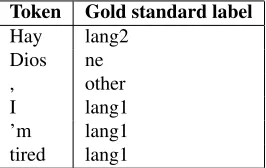
Token Gold standard label
Hay lang2
Dios ne
, other
I lang1
’m lang1
[image:1.612.357.490.239.323.2]tired lang1
Table 1: Example of label assignments for a English-Spanish codeswitched tweet
ne (named entity), unknown or fw (foreign word).
Lang1andlang2are the two languages presented in a codeswitched language pair. There are two lan-guage pairs available in this shared task: Modern Standard Arabic-Arabic Dialects (MSA-DA) and English-Spanish (EN-ES). An example of token lan-guage identification is shown in Table 1.
Our work covers only the EN-ES language pair. We use FastText (Bojanowski et al., 2016) to train a subword information enhanced word vectors model from the datasets of the shared task. We then use these vectors and, in addition, custom features ex-tracted from the words to train a linear-chain Con-ditional Random Field model that predicts the lan-guage label of each word. Our system requires only the dataset provided by the shared task, without any external resource. The final model scores 0.83 in weighted tweet-level F1 and 0.949 in overall token-level accuracy.
2 Related Work
Seven systems were submitted for the previous shared task. The system with the highest predic-tion result for the EN-ES language pair scores 0.822 in F-measure (Bar and Dershowitz, 2014). Solorio
et al. (2014) shows that Conditional Random Field (CRF) and Support Vector Machines (SVM) are the most popular supervised machine learning al-gorithms used for this task. Similar approach have been found outside of the share tasks, including Nguyen and Dogruoz (2013). All of these systems rely on external resources, while our system relies only on data prepared by the shared task.
Aside from the last shared task, previous work on identifying languages emphasizing on word-level identification includes Yamaguchi and Tanaka-Ishii (2012; VRL (2014; Zubiaga et al. (2015). There are also studies on multilingual documents, focusing on inter-sentential codeswitching (King and Abney, 2013; Singh and Gorla, 2007).
Previous work on language models that encode syntactic constraints from codeswitching theory in-cludes Li and Fung (2013; Li and Fung (2014). These models require a parser for the codeswitched input, while our work only requires word-level tok-enization.
3 System Description
Our system contains two steps to identify tokens in a codeswitched input.
In the first step, we use FastText (Bojanowski et al., 2016) to train a subword information en-hanced skipgrams word vectors model, using the tweets presents in the train and the dev dataset. Word vectors are vector representations of the words learned from their raw form, using models such as Word2Vec (Mikolov and Dean, 2013). When used as the underlying input representation, word vectors have been shown to boost the performance in NLP tasks (Socher et al., 2013). FastText word vectors are used instead of standard word2vec because Fast-Text can obtain representations of out-of-vocabulary words by summing the representations of character n-grams. This feature is particularly useful because the size of the training data is relatively small. We expect the test dataset to contain words not found in the training dataset. Another motivation for using FastText word vectors is for its ability to take into account morphological information. We trained a skipgram FastText word vector representation model from the train datasets, using the default parameters provided by FastText (size of word vectors: 100, size
of the context window: 5, number of epochs 5, min-imal number of word occurences: 5, max length of word ngram: 1 and loss function: ns)1.
In the second step, We use supervised machine learning to train a Linear-Chain Conditional Ran-dom Field (CRF) (Lafferty et al., 2001) classifier that predicts the label of every token in the order given by the EN-ES token assigner. CRF is natu-rally suited for sequence labeling tasks and it has been shown to perform well in previous work on lan-guage identification tasks (King and Abney, 2013; Chittaranjan et al., 2014; Lin et al., 2014). We use CRFsuite(Okazaki, 2007) in our experiment. 3.1 Feature Extraction
For each token, we extract three types of features: word features, spelling features and intra-word fea-tures.
3.1.1 Word features
Word features contain the word vector represen-tation of the current token and that of the token di-rectly before and after the current one. We use the word vector model trained in the first step to obtain the word vector of each token. Word vectors of out-of-vocabulary tokens are automatically predicted in FastText by summing up the vector representations of character n-grams.
3.1.2 Spelling features
The following boolean features are extracted from the current token and that of the token directly be-fore and after the current one:
• whether the token capitalized
• whether the token is all uppercase • whether the token is all lowercase
• whether the token contains an uppercase char-acter anywhere but in the beginning
• whether the token is alphanumeric
• whether the token contains any punctuation
• whether the token ends by an apostrophe
1https://github.com/facebookresearch/
• whether the token contains no roman alphabets
• whether the token is in the beginning of the sen-tence
• whether the token is in the end of the sentence
Capitalization is a strong indicator of a proper noun, hence a named entity. However, this is not always the case with social media texts, where gram-matical rules are not always followed. The boolean feature of the lack of roman alphabets is added be-cause of our observation on the training data – most tokens classified asother do not have roman alpha-bets.
We also considered adding a boolean feature of whether the token contains Spanish-only accented characters (i.e. ´ı, ´u, ´e). However, it did not positively impact the prediction performance when tested against the dev dataset. This is possibly due to that social media users are more casual with spelling and replace accented characters with their non-accented counterpart. For example, both the correct spellingas´ı como2and the incorrect spelling
asi comoare found in the training data. 3.1.3 Intra-word features
In contrast to English, Spanish is a morpholog-ically rich language, demonstrating a complicated suffixed-based derivational morphology (Bar and Dershowitz, 2014). To capture repeating prefixes and suffixes that characterize each language, we ex-tract the first 1-3 and the last 1-3 characters of each token as intra-word features. These features have also been shown to help predicting named entities and tokens labelled asother. For example, hashtags (tokens that begin with a # sign) are often named en-tities; twitter handles always begin with an @ sign.
4 Experiment
The shared task maintains three sets of dataset: a training dataset, a development dataset and a test-ing dataset. Each dataset contains rows of token extracted from EN-ES codeswitched tweets and the respective gold standard label for each token. We train an unsupervised FastText word vectors model
2Meaningas well asin English
using the training dataset. Then we train a vised CRF model using the same dataset. The super-vised model is validated on the development dataset by evaluating standard metrics: precision, recall and F-measure of the predictions (Powers, 2011). We make hyper-parameter tuning to the CRF classifier using grid search.
To verify that all our features were contributing to the model’s performance, we also did an ablation study, removing one group of features at a time.
Using the final model which consist of all the fea-tures, we compute predictions for the tokens in the testing dataset and submit the result to the workshop as final result.
5 Result and Analysis
5.1 Feature ablation
Table 2 shows the F1 scores on the dev dataset sulting from training with each group of feature re-moved. Note that although the removal of word fea-tures has no impact on the overall average F1, we decide to keep it because of the extra boost in per-formance it provides for named entities.
5.2 Final model performance
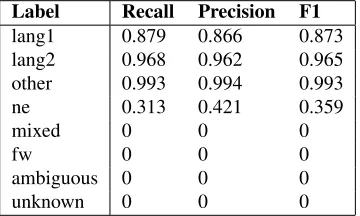
Our final model, when evaluated on the test dataset, has a tweet-level performance of 0.83 in weighted F1 as shown in Table 3. In terms of token-level per-formance, our model has an overall token accuracy of 0.949. The detailed metrics for each label are shown in Table 4.
We observe that the model is not able to predict mixed, foreign word, ambiguous and unknown la-bels. This is due to the lack of sufficient training data for these labels.
Features lang1 lang2 ne other unk Average
All 0.965 0.945 0.355 0.995 0.095 0.946
– Word features 0.965 0.944 0.331 0.997 0.058 0.946
[image:4.612.158.452.61.121.2]– Intra-word 0.957 0.936 0.228 0.981 0.126 0.936 – Spelling 0.963 0.944 0.353 0.989 0.093 0.944
Table 2:Feature ablation study. F1 on dev dataset after training with individual feature groups removed. The F1 formixed,fwand ambiguousare all 0, hence omitted in this table. The average F1 is micro-averaged, taking into account all eight labels. The number of tokens for each label are the following: lang1: 16813, lang2: 8653, ne: 740, mixed: 14, ambiguous: 70, unk: 133, other: 6853 and fw: 0
Monolingual F1 Codeswitched F1 Weighted F1
[image:4.612.95.275.265.373.2]0.86 0.79 0.83
Table 3: Tweet-level performance – there are in total 4626 codeswitched tweets and 6090 monolingual tweets.
Label Recall Precision F1
lang1 0.879 0.866 0.873
lang2 0.968 0.962 0.965
other 0.993 0.994 0.993
ne 0.313 0.421 0.359
mixed 0 0 0
fw 0 0 0
ambiguous 0 0 0
unknown 0 0 0
Table 4: Token-level performance – the number of tokens for each label are the following: ambiguous: 4, lang1: 16944, lang2: 77047, mixed: 4, ne: 2092, fw: 19, other: 25311, un-known: 25, Total : 121446.
6 Conclusion
We participated in the shared task of the second codeswitching workshop by creating a supervised machine learning model that identifies the languages given a English-Spanish codeswitched input. Our model uses FastText to train a subword information enhanced word vectors model from the shared task datasets. In addition to these vectors, we add custom features extracted from the words to train a linear-chain Conditional Random Field model that predicts the language label of each word. Our system uses only the training data provided by the shared task and requires no external resource. The final model scores 0.83 in weighted tweet-level F1 and 0.949 in overall token-level accuracy. Our result suggests that named entity recognition remains difficult for codeswitched text and warrants future work.
Acknowledgment
The author thank Jackie Chi Kit Cheung for mentor-ing and the two anonymous reviewers for providmentor-ing detailed constructive feedback.
References
Kfir Bar and Nachum Dershowitz. 2014. The Tel Aviv university system for the Code-Switching Workshop Shared Task.EMNLP 2014, page 139.
Piotr Bojanowski, Edouard Grave, Armand Joulin, and Tomas Mikolov. 2016. Enriching Word Vec-tors with Subword Information. arXiv preprint arXiv:1607.04606.
Gokul Chittaranjan, Yogarshi Vyas, and Kalika Bali Monojit Choudhury. 2014. Word-level lan-guage identification using CRF: Code-switching shared task report of MSR India system. In Pro-ceedings of The First Workshop on Computational Approaches to Code Switching, pages 73–79.
Ben King and Steven P Abney. 2013. Labeling the Languages of Words in Mixed-Language Documents using Weakly Supervised Methods. InHLT-NAACL, pages 1110–1119.
John Lafferty, Andrew McCallum, and Fernando Pereira. 2001. Conditional random fields: Probabilistic mod-els for segmenting and labeling sequence data. In Pro-ceedings of the eighteenth international conference on machine learning, ICML, volume 1, pages 282–289. Ying Li and Pascale Fung. 2013. Improved mixed
lan-guage speech recognition using asymmetric acoustic model and language model with code-switch inversion constraints. In2013 IEEE International Conference on Acoustics, Speech and Signal Processing, pages 7368–7372. IEEE.
Chu-Cheng Lin, Waleed Ammar, Lori Levin, and Chris Dyer. 2014. The CMU submission for the shared task on language identification in code-switched data. In Proceedings of the First Workshop on Computational Approaches to Code Switching, pages 80–86.
T Mikolov and J Dean. 2013. Distributed representa-tions of words and phrases and their compositionality. Advances in neural information processing systems. Dong-Phuong Nguyen and A Seza Dogruoz. 2013.
Word level language identification in online multilin-gual communication. Association for Computational Linguistics.
Naoaki Okazaki. 2007. Crfsuite: a fast implementation of conditional random fields (crfs).
David Martin Powers. 2011. Evaluation: from precision, recall and F-measure to ROC, informedness, marked-ness and correlation.
Anil Kumar Singh and Jagadeesh Gorla. 2007. Identi-fication of languages and encodings in a multilingual document. In Building and Exploring Web Corpora (WAC3-2007): Proceedings of the 3rd Web as Cor-pus Workshop, Incorporating Cleaneval, volume 4, page 95. Presses univ. de Louvain.
Richard Socher, John Bauer, Christopher D Manning, and Andrew Y Ng. 2013. Parsing with Compositional Vector Grammars. InACL (1), pages 455–465. Thamar Solorio, Elizabeth Blair, Suraj Maharjan, Steven
Bethard, Mona Diab, Mahmoud Ghoneim, Abdelati Hawwari, Fahad AlGhamdi, Julia Hirschberg, Alison Chang, et al. 2014. Overview for the first shared task on language identification in code-switched data. In Proceedings of The First Workshop on Computational Approaches to Code Switching, pages 62–72. Citeseer. NICTA VRL. 2014. Accurate language identification of twitter messages. InProceedings of the 5th Workshop on Language Analysis for Social Media (LASM)@ EACL, pages 17–25.
Hiroshi Yamaguchi and Kumiko Tanaka-Ishii. 2012. Text segmentation by language using minimum de-scription length. In Proceedings of the 50th Annual Meeting of the Association for Computational Linguis-tics: Long Papers-Volume 1, pages 969–978. Associa-tion for ComputaAssocia-tional Linguistics.